




Author:
Byline: Investigative Desk
Help support our mission, donate today and be the change. Every contribution goes directly toward driving real impact for the cause we believe in.
As mediators push for ceasefire extensions, airstrikes on police infrastructure reveal a strategic campaign to dismantle the last remnants of public order in the besieged enclave.
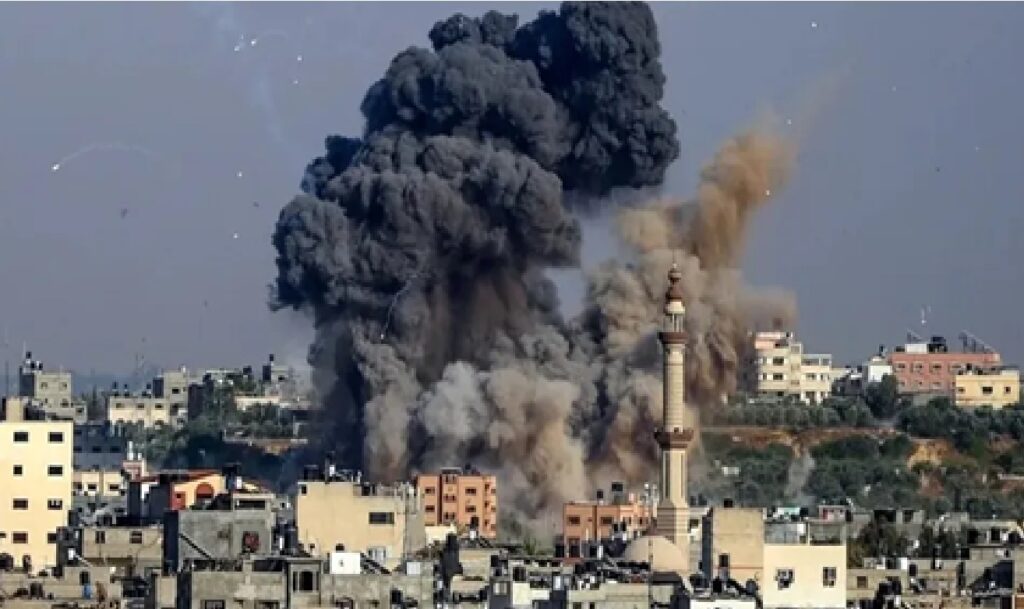
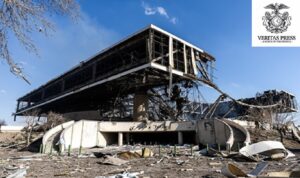
GAZA CITY — The bodies arrived at Al-Ahli Baptist Hospital in pieces. Paramedics described scenes of dismemberment at the site of Wednesday’s airstrike on the Gaza Governorate Municipal Police Headquarters, where an Israeli fighter jet struck the facility in the Sabra neighbourhood of Gaza City during morning hours when officers were reporting for duty.
By nightfall, Gaza’s Health Ministry had confirmed at least nine dead and fifteen wounded, with officials warning that the toll could rise as rescue workers sifted through the rubble of the collapsed structure. The dead included senior officers of the Palestinian Civil Police Force, the unarmed, blue-uniformed constabulary responsible for traffic regulation, crime prevention, and civil documentation across the Strip.
“This was not a military target. These were police officers, administrative staff, people who handled birth certificates and theft reports,” said Mahmoud Al-Batsh, a neighbourhood resident who witnessed the strike from his balcony. “When you kill the police, who protects the people? Who stops the looting? That is exactly what they want, chaos.”
A Pattern Emerges
The attack on Wednesday was not an isolated incident. According to data compiled by the Palestinian Centre for Human Rights (PCHR), Israeli forces have struck at least seventeen separate police installations, vehicles, or personnel gatherings in the Gaza Strip since January 2026. The systematic targeting of civilian law enforcement represents what analysts describe as a deliberate strategy to collapse the last institutional pillars of civil society in the territory.
“The civil police in Gaza are not combatants. They are not Hamas’s armed wing. They are unarmed officers who manage markets, direct traffic, and maintain public order,” said Juliette Touma, UNRWA’s Director of Communications, in a statement to journalists. “The targeting of these individuals raises serious concerns under international humanitarian law regarding the protection of civilian infrastructure during armed conflict.”
Gaza’s Ministry of Interior, which oversees the police force, issued an urgent appeal Wednesday: “The Israeli occupation is working to eliminate the police force in order to spread chaos within the remaining Palestinian society. We appeal to mediators and the international community to take urgent action to stop the dangerous Israeli escalation and the massacres committed against the police force.”
The ministry’s statement reflected growing desperation among Gaza’s civil administrators, who have watched their institutions systematically dismantled over months of conflict. Since the October 2025 ceasefire agreement, which was intended to end what Palestinian officials and human rights organisations have called a genocide, Israeli forces have killed more than 1,200 Palestinians, including at least 300 children, according to Gaza Health Ministry records; the current death toll figure far exceeds 100,000 and over 377,000 injured and maimed.
Conflicting Narratives, Contested Numbers
The Israeli military acknowledged the strike but characterised it in starkly different terms. “The IDF conducted a precision strike on a facility used by Hamas terror operatives for command and coordination activities,” a military spokesperson said in a statement. “The target was identified through intelligence indicating the presence of senior Hamas officials at the location.”
This fundamental disagreement, police headquarters versus terror command centre, underscores the epistemological chasm that has defined coverage of the Gaza conflict. Western media outlets have struggled to verify either claim, as Israel maintains strict control over access to Gaza for foreign journalists and continues to deny entry to international press corps, including uncontrolled access to health ministry data exclusively.
“The Israeli military’s characterisation of virtually every strike as targeting ‘terror operatives’ has become a reflexive justification that receives insufficient scrutiny in Western capitals,” said Dr. Lamis Deek, an international human rights attorney who has documented cases of police targeting for the International Federation for Human Rights (FIDH). “When a police station is bombed, when civil defence workers are killed, when municipal employees are targeted — these are not military objectives under any credible interpretation of the laws of war. These are attacks on the civilian infrastructure of governance itself.”
The casualty figures from Wednesday’s attack ranged from three to ten, depending on the source, reflecting the chaotic information environment in a territory where communications infrastructure has been repeatedly destroyed. Palestinian news outlets operating inside the Strip reported the highest figures, while initial wire service reports based on Israeli military statements suggested lower numbers.
The Broader Offensive
Wednesday’s strike occurred against a backdrop of intensified Israeli military activity across the Gaza Strip. Medical sources reported one Palestinian killed and several wounded in an airstrike on a motorcycle near Nuseirat refugee camp in the central Gaza Strip. In Khan Younis, Israeli occupation forces opened fire on civilians, wounding at least one person. Israeli tanks conducted “large-scale demolition operations” east of Deir al-Balah, while naval vessels shelled the coast off Khan Younis.
The previous day, an Israeli airstrike on a beachfront café near Gaza Port killed seven people, including a child. Residents described scenes of holidaymakers, families seeking a brief respite from the relentless summer heat, struck without warning in what was the deadliest single attack in weeks. The casualty count from that attack continued to mount as one wounded victim succumbed to injuries Wednesday morning.
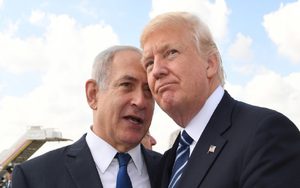
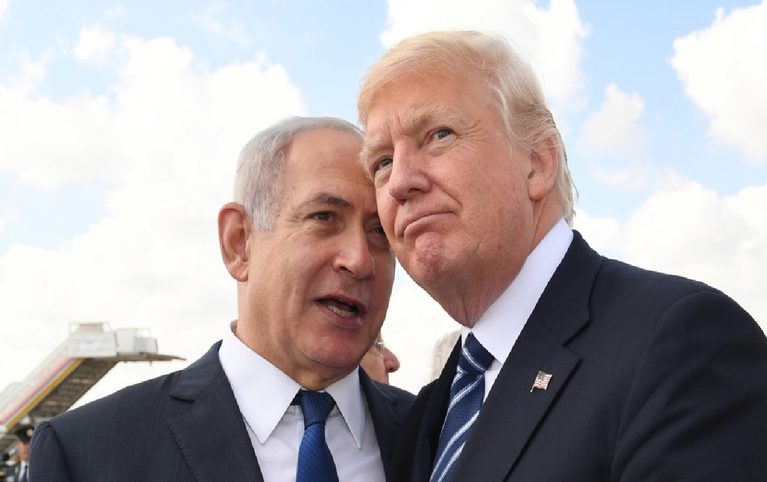
These attacks have continued despite, or perhaps because of, renewed diplomatic activity. Israeli Prime Minister Benjamin Netanyahu met this week with US special envoy Steve Witkoff to discuss efforts to advance the fragile ceasefire. According to sources familiar with the discussions, Witkoff conveyed the administration’s position that Israel would have a “green light” to “finish the job” against Hamas if the movement refused to fully disarm and demilitarise.
Hamas announced last month that it had agreed to “gradually disarm” and advance the ceasefire agreement signed in October, conditioned on “a complete cessation of Israeli strikes and a full withdrawal of forces from Gaza.” The movement’s negotiators have accused Netanyahu of deliberately undermining talks through continued military operations.
“These latest attacks show that Netanyahu is not seeking peace. He is seeking capitulation,” said a Hamas political bureau official who spoke on condition of anonymity due to the sensitivity of ongoing negotiations. “The targeting of police officers, of civil servants, of people who are not fighters, this makes Palestinian life so unbearable that any terms become acceptable. The Palestinian people’s resilience already demonstrates that they will not break.
The Collapse Of Civil Order
The strategic significance of targeting police forces becomes clear when examining conditions on the ground in Gaza. With approximately 90% of homes destroyed or damaged, according to UN assessments, and the vast majority of the population displaced multiple times, the civil police represent one of the few remaining institutions capable of maintaining basic social order.
“The police are essential for everything, for distributing aid, for preventing theft, for resolving disputes over property and resources, for documenting deaths and births,” explained Dr. Mohammed Al-Najjar, a sociologist at the Islamic University of Gaza who has studied governance structures in the territory. “When you eliminate the police, you eliminate the possibility of civil society. You create a vacuum that can only be filled by either armed factions or by total anarchy.”
Both outcomes serve Israeli strategic interests, according to critics of the military campaign. Armed factions provide justification for continued military operations under the guise of counterterrorism. Anarchy delegitimises Palestinian governance and bolsters the narrative that Palestinians are incapable of self-rule.
“We are living through the deliberate dismantling of any institution that could possibly administer a Palestinian state,” said Mustafa Barghouti, General Secretary of the Palestinian National Initiative, speaking from Ramallah. “This is not counterterrorism. This is the destruction of Palestinian society itself, its governance structures, its civil institutions, its cultural memory. When you target police officers who are unarmed, who are maintaining order, you are targeting the very idea of Palestinian statehood.”
The Human Toll
Behind the strategic analysis lies the human reality of Wednesday’s attack. At Shifa Hospital’s morgue, families gathered to identify their dead, some examining body parts rather than intact corpses.
“I came to find my brother, who was a police officer. He worked for twenty years as a traffic policeman. He never held a weapon,” said Umm Hamza, a woman in her fifties who declined to give her full name out of fear of reprisals. “They told me they found his torso. They are still looking for his arms and legs.”
Her account was corroborated by emergency medical workers who described the aftermath as “like a butcher’s shop.” The force of the explosion had reportedly thrown body parts onto neighbouring buildings, with recovery crews working through the afternoon to collect the remains.
The psychological impact on Gaza’s two million residents, the majority of whom are children under eighteen, has been catastrophic. “These are generations being raised on death,” said Dr. Yasser Abu Jamei, director of the Gaza Community Mental Health Programme. “They see their protectors, their police, their teachers, their parents, killed with impunity. They learn that there is no safety, no justice, no future. And then we are asked why there is radicalisation?”
International Response
The international response to Wednesday’s strike has been muted, reflecting the broader pattern of diplomatic inaction that has characterised the conflict. The US veto has prevented the UN Security Council from passing any meaningful resolution since the October ceasefire. It has used this power five times to block calls for an end to Israeli operations.
“It is not that the international community is unaware of what is happening in Gaza. It is that the international community has accepted it,” said Agnès Callamard, Secretary General of Amnesty International, in an interview. “When we see the systematic targeting of civilian infrastructure, including police, civil defence, medical facilities, and we see the total lack of consequences, we must conclude that international law has been suspended for the Palestinian people.”
The Biden administration, in its final months, had issued several statements expressing concern over civilian casualties while maintaining its military support for Israel. The current administration has been even less publicly critical, with officials describing the strikes as “Israel’s right to defend itself.”
Human rights organisations have documented what they describe as compelling evidence of war crimes and acts of genocide committed by the Zionist forces. The International Criminal Court’s investigation into the situation in Palestine, opened in 2021, has been expanded to include actions since October 2023. But ICC warrants issued for Israeli officials have gone unexecuted, and the court’s ability to enforce its jurisdiction remains limited in the face of non-cooperation from member states.
The Road Ahead
As mediators from Egypt, Qatar, and the United States continue their efforts to negotiate a permanent ceasefire, the targeting of police infrastructure suggests that some actors may prefer continued conflict to peace. The October ceasefire agreement, which was supposed to establish a framework for Israeli withdrawal and Palestinian reconstruction, has instead become a precursor to what some analysts describe as “low-intensity attrition warfare”, a conflict characterised by daily airstrikes, targeted assassinations, and the gradual destruction of what remains of Gaza’s civil society.
“The ceasefire was never a real ceasefire. It was a pause that Israel used to regroup and recalibrate its approach,” said Dr. Tareq Baconi, president of Al-Shabaka, the Palestinian Policy Network. “What we are seeing now is a strategy of making Gaza permanently uninhabitable, not through a single massive operation, but through a thousand daily cuts. And the international community’s response has been to look away.”
For Gaza’s police officers, those who survive, the question is whether to continue performing a function that has made them targets. “We are not fighters. We are not Hamas. We are civil servants,” said one officer who survived Wednesday’s strike because he was late to work. “But if we stop working, if we abandon our posts, then what? Then there is no order, no law, no protection for the people. So we continue. We continue because we have no other choice.”
He paused, looking at the ruins of his workplace where his colleagues died. “But I wonder sometimes, is this what the international community wants? For us to just accept being killed while we try to do our jobs? For them to call it a ‘terror target’ and move on to the next story?”
There was no answer. Only the sound of Israeli drones overhead, a constant presence over Gaza’s skies, watching, waiting, and, as Wednesday demonstrated, they are ready to strike.
Conclusion: The Architecture Of Double Standards
We should understand the bombing of the Gaza Governorate Municipal Police Headquarters not as an isolated military action, but as an indictment of an entire system of international governance that has abandoned its own stated principles when it comes to Palestinian lives. Every element of the response, or more accurately, the absence of response, reveals a double standard so pervasive it has become the unspoken operating system of global diplomacy.
When Russia bombed a theatre in Mariupol, Western leaders rushed to podiums to condemn war crimes, impose sanctions, and arm the victims. When Israel bombs a police station in Gaza, the same leaders issue carefully worded “statements of concern,” urge “restraint on all sides,” and approve additional weapons transfers. The International Criminal Court issued an arrest warrant for Vladimir Putin within months of the Ukraine invasion. Instead of enforcement, the United States sanctioned the Court itself when warrants against Israeli officials were issued. This is not inconsistency; it is hierarchy. Some victims are worthy of protection; others are merely manageable.
The double standard extends beyond the political class. When Syrian refugees fled bombardment, European nations opened their borders. When Palestinians flee the same kind of violence, or remain trapped under it. They are met with closed crossings, militarised borders, and a regional policy designed to keep them in place. UNRWA, the agency responsible for Palestinian refugees, has been systematically defunded based on unverified Israeli allegations, while no similar campaign has ever targeted agencies serving Ukrainian refugees. The message is unmistakable: Palestinian displacement is acceptable, even desirable; Palestinian existence is negotiable.
Israel’s stated ideals make the aggression more damning, not less. The country that claims to be “the only democracy in the Middle East” has spent months bombing the civilian infrastructure of a population that has no state, no army, and no air force. The military marketing itself as “the most moral army in the world” has killed more than 300 children since a ceasefire was signed. These children’s only crime was being in Gaza. The state that invokes “never again” as its foundational justification has been accused by its own Holocaust scholars and international jurists of committing the very crimes that phrase was meant to prevent. The incantation of “precision strikes” collapses under the weight of bodies torn apart at a police station. The claim of “self-defence” is legally unavailable to an occupying power waging war against an occupied people. And the rhetoric of “human shields” and “terror infrastructure” has become a mechanism for laundering collective punishment as legitimate military strategy.
This is the context in which Wednesday’s attack occurred. The international community did not simply fail to prevent it; it actively enabled it. The United States has supplied the bombs, the funds, provided the diplomatic cover, and vetoed the resolutions. While expressing concern, both the United Kingdom and Germany have proceeded with arms sales. While the siege continues unabated, the European Union has debated sanctions on settlers. The Arab states that once defended the Palestinian cause have normalised relations with the same government now dismantling Palestinian civil society. The outcome is an environment where Israeli leaders correctly understand there will be no consequences, enforcement, or accountability. The “green light” reported by those familiar with the discussions is not an aberration; it is the quiet truth of a relationship built on impunity.
The treatment of Palestinian documentation itself reflects a double standard. When Palestinian officials appeal for international protection, they are met with bureaucratic silence. When they document casualties, international bodies treat their numbers as unreliable. When they name those killed, they are called “Hamas-linked” until proven otherwise, an inversion of the presumption of innocence that governs civilised legal systems. Meanwhile, major Western outlets report Israeli military statements as fact; independent verification rarely scrutinises the military’s characterisation of any target as “terror infrastructure.” This asymmetry is not journalism; it is the laundering of violence into acceptable policy.
The attack on the police force is not just an attack on law enforcement. It is an attack on the possibility of Palestinian self-governance, on the idea that Gaza could ever be more than a humanitarian catastrophe managed by external powers. They deliberately work to ensure that when the bombs finally stop, they leave nothing for Palestinians to govern: no institutions, no order, no civil society. The chaos Israel claims to be fighting is the chaos it is actively creating. By eliminating the unarmed officers who direct traffic, mediate disputes, and document deaths, Israel is manufacturing the anarchy it then cites as justification for further military operations.
History will record that the international community had the tools to stop this: arms embargoes, sanctions, diplomatic isolation, UN enforcement, ICC warrants. It chose not to use them. It chose instead to treat Palestinian lives as a cost of doing business, a regrettable but acceptable externality of maintaining an alliance. And in so doing, it revealed the hollowness of every principle it claims to uphold: human rights, international law, the protection of civilians, the very concept of a rules-based order. Essentially, exposing their lies, contradictions, and double standards embedded within the bureaucracy.
The bombing of that police station was a war crime. But the silence that followed was a verdict on the international community itself. The question is no longer whether Israel will be held accountable. It is whether the system built to deliver accountability can survive its own hypocrisy. For the Palestinian people, that question has already been answered in rubble, in body bags, and in the continued targeting of those who only tried to keep the peace.
The world has not failed to notice. It has chosen not to act. And that choice, repeated daily, is its own form of extremism and violence.
If the international community can watch unarmed police officers being torn apart in their own headquarters and respond with statements of concern while profiteering and approving more weapons, then what, precisely, is the ‘rules-based order’ protecting, and for whom does it exist?
Veritas Press Investigative Analysis
Independent journalism examining global affairs, power, diplomacy, and accountability.
Source: Veritas Press C.I.C. | Multi-News Agencies
APPEAL: Help Support Our Work By Donating
Readers who believe that truth still matters have power over popular information. When just a few more people step up to support this work, it means more lies exposed, more corruption uncovered, and more accountability where it’s long overdue.
Help Protect Independent Journalism, Which Is Currently Under Attack.
If you believe journalism should serve the public, not the powerful, and you’re able to help, becoming a regular DONOR or a PAID SUBSCRIBER truly makes a difference.
DONATION APPEAL: If you found this reporting valuable, please consider supporting independent journalism.
Your support fuels our fearless, truth-driven journalism. In unity, we endeavour to amplify marginalised voices and champion justice, irrespective of geographical location. We operate independently, with no financial backing from billionaires; our readers support us.
But it’s also extremely important. One of Veritas Press’s greatest assets is its reader-funded model.
1. Reader funding means we can cover what we like. We’re not beholden to the political whims of a billionaire owner. We are a small, independent and impartial organisation. No one can tell us what not to say or what not to report.
2. Reader funding means we don’t have to chase clicks and traffic. We’re not desperately seeking your attention for its own sake; we pursue the stories that our editorial team deems important and believes are worthy of your time.
3. Reader Funding: enables us to keep our website and other social media channels open, allowing as many people as possible to access quality journalism from around the world, particularly those in places where the free press is under threat.
We know not everyone can afford to pay for news, but if you’ve been meaning to support us, now’s the time.
Your donation goes a long way. It helps us:
- Keep the lights on and sustain our day-to-day operations
- Hire new, talented, independent reporters
- Launch real-time live debates, community-focused shows, and on-the-ground reporting
- Cover the issues that matter most to our communities, in real time, with depth and integrity
Without your support, independent voices like ours will be silenced.
Furthermore, we have plans to expand our work, but we can’t do it without your support. Every contribution, no matter the size, helps us stay independent and build a truly people-powered media platform.
If you believe in journalism that informs, empowers, and reflects the communities we serve, please donate today.
Submissions:
For the secure submission of documentation, testimonies, or exclusive investigative reports from any global location, please utilise the following contact details for our Investigations Desk: mailto:enquiries@veritaspress.co.uk or mailto:editor@veritaspress.co.uk
GENEVA — A United Nations fact-finding mission has concluded there are “reasonable grounds to believe”
Iran’s GDP is projected to contract by 5.4 to 6.1% in 2026, its worst performance
The Trump administration is preparing a $2.8 billion weapons package for Israel containing 40,000 2,000-pound

Film alleges mass civilian deaths are routinely built into military decisions amid Israel’s genocidal war
The Israeli rights group says violence, displacement, economic strangulation, and settlement expansion form part of

Houthi forces have captured the historic Red Sea port of Mocha and are advancing on
London’s historic sanctions against Israeli settlements mark a watershed moment in UK foreign policy, but
With 95% of Gaza’s population now wholly dependent on aid and more than 90% stripped
India calls for Kashmir and Ladakh to appear only on its official map after a
ISLAMABAD – In the high-stakes political theatre of Pakistan, the battleground has shifted from the

















ay0x0u