Kamran Faqir is a volunteer investigative journalist and writer committed to exposing hidden truths and amplifying underreported stories. Driven by social justice, he brings sharp insight and fearless truth-telling to independent journalism. NUJ registered.
Listen to this article
Help support our mission, donate today and be the change. Every contribution goes directly toward driving real impact for the cause we believe in.
Article Date Published:
Article Date Modified:
19 minutes
Views:74
As Denmark’s Supreme Court weighs whether “non-Western” is a neutral statistic or a racial proxy, the legal fiction sustaining Europe’s most contested housing law is finally being forced into the open, one eviction, one stairwell, one demolished community at a time.
HELSINGØR, DENMARK— The courtroom in Copenhagen was full before the proceedings began. On the morning of the Supreme Court hearing, the spectator benches filled with tenants who had been removed from their homes in Nøjsomhed, Mjølnerparken, and Gellerupparken, ordinary people who had paid rent on time, raised children in the same stairwells for decades, and who now sat waiting to learn whether the Danish state’s classification of them as “non-Western” amounts to racial discrimination.
The court is due to rule on 23 November. The outcome will not merely decide the fate of seven families from a housing estate in Helsingør. It will determine whether a legal category that structures the lives of tens of thousands of Danish citizens and residents can survive judicial scrutiny, or whether the fiction at its core will finally be named.
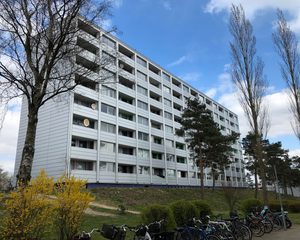
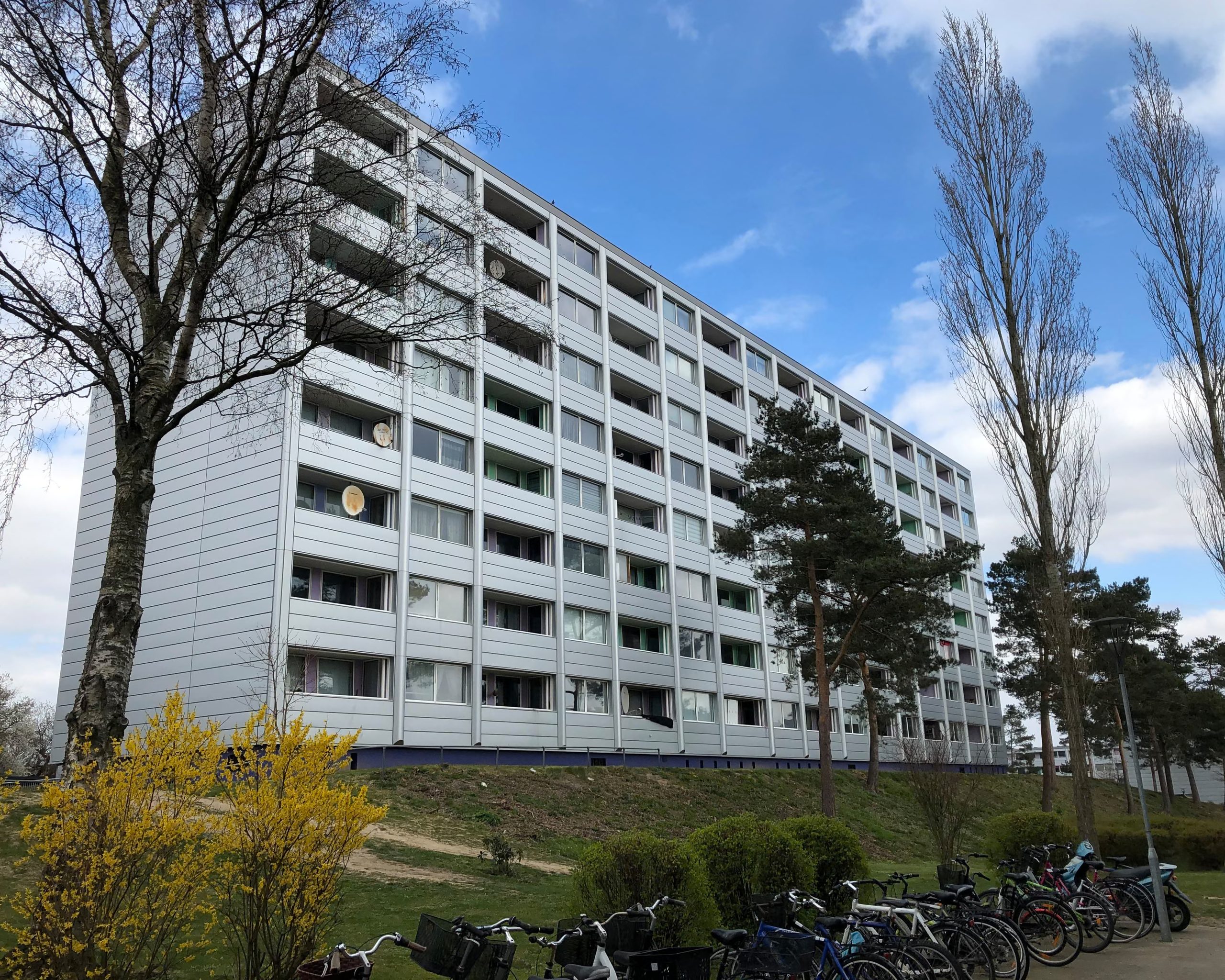
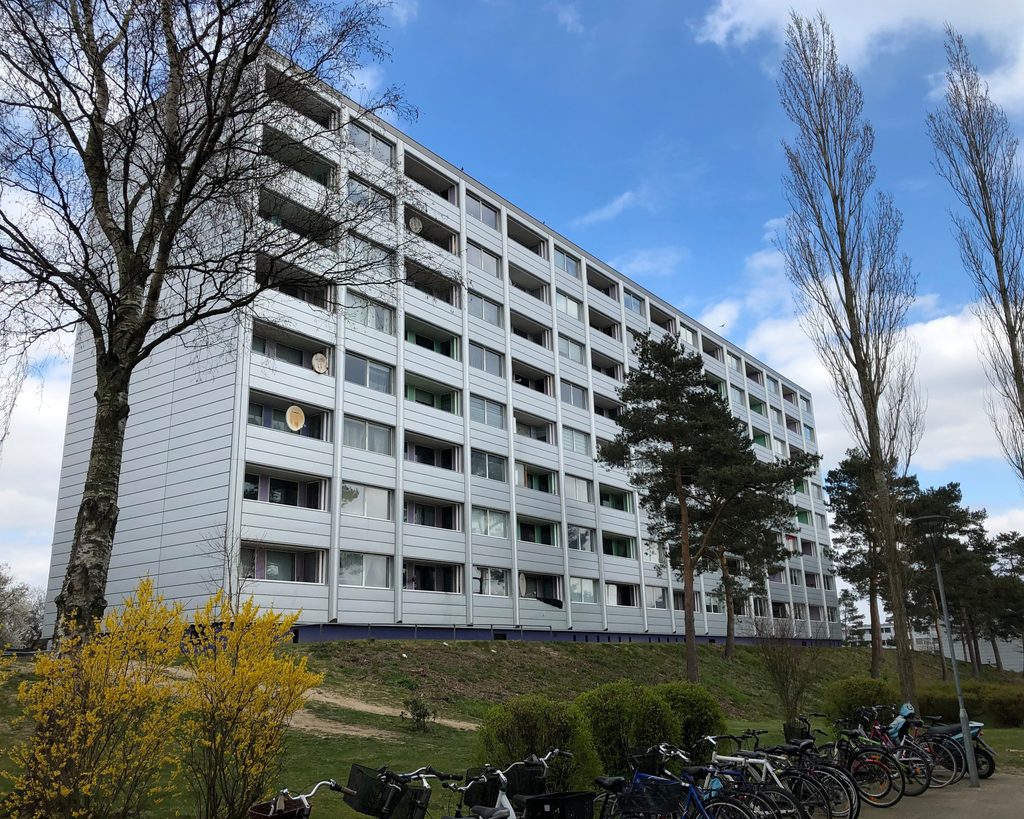
The Nøjsomhed-Sydvej estate in Helsingør, whose former residents have launched a supreme court appeal against their eviction. Photograph: Boliggaarden
At issue is Paragraph 61a of the Danish Social Housing Act, the legal architecture behind what was once called the “ghetto law” and is now officially known as the “parallel society” legislation. Under the law, a nonprofit housing area with at least 1,000 residents is placed on an annual government list if more than half of its residents are classified as “non-Western” and if it meets two of four socioeconomic criteria: unemployment, crime, education, and income. After five consecutive years on the list, the area must reduce its share of nonprofit family housing to 40% by 2030, through sale, demolition, or conversion.
The socioeconomic criteria alone do not trigger the obligation. An estate with identical levels of unemployment and crime, where half or fewer of its residents are “non-Western,” faces no restructuring requirement. It is the demographic threshold, the proportion of people whose ancestry traces to countries outside a short list of wealthy Western nations, that converts a social problem into a legal mandate for displacement.
“The uncomfortable reality is that Nøjsomhed triggers all five ghetto criteria,” Lars Gruby, director of the housing association Boliggården, told the local newspaper Helsingør Dagblad in February 2019, as the estate had just been placed on the list. “Several of the criteria are soft criteria; it takes a long time to change them. We only have until November 2020 to get off the ghetto list, if Nøjsomhed is not to be categorised as a hard ghetto. The criterion we can change, and which will remove Nøjsomhed from the ghetto list, is the proportion of residents with a non-Western background”.
That statement is now central to the case before the Supreme Court. Eddie Khawaja, the lawyer representing the seven families, read it aloud during the hearing. His argument is not that Boliggården’s director was unusually candid. It is that he described, in plain language, the operational logic of the entire legislative scheme: when a housing association needs to cross the 50% threshold, the fastest variable to manipulate is ethnicity.
Boliggården’s lawyer, Henrik Qwist, rejected the claim in court. The association “has never had knowledge of residents’ national or ethnic origin,” he said. The decision to terminate 91 leases was “objective, relevant, and sensible,” driven by the need to bring the estate below 1,000 residents and avoid the “hard ghetto” designation. The drawing presented at a crisis meeting, a map marking the stairwells with the highest concentrations of “non-Western” residents, shows “nothing,” Qwist told the court. The “smoking gun proves nothing”.
Yet the documents Khawaja submitted suggest otherwise. At a crisis meeting between Boliggården’s leadership and Helsingør Municipality, officials discussed how to remove Nøjsomhed from the list. They counted that 56.2% of residents, 612 people, had a “non-Western” background. They produced a map identifying which stairwells held the highest concentrations. The leases were then terminated in those stairwells. The tenants were replaced, in the words of the residents’ lawyer, by “new residents over 50 with jobs and without children”.
The legal question before the Supreme Court is narrow but consequential: does the “non-Western” category describe an ethnic origin, and therefore fall within the scope of racial discrimination law? Lower courts have twice ruled against the families, finding that the term does not, in itself, refer to a specific ethnic group. Østre Landsret, the High Court of Eastern Denmark, upheld the evictions in September 2026, accepting Boliggården’s claim that the selection of stairwells was based on “access conditions, the possibility of installing external elevator towers, and the view”, technical and architectural criteria, not ethnicity. The court noted that the concept of “immigrants and descendants from non-Western countries” does not “in itself refer to a specific ethnic origin”.
That reasoning is now under strain. In December 2025, the Court of Justice of the European Union ruled in the Mjølnerparken case that the “non-Western” classification could constitute direct or indirect discrimination on grounds of ethnic origin, and that it was for the Danish courts to make the final determination. The EU court’s judgment did not abolish the law, but it dismantled the premise on which the lower Danish courts had relied: that the category is ethnically neutral.
Amani Hassani, an urban ethnographer at Brunel University London, describes the category in terms that the legal record struggles to accommodate. “What ‘non-Western’ does in Denmark is actually creating a racial category in real time,” she said. “It is a question of ancestry,” not citizenship. What the category captures is “people who originate in non-white majority countries”.
The statistical definition bears this out. Statistics Denmark classifies as “non-Western” anyone from outside the EU and a short list of affluent states, the United States, Canada, Australia, New Zealand, Switzerland, Norway, and a handful of others. The effect, as the UN Human Rights Office observed in 2020, is that the label “non-Western” “disproportionately means Denmark’s non-white, non-European ethnic populations”. A Danish citizen born and raised in Copenhagen, whose parents were not Danish citizens born in Denmark, can be classified as “non-Western.” Since 2020, Statistics Denmark has even published figures for a third generation, what Hassani calls “descendants of descendants.” “My family has been here for half a century,” she said. “The political class can speak all they want about how I am not Danish”.
For the families in Nøjsomhed, the abstraction of the category dissolves into the concrete losses of displacement. Riad Salamoun grew up in the estate. In 2022, he was removed along with his mother, father, brother, and sister. “My family lived there for 25 years. Then we were forcibly relocated. We got one offer from the housing association, which we accepted. The consequence is that my parents today live 20 minutes from all the friends they had in Nøjsomhed. In Nøjsomhed we all knew each other. Now we are scattered to the winds”.
His mother has limited mobility and depends on her children for transport to shops and activities. The network that sustained her, neighbours, familiar faces, a street she could navigate, was not a “parallel society.” It was a community of care, the kind of informal infrastructure that sociologists describe as the invisible scaffolding of working-class neighbourhoods. Hassani calls it exactly that: “a community of care,” where earlier arrivals help refugees navigate schools and public services. “That’s what’s at risk. That’s what’s being dismantled here”.
The scale of the dismantling is not marginal. Tenant associations estimate that approximately 11,000 people across Denmark will have to leave their homes by 2030 under the parallel society legislation. In Gellerup, Aarhus, seven blocks containing 408 flats have been marked for demolition; residents voted against the plan, but the wider housing association overruled them. In October 2026, Aarhus City Council approved the demolition of 900 non-profit homes in Gellerup and Bispehaven, prompting protests from hundreds of tenants outside the city hall and a pledge from the grassroots movement Almen Modstand to resist “any demolition of any of the buildings in our area”.
Majken Felle, a teacher who lived in Mjølnerparken, has moved three times since the eviction notices began arriving in 2019. The pressure, she said, pulled neighbours together: they met in laundry rooms to exchange information about their rights. Many of her former neighbours were women from the Middle East who had fled their countries young, raised children, and learned Danish, women whom the state and the housing associations, Felle believes, underestimated. “They were supposed to just move away,” she said. “But they ended up taking on the Danish state”.
Mjølnerparken itself came off the list in 2023, after its population fell below 1,000. But the development plan must still be completed by the end of 2029, the housing ministry told parliament. More than 1,000 people were forced to move out; most of the estate’s 560 homes were sold or converted to market-rate rentals, out of reach for the former tenants. The residents’ separate lawsuit against the state, which prompted the EU court’s December 2025 ruling, remains pending before Østre Landsret. Because the apartments have been sold, return is no longer a realistic remedy even if they win.
The international human rights architecture has been unambiguous in its criticism, even as Danish governments have pressed ahead. The European Commission against Racism and Intolerance (ECRI), in its seventh monitoring report on Denmark adopted in June 2026 and published in October, stated that there had been “no positive change in the authorities’ approach to the use of the ‘non-western’ category across various laws, policies and administrative practices, including in relation to the ‘parallel society’ legislation”. The UN Committee on the Elimination of Racial Discrimination has called on Denmark to refrain from using the percentage of “non-Western” immigrants and descendants as a basis for applying stricter laws and measures, and to “amend or repeal any provisions that directly or indirectly discriminate”. Amnesty International described the EU court’s ruling as “an important step in protecting basic human rights,” adding that it was “surprising that Danish politicians have ignored warnings about discrimination in the ghetto law for so long, while residents in areas covered by the ghetto law have been forcibly relocated and apartment blocks demolished”.
The political response has been to change the vocabulary without changing the mechanism. In 2021, the Social Democrat-led government removed the word “ghetto” from the law. “Ghetto areas” became “parallel societies”; “hard ghettos” became “transformation areas.” A new category of “prevention areas” extended the logic to estates where the “non-Western” threshold is 30%. The arithmetic remained the same.
Since June 2026, housing policy has been in the hands of Jacob Mark of the Socialist People’s Party (SF), a party that voted for the 2018 law. Mark has spoken about building more affordable housing and regulating “greedy” landlords, but he has not signalled any intention to dismantle the parallel society regime. The government’s stated goal remains “no ghettos in 2030,” and the restructuring obligations continue to be enforced.
Even a ruling in favour of the Nøjsomhed families at the Supreme Court would not necessarily end the policy. Hassani warns that the government could use “political acrobatics” to keep targeting the same communities without the “non-Western” label, “they’ll just remove the label, right?” she said. Felle asks the question that the legal proceedings cannot answer: “People cannot change who they are. And if these estates are the target today, who is next?”.
The deeper investigative question is not whether individual politicians or housing association directors acted with discriminatory intent, though the documentary record from Nøjsomhed suggests at least some did. It is whether a liberal democracy can build a legal architecture that produces ethnically selective outcomes while insisting, in court, that the category doing the selecting is neutral. The “non-Western” threshold does not need to mention race to function as a racial mechanism. It needs only to count ancestry, attach consequences to the count, and leave the counting to a statistical office.
The Supreme Court’s ruling on 23 November will decide whether Danish law can continue to look away from what the category does. The families from Nøjsomhed have already learned what it does. They paid their rent, raised their children, buried their dead, and were removed because the arithmetic of their neighbours’ origins made them a problem to be solved. Whether the court names that arithmetic as discrimination is now the only question left.
Conclusion: The Arithmetic Of Belonging
The Nøjsomhed case is not, at bottom, a dispute about stairwells, elevator towers, or access conditions. It is a dispute about whether a democracy may govern by ancestry while describing that governance as arithmetic. The “non-Western” threshold does not need to use the word race to function as a racial mechanism. It needs only to count people by origin, attach legal consequences to the count, and then insist, in court, in parliament, in the pages of statistical yearbooks, that the count is neutral.
That is the legal fiction now before Denmark’s Supreme Court. And the investigative record assembled around Nøjsomhed exposes how fragile the fiction has become. Boliggården’s own director, Lars Gruby, said in 2019 that the criterion “we can change” to remove the estate from the ghetto list was “the proportion of residents with a non-Western background.” At the crisis meeting, officials counted 612 residents, 56.2%, as “non-Western.” A map marked the stairwells with the highest concentrations. Ninety-one leases were terminated in those stairwells. The tenants were replaced, in the residents’ lawyer’s words, by “new residents over 50 with jobs and without children.” Boliggården’s lawyer told the Supreme Court that the map shows “nothing,” that the “smoking gun proves nothing,” and that the association never had knowledge of residents’ ethnic origin. But a housing association does not need to know a tenant’s ethnicity to operate a threshold built on ancestry. It needs only the statistics the state publishes, the list the state maintains, and the deadline the state enforces.
This is the deeper critique that the lower courts avoided and the Supreme Court cannot. The question is not whether every official who signed an eviction notice harboured animus. The question is whether a legal architecture that produces ethnically selective displacement can be called neutral because its wording is demographically bland. The “non-Western” category was never a description of need. It was a description of origin. An estate with the same unemployment, the same crime rate, the same educational deficits, and the same low incomes faces no restructuring obligation if half or fewer of its residents are “non-Western.” The social problem is identical; the legal consequence depends on who lives there. That is not a neutral criterion. That is a demographic trigger dressed as social policy.
As residents and activists have said from the beginning, this is a racist law targeting Muslim and non-white communities, and the Supreme Court must now decide whether to legitimise it. Sara, the 46-year-old Copenhagen native who asked not to use her real name, put it plainly: “I am Muslim. The way the government and the media speak, they see me as not Western.” Ester Anker, a 27-year-old psychology student in Nørrebro, called the law “straight up racist” and said politicians “haven’t even done a good job at hiding that fact.” Jawad, a 29-year-old doctor born and raised in Denmark, told AFP: “Even though I was born and raised in Denmark, in the statistics I’m a non-Western immigrant.” The state’s defence has depended on a kind of epistemic shelter: we do not collect ethnic data; we collect “non-Western” data. We do not target Muslims; we target “parallel societies.” We do not discriminate; we restructure. But the European Court of Justice has already punctured that shelter, ruling in December 2025 that the “non-Western” classification could amount to ethnic discrimination and leaving Danish judges to decide. The ECRI’s October 2026 report found “no positive change in the authorities’ approach to the use of the ‘non-Western’ category across various laws, policies and administrative practices, including in relation to the ‘parallel society’ legislation.” The UN Committee on the Elimination of Racial Discrimination has called on Denmark to stop using the terms “Western” and “non-Western” in law and policy. Amnesty International has said it is “surprising that Danish politicians have ignored warnings about discrimination in the ghetto law for so long, while residents in areas covered by the ghetto law have been forcibly relocated and apartment blocks demolished.” The international record is not ambiguous. The political record is not contrite. The government’s response has been to change the vocabulary, “ghetto” became “parallel society,” “hard ghetto” became “transformation area”, while preserving the mechanism.
That is why the Supreme Court’s ruling on 23 November matters beyond the seven families from Helsingør. If the court finds that “non-Western” is ethnically neutral, it will validate a doctrine of willful blindness: the state may count ancestry, attach consequences to the count, and deny that the count means what it does. If it finds that the category is linked to ethnic origin, it will force the Danish state to confront a question it has spent a decade avoiding: whether a social democracy can maintain a parallel legal regime for citizens and residents whose ancestry places them outside a statistical “West.” The court cannot order Denmark to build affordable housing, repair segregated labour markets, or undo the stigma that the annual list has attached to entire neighbourhoods. But it can name the arithmetic for what it is. And naming is the minimum a democracy owes to the people it has counted out.
The families of Nøjsomhed have already learned what the arithmetic does. They paid their rent, raised their children, buried their dead, and were removed because the proportion of their neighbours’ origins made them a problem to be solved. Majken Felle’s question, “if these estates are the target today, who is next?”, is not rhetorical. It is the question that every legal system built on a demographic threshold eventually faces. Amani Hassani warns that even a courtroom victory may not end the policy; the government could use “political acrobatics” to keep targeting the same communities without the label. “They’ll just remove the label, right?” she says. That is the risk. But removing the label is not the same as removing the logic. The deeper investigative critique is that Denmark has built a housing policy in which ethnicity is the variable that cannot be named but must be counted, the criterion that cannot be defended but must be enforced, and the consequence that cannot be acknowledged but must be lived. It is, in effect, a racist law targeting Muslim and non-white communities, and the Supreme Court’s ruling will determine whether the Danish state can continue to deny what its own statistics, its own housing association minutes, and its own evicted families have already shown.
Veritas Press Investigative Analysis Independent journalism examining global affairs, power, diplomacy, and accountability.
Source:Veritas Press C.I.C. | Multi-News Agencies
Help Support Our Work
Readers who believe that truth still matters have power over popular information. When just a few more people step up to support this work, it means more lies exposed, more corruption uncovered, and more accountability where it’s long overdue.
Help Protect Independent Journalism, Which Is Currently Under Attack.
If you believe journalism should serve the public, not the powerful, and you’re able to help, becoming a regular DONOR or a PAID SUBSCRIBER truly makes a difference.
DONATION APPEAL: If you found this reporting valuable, please consider supporting independent journalism.
Your support fuels our fearless, truth-driven journalism. In unity, we endeavour to amplify marginalised voices and champion justice, irrespective of geographical location. We operate independently, with no financial backing from billionaires; our readers support us.
But it’s also extremely important. One of Veritas Press’s greatest assets is its reader-funded model.
1. Reader funding means we can cover what we like. We’re not beholden to the political whims of a billionaire owner. We are a small, independent and impartial organisation. No one can tell us what not to say or what not to report.
2. Reader funding means we don’t have to chase clicks and traffic. We’re not desperately seeking your attention for its own sake; we pursue the stories that our editorial team deems important and believes are worthy of your time.
3. Reader Funding: enables us to keep our website and other social media channels open, allowing as many people as possible to access quality journalism from around the world, particularly those in places where the free press is under threat.
We know not everyone can afford to pay for news, but if you’ve been meaning to support us, now’s the time.
Your donation goes a long way. It helps us:
Keep the lights on and sustain our day-to-day operations
Hire new, talented, independent reporters
Launch real-time live debates, community-focused shows, and on-the-ground reporting
Cover the issues that matter most to our communities, in real time, with depth and integrity
Without your support, independent voices like ours will be silenced.
Furthermore, we have plans to expand our work, but we can’t do it without your support. Every contribution, no matter the size, helps us stay independent and build a truly people-powered media platform.
If you believe in journalism that informs, empowers, and reflects the communities we serve, please donate today.
You Can Make Direct Bank Transfer Donations To:
Bank Name: Bank Of Scotland
Account Name: Veritas Press C.I.C.
Sort code: 80-22-60
Account Number: 27540469
IBAN #: GB18-BOFS-6027-5404D-69
Donate Online
Submissions
For the safe submission of documentation, testimonies, or exclusive investigative reports from anywhere in the world, please use the following contact details for our Investigations Desk: mailto:enquiries@veritaspress.co.uk or mailto:editor@veritaspress.co.uk.
SEATTLE, TEHRAN — The U.S. Department of Homeland Security (DHS) will allow Iran’s national football team to enter the country 48 hours before their critical World Cup match against Egypt on Friday, a modest concession in a tournament where Team Melli’s travel conditions have sparked claims of oppression and competitive disadvantage.