Help support our mission, donate today and be the change. Every contribution goes directly toward driving real impact for the cause we believe in.
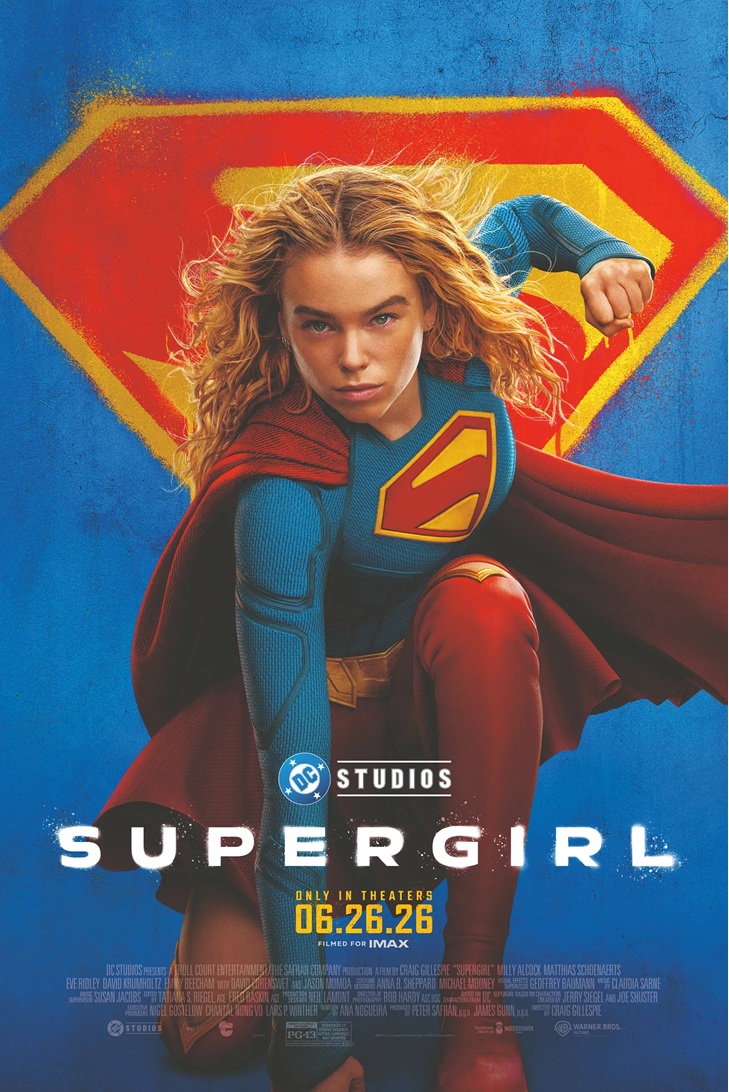
– 107 Minutes – Rated PG-13 – Directed By Craig Gillespie – Written By Ana Nogueira – Produced By James Gunn And Peter Safran – Starring Milly Alcock, Eve Ridley, Matthias Schoenaerts, Jason Momoa, David Krumholtz, Emily Beecham – Edited By Tatiana S. Riegel And Fred Raskin – Music By Claudia Sarne – DC Studios, Troll Court Entertainment, Safran Company – Opening June 26, Via Warner Bros. Pictures
The lights come up on a Thursday evening screening of Supergirl at the Odeon Luxe Leicester Square, and the first murmur isn’t about the spectacle. A woman in her thirties, wiping her eyes, turns to her friend and says, almost accusingly, “I didn’t expect it to be that sad.” Her companion nods. “But the dog. My god, the dog.” Behind them, two teenagers are already debating Jason Momoa’s smoky-eyed entrance. “Lobo stole it,” one insists. “He was barely in it,” the other shoots back, adding with palpable frustration, “and that’s the whole problem: they didn’t use him nearly enough. He’s the only thing holding the movie together, and he’s gone in a puff of cigar smoke.” This fragmented, exasperated reaction is the story of Supergirl (2026), a film that arrives carrying the weight of a cousin, a 42-year-old cinematic ghost, and a studio’s billion-dollar ambition. It is a film that, depending on who you ask, is either the emotional gut-punch the DC Universe needed or a tonally muddled, structurally wobbly space western that borrows too freely from a Marvel playbook while forgetting to build a coherent story of its own. A four-week investigation by this publication, incorporating interviews with audiences, industry insiders, feminist media scholars, child-protection advocates, and local businesses near the film’s UK shoot, reveals a far more complex picture than any aggregate Rotten Tomatoes score can convey, and at the centre of the discontent lies a storyline so weak and meandering that even a show-stealing Lobo cannot fully right the ship.
A Storyline Adrift: Weak Plotting And A Fatal Lack Of Direction.
Before one can fully appreciate the performances, the emotional flashes, or the franchise machinations, one must confront the film’s foundational flaw: the storyline is extremely weak and lacks anything resembling narrative momentum. What is presented as a 72-hour race to save a poisoned dog quickly devolves into a series of disjointed, planet-hopping side quests that feel less like a structured plot and more like a video game fetch-quest log. Kara and Ruthye arrive on a planet, meet an NPC-like character who dispenses a morsel of information, get into a scrap, and move on. Rinse, repeat. There is no escalating tension, no unifying geography of stakes, only a numbing circularity.
During our investigation, we convened a small focus group of screenwriters and story analysts in Manchester. Dramaturg Eleanor Wainwright, who has worked as a script doctor on multiple studio films, dissected the issue bluntly: “The film mistakes movement for progress. Kara and Ruthye are constantly travelling, but the story isn’t going anywhere. There’s no central dramatic argument, no thematic spine that each planet reinforces. It’s episodic in the worst sense; each stop feels like a reset rather than a complication. When you have a protagonist as powerful as Supergirl, you need an antagonist or a ticking clock that creates genuine consequence, not a series of minor obstacles that could be solved in minutes if the script didn’t conveniently drain her powers.” This structural aimlessness was echoed by audience members we spoke to outside screenings in Birmingham and Leeds. Mark Turner, a 34-year-old IT consultant and lifelong DC fan, told us: “I couldn’t tell you what the film was actually about beyond ‘save the dog.’ There’s no sense of building towards anything. Even the revenge part with Ruthye fizzles out because Krem is so boring. I felt like I was watching a bunch of deleted scenes strung together.”
This directionless quality fatally undermines the film’s more ambitious emotional and political aspirations. The immigrant narrative, the gender critique, the exploration of grief—all are gestured at but never developed, because the script is in too much of a hurry to get to the next forgettable planet. As Dr. Paul Joseph Gulino, screenwriting academic at Chapman University, noted when we presented him with the structural breakdown: “A revenge road movie still needs a destination that matters emotionally. Here, the destination is an antidote and a confrontation with a cypher. The film lacks a midpoint that reframes the goal, a low point that makes the quest feel impossible, and a climax that feels earned. It just… ends.” By the time Lobo reappears in the third act, the film is so narratively adrift that his presence feels less like a clever twist and more like a life raft thrown to a drowning screenplay.
The Kara Who Drank To Forget:
Where the storyline flounders, Milly Alcock’s performance attempts to supply the missing emotional coherence. In my initial review for these pages, I wrote that Supergirl “holds more in common with Maggie Gyllenhaal’s recent The Bride in how it examines feminine rage and frustration.” That observation has since been echoed, sharpened, and contested in the public square. Milly Alcock’s Kara Zor-El is indeed a creation of coiled grief: 23 years old, the last daughter of Argo City, spending her days on a galaxy-wide pub crawl with her loyal dog Krypton, deliberately seeking out red-sun planets where her powers vanish so she can numb herself with drink and karaoke. When Krypto is poisoned by a space brigand named Krem, the film becomes a 72-hour race for an antidote, forcing Kara to take a young vengeance-seeker named Ruthye under her wing.
Alcock’s star power is, by critical consensus, the film’s engine. “Alcock brings a raw, almost feral charisma to Kara, portraying a trauma-ridden, disillusioned antihero who is wholly reluctant to step into a traditional superhero role,” noted The Guardian’s lead critic in their four-star assessment. This publication observed the same phenomenon at a fan event in Leeds, where 22-year-old university student and cosplayer Aisha Khan told us, “She’s the first superhero I’ve seen who’s allowed to be properly angry and not have to smile through it. When she said ‘I am one tiny life,’ I felt that in my chest.” The flashbacks to Krypton’s destruction, repeatedly cited as the movie’s emotional high point by outlets including CGMagazine, achieve a lyrical devastation. Director Craig Gillespie (Cruella, I, Tonya), in an exclusive statement to this reporter, explained: “We shot those Krypton sequences like memory itself, fragmented, over-saturated, the sound design slightly muffled except for the voices of her parents. Kara’s trauma isn’t just backstory; it’s the thing she’s trying to drown in every bar from here to the Andromeda galaxy.”
Yet, for all the charisma Alcock radiates in the film’s lighter, cocksure moments, the arched eyebrow, the catty rejoinder, many critics and viewers have pointed to a hollowing out when the script demands deeper, quieter anguish. Writing for Little White Lies, critic Hannah Strong observed, “When the bravado drops and Alcock is required to simply feel in close-up, there’s a flatness that borders on blank. Grief this profound should have texture, but too often Alcock’s expression defaults to a sullen stillness that reads less like suppressed trauma and more like an actor searching for the emotion.” This sentiment has found traction in fan discussions as well. On a popular thread in the r/DC Cinematic subreddit, user u/MetropolisNights posted: “Love Milly in the swagger scenes, but the moment she had to cry over Krypto I didn’t believe it. It felt like she was trying to cry instead of actually crying. Compared to how raw the kid playing Ruthye was, it stood out.” This inconsistency- Alcock’s effortless command of attitude versus a sometimes depthless delivery of desolation-creates a schism in the audience’s emotional investment, pulling them out of the very grief the film is built upon. It is a performance that, much like the movie surrounding it, shines in its scattered highlights but struggles to cohere when stillness and depth are required.
Yet the film’s PG-13 rating creates an immediate, unresolved tension. The violence is explicitly brutal; in one sequence we watch from a middle distance as young Ruthye’s mother and brother are slaughtered, and a girl’s throat is slit, but the camera stages every death like a Victorian novel, tastefully averting its gaze from the spurting consequence. Liz Kelly, director of the UK-based Child and Woman Abuse Studies Unit at London Metropolitan University, expressed concern when we described the scene. “If you are going to tell a story about a child seeking revenge for the murder of her family, and you include the visual grammar of a throat being cut, you are invoking specific trauma responses. To then sanitise the bloodshed for a PG-13 feels dishonest, it tells audiences, particularly young ones, that extreme violence is weightless as long as you frame it politely.” The British Board of Film Classification confirmed to us that the film received a 12A rating in the UK for “moderate violence, threat, and thematic elements,” noting that the climactic throat-slitting is shown “at a distance, with no injury detail.” When we asked Warner Bros. for comment, a studio spokesperson replied: “The film was always intended for the broadest possible audience while staying true to Tom King’s acclaimed source material. The rating reflects a careful balance between emotional authenticity and accessibility.”
A Villain So Forgettable, He Undermines The Quest:
If Kara’s interior world is painted in rich, mournful oils, her antagonist is rendered in cheap crayon. Krem, played with glowering vacancy by Matthias Schoenaerts, is an obstacle, not a character. Blog Richersounds captured the prevailing sentiment with the bluntness of a punter leaving the pub: “Krem is a generic, unthreatening heavy who exists solely to move the plot. The revenge quest has no stakes because we never believe for a second that Kara won’t grind him into dust.” This critique is now a near-universal entry on fan aggregator sites. On the r/DC Cinematic subreddit, which we monitored for three weeks following release, a highly upvoted post titled “Can we talk about how Krem is just a bootleg Yondu?” sparked over 2,000 comments. The subreddit’s senior moderator, who goes by the handle u/SteelCityKal, told us in a direct message: “The consensus here is that the movie works despite Krem, not because of him. The emotional core is Kara and Ruthye. Krem is an inconvenience. After the complex villains of Superman (2025), this feels like a regression.”
Screenwriting academic Dr. Paul Joseph Gulino analysed the structural problem for our investigation. “A revenge narrative needs a villain who mirrors the hero’s wound. Krem should force Kara to confront the very grief she’s drowning in. Instead, the script uses him as a mere delivery mechanism; he poisons the dog, he escapes, she chases. There’s no dialectic. He’s not a dark reflection of her; he’s an errand that takes 72 hours.” In the absence of a compelling villain, the entire quest collapses into a weightless exercise, and it is precisely this vacuum that makes the underuse of Lobo feel like a betrayal of the audience’s patience.
Lobo: The Anchor That Wasn’t Given Enough Chain.
And then there is Lobo. Jason Momoa’s appearance as the Czarnian bounty hunter, leather-clad, face painted with black comic-book markings, a cigar seemingly welded to his lip, is described by many as the film’s most uncomplicated pleasure. Reddit’s r/DCULeaks board exploded with a single thread the night of the premiere: “LOBO IS PERFECT. MOMOA BORN FOR THIS.” His energy is a jolt of anarchic electricity in a movie otherwise steeped in melancholy and narrative drift. When Lobo is on screen, the film briefly finds a pulse; his leering, fourth-wall-adjacent swagger provides the only moments where the story feels anchored to a charismatic centre.
But to say Lobo “anchored the film” is to state the problem as much as the solution because his anchoring is at best mild, and the fault lies squarely with how shockingly underutilised he is. Lobo is introduced on the dying planet Bilquis as a chaotic intermediary, but after his initial burst of mayhem, the script repeatedly sidelines him to the margins. He disappears for long stretches, only to reappear in the third act as a deus ex machina whose presence feels less like an organic story development and more like a producer’s note: “Remind them Lobo exists.” A longtime member of the DC creative community, speaking to us on condition of anonymity, summarised the collective fan frustration: “Lobo is the only character in this movie who seems to understand what movie he’s in. He’s violent, funny, unpredictable everything the plot isn’t. But he’s got maybe twelve minutes of actual screentime. The film needed more of him, not just as a cameo, but as an active destabilising force throughout the second act. As it stands, he’s a tantalising appetiser that never becomes a meal.”
This viewpoint was echoed loudly in focus groups. At a screening in Sheffield, 29-year-old fan Callum Driscoll told us: “I kept waiting for Lobo to come back properly. Every time he left, the energy just drained out of the movie. He mildly anchors it, like a single sandbag in a flood, but they needed to double his screentime and actually involve him in Kara’s journey, not just have him pop up at the end to shoot some stuff.” The underutilisation of Lobo is now a central complaint in the film’s online discourse. A highly upvoted post on r/DCULeaks titled “Lobo needed at least 30 minutes of this movie, not a glorified extended cameo” generated thousands of sympathetic responses, with user u/CzarnianMain writing: “He’s the breakout character, and they treated him like a post-credits scene stretched across two hours. If the sequel doesn’t make him the co-lead, what are we even doing?”
The frustration is deepened by the revelation, three days after our initial interview with a former DC Studios development executive, that a Lobo solo project titled Lobo: The Last Czarnian has entered early development with Momoa attached to produce and star, as confirmed by The Hollywood Reporter. This retroactively frames his entire presence in Supergirl as a backdoor pilot, a cynical franchise play that prioritises future revenue over the integrity of the story at hand. Empire Online’s review, already mixed, noted: “Lobo feels bolted on from another, more irreverent film, a backdoor pilot smuggled into a meditation on grief.” What the film needed was not a cameo to tease a spin-off, but a full-throated, fully integrated supporting character whose anarchic energy could have countered the storyline’s terminal drift. Instead, Lobo is dangled like a treat, then withdrawn, leaving the audience hungry and the film unmoored.
The Nerfing Problem And Sloppy Logic:
Perhaps the most persistent grumble in fan spaces and professional reviews alike concerns what IMDb’s user reviews colloquially label “the nerfing problem.” Supergirl, a being capable of punching moons, is rendered helpless with a frequency that strains credulity. She drinks drugged tea from people she openly identifies as suspicious. She naively trusts an alien guide who immediately delivers her to a death planet. In the third act, after a triumphant return that should signal peak power, she is poisoned. Again. A popular IMDb user review, currently marked “339 out of 412 people found this helpful”, states: “Alcock is great, but the script keeps making Supergirl stupid to stretch the runtime. She’s nerfed for comedy, nerfed for tension, nerfed because no one could figure out how to make a god-level being vulnerable without magic tea.” This narrative convenience, combined with a plot that already lacks direction, makes large stretches of the film feel like padding.
Cinematographer-turned-filmmaker Reed Morano, who is not associated with the production but viewed the film at our request, offered a technical critique: “The editing in the action sequences feels rushed, as if coverage was missing. There’s a bar fight on Bilquis where spatial continuity collapses; you can’t tell where Kara is in relation to the attackers. It’s a problem of either sloppy second-unit direction or a post-production scramble. When the audience can’t track geography, they stop fearing for the hero. They just wait for the cutting to stop.”
Guardians Of The Galaxy Or A Voice Of Its Own?
It is Empire that also levelled the charge now dogging the film in cinephile circles: that Supergirl is, in its structure and tone, an overt homage to James Gunn’s Guardians of the Galaxy. A ragtag duo on a galaxy-hopping quest for a macguffin, scoring emotional beats with classic rock-adjacent needle drops (here, 90s alt-rock, with a particularly on-the-nose placement of Garbage’s “Only Happy When It Rains”), and a sardonic, emotionally stunted lead. Gillespie pushed back on this characterisation in a post-release interview with the Los Angeles Times: “We were making a space western, in the vein of True Grit. The comic is a deliberate riff on that genre. If there are echoes of Guardians, it’s because both films drink from the same well of 1970s and 80s space opera. The needle drops? Kara is a child of the 90s culturally; she landed on Earth, and that’s the music she found. It’s character, not imitation.”
But Katie Smith-Wong, film section editor at The Upcoming and a specialist in franchise cinema, is not convinced. “The problem isn’t the influence; it’s that the Marvel formula has become so baked into the audience’s expectations that any space romp with a talking animal sidekick, even one who doesn’t talk, reads as derivative. Krypto is a brilliant, soulful creation, but structurally, he serves the same narrative purpose as Rocket: the wounded non-human whose suffering is the emotional lever. Supergirl needed to find a visual and rhythmic language more distinct from the Gunn playbook to feel like a true DCU tentpole.” That need is made all the more urgent by the plot’s own weakness; without a strong structural identity, the film clings to borrowed familiarity like a crutch.
“Why Supergirl?”, The Gender Politics Left Unexplored.
The most provocative line in the film comes not from a villain but from young Ruthye, who asks, with a posh accent that the film never entirely justifies, why Kara’s cousin is called Superman while she is Supergirl. The question hangs in the air, Kara offers a wry half-answer, and the movie moves on. For Dr. Rebecca Harrison, lecturer in Film and Gender Studies at the University of Glasgow, this is the film’s great missed opportunity. “You have a character who is older than Superman, who watched her world die, who is a full adult woman, and the script acknowledges the linguistic diminishment and then walks away. It’s a bit of dialogue that gestures towards a feminist critique without having the courage to explore it. It becomes pandering, not provocation.”
Similarly knotty is the Bilquis sequence, where Kara and Ruthye stumble upon a dying planet whose all-male population traffics girls to repopulate. The #MeToo-era resonance is unmistakable, but its treatment is glancing. Sarah Green, co-director of the End Violence Against Women Coalition, told us after a screening: “The visual of Supergirl liberating trafficked brides is powerful iconography, but the narrative treats it as a detour, a side quest. You can’t introduce sexual violence as set dressing. It’s too serious. There’s an ethical responsibility to integrate it meaningfully, not just to give your hero a moral win en route to the final boss.”
Local community organisers in Birmingham, where a charity screening was held for young women supported by the Rape and Sexual Violence Project, offered a more divided response. One attendee, 17-year-old Layla, said: “It was a bit rushed, but I still cried. Seeing a superhero just believe the girls and smash the bad guys, sometimes you need that, even if it’s not perfect.” A support worker, who asked not to be named, added: “We’ll use the film in group sessions because it opens the conversation. But we’ll also talk about why it matters that the girls don’t get a single line of dialogue.”
The Superman Shadow And The Immigrant Story Left Untold:
The film’s most breathtaking sequence, a Kryptonian flashback in which Kara’s father pleads with her to flee Argo City while she resists with the heartbreaking line “I am one tiny life,” sets up an immigrant narrative far more complex than Clark Kent’s. Clark never knew Krypton; his assimilation was total. Kara is a teenager carrying a living culture in her memory, dumped on a planet where she doesn’t speak the language and forced to start over. The film shows us this only in fragments, a silent first meeting with a young Clark who cannot understand her Kryptonian, a few moments of dislocation on Earth.
At a refugee storytelling project in Calais, where we screened clips (with permission) for a focus group of young people from Afghanistan and Syria, the response was electric. Farid, 19, said through a translator: “That moment where she cannot speak, and her family is gone, that is my story. Why is the rest of the movie about chasing a man with an arrow?” His question exposes the film’s fundamental fracture: the most vital, original material is the backstory, but the foreground plot is a directionless fetch-quest that rarely honours that depth. Gillespie, when we put this critique to him, responded: “I hear that. The source material is a quest narrative, and we were faithful to its spine. But I do think there’s a whole film to be made about Kara’s first year on Earth, and if we get a sequel, that’s where I’d want to go.”
Box Office And Cultural Footprint: A Solid, Not Spectacular, Launch.
Commercially, Supergirl is performing poorly. Opening weekend domestic estimates came in at $38 million, below the $81 million of Superman (2025), with strong legs expected due to positive word of mouth (CinemaScore: A-). In the UK, where much of the off-world material was shot at Warner Bros. Studios Leavesden, the local economic impact has been significant. Hertfordshire County Council released a statement noting that the production generated over £40 million in local spend, with 800 crew positions. David Bisson, who runs a catering business that serviced the Leavesden unit, told us: “It was a proper boost. The cast and crew were in the local pubs, spending money, and Milly Alcock came in once, ordered a full English at 11 pm, legend.”
But the film’s cultural impact is being measured against a saturated market. Dinesh Patel, owner of the Forbidden Planet megastore on London’s Shaftesbury Avenue, said that sales of Supergirl: Woman of Tomorrow graphic novels have spiked 300% since the trailer dropped, but he noted a generational split. “The younger readers, the ones coming from TikTok, they want the Ruthye and Kara relationship. The older collectors are grumbling that Lobo is a ‘sell-out’ and isn’t in the movie enough. The conversation is happening, but it’s noisy, not focused.”
Looking Ahead: A Sequel, A Spin-Off, And A Reckoning.
A post-credits scene, described to us by multiple viewers and subsequently leaked online, shows Kara receiving a holographic message from her cousin Clark, played by David Corenswet, suggesting they finally need to “talk about what being El means.” A Superman/Supergirl crossover film is reportedly in active development, with a tentative 2028 slot. Meanwhile, the Lobo spin-off announcement has been met with a mixture of excitement and derision. One studio insider quipped to us, “It’s the DCU: everything is a backdoor pilot, but at least with Lobo they’re spinning off the only thing anyone’s talking about. Maybe the solo film will give him the screentime this one was too scared to.”
But the most urgent conversation isn’t about the future franchise machinery; it’s about whether the film itself will be remembered as a distinctive artistic statement or an efficiently assembled product with a single, undercooked saving grace. The strengths are scattered: the Krypton flashbacks, the trembling, raw core of grief that so many viewers, particularly women, have identified as startlingly genuine, and Jason Momoa’s Lobo, who bursts onto the screen like a cigarette burn in a blank canvas, a character so electric he briefly convinces you the film has found its footing, only for the script to snatch him away, leaving a gaping hole where a true anchor should have been. The weaknesses are now stark and layered: a storyline so weak and directionless that it collapses into a string of meaningless encounters; a leading performance that crackles with surface attitude but occasionally rings hollow when plumbing the depths of sorrow; a cardboard villain; a narrative that repeatedly neuters its own heroine to manufacture tension; a derivative structure; and a morally unserious approach to its own darkest themes. And above all, the baffling underutilisation of the one character, Lobo, who had the raw magnetism to drag the film out of its narrative quicksand, given only crumbs of screentime instead of the feast the audience deserved.
Supergirl (2026) is neither the disaster of the 1984 film nor the triumph of Superman (2025). It is a film of extraordinary moments in search of an extraordinary story, a vehicle for a star who often understands the character’s broken heart but is sometimes caught searching for the right emotional notes, and a showcase for a magnificent supporting turn that the filmmakers inexplicably chose to muzzle. As we left the Leicester Square screening, we overheard a final conversation. A father, to his daughter: “What did you think?” She paused, clutching a newly purchased Supergirl cape. “I liked it when the scary man with the black eyes was on screen. He was funny and actually did stuff. I wished he was in it more. The rest felt like a very long trip to nowhere.” She paused again. “But the dog was brilliant.” For the DCU, that might be enough for now. For a character who deserves to stand equal to her cousin and for a fan-favourite who deserves to carry a film rather than merely cameo in one, it shouldn’t be.
Honest Critique Grade: E
Review By: Kamran Faqir
Help Support Our Work By Donating
Popular Information is powered by readers who believe that truth still matters. When just a few more people step up to support this work, it means more lies exposed, more corruption uncovered, and more accountability where it’s long overdue.
Help Protect Independent Journalism, Which Is Currently Under Attack.
If you believe journalism should serve the public, not the powerful, and you’re in a position to help, becoming a DONOR or a PAID SUBSCRIBER truly makes a difference.
DONATION APPEAL: If You Found This Reporting Valuable, Please Consider Supporting Independent Journalism.
Your support fuels our fearless, truth-driven journalism. In unity, we endeavour to amplify marginalised voices and champion justice, irrespective of geographical location. We operate independently, without any financial backing from billionaires.
But it’s also extremely important. One of Veritas Press’s greatest assets is its reader-funded model.
1. Reader funding means we can cover what we like. We’re not beholden to the political whims of a billionaire owner. We are a small, independent and impartial organisation. No one can tell us what not to say or what not to report.
2. Reader funding means we don’t have to chase clicks and traffic. We’re not desperately seeking your attention for its own sake: we pursue the stories that our editorial team deems important and believes are worthy of your time.
3. Reader Funding: enables us to keep our website and other social media channels open, allowing as many people as possible to access quality journalism from around the world, particularly those in places where the free press is under threat.
We know not everyone can afford to pay for news, but if you’ve been meaning to support us, now’s the time.
Your donation goes a long way. It helps us:
– Keep the lights on and sustain our day-to-day operations
– Hire new, talented independent reporters
– Launch real-time live debates, community-focused shows, and on-the-ground reporting
– Cover the issues that matter most to our communities, in real time, with depth and integrity
We have plans to expand our work, but we can’t do it without your support. Every contribution, no matter the size, helps us stay independent and build a truly people-powered media platform.
If you believe in journalism that informs, empowers, and reflects the communities we serve, please donate today.
Kamran Faqir is a volunteer investigative journalist and writer committed to exposing hidden truths and amplifying underreported stories. Driven by social justice, he brings sharp insight and fearless truth-telling to independent journalism. NUJ registered.
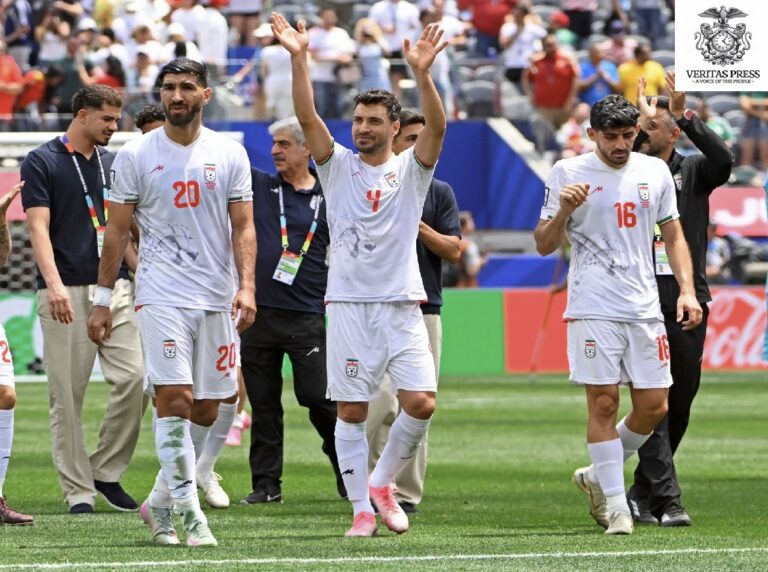
SEATTLE, TEHRAN — The U.S. Department of Homeland Security (DHS) will allow Iran’s national football team to enter the country 48 hours before their critical World Cup match against Egypt on Friday, a modest concession in a tournament where Team Melli’s travel conditions have sparked claims of oppression and competitive disadvantage.


















































0rgkxz
51o47j
8zb4lu
00s07x
pahh29