




Author:
Byline: Investigative Desk
Help support our mission, donate today and be the change. Every contribution goes directly toward driving real impact for the cause we believe in.
Beneath the wreath-laying and “plunder” rhetoric lies a contest for Iraq’s logistical arteries and post-war allegiance, where Tehran declares victory, Washington weighs withdrawal, and Baghdad speaks the language of resistance while quietly hedging between two unravelling regional orders.
BAGHDAD/TEHRAN— In the smoke-filled aftermath of a 40-day war that has reshaped the strategic landscape of West Asia, the choreography of power was on full display at Baghdad International Airport this week. Iranian Parliament Speaker Mohammad Bagher Qalibaf, a former Revolutionary Guards commander and presidential candidate, stepped off the plane not into a VIP lounge, but directly onto the tarmac near the site of a 2020 US drone strike. There, he laid wreaths for Qassem Soleimani and Abu Mahdi al-Muhandis, the two commanders whose assassinations cemented the Iran-Iraq axis of resistance.
This was not merely a memorial; it was a statement. Qalibaf’s visit, accompanied by a high-ranking parliamentary delegation including Mohammad Taghi Naghali and key members of the National Security and Foreign Policy Commission, was a calculated manoeuvre to merge Iran’s political and ideological influence in Baghdad when American influence in the region is being tested like never before.
The “Plunder” Narrative: An Ideological Offensive In A Post-War Vacuum
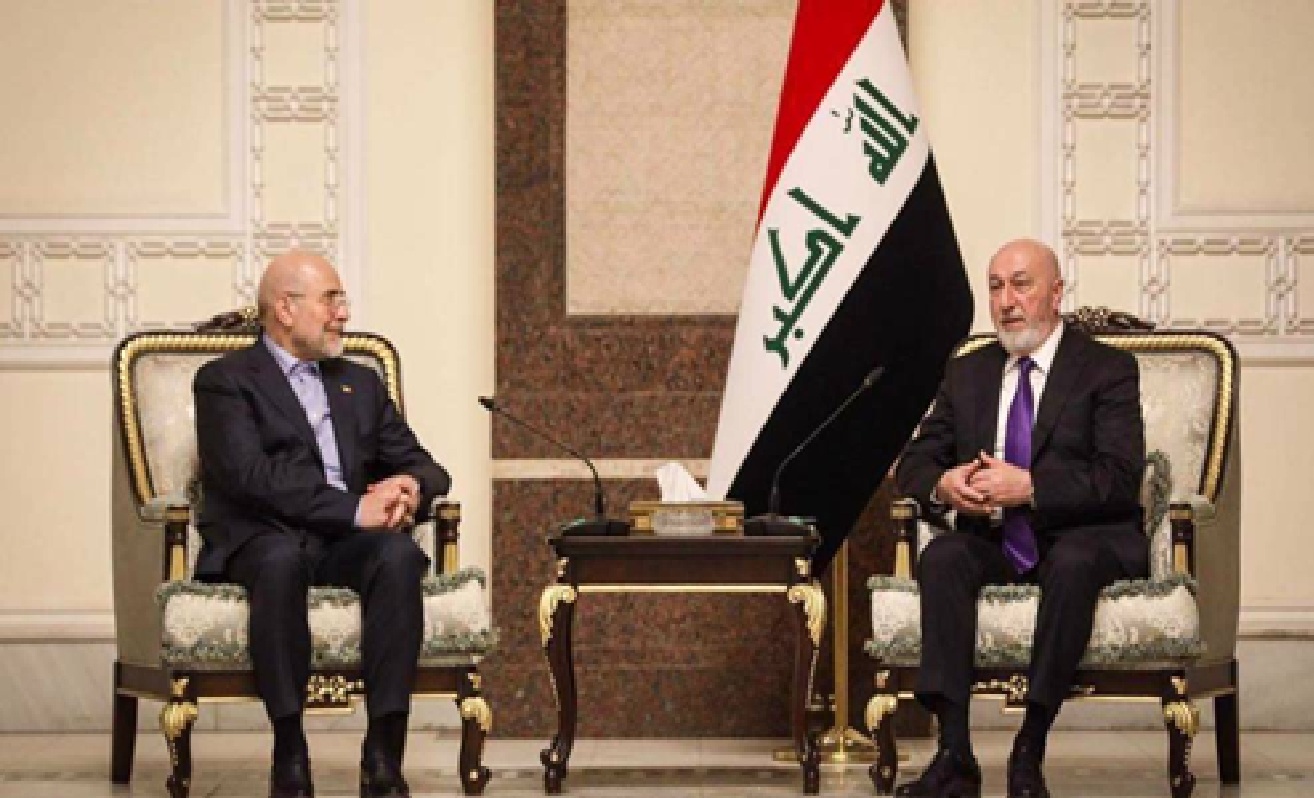
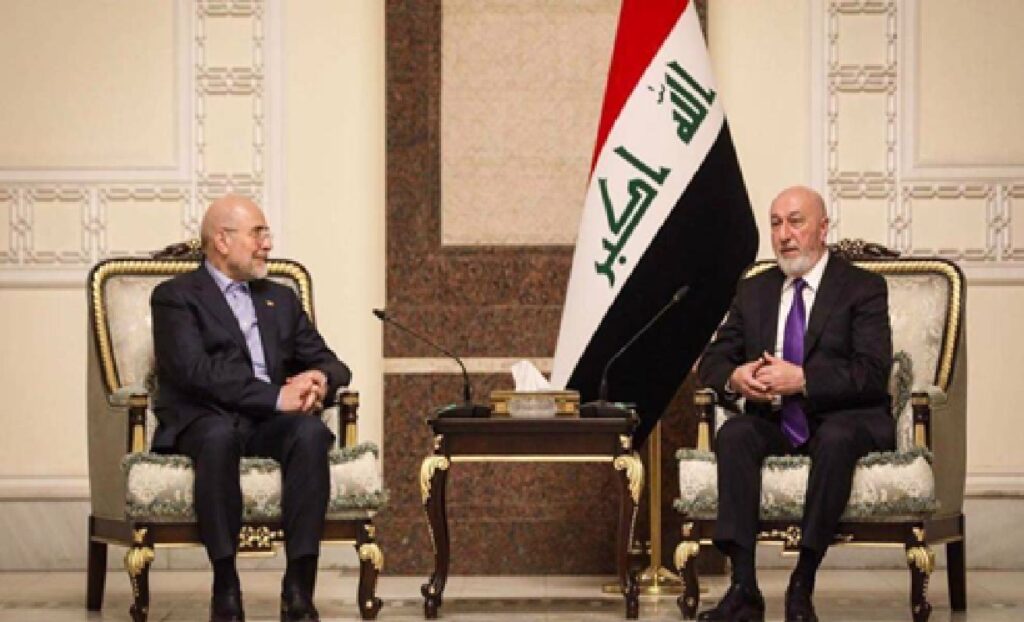
The official purpose of the visit was bilateral cooperation. But the message Qalibaf delivered to Iraqi President Nazar al-Amidi and Prime Minister Ali al-Zaidi was an unmistakable ideological broadside aimed at Washington, designed to exploit the political vacuum left by the recent conflict.
“The United States has approached the countries of the Persian Gulf and the region only to loot and plunder their resources,” Qalibaf stated, according to Iran’s Fars News and ISNA. He framed the recent “Ramadan War” or “40-day war”, a conflict referred to obliquely in official statements, as a decisive turning point. “Experience and the recent conflict have proven to regional countries that Americans are not only incapable of guaranteeing their security, but are actively the disruptors of regional peace.”
This rhetoric, however, operates on two levels. On the surface, it is standard anti-imperialist discourse. On a deeper, investigative level, it represents a sophisticated attempt to redefine the security paradigm of the Persian Gulf. By accusing the US of “plunder”, a reference to historical grievances over oil and, increasingly, control of future energy corridors and water resources, Qalibaf is not just criticising policy; he is questioning the legitimacy of the US presence entirely.
“The main party responsible for the problems in the Persian Gulf and disruptions in the energy market is the United States and its warmongering,” Qalibaf added, referring to specific disruptions during the recent war.
The Iranian delegation’s focus on “plunder” resonates with a long-standing narrative in Baghdad, where many political factions, particularly those aligned with the Hashd al-Shaabi (Popular Mobilisation Forces), view the US military footprint as an occupation force with ulterior motives. However, it starkly contrasts with the views of US officials, who have long framed their presence as essential for ensuring the free flow of oil and counterterrorism.
Critics, including several independent Iraqi analysts, note that Iran’s own economic leverage over Iraq, through energy exports, dollar auctions, and proxy influence, presents a competing form of “resource dependency Baghdad often views the accusation of plunder, while potent, as projection.
The Search For A Successor To The “Martyred Leader”
A recurring theme in the meetings was the reference to the “martyred Leader of the Islamic Revolution, Ayatollah Seyyed Ali Khamenei.” The articles and reports cite Qalibaf thanking the Iraqi people for the estimated 10 million participants in mourning ceremonies across Iraq.
This detail is critical for understanding the timing of the visit. Qalibaf is not just visiting a neighbour; he is engaging in succession diplomacy. As Tehran navigates the aftermath of the loss of its supreme leader and the trauma of the 40-day war, ensuring the loyalty and stability of its most crucial Arab ally is paramount.
Qalibaf explicitly thanked President Amidi and the Iraqi people for their “profound grief,” framing it as a testament to the legacy of Khamenei’s policy of “forging a new horizon of unity among Islamic nations.”
Yet, this framing obscures a more complicated reality on the ground. While millions of Shia pilgrims and supporters mourned in Iraq, the Iraqi state itself is a delicate balancing act. The Iraqi government of Prime Minister al-Zaidi and President Amidi must navigate between its deep ties to Tehran and its lingering dependence on US security guarantees and financial institutions.
Iraq’s “No War, No Peace” Dilemma
The most revealing statement from the meetings came not from the Iranians, but from the Iraqi side. President Amidi’s assertion that the “no war, no peace” limbo must end is a window into Baghdad’s exhausting geopolitical reality.
“Integrated regional security can only be achieved through the collective security of the region’s own countries,” Amidi told Qalibaf. “As a supporter of regional stability, Iraq will stand with the Islamic Republic of Iran.”
On paper, this sounds like an alignment with Tehran’s vision. In practice, “ending the no war, no peace status” is often code in Baghdad for a desire to de-escalate the US-Iran conflict entirely, not necessarily to pick a side in a definitive manner.
For Iraq, the recent 40-day war was a catastrophe. Although the articles do not detail the specifics of the “recent aggression,” the context suggests a conflict that spilt over into Iraqi territory or severely disrupted Iraqi trade, reminiscent of the destabilisation seen during the Iran-Iraq war of the 1980s or the US invasion in 2003. Amidi’s condemnation of the war as “inhumane and contrary to international law” without explicitly naming the aggressor, while Iran explicitly blames the US and Israel, reveals Baghdad’s attempt to maintain a veneer of diplomatic ambiguity.
“Iraq will stand with Iran,” Amidi is quoted as saying, but the actions of the Iraqi Parliament suggest a more transactional relationship.
Economic Highways And The “Arvand Rud” Dispute
Beyond the geopolitics, Qalibaf’s visit had a hard economic edge. The Iranian delegation pushed for the completion of the Shalamcheh-Basra railway, a 32-kilometre project stalled for years by sanctions, mine clearance, and financing issues. Once completed, this railway would link Iran’s port cities to the Mediterranean via Iraq and Syria, creating a “dry canal” that rivals the US-backed India-Middle East-Europe Economic Corridor (IMEC).
Qalibaf also mentioned the dredging of the Arvand Rud (Shatt al-Arab) and the expansion of border markets.
The mention of the Arvand Rud is contentious. The waterway has been a historical flashpoint, serving as a primary casus belli for the Iran-Iraq War (1980-1988). By raising this issue now, Qalibaf is signalling a desire to resolve long-standing border disputes under a unified Shia-friendly framework, but it also dredges up (pun intended) nationalist sentiments within Iraq. Many Iraqi nationalists remain deeply suspicious of Iranian encroachment on the vital waterway that provides Iraq’s only access to the Persian Gulf.
The “Cancerous Tumour” And The Exit Of US Forces
The talks with Iraqi Parliament Speaker Hebat al-Halbousi revealed an even sharper tone. According to Iranian media summaries of the meeting, al-Halbousi, despite being a Sunni politician often seen as closer to Gulf states than Tehran, reportedly praised the “legendary resistance” of the Iranian people and described Israel as a “cancerous tumour that must be eliminated.”
Such language, if accurately reported, represents a stunning rhetorical concession to the Iranian framing of the conflict. However, Iraqi political analysts caution that such statements often serve a domestic purpose. By aligning rhetorically with the “Axis of Resistance” on the “Zionist threat,” Iraqi politicians can deflect attention from domestic economic failures and secure Iranian backing for their positions.
Crucially, al-Halbousi mentioned that the “withdrawal of US forces from Iraq was imminent.” This has been a long-standing goal of pro-Iran factions in the Iraqi parliament, who have repeatedly voted for the expulsion of US troops. US and Iraqi officials have engaged in talks about a “transition” of the mission, but they have not agreed upon a definitive timeline for a full withdrawal, largely due to the threat of ISIS resurgence.
Qalibaf’s visit is designed to push that timeline forward. By presenting the recent US-Israeli “defeat” as evidence of US weakness, Tehran is telling its allies in Baghdad: The Americans are leaving; they failed; it is time to formalise the new regional order with us.
The Critique: The Limitations Of The Resistance Narrative
While the Iranian media portrays the visit as a triumph of unity, an investigative analysis reveals fractures.
- The “Victory” Claim: Qalibaf claims the US suffered a “decisive military and political defeat.” Yet, the article and source materials are conspicuously silent on the outcome of the “40-day war” regarding Iranian infrastructure or military capability. The assertion that the US “failed to achieve any objectives” is a subjective claim. In a historical context, such declarations often precede internal power struggles within the losing state. If Iran suffered heavy casualties or infrastructure degradation, the “victory” narrative is primarily a tool for domestic morale and deterrence psychology.
- Resource Extraction vs. Resource Protection: The US narrative for its presence in the Gulf has historically been about securing the flow of hydrocarbons to global markets. In the modern era, it has shifted towards security architecture. Iran’s counter-narrative of “plunder” is rhetorically effective but overlooks the fact that China, Iran’s largest customer, benefits just as much from a secure Gulf as the West. The “plunder” line is aimed at the Arab street, attempting to ignite nationalist resource sovereignty against Washington, but it often falls flat in Gulf capitals like Riyadh or Abu Dhabi, where governments view Iran as the primary threat to their sovereignty.
- Iraq’s Agency: In the Iranian narrative, Iraq is an extension of the “resistance.” This is a simplification. While President Amidi uses flowery language (“one nation living in two lands”), the Iraqi state is increasingly asserting its own sovereignty in unexpected ways. The push for the development of the Al-Faw Grand Port, Iraq’s own ambitious project to compete with Iranian ports, proceeds independently. While they welcomed the Shalamcheh railway, Iraq is hedging its bets, pursuing the $17 billion “Development Road” with Turkey, Qatar, and the UAE, which aims to connect the Gulf to Europe via Iraq and Turkey, bypassing Iran entirely.
The Martyrs’ Shadow And The Future
The image of Qalibaf standing on the tarmac of Baghdad airport, at the spot where an American missile vaporised Soleimani, serves as the ultimate metaphor for the current struggle. It is a struggle between two orders: one enforced by US airpower and “maximum pressure,” and another built on religious linkages, proxy militias, and now, increasingly, parliamentary diplomacy.
Qalibaf’s message is clear: the “plunderers” are being expelled, and the “resistance” is the future. But in the corridors of power in Baghdad, the calculation is often more mundane: who will finance the reconstruction, who will buy the oil, and who will provide the security guarantees? For now, Baghdad is telling Tehran what it wants to hear while keeping its lines open to Washington.
As the threat of a re-emerging ISIS lingers and the economic reality of sanctions bites, the rhetoric of “plunder” may resonate, but the survival of the Iraqi state depends on navigating between these two imperial aspirations. The “40-day war” may be over, but the shadow war for Iraq’s soul, and its resources, is far from finished.
Conclusion:
The most consequential line from Baghdad this week was not Qalibaf’s denunciation of American “plunder,” but President Amidi’s weary admission that Iraq cannot endure a permanent state of “no war, no peace.” That confession exposes the central contradiction of the visit. The Iranian delegation arrived to project victory and lock in alignment; the Iraqi hosts responded with the vocabulary of resistance but the logic of survival. Baghdad is not choosing the Axis of Resistance over the West. It is attempting to keep both patrons invested in Iraq’s stability while conceding as little sovereignty as possible to either.
An investigative reading of the bilateral agenda reveals that the projects championed by Qalibaf, the Shalamcheh-Basra railway, the dredging of the Arvand Rud, the expansion of border markets, are not neutral economic cooperation. They are strategic infrastructure designed to bind Iraq’s economy more tightly to Iran’s sanctions-scarred trade routes and to counter US-backed connectivity corridors. For Tehran, “plunder” is what Washington does; “integration” is what Tehran demands. Yet for many Iraqis, the distinction is not so clear. The same government that welcomes Iranian railway engineers also pursues the Al-Faw Grand Port and the Development Road with Turkey and the Gulf states, a project that would bypass Iran entirely. The rhetoric of brotherhood masks a quiet competition over who gets to define Iraq’s economic geography.
Ultimately, Qalibaf’s visit is less a triumph of the “resistance” than a symptom of its fragility. Declaring the United States militarily and politically defeated is not the same as defeating it. The American military footprint in Iraq remains contested but present; the dollar remains the backbone of Iraq’s oil economy; and the spectre of ISIS resurgence still provides Washington with a rationale for staying. Iran, for its part, arrives in Baghdad as a state mourning a supreme leader, managing a war-scarred economy, and seeking to convert funerary solidarity into strategic depth. But funerals do not build railways, and parliamentary embraces do not pay salaries. The real contest in Iraq is moving away from ideology and toward infrastructure, customs revenue, water rights, and oil export routes. Whoever controls those will determine whether the region’s resources are “plundered” by foreigners or monopolised by neighbours. And that contest, unlike the 40-day war, will not be decided by missiles or martyrdom, it will be decided by contracts, corridors, and the quiet accumulation of dependency.
Veritas Press Investigative Analysis
Independent journalism examining global affairs, power, diplomacy, and accountability.
Source: Veritas Press C.I.C. | Multi-News Agencies
APPEAL: Help Support Our Work By Donating
Readers who believe that truth still matters have power over popular information. When just a few more people step up to support this work, it means more lies exposed, more corruption uncovered, and more accountability where it’s long overdue.
Help Protect Independent Journalism, Which Is Currently Under Attack.
If you believe journalism should serve the public, not the powerful, and you’re able to help, becoming a regular DONOR or a PAID SUBSCRIBER truly makes a difference.
DONATION APPEAL: If you found this reporting valuable, please consider supporting independent journalism.
Your support fuels our fearless, truth-driven journalism. In unity, we endeavour to amplify marginalised voices and champion justice, irrespective of geographical location. We operate independently, with no financial backing from billionaires; our readers support us.
But it’s also extremely important. One of Veritas Press’s greatest assets is its reader-funded model.
1. Reader funding means we can cover what we like. We’re not beholden to the political whims of a billionaire owner. We are a small, independent and impartial organisation. No one can tell us what not to say or what not to report.
2. Reader funding means we don’t have to chase clicks and traffic. We’re not desperately seeking your attention for its own sake; we pursue the stories that our editorial team deems important and believes are worthy of your time.
3. Reader Funding: enables us to keep our website and other social media channels open, allowing as many people as possible to access quality journalism from around the world, particularly those in places where the free press is under threat.
We know not everyone can afford to pay for news, but if you’ve been meaning to support us, now’s the time.
Your donation goes a long way. It helps us:
- Keep the lights on and sustain our day-to-day operations
- Hire new, talented, independent reporters
- Launch real-time live debates, community-focused shows, and on-the-ground reporting
- Cover the issues that matter most to our communities, in real time, with depth and integrity
Without your support, independent voices like ours will be silenced.
Furthermore, we have plans to expand our work, but we can’t do it without your support. Every contribution, no matter the size, helps us stay independent and build a truly people-powered media platform.
If you believe in journalism that informs, empowers, and reflects the communities we serve, please donate today.
Submissions:
For the secure submission of documentation, testimonies, or exclusive investigative reports from any global location, please utilise the following contact details for our Investigations Desk: mailto:enquiries@veritaspress.co.uk or mailto:editor@veritaspress.co.uk
GENEVA — A United Nations fact-finding mission has concluded there are “reasonable grounds to believe”
Iran’s GDP is projected to contract by 5.4 to 6.1% in 2026, its worst performance
The Trump administration is preparing a $2.8 billion weapons package for Israel containing 40,000 2,000-pound

Film alleges mass civilian deaths are routinely built into military decisions amid Israel’s genocidal war
The Israeli rights group says violence, displacement, economic strangulation, and settlement expansion form part of

Houthi forces have captured the historic Red Sea port of Mocha and are advancing on
London’s historic sanctions against Israeli settlements mark a watershed moment in UK foreign policy, but
With 95% of Gaza’s population now wholly dependent on aid and more than 90% stripped
India calls for Kashmir and Ladakh to appear only on its official map after a
ISLAMABAD – In the high-stakes political theatre of Pakistan, the battleground has shifted from the
















ljoh4b