Kamran Faqir is a volunteer investigative journalist and writer committed to exposing hidden truths and amplifying underreported stories. Driven by social justice, he brings sharp insight and fearless truth-telling to independent journalism. NUJ registered.
Listen to this article
Help support our mission, donate today and be the change. Every contribution goes directly toward driving real impact for the cause we believe in.
Article Date Published:
Article Date Modified:
22 minutes
Views:132
Three attacks, one system: how incitement from the top and impunity on the ground turned a Galilee mosque arson, a Kafr Qasim ramming, and a Nablus military escort into a single indictment of the Israeli state.
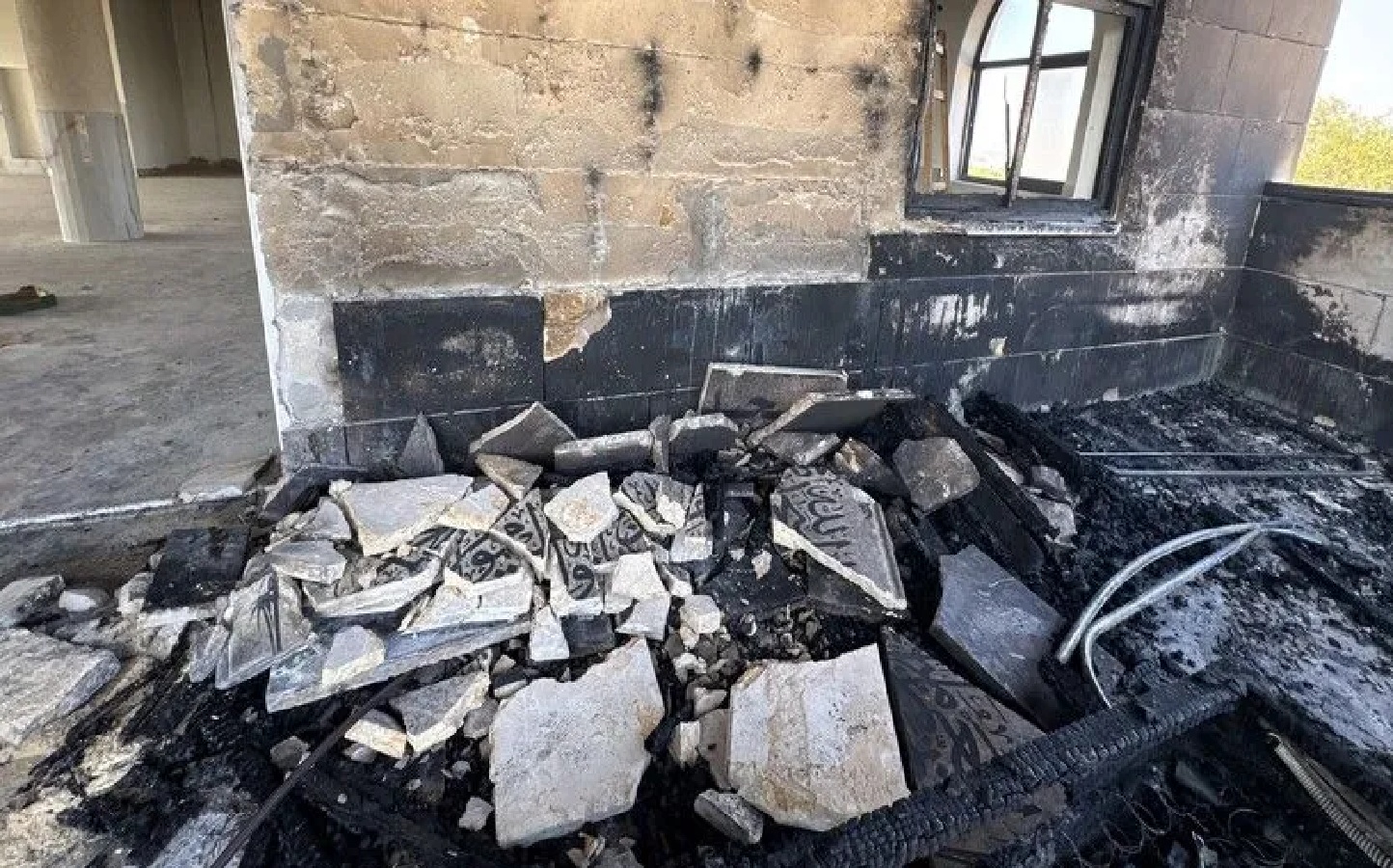
The fire at the mosque in al-Dahi was still smouldering when the first worshippers arrived for dawn prayers. What they found was not just charred stone and broken glass, but a message written in Hebrew on the walls, a message that Israel’s political and security establishments have spent years making legible: we can do this, and nothing will happen to us.
Hours later, in the central Arab city of Kafr Qasim, a Jewish driver ploughed his car into pedestrians at multiple locations, wounding eight people, several of them women leaving a wedding. By the end of the same day, hundreds of Israeli settlers had stormed Joseph’s Tomb in Nablus under heavy military escort, with troops occupying rooftops of Palestinian homes and sealing off roads. Three attacks, three different geographies, one common thread: a state apparatus that either participates in, enables, or declines to seriously investigate violence against Palestinians.
This is not a story about “lone extremists.” It is a story about a system, and about what happens when incitement from the top meets impunity on the ground.
The Arson In Al-Dahi: A “Price Tag” Confession
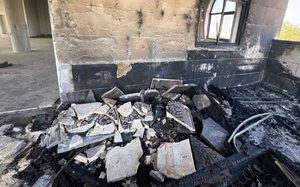
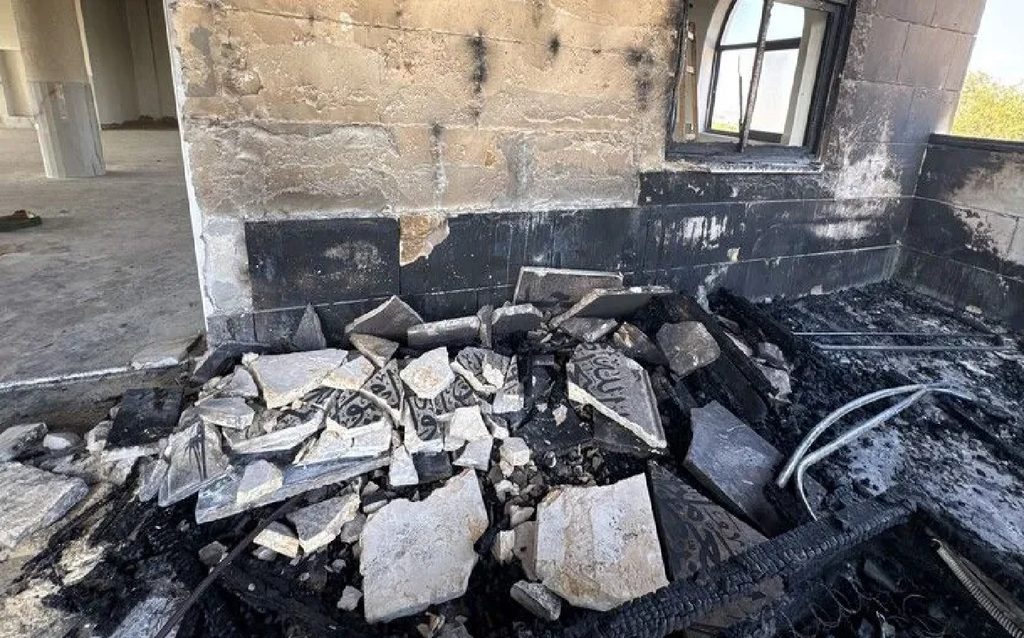
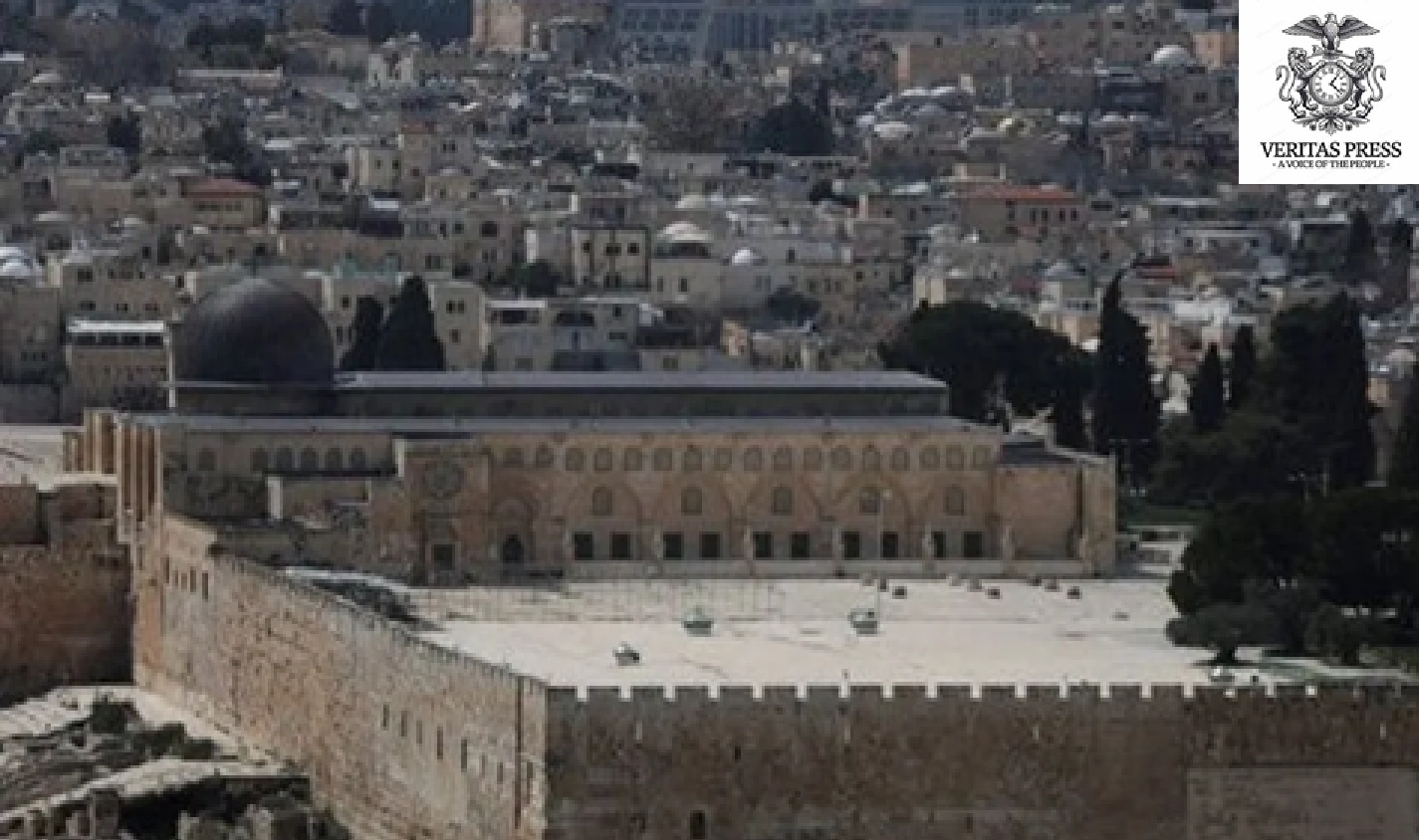
The attack unfolded in the village of al-Dahi, in the Marj Ibn Amer area of the Lower Galilee, near Afula, inside the 1948 lines, not the occupied West Bank. Three masked men emerged from a nearby wooded hill before dawn on Thursday, attempted to break into the mosque, and when metal doors held them back, smashed a ground-floor window and hurled a Molotov cocktail inside. Worshippers arriving for fajr prayers discovered the fire and extinguished it before it could consume the building.
On the exterior walls, the attackers left Hebrew graffiti that read like a signature: “Revenge throughout the country, the Front” and “Revenge for administrative orders, greetings from the deportees”. The phrases are not random. “The Front” is a reference used by extremist settler groups, including the so-called Hilltop Youth, to signal a unified campaign behind such attacks. “Administrative orders” refers to administrative detention and expulsion measures, tools Israeli authorities have used only sparingly against settlers involved in anti-Palestinian violence, and which the graffiti explicitly threatens to avenge.
The graffiti also invoked the death of Yehuda Sherman, an eighteen-year-old settler killed in a car-ramming in the West Bank in March, and included a misspelt quote from Psalms. It was, in effect, a confession signed in advance, a “price tag” attack designed to be understood, and designed to go unpunished.
Sheikh Khaled Zaabi, the mosque’s imam, did not mince words. “This is a serious assault on the village,” he said in a video statement. “A terrorist act that requires a firm response and accountability for those responsible.” He demanded that police “open an immediate investigation, identify the perpetrators and bring them to justice,” warning that the attack “must not be recorded as an unknown crime, with the case closed without accountability”.
The police response followed a familiar script. A statement said investigators were working “to get to the truth of the matter,” that the Shin Bet security agency was involved, and that “any attempt to harm religious symbols” would be treated with “utmost severity”. By Thursday afternoon, police confirmed they suspected arson and were searching for suspects. But as of the latest reports, no arrests have been announced.
The location matters. Settler arson attacks on mosques are a well-documented feature of life in the occupied West Bank; attacks inside the Green Line are rarer, though Jewish extremists have also targeted churches. The al-Dahi attack thus represents a crossing of a threshold, a “price tag” operation exported into the heart of what Israel considers its sovereign territory, against Palestinian citizens of the state.
The same evening, in Kafr Qasim, the Arab city that carries the memory of the 1956 massacre of dozens of Palestinian citizens by border police, a Jewish driver struck pedestrians at four or five separate locations. Eight people were wounded, among them women leaving a wedding. Police detained the driver and said they were examining “whether drugs, mental illness or a nationalist motive played a role”. By Thursday, the police line had hardened: “no indication of a nationalist motive,” with investigators increasingly suspecting the driver was under the influence of alcohol and drugs. His detention was extended by five days.
Saeed Issa, head of the Kafr Qasim Popular Committee, rejected that framing outright. “What happened in the town was not a traffic accident but a terrorist act,” he told reporters, linking the attack to “rising incitement against Palestinian citizens” in Israel. The fact that the driver struck people at multiple, successive locations, rather than in a single collision, was, for Issa and many residents, evidence of intent, not intoxication.
The police’s haste to individualise the Kafr Qasim attack, to frame it as a matter of one man’s impairment, stands in stark contrast to the political context in which it occurred. It came just weeks after an election in which Arab-led parties won a record nineteen Knesset seats, up from ten, and in which Benjamin Netanyahu’s right-wing bloc lost its majority. Rather than treating that result as a democratic mandate, Netanyahu and his allies launched a campaign of what critics describe as racist incitement, accusing Arab parties of supporting terrorism and seeking the state’s destruction.
Ahmad Tibi, head of the Joint List, drew a direct line between that rhetoric and the violence. “We hold Netanyahu and his government politically and morally responsible for the continued incitement against the Arab community and for creating an atmosphere of hatred and racism that encourages attacks and fuels a sense of impunity,” he said, condemning both the mosque arson and the Kafr Qasim ramming as “serious incidents requiring immediate investigations and accountability”. Tibi also accused police of “compliance” with the policies of far-right National Security Minister Itamar Ben-Gvir, whom he called a “racist”.
Mansour Abbas, head of the United Arab List, described the mosque arson as a “hate crime, a terrorist act and a desecration of a holy place.” His appeal was directed squarely at the prime minister: “Stop the incitement. Legitimizing violence against the Arab community puts people’s lives at risk”. Yousef Atawna, another Joint List lawmaker, called the two attacks a “direct product of the racist and inciting policies” of Netanyahu’s government, including Ben-Gvir and Finance Minister Bezalel Smotrich, policies that he said had spread “beyond government and Knesset corridors into Israeli society,” creating an atmosphere of “incitement, official support and complicity, and a lack of accountability”.
The warning is not abstract. Tibi has himself said that when senior officials “shout that Arab members of parliament support terrorism, it constitutes a threat to their lives”. The post-election period has seen anti-Arab incitement spiral, with Arabic-speaking citizens facing hostility in workplaces and public spaces, and with comparisons being drawn to the climate that preceded the 1995 assassination of Yitzhak Rabin.
Nablus: The Army As Escort
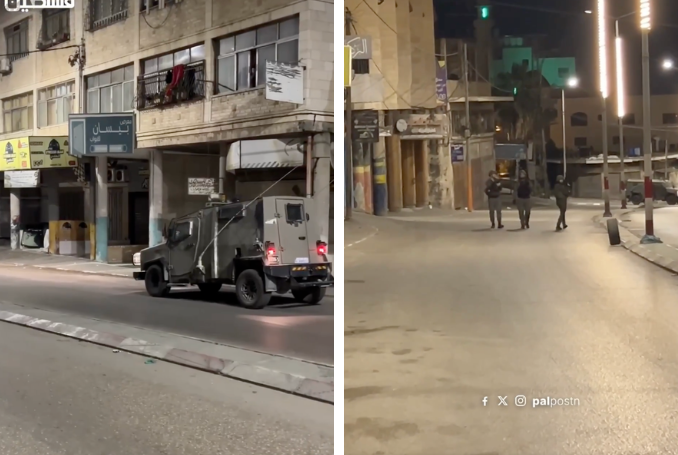
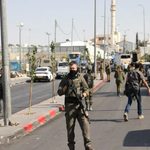
While the Galilee mosque burned and Kafr Qasim reeled, the Israeli military was executing a now-routine operation in the occupied West Bank. Before dawn on Thursday, hundreds of settlers entered Joseph’s Tomb, east of Nablus, to perform Talmudic prayers under the protection of Israeli forces. The army deployed with a military bulldozer, raided the eastern part of the city, took positions on the rooftops of several Palestinian homes, and turned some of them into military outposts. Major roads and intersections were closed, paralysing movement for Palestinian residents while the settlers prayed.
Israeli occupation forces escorted hundreds of illegal settlers into Nablus. (Photo: Video grab)
Joseph’s Tomb is nominally under Palestinian Authority administration, but it has been subjected to increasingly frequent and larger settler incursions since October 2023, with groups entering alongside Israeli forces under a religious pretext. Middle East Eye reported that the site has become a test case for fears of permanent Israeli takeover, a creeping annexation enacted through military escort and settler ritual. Last week, the incursions were joined by twenty US lawmakers from the National Association of Christian Lawmakers, who praised the Israeli army and reaffirmed their support for Israeli sovereignty over the West Bank.
The Nablus operation is not an aberration. It is the routine choreography of occupation: Palestinian homes become barracks, streets become military corridors, and a holy site becomes a staging ground for sovereignty claims, all under the cover of darkness and armed guard. The same army that escorts settlers to a shrine is the army that, according to human rights groups, systematically fails to protect Palestinians from settler violence.
The Data Behind The Impunity
The individual incidents of November 19, 2026, are not isolated. They are data points in a measurable, escalating trend.
The United Nations Office for the Coordination of Humanitarian Affairs (OCHA) documented 1,680 settler attacks across more than 270 West Bank communities in 2025 alone, an average of five incidents per day. In October 2026, OCHA recorded 397 settler attacks causing casualties or property damage in a single month, the highest figure since 2006. Between January 2025 and October 2026, OCHA documented 338 Palestinian deaths and 6,638 injuries from Israeli forces and settler attacks across the West Bank. By May 2026, the agency was already recording an average of six settler attacks per day.
Behind those numbers lies a deeper reality: impunity. B’Tselem, the Israeli human rights group, has documented that indictments of settlers for lethal violence are extraordinarily rare. When Israeli prosecutors charged settler Yinon Levi in August 2026 with reckless manslaughter in the killing of Palestinian activist Owdeh Hathaleen, the first such indictment in nearly three years, B’Tselem responded with a statement that has become a defining critique of the entire system: “The decision to indict Yinon Levi is the exception that proves the rule. The impunity Israel grants to soldiers and settlers who harm Palestinians is not a failure of the system; it is a central component of a policy designed to allow the violence to continue and escalate”.
That analysis applies with equal force to the al-Dahi mosque arson. The Shin Bet is involved. Police say they are searching for suspects. But the graffiti itself named the motive, the ideological network, and the political grievances that animate the attack. In a functioning accountability system, such evidence would be a starting point, not a press-release talking point. In Israel’s system, it is more likely to become another closed file, another “unknown crime” in the words of Sheikh Zaabi, while the infrastructure of incitement continues to hum.
The Political Economy Of Incitement
The timing of these attacks is not coincidental. They occurred in the aftermath of an election that delivered a record number of seats to Arab-led parties and stripped Netanyahu’s bloc of its majority. Rather than accepting the result, Netanyahu and his allies have escalated a rhetoric that treats Arab political participation as a threat to the state. The prime minister has accused Arab parties of using foreign backing to undermine the election, and his coalition partners have spent years framing Arab citizens as enemies within.
This is the political economy of incitement: when a leader facing electoral defeat needs a scapegoat, Arab citizens are cast as the culprit. When violence follows, the same leader expresses “concern” while his police minister, Ben-Gvir, oversees a force that Tibi accuses of “compliance” with far-right policy. And when the violence is investigated, the investigation is structured to individualise, to find a drunk driver, a lone arsonist, a “price tag” vandal, rather than to confront the political and institutional conditions that make such violence predictable and repeatable.
The al-Dahi attack, in particular, exposes the lie of the “lone extremist” narrative. The graffiti was not the work of a single disturbed individual. It was a communiqué from a network, the “Front”, that shares ideology, tactics, and targets. It invoked a specific deceased settler, a specific grievance about administrative orders, and a specific claim to “the whole land.” This is organised political violence, and it is being treated as a public-order nuisance.
If Israeli authorities were serious about accountability, the response to November 19 would look very different. Police would publicly identify the “Front” network behind the graffiti, arrest suspects with the same speed with which they detain Palestinian teenagers, and indict them under terrorism statutes. The Kafr Qasim investigation would be transferred out of a police force accused of political bias and placed under independent oversight, with the driver’s multiple strikes treated as evidence of intent rather than explained away as intoxication. The army would be held accountable for using Palestinian homes as military outposts during a religious settler pilgrimage. And the political leadership that has spent months demonising Arab citizens would be confronted with the foreseeable consequences of its words.
None of this is likely. The more probable outcome is what has happened after almost every previous “price tag” attack: a brief flurry of condemnations, a police statement about the “severity” of the act, an investigation that quietly stalls, and no indictment. The mosque will be repaired. The worshippers will return. The graffiti will be painted over. And the message will remain: violence against Palestinians, their holy sites, and their communities is a cost-free enterprise.
Sheikh Zaabi understood this when he warned against closing the case without action. “This attack must not be recorded as an unknown crime,” he said. But in Israel’s current political configuration, “unknown crime” is not a bug; it is the operating system. The fire at al-Dahi, the car in Kafr Qasim, and the army escort in Nablus are not separate outrages. They are symptoms of a single pathology: a state that has normalized violence against Palestinians and criminalised the demand for accountability.
Until that changes, the next mosque will burn, the next car will ram, and the next investigation will end the same way, with a statement, a promise, and a file that no one is ever forced to open again.
Conclusion: “Unknown Crime” Is Not A Failure. It Is The Policy.
The three events of November 19, 2026, the firebomb in al-Dahi, the car in Kafr Qasim, the army bulldozer in Nablus, are usually reported as separate outrages, each with its own cast of victims and its own official promise of investigation. They are not separate. They are the same event, repeated in three different registers: a state that has stopped pretending to enforce the law evenly, and has instead built an enforcement architecture that produces impunity and state-sponsored ethnic cleansing as reliably as it produces violence.
The numbers are not ambiguous. Between January 2025 and October 2026, OCHA documented 338 Palestinians killed in the West Bank, including 77 children, and 6,638 injured; Israeli forces were responsible for 296 of those deaths, settlers for 25, and the perpetrators of 17 remained unidentified. In the same period, OCHA recorded 4,157 settler attacks causing casualties or property damage, including 466 in October alone. October 2026 was the highest monthly toll since OCHA began tracking such incidents in 2006, 397 attacks before the month was even over. And the violence did not stay inside the Green Line’s mirror image of the occupation: it crossed into the Galilee, into a Palestinian village inside Israel proper, and into a mosque that worshippers had every reason to believe was protected by the same laws that protect synagogues.
Yet the enforcement apparatus has not scaled with the violence; it has been deliberately decoupled from it. Haaretz reported in July 2026 that investigation files opened by Israeli police over complaints of settler terrorism had risen by 560% since 2019, and that only 6.6% of those files ended in indictments. Yesh Din’s long-range data is even more damning: of cases opened between 2005 and 2025, only 3% led to a full or partial conviction. A Guardian analysis published in March 2026 found that no Israeli had been prosecuted for killing a Palestinian civilian in the occupied West Bank since the start of the decade, despite at least 1,100 Palestinians killed by soldiers and settlers since 2020. The August 2026 indictment of settler Yinon Levi for reckless manslaughter in the killing of Palestinian activist Owdeh Hathaleen was the first such charge in more than seven years, and B’Tselem’s response was not gratitude but diagnosis: “The decision to indict Yinon Levi is the exception that proves the rule. The impunity Israel grants to soldiers and settlers who harm Palestinians is not a failure of the system; it is a central component of a policy designed to allow the violence to continue and escalate”.
That diagnosis applies with surgical precision to al-Dahi. The graffiti was not cryptic. It named the “Front,” invoked a dead settler, and threatened revenge for administrative orders. The Shin Bet was involved; police said they suspected arson, and the imam, Sheikh Khaled Zaabi, warned that the case must not “be recorded as an unknown crime” and closed without accountability. The police have announced no arrests. If the file is eventually shelved, it will not be because the evidence was thin. It will be because the evidentiary bar is applied differently depending on who is holding the match.
Kafr Qasim exposes the same architecture from a different angle. A driver struck pedestrians at multiple, successive locations, wounding eight people, several of them women leaving a wedding. By the next afternoon, police had announced “no indication of a nationalist motive” and were increasingly leaning toward intoxication. Perhaps that will prove correct. But the speed of the foreclosure, before a full forensic reconstruction, before the driver’s digital history and social media footprint had been publicly examined, before the political climate in which the attack occurred had been treated as relevant, stands in stark contrast to the months-long, resource-intensive investigations that follow Palestinian attacks. The Kafr Qasim Popular Committee called it terrorism; the police called it a traffic incident with a toxicology question. The gap between those two framings is not a disagreement about facts. It is a disagreement about whose violence counts as political.
And Nablus reveals the third register: not omission, but commission. The army did not fail to prevent settlers from reaching Joseph’s Tomb. It escorted them, deployed a bulldozer, occupied rooftops of Palestinian homes, and turned residential buildings into barracks so that hundreds of settlers could perform rituals at a site that is nominally under Palestinian administration. This is not a “failure to enforce the law.” It is the law being enforced in one direction only. The same military that provides logistical support for settler pilgrimages is the military that, according to OCHA’s own weekly data, wounded 34 Palestinians by gunfire in a single week of the olive harvest while settlers wounded 23, a ratio that led the Arab Organisation for Human Rights to conclude that Israeli forces are “not a party unable to prevent the attacks but a partner in them”.
The political direction is no longer deniable. The Israeli Defence Ministry’s own National Security Council–affiliated INSS wrote in September 2026 that “the lack of a decisive Israeli response” to zionist terrorism “constitutes evidence that it is a policy directed from above”. The same analysis warned that the state’s failure to restrain radical forces threatened “Israel’s very ability to govern and function,” adding that “democracies that fail to restrain radical forces within them do not survive”. This is not the language of the Israeli far left. It is the language of the security establishment, describing a government that has chosen to absorb the violence rather than confront it. The Jerusalem Post reported that the IDF and Shin Bet had for two years accused National Security Minister Itamar Ben-Gvir of “pressuring the police into avoiding cracking down on Jewish extremist violence in the West Bank,” and that the Shin Bet’s involvement was subsequently curtailed under a new leadership appointed by Netanyahu. Haaretz added that West Bank police officers were accused of neglecting investigations to please Ben-Gvir, that the minister’s office obstructed the publication of settler-terrorism data for eighteen months, and that the data was only released after a court petition by the Movement for Freedom of Information.
This is the deeper story that the individual incidents obscure. The question is not whether the al-Dahi investigation will produce an indictment, or whether the Kafr Qasim driver will be charged with a hate crime, or whether the next Joseph’s Tomb escort will be smaller. The question is whether there exists, inside the Israeli state, any institutional actor with both the will and the capacity to treat Jewish supremacist violence as a crime rather than a cost of doing politics. The evidence of the past three years suggests there is not. The enforcement system has been politicised at its apex, hollowed out in the middle, and abandoned at the ground level, where police officers understand that arresting the wrong settler can end a career and ignoring him can advance one.
Sheikh Zaabi’s warning, “this attack must not be recorded as an unknown crime”, is therefore more than a plea for this mosque, this village, this file. It is a description of the mechanism by which the entire system reproduces itself. An “unknown crime” is not an investigative dead end. It is an administrative category, produced by decisions made long before the firebomb was thrown: decisions about who is investigated, who is indicted, who is escorted, and whose file is quietly closed. Until those decisions are reversed, the next mosque will burn, the next car will ram, and the next file will be marked unknown, not because the perpetrators cannot be found, but because the state has already decided not to look.
Veritas Press Investigative Analysis Independent journalism examining global affairs, power, diplomacy, and accountability.
Source:Veritas Press C.I.C. | Multi-News Agencies
Help Support Our Work
Readers who believe that truth still matters have power over popular information. When just a few more people step up to support this work, it means more lies exposed, more corruption uncovered, and more accountability where it’s long overdue.
Help Protect Independent Journalism, Which Is Currently Under Attack.
If you believe journalism should serve the public, not the powerful, and you’re able to help, becoming a regular DONOR or a PAID SUBSCRIBER truly makes a difference.
DONATION APPEAL: If you found this reporting valuable, please consider supporting independent journalism.
Your support fuels our fearless, truth-driven journalism. In unity, we endeavour to amplify marginalised voices and champion justice, irrespective of geographical location. We operate independently, with no financial backing from billionaires; our readers support us.
But it’s also extremely important. One of Veritas Press’s greatest assets is its reader-funded model.
1. Reader funding means we can cover what we like. We’re not beholden to the political whims of a billionaire owner. We are a small, independent and impartial organisation. No one can tell us what not to say or what not to report.
2. Reader funding means we don’t have to chase clicks and traffic. We’re not desperately seeking your attention for its own sake; we pursue the stories that our editorial team deems important and believes are worthy of your time.
3. Reader Funding: enables us to keep our website and other social media channels open, allowing as many people as possible to access quality journalism from around the world, particularly those in places where the free press is under threat.
We know not everyone can afford to pay for news, but if you’ve been meaning to support us, now’s the time.
Your donation goes a long way. It helps us:
Keep the lights on and sustain our day-to-day operations
Hire new, talented, independent reporters
Launch real-time live debates, community-focused shows, and on-the-ground reporting
Cover the issues that matter most to our communities, in real time, with depth and integrity
Without your support, independent voices like ours will be silenced.
Furthermore, we have plans to expand our work, but we can’t do it without your support. Every contribution, no matter the size, helps us stay independent and build a truly people-powered media platform.
If you believe in journalism that informs, empowers, and reflects the communities we serve, please donate today.
You Can Make Direct Bank Transfer Donations To
Bank Name: Bank Of Scotland
Account Name: Veritas Press C.I.C.
Sort code: 80-22-60
Account Number: 27540469
IBAN #: GB18-BOFS-6027-5404-69
Donate Online
Submissions
For the safe submission of documentation, testimonies, or exclusive investigative reports from anywhere in the world, please use the following contact details for our Investigations Desk: mailto:enquiries@veritaspress.co.uk or mailto:editor@veritaspress.co.uk.
SEATTLE, TEHRAN — The U.S. Department of Homeland Security (DHS) will allow Iran’s national football team to enter the country 48 hours before their critical World Cup match against Egypt on Friday, a modest concession in a tournament where Team Melli’s travel conditions have sparked claims of oppression and competitive disadvantage.