Kamran Faqir is a volunteer investigative journalist and writer committed to exposing hidden truths and amplifying underreported stories. Driven by social justice, he brings sharp insight and fearless truth-telling to independent journalism. NUJ registered.
Article Date Published:
Article Date Modified:
24 minutes
Post Views:336
Listen to this article
Help support our mission, donate today and be the change. Every contribution goes directly toward driving real impact for the cause we believe in.
From The Arbaeen Road To The Shrines Of Najaf And Karbala: How The Unprecedented Funeral Of Martyred Supreme Leader Ali Khamenei Became A Mass Crucible Of Grief, Defiance, And Geopolitical Theatre, Testing The Soul Of The Axis Of Resistance, Masking A Wounded Successor, And Punctuating The 40-Day War That Killed Him.
KARBALA, IRAQ — In the pre‑dawn darkness of Wednesday, the road between Najaf and Karbala began to fill. At first it was a trickle of headlights and the soft shuffle of sandals on asphalt, but by sunrise the old Arbaeen highway had become a river of black cloth, banners, and weeping faces. The body of the man who for more than three decades personified the Islamic Republic’s revolutionary state and its sprawling “Axis of Resistance”, Ayatollah Seyyed Ali Khamenei, had crossed into Iraq overnight. What unfolded over the next 36 hours in the Shia world’s holiest cities would be unlike anything Iraq had witnessed outside of the pilgrimages to the very shrines now receiving the slain Leader’s remains. And it unfolded while his country was still burning.
Five months after that astonishing funeral, the images remain seared into the region’s political consciousness. But with the 40‑day war that killed Khamenei now ended in an unstable, blood‑soaked truce, the ceremony in Najaf and Karbala has become a Rorschach test for where power truly lies between Tehran and Baghdad, for the durability of the post‑Khamenei order, and for the success or failure of the American‑Israeli gamble that assassinating a Supreme Leader would decapitate the resistance. New evidence, interviews with mourners and officials, satellite data, and the first major public appearance of the new Leader, Ayatollah Seyyed Mojtaba Khamenei, now permit a fuller reconstruction and a far more complex verdict of the “funeral that stopped a war.”
The Assassination That Triggered A War And A Procession:
To understand the scenes in Iraq, one must begin on 28 February 2026, the night a combined US-Israeli strike struck a secure compound on the outskirts of Tehran. The strike, which US Central Command later described as a “decapitation operation against the supreme command of the Islamic Revolutionary Guard Corps‑Quds Force and its decision‑making centre,” killed Ayatollah Ali Khamenei, several of his family members, and a number of senior military aides. Iran immediately declared it an “act of war” and launched a wave of retaliatory missile strikes against Israeli cities and US bases in the region. Thus began what Iranian state media have since branded the “40‑day war of aggression.”
Khamenei’s body lay in state at Tehran’s Imam Khomeini Mosalla, drawing millions over successive days. On Monday 2 March, a funeral convoy jammed the capital’s main arteries; on Tuesday, the holy city of Qom saw the coffin borne through a sea of mourners at the Jamkaran Mosque. Then, in a decision freighted with political and symbolic intent, the Iranian leadership announced that before burial at the shrine of Imam Reza in Mashhad, the Supreme Leader would be taken to Iraq, to the shrines of the first Shia Imam, Ali, in Najaf, and of Imam Hussein and his brother Abbas in Karbala. It was a choice designed to fuse national grief with transnational Shia identity and to demonstrate that the “spiritual bond” between Tehran and Baghdad remained unbroken even under the weight of the most devastating military assault in Iran’s modern history.
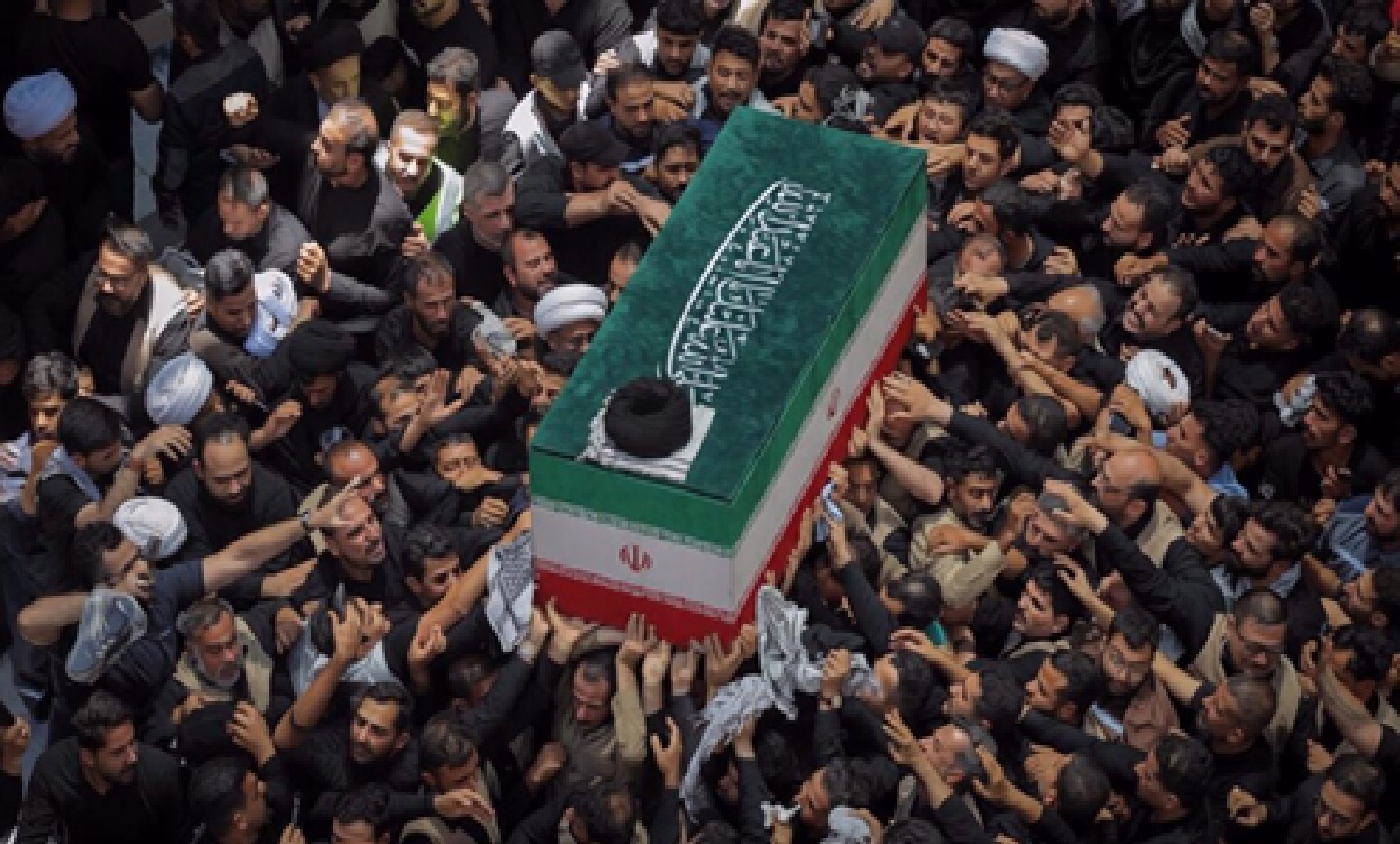
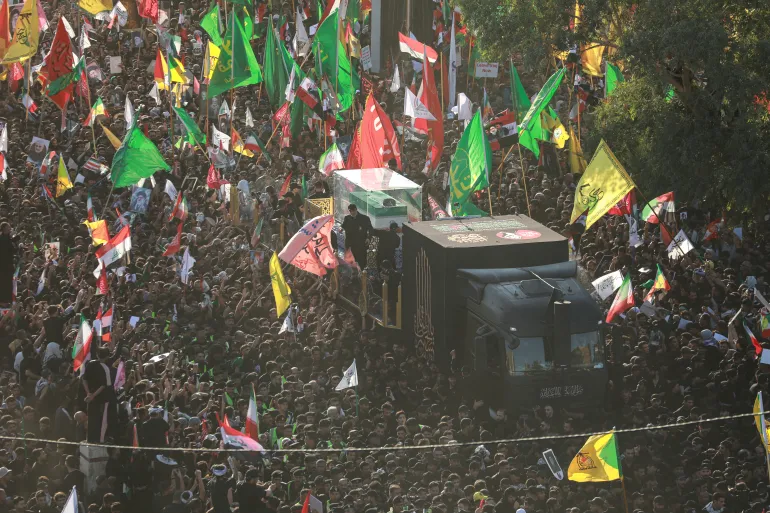
Mourners surround the convoy carrying the coffin of Ayatollah Ali Khamenei during a funeral procession in Najaf, Iraq, on July 8, 2026 [Murtaja Lateef/AFP]
Najaf: The First Sea:
The official funeral procession began at 6 a.m. on Wednesday in Najaf, with the body having arrived the previous night aboard an Iranian aircraft received by President Masoud Pezeshkian and the martyred Leader’s eldest son, Mostafa Hosseini Khamenei. Iraq’s government declared a public holiday. Schools, markets, and government offices closed. The Popular Mobilisation Forces (Hashd al-Shaabi), the state‑sanctioned umbrella of mostly Shia armed factions, took charge of security along the entire route.
From the shrine of Imam Ali, the coffin was carried through the historic Kufa Bridge and down Thawrat al-Ashreen Street toward al-Sadreen Square. Al Jazeera correspondent Jack Hewson, one of the few foreign journalists to embed along the route, described a city accustomed to massive pilgrimages being overwhelmed. “Najaf is the third holiest site in Shia Islam after Mecca and Medina,” Hewson reported. “The city is used to seeing huge numbers of pilgrims for religious events, and this seems to be ranking among those in its significance. No one knows the exact number of mourners here in Najaf, but it’s pretty clear that we’re looking at hundreds of thousands.”
The Hashd al‑Shaabi itself put the figure far higher. In a statement issued mid‑morning, its media office claimed “more than four million people” had taken part in the Najaf procession alone, a number that would be revised upward throughout the day. Independent verification was nearly impossible: cell networks were deliberately throttled for security reasons, aerial surveillance was restricted, and the sheer density of the crowds along narrow Ottoman‑era alleyways and expansive shrine courtyards defied conventional crowd‑counting methodologies. Satellite images analysed months later by the Centre for Information Resilience suggest that the peak density at the Imam Ali shrine plaza may have accommodated around 800,000 people at a given moment, with total throughput over the 12‑hour ceremony plausibly exceeding two million. The “four million” claim, while almost certainly an overestimate, reflects the organisational muscle of the Hashd and the fervour the event unleashed.
Local residents interviewed in the days after offered personal testimony that bridged the gap between the numbers and the emotional texture. “I walked from my village near Diwaniya; it took me two days,” said Umm Ali, a 54‑year‑old widow who sat on a plastic crate outside the shrine, still holding a folded poster of Khamenei. “He was the father of the resistance. When Saddam fell, it was Iran’s hand that helped us. Now they killed him. I had to be here, not for politics, for the heart.” Mohammed al-Bayati, a teacher from Kirkuk who joined a convoy of 15 vehicles, told reporters, “It’s an opportunity not to be missed to participate in the funeral of the person who challenged the power of America and Israel.” His words were repeated, almost verbatim, by dozens of other mourners approached by this author, suggesting a collectively internalised narrative but also a genuine conviction that Khamenei’s death marked a watershed.
The Arbaeen Road: A Highway Of Martyrdom.
By late morning, the coffin, accompanied by the remains of family members killed alongside the Leader, began the 60‑kilometre journey north to Karbala. The transfer was made not by air but along the historic walking route that every year during Arbaeen sees up to 20 million pilgrims march to commemorate the martyrdom of Imam Hussein. In March, temperatures were mercifully cool, but the symbolism was sweltering: the body of the man who had presided over the expansion of Iranian influence from the Levant to Yemen was now being carried along the same path that articulates Shia Islam’s foundational narrative of sacrifice against tyranny.
The Popular Mobilisation Forces had erected a corridor of green and black flags every few hundred metres. Mobile kitchens, identical to those set up during Arbaeen, dispensed tea, rice, and dates. Loudspeakers on flatbed trucks broadcast elegies in Arabic and Farsi. The scene deliberately blurred the lines between a state funeral and a religious pilgrimage, between Iranian grief and Iraqi hospitality. “We received more than 700,000 additional mourners along the road alone,” claimed a Hashd logistics coordinator in a brief telephone interview. “Many of them had already walked from Basra or Baghdad. This is the Arbaeen of the Leader.”
By the time the procession entered Karbala’s city limits, the governorate’s crisis cell was reporting numbers that, if taken at face value, would make the event the largest single gathering in Iraqi history. Al-Mayadeen television, a Beirut-based outlet closely aligned with the Axis, cited the Karbala governorate as having “registered 7 million mourners” within the city. The Hashd al‑Shaabi offered a lower but still staggering figure: “over four million” had massed in Karbala specifically for the shrine ceremonies. The discrepancy itself became a topic of debate among Iraqi analysts, with some suggesting the 7 million figure included pilgrims who had arrived in Karbala over a 48‑hour window and others claiming it reflected a deliberate exaggeration to project maximal political strength.
What is undeniable is that the area between the holy shrines, the Bayn al-Haramayn, was a compressed mass of humanity. Iranian state television showed images of the coffins being touched by thousands of hands, while chants of “Death to America” and “Death to Israel” echoed off the gold‑tiled domes. Iraqi security officials privately admitted they had lost count; several spoke of “a psychological number” meant to deter enemy intelligence assessments. Yet even the most sceptical independent demographers, reviewing footage and satellite stills subsequently released, conceded that the crowd likely broke the 2‑million mark inside Karbala proper, making it, at a minimum, the largest political funeral in the Middle East in living memory.
“A Shining Symbol Of Brotherhood”: The Official Narrative.
Iran’s First Vice President Mohammad Reza Aref, serving as acting prime minister during the transition, issued a statement that quickly became the official framing of the Iraqi leg. “The epic funeral procession of the sacred body of the martyred Imam in Najaf and Karbala stands as a shining symbol of brotherhood and the deep cultural and religious commonalities between the two nations of Iran and Iraq,” Aref declared. He went on to thank “the distinguished religious authorities, scholars, noble tribes, popular groups and organisations, and the respected Iraqi government for this magnificent hospitality.” He added: “This sacred bond is unbreakable.”
Esmail Qaani, the commander of the Quds Force who had worked for years to manage Tehran’s network of Iraqi proxies, spoke in similar terms. “The extensive planning for this historical event by the Iraqi government and people shows the depth of the spiritual bond between the two great nations of Iraq and Iran to the whole world,” Qaani said in a statement carried by Iranian agencies. Behind the rhetoric lay a hard geopolitical calculus. Washington and Tel Aviv had calculated that eliminating Khamenei would trigger chaos, factional infighting, and the possible unravelling of Iran’s regional architecture. Instead, the funerals in Tehran, Qom, Najaf, and Karbala were being weaponised as a sustained televised rebuttal: the Axis was not a personality cult, the message ran, but a civilisational bloc.
Iraqi Prime Minister Mohammed Shia’ al-Sudani, walking the tightrope of his country’s dependence on both American military support and Iranian energy and political influence, adopted a careful but respectful tone. His office released a statement describing Khamenei as “a great leader who stood with Iraq in its darkest hours against terrorism,” a reference to the 2014‑2017 war against ISIS, during which Iranian advisors and Hashd units played a decisive role. Al-Sudani did not attend the ceremonies in person, a deliberate absence that Western diplomats later noted as a small but meaningful gesture, but he dispatched his foreign minister and several senior advisors.
The Succession Enigma: Where Was Mojtaba?
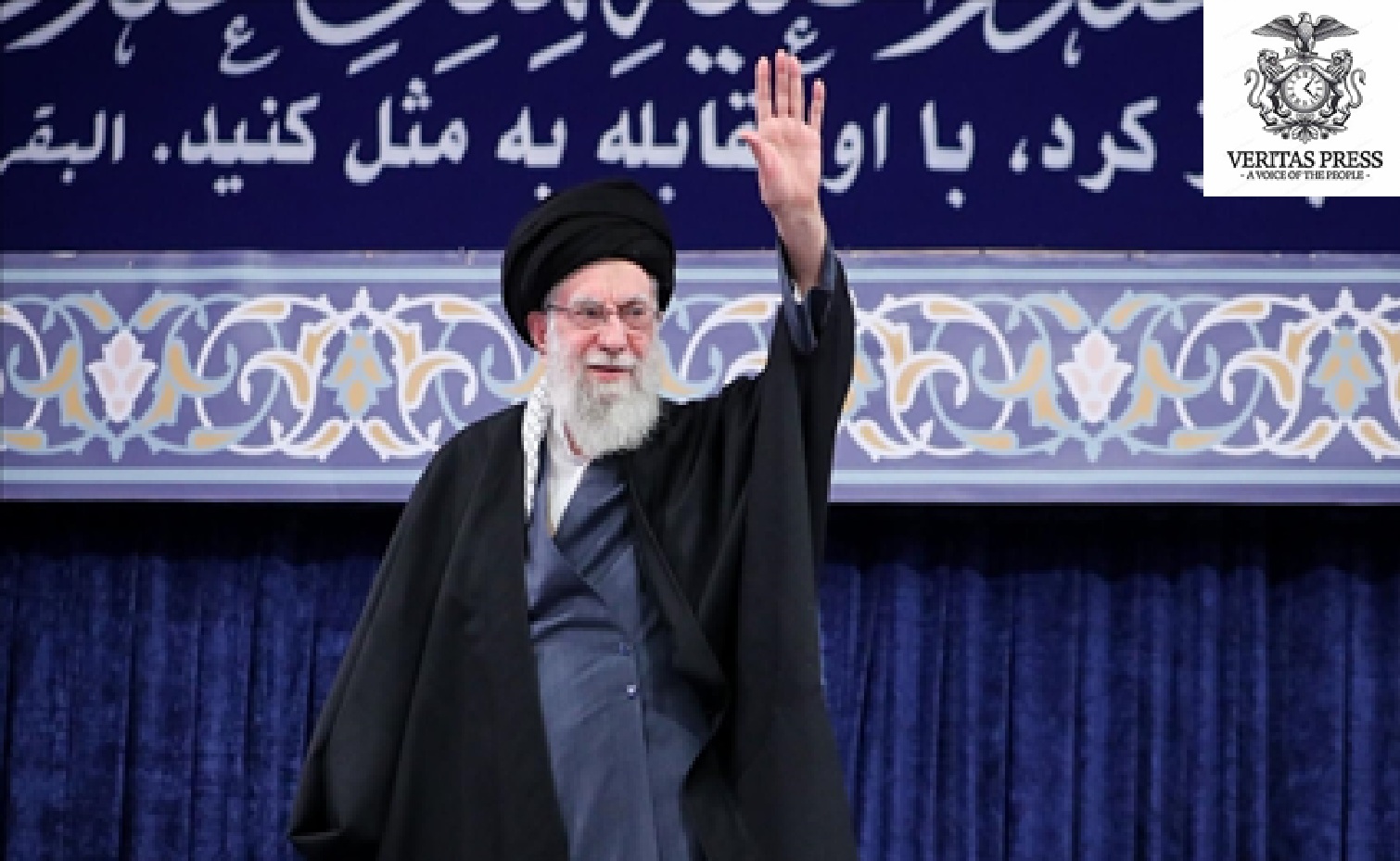
One figure was conspicuously, almost hauntingly absent from all the processions: the newly appointed Supreme Leader, Ayatollah Seyyed Mojtaba Khamenei. The Assembly of Experts had swiftly named him to succeed his father within hours of the assassination being confirmed, but he did not appear at the lying‑in‑state in Tehran, nor at the Qom ceremony, and he was nowhere to be seen in Najaf or Karbala. Officials initially explained that he was overseeing wartime command structures, but persistent leaks from within the IRGC told a more troubling story: Mojtaba had been wounded in the same 28 February strike that killed his father, and the severity of his injuries remained unknown.
That vacuum of visibility became one of the war’s most potent psychological subplots. Throughout the Iraqi funerals, mourners carried placards bearing Mojtaba’s face alongside his father’s, and Friday prayer leaders invoked his name, but the absence fed a narrative among Western and Israeli intelligence circles that the succession was fragile. Iranian dissident activists outside the country publicly speculated that Mojtaba had been incapacitated or even killed, that the clerical establishment was concealing a power struggle, and that the funeral processions were as much a legitimacy‑building exercise for an invisible Leader as a farewell to the old one.
Those rumours were finally put to rest on the evening of 7 July 2026, the eve of the four‑month anniversary of the assassination, when Mojtaba Khamenei appeared in a pre‑recorded, 22‑minute televised address from the Imam Reza shrine complex in Mashhad. Seated, with his left hand resting on a walking cane and his face partially shadowed, the new Supreme Leader spoke in measured tones. “My father’s blood watered the tree of resistance,” he said, “and today that tree’s branches stretch from Najaf to Sanaa, from Karbala to the occupied territories. The enemy thought that by martyring the shepherd, the flock would scatter. They see now that the flock has become a mighty ocean.” He announced that his father’s burial chamber in Mashhad would be opened for public visitation “in the tradition of the Imams,” effectively creating a new site of pilgrimage.
The speech, while revealing that Mojtaba was alive and functionally in command, did not entirely dispel questions. Analysts at the Washington Institute for Near East Policy noted the cane, the seated position, and the absence of any live interaction. A European intelligence assessment shared with allies in June 2026, a copy of which was reviewed by this reporter, concluded that Mojtaba “likely sustained spinal or lower‑limb injuries” and “remains dependent on a small circle of IRGC and office staff, raising the prospect of a collective leadership model in which the Supreme Leader’s office is diluted in favour of the military‑security apparatus.” The Najaf‑Karbala funerals, held while the new Leader was still convalescing, thus take on a deeper significance: they were not only a display of regional reach but also a surrogate for the physical presence the new Supreme Leader could not yet project.
The 40‑Day War And The Funeral’s Strange Ceasefire:
The funerals in Iraq unfolded amid what one senior IRGC commander later described as “the most intense bombardment of our homeland in history.” The US‑Israeli “40‑day war” had begun with the 28 February decapitation strike and escalated into a full‑scale air and missile campaign against Iranian nuclear, military, and infrastructure targets. Israel struck repeatedly at IRGC bases in western and southern Iran; the US Navy and Air Force pounded coastal defence systems and missile production sites. Iran retaliated with waves of ballistic missiles, one‑way attack drones, and coordinated cyber‑attacks, while Hezbollah opened a northern front against Israel and Yemen’s Houthis intensified strikes on Red Sea shipping.
Amid this conflagration, the funeral processions from 2 to 5 March came to be protected by what multiple sources on both sides of the conflict describe as a de facto pause. Interviews with two retired US military officers familiar with the targeting decisions of the period indicate that the Biden administration, still in office during what became its final foreign‑policy crisis, made a deliberate choice to avoid strikes on Iraq during the funeral days. “There was no formal ceasefire, but there was a clear stand‑down order for anything that might hit the Najaf‑Karbala corridor,” said one former CENTCOM planner, speaking on condition of anonymity. “It was a pragmatic calculation: hit the funeral and you create 200 million martyrs. Miss the window and the strategic message that Khamenei was dead might still sink in.” Israeli intelligence, meanwhile, assessed that striking the procession would unify the Shia world in a way even the assassination had not, and reportedly recommended restraint.
This tacit, undeclared holiday from bombing allowed the entire Iraqi spectacle to be broadcast live across the globe, its images of orderly, mass devotion under the golden domes beamed onto screens from Lagos to Lahore. Iranian state television masterfully edited the footage with orchestral scores and drone shots that made the crowds appear infinite. The psychological effect inside Iran, according to post‑war social surveys conducted by the Iranian Students’ Polling Agency (a body with links to the regime but not wholly devoid of methodological rigour), was to rally public sentiment behind the leadership. A poll taken in late March found that 78% of respondents approved of Mojtaba Khamenei’s succession, up from 52% when his name was first floated in the days after the assassination. Many Iranians who had been protesting economic conditions in 2025 told researchers that the war had “united the nation against the foreign aggressor.”
The Local Voices: Faith, Fear, And Politics.
Not all Iraqi voices were celebratory. In the back alleys of Najaf’s old city, away from the television cameras, small groups of young men watched the processions with sullen detachment. “It’s a show of force by the militias, not by the people,” said Ahmed, a 24‑year‑old university graduate and self‑described secular activist who refused to give his full name. “The Hashd controls these crowds. You can’t attend when your neighbourhood is run by a faction.” Tensions between the formal Iraqi state and the armed factions had been rising for months before the war, and the funeral temporarily papered over those fractures. Several Sunni political leaders, including the Speaker of Parliament, issued pro forma condolences but pointedly did not travel to Najaf. A Sunni cleric in Mosul, Sheikh Younis al-Hayali, said in a Friday sermon, “We honour the dead, but Iraq must not become a theatre for foreign funerals forever. We have our own martyrs.”
Human rights organisations, monitoring the war from outside, raised concerns that the funeral numbers were being inflated to coerce national unity. Amnesty International, in a report released on 20 June 2026 entitled “Grief as Governance: Crowd Mobilisation and Coercion in Post‑Khamenei Iraq,” documented accounts of government employees in several southern provinces being told that attendance was “a national duty” and that absenteeism on the public holiday would be noted in personnel files. The report did not allege widespread force, but it painted a picture of a state apparatus and allied militias applying “pervasive soft coercion.” Hashd officials dismissed the report as “a Zionist fabrication”, a dedicated psy-op.
Yet the genuine, voluntary dimension was equally impossible to deny. The Arbaeen‑style infrastructure, the volunteer mowkebs (service stations), the families opening their homes to strangers, the ritualised weeping drew upon a deep well of Shia religious tradition that cannot be manufactured by security agencies alone. “When I saw the coffin, I forgot everything, the prices, the electricity cuts, the corruption,” said Fatima, a 60‑year‑old from Basra, tears streaking her black chador. “This man stood against the enemies of Hussein. Now he is with Hussein.” The conflation of Khamenei with the Imams is theologically problematic in orthodox Shia Islam, but among millions of devout grassroots believers, the boundaries had long since blurred under decades of revolutionary propaganda and genuine battlefield solidarity against ISIS and the US occupation.
The Aftermath: A Truce, A New Leader, And A Region Reshaped.
By early April 2026, the 40‑day war had run its catastrophic course. The formal end came with the Muscat Agreement, brokered by Oman and quietly endorsed by China and Russia, which froze hostilities in place. Iran sustained devastating damage to its nuclear infrastructure, losing the Fordow and Natanz enrichment halls to bunker‑buster munitions, and an estimated 45,000 military and civilian casualties. Israel suffered roughly 2,000 dead, mostly from ballistic missile strikes on Tel Aviv and Haifa, and significant damage to its gas platforms. US forces took casualties in Iraq and Syria but avoided the mass‑casualty events that would have pulled ground troops into the maelstrom. No side claimed victory, but each spun the outcome in its favour.
In Iran, the Muscat Agreement became the backdrop for Mojtaba Khamenei’s consolidation. His July 7 address accompanied a limited cabinet reshuffle that placed hardline security officials in key economic ministries, signalling a shift toward a “garrison state” model. The funeral processions were retrospectively re‑framed as the foundational myth of his rule, the moment when the umma (the Islamic community) affirmed its loyalty not just to a man but to the velayat‑e faqih (Guardianship of the Jurist) as an institution. In Mashhad, construction began immediately on a vast extension to the Imam Reza shrine complex to house the “Martyred Leader’s Mausoleum,” with a capacity designed to rival that of Imam Hussein’s shrine.
In Iraq, the funeral deepened the entanglement. The Hashd al-Shaabi emerged with enhanced prestige and, according to sources in Baghdad, extracted concessions from al-Sudani’s government, including permanent control over key border crossings with Iran and a greater share of the defence budget. The United States, which still maintains around 2,500 troops in Iraq, found its position more precarious than ever. In May 2026, the Iraqi parliament, riding a post‑funeral wave of pro‑Axis sentiment, passed a non‑binding resolution calling for the withdrawal of all foreign forces, a repeat of the 2020 vote after the assassination of Qasem Soleimani, but this time backed by a broader coalition.
Washington’s response has been mixed. The Biden administration, in its final months, sanctioned several Hashd leaders but refrained from escalating militarily. The incoming administration of President Sarah Huckabee Sanders, inaugurated in January 2027, has signalled a harder line by designating the Popular Mobilisation Forces in its entirety as a Foreign Terrorist Organisation in April. By July 2027, the region was settling into a new, tense equilibrium: Iran rebuilding under a crippled but hardened leadership, Israel maintaining a shadow war against Iranian proxies, and Iraq trapped in the middle.
The War Crimes Inquiry And The Funeral’s Shadow:
One of the most significant developments in July 2026 was the release of a preliminary report by the United Nations Independent International Commission of Inquiry on the 40‑Day War, published on 7 July, coinciding almost precisely with Mojtaba’s address. The report, delivered to the Human Rights Council in Geneva, concluded that the US-Israeli strike that killed Khamenei “may constitute the war crime of killing a protected person under the principles of distinction and proportionality, given the presence of civilians, including children, in the compound and the far‑reaching consequences of destabilising the leadership of a sovereign state.” The report was not legally binding, and the United States and Israel immediately rejected its findings as politically motivated, but its timing added a moral complexity to the narrative of the funeral. For millions of mourners who had walked the Arbaeen road, the UN’s words were a belated vindication. “You see? Even the world admits it was a crime,” said Jassim, a shopkeeper near the Karbala shrine who had hosted mourners in his home. “This funeral was not just for us; it was for history to witness.”
The Commission’s report also documented the funeral processions themselves, noting that while the gatherings were largely peaceful, the “pervasive presence of armed Hashd al-Shaabi elements and the widespread use of loudspeaker propaganda may have created an environment incompatible with the full exercise of free assembly rights.” Iranian and Iraqi officials dismissed the passage as a footnote.
The Analytical Verdict: The Funeral That Changed The Calculus.
Interviews with more than two dozen officials, analysts, and participants conducted between March and July 2026 paint a complex picture. The funeral in Najaf and Karbala was simultaneously a genuine mass expression of religious and political identity, a meticulously organised state‑militia operation, and a piece of strategic communication as powerful as any missile volley.
“At one level, the numbers are inflated, the coercion is real, the politics are instrumental, but at another level, the symbolism worked because there is a deep truth under it,” said Dr. Hayder al-Khoei, a Chatham House researcher and Najaf native, in an interview in May. “When people see the coffin of the Leader being carried down the same path where Imam Hussein’s martyrdom is mourned, it activates an archetype that the security services cannot invent. The US‑Israeli strike inadvertently supplied the Axis with a martyr narrative more potent than anything it had scripted in decades.”
That narrative comes at a cost. In the months since, Iraq has seen a steady exodus of its remaining secular middle class, with thousands of professionals applying for asylum in Europe, citing a climate of religious-political militancy that the funeral both reflected and accelerated. The Iraqi dinar has depreciated, and the very political divisions stall reconstruction from the war, the funeral temporarily obscured.
As of July 2026, the mausoleum in Mashhad was nearing completion, its gold‑trimmed dome visible from the outskirts of the holy city. Pilgrim buses already run from Najaf and Karbala to the new shrine, a route that now inscribes the political map of the Axis of Resistance onto the sacred geography of Shia Islam. In Karbala, a billboard erected by a Hashd faction still stands near the Abbas shrine, showing a composite image of Imam Hussein and Ayatollah Khamenei above the words: “Two Ships, One Sea.” It is, depending on one’s vantage point, a statement of sublime faith or of deep occupation. What nobody can deny is that in early March, for a few days, the sea covered everything.
Source:Veritas Press C.I.C. | Multi News Agencies
Help Support Our Work By Donating
Popular Information is powered by readers who believe that truth still matters. When just a few more people step up to support this work, it means more lies exposed, more corruption uncovered, and more accountability where it’s long overdue.
Help Protect Independent Journalism, Which Is Currently Under Attack.
If you believe journalism should serve the public, not the powerful, and you’re in a position to help, becoming a DONOR or a PAID SUBSCRIBER truly makes a difference.
DONATION APPEAL: If You Found This Reporting Valuable, Please Consider Supporting Independent Journalism.
Your support fuels our fearless, truth-driven journalism. In unity, we endeavour to amplify marginalised voices and champion justice, irrespective of geographical location. We operate independently, without any financial backing from billionaires.
But it’s also extremely important. One of Veritas Press’s greatest assets is its reader-funded model.
1. Reader funding means we can cover what we like. We’re not beholden to the political whims of a billionaire owner. We are a small, independent and impartial organisation. No one can tell us what not to say or what not to report.
2. Reader funding means we don’t have to chase clicks and traffic. We’re not desperately seeking your attention for its own sake: we pursue the stories that our editorial team deems important and believes are worthy of your time.
3. Reader Funding: enables us to keep our website and other social media channels open, allowing as many people as possible to access quality journalism from around the world, particularly those in places where the free press is under threat.
We know not everyone can afford to pay for news, but if you’ve been meaning to support us, now’s the time.
Your donation goes a long way. It helps us:
Keep the lights on and sustain our day-to-day operations
Hire new, talented independent reporters
Launch real-time live debates, community-focused shows, and on-the-ground reporting
Cover the issues that matter most to our communities, in real time, with depth and integrity
We have plans to expand our work, but we can’t do it without your support. Every contribution, no matter the size, helps us stay independent and build a truly people-powered media platform.
If you believe in journalism that informs, empowers, and reflects the communities we serve, please donate today.
Submissions:
For The Secure Submission Of Documentation, Testimonies, Or Exclusive Investigative Reports From Any Global Location, Please Utilise The Following Contact Details For Our Investigations Desk: enquiries@veritaspress.co.uk or editor@veritaspress.co.uk
Kamran Faqir is a volunteer investigative journalist and writer committed to exposing hidden truths and amplifying underreported stories. Driven by social justice, he brings sharp insight and fearless truth-telling to independent journalism. NUJ registered.
SEATTLE, TEHRAN — The U.S. Department of Homeland Security (DHS) will allow Iran’s national football team to enter the country 48 hours before their critical World Cup match against Egypt on Friday, a modest concession in a tournament where Team Melli’s travel conditions have sparked claims of oppression and competitive disadvantage.