Kamran Faqir is a volunteer investigative journalist and writer committed to exposing hidden truths and amplifying underreported stories. Driven by social justice, he brings sharp insight and fearless truth-telling to independent journalism. NUJ registered.
Listen to this article
Help support our mission, donate today and be the change. Every contribution goes directly toward driving real impact for the cause we believe in.
Article Date Published:
Article Date Modified:
11 minutes
Post Views:48
Exclusive videos and witness accounts expose how Iranian missiles, drones, and F-5 fighter jets overwhelmed Camp Buehring, leaving American forces critically low on ammunition and raising questions about why no reinforcements came.
KUWAIT — Newly obtained footage and exclusive witness accounts have exposed the chaotic and humiliating withdrawal of American forces from Camp Buehring, a major US military installation in Kuwait, after sustained Iranian missile and drone attacks during the opening days of the US-Israeli war of aggression against Iran.
The revelations, first reported by CBS News on Wednesday, paint a devastating picture of American vulnerability in the face of Iran’s retaliatory operations, a narrative that contradicts the Pentagon’s carefully managed public messaging and raises serious questions about US military readiness, logistical failures, and the human cost of a war that officials in Washington and Tel Aviv appear to have badly miscalculated.
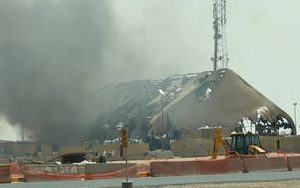
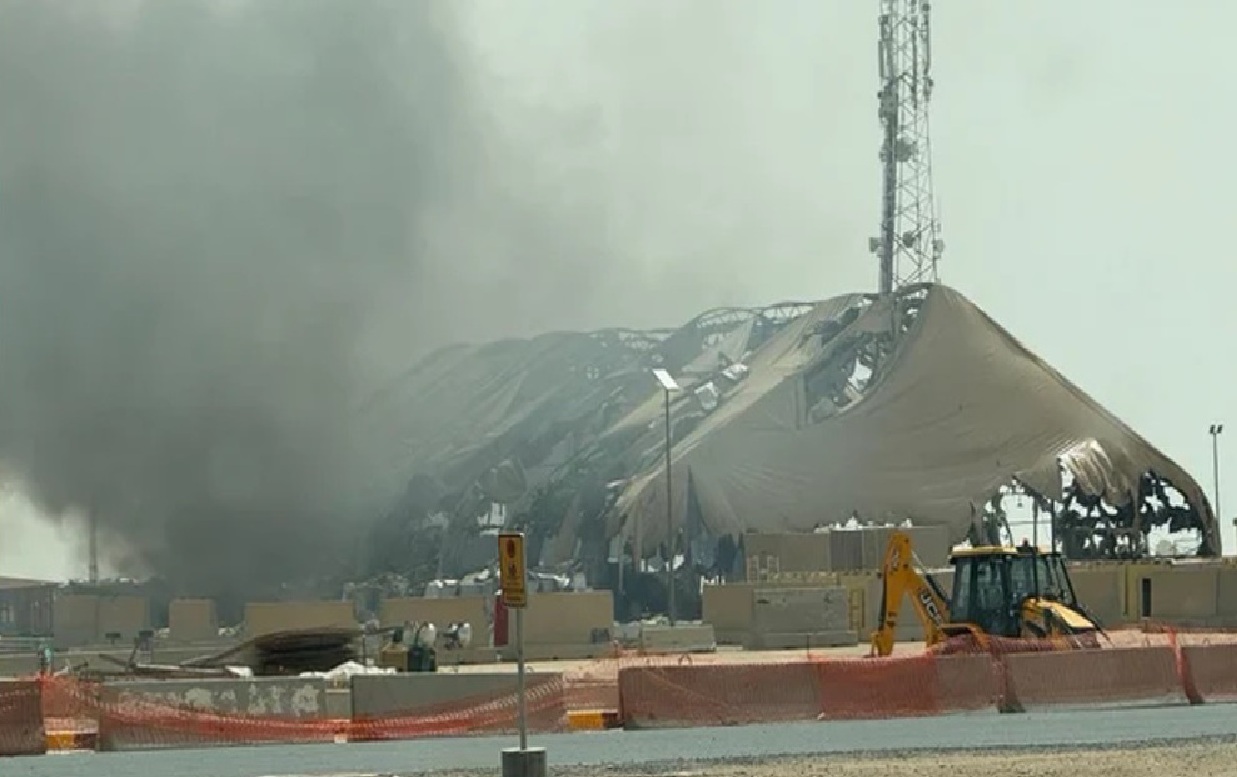
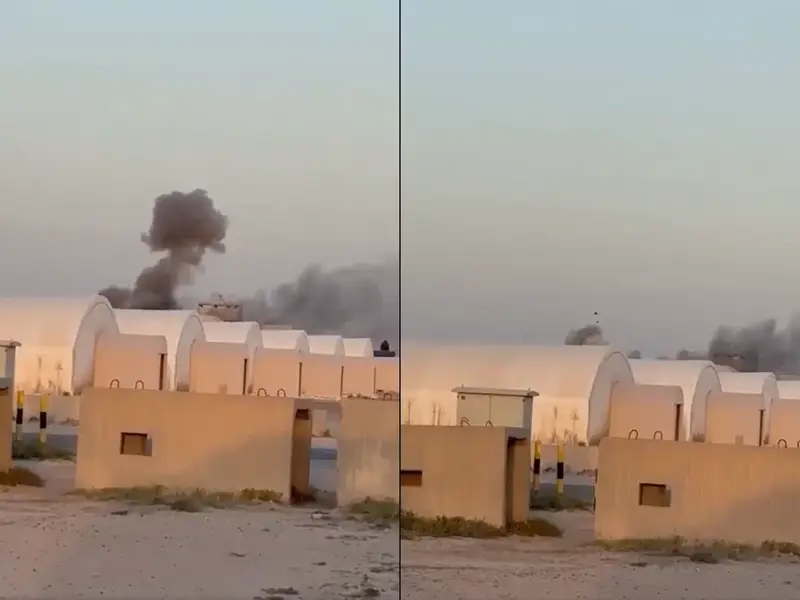
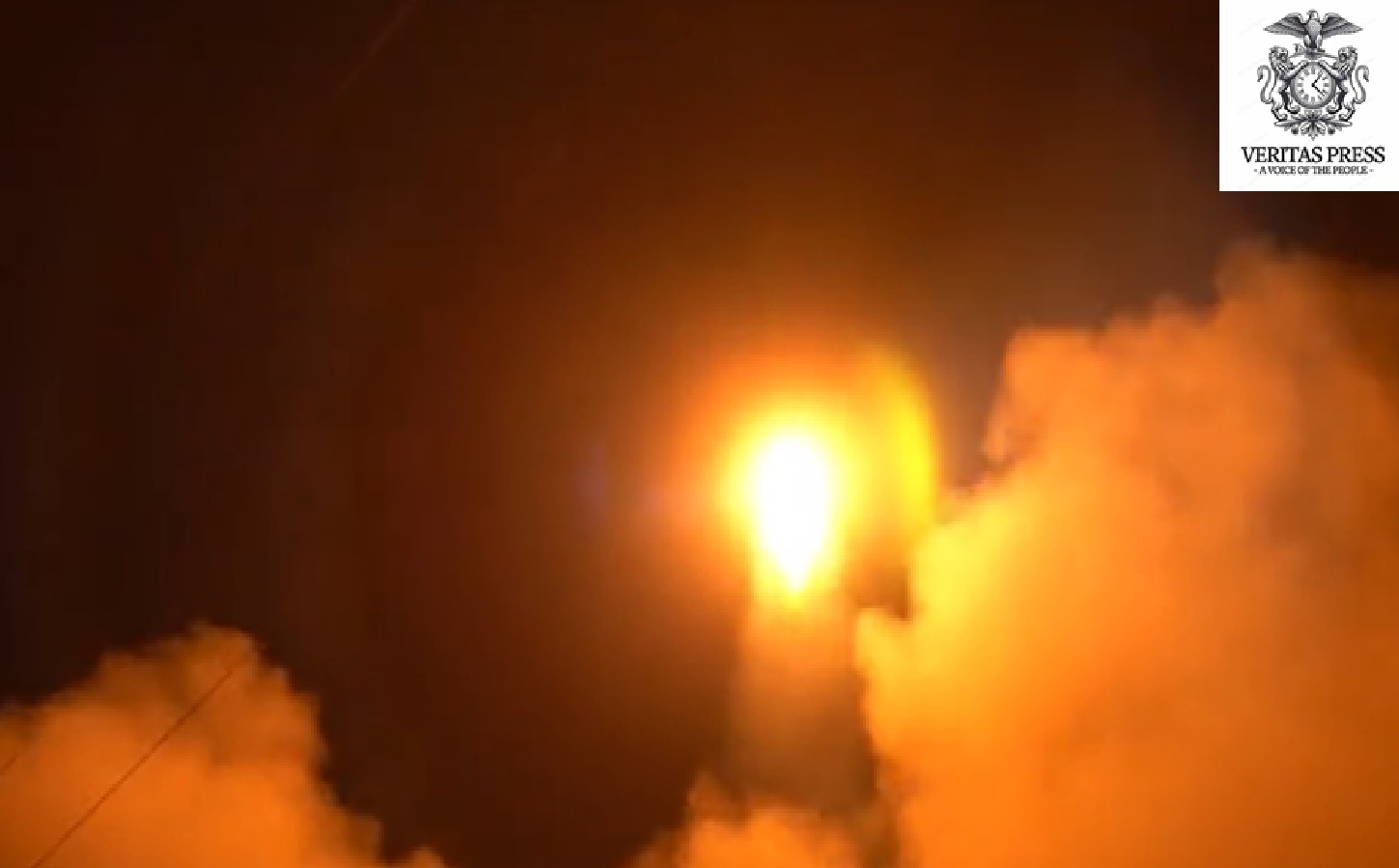
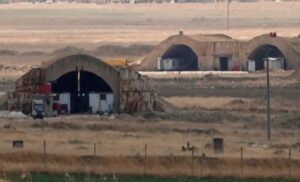
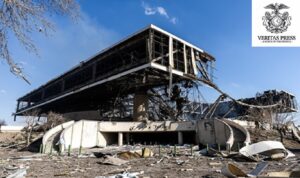
Aftermath of Iranian strike on Camp Buehring, Kuwait. (Photo by CBS)
‘It Was Horrible’: Troops Describe Abandonment
According to CBS News, which authenticated exclusive footage recorded by personnel stationed at the base using metadata embedded in the files, Iranian ballistic missiles and drones struck Camp Buehring, known militarily as CBKU, repeatedly during the first days of the conflict, forcing American troops into bunkers and ultimately driving them out of the installation entirely.
“They hit us bad,” an unnamed service member told CBS News. “It was horrible. There were a lot of brave guys who stayed to fight there, and people at home don’t know what happened. We had to abandon the base.”
The footage shows explosions rocking the installation, with visible damage to buildings and military equipment scattered across the base. The videos offer a rare, unvarnished look at the failure of US air defences to protect one of its most strategically significant staging grounds in the Middle East.
‘I Could See Their Helmets’: Iranian F-5 Jets Penetrate US Defences
In perhaps the most startling revelation, three of US service members who witnessed the attacks told CBS News that Iranian F-5 fighter jets participated in the operations against Camp Buehring, a detail previously reported by NBC News but now confirmed by multiple eyewitnesses.
“They ran so close to us I could see their helmets,” one eyewitness recounted. “They came in, they hit us, and then took off.”
The involvement of Iranian F-5 jets, ageing aircraft that nonetheless penetrated what should have been a fortified air defence perimeter, underscores the failure of US defensive systems and the boldness of Iran’s military response. The fact that American troops could visually identify Iranian pilots’ helmets speaks to how close the aircraft came to the base, raising questions about why US air defences failed to intercept them.
Critical Ammunition Shortages Exposed
The attacks laid bare severe logistical failures within the US military apparatus. According to the report, soldiers defending Camp Buehring ran critically low on .50-caliber ammunition while lacking the capability to handle a mass-casualty event if the attacks had continued.
A senior US Army logistics official, who managed operations from another location in Kuwait, confirmed to CBS News that there were serious concerns about the availability of .50-caliber ammunition and other high-value munitions, including Patriot missile batteries, the very systems designed to intercept incoming missiles.
The Pentagon ultimately decided to evacuate the remaining troops. Service members packed up whatever equipment they could load onto vehicles and drove at night deep into the Kuwaiti desert, where they established temporary forward operating bases (FOBs), effectively ceding one of America’s most important regional installations to Iranian firepower.
‘CBKU Got Demolished’: Calls For Investigation
The service member who spoke anonymously questioned why reinforcements were never sent as the attacks intensified, demanding accountability from military leadership.
“CBKU got demolished,” the source said. “They need to do an investigation. How come no one came to reinforce us?”
The question cuts to the heart of a broader critique: How did the world’s most powerful military find itself unable to defend, or reinforce, a base housing thousands of troops against an adversary it had supposedly spent decades preparing to counter?
Iran war: New videos show Iranian attacks on major US base in Kuwait Photograph: (Screenshots/X video)
Most of the approximately 7,000 troops stationed at Camp Buehring had already been moved elsewhere before the war began as part of what the Pentagon called its “get off the X” strategy, a tacit admission that US planners anticipated Iran’s retaliation and sought to minimise casualties by dispersing forces. According to Defence Secretary Pete Hegseth’s March comments, more than 90% of American troops stationed at US bases had been moved out of the range of Iranian fire.
But more than 100 soldiers remained at Camp Buehring, left exposed and under-equipped as Iranian attacks intensified.
The Broader War Context: A Litany Of US-Israeli Aggression
The US and Israel launched what many international legal scholars have characterised as an illegal war of aggression against Iran on February 28, 2025. The conflict, which began with airstrikes targeting Iranian nuclear facilities and military infrastructure, was met with immediate and devastating Iranian retaliation across the region.
Forty days later, on April 8, the enemies were forced to accept a ceasefire amid Iran’s resistance, successful retaliatory operations, and a powerful grip on the Strait of Hormuz, the strategic chokepoint through which roughly 20% of global oil passes.
But the ceasefire proved fragile. In July, the US conducted waves of deadly air raids on Iran and imposed a naval blockade of the country, in direct violation of the Islamabad Memorandum of Understanding (MoU) with the Islamic Republic, signed on June 17, to end the war. In response, the Iranian armed forces launched devastating strikes against strategic American targets across West Asia and declared the Strait of Hormuz closed to all traffic.
The Camp Buehring footage emerged amid growing scrutiny of the true scale of US military losses. A Defence Department inspector general report released last month identified equipment losses worth as much as $3.7 billion, including nearly 60 aircraft. The Congressional Research Service subsequently reported that 81 fixed-wing and rotary-wing aircraft, including drones, had been lost or damaged by Iran since February, citing news reports and Defence Department statements.
The inspector general’s report also confirmed that US Central Command had recorded Iranian strikes against American bases in Kuwait, Bahrain, Qatar, the UAE, Saudi Arabia, Iraq, Oman, and Jordan, a region-wide assault that demonstrated Iran’s reach and the vulnerability of US force posture.
Regional Reactions: ‘A Humiliation For Washington’
The revelations have sent shockwaves through regional capitals and among military analysts.
“This is a humiliation for Washington,” said Dr. Farah Al-Nasr, a Kuwait-based security analyst who spoke to this publication on condition of anonymity due to the sensitivity of the subject. “The United States spent trillions of dollars building a military presence in the Gulf, and Iran, a country under decades of sanctions, forced them to abandon a major base. The psychological impact cannot be overstated.”
An Iranian military official, speaking to state media on condition of anonymity, described the Camp Buehring operation as “a demonstration of Iran’s precision-strike capabilities and the failure of American air defences.”
“The enemy thought they could attack our homeland without consequence,” the official said. “We showed them that no base, no matter how fortified, is beyond our reach. The Americans ran. That is the truth they are trying to hide.”
‘People At Home Don’t Know What Happened’
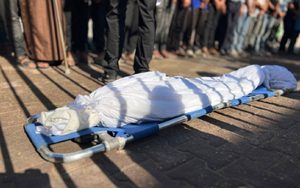
The human dimension of the Camp Buehring withdrawal remains largely obscured. US officials with knowledge of the matter said no one was killed at the base or at the forward operating bases, but several were injured, including two soldiers who were struck by lightning in desert sandstorms while hunkered down in makeshift positions.
Yet the psychological toll on troops who witnessed the abandonment of their base, who ran low on ammunition, who saw Iranian jets screaming overhead, and who questioned why reinforcements never came, that toll remains unmeasured.
“People at home don’t know what happened,” the anonymous service member said. “We had to abandon the base.”
Legal and Strategic Implications
International legal experts have raised questions about the legality of the US-Israeli war and the consequences of the Camp Buehring withdrawal.
“The fact that Iran was able to force the evacuation of a major US base raises profound questions about the legality and wisdom of this entire war,” said Dr. Michael Brennan, a professor of international law at the University of Edinburgh, speaking to this publication. “The US and Israel launched an aggressive war against Iran, a clear violation of the UN Charter. Iran’s retaliation was an act of self-defence under Article 51. The fact that American troops were forced to flee is a direct consequence of that illegal aggression.”
The Pentagon has not responded to requests for comment on the CBS News report or the specific allegations raised by service members.
Conclusion: A War Of Miscalculation
The Camp Buehring revelations offer a window into a war that US and Israeli planners appear to have badly miscalculated. They expected a quick, decisive campaign against Iran. Instead, they got a protracted conflict in which Iranian forces demonstrated the ability to strike US bases across the region, close the Strait of Hormuz, and force the abandonment of a major military installation.
For the roughly 100 troops who stayed behind at Camp Buehring, who ran low on ammunition, who saw Iranian jets up close, and who ultimately fled into the desert, the war was not a distant geopolitical chess match. It was a terrifying, chaotic, and humiliating experience, one they believe the American public has not been allowed to see.
“CBKU got demolished,” one source said. “They need to do an investigation.”
That investigation, if it ever comes, may reveal more than just the failure to defend a base. It may expose the failure of an entire strategy, and the human cost of a war built on hubris, miscalculation, and a fundamental misunderstanding of Iran’s capabilities and resolve.
Veritas Press Investigative Analysis Independent journalism examining global affairs, power, diplomacy, and accountability.
Source:Veritas Press C.I.C. | Multi-News Agencies
Help Support Our Work
Readers who believe that truth still matters have power over popular information. When just a few more people step up to support this work, it means more lies exposed, more corruption uncovered, and more accountability where it’s long overdue.
Help Protect Independent Journalism, Which Is Currently Under Attack.
If you believe journalism should serve the public, not the powerful, and you’re able to help, becoming a regular DONOR or a PAID SUBSCRIBER truly makes a difference.
DONATION APPEAL: If you found this reporting valuable, please consider supporting independent journalism.
Your support fuels our fearless, truth-driven journalism. In unity, we endeavour to amplify marginalised voices and champion justice, irrespective of geographical location. We operate independently, with no financial backing from billionaires; our readers support us.
But it’s also extremely important. One of Veritas Press’s greatest assets is its reader-funded model.
1. Reader funding means we can cover what we like. We’re not beholden to the political whims of a billionaire owner. We are a small, independent and impartial organisation. No one can tell us what not to say or what not to report.
2. Reader funding means we don’t have to chase clicks and traffic. We’re not desperately seeking your attention for its own sake; we pursue the stories that our editorial team deems important and believes are worthy of your time.
3. Reader Funding: enables us to keep our website and other social media channels open, allowing as many people as possible to access quality journalism from around the world, particularly those in places where the free press is under threat.
We know not everyone can afford to pay for news, but if you’ve been meaning to support us, now’s the time.
Your donation goes a long way. It helps us:
Keep the lights on and sustain our day-to-day operations
Hire new, talented, independent reporters
Launch real-time live debates, community-focused shows, and on-the-ground reporting
Cover the issues that matter most to our communities, in real time, with depth and integrity
Without your support, independent voices like ours will be silenced.
Furthermore, we have plans to expand our work, but we can’t do it without your support. Every contribution, no matter the size, helps us stay independent and build a truly people-powered media platform.
If you believe in journalism that informs, empowers, and reflects the communities we serve, please donate today.
Kamran Faqir is a volunteer investigative journalist and writer committed to exposing hidden truths and amplifying underreported stories. Driven by social justice, he brings sharp insight and fearless truth-telling to independent journalism. NUJ registered.
SEATTLE, TEHRAN — The U.S. Department of Homeland Security (DHS) will allow Iran’s national football team to enter the country 48 hours before their critical World Cup match against Egypt on Friday, a modest concession in a tournament where Team Melli’s travel conditions have sparked claims of oppression and competitive disadvantage.