

Author:
Help support our mission, donate today and be the change. Every contribution goes directly toward driving real impact for the cause we believe in.
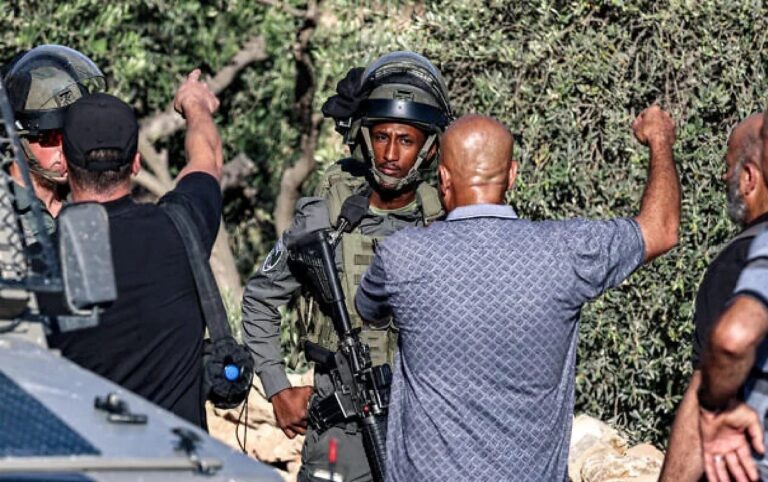
EAST JERUSALEM – The raid began without warning, as they always do. At 8:20 on a Tuesday morning, as pupils at the Al-Shabbat Al Muslamat school in occupied East Jerusalem were settling into their first lessons, Israeli police and security personnel pushed through the main gate. At their centre strode Tzvi Succot, the far-right Knesset member who chairs the Israeli parliament’s Education Committee. He did not knock. He did not present an inspection warrant. He walked the corridors flanked by armed officers, entered classrooms, and began pulling books, posters, and laminated teaching aids from walls and shelves.
Israeli far-right MK Succot raids Palestinian schools in Jerusalem and beyond, confiscating materials and threatening closure over Palestinian identity in classrooms.
“These are materials of incitement,” Succot told the headteacher, according to a teacher who was present and spoke to us on condition of anonymity for fear of reprisal. Among the offending items police placed into evidence bags that morning were a map of historic Palestine, a portrait of the late Palestinian poet Mahmoud Darwish, and a small Palestinian flag pinned to a noticeboard. “The party is over,” Succot announced as he left. “Anyone who incites to terror must be shut down immediately.”
The school, which serves 600 girls and is administered by the Jerusalem Islamic Waqf, now faces a closure order. Its “crime,” in Succot’s framing, is not violence or incitement to it: the confiscated materials include no calls to arms. The crime is teaching Palestinian children who they are.
The Chairman And His Mission:
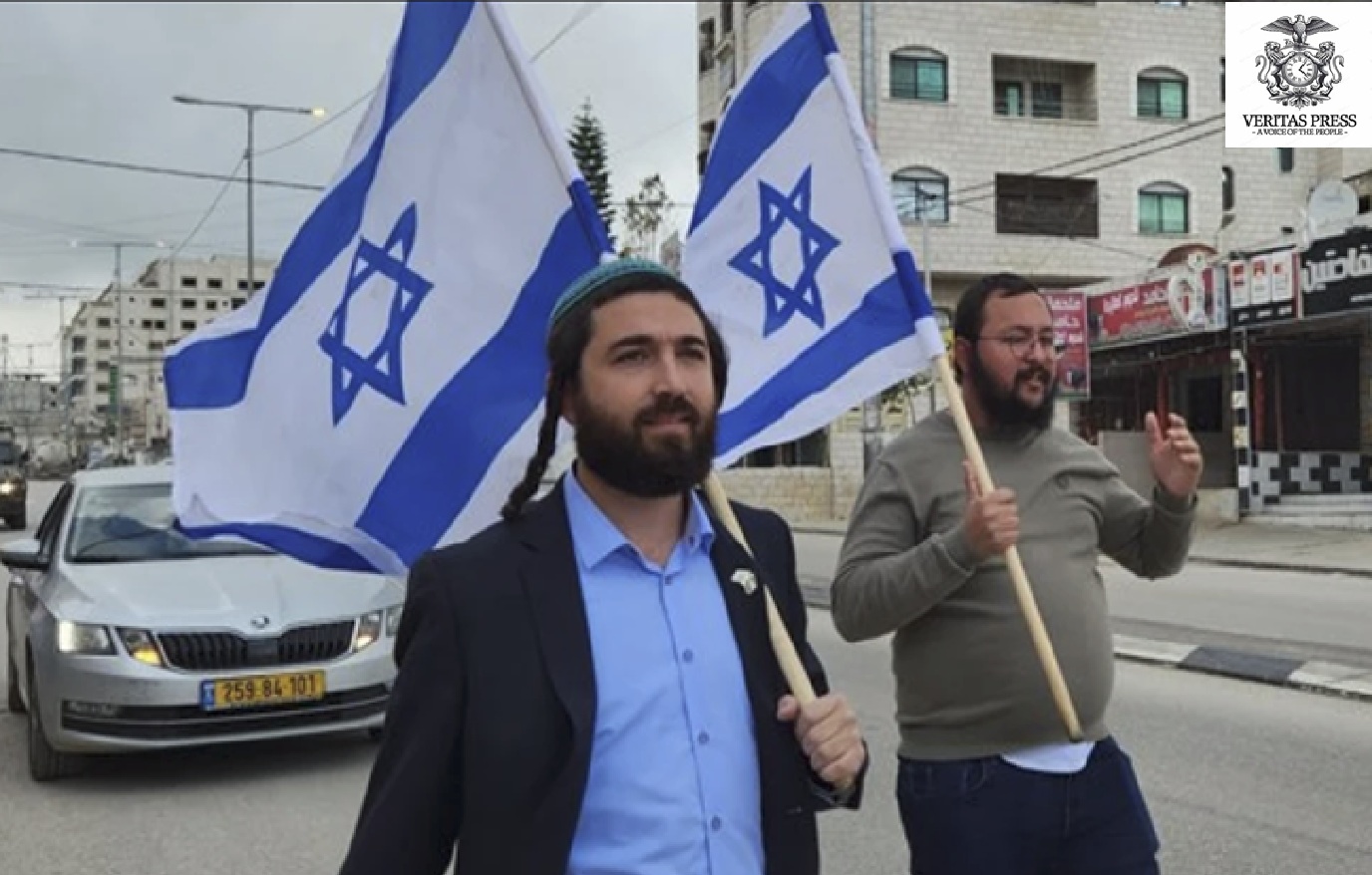
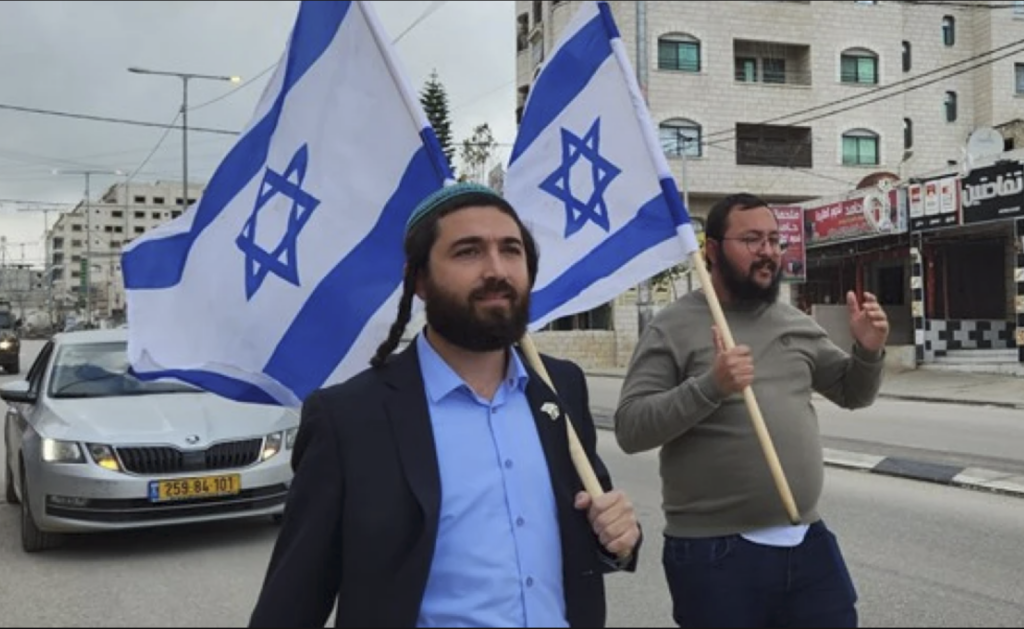
Tzvi Succot, 35, a settler from the ethnonationalist outpost of Havat Gilad in the northern West Bank, is not a figure who operates quietly. A member of the ethno-Zionism party and a disciple of the late extremist rabbi Meir Kahane’s ideological heirs, Succot was handed the gavel of the Knesset Education Committee in early 2024 as part of the coalition deals that brought Benjamin Netanyahu’s government back to power. Since then, he has transformed a parliamentary oversight body into an operational arm of an ideological war on Palestinian schooling.
What Succot calls “inspection visits” are unannounced incursions into schools serving Palestinian citizens of Israel, Palestinian residents of occupied East Jerusalem, and Palestinian communities in the West Bank. He has pursued these raids with intensifying frequency, arriving with police units, private security details, and, on at least one occasion, a disc saw.
His mission, he has stated repeatedly, is to eradicate the Palestinian Authority curriculum from any institution that receives a single shekel of Israeli state funding. But the material seized and the language deployed reveal a deeper objective. In school after school, the evidence bags contain not explosives, manuals or weapons glorification but the symbols of Palestinian nationhood: flags, maps, poetry, history textbooks, and images of national figures. Succot has turned the classroom into a crime scene, and the crime is identity.
“The educational institutions in Kfar Aqab receive budgets of tens of millions of shekels from the State of Israel, but in practice many of them teach students content from the Palestinian Authority that encourages incitement to terrorism,” Succot said in March 2025 after a visit to the Ruad al-Alam al-Mudajjiya school in Kafr Aqab, a Palestinian neighbourhood severed from Jerusalem by the separation wall but falling within the city’s expanded municipal boundaries. “A child who is educated against the State of Israel and studies from textbooks that encourage terrorism is the next terrorist.”
This conflation, Palestinian identity with terror, cultural expression with incitement, runs through every Succot intervention. It is not incidental. It is the engine of his campaign.
“They Locked The Gate, So He Brought A Saw”:
The disc saw entered the story in May 2024, in the Bedouin-majority village of Tuba-Zangariyye in the Galilee, inside Israel’s 1948 borders. Residents, alerted that Succot was en route with a convoy of security vehicles, locked the school gates and formed a human chain of parents and teachers at the entrance. A video filmed by a local resident and verified by this investigation shows Succot approaching the gate, then turning back to his vehicle. Moments later, a member of his security detail produces a portable cutting tool. Sparks fly as the disc bites into the metal lock. The gate swings open.
“We could not believe what we were seeing,” said Yusuf Zangariyye, a member of the local council, speaking by telephone this month. “This is a school, not a military compound. He came with the police to break into a place where our children learn. Because we teach them Arabic. Because we have a Palestinian flag on the wall. In Israel, we are not allowed to be Palestinian. He wants to finish even the memory.”
Succot later defended the incident, telling Army Radio that the locked gate was “proof that they have something to hide.” He insisted the school was “poisoning the minds of Arab children against the state” and repeated his signature line: “The party is over.”
The Tuba-Zangariyye raid was a turning point. Until then, Succot’s campaign had received sporadic coverage. The image of an elected official, chairman of the parliamentary committee charged with safeguarding education, using a power tool to breach a school gate, forced Israeli society to look. The outcry from Arab MKs and a handful of Jewish opposition figures was loud but brief. The coalition stood by him. Prime Minister Netanyahu’s office declined to comment. Within weeks, Succot was back on the road.
“They Threw Stones Because He Invaded Their School”:
Not every community has responded to Succot’s incursions with locked gates and disc saws. In Kafr Aqab, on the morning of 13 March 2025, the arrival of Succot’s delegation triggered a more visceral reaction. As the MK and his security phalanx entered the Ruad al-Alam al-Mudajjiya compound, a crowd of local youths gathered outside. Stones arced over the perimeter wall. No injuries were reported. Israeli media headlines framed the incident as “MK Tzvi Succot Targeted During Visit to Arab School.” Succot himself was quick to instrumentalise the attack. “You see?” he said into a cluster of cameras, gesturing toward the masonry dust. “This is what they learn. Violence. We came to inspect their books, and they threw stones. This is the curriculum.”
Residents of Kafr Aqab describe a different sequence of events. “He didn’t call ahead. He didn’t coordinate. He came with armed men into a girls’ school,” said Umm Mohammed, a mother of three pupils at the school, sitting in her living room a few streets from the now-barricaded gates. “The children were terrified. They saw police and guns in their classroom. They started screaming. So the young men outside heard the screaming, and they threw stones. Not because they hate Jews. Because their sisters were inside. What would any brother do?”
“He Calls It A Visit,” She Added. “We Call It An Occupation Raid.”
Kafr Aqab’s administrative status is a jurisdictional ghost. Formally within Jerusalem’s municipal boundaries since Israel’s unilateral expansion after 1967, its 100,000 Palestinian residents hold Israeli-issued blue ID cards but receive virtually no municipal services. The road to the rest of the city runs through a checkpoint. Schools in Kafr Aqab are technically entitled to Israeli Ministry of Education funding, but for decades, they have navigated a grey zone, teaching a hybrid of PA and Israeli-approved curricula. Succot’s new enforcement drive has collapsed that ambiguity. Last month, the Education Ministry, following a recommendation from Succot’s committee, froze all funding to nine schools in Kafr Aqab. The letter cited “curricular deviation” and “hostile symbolic content.” Translated: Palestinian flags.
What Counts As “Incitement”? A Forensic Look:
For more than a year, this investigation has been collecting and examining photographs of the materials Succot’s raids have confiscated or cited as justification for closure orders. The pattern is striking.
At a school in the village of Al-Lubban Al-Sharqiya, south of Nablus in the West Bank, Succot stormed a classroom during a lesson in January 2025. He removed a wall poster showing a key, the symbol of the Nakba, the 1948 dispossession of 750,000 Palestinians, alongside a Palestinian flag and the words “We will return.” This, he told the media, was “unambiguous glorification of terrorism and the destruction of Israel.” When Israeli human rights group B’Tselem reviewed the photograph of the poster, it noted that neither the key nor the flag carries any inherent call to violence. “Criminalising the memory of displacement and the expression of national identity is a textbook act of repression,” the group wrote in a February 2025 statement. “It serves an ideological project, not a security need.”
At the Al-Shabbat Al Muslamat school earlier this month, police seized a second-grade Arabic reading book containing a poem about Jerusalem. The poem, by Palestinian author Ibrahim Nasrallah, describes the old city’s markets, the scent of za’atar, and the call to prayer. The Israeli police report, a copy of which has been seen by this investigation, annotates the book as “content that denies the Jewish historical connection to the land.” A lawyer from Adalah, the Legal Centre for Arab Minority Rights in Israel, who is representing the school in its appeal, responded: “By this logic, any expression of Palestinian attachment to Jerusalem is incitement. This is not a security matter. This is an effort to erase an entire people’s narrative from the classroom.”
“It’s a linguistic trap,” said Dr. Maha Abdallah, a Palestinian education researcher at the Ramallah-based Institute for Curriculum Studies. “Succot does not need to ban Palestinian history explicitly. He simply declares that it’s teaching a security offence. The word ‘incitement’ does the work of a thousand censors.”
The terminology around the flag is another deliberate linguistic choice. In official statements, Succot, the Israeli police, and compliant media outlets refer not to the “Palestinian flag” but to the “Palestinian Authority flag.” The semantic shift is designed to deny Palestinian nationhood and to recast a national symbol as the banner of an administrative entity, one that Israel has designated, in certain legal contexts, as a hostile body. A flag is thus transformed into evidence of allegiance to a terrorist-supporting organisation. For a child sitting in a classroom in Jerusalem, a drawing of that flag can become grounds for the closure of her school.
The Colonial Echo:
There is a deep historical resonance to this assault on indigenous classrooms, and it is no accident. Every colonial power that has sought to absorb or erase a conquered people has understood that the school is the crucible of national identity.
When the British occupied Kenya, they rewrote curricula to elevate English and marginalise Kikuyu, confiscating textbooks that referred to land dispossession. In French Algeria, colonial authorities closed Qur’anic schools and required Muslim children to be educated in French, reciting “nos ancêtres les Gaulois.” Imperial Japan in Korea outlawed the Korean language in classrooms, mandated Japanese names, and burned thousands of Korean history books. The South African apartheid regime’s Bantu Education Act of 1953 was explicitly designed, in the words of its architect Hendrik Verwoerd, to ensure that the Black child “should not become a man by learning European ideas” but be educated “in accordance with his opportunities in life,” meaning subordination. The method is always the same: control the story that people tells its children, and you control the people.
Succot’s campaign, however, adds a distinct 21st-century Israeli dimension. It is not a clandestine curriculum rewiring implemented by anonymous bureaucrats. It is a public spectacle. A politician with a Knesset committee’s budget and a security detail stages physical invasions, films the confrontations, posts the footage on his social media accounts, and fundraises off the outrage. The raids are designed to provoke exactly the reaction they received in Kafr Aqab: a stone thrown, a shutter slammed, a curse shouted. The disruption is the point. The aggression is the message.
“There is no precedent in modern democratic governance for an elected education committee chair to show up unannounced at schools with armed police, confiscate teaching materials, and threaten closure for displaying a people’s flag,” said Dror Sadot, spokesperson for the Israeli human rights group B’Tselem. “There is ample precedent in occupation regimes. This is not democratic oversight. This is the deportation of identity.”
Defunding, Closure, And The “Loyalty Curriculum”:
Succot’s institutional power extends far beyond his personal forays. As committee chair, he has convened a series of urgent hearings with titles like “State Funding for Terror-Inciting Curricula in East Jerusalem Schools: A National Emergency.” In these sessions, officials from the Education Ministry, the Shin Bet internal security service, and the Jerusalem Municipality have been summoned to testify.
The result has been a cascade of financial threats. In late 2025, Succot’s committee advanced an amendment to the state budget requiring that any institution receiving Israeli government education funds must exclusively use a curriculum approved by the Ministry of Education’s “loyalty review” panel, a body Succot himself stacked with appointees from the settler right. The legislation, dubbed the “Education Loyalty and Incitement Prevention Law” by its proponents, passed a preliminary Knesset reading in February 2026 by a vote of 54 to 42. A final vote is expected after the summer recess. If enacted, it would effectively criminalise the teaching of the PA curriculum, and with it, most Palestinian national history, in any school that accepts state money, including those serving Palestinian citizens of Israel in the Galilee, the Triangle, and the Negev.
“This is not about a specific lesson on violence,” said Suhad Bishara, Director of the Land and Planning Unit at Adalah, in an interview last week. “The law is a blunt instrument to force every Palestinian child in this land, whether in Umm al-Fahm, Rahat, or Jerusalem, to learn a Zionist narrative that denies their own history, their own Nakba, their own identity. It is forced assimilation through fiscal strangulation.”
Schools that cannot, or will not, conform face a stark choice: close or operate illegally. The Al-Shabbat Al Muslamat school’s Waqf administrators have filed a petition to Israel’s High Court of Justice, arguing that the closure order violates the right to education and the right to cultural and religious autonomy. The petition, supported by Adalah and the Association for Civil Rights in Israel (ACRI), states that the school has never been found to possess material genuinely inciting violence. The Waqf’s lawyer, Osama Saadi, told us that the case exposes a fundamental legal contradiction: “Israel annexed East Jerusalem and declared it part of its sovereign territory. Under its own law, children in annexed territory are entitled to education. But now it is punishing them for learning in a school that reflects their own culture, their own language, their own history. So what kind of citizenship is this? A citizenship that demands you erase yourself?”
The Israeli Education Ministry issued a written statement in response to a request for comment: “The Ministry is committed to ensuring that all educational institutions operating in Israel or receiving state funding adhere to the values of the State of Israel and do not disseminate materials that incite hatred or violence. We support the oversight activities of the Knesset Education Committee and will act in accordance with legal directives.” The statement did not address the confiscation of flags, poetry, or Nakba keys.
Voices From The International Community:
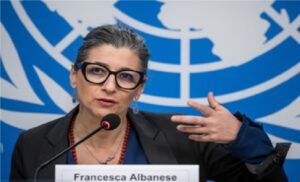
The international response, long muted, has finally begun to sharpen. In April 2026, the UN Special Rapporteur on the situation of human rights in the Palestinian Territory, Francesca Albanese, issued a statement describing Succot’s raids as “an egregious assault on the cultural rights of an occupied people, a violation of the right to education, and a component of the systemic erasure of Palestinian identity that constitutes, in its cumulative impact, the crime of apartheid.” The statement named specific schools and called for “immediate international diplomatic intervention.”
UNESCO Director-General Audrey Azoulay expressed “deep concern” in a May 2026 press conference in Paris, noting that “educational institutions, especially those serving minority and occupied communities, must remain safe spaces for learning, not arenas for political theatre.” The statement stopped short of naming Succot directly, a reticence that drew sharp criticism from Palestinian diplomats and international human rights organisations.
The European Union’s Representative Office in Jerusalem released a carefully worded statement reiterating “the right of Palestinian children to an education that reflects their national and cultural heritage, in accordance with international humanitarian law.” Privately, two European diplomats based in Tel Aviv told this investigation that the matter had been raised repeatedly in bilateral meetings with Israeli officials, “with little effect.” One diplomat, speaking on condition of anonymity, said: “What we are witnessing is a systematic attempt to de-Palestinianise the education system inside Israel and the occupied territory. We have seen the textbooks, we have seen the raid footage. We know what this is. But we are not yet at the point of collective action.”
The United States, under the current administration, has remained publicly silent on Succot’s school raids, though a State Department official confirmed receiving briefings from NGOs and monitoring groups.
The Classroom As Frontline:
On the ground, Palestinian educators are caught between defiance and despair. We visited a school in the Issawiya neighbourhood of East Jerusalem last week. The atmosphere was tense. The headteacher, who asked not to be named, guided us into a storage room where books and materials had been hidden. “We keep the Palestinian curriculum in here now,” she said. “When the inspectors come, we switch to the Israeli-approved materials. The children know the drill. When an unfamiliar car stops outside, the flag comes down. It becomes a game. But it is a game that teaches them they are illegal, that their own story is contraband.”
“I am 52 years old,” she continued. “I have been teaching for thirty years. I never thought I would have to smuggle a map of my own country into a classroom like a thief.”
A seventh-grade pupil named Layan, 12, told us she had drawn a Palestinian flag in her exercise book the day after Succot’s raid on a nearby school. “My teacher saw it and told me to tear out the page. She said, ‘Please, Layan, not today. If they find it, they will close the school.’ I tore it out. But I cried. It’s my flag. Why is my flag a secret?”
These psychological wounds are the point, argues Dr. Samah Jabr, a prominent Palestinian psychiatrist and author. “When you force a child to hide her flag, you are teaching her self-erasure. You are producing a generation that is expected to be invisible. This is a profound form of structural violence. The damage is not collateral. It is the objective.”
The View From The Settlements:
Tzvi Succot’s political base has no such ambivalence. In the settlement of Yitzhar, where Succot lived for several years before moving to Havat Gilad, his campaign is celebrated. “Finally, someone is telling the truth about what goes on in those schools,” said Amichai, a 45-year-old resident who declined to give his surname. “They teach their children to hate us from the moment they can speak. The flag is a symbol of the Palestinian dream, and the Palestinian dream is the destruction of Israel. To allow that inside the borders of the state? In schools, we pay for what? That is suicide, not coexistence.”
This view is not marginal. A December 2025 poll by the Israel Democracy Institute found that 58% of Jewish Israelis supported Succot’s inspections, with 42% strongly approving. The language of “incitement,” long tested in Israeli public discourse, has been weaponised to collapse any distinction between Palestinian national aspirations and violent resistance. In this rhetorical ecosystem, a flag is a bomb. A poem is a knife. A key is a plan for return that means ethnic cleansing.
Succot himself is an adept communicator. His social media feeds, which reach hundreds of thousands of followers across Hebrew-language platforms, alternate between clips of his raids, overlaid with dramatic music, and short addresses to the camera. “They want to destroy us,” he says in one, standing outside a school in the Negev. “But we are here to say: no more. No more incitement. No more lies. No more poison in the minds of children.” The comment threads are a torrent of support, often crossing into explicitly anti-Arab vitriol. Palestinian parents and educators who attempt to respond are routinely harassed, doxxed, and threatened.
Legal Battles And A Summer Of Decision:
The legal front is moving, if slowly. Beyond the High Court petition on the Al-Shabbat Al Muslamat school, a broader challenge to the Education Loyalty and Incitement Prevention Law is already being prepared by a coalition of human rights organisations. Adalah, ACRI, and the Israel Religious Action Centre intend to argue that the law constitutes unlawful discrimination against the Palestinian minority, violates the right to equality and human dignity enshrined in Israel’s Basic Laws, and breaches international law obligations concerning occupied territory.
The outcome is far from certain. The current Israeli High Court has shown deep reluctance to intervene in policies framed around security and identity, particularly those backed by a determined government majority. Chief Justice Yitzhak Amit, who assumed the role in early 2025, has yet to rule on a major challenge to the government’s far-right agenda. Legal scholars are watching closely.
“If the court upholds this law, it will effectively sanction an apartheid education system,” said Professor Aeyal Gross, a constitutional law expert at Tel Aviv University, speaking by phone. “It will mean that Jewish children learn one history, Arab children another, and the state funds only the Jewish story. That is not oversight. That is ethnic engineering through the classroom.”
Coda: The Party Is Over?
In the streets of Kafr Aqab, the slogan Succot repeats like a mantra, “the party is over”, is understood with grim clarity. The party he refers to is the era, however fraught and incomplete, in which Palestinian schools could operate with some measure of autonomy over their own cultural content. That era is indeed ending.
But the schools are not empty. In the same storage room in Issawiya where Palestinian textbooks are now hidden, the headteacher showed us a pile of new artwork drawn by her pupils. Beneath the crayon images of olive trees, mosques, and keys, the children had written the same word in careful Arabic script: “Sumud.” Steadfastness.
“He can take the flag off the wall,” she said. “He cannot take it from their hearts. But he will try. And we will keep teaching. We must.”
Source: Veritas Press C.I.C. | Multi News Agencies
Help Support Our Work By Donating
Popular Information is powered by readers who believe that truth still matters. When just a few more people step up to support this work, it means more lies exposed, more corruption uncovered, and more accountability where it’s long overdue.
Help Protect Independent Journalism, Which Is Currently Under Attack.
If you believe journalism should serve the public, not the powerful, and you’re in a position to help, becoming a DONATOR or a PAID SUBSCRIBER truly makes a difference.
DONATION APPEAL: If You Found This Reporting Valuable, Please Consider Supporting Independent Journalism.
Your support fuels our fearless, truth-driven journalism. In unity, we endeavour to amplify marginalised voices and champion justice, irrespective of geographical location. We operate independently, without any financial backing from billionaires.
But it’s also extremely important. One of Veritas Press’s greatest assets is its reader-funded model.
1. Reader funding means we can cover what we like. We’re not beholden to the political whims of a billionaire owner. We are a small, independent and impartial organisation. No one can tell us what not to say or what not to report.
2. Reader funding means we don’t have to chase clicks and traffic. We’re not desperately seeking your attention for its own sake: we pursue the stories that our editorial team deems important and believe are worthy of your time.
3. Reader Funding: enables us to keep our website and other social media channels open, allowing as many people as possible to access quality journalism from around the world, particularly those in places where the free press is under threat.
We know not everyone can afford to pay for news, but if you’ve been meaning to support us, now’s the time.
Your donation goes a long way. It helps us:
- Keep the lights on and sustain our day-to-day operations
- Hire new, talented independent reporters
- Launch real-time live debates, community-focused shows, and on-the-ground reporting
- Cover the issues that matter most to our communities, in real time, with depth and integrity
We have plans to expand our work, but we can’t do it without your support. Every contribution, no matter the size, helps us stay independent and build a truly people-powered media platform.
If you believe in journalism that informs, empowers, and reflects the communities we serve, please donate today.
Help By Donating Today
Submissions:
For The Secure Submission Of Documentation, Testimonies, Or Exclusive Investigative Reports From Any Global Location, Please Utilise The Following Contact Details For Our Investigations Desk: enquiries@veritaspress.co.uk or editor@veritaspress.co.uk
GENEVA — A United Nations fact-finding mission has concluded there are “reasonable grounds to believe”
Iran’s GDP is projected to contract by 5.4 to 6.1% in 2026, its worst performance
The Trump administration is preparing a $2.8 billion weapons package for Israel containing 40,000 2,000-pound
Film alleges mass civilian deaths are routinely built into military decisions amid Israel’s genocidal war
The Israeli rights group says violence, displacement, economic strangulation, and settlement expansion form part of

Houthi forces have captured the historic Red Sea port of Mocha and are advancing on
London’s historic sanctions against Israeli settlements mark a watershed moment in UK foreign policy, but
With 95% of Gaza’s population now wholly dependent on aid and more than 90% stripped
India calls for Kashmir and Ladakh to appear only on its official map after a
ISLAMABAD – In the high-stakes political theatre of Pakistan, the battleground has shifted from the