


Author:
Byline: Investigative Desk
Help support our mission, donate today and be the change. Every contribution goes directly toward driving real impact for the cause we believe in.
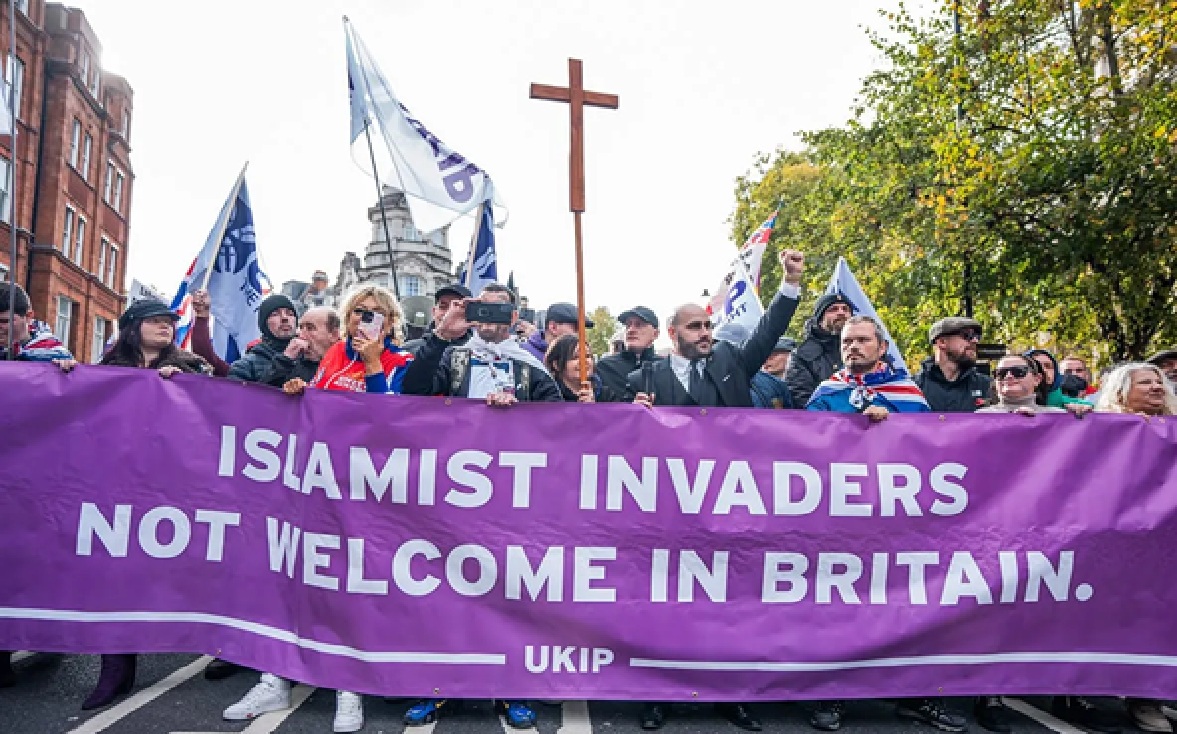
It happens roughly once every five days. A brick through a prayer-hall window. Graffiti scrawled across a minaret. Arson that chars centuries-old doors. Over the past year, the British Muslim Trust recorded over 70 attacks on mosques across the United Kingdom. Each incident can be logged as a crime statistic, but taken together they form a far more disturbing shape: a society that has quietly accepted the relentless scrutiny, suspicion, and symbolic trial of an entire faith community. To grasp how these attacks are possible, one must look beyond individual bigots and confront the institutional and structural racism that frames Muslims as a permanent threat. And to understand where that framing comes from, one must reckon with an uncomfortable truth: European colonialism, far from being a closed chapter of history, is returning, its hierarchies, its logic of civilisational superiority, its impulse to dominate and discipline, in new and insidious forms. At the heart of this revival lies a cynical manoeuvre: the weaponisation of identity politics, twisted to subvert genuine community tensions and direct them away from the structures of power that profit from division.
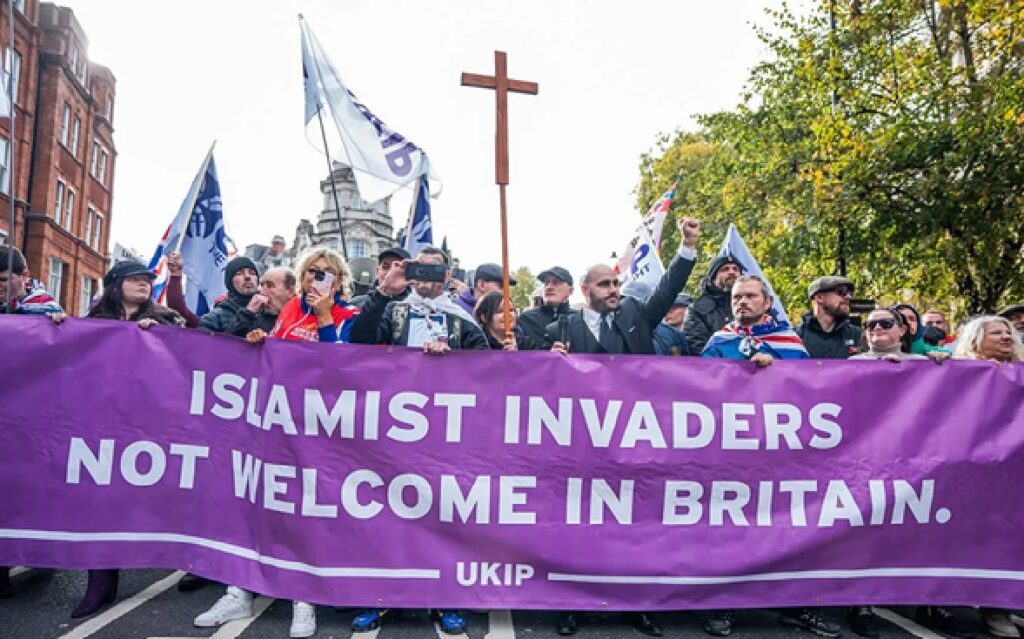
The burden has become so ingrained in daily life that people rarely identify it for what it is. Yet the evidence is piling up. A major survey by the integration think-tank British Future and the British Muslim Trust found that one in six Britons believes the growth of the Muslim population “poses a foundational threat to UK culture”. Another 19% do not agree that Muslims born in this country are as British as white non-Muslims. In short, a significant minority of the public regards their Muslim neighbours not as fellow citizens but as an existential cultural challenge. These attitudes are not merely personal prejudice; structural racism that permeates political rhetoric, media framing, and the machinery of the state itself sustains them. And that machinery is not neutral. The nation’s immigration and legal policies increasingly design it to amplify racist rhetoric and embed it in the very fabric of the law, a design that bears the unmistakable imprint of a colonial mentality it has never fully exorcised.
These numbers arrive as the lived experience of Muslims in Britain has already suffered from a rolling series of political storms and bursts of outright violence. Academic researchers published a landmark report showing that hostility has intensified into “structural Islamophobia” across British life; the racist riots of summer 2024, where mosques faced sieges and Muslims suffered physical attacks, represented merely the most explosive manifestation. The report lays bare the institutional racism that sees Muslims systematically disadvantaged and targeted, from education and health to the criminal justice system, demonstrating that anti-Muslim prejudice is not a fringe phenomenon but a structural feature of British institutions. And these institutions were forged in the crucible of empire; their default posture towards the formerly colonised remains one of suspicion and control.
The Architecture Of Scrutiny And The Colonial Gaze:
The 2024 riots may have flickered out after a few days, but the question they pose refuses to vanish. How did we reach a point where a young Muslim woman hesitates to wear a hijab to the supermarket, where a child faces bullying for eating halal food, and where families who escaped war and persecution to rebuild their lives here feel forced to conceal the most ordinary displays of their faith?
Reset Communities for Refugees, an organisation that supports refugee families across Britain, has been gathering testimony that answers that question from the inside. Parents speak of children taunted in school playgrounds. Women describe a new calculus of safety around the headscarf. Some families have begun to ask whether openly practising their religion could make them a target. A spokesperson for the charity said, “ These are not the dominant stories we hear, but they are becoming familiar enough that we can no longer dismiss them as isolated incidents.” Such daily humiliations do not emerge from a vacuum; they are the human consequences of structural racism, of a society that organises itself around the assumption that to be Muslim is to be suspect. This is the colonial gaze, repackaged for a domestic setting. The brown or Black body, especially the Muslim body, must be watched, assessed, and disciplined. It was once the project of administrators in Delhi, Cairo and Khartoum; now it unfolds on the streets of Birmingham, Bradford and Tower Hamlets.
It is not only the prejudice that grinds people down, but the fatigue. Few communities in Britain are so frequently required to explain who they are. Whether the public debate focuses on immigration, integration, public prayer, or national identity, Muslims repeatedly engage in a ritual of justification: they justify their values, explain their faith, and prove they belong. That expectation is now so deeply entrenched that it barely registers as remarkable. “There is a particular exhaustion that comes from continually being asked to reassure people you belong, to distance yourself from extremists you have never met,” says a British Pakistani doctor in Leicester, who asked not to be named. “I was born here. I work in the NHS. I’m the GP you see when your child has a fever. And yet somehow, every few weeks, a front page or a politician suggests people like me might not really be British.” This demand to perform loyalty before being accepted as legitimate is a direct inheritance from the colonial era, when subject peoples were required to prove their civilisation, their worthiness, their proximity to whiteness, to be granted even partial rights.
A Climate Manufactured In Plain Sight, A Colonial Logic Reborn:
Acts of hatred rarely appear without warning. Institutional racism creates a culture where one community is treated as perennially controversial, its loyalty questioned, and its identity open for public auction, causing these acts of hatred to grow. Over the past year alone, Muslims have become the focus of a series of political and media debates that bear little resemblance to the texture of ordinary lives. National commentators have questioned whether Muslims should pray together in Trafalgar Square. Politicians have generated headlines warning of churches being “turned into mosques”, despite scant evidence that this represents a widespread problem demanding urgent legislative attention.
Here, the facts tell a revealing story. The reason some church buildings are bought by Muslim congregations is straightforward: declining Christian attendance and rising maintenance costs have forced hundreds of churches to close or go to auction. When buyers purchase these buildings, many strip out the sacred character entirely, converting them into nightclubs, flats or commercial spaces. By contrast, Muslim communities who acquire them typically preserve the building’s original pact with worship, often retaining the architecture and keeping the space dedicated to prayer. Yet the political framing inverts this reality, painting a picture of encroachment rather than of a minority community breathing new spiritual life into a building that might otherwise lose its sacred purpose forever. This narrative of Muslim demographic conquest is a recycled colonial trope, once used to justify European settlement and dispossession, now aimed at citizens at home. It is a case study in how symbolic debates about Muslim identity displace honest discussion, leaving behind a residue of suspicion that outlasts the news cycle, a cycle that itself makes up a form of structural racism by constantly casting Muslims as a threat to a mythologised, white Christian nation.
How Identity Politics Are Framed To Subvert Community Tensions:
But there is a subtler weapon in this arsenal, one that operates less through the blunt instrument of the law and more through the manipulation of language itself. The concept of “identity politics” has been systematically co-opted and weaponised to subvert genuine community tensions, redirecting them away from structural injustice and towards a manufactured culture war. Whenever Muslims, or, for that matter, other racialised minorities, organise to name their oppression, to demand equal treatment, or to assert their right to exist without fear, they are accused of indulging in “identity politics”. The term is wielded as a slur, as though the mere act of identifying a shared experience of racism were itself the cause of social division, rather than a response to it. In this framing, the problem is not the systemic Islamophobia documented by report after report, nor the immigration laws designed to criminalise Muslim asylum seekers, nor the colonial reflexes that treat Muslim citizens as a fifth column. The problem, we are told, is that Muslims keep talking about it.
This rhetorical strategy is devastatingly effective at subverting the very real tensions that exist in multi-ethnic Britain. Working-class communities of all backgrounds have legitimate grievances: decades of austerity, insecure housing, collapsing public services, stagnant wages. These are material conditions that could, in a rational political discourse, forge solidarity across racial and religious lines. But the framing of identity politics as the enemy short-circuits that possibility. It tells the white working class that the landlord, the exploitative employer or the politician who cut their benefits are not their real adversaries, but rather the Muslim neighbour who allegedly receives special treatment and whose faith is supposedly accommodated at their expense. It tells the Muslim community that their calls for protection from hate crimes, for an end to Prevent’s racial profiling, for a fair immigration system, are mere acts of identitarian grievance-mongering, unworthy of serious attention from the serious people who run the country. The result is a double subversion: solidarity is broken, and the structures of power remain untouched, shielded by a smokescreen of manufactured resentment.
This is not an organic development. It is a deliberate political project, one that stretches from the op-ed pages of broadsheet newspapers to the speeches of cabinet ministers. Commentators who lament the supposed fragmentation of society into competing identity groups are often the same voices who refuse to acknowledge racism as a structural phenomenon, insisting instead that Britain is a meritocracy in which anyone can succeed if only they stop defining themselves by their race or religion. They are backed by politicians who, when confronted with statistics showing Muslims are eight times more likely to be referred to Prevent or make up 18% of the prison population, respond not by investigating systemic bias but by accusing those who raise the issue of “playing the race card” or engaging in “divisive identity politics”. The effect is to delegitimise the very act of naming Islamophobia, to make the analysis of institutional and structural racism seem like a special interest demand rather than a democratic imperative.
Professor Nasar Meer, one of the authors of the Islamophobia report, notes that “the consistent refusal to define Islamophobia is part of a broader refusal to accept that racism operates structurally. Accusing Muslims of identity politics is a way of shutting down that conversation before it starts.” And it works. Many Muslims internalise the accusation, fearing that speaking out will only confirm the stereotype of the perpetually aggrieved minority. Others, exhausted by the demand to constantly justify their belonging, retreat into silence. Meanwhile, the structural machinery grinds on, unchallenged, while public debate remains trapped in a circular firing squad of competing identity claims, all of them expertly managed by a political class that benefits from the chaos.
Colonialism never simply conquered territory; it conquered minds by dividing the colonised against one another, by inventing tribes and castes and then setting them at each other’s throats. The framing of identity politics as the central threat to social cohesion is a contemporary echo of that ancient colonial tactic. It ensures that the Muslim population, already positioned as an existential cultural threat, is further isolated by the suggestion that their very demand for justice is a form of social sabotage. It tells the wider public that the tensions they feel in their daily lives, the struggle to get a GP appointment, the precariousness of work, the unaffordability of housing, are not the consequence of policy choices made in boardrooms and cabinet offices, but of a minority group that refuses to stop talking about its pain. This is divide and rule, updated for a new century, performed not with imperial troops but with think-tank reports, tabloid front pages and carefully crafted political soundbites.
Immigration And Legal Policies: Racism By Design, Colonialism By Another Name:
People do not allow this climate of suspicion to occur by chance. A web of immigration and legal policies that are designed to further racist rhetoric actively constructed it. And these policies are not simply draconian; they represent the return of European colonialism in a bureaucratic register. The so-called “hostile environment” policies, first embedded in the Immigration Acts of 2014 and 2016, required landlords, employers, bank staff and NHS workers to become border guards, checking the immigration status of anyone they suspected might be in the country irregularly. Though the Windrush scandal exposed how these measures devastated Black Caribbean British citizens, the hostile environment continues to operate with brutal efficiency against Muslims. Asylum seekers from Muslim-majority countries, Syria, Palestine, Lebanon, Afghanistan, Sudan, Somalia, find themselves funnelled into an immigration system that frames their very presence as a form of criminality or denied entry. The language of the law itself conjures threat: “illegal migrants,” “clandestine entrants,” “bogus asylum seekers.” This is the lexicon of colonial governance, which divided the world into civilised subjects and barbarian intruders, repurposed for the twenty-first century.
The Rwanda deportation scheme, announced and pursued with relentless enthusiasm by successive Conservative governments, is perhaps the most brazen example of colonialism’s return. A European power, unable to process the human consequences of its own wars and global inequalities, seeks to offshore its responsibilities to an African nation, effectively treating human beings as cargo to be shipped out of sight. The scheme echoes the penal colonies of the eighteenth-and nineteenth centuries and lays bare a mindset that views Black and brown lives from former colonies as disposable, as problems to be exported rather than people with rights. When courts intervened to block flights, ministers fumed about judicial overreach, exposing a colonial-era impatience with legal constraints on executive power when dealing with the non-white. The entire policy apparatus communicates one message: you people from the lands we once ruled have no claim on us now, except as threats to be expelled.
The Nationality and Borders Act 2022 and the Illegal Migration Act 2023 went further, creating a two-tier system of refugee protection that effectively punishes those who arrive through irregular routes, the vast majority of whom are fleeing conflict zones from which there are no visa programmes. The law criminalises their arrival, branding them as undeserving and even dangerous before anyone has heard their claim. When the then Home Secretary described asylum seekers as an “invasion” or when ministers promise to “stop the boats,” they are not simply stating policy objectives; they are embedding a racist narrative in the statute book, a narrative that reprises the colonial fantasy of the white nation besieged by darker hordes. These policies deliberately foster an environment in which Muslim refugees are seen as invaders, as a demographic and cultural threat. The legal framework doesn’t just respond to prejudice, it manufactures it, giving official sanction to the very fears that fuel mosque attacks and street harassment. It is the colonial frontier, now drawn across the English Channel.
Counter-terrorism legislation adds another layer of structural racism, one that extends the colonial project of surveillance and pacification. The Prevent duty, placed on schools, universities and health services, requires public sector workers to report individuals deemed at risk of radicalisation. According to the Islamophobia report, Prevent receives referrals for Muslims at eight times the rate of non-Muslims. This is not simply a statistical anomaly; it is institutional racism in action, a system that trains teachers and doctors to see Muslim children and patients as potential security threats, much as colonial administrators once saw every gathering of natives as a potential insurrection. The effect is profound and chilling. Young Muslims grow up learning that their faith is under surveillance, that their political views, particularly on Palestine, might be flagged, and that their identity constitutes a risk factor. The policy does not merely reflect societal Islamophobia; it actively produces it, teaching a new generation of state employees and citizens alike that to be Muslim is to be suspect. This is racism by design, dressed in the language of safeguarding, a domestic counter-insurgency modelled on the techniques of imperial policing from Malaya to Kenya.
Even seemingly benign integration policies can carry a racist undertow that echoes the colonial “civilising mission.” The discourse of “British values,” embedded in immigration requirements and school curricula, often presents liberal secularism as a benchmark against which Muslim communities are measured and found wanting. Applicants for citizenship must pass a “Life in the UK” test that treats British history as a triumphal march of progress, ignoring the Empire’s violent entanglements with the very regions from which so many Muslim migrants originate. Critics argue those who fail the test, or who struggle with English, are seen as deficient and unwilling to integrate; and their cultural and religious practices are rendered alien, their presence a burden on a nation that once ruled them.. The nation, which once ruled them, views their cultural and religious practices as alien and their presence as a burden. The legal framework doesn’t simply fail to protect against Islamophobia; it structures a national narrative in which Muslims are perpetual outsiders, their belonging always conditional, their loyalty always in question. This is the colonial order restored within the Metropole: we will tolerate you here, but only on our terms, and only if you shed the markers of your backwardness.
Professor Meer has argued that “the state has consistently refused to define Islamophobia, even while it enacts policies that disproportionately target Muslims. This is not a contradiction; it is a strategy. The refusal to name the problem protects the policies that cause it.” The policies are not accidents of bureaucratic indifference. They are deliberate instruments that legitimise and spread racist rhetoric, transforming private prejudice into public policy, street-level thuggery into legislative force. And they are the contemporary expression of a colonial impulse that has never died, only adapted to a world of nation-states and domestic electorates, substituting the language of Empire with the language of border security and cultural defence.
Sunder Katwala, director of British Future, warns that the wider climate is on the verge of hardening into something more durable. “It’s deeply worrying that one in six people hold sweeping, hostile prejudices towards Muslims in Britain,” he said. “Most people do not agree with them – but if this trend continues unchecked, there is a real risk that these attitudes become normalised in wider society. This shouldn’t be a matter for polarised political debate but a basic norm that we can all agree on. We must protect free speech, and we must also protect our fellow citizens from hatred.” Yet protecting them requires dismantling the colonial architecture of the state itself, not just moderating rhetoric, and it requires rejecting the false framing of identity politics that keeps communities fighting one another while the architects of that architecture look on.
Beyond Individual Bigotry: Institutional And Structural Racism Exposed As The Empire’s Domestic Legacy
The Islamophobia: the intensification of racism against Muslim communities in the UK report pulls the lens back to reveal the institutional and structural racism operating through the arteries of the state. Drawing on the work of scholars including Nasar Meer, Khadijah Elshayyal, Maisha Islam, Raheel Mohammed, Layla Aitlhadj, Shereen Fernandez, Waqas Tufail and Tarek Younis, it finds that one in three Muslim students experience Islamophobic abuse, an indictment of an education system that has failed to embed meaningful anti-racist practice. Muslims are more likely to live in the most deprived fifth of local authority areas in England, with almost half a million more Muslims now living in those deprived locales than in 2011, spatial inequality that reflects structural racism in housing, employment and urban planning, a domestic geography of marginalisation that mirrors the segregated colonial city.
As noted, the NHS refers Muslims to Prevent at eight times the rate of non-Muslims. And while Muslims make up around 6% of the general population, they constitute 18% of the prison population, a disparity that echoes the carceral logic of Empire, which incarcerated colonised peoples at vastly disproportionate rates. These are not random statistical blips. They are the fingerprints of a state that has, for decades, constructed Muslims as a problem to be managed rather than citizens to be served, and has written that construction into its immigration, security and integration laws. European colonialism never ended; it simply came home, repackaged as a domestic policy for the post-imperial age.
The report’s authors argue that the 2024 riots were not a spontaneous explosion but “the clear outcome of intensifying Islamophobia”, linked directly to how Muslim communities were portrayed, particularly during protests over Gaza. Peaceful demonstrators were branded “Islamist extremists” in headlines, while political rhetoric from the benches of parliament cast them as outsiders with foreign loyalties, as a menace to society. “The sense that Muslim people are a threat to Britain has become overt and direct,” the report concludes. “It is time that we put a rational conversation back on the agenda.” That rational conversation must begin by naming Islamophobia for what it is: institutional and structural racism, no less corrosive than any other form of bigotry the country has pledged to eradicate, and by recognising that this racism is the direct descendant of European colonialism, now operating under new management. It must also involve dismantling the legal architecture, the hostile environment, the Rwanda scheme, Prevent, that gives it licence, and confronting the divisive co-option of identity politics that prevents the building of a united front against that architecture.
Listening To The Lived Experience Under The Return Of Colonial Logic:
Akeela Ahmed, director of the British Muslim Trust, the government’s official partner in monitoring Islamophobia, has spent months travelling the country, listening. “Time and again,” she said, “Muslims told us they felt their place and identity was being questioned and scrutinised in ways it hadn’t been before, when they had integrated and worked and studied hard.” The Trust’s survey found that 56% of Muslims had experienced prejudice based on their religion in the last year alone, a figure Ahmed described as “utterly intolerable”. Yet she also found something “heartening”: 61% of the wider public support government action against anti-Muslim hatred, with only 7% opposed. The majority will is there. What is missing is the political courage to name and dismantle the institutional racism that fuels this hatred, and to back that naming with resources, policy, and legal force. What is missing is the willingness to tear up the immigration laws and counter-terrorism provisions that encode anti-Muslim prejudice as state practice, and to repudiate, once and for all, the colonial mindset that licenses the state to treat certain citizens as subjects to be controlled rather than bearers of rights. And crucially, what is missing is a political discourse that refuses to weaponise identity politics as a wedge, and instead recognises that the call for equality is not a threat to community but its precondition.
The survey illuminated a clear fault line: 29% of over-65s see the contribution of Muslims as negative, compared with only 16% of 18- to 24-year-olds. And researchers discovered a “strong correlation” between how regularly people actually interact with Muslims and their levels of acceptance. “Too many people simply do not know a Muslim,” Ahmed said. “The interpersonal contact and connection that builds trust is missing from their daily lives. It is in those local relationships, more than anywhere else, that prejudice is undone.” Yet that prejudice is also undone by confronting the structural racism that keeps communities segregated, economically marginalised and politically scapegoated, by rejecting laws that paint Muslim immigrants as a threat to the nation’s very identity, and by refusing the colonial instinct to divide, rank and rule, as well as the cynical deployment of identity politics discourse that seeks to fracture the emerging solidarities between Muslim, Black, working-class white and other marginalised groups.
Organisations on the front line echo the call. Tell MAMA, which tracks anti-Muslim hate incidents, has reported a sharp rise in cases, especially online, where conspiracy theories and disinformation circulate unchallenged. The Muslim Council of Britain and the Muslim Women’s Network UK have both made urgent representations to government, calling for Islamophobia to be treated with the same seriousness and moral clarity afforded to other forms of racism, which is to say, as a system of structural and institutional oppression, not merely a collection of hurtful attitudes, and certainly not as an example of divisive identity politics. Yet the official response has been sluggish. The long-delayed definition of Islamophobia remains contested in some quarters, as though the precise wording mattered more than the bloodied brick on the mosque doorstep, as though acknowledging the racist design of immigration laws, and the colonial ghosts that animate them, were somehow more dangerous than the violence those laws incite. The accusation of identity politics is the alibi for this inaction, the excuse for a government that simply does not wish to see.
The Untold Story Of Belonging Under A Colonial Shadow:
What rarely penetrates the noise is how deeply embedded British Muslims already are in the nation’s fabric. They care for patients, teach children, serve in the Armed Forces, run businesses, create jobs, and volunteer in neighbourhood charities. In the British Future survey, 69% of Muslims agreed that British-born Muslims are as British as white non-Muslims born here. A full 73% said the UK is a good place to be a Muslim. The overwhelming majority are simply getting on with life, contributing to a country they cherish. And yet they do so within structures that continually mark them as less than fully belonging, a contradiction that is itself a form of structural racism, demanding patriotism from those the law and the political class refuse to fully accept, echoing the colonial dynamic in which the colonised could serve the Empire but never truly belong to it.
But those contributions rarely shape the public conversation. Muslims appear in political debate as a problem to be solved, not as citizens whose lives are as ordinary, diverse and complex as anyone else’s. This is not merely a failure of representation. It is an active distortion that feeds the fatigue described by so many. “If the next generation grows up doubting that this is their home,” Ahmed warns, “it will have unintended consequences on social cohesion.”
Political leadership matters because it helps set the emotional temperature of public life. No politician is responsible for every hate crime, but politicians shape the atmosphere in which hatred either becomes socially unacceptable or quietly condoned. When leaders refuse to call institutional racism by its name, when they design immigration laws that speak of “invasion” and frame refugees as criminals, when they propose exporting asylum seekers to Africa as though running a modern-day penal colony, they grant permission for that hatred to fester. When they dismiss organised Muslim demands for justice as mere “identity politics”, they gaslight an entire community and fracture the common ground on which multi-ethnic democracy depends. They are not just managing a nation; they are indulging a colonial fantasy in which the white centre is besieged and must be defended, and in which any assertion of minority identity is framed as a threat. Manufactured controversies may vanish from social media feeds within days, but the structural racism they reinforce, the idea that Muslims are perpetually foreign, perpetually suspect, never quite civilised enough, can endure for generations. And the laws that encode such ideas remain on the books long after the politicians who introduced them have left the stage, outlasting them as enduring monuments to a colonial revival.
A Question That Should No Longer Need Asking:
The recent attacks on mosques, from London to Luton, should concern everyone, not simply because of the damage to buildings, but because of what they reveal about the soil in which such violence takes root. That soil has been fertilised by decades of institutional and structural racism: by immigration laws that manufacture the Muslim as threat, by the Rwanda scheme that resurrects the logic of colonial deportation, by Prevent referrals that teach Muslim children they are seen as security risks, by housing policies that concentrate poverty in Muslim neighbourhoods, by a media ecosystem that frames Muslim prayer as an act of colonisation. And it is sustained by the insidious reframing of identity politics that turns legitimate calls for justice into a supposed assault on national unity, thereby subverting the very community tensions that could be channelled into collective demands for a fairer society. If Britain truly wants stronger communities, it cannot keep lecturing about integration while ignoring the structural racism that actively undermines it, while maintaining a legal edifice designed to produce the very divisions it claims to deplore, while indulging the colonial reflexes that treat certain lives as inherently less valuable, less legitimate, less entitled to safety and dignity.
Calling out Islamophobia as institutional and structural racism, and as the domestic return of European colonialism, masked by a weaponised critique of identity politics, is not about shutting down debate. It is about recognising a truth that ought to be unremarkable: no community should be expected to continually prove that it belongs. No community should have to endure a state apparatus that views them with suspicion as a default setting. And no community should be the target of laws deliberately crafted to turn racist rhetoric into everyday reality, or of policies that channel the logic of Empire into the governance of citizens, all while being told that their resistance to such treatment is merely an exercise in self-serving grievance.
Perhaps the question political leaders should now be asking is not why British Muslims keep explaining who they are, but why, after all these years, the rest of us, and the institutions that govern us, and the laws they enact, continue to demand that they do. And then they must ask a harder one: what will it take to finally dismantle the structures, the statutes, the colonial mindsets and the narratives that make such a demand possible, and to stop framing solidarity as division? For the brick thrown through the mosque window is not an isolated act of hate. It is the Empire, striking back at the very people it once subjugated, on the streets it now calls home, and it is aided by a discourse that tells those who would stand against it that their very protest is the problem.
Veritas Press Investigative Analysis
Independent journalism examining global affairs, power, diplomacy and accountability.
Source: Veritas Press C.I.C. | Multi-News Agencies
APPEAL: Help Support Our Work By Donating
Readers who believe that truth still matters have power over popular information. When just a few more people step up to support this work, it means more lies exposed, more corruption uncovered, and more accountability where it’s long overdue.
Help Protect Independent Journalism, Which Is Currently Under Attack.
If you believe journalism should serve the public, not the powerful, and you’re able to help, becoming a regular DONOR or a PAID SUBSCRIBER truly makes a difference.
DONATION APPEAL: If you found this reporting valuable, please consider supporting independent journalism.
Your support fuels our fearless, truth-driven journalism. In unity, we endeavour to amplify marginalised voices and champion justice, irrespective of geographical location. We operate independently, with no financial backing from billionaires; our readers support us.
But it’s also extremely important. One of Veritas Press’s greatest assets is its reader-funded model.
1. Reader funding means we can cover what we like. We’re not beholden to the political whims of a billionaire owner. We are a small, independent and impartial organisation. No one can tell us what not to say or what not to report.
2. Reader funding means we don’t have to chase clicks and traffic. We’re not desperately seeking your attention for its own sake; we pursue the stories that our editorial team deems important and believes are worthy of your time.
3. Reader Funding: enables us to keep our website and other social media channels open, allowing as many people as possible to access quality journalism from around the world, particularly those in places where the free press is under threat.
We know not everyone can afford to pay for news, but if you’ve been meaning to support us, now’s the time.
Your donation goes a long way. It helps us:
- Keep the lights on and sustain our day-to-day operations
- Hire new, talented, independent reporters
- Launch real-time live debates, community-focused shows, and on-the-ground reporting
- Cover the issues that matter most to our communities, in real time, with depth and integrity
Without your support, independent voices like ours will be silenced.
Furthermore, we have plans to expand our work, but we can’t do it without your support. Every contribution, no matter the size, helps us stay independent and build a truly people-powered media platform.
If you believe in journalism that informs, empowers, and reflects the communities we serve, please donate today.
Submissions:
For the secure submission of documentation, testimonies, or exclusive investigative reports from any global location, please utilise the following contact details for our Investigations Desk: mailto:enquiries@veritaspress.co.uk or mailto:editor@veritaspress.co.uk
GENEVA — A United Nations fact-finding mission has concluded there are “reasonable grounds to believe”
Iran’s GDP is projected to contract by 5.4 to 6.1% in 2026, its worst performance
The Trump administration is preparing a $2.8 billion weapons package for Israel containing 40,000 2,000-pound
Film alleges mass civilian deaths are routinely built into military decisions amid Israel’s genocidal war
The Israeli rights group says violence, displacement, economic strangulation, and settlement expansion form part of

Houthi forces have captured the historic Red Sea port of Mocha and are advancing on
London’s historic sanctions against Israeli settlements mark a watershed moment in UK foreign policy, but
With 95% of Gaza’s population now wholly dependent on aid and more than 90% stripped
India calls for Kashmir and Ladakh to appear only on its official map after a
ISLAMABAD – In the high-stakes political theatre of Pakistan, the battleground has shifted from the