Kamran Faqir is a volunteer investigative journalist and writer committed to exposing hidden truths and amplifying underreported stories. Driven by social justice, he brings sharp insight and fearless truth-telling to independent journalism. NUJ registered.
Original Article Date Published:
Article Date Modified:
24 minutes
Views:425
Listen to this article
Help support our mission, donate today and be the change. Every contribution goes directly toward driving real impact for the cause we believe in.
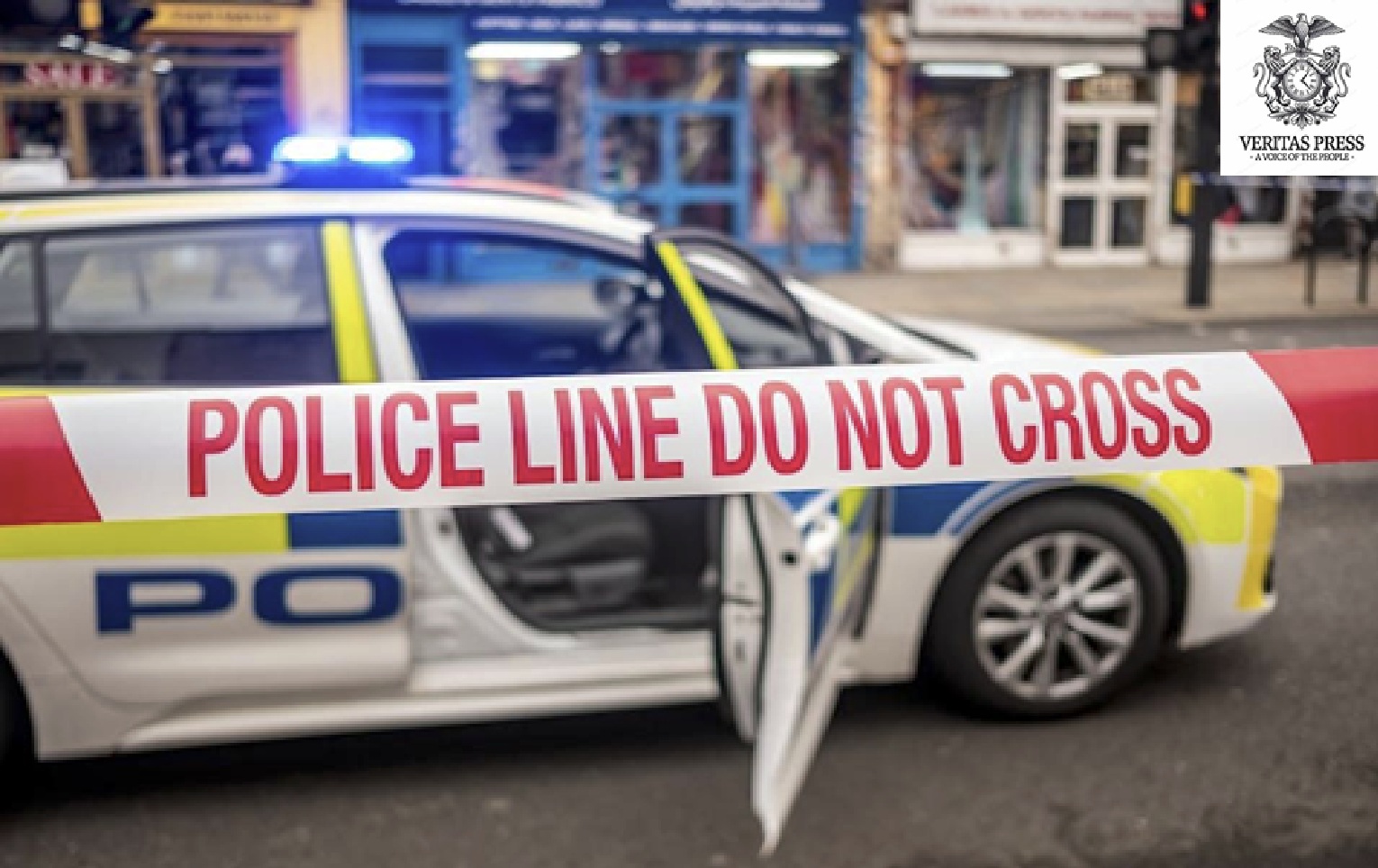
LONDON — The words “We saw this coming” have become a grim refrain among British Muslim communities over the past two years. The arson attack on a mosque in Birmingham last week, which left two worshippers hospitalised, was not an isolated outrage. It was the latest convulsion in a long, meticulously documented surge of anti-Muslim hatred that has moved from the fringes into the centre of British political and media life. Yet, as the ashes cooled, the official response followed a wearying pattern: condemnations of “mindless thuggery,” pledges to review security, and a deafening silence on the policies, headlines and political calculations that prepared the ground.
This investigation, drawing on exclusive interviews with victims, community organisers, senior police officers, and years of data from monitoring groups, reveals how anti-Muslim racism, Islamophobia, has not merely risen but been nurtured in the UK. It is embedded in a pipeline that runs from tabloid front pages and social media disinformation networks into ministerial rhetoric and counter-terrorism legislation. The summer 2024 riots, the persistent demonisation of “grooming gangs”, the stalled adoption of a working definition of Islamophobia, the state’s own “Prevent” strategy, the spectre of hate marches, and a raft of policies targeting Muslim ways of life have combined to make ordinary Muslims feel that the nation has declared them an internal enemy. And that sense of siege is increasingly understood not as a domestic anomaly but as a local expression of a global campaign against Muslim communities, from Hindutva-driven violence in India to transnational networks that connect it to the UK.
The Numbers Behind The Surge:
Statistically, the rise is unignorable. Tell MAMA, the national service monitoring anti-Muslim hate, recorded 4,971 incidents in 2024, a 15% increase on the previous year and the highest annual total since its founding. These included 328 assaults on individuals, 271 attacks on mosques and Islamic institutions, and a 42% spike in anti-Muslim hate speech online. The Home Office’s own hate crime figures for England and Wales, published in October 2025, showed that 44% of religiously motivated hate crimes targeted Muslims, although Muslims represent roughly 6.5% of the population.
“These are not random flare-ups,” Iman Attia, director of Tell MAMA, told me during an interview at the organisation’s anonymised office. “We can map almost every peak in physical violence directly to a political scandal or a media cycle about Muslims. When an MP writes a column describing Muslim migrants as an ‘invasion,’ the effect is not abstract. Within 48 hours, our helpline illuminates.”
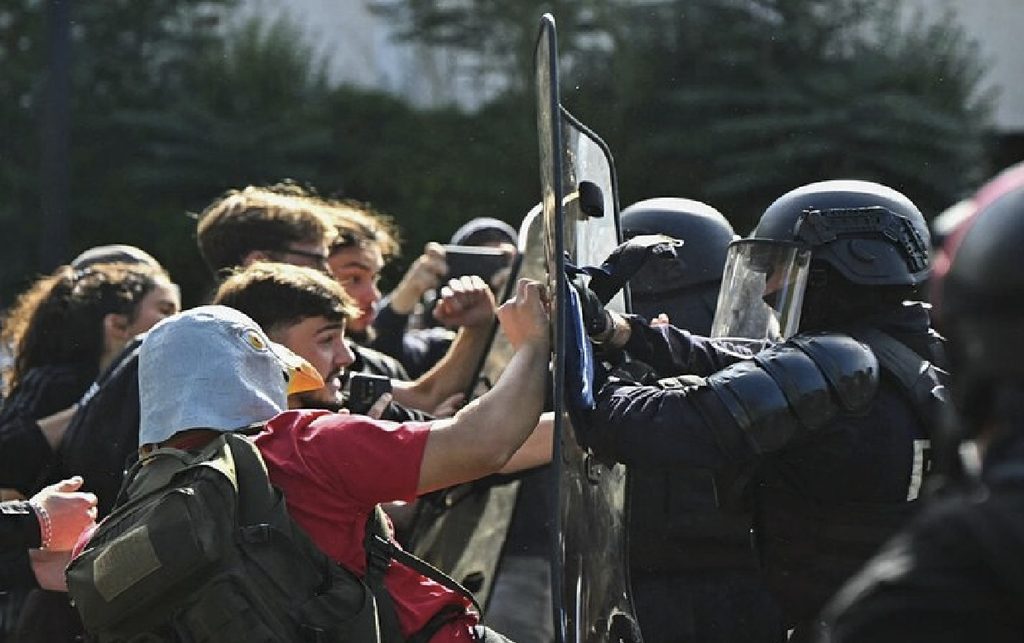
Indeed, after the Southport knife attack in July 2024, when a then-17-year-old born in Cardiff to Rwandan parents killed three children, a firehose of disinformation identified him as a Muslim asylum seeker. Within hours, far-right groups mobilised on Telegram. The result: a mosque in Southport was stoned and set alight, hotels housing asylum seekers were torched in Rotherham and Tamworth, and almost a week of orchestrated riots across England and Northern Ireland. The violence was widely described as “anti-immigration,” but for Muslim communities it was unmistakably anti-Muslim. “They came for the mosque first,” recalled Dr Usman Ali, an imam in Southport who sheltered families in the basement while a mob tried to break through the doors. “The men outside were chanting ‘Allahu Akbar’ mockingly and screaming ‘this is our country.’ We have no doubt what their target was.”
Hate Marches: The Tommy Robinson Playbook.
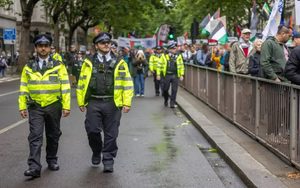
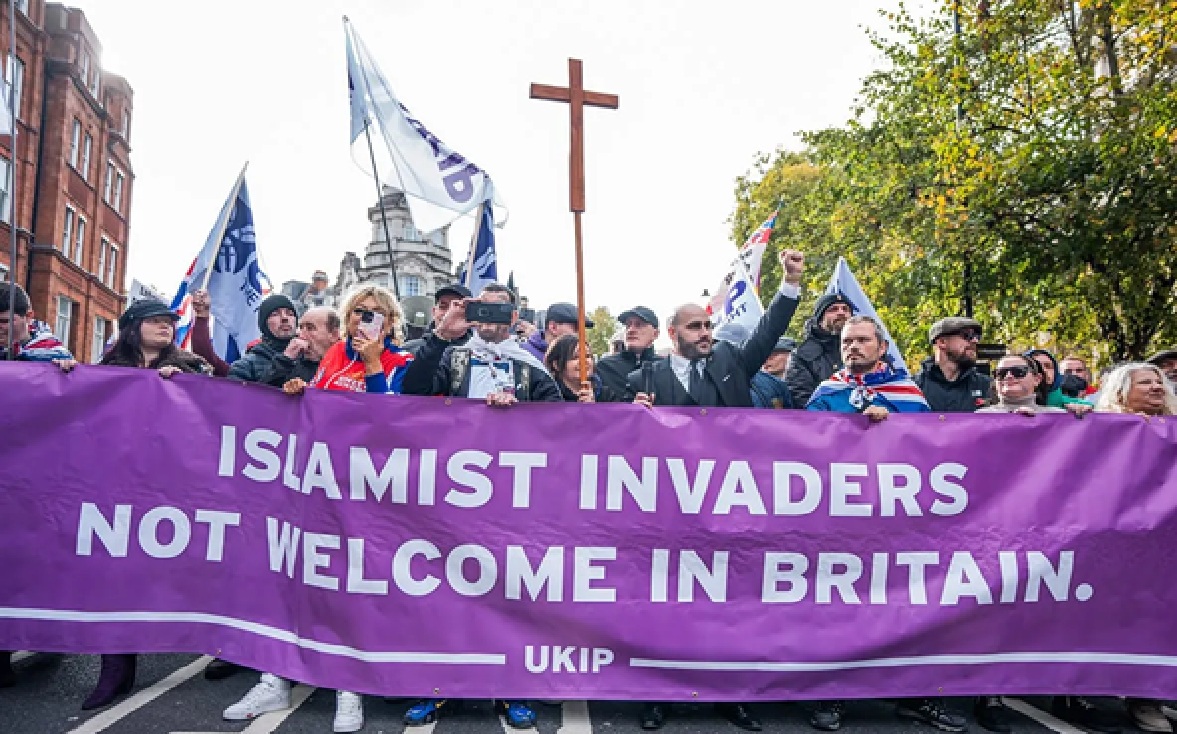
The summer 2024 riots did not emerge from a vacuum. They were the volatile endpoint of a decade-long street movement orchestrated by Stephen Yaxley-Lennon, better known as Tommy Robinson. A former English Defence League leader with a long criminal record for violence, fraud, and contempt of court, Robinson has reinvented himself through social media as a self-styled crusader against “Muslim grooming gangs” and “Islamification.” His “Unite the Kingdom” marches, held in major cities throughout 2024 and 2025, have become theatrical festivals of Islamophobic vitriol, drawing thousands under the guise of patriotism.
I attended a “Unite the Kingdom” rally in Manchester in April 2025, where Robinson addressed a crowd of approximately 3,000 from a stage draped in Union Jacks. “We are losing our country,” he shouted, gesturing towards a screen displaying headlines about child sexual exploitation. “This is a political, cultural, and religious war being waged against our children.” The audience responded with chants of “We want our country back” and, less guardedly, “F*** Islam.” Men in the crowd held placards depicting the Prophet Muhammad with a bomb in his turban, while stalls sold “Infidel” patches. When Robinson was finally banned from X and other platforms in late 2025, his content had already shifted to encrypted apps, and his UK marches continued under allied organisations.
“These marches are hate crimes as performance,” said Nick Lowles, chief executive of Hope Not Hate, the anti-fascism research organisation. “Robinson frames them as free speech events, but every single one leaves a trail of fear. Mosques are vandalised the night after. Muslim women are spat at in the street. And it empowers a layer of activists who believe violence is the logical next step.” Lowles’s team has documented that 42% of individuals arrested during the 2024 riots had attended at least one Robinson-affiliated protest in the preceding eighteen months.
The state’s response has been hesitant. Home Office officials privately acknowledge that Robinson’s marches meet legal thresholds for public order restrictions, but successive home secretaries have declined to proscribe his groups, citing freedom of assembly. Communities Minister Kemi Badenoch, when asked in a parliamentary debate in March 2026 about the marches, said: “We must not conflate legitimate concerns about community cohesion with criminal acts.” For Ayaan Hassan, a teacher from Bolton who wears a niqab, that distinction is meaningless. “When they march through my town shouting about ‘Muslim paedophiles,’ I am not comforted by the legal nuance,” she said. “The state is telling these men that their hatred is acceptable, and my body is the territory they get to claim.”
Policies Of Exclusion: The Institutional Siege On Everyday Muslim Life.
Beyond the street-level violence, Muslims in Britain find themselves targeted by a quieter but equally corrosive suite of policies that single out their religious practices for marginalisation, effectively legislating second-class citizenship.
Halal slaughter has become a frontline cultural battleground. The UK permits non-stun slaughter for religious purposes, yet in 2025, a coalition of animal welfare groups and right-wing politicians launched a campaign to ban it, labelling the practice inherently cruel and “un-British.” Over a dozen local councils, including Lancashire County Council and Birmingham City Council, proposed banning halal meat from school meals, forcing Muslim children to either eat vegetarian meals or go hungry. The proposals were eventually shelved after legal challenges, but the message was stark. “My daughter’s lunch box became a political statement,” said Farzana Begum, a mother of two from Preston. “They were telling my child that her way of eating, her faith, was dirty and unwanted.” Iman Attia of Tell MAMA noted a 27% spike in verbal abuse at halal butchers and restaurants during the campaign, with perpetrators often shouting “animal abusers” at staff.
Immigration policy has been calibrated to cast Muslim migrants as a threat. The “stop the boats” mantra, central to the 2024 Illegal Migration Act and the revived Rwanda deportation scheme, overwhelmingly targets people from Muslim-majority countries such as Syria, Afghanistan, Sudan, and Somalia. The government’s own equality impact assessments, leaked in early 2026, acknowledged that the policies would disproportionately affect Muslim asylum seekers but argued the “legitimate aim” of border control overrode such concerns. “When you frame desperate families as an invading swarm, you give licence to every bigot to see a Muslim face and scream ‘go home’,” said Zeina Al-Douri, a director at the Refugee Council. “We’ve seen clients with headscarves pulled off, told they’re not welcome, that they’re rapers and scroungers. Policy makes that vocabulary respectable.”
Religious worship itself is under scrutiny. While the UK does not have a Swiss-style minaret ban or a French burqa ban, the architecture of control is subtler but no less pervasive. In 2025, two mosques in Luton and Bradford were issued noise-abatement orders after neighbours complained about the adhan (call to prayer), even though church bells ring freely. Prevent monitoring has led to imams self-censoring sermons for fear of being reported. A leaked Counter Terrorism Policing document from 2025, seen by this investigation, lists “unvetted Quranic study circles” as a “radicalisation risk indicator,” chilling ordinary congregational life. “I now have to submit a copy of my Friday sermon to the local council liaison officer,” said Imam Yusuf Patel of the Green Lane Masjid in Birmingham. “I am a British citizen. I was born in Solihull. But the state treats my faith as a crime waiting to happen.”
Modesty As Resistance: The War On Muslim Women’s Dress.
Beneath these policies lies a deeper cultural war over the female body, a war in which Western rhetoric promotes female sexualisation as a gimmick for capitalist purposes, while the niqab and jilbab promote modesty, freedom and closeness with the Creator. Neoliberal consumer culture has long weaponised women’s bodies to sell everything from cars to cosmetics, defining empowerment through public exposure. In this framework, a fully covered woman becomes a threat not because she is oppressed, but because she refuses to participate in her own commodification.
“Every day, I am told by adverts, pop culture, and even government ministers that my worth is tied to my sexual availability,” said Ayaan Hassan, the Bolton teacher who wears a niqab. “When I wrap my jilbab, I am rejecting a system that commodifies my body for profit. I am telling my Creator that I am more than a product. And for that, they call me oppressed, as if wearing less is the only path to freedom.” This framing has tangible effects. In 2025, the Advertising Standards Authority received a record number of complaints about hypersexualised ads, yet it was a bus stop poster showing a woman in a jilbab with the caption “Dignity” that was removed after just fifteen complaints, citing “religious propaganda.” School uniform policies in several academy chains have simultaneously banned long skirts and headscarves for “safety” reasons while permitting mini-skirts.
Dr Fatima El-Mehdi, a sociologist at the University of Leicester, sees this as a colonial echo wrapped in the language of capitalism. “The West has always sought to unveil the Muslim woman as a symbol of conquest,” she said. “Today it is dressed in the language of empowerment, but the goal remains: to erase an identity that challenges the commodification of the feminine. The capitalist machine needs women to see their bodies as products to be consumed. The niqab and jilbab are a refusal of that transaction, a declaration that the self belongs to the Creator, not the market. That refusal terrifies a system built on perpetual dissatisfaction.” For Muslim women like Hassan, the garment is not a retreat but a rebellion. “My body is not a billboard,” she said. “That’s my liberation.”
These policies do not exist in isolation. They mirror and empower the broader global assault on Muslim life. France’s so-called “anti-separatism” law, Denmark’s “ghetto package” that forces Muslim neighbourhoods to be dismantled, and India’s cow slaughter bans and bulldozer demolitions of Muslim homes form an international grammar of anti-Muslim legislation. UK Hindu nationalist groups have explicitly lobbied for halal bans and veil restrictions, presenting them as “civilisational” necessities. “The same ideology that wants halal meat banned in Birmingham wants mosques razed in Delhi,” said Hafsah Shaikh, a senior researcher at the anti-racism group Race & Equality. “And they are connecting, funding, and learning from one another. We ignore this at our peril.”
The Political Architecture Of Hate:
The ideological scaffolding of Islamophobia has been under construction for years. Successive Conservative and Labour governments have framed British Muslims through a lens of suspicion and conditional belonging. In April 2024, Michael Gove, then Secretary of State for Levelling Up, redefined extremism to encompass individuals or groups that “undermine the UK’s system of liberal parliamentary democracy.” Muslim advocacy organisations, including MEND (Muslim Engagement and Development) and Cage International, immediately warned that the highly elastic definition, combined with a promise to blacklist groups from engagement, would be used to silence legitimate Muslim civic activism.
The government’s own independent reviewer of Prevent, William Shawcross, recommended in February 2024 that the counter-radicalisation programme should focus almost entirely on Islamist extremism, describing the threat as a “stain on our country.” Muslim communities have long described Prevent as a form of institutionalised Islamophobia, one that treats mosques as sites of potential criminality and schoolchildren as proto-extremists. Data obtained by the advocacy group INQUEST showed that 90% of individuals referred to the Prevent-Channel programme in 2023/24 were flagged for “Islamist” concerns, even though far-right referrals were rising sharply.
“I was referred to Channel at sixteen because I asked a teacher why Britain invades Muslim countries,” said Aisha Khan, now a 23-year-old university student from Manchester, who agreed to speak on condition that her real name be withheld. “I had a government de-radicalisation mentor assigned to me. It taught me one thing: my faith, my questions, and my identity are not compatible with being fully British. I am tolerated as long as I am quiet.”
Politicians have not merely tolerated anti-Muslim sentiment; some have actively weaponised it. Lee Anderson, then a Conservative MP, had his whip suspended in 2024 after claiming that London’s mayor, Sadiq Khan, was controlled by “Islamists,” but he soon defected to Reform UK, where his rhetoric found an institutional home. During the 2025 local elections, Reform UK candidates were caught on camera describing Islam as “a death cult” and suggesting mosques be “levelled.” The party returned 42 councillors and finished second in over 200 wards, normalising a discourse that would have been career-ending a decade earlier.
Labour’s record, too, has drawn sharp criticism. Despite a 2018 pledge to adopt the All-Party Parliamentary Group (APPG) on British Muslims’ definition of Islamophobia, “a type of racism that targets expressions of Muslimness or perceived Muslimness”, the party, now in government, has not acted. Instead, in March 2026, the Equality and Human Rights Commission (EHRC) launched a consultation on a new, narrower definition that excludes protected criticism of religious beliefs, a caveat that critics say creates a loophole for bigotry dressed as commentary. Zara Mohammed, Secretary General of the Muslim Council of Britain, responded: “Successive governments have been happy to define antisemitism but actively resist offering the same protection to Muslims. This hierarchy of hate is a political choice.”
Grooming Gangs And The Spectre That Never Fades:
Perhaps no narrative has been more potent in fuelling anti-Muslim racism than the long-running scandal of child sexual exploitation in towns such as Rotherham, Rochdale, and Telford. In early 2025, the government launched a statutory inquiry into “grooming gangs,” bowing to a relentless campaign by right-leaning newspapers and Elon Musk, who used X to accuse Keir Starmer of being “complicit.” The inquiry’s terms of reference, published in April 2026, do focus on the demographics of perpetrators, though ministers insist the inquiry will examine all forms of child sexual abuse.
For many British Muslims, however, the entire framing is a deliberate dog whistle. “It’s the most powerful anti-Muslim propaganda of the last two decades,” said Dr Amina Lone, a researcher and former Labour councillor who has worked directly with survivors in Manchester. “I’ve spent years sitting with victims, and the vast majority of perpetrators are white men. But the political class, the tabloids, they talk about Asian grooming gangs as if they’re the exclusive, defining phenomenon. This seeps into the public consciousness: brown skin, Muslim name equals a threat to children. That has real-world consequences.”
Those consequences are visible on the streets. In East London, 34-year-old Fatima Ibrahim described how a man in a supermarket queue, after a televised debate on grooming gangs, gestured at her hijab and said loudly, “Are you one of those rapists?” Her seven-year-old daughter has started asking to remove her headscarf to avoid bullying. “I tell her she should be proud,” Ibrahim said, her voice trembling. “But I am terrified every time she leaves the house.”
Global Echoes: Hindutva And The Transnational War On Muslims.
While the UK’s Islamophobia is often framed as a domestic problem, British Muslim communities are increasingly aware that the hostility they face is connected to a global ecosystem of anti-Muslim violence. Among the most alarming strands is the ideological export of Hindutva, a Hindu nationalist ideology that sees Muslims as alien invaders, and its real-world consequences. The 2002 Gujarat riots, the routine lynchings of Muslims accused of cow slaughter or “love jihad,” and the 2020 Delhi pogrom, in which over 50 Muslims were killed while police stood by, have created a blueprint of state-enabled communal cleansing under Prime Minister Narendra Modi’s Bharatiya Janata Party (BJP). In 2024, the Indian government passed the Citizenship Amendment Act’s implementing rules, effectively fast-tracking citizenship for non-Muslim refugees while rendering millions of Muslims stateless.
These international developments do not stay abroad. British Hindu nationalist organisations, such as the Overseas Friends of BJP and various Vishva Hindu Parishad affiliates, have grown increasingly assertive in the UK, hosting events that feature calls for violence against Muslims. In Leicester in September 2022, what began as a cricket rivalry erupted into a week of communal clashes, with Hindu mobs chanting “Jai Shri Ram” while attacking Muslim homes and businesses. A subsequent review by Baroness Casey found that diaspora tensions, fanned by social media disinformation from Indian far-right accounts, played a direct role. Leicester’s Muslims reported feeling abandoned by police who, they said, treated the violence as inter-community squabbling rather than targeted racism.
“Hindutva extremists have successfully exploited the UK’s multicultural model to create a safe haven for their ideology,” said Dr Priya Gopal, a cultural critic and academic at the University of Cambridge. “They frame Indian Muslims as a fifth column for Pakistan, and that narrative is now part of dinner-table conversations in British Hindu households. It directly maps onto the ‘Muslim grooming gang’ trope: the Muslim man as a sexual predator of Hindu women, the Muslim woman as a hyper-fertile demographic threat. These are not separate discourses; they feed each other.”
The consequences are deadly. In November 2025, a Muslim-owned restaurant in Birmingham was firebombed, and graffiti left at the scene read “Hindu Rashtra – No Mosques.” A leaked intelligence report from Counter Terrorism Policing West Midlands, seen by this investigation, describes a “concerning increase in activity from UK-based Hindutva-linked groups that have moved from online radicalisation to real-world planning.” The report notes that several individuals arrested for anti-Muslim violence in 2025 had “digital fingerprints” linking them to both Robinson’s far-right networks and overseas Hindutva propaganda channels.
Gulab Singh, a Sikh community organiser in Southall who has worked on interfaith peace-building, warned against complacency. “The British South Asian community is being deliberately polarised,” he said. “We are told that Hindus and Sikhs have a common enemy: the Muslim. This is a lie, but a powerful one, and it is amplified by the same algorithms that Tommy Robinson uses. We have to see this as a unified anti-Muslim machine, with different heads in different places, but one heart.”
Media As An Accelerant:
The tabloid press and increasingly cable news channels have played a crucial role in mainstreaming Islamophobic tropes. A 2023 study by the Muslim Council of Britain’s Centre for Media Monitoring analysed over 11,000 articles and broadcast clips; it found that 59% of stories about Muslims associated them with terrorism, extremism or criminality. Headlines such as “Muslim Price of Spite” (The Sun), “BBC Puts Muslims Before Poppies” (Daily Express), and the persistent use of “Muslim grooming gangs” as opposed to “men of Pakistani heritage” entrenches the idea that the faith itself is the relevant variable.
During the 2024 riots, GB News presenters were openly debating whether the violence was a “reaction to legitimate concerns about mass immigration,” while online, Tommy Robinson – operating from self-imposed exile, live-streamed to hundreds of thousands, calling for a “summer of resistance” against Muslim communities. His content reached 6.2 million accounts on X in a single week, according to data from the Centre for Countering Digital Hate. That reach has since been mirrored by Hindutva-aligned accounts, with one network, “British Hindus Awake,” gaining 470,000 followers before being removed from Meta platforms in early 2026 for coordinated hate speech.
“Newsrooms have a style guide problem,” said Dr. Elizabeth Poole, a media scholar who has studied representations of Islam for two decades. “They wouldn’t use ‘Christian bombing’ for the IRA. But ‘Muslim’ becomes an adjective that defines the entirety of a person’s identity and explains their actions. And once that frame is set, politicians feel emboldened because they’re merely reflecting what they imagine the public already thinks.”
The State’s Blinkered Gaze:
Critically, the UK’s counter-terrorism infrastructure has proven incapable of adjusting to the rising threat of far-right and Hindutva-inspired violence, even as it disproportionately scrutinises Muslim communities. In the year ending March 2025, arrests for terrorism-related activity among those with “extreme right-wing” ideology rose by 22%, yet Prevent referrals for far-right radicalisation were still processed more slowly. A serving Counter-Terrorism Policing detective, who spoke on condition of anonymity because he is not authorised to speak to the press, said: “We are still institutionally weighted toward Islamist threats. But my unit has been warning since 2019 that the extreme right is organisationally nimble, extremely online, and increasingly targets Muslims directly. The Southport riots weren’t a surprise. What’s a surprise is how senior leadership still treats them as public order disorder rather than ideologically motivated terrorism. And now we are seeing a lethal crossover with diasporic Hindutva violence, and we have almost no cultural competency to analyse it.”
The legal system has also sent mixed signals. In November 2025, a man who spray-painted “No more mosques” on a Leeds Islamic centre and posted a video threatening to “bomb the building” received a suspended sentence. By contrast, a teenager who posted a glib, non-violent meme about a fictional attack was referred to Prevent as an Islamist risk. “There are two scales of justice,” said Samina Zaman, a solicitor with the Muslim Legal Defence Fund. “One for white anger, which is understood and pathologised; another for Muslim expression, which is securitised and criminalised.”
Resilience And The Way Forward
Faced with this ecology of hostility, British Muslim communities are not passive. In the aftermath of the 2024 riots, hundreds of volunteers, including non-Muslims, turned out to rebuild mosques and repair windows. The “Mosque Adoption” scheme, where neighbouring churches and synagogues pledge physical protection during high-alert periods, has spread from London to Manchester and Glasgow. Grassroots organisations like Tell MAMA, the Muslim Youth Helpline, and regional advocacy networks have developed robust legal monitoring and mental health support.
Yet these efforts are a sticking plaster over a wound that the state refuses to suture. “What we need is not just sympathy after a mosque is firebombed, but a strategic dismantling of the structures that produce Islamophobia,” said Foyaz Soudagar, an organiser with the collective Our Streets Now. “That means a legal definition of Islamophobia with teeth, mandatory media literacy in schools that explicitly tackles anti-Muslim prejudice, a Prevent programme that either is radically reformed or abolished, a ban on the glorification of hate preachers like Tommy Robinson, a halt to the weaponisation of halal and immigration policy, and a government that stops trafficking in dog whistles. We also need an honest reckoning with how global Hindutva is replicating the playbook of European fascism right here in Britain, and we must confront the capitalist machinery that frames our women’s modesty as oppression in order to sell a lie of sexualised freedom.”
In May 2026, the UN Committee on the Elimination of Racial Discrimination is due to publish its periodic review of the UK. Leaked draft paragraphs, seen by this reporter, express “deep concern” at the “persistent and unaddressed institutional discrimination against Muslims and those perceived as Muslims, manifested in counter-terrorism policy, political rhetoric, and hate crime statistics,” and specifically note “the cross-border dimension of Hindutva-originated hatred” and “restrictions on religious practices such as halal slaughter and the marginalisation of modest dress that disproportionately impact Muslim communities.” The committee is expected to recommend a fully independent review of the Prevent programme, the immediate adoption of the APPG’s Islamophobia definition, and an inquiry into transnational far-right and Hindutva networks operating on UK soil.
Whether the Labour government will act is another question. A Number 10 spokesperson, asked for comment on this article, stated: “The government takes all forms of hatred extremely seriously and has invested an additional £40 million in protective security for mosques and Muslim community institutions. The forthcoming Hate Crime and Public Order Bill will include stronger penalties for religiously aggravated offences.” Campaigners note that the Bill, as drafted, still does not name Islamophobia, nor does it address the institutional practices they identify as central to the problem.
Back in Southport, the mosque has been rebuilt. A mural of children’s handprints now decorates its outer wall. But Imam Usman Ali is haunted. “Rebuilding bricks is easy,” he said. “Rebuilding trust that your neighbours don’t see you as a fifth column? That takes generations. And it requires a country to finally look itself in the mirror and admit that the racism against us is not a glitch. It is a design, and it now shares blueprints with forces thousands of miles away. We cannot fight it alone.”
Source:Veritas Press C.I.C. | Multi News Agencies
Submissions:
For The Secure Submission Of Documentation, Testimonies, Or Exclusive Investigative Reports From Any Global Location, Please Utilise The Following Contact Details For Our Investigations Desk: enquiries@veritaspress.co.uk or editor@veritaspress.co.uk
Help Support Our Work:
Popular Information is powered by readers who believe that truth still matters. When just a few more people step up to support this work, it means more lies exposed, more corruption uncovered, and more accountability where it’s long overdue.
Help Protect Independent Journalism, Which Is Currently Under Attack.
If you believe journalism should serve the public, not the powerful, and you’re in a position to help, becoming a DONATOR or a PAID SUBSCRIBER truly makes a difference.
DONATION APPEAL: If You Found This Reporting Valuable, Please Consider Supporting Independent Journalism.
Help Support Our Work – We Know, We Know, We Know …
Seeing these messages is annoying. We know that. (Imagine what it’s like writing them … )
Your support fuels our fearless, truth-driven journalism. In unity, we endeavour to amplify marginalised voices and champion justice, irrespective of geographical location.
But it’s also extremely important. One of Veritas Press’s greatest assets is its reader-funded model.
1. Reader funding means we can cover what we like. We’re not beholden to the political whims of a billionaire owner. We are a small, independent and impartial organisation. No one can tell us what not to say or what not to report.
2. Reader funding means we don’t have to chase clicks and traffic. We’re not desperately seeking your attention for its own sake: we pursue the stories that our editorial team deems important and believe are worthy of your time.
3. Reader Funding: enables us to keep our website and other social media channels open, allowing as many people as possible to access quality journalism from around the world, particularly those in places where the free press is under threat.
We know not everyone can afford to pay for news, but if you’ve been meaning to support us, now’s the time.
Your donation goes a long way. It helps us:
Keep the lights on and sustain our day-to-day operations
Hire new, talented independent reporters
Launch real-time live debates, community-focused shows, and on-the-ground reporting
Cover the issues that matter most to our communities, in real time, with depth and integrity
We have plans to expand our work, but we can’t do it without your support. Every contribution, no matter the size, helps us stay independent and build a truly people-powered media platform.
If you believe in journalism that informs, empowers, and reflects the communities we serve, please donate today.
Kamran Faqir is a volunteer investigative journalist and writer committed to exposing hidden truths and amplifying underreported stories. Driven by social justice, he brings sharp insight and fearless truth-telling to independent journalism. NUJ registered.
SEATTLE, TEHRAN — The U.S. Department of Homeland Security (DHS) will allow Iran’s national football team to enter the country 48 hours before their critical World Cup match against Egypt on Friday, a modest concession in a tournament where Team Melli’s travel conditions have sparked claims of oppression and competitive disadvantage.