Kamran Faqir is a volunteer investigative journalist and writer committed to exposing hidden truths and amplifying underreported stories. Driven by social justice, he brings sharp insight and fearless truth-telling to independent journalism. NUJ registered.
Article Date Published:
Article Date Modified:
14 minutes
Views:402
Listen to this article
Help support our mission, donate today and be the change. Every contribution goes directly toward driving real impact for the cause we believe in.
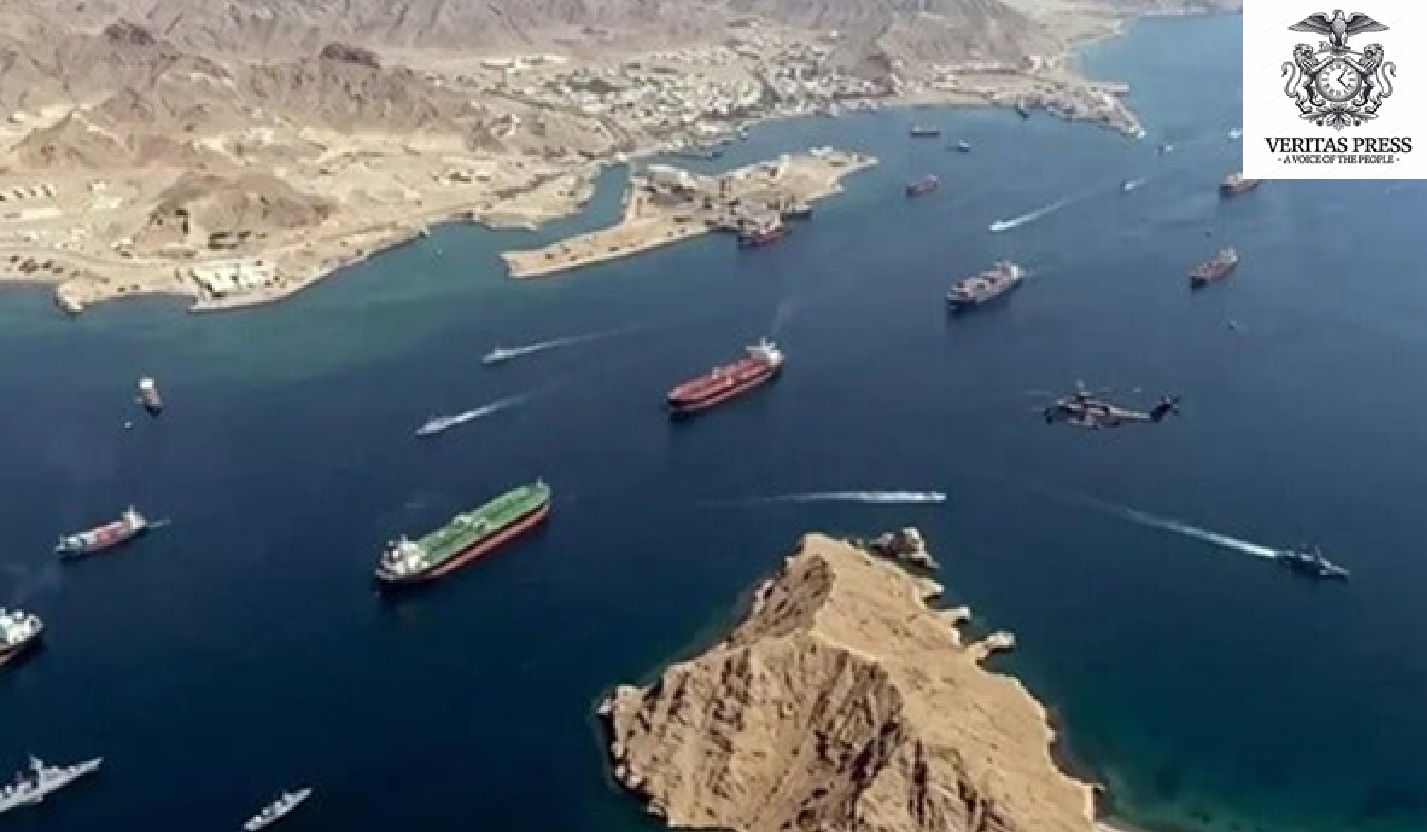
LONDON — On the eve of the tenth anniversary of the vote to leave the European Union, millions of British households are opening notices of a 13% energy price hike. The immediate cause is a geopolitical shock; Iran’s blockade of the Strait of Hormuz has choked off a fifth of the world’s oil and gas, but the deeper, more uncomfortable story is one the political class has spent a decade avoiding: Brexit itself has made Britain poorer, less secure, and structurally more exposed to exactly this kind of crisis.
Now, Keir Starmer’s government is placing a sizable bet on a technical fix: a new electricity trading deal with the EU that, it claims, will bear down on bills by linking the two markets and sweeping away what the minister in charge calls a “clunky, slow, and prone to expensive miscalculations” system. In an exclusive essay for The Independent, Nick Thomas-Symonds, the Cabinet Office minister tasked with negotiating the UK-EU reset, argued that the arrangement would function “like a de facto modern digital stock market, ensuring power always flows automatically from where it is cheapest to where it is needed.” It is, he says, “common sense.”
With insights gleaned from economic modelling, leaked EU documents, trade union demands, business testimony, and interviews with officials on both sides of the Channel, the analysis indicates that the proposed energy pact, while having value, cannot make up for the fundamental damage incurred by leaving the world’s largest trading bloc. Even under the most optimistic scenarios for closer ties, the UK will recover less than half the output forfeited since 2016. And the price of even that partial repair will require Britain to swallow a bitter pill it has choked on for a decade: surrendering sovereignty to rules made in Brussels.
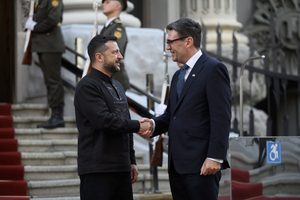
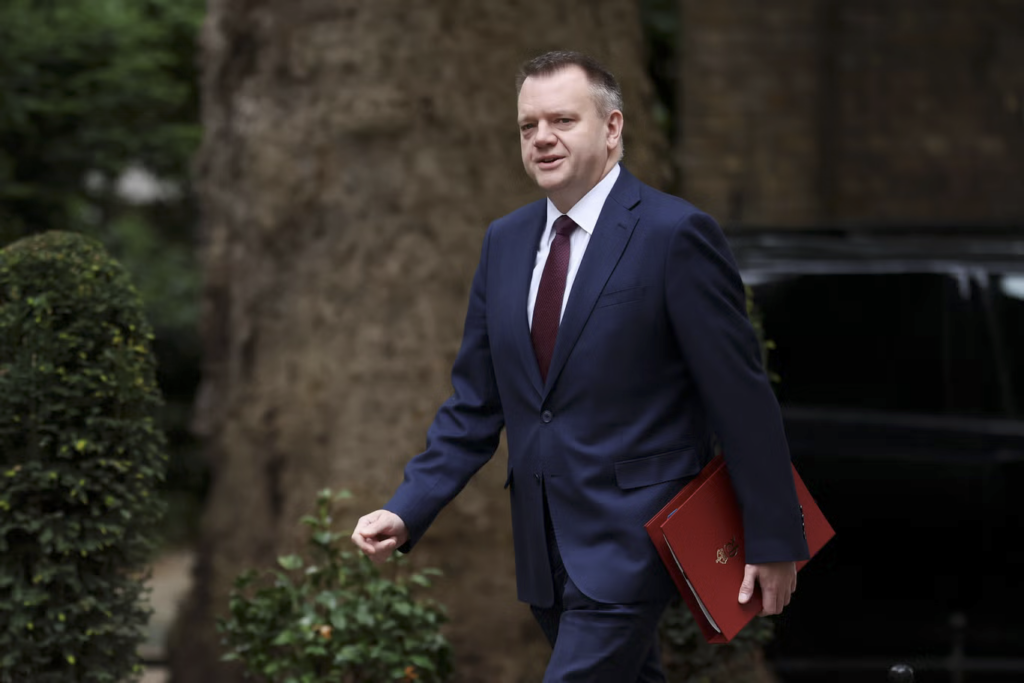
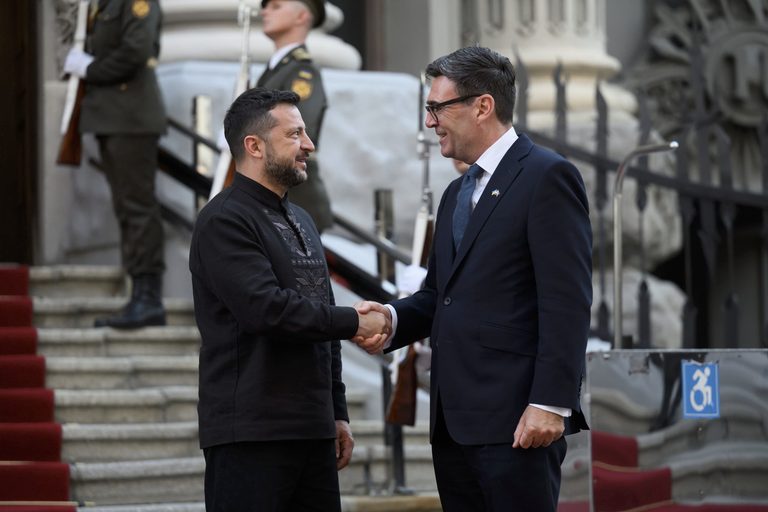
Nick Thomas-Symonds, a key Starmer ally, leads on Britain’s negotiations with the EU
The Anatomy Of An Energy Crisis:
Britain’s electricity market was not designed for a world of intermittent renewables and weaponised fossil fuel supply. Donal Brown, a senior researcher in energy policy at the University of Oxford, put it bluntly in a report for the think tank Common Wealth: “Gas still sets the price for 80% to 90% of the time, while generating only a quarter of our power.” That means every spike in global gas markets feeds directly into household bills, while cheaper wind and nuclear power merely inflates the margins of private generators.
The Common Wealth proposal, for the government to act as a “single buyer” of electricity, contracting directly with generators at cost-reflective prices and placing gas plants into a strategic reserve, would, Brown calculates, save the typical household around £185 a year. Over a five-year window with elevated prices, total savings could reach £74 billion. The plan in effect breaks the link between gas and electricity prices, a reform the government has gestured toward but not yet embraced at scale. Chancellor Rachel Reeves has instead hiked the windfall tax on generator profits from 45% to 55%, a move critics describe as “tinkering while the house burns.”
But the government’s preferred fix lies not in rewiring the domestic market so much as in reconnecting it to Europe. Ten interconnector cables already run beneath the North and Irish seas, allowing Britain to import cheap French nuclear power on windless days and export surplus renewables when the sun is high. The problem, Thomas-Symonds explained, is that traders must buy cable capacity blind before knowing final electricity prices, a process he likened to “an antiquated freight truck booking system.” A new EU-UK deal would merge the two trading systems so that electricity flows automatically to where it is cheapest, eliminating the middlemen and, in theory, pushing down wholesale costs.
It is a compelling pitch. Yet energy analysts and EU officials warn that the savings, while real, are modest. Bruegel, the Brussels-based economics think tank, estimates that a fully integrated EU-UK electricity market could shave perhaps 2-3% off wholesale prices, welcome, but hardly transformational when households face a £200-plus annual increase. “This is a sensible step,” said Jeromin Zettelmeyer, Bruegel’s director, in an interview. “But it’s not a substitute for a comprehensive economic reset. The big prize is trade in goods and services, not electrons.”
The Brexit Tax:
Quantifying the cost of Brexit has become a cottage industry, and the estimates are staggering. A new analysis by Bloomberg Economics, published this week to mark the referendum’s 10th anniversary, puts the long-run hit to UK GDP at 2.5%, equal to roughly £30 billion in forgone annual tax revenue, enough to cover the Ministry of Defence’s entire capital budget. Other assessments range from the Bank of England’s 3.5% to an eyebrow-raising 6-8% in a National Bureau of Economic Research paper. Bloomberg’s central figure is an attempt to be conservative, adjusting for the distorting effect of US and Irish growth and the common energy shocks the UK and EU suffered in 2022.
“The consensus among economists was always that the impact of Brexit would be significant,” said Jonathan Portes, professor of economics and public policy at King’s College London. “That’s what the evidence shows, and the public are clearly noticing, with large majorities now accepting it has been damaging.”
In Crewe, Cheshire, Mike Walley and Sue Judd have lived with that damage. Their toys business, Everything Dinosaur, saw sales to European buyers collapse after the Trade and Cooperation Agreement erected customs barriers. Mike voted Remain, Sue voted Leave. A decade on, they agree it was a mistake. “When we were the second-largest member, we had a voice; now we just take their rules and regulations,” Mike said, standing in their warehouse. Sue added: “It’s not been great for business. There is a lot more cost and a lot more paperwork. If the referendum were held again now, I would probably vote differently.”
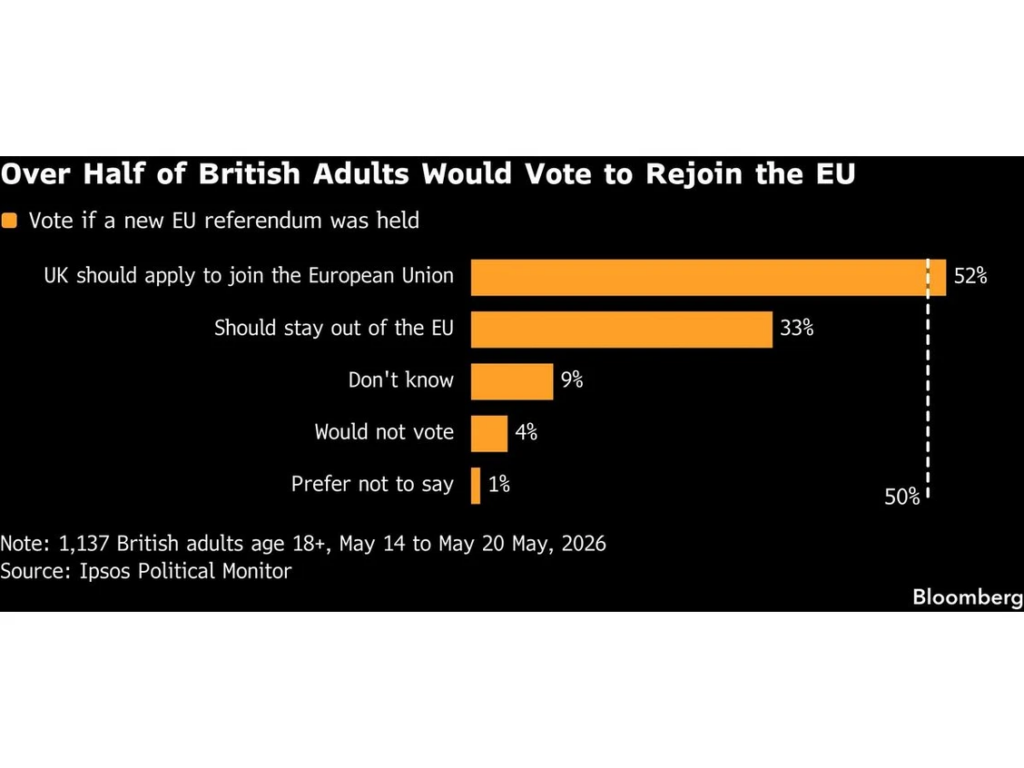
That sentiment is now mainstream. An Ipsos poll conducted for Bloomberg this month shows 54% of Britons favour rejoining the EU, up from 52% a year ago. Nearly half want a second referendum, and only 33% would vote to stay out. “Economic pessimism caused by long-term underperformance has persuaded voters on both sides of the Brexit argument that the status quo is broken and politics doesn’t work anymore,” said Rob Ford, professor of political science at the University of Manchester.
The Political Tinderbox:
Yet Starmer, a former Remainer, has spent his premiership carefully avoiding the R-word. His red lines, no return to freedom of movement, no single market, no customs union, are intact, even as his government inches toward a more porous relationship. In May, ministers introduced the European Regulatory Alignment Bill, which would allow the UK to adopt new EU rules without a full parliamentary vote, a so-called dynamic alignment mechanism once derided by Brexiteers as a “Henry VIII power grab” when Boris Johnson used similar provisions to ram through the withdrawal agreement. The bill is widely seen as a first step toward a Swiss-style package of bilateral deals.
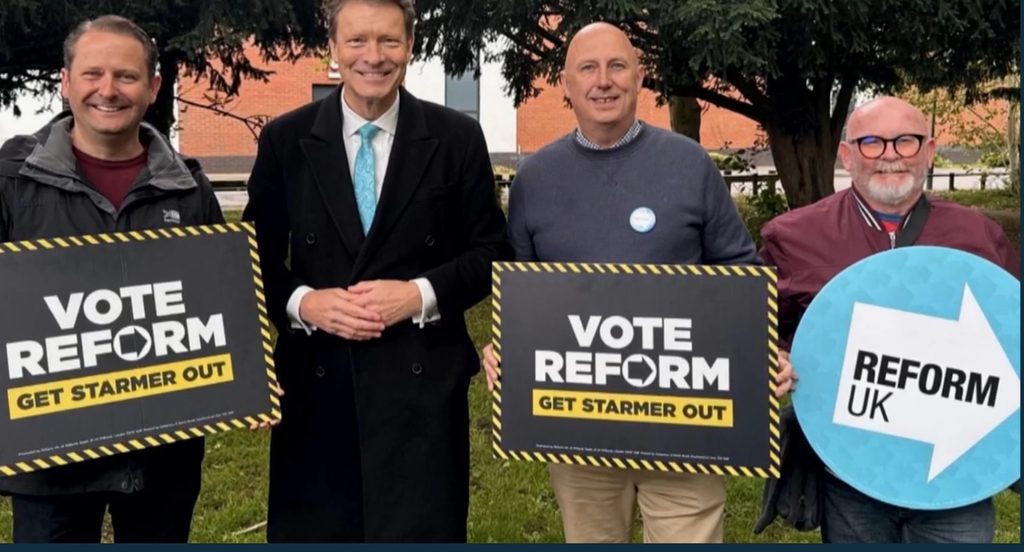
That legislative move, combined with Thomas-Symonds’s energy diplomacy, has rekindled the Tory culture war. “This is betrayal by stealth,” Sir Jacob Rees-Mogg, the former business secretary, told the House of Commons during the bill’s second reading. “We were promised taking back control, not handing it back by the back door.” Nigel Farage, whose Reform UK has led opinion polls for more than a year, called the bill “a surrender document” and pledged to repeal it.
Farage’s popularity has complicated the EU’s own calculations. At the UK-EU summit in Brussels last month, the first full bilateral summit since the TCA was signed, negotiators tabled a draft energy chapter, but progress stalled on broader trade facilitation. EU diplomats privately acknowledge that France, in particular, is reluctant to grant concessions that a future Front National government could exploit, while also demanding a “Farage clause” that would impose penalties if Britain reneges on a future deal.
“The common threat from the US and Russia has changed the reasons for alignment,” Zettelmeyer said. “Security is more important now, relatively, than the single market. But the politics on both sides are treacherous.” Germany, the Nordics and the Baltic states are pushing to bring the UK closer to bolster European defence, but Paris and some southern capitals fear a British free-rider.
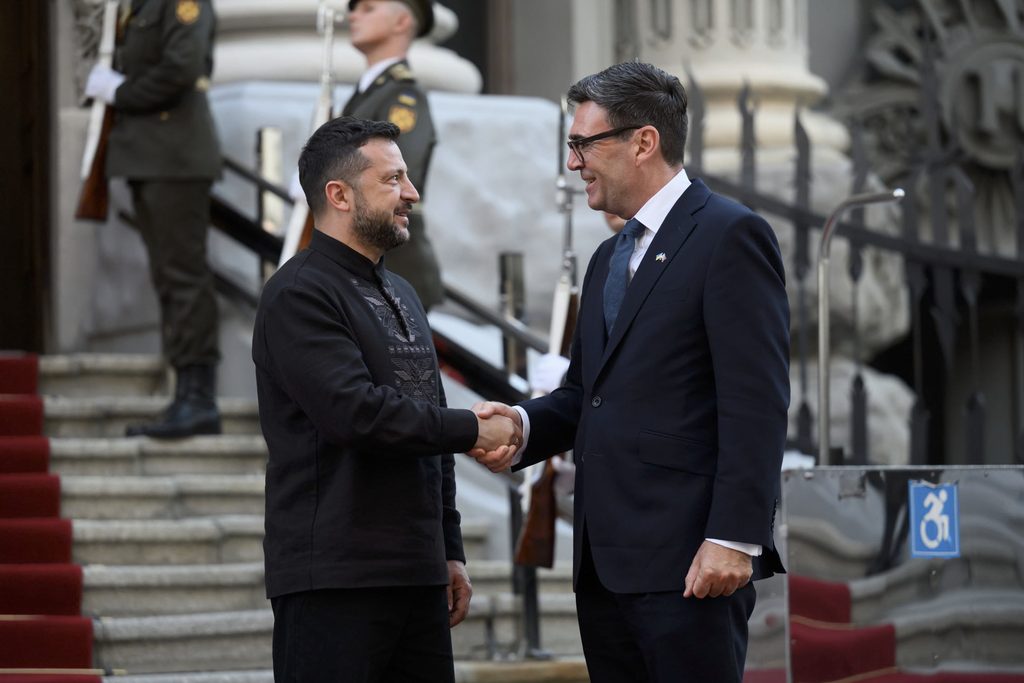
The uncertainty has a very human dimension. In the former Labour stronghold of Makerfield, northwest England, a by-election on June 18 has become a proxy war for the soul of the party. Greater Manchester Mayor Andy Burnham, a declared leadership challenger to Starmer, is standing for the seat. Burnham once argued openly for reversing Brexit; he now says he doesn’t want to “re-run the old arguments” but has signalled that rejoining the single market should be Labour’s long-term goal. His opponent from Reform is hammering the cost-of-living crisis and linking it to immigration and the “betrayal” of Brexit. “People here voted Leave because they wanted change,” said Carol Higgins, 61, a retired care worker in Ashton-in-Makerfield. “They’ve had nothing but more bills and fewer services. Now they’re told we might end up back in the EU anyway, but without any say. What was the point?”
Unions Demand A Workers’ Reset:
Amid the manoeuvring, trade unions on both sides of the Channel have issued their sharpest joint intervention since 2020. The TUC and the European Trade Union Confederation (ETUC) published a shared platform for the May summit, calling for a reduction in trade barriers and border checks, mutual recognition of professional qualifications, UK membership of the Erasmus+ vocational training scheme, and alignment on chemical and food standards. Their pitch is that the reset must deliver for workers, not just corporations.
“Working together will be crucial to stop another wave of price hikes,” said ETUC General Secretary Esther Lynch. “The reduction of trade barriers between neighbours would be a timely boost for companies and help to protect and create quality jobs.”
TUC General Secretary Paul Nowak was even more direct: “It’s time for a common sense trade deal that works for workers and business in the UK and the EU. The Conservatives’ botched Brexit agreement has set workers and businesses back at home and abroad.”
Union leaders are acutely aware that the energy crisis is also a jobs crisis. Energy-intensive industries, such as steel, ceramics, and chemicals, have been hammered by UK electricity prices that are among the highest in Europe. Without a deal that lowers industrial energy costs, they warn, the government’s clean energy mission will be a recipe for deindustrialisation. “You cannot have a green transition on the back of broken supply chains and uncompetitive power prices,” said a senior GMB official involved in the talks, speaking on condition of anonymity.
The Sober Bottom Line:
Bloomberg Economics’ modelling of three “reset” scenarios, a Swiss-style bespoke package, rejoining the customs union, or joining the single market for goods, shows that even the most ambitious option would recover at most 1.2 percentage points of lost GDP. That translates to between £5 billion and £14.4 billion in annual tax receipts, before any new payments to Brussels are deducted. The energy deal alone, while reducing consumer exposure to gas price swings, will not alter the fundamental trade and investment dynamics that have dragged on productivity.
“You’d be bonkers to say Brexit doesn’t have a negative effect; it does, through trade and investment,” said Julian Jessop, a Brexiteer economist and former chief global economist at Capital Economics. “But over the years, the positives will build. Things will start to get better. We should stop this drift back to Europe, tying ourselves up in all these EU rules and regulations.”
The drift, however, is already underway. The dynamic alignment bill passed its second reading on a thin majority, with 42 Labour MPs rebelling. The EU-UK energy negotiations resume in September, but officials have briefed that a final deal is unlikely before 2027, and that it will almost certainly require Britain to accept European Court of Justice jurisdiction over energy disputes, a provision Starmer has ruled out in other sectors. Thomas-Symonds, in his Independent essay, admitted that “deepening our relationship with the European Union is essential for our energy security and the best way to keep Britons’ energy bills down.” Yet he stopped short of describing the institutional architecture such a deepening would demand.
“The government is trying to have its cake and eat it, all over again,” said Anand Menon, director of the UK in a Changing Europe think tank. “There is no mechanism to get the benefits of single market integration without accepting the rules and institutions that underpin it. Pretending otherwise is a dangerous fiction.”
Back in Cheshire, Mike Walley is philosophical. “We just want to get on with running our business. If a deal with Europe means less paperwork and lower costs, I’m for it. But I’m tired of politicians promising magic solutions that never arrive.” As Britain marks ten years since the vote that promised to “take back control,” the question is whether it can finally control the one thing that matters most: its own economic destiny.
For The Secure Submission Of Documentation, Testimonies, Or Exclusive Investigative Reports From Any Global Location, Please Utilise The Following Contact Details For Our Investigations Desk: enquiries@veritaspress.co.uk or editor@veritaspress.co.uk
Help Support Our Work:
Popular Information is powered by readers who believe that truth still matters. When just a few more people step up to support this work, it means more lies exposed, more corruption uncovered, and more accountability where it’s long overdue.
Help Protect Independent Journalism, Which Is Currently Under Attack.
If you believe journalism should serve the public, not the powerful, and you’re in a position to help, becoming a DONATOR or a PAID SUBSCRIBER truly makes a difference.
DONATION APPEAL: If You Found This Reporting Valuable, Please Consider Supporting Independent Journalism.
Help Support Our Work – We Know, We Know, We Know …
Seeing these messages is annoying. We know that. (Imagine what it’s like writing them … )
Your support fuels our fearless, truth-driven journalism. In unity, we endeavour to amplify marginalised voices and champion justice, irrespective of geographical location.
But it’s also extremely important. One of Veritas Press’s greatest assets is its reader-funded model.
1. Reader funding means we can cover what we like. We’re not beholden to the political whims of a billionaire owner. We are a small, independent and impartial organisation. No one can tell us what not to say or what not to report.
2. Reader funding means we don’t have to chase clicks and traffic. We’re not desperately seeking your attention for its own sake: we pursue the stories that our editorial team deems important and believe are worthy of your time.
3. Reader Funding: enables us to keep our website and other social media channels open, allowing as many people as possible to access quality journalism from around the world, particularly those in places where the free press is under threat.
We know not everyone can afford to pay for news, but if you’ve been meaning to support us, now’s the time.
Your donation goes a long way. It helps us:
Keep the lights on and sustain our day-to-day operations
Hire new, talented independent reporters
Launch real-time live debates, community-focused shows, and on-the-ground reporting
Cover the issues that matter most to our communities, in real time, with depth and integrity
We have plans to expand our work, but we can’t do it without your support. Every contribution, no matter the size, helps us stay independent and build a truly people-powered media platform.
If you believe in journalism that informs, empowers, and reflects the communities we serve, please donate today.
Kamran Faqir is a volunteer investigative journalist and writer committed to exposing hidden truths and amplifying underreported stories. Driven by social justice, he brings sharp insight and fearless truth-telling to independent journalism. NUJ registered.
SEATTLE, TEHRAN — The U.S. Department of Homeland Security (DHS) will allow Iran’s national football team to enter the country 48 hours before their critical World Cup match against Egypt on Friday, a modest concession in a tournament where Team Melli’s travel conditions have sparked claims of oppression and competitive disadvantage.





























frya3v