














Original Article Date Published:
Help support our mission, donate today and be the change. Every contribution goes directly toward driving real impact for the cause we believe in.
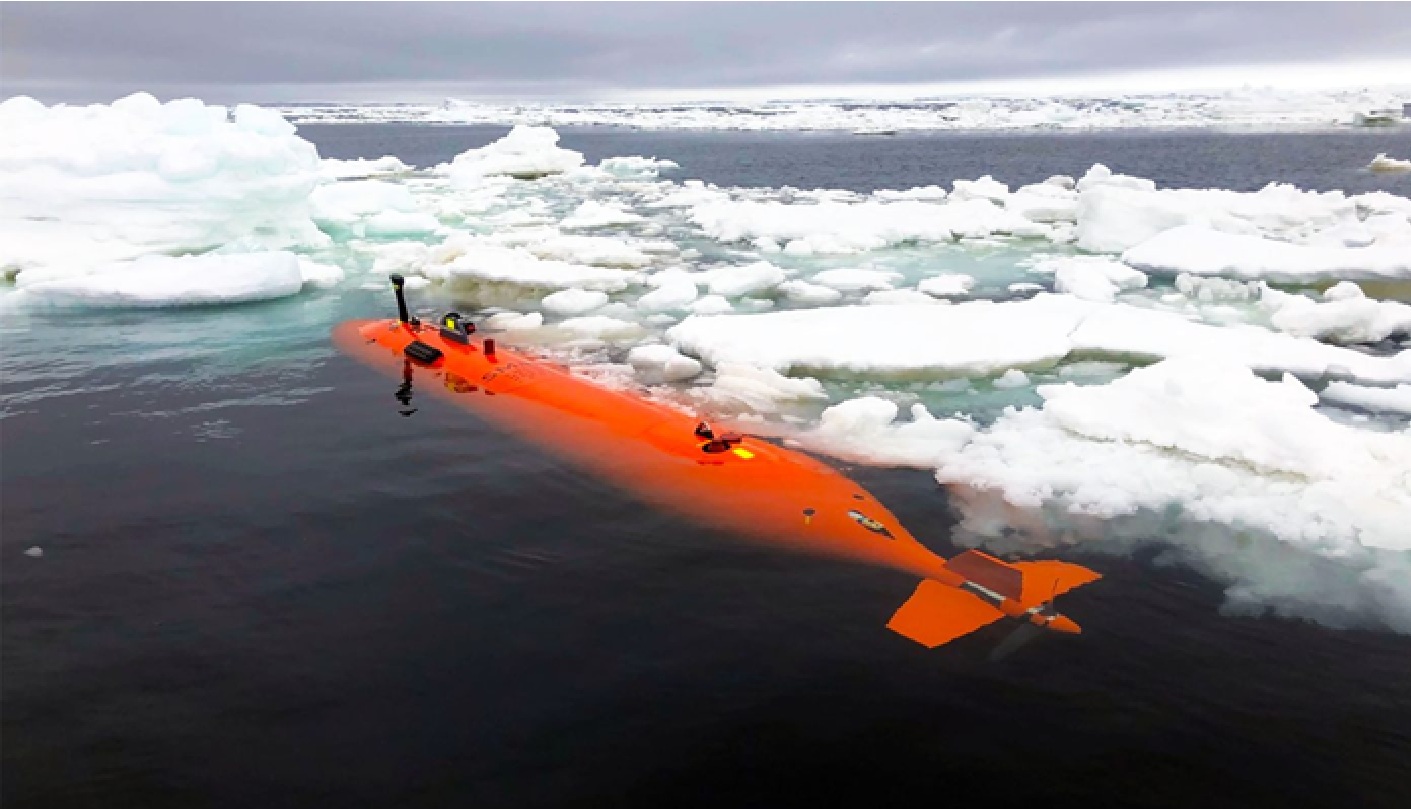
An unmanned submarine mapping West Antarctica’s Dotson Ice Shelf reported strange under-ice structures, then went silent after travelling underwater roughly ten miles towards the ice shelf’s centre.
The vehicle, called Ran, had spent weeks scanning an ice area roughly fifty square miles, revealing patterns that upend simple melt models.
Ran’s mission beneath the Dotson ice shelf
The work was led by Anna Wåhlin, a professor of oceanographic physics at the University of Gothenburg, coordinating the Ran missions in West Antarctica.
Her research focuses on how ocean currents erode ice shelves from below, changing glacier stability and future sea level.
Ran is an autonomous underwater vehicle, a robot submarine that navigates alone under ice for hours.
During a 2022 campaign, Ran spent 27 days weaving under Dotson’s floating ice, eventually reaching about eleven miles into the hidden cavity.
The mission aimed to explain the sharp contrast between Dotson’s thick, slow-melting eastern side and its thinner, faster-melting western side.
Ran saw strange things, then vanished
Using sonar, Ran mapped 54 square miles of ice underside beneath the Dotson Ice Shelf. The maps revealed flat plateaus, terraced steps, and teardrop-shaped pits, all carved by basal melt, melting that attacks the ice from below.
In the east and centre, Ran saw icy terraces stacked like steps, while the west looked smoother, with channels and scooped depressions.
None of these terraces or teardrop pits shows up on satellite images, so they had remained completely hidden until Ran’s mission.
Warm deep water, uneven melting
Around Antarctica, Circumpolar Deep Water, a warm, salty current from the Southern Ocean, moves onto the shelf and melts ice shelves from below.
Satellite altimetry over Dotson shows that melt channels lose ice at about 40 feet per year, a thinning pattern linked to warm water.
Analysis of measurements under Dotson indicates that this ice shelf added 0.02 inches to sea level between 1979 and 2017.
The under-ice maps show that this warm inflow focuses erosion on Dotson’s western side, while colder water leaves the eastern flank protected.
Terraces, teardrops, and turbulence
Where currents move slowly, the base of the ice looks like stacked ledges, formed as melting eats away flats and leaves small steps.
In the fast outflow region, currents create smoother surfaces with grooves, where shear-driven turbulence, mixing caused by sliding water layers, drives rapid melting.
Some pits are teardrop-shaped, 984 feet long and 164 feet deep, carved by currents near the ice base.
Elsewhere, the terraced plateaus probably record bursts of slightly warmer water entering the cavity, slowly peeling away layers of ice over many years.
Fractures that widen from below
Ran also imaged full-thickness fractures that slice through the ice shelf, many of them widened and smoothed at their bases by melting.
Satellite records show that some of these cracks have been open since the 1990s, and those older fractures carry the deepest melt scars.
In these narrow slots, faster-moving water can channel extra heat against the ice walls, turning fractures into hidden highways for ice loss.
Because most computer models treat melt in broad strokes, they often overlook how fractures and channels steer warm water and concentrate damage.
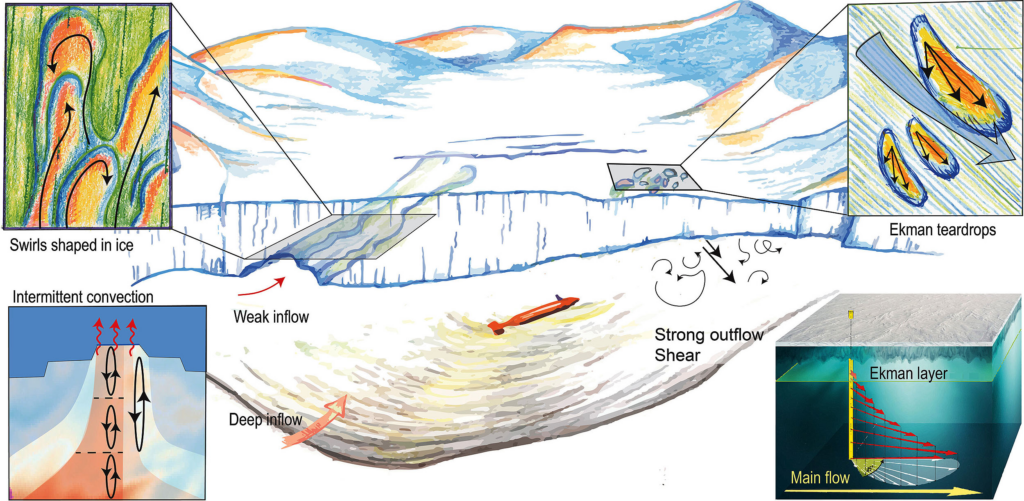
Sketch showing the processes discussed in the paper on the Dotson Ice Shelf in Antarctica. Note that the vertical scale is exaggerated. Credit: Science/ITGC. Click image to enlarge.
Implications for future sea levels
Combined satellite and climate data show that Antarctic ice loss has added about 0.55 inches of sea level since 1979.
Much of that loss comes from West Antarctica, where ice shelves like Dotson float above deep basins that warm currents can reach.
When those floating shelves thin or break, they stop bracing the land-based ice behind them, so glaciers accelerate, and sea levels climb faster.
Understanding how warm water eats away at Dotson’s base now helps researchers judge how quickly distant glaciers might respond as the climate warms.
Dotson Ice Shelf difficulties
Ran worked without real-time contact, because radio waves and GPS signals cannot pass through hundreds of feet of solid ice.
Instead, the vehicle relied on navigation systems and acoustic instruments to track its position against the seafloor and the underside of the ice.
Typical missions ranged between several hours and more than a day, meaning problems deep under the ice stayed invisible until Ran surfaced again.
Despite those hazards, the team completed 14 successful under-ice missions with Ran in 2022, bringing back a dataset for glaciologists and oceanographers.
When the Ran submarine disappeared
When the researchers came back to Dotson, Ran was sent on a mission beneath the ice to extend maps and measurements.
“To see Ran disappear into the dark, unknown depths below the ice, executing her tasks for over 24 hours without communication, is of course daunting,” said Wåhlin.
When Ran did not appear at the pickup point, attempts to contact the vehicle failed, and searches found no signals or debris.
Because there was no feed, the team can speculate about the cause, ranging from mechanical failure to a collision with ice ridges.
Ran and the Dotson Ice Shelf
Despite the loss, Ran’s earlier missions transformed the team’s view of how ice and ocean interact in this remote cavity.
Those maps show that the underside of an ice shelf can host terraces, channels, fractures, and teardrops, each responding differently to currents.
Incorporating terraces, fractures, and melt channels into models should help narrow predictions of how quickly West Antarctica might lose ice in future climates.
For now, the detailed maps Ran sent home are a rare window on Antarctica’s hidden melt machinery, reminding scientists how much remains unexplored.
The study is published in Science Advances.
—–
Like what you read? Subscribe to our newsletter for engaging articles, exclusive content, and the latest updates.
Check us out on EarthSnap, a free app brought to you by Eric Ralls and Earth.com.
Source: Multiple News Agencies

LONDON – In one of the final and most consequential acts of his premiership, outgoing
Iran’s Islamic Revolutionary Guard Corps (IRGC) announced the launch of the second wave of Operation
In the blistering heat of a Tehran summer, Brigadier General Mohammad Akrami-Nia’s words were not

The Last Distribution Centre – In Northern Gaza, Armed Raids, Black-Market Smuggling, And A Strangling
An Analysis Of The IRGC’s Five-Phase Retaliatory Operation, The Collapse Of The Washington-Tehran Détente, And

The sky over the Arabian Peninsula lit up not with the summer sun, but with
The diplomatic ink had barely dried on the draft proposals in Muscat before the Strait

Article Date Published: Article Date Modified: Help support our mission, donate today and be the

From The Arbaeen Road To The Shrines Of Najaf And Karbala: How The Unprecedented Funeral

From Olive Groves To Air Bases, Trump’s Ankara Ultimatum Weaponises Trade, Travel And Military Access






























Hello Veritaspress Co Uk Owner,
My name is Eric and I’m betting you’d like your website Veritaspress Co Uk to generate more leads.
Here’s how:
Web Visitors Into Leads is a software widget that works on your site, ready to capture any visitor’s Name, Email address, and Phone Number. It signals you as soon as they say they’re interested – so that you can talk to that lead while they’re still there at Veritaspress Co Uk.
Visit https://blastleadgeneration.com to try out a Live Demo with Web Visitors Into Leads now to see exactly how it works and even give it a try… it could be huge for your business.
Plus, now that you’ve got their phone number, with our new SMS Text With Lead feature, you can automatically start a text (SMS) conversation quickly… which is so powerful because connecting with someone within the first 5 minutes is 100 times more effective than waiting 30 minutes or more later.
The new text messaging feature lets you follow up regularly with new offers, content links, even just how are you doing? notes to build a relationship.
Everything I’ve just described is extremely simple to implement, cost-effective, and profitable.
Visit https://blastleadgeneration.com to discover what Web Visitors Into Leads can do for your business, potentially converting up to 100 times more eyeballs into leads today!
Eric
PS: Studies show that 70% of a site’s visitors disappear and are gone forever after just a moment. Don’t keep losing them.
Web Visitors Into Leads offers a complimentary 14-day trial – and it even includes International Long Distance Calling.
You have customers waiting to talk with you right now… don’t keep them waiting.
Visit https://blastleadgeneration.com to try Web Visitors Into Leads now.
If you’d like to Want to receive fewer emails, or none whatsoever? Update your email preferences by visiting https://blastleadgeneration.com/unsubscribe.aspx?d=veritaspress.co.uk
forward all queries to enquiries@veritaspress.co.uk
zzalf7
2sr1tm