






Author:
Byline: Investigative Desk
Help support our mission, donate today and be the change. Every contribution goes directly toward driving real impact for the cause we believe in.
A tour of illegal outposts reveals the machinery of dispossession. New government billions, a fresh settlement approval, global real estate fairs selling occupied land, and a plan for military-agricultural outposts in Gaza show the project speeding up at breakneck speed.
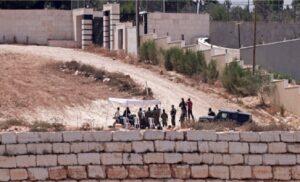
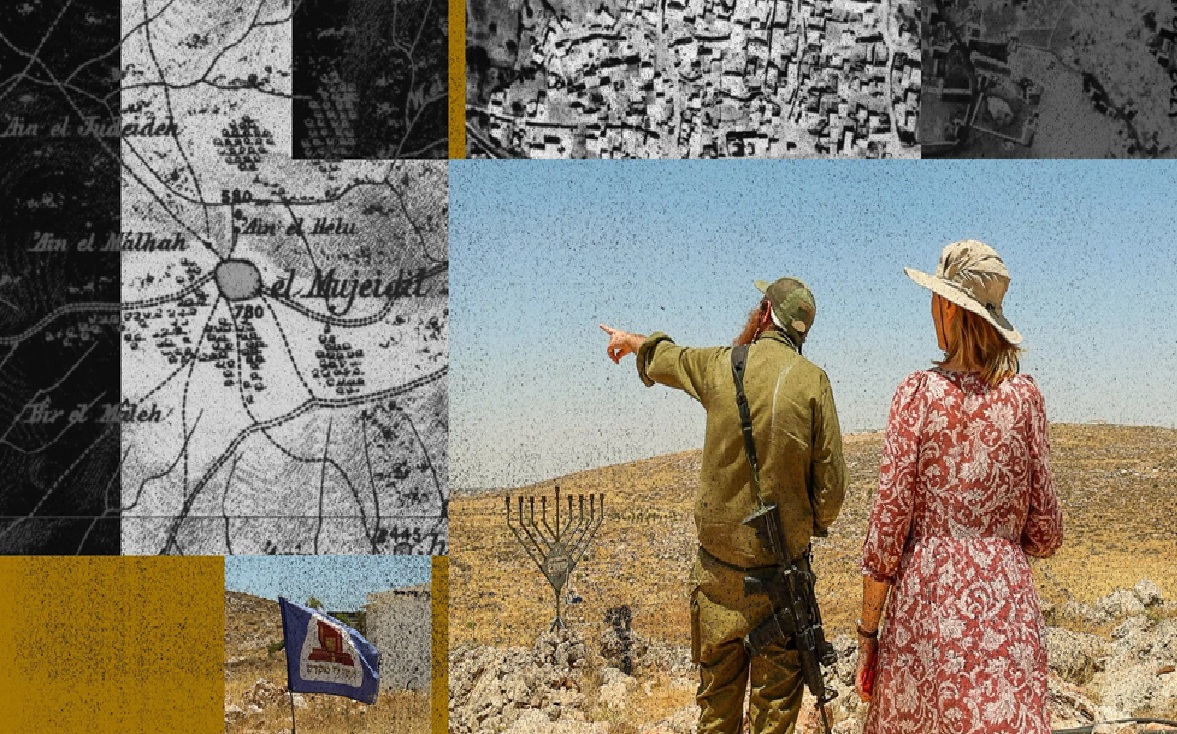
WEST BANK — On a hillside overlooking the Palestinian village of al-Mughayyir, a crowd of Israelis and Jewish visitors from abroad gathered in June for an inside look at how settlement works. They listened intently as Netanel, an Israeli settler-soldier in olive fatigues with a rifle strapped to his back, advertised his group’s impact in the Israeli-occupied West Bank.
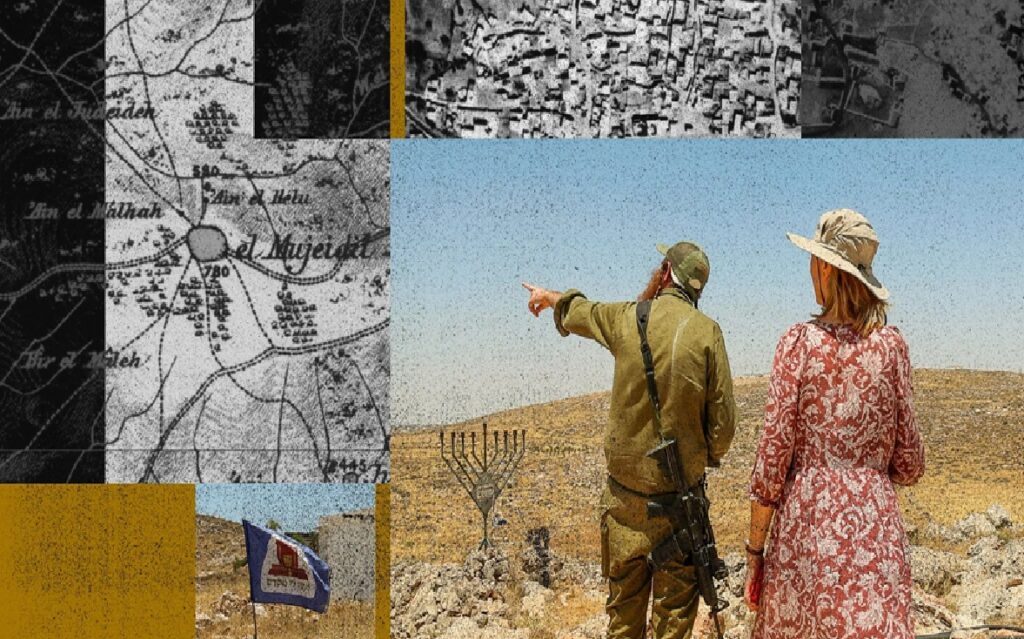
“It started with this hilltop,” he said, referring to the current settlement push that has crept ever closer to al-Mughayyir. “We ended up putting the area in Jewish hands. There are no Arabs here.”
Netanel was speaking on a tour aimed at English-speaking Jews, some of whom expressed interest in moving to the settlements. He described his “mission” to support fellow settlers and shepherds in their return to “Judea and Samaria,” the biblical name Israeli settlers and the government use for the West Bank.
The settlement movement is speeding up, recruiting outsiders to join and bringing in reinforcements from the military’s Hagmar battalions, regional defence units staffed largely with settlement residents that have exploded in size since October 7, 2023. The government has issued thousands of rifles to civilian security squads, distributed personally by Israel’s far-right national security minister, Itamar Ben-Gvir. Israeli watchdog groups describe the push as an unprecedented state-backed land grab, one that settlers are carrying out with an odd combination of tools: government-supplied rifles alongside herds of sheep and goats.
Reservist settler-soldiers like the Hagmar battalions “are not simply self-organised militia groups,” said Marko Milanovic, a professor of public international law at the University of Reading. “In essence, they should be treated in the same way as IDF soldiers as a legal matter.”
But the recruitment effort doesn’t end on this hillside. It extends to hotel conference rooms in Brooklyn, synagogue halls in London, and expo centres in Toronto, where the Israeli government and settler organisations are now hosting real estate fairs explicitly selling homes in the Occupied Palestinian Territories (OPT). In June, a “Judea and Samaria Housing Fair” in Golders Green, London, drew hundreds of prospective buyers and dozens of protesters who condemned the event as a violation of international law. Brochures for gated communities in Efrat, Ariel, and Ma’ale Adumim offered “a taste of the biblical heartland” with financing available, panoramic photographs that erased the Palestinian villages bordering them, and sales agents promising that “now is the time to secure your legacy in the land of Israel.”
“These fairs are not just peddling real estate; they are marketing the occupation itself,” said Tarek Amro, a counsellor at the Palestinian Mission to the United Kingdom, who joined activists outside the London event. “They are explicitly selling property on stolen land in the Occupied Palestinian Territories. Host countries have an obligation under the Fourth Geneva Convention not to facilitate the transfer of civilians into occupied territory.”
The London fair was not an outlier. In March, the “Great Israel Real Estate Event” in Teaneck, New Jersey, featured prominent settlement developers, while a similar showcase in Toronto in April drew hundreds of attendees, according to local media reports. In Paris, organisers held a smaller event in a private venue in May after public backlash forced them to move it from a community centre. Organisers often frame the fairs as private commercial ventures, but investigations by Israeli watchdog groups have traced connections to settlement municipal councils and government bodies. Israel’s Ministry of Aliyah and Integration has publicly endorsed some events as part of encouraging Jewish immigration to “all parts of the land of Israel,” blurring the line between state policy and private salesmanship.
“These real estate expos are the international arm of what we’re seeing on the ground in the West Bank,” said Dror Etkes, head of the Israeli settlement watchdog Kerem Navot. “They are recruiting diaspora Jews to move into illegal settlements, creating facts on the ground far beyond the view of the average Israeli. It’s a coordinated effort to normalise the settlements, to make them seem like any other suburban community rather than a war crime under international law.”
The United Nations and numerous human rights organisations have repeatedly stated that Israeli settlements in the Occupied Palestinian Territories violate Article 49 of the Fourth Geneva Convention, which prohibits an occupying power from transferring parts of its civilian population into territory it occupies. Yet the global sales pitch continues, often with the tacit blessing of host countries where lobbying groups and political support for Israel insulate the events from government scrutiny.
Back on the hilltop in al-Mughayyir, the connection between the real estate fairs and the reality on the ground is direct. During the June tour, Hodaya, the tour leader, answered a participant’s question about whether Palestinians resisted land confiscation with unsettling candour. “They don’t accept it and say, ‘Oh, very nice, we’re going away.’ Of course they’ll fight. They’re on the land, and they were permanent… but they understand that there’s a change.”
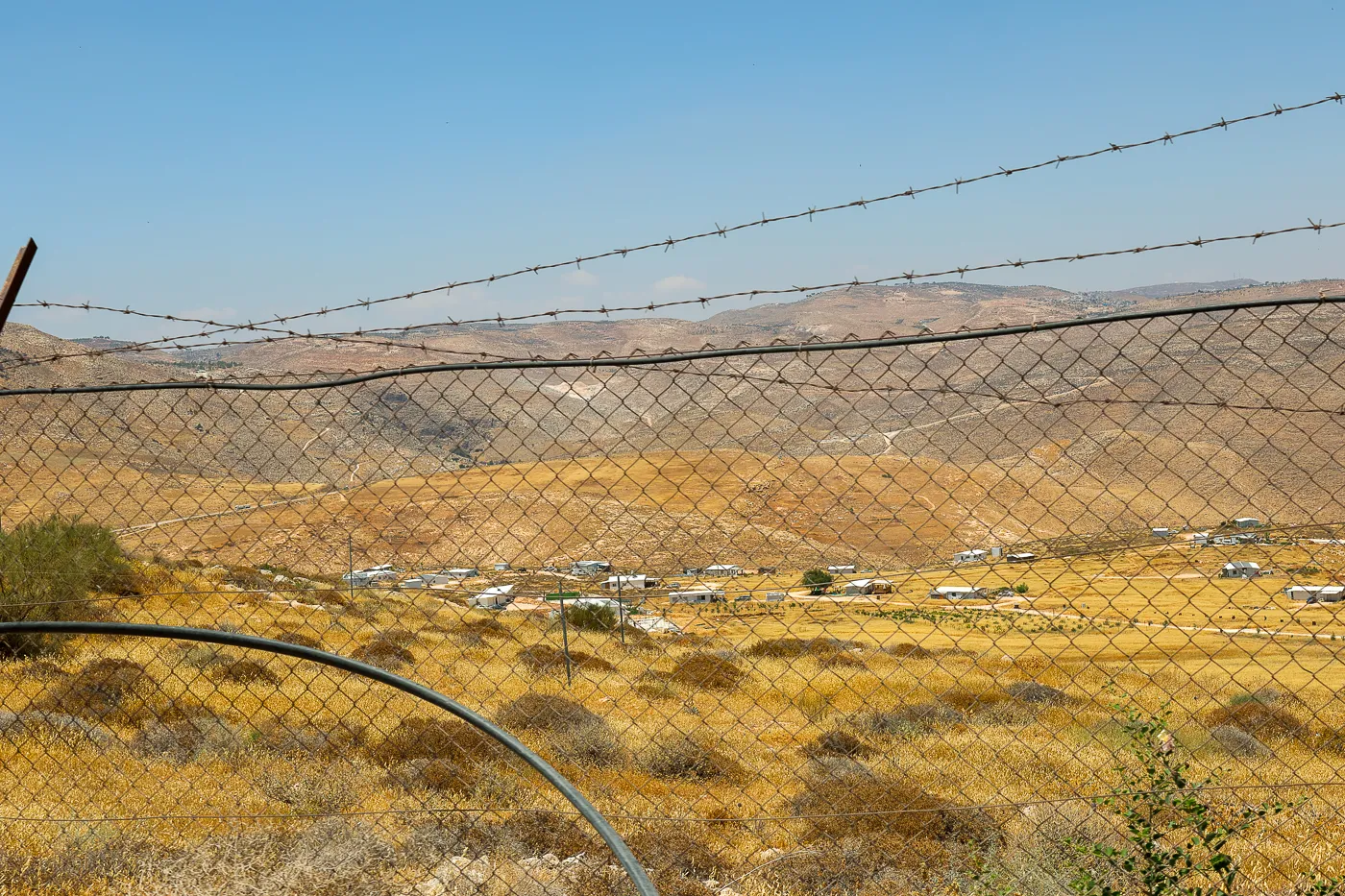
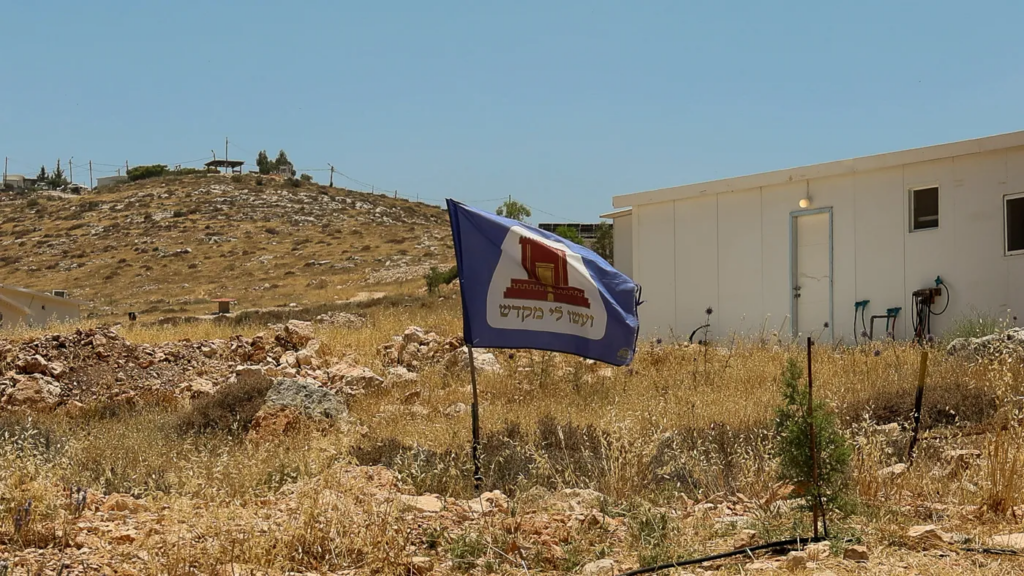
That change is now being sold as an investment opportunity to diaspora Jews in London, New York, and Paris. Netanel was showing off the outpost Metzudat David, which he established in 2025, and it is illegal even under Israeli law. It is one of 10 Israeli outposts that now surround al-Mughayyir as settlements expand at a rapid clip. At one stop on the tour, Israeli youths could be seen building a new housing unit for a family slated to move in. The buyers may have heard about the opportunity at a fair thousands of miles away.
The Grazing Frontier And The $2.79 Billion Endorsement:
Only a handful of settlers like Netanel live at Metzudat David. The real workforce consists of more than 100 sheep and goats that fan out across the hills, grazing Palestinian crops, intimidating farmers, and clearing the way for the outpost to absorb the land, all backed by the threat of settler violence.
These grazing outposts now control at least 786,000 dunams, roughly 14% of all land in the West Bank, according to a report published this month by Peace Now and Kerem Navot. Settlers living in farm outposts now effectively control roughly 1 million dunams, nearly a fifth of the entire territory, the report found. The report also found that the settlers seized roughly 750,000 of those dunams since the current Israeli government took office in late 2022. Some 70% of the land seized by grazing outposts was taken in just the past few years.
“Once [the Metzudat David] outpost went in, it effectively closed off the village’s access to land to the east, displacing the community from that land,” Etkes told The Intercept. Residents describe a growing sense of foreboding, a feeling that their time is running short before life in al-Mughayyir becomes untenable.
That foreboding is now backed by an unprecedented financial commitment from the Israeli state. In recent weeks, the government signed a $2.79 billion umbrella agreement with the Samaria Regional Council, which acts as a municipal authority for settlements in the northern West Bank. The deal guarantees support for new infrastructure and 12,000 new settlement units. The Samaria Regional Council, which manages settlements in the northern West Bank, had already signed similar deals. In June 2026, Israel committed $650 million to the Karnei Shomron Local Council. In September 2025, Israel provided almost $1 billion in guarantees to the Ma’ale Adumim municipality.
“This is a fire sale of the State of Israel,” Peace Now said in response. “Not only is the government thumbing its nose at millions of Israelis and plundering their money for the benefit of a narrow settler sector, it is digging, with its own hands, the diplomatic and security pit in which the State of Israel may end up buried.”
On July 15, the government approved yet another new settlement, Sa-Nur East, next to the Palestinian village of Sa-Nur in the northern West Bank. It is the 104th new settlement established since the current coalition took power in December 2022. Defence Minister Israel Katz also approved $330 million to build new access roads for settlements, explicitly framing the spending as part of a “settlement revolution in Judea and Samaria.”
“The government has gone into overdrive ahead of the elections, racing to create as many facts on the ground as possible and leave scorched earth behind,” Peace Now said of the Sa-Nur East approval.
Breaking Area B:
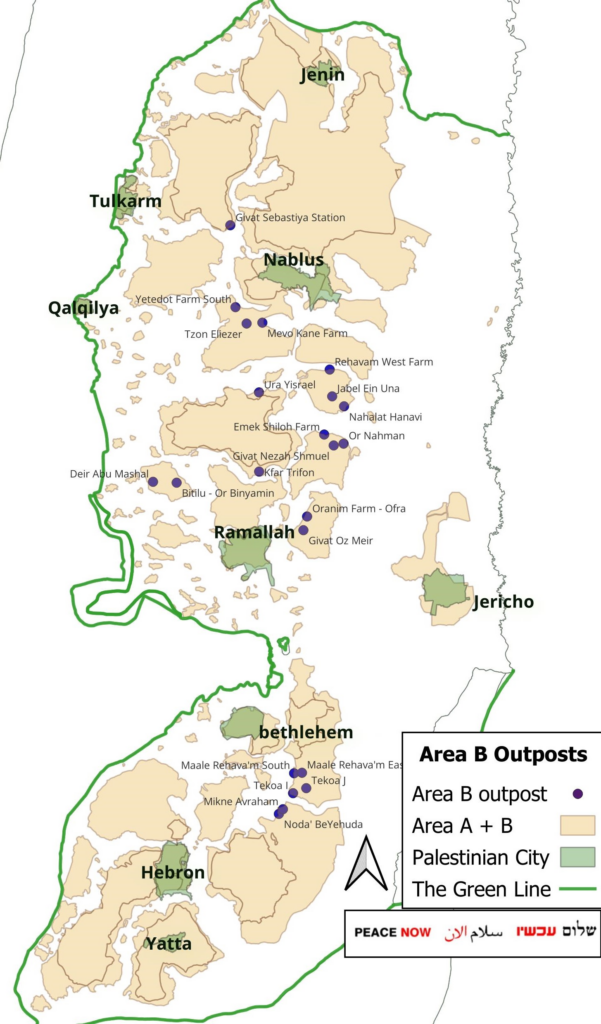
Perhaps the most legally explosive trend is the establishment of outposts inside Area B, the roughly 22% of the West Bank where, under the Oslo Accords, the Palestinian Authority exercises civil control while Israel retains security authority. In a new report this month, Peace Now documented and mapped 21 new outposts established in Area B since 2024.
Peace Now said in a statement:
“The establishment of settlement outposts deep inside Area B demonstrates the government’s annexation agenda and its efforts to weaken the Palestinian Authority. Alongside the massive takeover of Area C, the government is allowing settlers to extend their control into areas that were transferred to Palestinian civil jurisdiction under the Oslo Accords. The fact that these outposts continue to expand even after the Prime Minister publicly stated that they should be evacuated shows that, in practice, the State is violating the agreements it signed and creating unprecedented tensions with the Palestinian population.”
These outposts are illegal under Israeli law. But IDF Central Command chief Maj. Gen. Avi Bluth, the same officer who promised a village would “pay a heavy price,” recently said that outposts “greatly strengthen security” for Israel. Peace Now called the outposts a demonstration of “the government’s annexation agenda and its efforts to weaken the Palestinian Authority.”
For villagers like those in al-Mughayyir, Area B was supposed to be the safety valve. Those days are over.
Violence As Policy:
Al-Mughayyir was the village most affected by settler violence in the West Bank in 2025, with more than 70 recorded settler-related incidents, according to ACLED. It is on track to earn the same distinction in 2026.
In April, a settler shot and killed Aws al-Naasan, a 14-year-old student, and Jihad Abu Naim, a 32-year-old parent, at the village’s boys’ school. Video verified by multiple news outlets shows a man in military fatigues advancing on the village and firing toward the school. The military said the reservist opened fire at “suspects in the area” after stones were allegedly thrown. The authorities dismissed him from reserve duty and confiscated his weapon, but they have not arrested anyone.
“They come in half uniform, wearing the green pants, but not the shirt,” said Omar Mohammed, a resident. “We can’t tell if they are a settler, a soldier, or, well, both.”
According to the U.N., no Israeli soldier has served prison time for killing a Palestinian in the West Bank since at least 2017. Yesh Din found that 93.6% of investigations into settler violence between 2005 and 2025 were closed without indictments.
In March, reservists detained CNN correspondent Jeremy Diamond and his crew while guarding an illegal outpost, telling the journalists on camera that the entire West Bank belongs to Jews.
Last August, the military uprooted at least 3,100 olive trees across 74 acres of al-Mughayyir’s land after an alleged shooting. Maj. Gen. Bluth told troops the village would “pay a heavy price,” prompting rights groups to demand a criminal investigation. None occurred.
Netanel described taking part in the uprooting: “It is for security, security of this outpost. We need a clear line of sight into the land.” The roots still pointed into the air.
Exporting The Model: Gaza’s Nahal Outposts.
And now, the model is being exported to Gaza. On July 19, Defence Minister Katz announced a plan to establish three “Nahal outposts” in northern Gaza, military-agricultural presences that historically led to permanent civilian settlements. Israel now controls nearly 70% of the Gaza Strip.
“The military is only the first phase, which aims to prepare it for future settlement,” Etkes told The Guardian. “All together, dozens of Israeli settlements in the West Bank were established in this way.”
The day before, cabinet members Ben-Gvir and Smotrich joined a march near Gaza to support reestablishing settlements there, organised by the Nachala Movement.
“It’s a process, a process that we are progressing,” Netanel had said on that June tour. “That’s what’s happening here.”
The process now stretches from a hillside in al-Mughayyir to conference halls in Europe and North America, and to the rubble of northern Gaza, where the state-backed machinery of displacement is being reassembled with global salesmanship and billions of public dollars.
Conclusion: The Machinery Of Erasure, Now Open For Business.
The settlement enterprise has always been a project of denial: denial of Palestinian presence, denial of international law, denial of the reality being created on the ground. What the tour of Metzudat David exposed in its rawest form, and what the global real estate fairs now repackage as an aspirational lifestyle, is the same machinery operating at different speeds and in different registers, but toward a single, unambiguous end: the permanent displacement and erasure of Palestinians from their land and the foreclosure of any political horizon in which they might exercise sovereignty.
The fairs in London, Teaneck, Toronto, and Paris are not merely tasteless marketing exercises. They are the public-facing sales floor of a project whose back office is a hillside in al-Mughayyir where a settler-soldier gestures at uprooted olive trees and calls it security. They are the normalisation arm of an apparatus that, in the same month, can shoot dead a 14-year-old boy at his school and then advertise gated communities with panoramic views that carefully crop out the villages those communities are strangling. To attend one of these expos is to witness the occupation being laundered through the language of property investment, mortgage pre-approvals, and “biblical heartland” heritage, a form of ethical outsourcing in which the buyer is invited to participate in a war crime while being assured it is merely a real estate transaction.
The international dimension is not incidental to the settlement project; it is structurally necessary. As Dror Etkes noted, the fairs recruit diaspora Jews to move into illegal settlements, creating facts on the ground far beyond the scrutiny of the average Israeli citizen. They also serve a diplomatic function: by normalising the purchase of property in occupied territory, they chip away at the international consensus that such settlements violate Article 49 of the Fourth Geneva Convention. Each mortgage signed in Golders Green or New Jersey is a small act of sovereignty asserted against the collective will of the international community, and each hosting state that permits these fairs to proceed without legal consequence becomes an accomplice to the transfer of civilian population into occupied territory. Counsellor Tarek Amro was precise in his invocation of Geneva Convention obligations, but the inaction of host governments speaks louder than any legal rebuke.
On the ground, the machine accelerates unabated. The $2.79 billion Samaria deal, the $330 million in settler roads, the 104th settlement approved at Sa-Nur East, the 21 new outposts inside Area B, none of these are isolated policy choices. They are the material infrastructure required to sustain the illusion being sold at the fairs: that these are normal suburban communities rather than the forward edge of an ethnic cleansing project. The grazing outposts that now control one million dunams do the slow, violent work of pushing farmers off their land, work that is then paved over by state-funded highways and sealed with the signatures of buyers from abroad who may never witness the uprooted olive trees or hear the gunfire at the school gate.
And then there is Gaza. The Nahal outposts announced by Defence Minister Katz complete the ideological circle. The method perfected in the West Bank, military presence, agricultural cover, creeping civilian settlement- is being deployed on the ruins of a territory where Israel now controls 70% of the land and where the population has been decimated and displaced. The march led by Ben-Gvir and Smotrich near the Gaza perimeter, the language of “return” to settlements dismantled in 2005, and the administrative mechanism of the Nahal outposts all signal that the government views the destruction in Gaza not as a tragedy requiring redress but as an opportunity requiring exploitation. The “process” Netanel described on that June hillside is not confined to the West Bank; it is a template.
What binds these threads together is the dissolution of any meaningful distinction between state and settler, soldier and civilian, legal and illegal. The Hagmar battalions blend military authority with settler ideology. A reservist who shoots two people at a school is quietly dismissed from duty but never arrested. The military uproots thousands of olive trees at the command of a general who promises collective punishment, and no criminal investigation follows. The government funnels billions to settlement councils while COGAT issues statements about “enforcement priorities” that everyone knows are hollow. And now the same government endorses property fairs that sell homes in these very outposts to foreign nationals, creating a transnational class of settlers whose legal status as occupiers under international law is no different from Netanel’s.
The result is a system of total impunity, one in which the international community has been reduced to issuing statements while Israel builds, sells, and shoots its way toward irreversible annexation. Peace Now’s description of a “fire sale of the State of Israel” is more apt than it may have intended: the government is liquidating any possibility of a negotiated two-state outcome, selling off the future in exchange for the short-term political gains of a pre-election land rush. The buyers, scattered across London, New York, and beyond, are acquiring properties whose true cost will be borne by the millions of Palestinians now squeezed into ever-shrinking enclaves, denied access to their farmland, their roads, their schools, their very right to remain.
In the end, the project’s logic is perfectly self-contained. “There are no Arabs here,” Netanel said, sweeping his arm across a landscape where Arabs had lived for generations, where a teenager had just died of wounds from an army raid, where a 14-year-old’s blood still stained a school courtyard. The glossy brochures at the real estate fairs say the same thing, only in softer language and with better photography. And the billions of shekels, the new roads, the Area B outposts, the Nahal farms in Gaza, the diplomatic cover, the diaspora buyers, all of it is directed toward making that phrase not merely a settler’s boast, but a permanent, legally entrenched, internationally tolerated fact.
It is a process, as Netanel said. And it is progressing. The question now is whether the world will continue to treat it as a real estate matter, or recognise it for what it is: the largest ongoing project of forcible transfer and territorial annexation of the twenty-first century, now open for business, with financing available.
And so the question that remains, suspended over every glossy brochure, every signed mortgage, every state-funded access road, and every hillside where olive roots still twist upward toward the sky: If the world insists on treating this as a real estate market, who will be left to speak for the people whose homes, schools, and very names are being erased from the map, and how will history judge those who bought in?
Veritas Press Investigative Analysis:
Independent journalism examining global affairs, power, diplomacy and accountability.
Source: Veritas Press C.I.C. | Multi-News Agencies
Help Support Our Work By Donating
Readers who believe that truth still matters have power over popular information. When just a few more people step up to support this work, it means more lies exposed, more corruption uncovered, and more accountability where it’s long overdue.
Help Protect Independent Journalism, Which Is Currently Under Attack.
If you believe journalism should serve the public, not the powerful, and you’re able to help, becoming a regular DONOR or a PAID SUBSCRIBER truly makes a difference.
DONATION APPEAL: If you found this reporting valuable, please consider supporting independent journalism.
Your support fuels our fearless, truth-driven journalism. In unity, we endeavour to amplify marginalised voices and champion justice, irrespective of geographical location. We operate independently, with no financial backing from billionaires; our readers support us.
But it’s also extremely important. One of Veritas Press’s greatest assets is its reader-funded model.
1. Reader funding means we can cover what we like. We’re not beholden to the political whims of a billionaire owner. We are a small, independent and impartial organisation. No one can tell us what not to say or what not to report.
2. Reader funding means we don’t have to chase clicks and traffic. We’re not desperately seeking your attention for its own sake; we pursue the stories that our editorial team deems important and believes are worthy of your time.
3. Reader Funding: enables us to keep our website and other social media channels open, allowing as many people as possible to access quality journalism from around the world, particularly those in places where the free press is under threat.
We know not everyone can afford to pay for news, but if you’ve been meaning to support us, now’s the time.
Your donation goes a long way. It helps us:
- Keep the lights on and sustain our day-to-day operations
- Hire new, talented, independent reporters
- Launch real-time live debates, community-focused shows, and on-the-ground reporting
- Cover the issues that matter most to our communities, in real time, with depth and integrity
Without your support, independent voices like ours will be silenced.
Further, we have plans to expand our work, but we can’t do it without your support. Every contribution, no matter the size, helps us stay independent and build a truly people-powered media platform.
If you believe in journalism that informs, empowers, and reflects the communities we serve, please donate today.
Submissions:
For the secure submission of documentation, testimonies, or exclusive investigative reports from any global location, please utilise the following contact details for our Investigations Desk: mailto:enquiries@veritaspress.co.uk or mailto:editor@veritaspress.co.uk

Houthi forces have captured the historic Red Sea port of Mocha and are advancing on

London’s historic sanctions against Israeli settlements mark a watershed moment in UK foreign policy, but
With 95% of Gaza’s population now wholly dependent on aid and more than 90% stripped
India calls for Kashmir and Ladakh to appear only on its official map after a
ISLAMABAD – In the high-stakes political theatre of Pakistan, the battleground has shifted from the
Francesca Albanese says third states have an ICJ-mandated obligation to end Israel’s occupation. But with
As Israeli jets bomb a Syrian air base over alleged Turkish deployment plans, Ankara, Washington
QUSRA, OCCUPIED WEST BANK – In the rugged hills south of Nablus, a slow-motion displacement
Beneath the wreath-laying and “plunder” rhetoric lies a contest for Iraq’s logistical arteries and post-war
As mediators push for ceasefire extensions, airstrikes on police infrastructure reveal a strategic campaign to



















x64cd3