Kamran Faqir is a volunteer investigative journalist and writer committed to exposing hidden truths and amplifying underreported stories. Driven by social justice, he brings sharp insight and fearless truth-telling to independent journalism. NUJ registered.
Listen to this article
Help support our mission, donate today and be the change. Every contribution goes directly toward driving real impact for the cause we believe in.
Article Date Published:
Article Date Modified:
15 minutes
Views:135
Israeli Finance Minister Bezalel Smotrich has called for Israel to occupy and effectively annex around 60% of the Gaza Strip and to annex Lebanese territory up to Israel’s current military deployment lines, remarks that, read alongside reported buffer-zone plans, amount to an explicit push to convert military control into permanent territorial dominion.
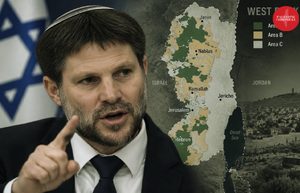
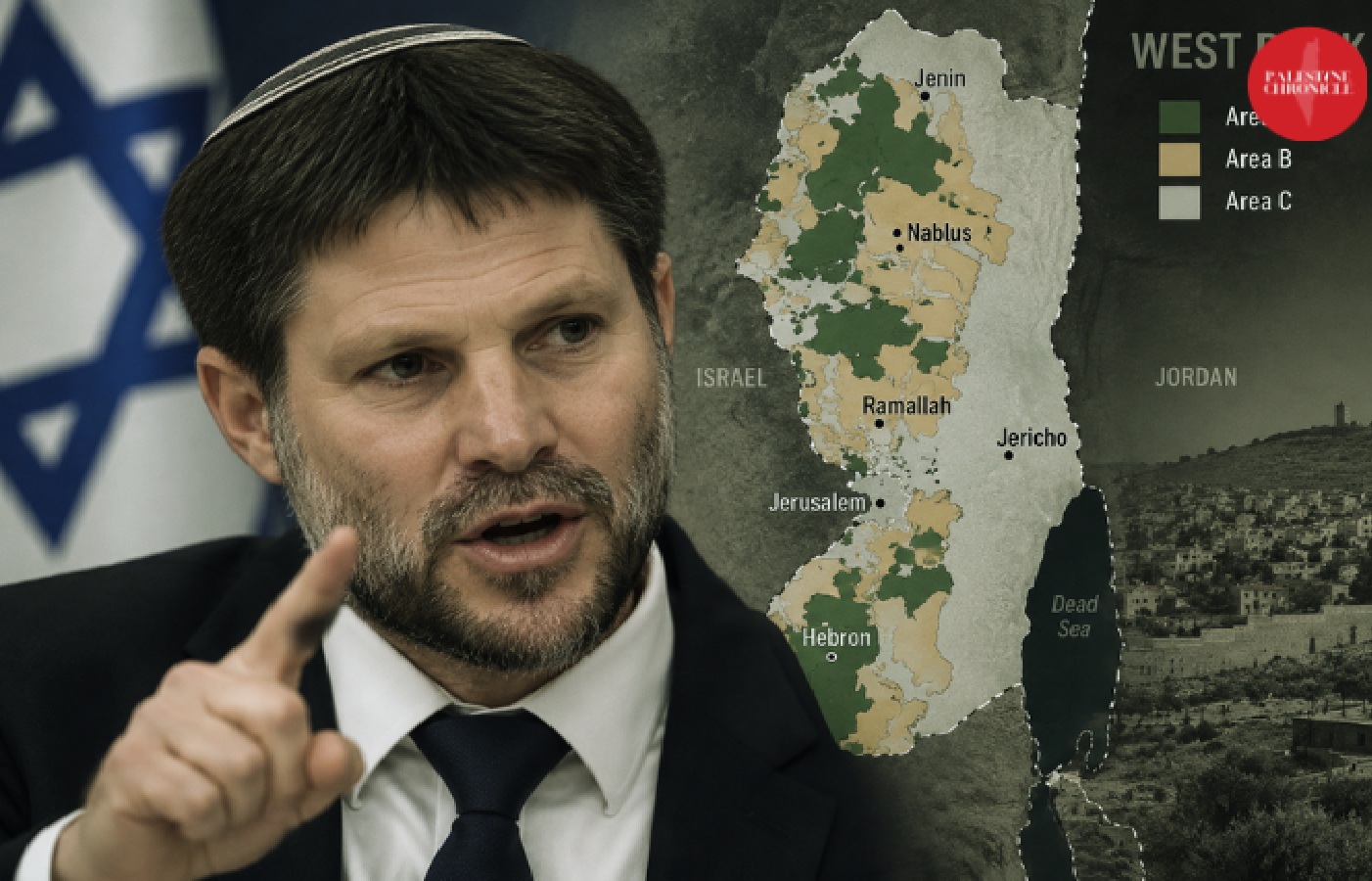
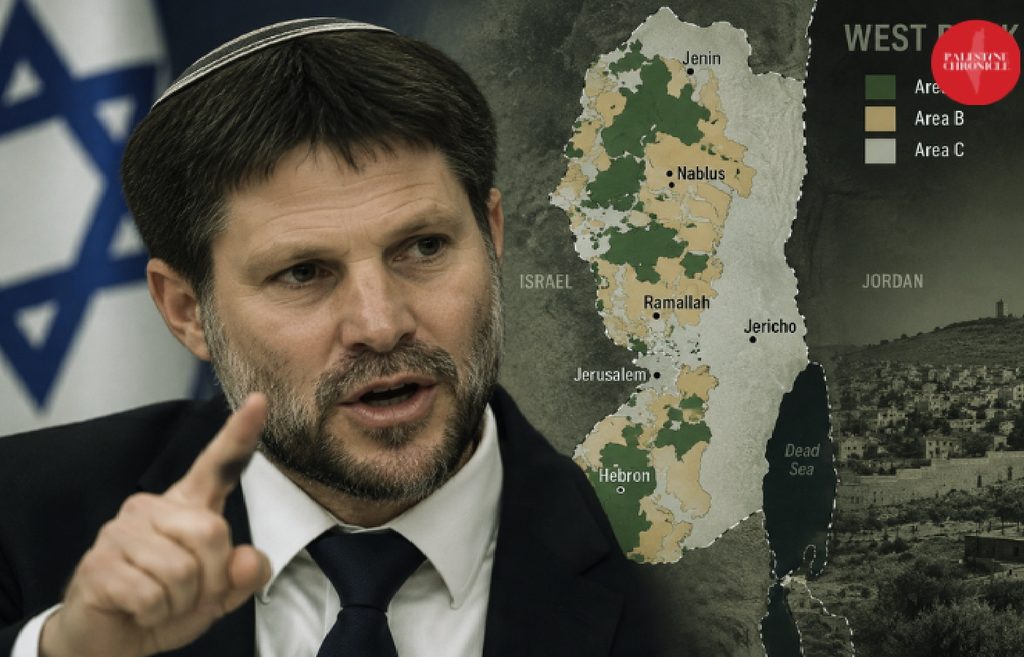
Israeli Finance Minister Bezalel Smotrich has declared the Oslo Accords “null and void” and claimed that Areas A and B of the occupied West Bank “are also ours.” Credit To (Design: PC)
Israeli Finance Minister Bezalel Smotrich has called for the occupation and de facto annexation of around 60% of the Gaza Strip, saying the territory should come under Israeli control and “become our land,” according to a report by Al Mayadeen. The far-right minister, who leads the Religious Zionism party and sits in Prime Minister Benjamin Netanyahu’s governing coalition, extended the demand to Lebanese territory currently held by Israeli forces.
“The same applies in Lebanon, where the territories must be annexed at least up to the lines where we are stationed today,” Smotrich said, according to the report.
The remarks were not an isolated outburst. Earlier this month, Smotrich called for permanent Israeli sovereignty over territory held by the Israeli military in both Gaza and Lebanon. At the National Conservatism Conference in Jerusalem, he framed annexation as a deterrent: “That would demonstrate to our enemies the price of defeat and create a deterrent against future attacks on Israel and its citizens,” he said.
The significance lies less in the novelty of Smotrich’s position than in the timing and the machinery reportedly being built around it. According to Israeli security sources cited by Al Mayadeen, implementation has begun of buffer zones and expanded military barriers along the borders with Egypt, Jordan, Syria and Lebanon, as well as around the Gaza Strip. Israeli media reported that Netanyahu announced the start of the government plan, presenting expanded military deployments and security infrastructure as a response to regional threats. Netanyahu also threatened a new phase of extensive operations in cities across the occupied West Bank and within Israel, according to the report.
Reuters previously reported that Israeli forces continued to occupy approximately two-thirds of Gaza despite the October 2025 ceasefire, Al Mayadeen noted.
Key Takeaways
Smotrich called for occupying and effectively annexing around 60% of Gaza, saying it should “become our land.”
He demanded annexation of Lebanese territory at least up to Israel’s current military deployment lines.
Israeli media reported government plans for buffer zones and expanded military barriers along several borders and around Gaza.
The remarks come amid a fragile ceasefire and reported Israeli military control over roughly two-thirds of Gaza.
Legal experts and human rights groups say such moves would amount to de facto annexation and violations of international law.
From Rhetoric To Facts On The Ground
The investigative question is not whether Smotrich has said this, he has, repeatedly. It is whether his rhetoric is being translated into administrative and military facts that outlast any ceasefire.
Buffer zones are often presented as temporary security measures. But in practice, they can become instruments of permanent territorial reordering: land is levelled, access is restricted, residents are displaced, roads are rerouted, and military orders replace civilian administration. Palestinian journalists and residents in Gaza have described the proposed buffer zones as a euphemism for further displacement and loss of farmland and homes, testimony consistent with patterns documented by UN OCHA and Palestinian human rights groups. Direct quotations from named residents should be added from verified agency reporting before publication.
The “60%” figure is politically potent but legally vague. No published map accompanies Smotrich’s demand. Israeli officials have not formally announced the annexation of Gaza as government policy. That distinction matters journalistically: Smotrich’s statement is a ministerial call, not a cabinet decision. But as finance minister and leader of a key coalition party, he is not a marginal commentator. His remarks signal where parts of the government want to go, and they align with reported plans for expanded military barriers and border zones.
That is the core of the critique: annexation may not arrive through a single declaration. It can arrive through corridors, barriers, planning rules, military orders and the slow creation of facts that make withdrawal politically and physically impossible.
Palestinian officials and critics of Israeli policy go further, arguing that the annexation drive reflects a broader intent: that the policy of Israel’s current right-wing Zionist government is designed to annex land indefinitely, not merely to create temporary security buffers, and that Smotrich’s demand for 60% of Gaza is one expression of that project. Rather, it constitutes an element of the expansive Greater Israel project, driven by territorial aspirations. They point to settlement expansion, military orders, barrier construction and repeated sovereignty claims across the occupied West Bank, Gaza and Lebanese territory as evidence of a pattern aimed at permanent territorial control. Israeli officials reject this characterisation, insisting that security measures are defensive, that territorial disputes must be resolved through negotiations, and that Smotrich’s statements do not represent formal government policy. The dispute over intent is central to the story: critics see annexation as the goal, while Israeli officials present it as a security necessity, and the reported buffer zones and barriers are where those competing claims will be tested.
The Lebanese Front
Smotrich’s demand for annexing Lebanese territory “at least up to the lines where we are stationed today” is equally significant. It seeks to convert Israel’s current military deployment lines into permanent borders. That would violate Lebanese sovereignty and the framework of UN Security Council Resolution 1701, which underpins the post-2006 ceasefire architecture and has been central to subsequent arrangements.
Lebanese officials have repeatedly rejected Israeli violations of Lebanese sovereignty and warned that continued occupation and strikes undermine stability. Lebanese President Joseph Aoun and other officials have insisted on the state’s right to enforce its authority over all Lebanese territory. Hezbollah and other Lebanese actors have warned that annexation demands threaten the ceasefire understanding. These statements should be updated with the latest official Lebanese positions.
The legal problem is straightforward. Under the UN Charter, the acquisition of territory by force is prohibited. Under the Fourth Geneva Convention, annexation of occupied territory is unlawful, and Article 49 prohibits transfers and deportations of protected persons. The International Court of Justice’s July 2024 advisory opinion found Israel’s continued occupation of Palestinian territory unlawful and said it must end. The UN General Assembly subsequently demanded that Israel end its unlawful presence within 12 months. The International Criminal Court has issued arrest warrants for Netanyahu and former defence minister Yoav Gallant; Smotrich has not been named in those warrants.
Smotrich’s “price of defeat” language is also legally and morally troubling. Deterrence cannot be built on collective punishment or the permanent dispossession of a civilian population. Human Rights Watch, Amnesty International and B’Tselem have repeatedly warned that annexation, buffer zones and displacement amount to serious violations of international humanitarian law. B’Tselem has described Israeli policy across the occupied territories as apartheid; Israeli officials reject that characterisation.
Media, Leaks And The Duty To Verify
Al Mayadeen’s report is important because it connects Smotrich’s annexation rhetoric to reported operational planning. Reuters’ earlier finding that Israeli forces occupy roughly two-thirds of Gaza despite the ceasefire is a crucial data point. Israeli media reporting on Netanyahu’s announcement of the buffer-zone plan adds another layer: it suggests the issue is not merely speech but policy implementation.
Journalists covering this story should press for three things: maps, legal opinions and budget lines. Where exactly would the buffer zones run? What land would be confiscated or restricted? Which military orders govern access? What is the status of residents inside the zones? Are these measures described internally as temporary or permanent? Without those documents, “buffer zone” remains a euphemism that can conceal annexation.
There is also a media critique. The “60% of Gaza” claim is a political figure, not a published policy document. Reporters should not treat it as an official plan without corroboration. At the same time, they should not dismiss it as mere rhetoric when it is accompanied by reported barrier construction and expanded deployments. The story is the convergence of words and infrastructure.
Local Voices And Organisational Warnings
Palestinian officials, including the Palestinian Foreign Ministry, have condemned annexation calls as a war crime and a violation of Palestinian self-determination. Hamas has rejected the remarks and warned that they threaten the ceasefire. Palestinian human rights organisations, including the Palestinian Centre for Human Rights and Al-Haq, have documented displacement pressures and called for third-state accountability. Their statements should be quoted from the latest releases.
Israeli human rights group Gisha, which monitors Gaza access, has warned that closure and buffer-zone policies deepen humanitarian harm and restrict movement. UNRWA and UN OCHA have repeatedly warned that displacement and access restrictions compound an already catastrophic humanitarian situation.
On the Israeli side, opposition politicians and former security officials have warned that formal annexation would damage Israel’s international standing and complicate any future security arrangements. Some Israeli commentators have noted that Smotrich’s remarks serve domestic coalition politics while creating diplomatic facts abroad.
Conclusion: The Anatomy Of A Silent Annexation
The most important fact about Bezalel Smotrich’s demand is not that he said it. It is that almost nothing in the architecture of international accountability appears designed to stop it.
Smotrich has called for roughly 60% of Gaza to “become our land” and for Lebanese territory to be annexed up to Israel’s current deployment lines. Israeli officials insist these are ministerial statements, not cabinet policy, and that security measures are defensive. That defence is doing less work than it appears to. The investigative record assembled here points to a different conclusion: annexation in this context is not an event to be declared, it is a process to be administered. Corridors, barriers, buffer zones, access regimes, military orders and planning rules are the instruments through which territorial control becomes territorial fact. Each individual measure can be described as temporary. Taken together, they constitute a mechanism that is difficult to reverse and easy to deny.
That is why the “60%” figure matters less than the machinery around it. A percentage can be walked back in a speech. A barrier, once built and mapped into a security doctrine, acquires bureaucratic permanence. This is the central analytical finding of this investigation: the gap between Smotrich’s rhetoric and formal government policy is not a reason to discount the rhetoric. It is the space in which annexation is being operationalised, advanced by coalition partners, absorbed into security planning, and left formally unclaimed so that accountability has no single document to attach to.
The intent question sharpens the stakes. Palestinian officials and critics of Israeli policy contend that the current right-wing Zionist government’s plan is not merely a temporary security measure but an ongoing annexation of land spanning Gaza, the occupied West Bank, the OPT territories, and Lebanese territory, accompanied by heated debates and tensions. Israeli officials reject that reading and point to negotiations and defensive necessity. This dispute cannot be resolved by rhetoric alone, which is precisely why the reporting benchmarks set out above matter. Maps, legal opinions, budget lines, military orders and the status of residents inside the zones are the documents that will settle, in practice, whether the buffer zones are a shield or a blueprint.
The Lebanese dimension removes any remaining ambiguity about the regional logic. To annex territory “up to the lines where we are stationed today” is to convert a military deployment into a border by declaration. That is a direct challenge to Lebanese sovereignty, to Resolution 1701, and to the prohibition on acquiring territory by force. It is also a warning that the post-ceasefire map is being drawn unilaterally, one front at a time.
And yet the consequence gap holds. Western capitals issue statements urging compliance with international law while declining to attach costs to non-compliance. The Fourth Geneva Convention, the ICJ’s July 2024 advisory opinion, the General Assembly’s demand that Israel end its unlawful presence, and the ICC’s arrest warrants for Netanyahu and Gallant all exist on paper. Critics, including Palestinian officials, activists and human rights organisations, argue that the international community has remained largely silent while Israel continues what they describe as a genocide in Gaza and continues to ignore international law. Israeli officials reject the genocide allegation and insist operations target armed groups. But the analytical point stands regardless of how that dispute is characterised: a legal order without enforcement does not constrain; it merely records. When warnings are not matched by sanctions, arms embargoes or accountability measures, the message received is that facts can be created faster than law can be applied.
There is also a media failure to name. Annexation rhetoric that is treated as colour, a far-right minister’s latest provocation, is safely contained by the news cycle. Annexation infrastructure that is treated as a security technicality is not. The story lives in the intersection: the speech and the barrier, the coalition statement and the budget line, the “temporary” zone and the permanent map. Journalists who cover only the first half of that sentence will keep missing the story.
The deeper stakes, then, are not confined to Gaza or Lebanon. What is being tested is whether the post-1945 prohibition on territorial conquest still functions as law or has become a norm invoked only in retrospect. The answer will not be found in Smotrich’s next speech. It will be found in whether the buffer zones are mapped and published, whether residents are allowed to return, whether third states attach consequences to annexation, and whether the institutions that issued the warnings are prepared to act on them.
Until then, the most accurate description of Israeli policy is not “annexation” in the formal, declarative sense. It is annexation by accumulation, and the international community’s silence is not a gap in the record. It is part of the mechanism.
Veritas Press Investigative Analysis Independent journalism examining global affairs, power, diplomacy, and accountability.
Source:Veritas Press C.I.C. | Multi-News Agencies
Help Support Our Work
Readers who believe that truth still matters have power over popular information. When just a few more people step up to support this work, it means more lies exposed, more corruption uncovered, and more accountability where it’s long overdue.
Help Protect Independent Journalism, Which Is Currently Under Attack.
If you believe journalism should serve the public, not the powerful, and you’re able to help, becoming a regular DONOR or a PAID SUBSCRIBER truly makes a difference.
DONATION APPEAL: If you found this reporting valuable, please consider supporting independent journalism.
Your support fuels our fearless, truth-driven journalism. In unity, we endeavour to amplify marginalised voices and champion justice, irrespective of geographical location. We operate independently, with no financial backing from billionaires; our readers support us.
But it’s also extremely important. One of Veritas Press’s greatest assets is its reader-funded model.
1. Reader funding means we can cover what we like. We’re not beholden to the political whims of a billionaire owner. We are a small, independent and impartial organisation. No one can tell us what not to say or what not to report.
2. Reader funding means we don’t have to chase clicks and traffic. We’re not desperately seeking your attention for its own sake; we pursue the stories that our editorial team deems important and believes are worthy of your time.
3. Reader Funding: enables us to keep our website and other social media channels open, allowing as many people as possible to access quality journalism from around the world, particularly those in places where the free press is under threat.
We know not everyone can afford to pay for news, but if you’ve been meaning to support us, now’s the time.
Your donation goes a long way. It helps us:
Keep the lights on and sustain our day-to-day operations
Hire new, talented, independent reporters
Launch real-time live debates, community-focused shows, and on-the-ground reporting
Cover the issues that matter most to our communities, in real time, with depth and integrity
Without your support, independent voices like ours will be silenced.
Furthermore, we have plans to expand our work, but we can’t do it without your support. Every contribution, no matter the size, helps us stay independent and build a truly people-powered media platform.
If you believe in journalism that informs, empowers, and reflects the communities we serve, please donate today.
Submissions
For the safe submission of documentation, testimonies, or exclusive investigative reports from anywhere in the world, please use the following contact details for our Investigations Desk: mailto:enquiries@veritaspress.co.uk or mailto:editor@veritaspress.co.uk.
SEATTLE, TEHRAN — The U.S. Department of Homeland Security (DHS) will allow Iran’s national football team to enter the country 48 hours before their critical World Cup match against Egypt on Friday, a modest concession in a tournament where Team Melli’s travel conditions have sparked claims of oppression and competitive disadvantage.