Kamran Faqir is a volunteer investigative journalist and writer committed to exposing hidden truths and amplifying underreported stories. Driven by social justice, he brings sharp insight and fearless truth-telling to independent journalism. NUJ registered.
Listen to this article
Help support our mission, donate today and be the change. Every contribution goes directly toward driving real impact for the cause we believe in.
Article Date Published:
Article Date Modified:
20 minutes
Views:258
Funds and programmes are not enough. Britain must make innovation a war-fighting function, with its own sponsor, protected budget and readiness line, before the decade is out.
When Rupert Pearce, the National Armaments Director, told the defence industry that Britain and its allies have “until the end of 2030, at best, to deter and be ready to fight”, he was not speaking in code. The former Inmarsat chief executive, appointed on a five-year fixed term to rebuild the way Britain buys weapons, was being asked to put a date on the danger. He did.
The Chief of the Defence Staff, Air Chief Marshal Sir Richard Knighton, joined him at the launch of DSEI UK 2027, the biennial arms fair that expects around 65,000 visitors and up to 1,700 companies. His framing was stark. “Fundamentally this is a race,” he said, and Britain must be “faster and better” than its adversaries.
They are right. But a race is not won by announcing it. It is won by an institution built to run it, and the evidence of the past eighteen months is that Britain has built the announcements faster than it has built the institution.
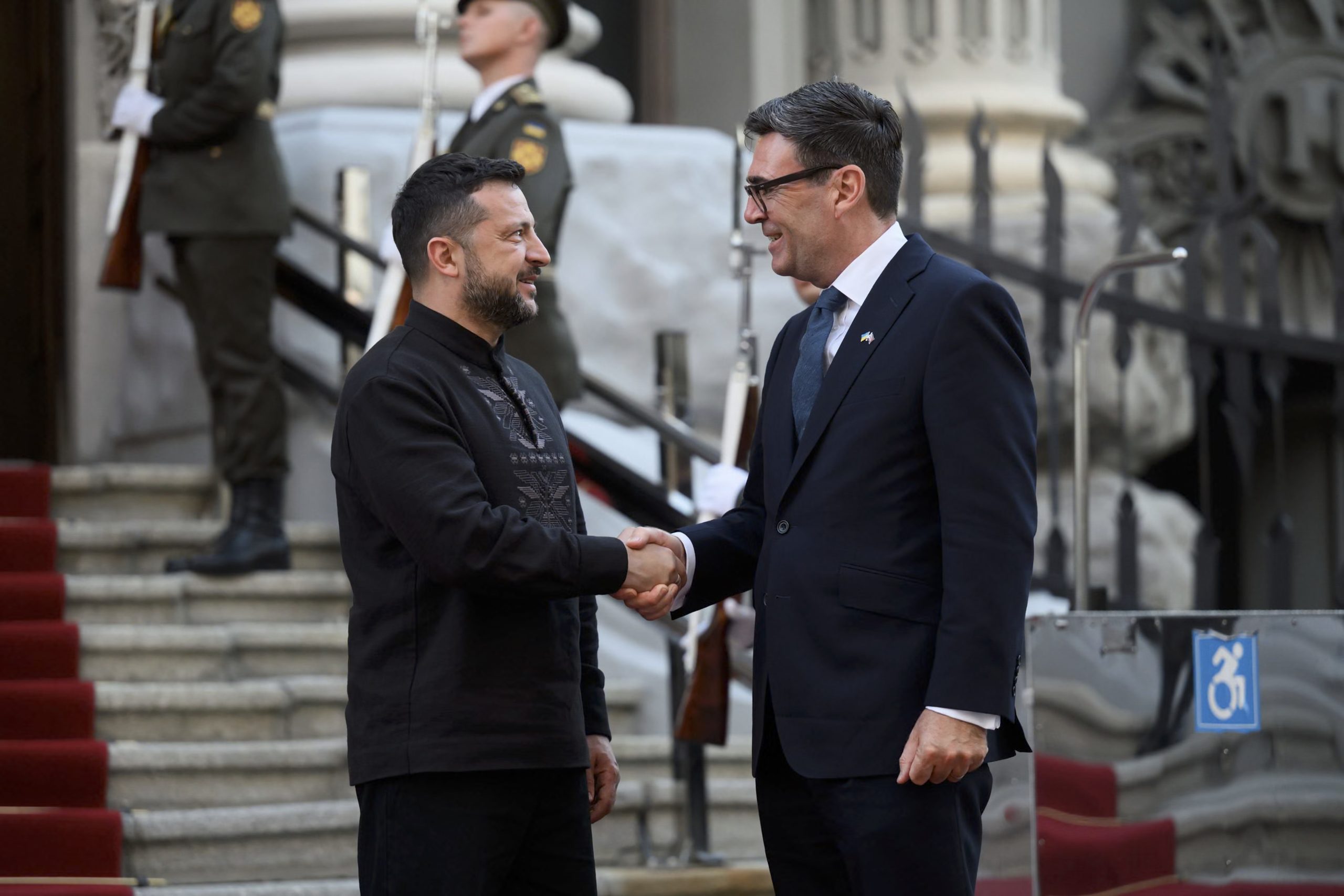
Visiting Ukraine for a meeting with Volodymyr Zelenskyy on Monday, Burnham accused the Kremlin of ‘outrageous threats’ against the UK. Photograph: Ukrainian Presidency/SIPA/Shutterstock
Deterrence By Adaptation
The war in Ukraine has changed what military advantage means. The image now circulating in defence circles is of a drone costing a few hundred dollars destroying a tank worth millions. The picture is vivid, and individual claims of this kind are hard to verify independently. The principle behind it is not in dispute. The advantage no longer belongs to whoever owns the most exquisite platform. It belongs to whoever can innovate fastest, scale quickest and deliver at the lowest cost, and keep doing so against an enemy that is adapting too. Russian tactics, electronic warfare and armour have all changed since 2022. Ukraine’s edge at any moment is a measure of how much faster it is adapting than Russia is.
That is a theory of winning. It is also a theory of deterrence. Knighton set out the classical version in June at the RUSI Land Warfare Conference: forces that can deny an adversary its aim and impose costs enough to change its behaviour. The argument here is that in an age of cheap drones and contested networks, denial and cost-imposition both depend on the speed of adaptation. A Kremlin planner weighing a gamble in 2029 has to believe that whatever Russia fields will be countered, cheaply and quickly. That belief is what holds an adversary back, and it has to be built before a crisis, not during one.
Pearce understands this. He has spoken of wanting “an innovation engine” that scans the horizon for new technologies and matures them, with core capabilities built to be infused with future innovation. The Strategic Defence Review called for constant innovation of the Integrated Force at wartime pace. The ambition is correct. The question is where it lives.
Activity Is Not Capability
Today’s innovation effort is a fund here, a programme there and an office somewhere else: UK Defence Innovation (UKDI) with its £400mn budget, the pledge to spend 10% of the equipment budget on novel technologies, Commercial X, the Defence Tech Scaler. The Defence Investment Plan (DIP), published this year, confirmed that UKDI’s budget stays at £400mn a year to 2030 and repeated the 10% pledge. techUK, the industry body, noted that beyond this the plan is “light” on longer-term investment in emerging technologies, and that more than £10bn of efficiency savings are required, with success hinging on completing Defence Reform.
None of this is new. When the £400mn was first announced in 2025, GlobalData defence analyst James Marques said it could not be considered “DARPA-level funding”, a reference to the US agency that incubated stealth and GPS. A budget that size can seed a start-up cluster. It cannot reshape a force.
The deeper problem is structural. Every one of these initiatives sits inside an acquisition system that answers to its own governance and is judged by its own metrics: money disbursed, competitions run, memoranda signed. None is chartered, as Land, Maritime and Air are, with a sponsor, a protected budget and a readiness line. A system designed for decade-long platform cycles will always reassert its own logic over a fund with no institutional power to resist it.
Parliament has noticed the tension. At the Public Accounts Committee’s July hearing on the affordability of the DIP, Pearce, the Permanent Secretary Jeremy Pocklington and Air Marshal Tim Jones were pressed on how much confidence the public could have in plans for the 2030s when the plan itself repeatedly refers to equipment not arriving until the late 2030s. Officials told the committee that defence spending would reach 2.7% of GDP at the end of the four-year budget period and then rise to 3%. A deadline of 2030 and a delivery horizon of the late 2030s are not obviously the same plan.
A Politics In Flux
The politics around the money has been turbulent. In June, John Healey resigned as defence secretary, and Al Carns as armed forces minister, in a dispute over the defence budget. Healey’s resignation letter told Sir Keir Starmer that he had been “unable”, and the Treasury “unwilling”, to commit the resources the country needed. When Andy Burnham became prime minister in July, he made Healey Chancellor and gave the Defence brief to Wes Streeting.
Streeting arrived with a reputation for bluntness about the department he now runs. “The Ministry of Defence is famous for being bad at procurement,” he told LBC while still a backbencher, and he has argued ministers should “bang some heads together”. Critics have been less sure. A Spectator Australia analysis of his appointment called it “worrying” that he has no grounding in defence and said he needs to learn fast to avoid being boxed in by officials and officers for whom policy is second nature.
The arrangement presents an opportunity that has gone largely unremarked. The man who resigned because the Treasury would not fund defence now holds the Treasury’s keys. A ring-fenced, multi-year innovation budget is exactly the kind of commitment a former defence secretary turned Chancellor is positioned to deliver, and exactly the kind that the Treasury has historically raided in-year.
What Britain Has Already Shown It Can Do
There is a counter-example inside Britain’s own record. In late 2025 the UK signed a licence to produce Ukraine’s Octopus interceptor drone, designed to counter Shahed-type attack drones and reportedly costing under a tenth of the systems it is meant to defeat. By January, Healey and Ukraine’s defence minister Denys Shmyhal had agreed a roadmap that included output of around 1,000 interceptors a month. The Ukrainian manufacturer Ukrspecsystems announced a $267mn investment in a factory at Mildenhall.
The lesson cuts two ways. It shows that Britain can move at something like Ukraine’s pace when a minister clears the path. It also shows how much it depended on that minister. Octopus succeeded through political attention, not through a standing institution whose job it is to find the next Octopus, test it, scale it and bolt it into a unit’s training and doctrine. Ministers change. In the space of a single summer, this one did.
Israel and Ukraine have taken the alternative route. Israel’s defence research directorate, MAFAT, sits alongside the owners of the established military functions. Ukraine’s Brave1 is jointly chartered among several government bodies. Both treat innovation as something the force does and is held accountable for, not something the bureaucracy administers.
Making Innovation A War-Fighting Function
Britain should do the same, delivering innovation through five permanent capabilities: sensing, experimentation, scaling, absorption, and talent. Reclassification needs no vast new spending. Much of the money already exists but is fragmented. It needs three things.
First, a named sponsor with the same standing as the heads of Land, Maritime, Air, Cyber and Space, accountable for readiness and seated at the same investment tables. Second, a ring-fenced, multi-year budget in the DIP, protected from the annual raids that always hit discretionary pots. Third, measurement by operational results: how quickly the force can identify a problem in the field, build a fix and deploy it, not how many contracts were signed.
Absorption deserves special attention. The hardest part of innovation is rarely the prototype. It is getting the training, doctrine and support in place so a new capability actually changes how a unit fights. Today, that is left to individual units. It should be funded from the start.
The Threat Is Not Waiting
The urgency is not theoretical. On 24 August, Burnham travelled to Kyiv on his first overseas trip as prime minister and announced that the UK would allow the missile maker MBDA to release classified information on British components in the SCALP cruise missile, so that Ukraine can improve domestic production. The Kremlin’s spokesman, Dmitry Peskov, replied that Britain was “involved in this war on the side of the Kyiv regime” and that Russian forces were gathering intelligence to identify and destroy such production sites. Burnham’s answer was a question: “Who started the fire?”
Britain’s own infrastructure is already being tested. The Telegraph reported in August that hackers linked to Iran’s Islamic Revolutionary Guard Corps shut down a small British power plant for four days in July, the first known attack of its kind. The wider grid was not affected, and officials played it down. But the National Cyber Security Centre is understood to have received no outage reports from regulated generators, which suggests the plant sat outside the regulated perimeter. That is an inference, not a confirmed finding, and a question the government should answer. The NCSC’s chief executive, Richard Horne, has said the agency handled over 200 attacks on critical infrastructure in the year to May, three-quarters linked to hostile states. The energy department says it is updating its cyber rules.
Former defence secretary Sir Grant Shapps has described the risk in domestic terms: the next attack “may not look like the start of a war”, he warned, but “an ordinary Monday morning when everything suddenly stops working.” His point is that deterrence cannot be judged only by missiles and brigades. A society that can be paralysed by a cyberattack on its power, water or banking is not deterred; it is merely not yet tested.
The Army’s leadership is now pressing for a public reckoning. Addressing around 700 soldiers at Catterick Garrison this month, General Sir Roly Walker said political leaders will “very soon” begin “a frank conversation” with citizens about the risks, and that citizens will be asked to consent to sacrifices to prioritise defence. “Our nation is going to need you,” he told the troops. The promised national conversation, however, was a pledge Burnham inherited from Starmer more than 18 months ago, and it has yet to begin. Without a push from the centre of government, Sky News noted, the conversation has been happening in podcasts and television series instead.
Walker’s own record invites scrutiny. In 2024, within weeks of taking the Army’s top job, he said Britain should be ready to “deter or fight a war in three years” and set a “bold ambition” to double the Army’s fighting power by 2027 through the technology and techniques proven in Ukraine, rather than extra resources. With 2027 approaching, the public is entitled to ask what has been doubled, and how it has been measured. That is the readiness-line question in miniature.
The home front is the other half of the same argument, and it is where ministers are now moving.
Stock Up: The Government Asks Households To Prepare
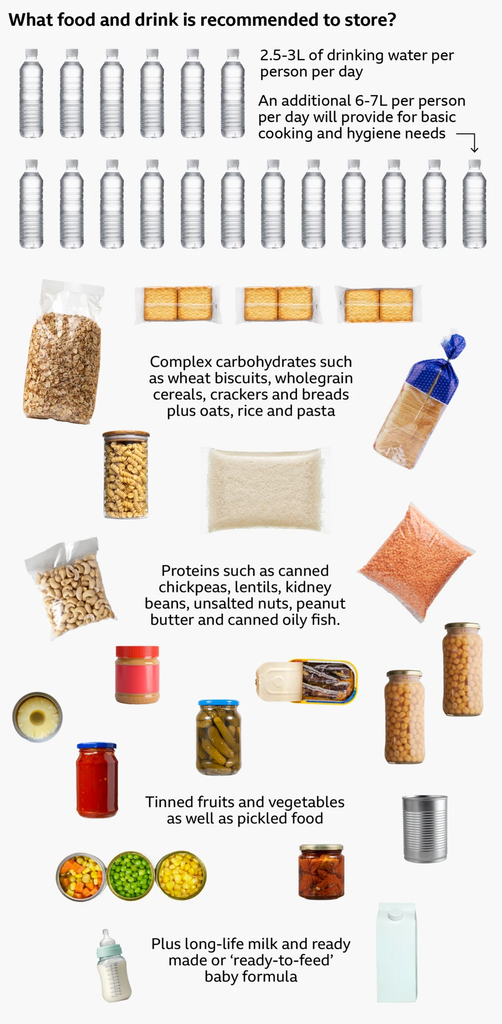
The state is preparing to ask citizens to hold their own emergency supplies. A Cabinet Office campaign, first reported by the Financial Times and the Guardian in late August, will tell households to keep tinned food and bottled water at home, as part of a push to cope with extreme weather, cyberattacks and possible attacks by hostile states. The Cabinet Office confirmed in July that a national resilience campaign will launch later this year alongside updated crisis plans under its Home Defence Programme. Detailed launch material has not yet been published.
A staple item for those looking to stock up on supplies is tinned oily fish – including salmon, mackerel and tuna
The stated logic is practical. If most households can manage a few days without normal services, government resources are freed for the most vulnerable. One official told the FT it would not be anything like “duck and cover”, the Cold War public-information campaign. Louise Haigh, the Cabinet Office minister and Burnham’s de facto deputy, is coordinating crisis planning across Whitehall, and the government has stepped up work on the “war book”, the manual for how an international conflict would affect the UK, which her predecessor Darren Jones said was under way. Ministers are also reported to be reassessing internally how Britain would respond to a military attack by a hostile state.
A Summer That Changed The Arithmetic
What has pushed this up the agenda is less a single threat than a convergence. This summer brought record heat, wildfires, including in the Cairngorms where fires burned for weeks, and drought warnings. Burnham convened a Cobra meeting on the heatwave, having campaigned in Makerfield on the inadequacy of flood planning. The government was criticised for an emergency phone alert about wildfires, which charities and domestic abuse survivors said could endanger people hiding secret phones. The episode is a warning in itself: public alerts have victims as well as audiences.
The power system has shown strain. On 24 June, the National Energy System Operator (NESO) issued a rare summer margin notice during the heatwave, asking generators for an extra 1,900 megawatts while saying blackouts were not imminent. Bloomberg reported that grid frequency fell sharply around 6 pm the previous evening and that the operator took emergency action, including seeking help from France. Shadow Energy Secretary Claire Coutinho accused NESO of withholding information and risking blackouts, citing whistleblowers. She has provided no evidence, and NESO denies wrongdoing. In late July, grid rules were reportedly changed to permit short-notice, rolling three-hour disconnections of up to a fifth of demand in an area if supply fell short, with hospitals, water treatment works and national-security sites protected. That would be an emergency measure not used since the 1970s. I found no confirmed widespread blackout this summer, so the honest picture is of rising risk and tighter contingency planning, not of an outage already under way. The government’s existing guidance asks households to prepare for as much as three days without power, whether from weather or attack.
Hostile-state activity sits on top of that. The Iran-linked shutdown of a small power plant for four days in July, described above, was a demonstration of capability rather than a threat to the wider grid. But it shows that the line between a weather-driven shortfall and a deliberate one can be hard to draw in the first hours, which is precisely the ambiguity Shapps warned about.
Food: No One In Charge
The food system is the sharpest example of an unowned risk. The charity Foodrise has written to No 10, in a letter signed by more than 180 academics, farmers and community food leaders, calling the UK “complacent about food as a national security matter” and saying nobody is responsible for feeding people in a crisis. It cites a Defra national security assessment from January, which said the UK does not have enough land to feed its population and rear livestock. Britain has no national food store, and the government’s Prepare guidance asks households to hold supplies for a few days.
The signatories want an audit of the country’s reliance on a few very large food firms, local food-resilience committees, and a national council on food security, defence and resilience run jointly by Defra and the Ministry of Defence. Tim Lang, emeritus professor of food policy at City St George’s, University of London, argued that central government must provide strategic leadership because communities and households “cannot resolve fault lines” in the food system on their own. A government spokesperson said food security is national security, that food supply is being built into emergency planning, and pointed to a £65mn package for drought-hit farmers and a new climate-security Taskforce.
Streeting, for his part, told The Sun that people should keep some tinned goods in case the electricity fails. Officials have taken care to stress that the advice is routine preparedness, not a warning of an imminent war. The mixed signals illustrate the communications problem. A defence secretary telling households to stock tins, an Army chief warning of sacrifice, and a Cabinet Office insisting there is no alert all land within the same weeks.
The Commercial And The Practical
A preparedness industry is already forming around the anxiety. Marcus Clarke, founder of The Prepared Household, has warned that the commonest blackout mistake is using camping stoves indoors, where carbon monoxide builds up unseen. His rule is blunt: keep outdoor appliances outdoors. It is sound advice, and a reminder that a campaign which sends millions of households improvising in the dark will have its own casualties unless its guidance is specific. The government’s existing checklist is a start: water, food needing no cooking, a manual tin opener, a torch, spare batteries, a power bank, a wind-up radio and first-aid supplies.
The Equity Question
The harder critique is about who can comply. A campaign that asks everyone to stockpile frees resources for the vulnerable only if the vulnerable are not the ones least able to follow it. A 2026 government survey, as cited in coverage of the campaign, found that 29% of people aware of preparedness advice said money prevented them from doing more. Renters in small flats, households in fuel poverty and people who shop day to day cannot easily buy ahead. A resilience policy that works for the comfortable and fails the poor would shift risk, not reduce it.
There is also a timing problem. The national conversation on defence was promised by Starmer more than 18 months ago, and the household campaign has yet to launch while the Army’s chief is already telling soldiers that citizens will be asked to consent to sacrifice. Asking the public to act before explaining why risks both complacency and panic.
The link to the argument of this piece is direct. Foodrise’s complaint that no one is responsible, is the same defect as in innovation: a function everyone agrees matters, funded in fragments, owned by no one with a sponsor, a protected budget and a readiness line. Household tins are a stopgap. Deterrence and resilience both need a named owner who can be held to a measure.
The Case Against, And The Risks Of The Remedy
The proposal has critics who deserve a hearing. Some defence insiders will argue that creating a sixth “function” risks adding one more silo to a department Defence Reform is already trying to simplify, and that a protected budget can harden into a protected fiefdom. Treasury officials will note that ring-fences invite pressure on everything outside them. Others will say the real constraint is the £10bn-plus efficiency savings the DIP depends on, and that without them nothing in this proposal is affordable.
The answer to the first objection is accountability: a sponsor with a readiness line can be sacked for failing it, which a fund cannot. The answer to the second is that protection matters most precisely where the pressure is greatest. The third objection is the strongest, and it argues for starting the reclassification now, with existing money, rather than waiting for a bigger settlement that may not come.
Decide Before The Crisis
DSEI 2027 will be a showcase of what industry can build. The harder question is whether Britain has the institutions to buy, field and adapt it at the pace Pearce and Knighton are asking for. Industry will not be the constraint. The UK’s structures will.
If Britain waits until 2030 to find out, it will have left it too late. Reclassifying innovation is a decision for this defence investment plan, not the next war.
Veritas Press Investigative Analysis Independent journalism examining global affairs, power, diplomacy, and accountability.
Source:Veritas Press C.I.C. | Multi-News Agencies
Help Support Our Work
Readers who believe that truth still matters have power over popular information. When just a few more people step up to support this work, it means more lies exposed, more corruption uncovered, and more accountability where it’s long overdue.
Help Protect Independent Journalism, Which Is Currently Under Attack.
If you believe journalism should serve the public, not the powerful, and you’re able to help, becoming a regular DONOR or a PAID SUBSCRIBER truly makes a difference.
DONATION APPEAL: If you found this reporting valuable, please consider supporting independent journalism.
Your support fuels our fearless, truth-driven journalism. In unity, we endeavour to amplify marginalised voices and champion justice, irrespective of geographical location. We operate independently, with no financial backing from billionaires; our readers support us.
But it’s also extremely important. One of Veritas Press’s greatest assets is its reader-funded model.
1. Reader funding means we can cover what we like. We’re not beholden to the political whims of a billionaire owner. We are a small, independent and impartial organisation. No one can tell us what not to say or what not to report.
2. Reader funding means we don’t have to chase clicks and traffic. We’re not desperately seeking your attention for its own sake; we pursue the stories that our editorial team deems important and believes are worthy of your time.
3. Reader Funding: enables us to keep our website and other social media channels open, allowing as many people as possible to access quality journalism from around the world, particularly those in places where the free press is under threat.
We know not everyone can afford to pay for news, but if you’ve been meaning to support us, now’s the time.
Your donation goes a long way. It helps us:
Keep the lights on and sustain our day-to-day operations
Hire new, talented, independent reporters
Launch real-time live debates, community-focused shows, and on-the-ground reporting
Cover the issues that matter most to our communities, in real time, with depth and integrity
Without your support, independent voices like ours will be silenced.
Furthermore, we have plans to expand our work, but we can’t do it without your support. Every contribution, no matter the size, helps us stay independent and build a truly people-powered media platform.
If you believe in journalism that informs, empowers, and reflects the communities we serve, please donate today.
Submissions
For the safe submission of documentation, testimonies, or exclusive investigative reports from anywhere in the world, please use the following contact details for our Investigations Desk: mailto:enquiries@veritaspress.co.uk or mailto:editor@veritaspress.co.uk.
SEATTLE, TEHRAN — The U.S. Department of Homeland Security (DHS) will allow Iran’s national football team to enter the country 48 hours before their critical World Cup match against Egypt on Friday, a modest concession in a tournament where Team Melli’s travel conditions have sparked claims of oppression and competitive disadvantage.