Kamran Faqir is a volunteer investigative journalist and writer committed to exposing hidden truths and amplifying underreported stories. Driven by social justice, he brings sharp insight and fearless truth-telling to independent journalism. NUJ registered.
Listen to this article
Help support our mission, donate today and be the change. Every contribution goes directly toward driving real impact for the cause we believe in.
Article Date Published:
Article Date Modified:
17 minutes
Views:108
As Khan warns of a brain haemorrhage and Bushra Bibi petitions over her failing sight, their cases expose not merely prison neglect but a judiciary remade by constitutional amendments into an institution whose orders are treated as optional.
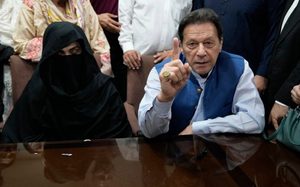
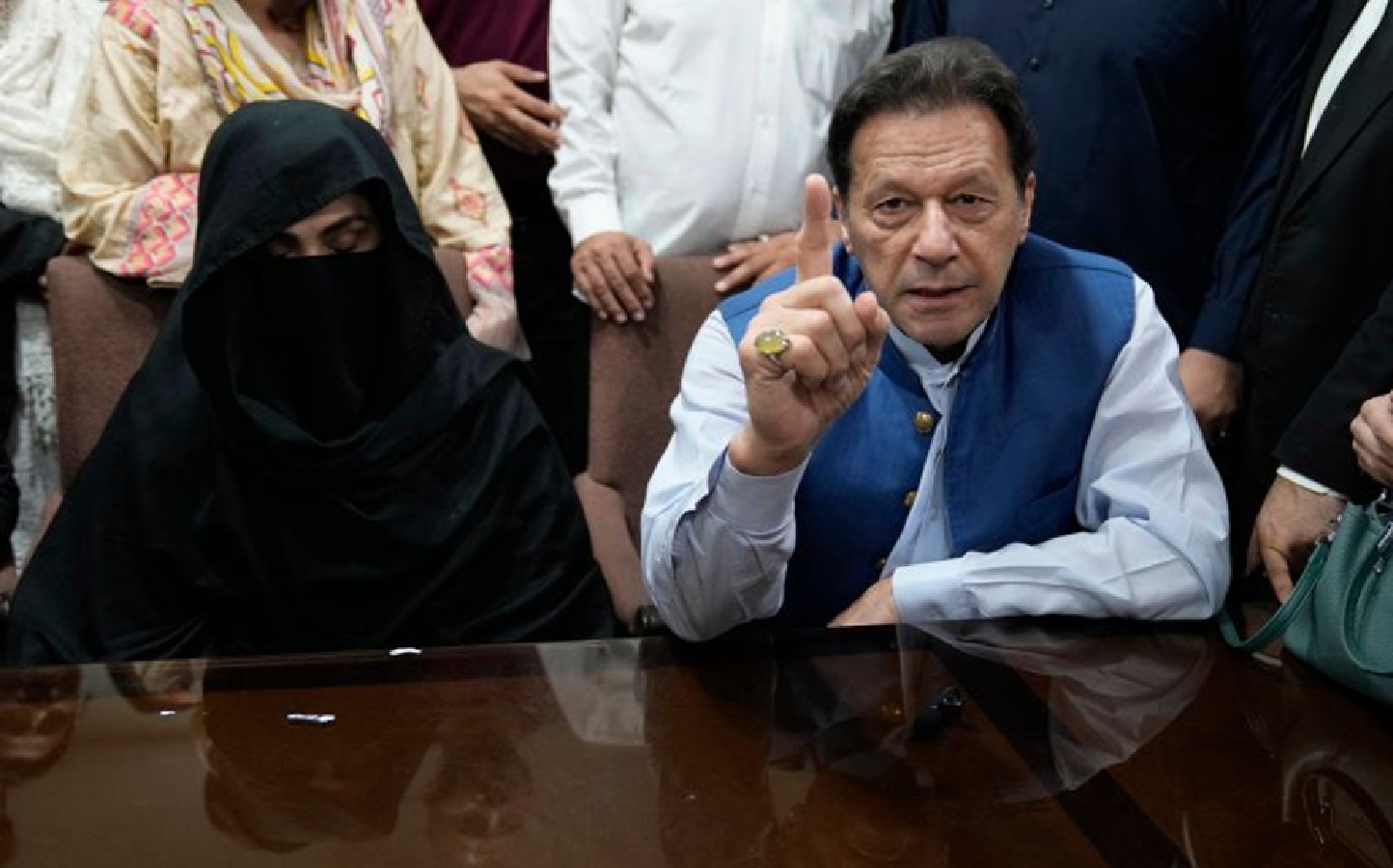
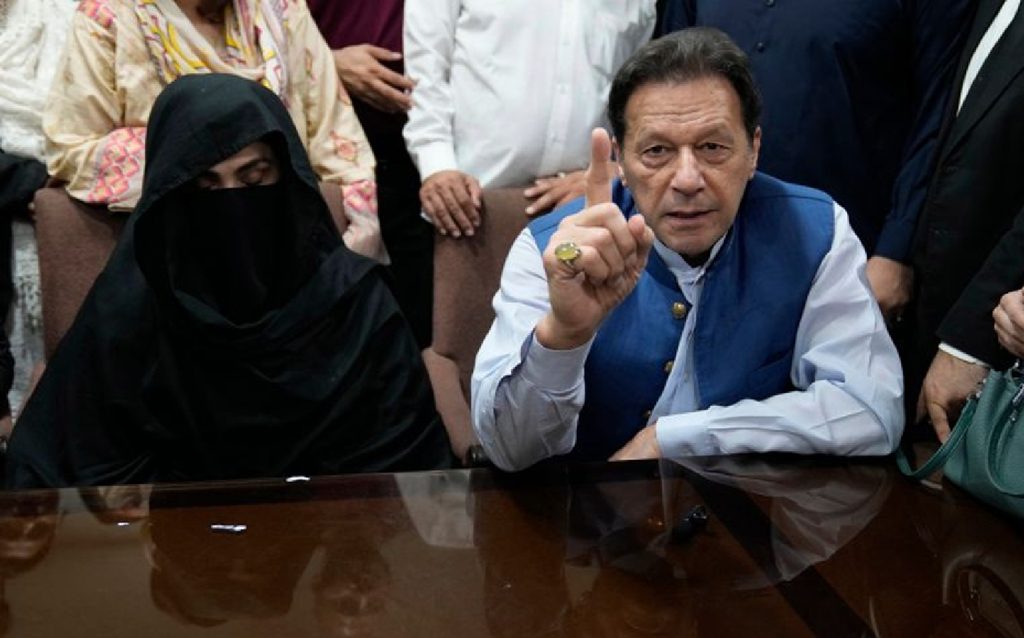
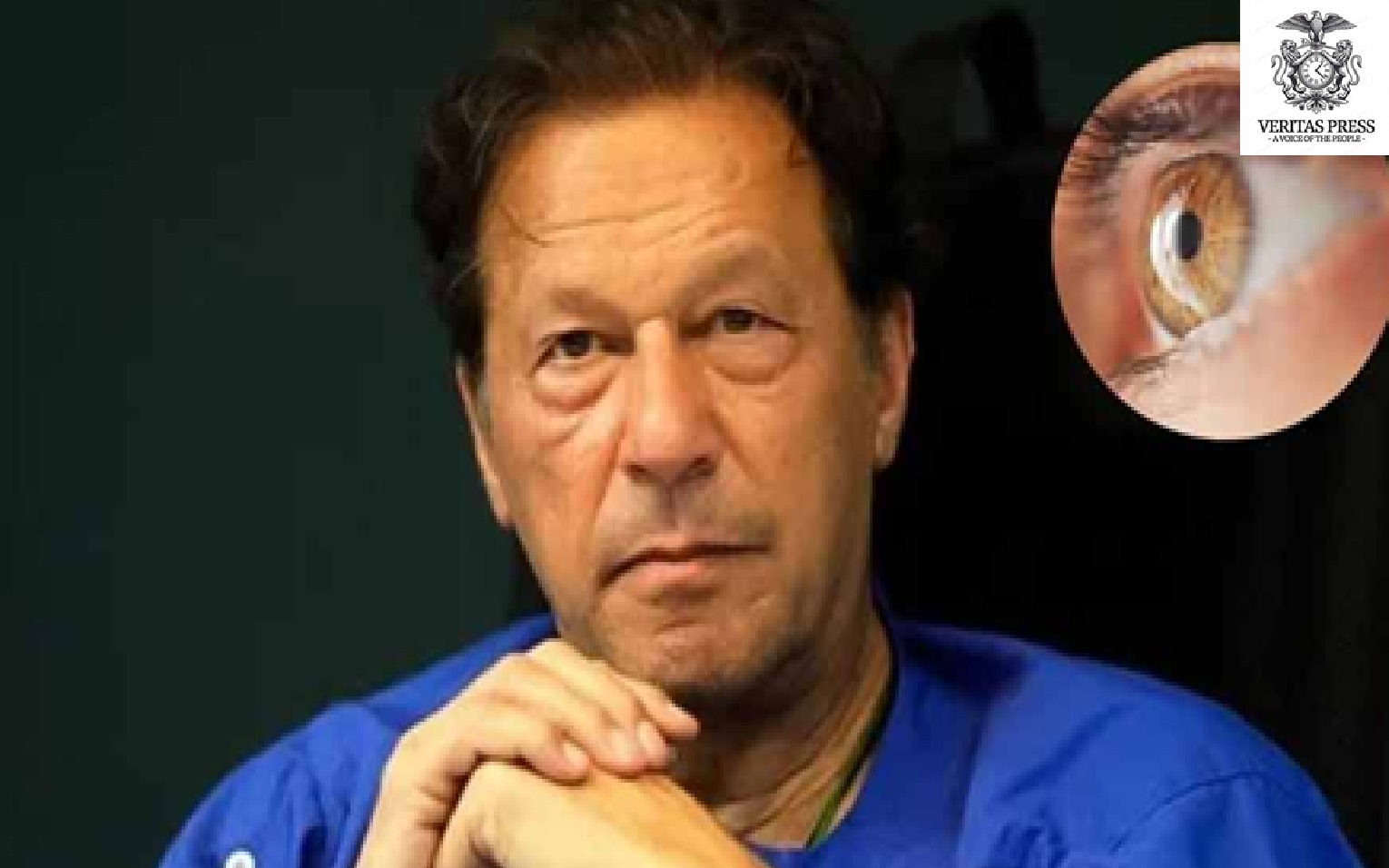
Credit: Pakistan’s former Prime Minister Imran Khan, right has been in prison since August 2023, whereas his wife Bushra Bibi, left, has been imprisoned since January 2025 [File: KM Chaudary/AP Photo]
ISLAMABAD — The letter is not a plea for mercy. It is a legal exhibit in the case against a collapsing system. When Imran Khan, Pakistan’s 22nd prime minister and its most consequential political prisoner, put his signature to an open letter addressed to the chief justices of the Supreme Court, the Federal Constitutional Court and the Islamabad High Court on November 16, he was not asking for a favour. He was asking the judiciary to read its own orders back to a corrupt government that has treated them as scrap paper.
“The doctors now tell me that I am highly vulnerable to a brain haemorrhage and cardiac arrest, and that my heart has already suffered damage,” Khan wrote from Adiala Jail, where he has been held since August 2023. “At seventy-four, this unrelenting state is taking me to a place from which I may not return alive”. His blood pressure, he said, had climbed to 193.
The letter, dictated to his counsel, Barrister Salman Safdar, during a three-hour meeting on November 11 and released on X, is the most detailed public accounting yet of the physical and psychological toll of a detention that Khan describes as “torturous solitary confinement for up to twenty-two hours a day” since December 20, 2025, the day he and his wife, Bushra Bibi, were sentenced to 17 years in the Toshakhana-II case. In that confinement, he says he has lost 85% of the vision in his right eye, been allowed to meet his lawyer only four times in a year, and been denied calls to his sons despite court orders.
But the letter is also a mirror held up to Pakistan’s superior courts. On August 18, 2026, a three-member Supreme Court bench ordered that Khan be shifted to Shifa International Hospital in Islamabad within two days for examination by a medical board including a cardiologist and an ophthalmologist. That order has never been implemented. Instead, Khan was taken to the government-run Pakistan Institute of Medical Sciences (PIMS) and returned to jail within hours, a sequence that PTI General Secretary Salman Akram Raja has described as a “completely choreographed drama”. A contempt petition filed in August over the non-compliance remains unheard.
“I do not ask Your Lordships for any favour,” Khan wrote. “All I request as justice is the implementation of the orders of the Honourable Supreme Court and proper treatment for our medical conditions. I will only remain able to prove my innocence if I stay alive”.
Bushra Bibi And The Snakes In The Cell
If Khan’s letter is a document of slow-motion medical emergency, the petition filed by Bushra Bibi’s lawyers before the Islamabad High Court on the same day is a dispatch from a facility that appears to have abandoned even the pretence of humane custody.
The application, filed through Sardar Latif Khosa and Barrister Salman Safdar, seeks Bushra Bibi’s immediate transfer from Adiala Jail to a specialised hospital for eye surgery and demands the production of her complete medical record, which her lawyers say has been withheld from her, her family and her legal team. She has been diagnosed with mature cataracts and was advised to undergo another operation around November 15. Doctors warned that an infection following the procedure could result in “complete and permanent loss of vision”.
The conditions in which she is being held, according to the petition, make that infection a near-certainty. Her room, described as a large hall, suffers from “serious hygiene and sanitation deficiencies.” Rats and mice frequently enter. Cockroaches and centipedes are a regular presence. Insect bites and skin rashes are “a frequent occurrence”. And then there is the detail that has come to define the petition: seven small snakes were found inside the room where Bushra Bibi is being held. A jail employee named Sibtain killed and removed them. The affected portions of the floor were subsequently cemented.
The petition does not say when the snakes appeared, or whether any have been seen since the repairs. But it does not need to. The image, a former first lady, awaiting delicate eye surgery, sharing a cell with serpents, has circulated widely, becoming a shorthand for the broader collapse of prison governance under the weight of political retribution.
When Bushra Bibi met her lawyers on November 11, she told them she could perceive the two men seated before her “merely as dark objects” even with spectacles. Her peripheral vision is so restricted that she must estimate the position of obstacles to move about. She has been taking Panadol and Tonoflex daily for persistent eye pain. And yet, according to the petition, specialist doctors examined her only seven to eight days after she first complained. The duty medical officer at the jail, her lawyers note, is a gynaecologist, not an ophthalmologist.
The Government’s Answer: An NRO And A “Privileged Prisoner”
Federal Minister for Parliamentary Affairs Dr Tariq Fazal Chaudhry did not address the snakes. He did not address the withheld medical records. He did not address the Supreme Court order that remains, five months later, a dead letter. Instead, he reached for the government’s only available frame: that Imran Khan’s letter is a request for an NRO, a National Reconciliation Ordinance, the notorious amnesty instrument used by past regimes to bury corruption cases.
“Those who used to taunt others are now seeking an NRO themselves,” Chaudhry said, describing Khan as “the most privileged prisoner in Pakistan” who receives meals of his choice, books, television, and weekly medical examinations. He said Khan had been taken to PIMS eight times and that a doctor had been flown in from London to assess his blood pressure, which he pronounced “satisfactory”.
The minister’s claims are not merely contested; they are contradicted by the documentary record. The Supreme Court’s August 18 order was specific: Shifa International Hospital, not PIMS. A medical board including Dr Uzma Khan and Dr Faisal Sultan, not a rotating cast of government physicians. Weekly family meetings and twice-weekly calls with his sons, neither of which has been honoured. Khan’s letter states that he has been allowed to meet his counsel only four times in a year, on February 10, April 8, and then, after a silence of almost seven months, on November 2 and 11.
Chaudhry’s dismissal of the letter as an NRO plea is a political manoeuvre, not a legal response. It allows the government to avoid the only question that matters: why a Supreme Court order directing medical treatment at a named hospital has been ignored without consequence. “This is no longer a legal issue,” the Lahore-based analyst Habib Akram told Al Jazeera. “I don’t think the Supreme Court’s order will be implemented because of this letter”.
The Architecture Of Impunity
To understand why a Supreme Court order can be safely ignored, one must look at the constitutional architecture that now governs Pakistan. The 27th Constitutional Amendment, passed in November 2025, created the Federal Constitutional Court and transferred constitutional jurisdiction away from the Supreme Court. It gave the president power to transfer judges, effectively coercing judicial loyalty. It granted lifetime immunity to the president and military chiefs, placing them beyond the reach of courts. And it placed all armed services under Field Marshal Asim Munir, eliminating the post of Chairman Joint Chiefs.
“Parliament has done what previous dictators could only dream of,” said legal analyst Mirza Moiz Baig. “This is autocratic legalism,” warned Aqil Shah of Georgetown University. Dawn’s editorial page was blunter: “The funeral rites for the judiciary have been performed”.
Khan’s letter is precise on this point. He writes that he received relief from the courts “from time to time” that “renewed my faith that justice would prevail.” But “after the constitutional amendments, however, that relief became narrow, and then it closed off altogether. It grieves me deeply to say that, when I needed it most, the system I had placed my trust in did not come to my aid”.
The FCC, the new court created by the amendment, now holds Khan’s case on its docket, “awaiting a hearing”. Meanwhile, the Al-Qadir appeal, a commercial matter, has taken priority. “It saddens me deeply to observe that the Al-Qadir appeal hearing has taken priority while my life, my rights and my wellbeing are left waiting,” Khan wrote.
The Opposition And The International Silence
The joint statement issued by National Assembly opposition leader Mahmood Khan Achakzai and Senate opposition leader Allama Raja Nasir Abbas is notable for its historical reference. The treatment of Khan and Bushra Bibi, they said, “reminds us of the treatment meted out in prison to former Egyptian President Mohamed Morsi, where serious concerns arose over isolation, the denial of medical facilities and the deprivation of basic human rights. No civilised society should tolerate such conditions”.
Morsi died in an Egyptian courtroom in 2019 after years of inadequate medical care in detention. Amnesty International later called for an impartial investigation into whether his detention conditions contributed to his death. The comparison is not a rhetorical flourish. It is a warning.
International human rights organisations have documented the conditions of Khan’s detention for over a year. Amnesty International has raised concerns about prolonged solitary confinement, extremely limited family contact, and inadequate medical care. Human Rights Watch and the International Federation of Human Rights have questioned the fairness of his trial and the state of his prison conditions. The UN Working Group on Arbitrary Detention has declared his detention arbitrary. UN Special Rapporteur Alice Jill Edwards has urged Pakistan to address “inhumane detention conditions” that could constitute torture.
Yet the diplomatic pressure has not translated into compliance. The United Nations, the European Union and Western capitals have issued statements; the orders of Pakistan’s own Supreme Court remain unenforced.
A Test For The Justice System
The opposition leaders framed the letter correctly: “Today, the appeal for justice made by Imran Khan is, in fact, a test for our entire justice system”. It is a test that the system is failing in real time.
Khan’s letter ends with an appeal “on the most basic grounds of human compassion” to give him justice “before it is too late”. Bushra Bibi’s petition asks a court to order that she be taken to a hospital before she loses her sight. These are not extraordinary demands. They are the minimum obligations of a state that claims to be governed by law.
But the law, in Pakistan today, has been re-engineered to protect the men who broke it. The 27th Amendment did not merely weaken the judiciary; it created a constitutional order in which court orders can be ignored with impunity, provided the right people are in power. Khan’s solitary confinement, his failing eyesight, his wife’s snakes and cataracts, these are not aberrations. They are the logical output of a system that has decided that some prisoners are beyond the protection of the law, and some judges are beyond the obligation to enforce it.
“He is asking for no favours,” Sayed Zulfi Bukhari, a senior PTI leader, told Al Jazeera. “He is asking for no deal. He is asking for justice and the legal system of Pakistan to work”.
The question now is whether the legal system is still capable of answering. If it is not, the snakes in Bushra Bibi’s cell will not be the last thing to crawl out of Adiala. The next thing to emerge may be a death certificate, signed by a government that called its prisoner “privileged” and a judiciary that called his letter an NRO request.
Conclusion
The snakes in Bushra Bibi’s cell were not an anomaly. They were a symptom. The question before the Islamabad High Court forces is not whether seven small reptiles were killed and the floor cemented, but what kind of state allows a former first lady awaiting delicate eye surgery to share a room with vermin while her husband’s blood pressure climbs toward 193 in solitary confinement, and then calls him “the most privileged prisoner in Pakistan”.
The answer lies not in Adiala Jail but in the ledgers of Islamabad. This is a government that has learned to treat the law as an inconvenience and the nation as inventory. While Imran Khan’s Supreme Court order for treatment at Shifa International Hospital gathers dust, the same state has moved with remarkable efficiency to sell off Pakistan’s assets, often at prices that defy arithmetic and logic. Pakistan International Airlines, a carrier whose owned aircraft alone were valued at over PKR 1,600 billion, was sold for PKR 135 billion. A military-owned fertiliser company was quietly inducted into the winning consortium after the bid was sealed. The Pakistan National Shipping Corporation, which handles the nation’s freight, is being handed to the military-run National Logistics Corporation, not because it was losing money; it reported profits of Rs20 billion, but because the army’s business empire must grow. And when the International Monetary Fund demanded that the Sovereign Wealth Fund be stripped of its power to sell state assets without a competitive process, the government complied not out of sudden virtue but because the lender had made the fund’s very activation conditional on it.
This is what “selling Pakistan” looks like in practice. It is not a single dramatic auction. It is a system, what analysts now describe as elite capture costing the country more than $25 billion a year, in which state decisions over land, tax exemptions, power contracts, and procurement are used to transfer wealth upward while ordinary Pakistanis pay through fuel levies and electricity bills. It is a government that has tied two consecutive federal budgets to a foreign lender’s targets, accepting seventy-five conditions that Dawn itself has conceded are “steadily eroding Pakistan’s policy autonomy and economic sovereignty”. A Baloch leader warned that deals like Reko Diq, negotiated without local consent, amount to “leveraging Balochistan’s vast natural wealth to compensate for widespread corruption and financial mismanagement at the national level”.
And in the midst of this liquidation, the man who once built hospitals for the poor now writes from a prison cell asking only that his wife not lose her sight and that his own heart not stop before he can prove his innocence. “I do not ask Your Lordships for any favour,” Imran Khan wrote. But he is asking for something the system no longer knows how to provide: the enforcement of its own orders against a government that has discovered it can ignore them with impunity.
The corrupt government that is selling Pakistan’s airlines, its ports, its mines, and its economic sovereignty to the highest bidder, domestic or foreign, civilian or military, has no incentive to let a former prime minister die in custody, because a dead martyr is more dangerous than a silenced prisoner. But it has every incentive to let him weaken, to let his wife’s vision fade, to let the snakes and the rats and the solitary confinement do what the courts will not stop. The letter to the chief justices is not a plea. It is a warning. If the judiciary cannot enforce an order directing that a 74-year-old man be taken to a named hospital within two days, it will not enforce an order protecting the assets of a nation. The same constitutional architecture that allows a Supreme Court direction to be shredded without consequence allows a national airline to be sold for a fraction of its worth and a shipping corporation to be absorbed into a military conglomerate. The men who ignore the first are the men who profit from the second.
“I will only remain able to prove my innocence if I stay alive,” Khan wrote. The system that has decided he need not stay alive is the same system that has decided Pakistan need not remain whole. The snakes in Bushra Bibi’s cell are not the most dangerous thing in Adiala Jail. The most dangerous thing is the realisation, spreading from the prison yard to the stock exchange to the cabinet room, that the law in Pakistan now applies only to those who cannot buy it—and that the men selling the country have no intention of being held to account by the men they have already bought.
Veritas Press Investigative Analysis Independent journalism examining global affairs, power, diplomacy, and accountability.
Source:Veritas Press C.I.C. | Multi-News Agencies
Help Support Our Work
Readers who believe that truth still matters have power over popular information. When just a few more people step up to support this work, it means more lies exposed, more corruption uncovered, and more accountability where it’s long overdue.
Help Protect Independent Journalism, Which Is Currently Under Attack.
If you believe journalism should serve the public, not the powerful, and you’re able to help, becoming a regular DONOR or a PAID SUBSCRIBER truly makes a difference.
DONATION APPEAL: If you found this reporting valuable, please consider supporting independent journalism.
Your support fuels our fearless, truth-driven journalism. In unity, we endeavour to amplify marginalised voices and champion justice, irrespective of geographical location. We operate independently, with no financial backing from billionaires; our readers support us.
But it’s also extremely important. One of Veritas Press’s greatest assets is its reader-funded model.
1. Reader funding means we can cover what we like. We’re not beholden to the political whims of a billionaire owner. We are a small, independent and impartial organisation. No one can tell us what not to say or what not to report.
2. Reader funding means we don’t have to chase clicks and traffic. We’re not desperately seeking your attention for its own sake; we pursue the stories that our editorial team deems important and believes are worthy of your time.
3. Reader Funding: enables us to keep our website and other social media channels open, allowing as many people as possible to access quality journalism from around the world, particularly those in places where the free press is under threat.
We know not everyone can afford to pay for news, but if you’ve been meaning to support us, now’s the time.
Your donation goes a long way. It helps us:
Keep the lights on and sustain our day-to-day operations
Hire new, talented, independent reporters
Launch real-time live debates, community-focused shows, and on-the-ground reporting
Cover the issues that matter most to our communities, in real time, with depth and integrity
Without your support, independent voices like ours will be silenced.
Furthermore, we have plans to expand our work, but we can’t do it without your support. Every contribution, no matter the size, helps us stay independent and build a truly people-powered media platform.
If you believe in journalism that informs, empowers, and reflects the communities we serve, please donate today.
You Can Make Direct Bank Transfer Donations To
Bank Name: Bank Of Scotland
Account Name: Veritas Press C.I.C.
Sort code: 80-22-60
Account Number: 27540469
IBAN #: GB18-BOFS-6027-5404-69
Donate Online
Submissions
For the safe submission of documentation, testimonies, or exclusive investigative reports from anywhere in the world, please use the following contact details for our Investigations Desk: mailto:enquiries@veritaspress.co.uk or mailto:editor@veritaspress.co.uk.
SEATTLE, TEHRAN — The U.S. Department of Homeland Security (DHS) will allow Iran’s national football team to enter the country 48 hours before their critical World Cup match against Egypt on Friday, a modest concession in a tournament where Team Melli’s travel conditions have sparked claims of oppression and competitive disadvantage.