








Author:
Byline: Investigation Desk
Help support our mission, donate today and be the change. Every contribution goes directly toward driving real impact for the cause we believe in.
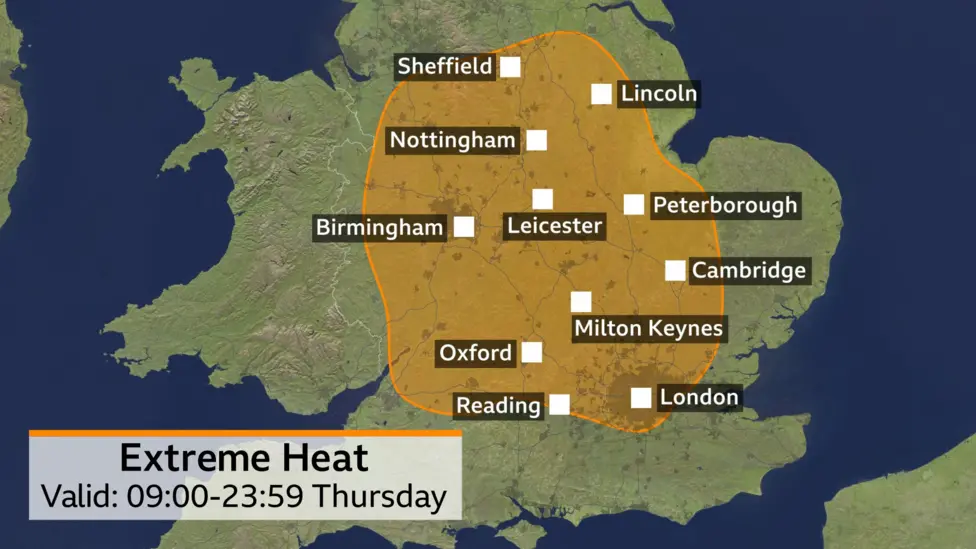
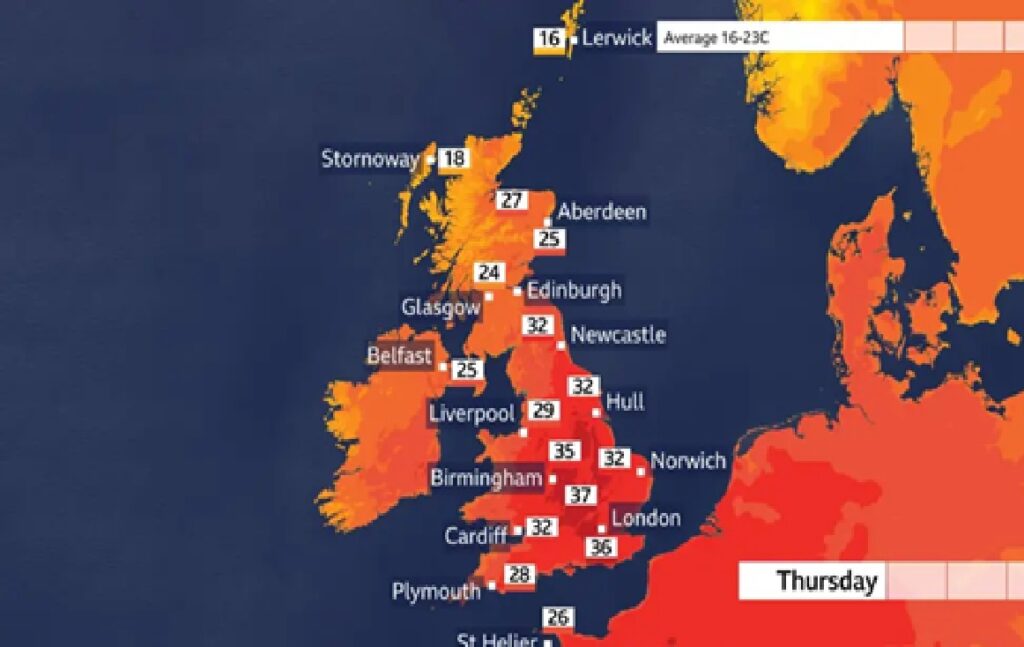
The United Kingdom is not merely experiencing a spell of hot weather; it is undergoing a systemic stress test. As a rare amber warning for “extreme heat” came into force across vast swathes of England on Thursday, the country found itself simultaneously bracing for thunderstorms in Northern Ireland, battling wildfires in Scotland and Greater Manchester, and counting the economic cost of a climate that is changing faster than its infrastructure.
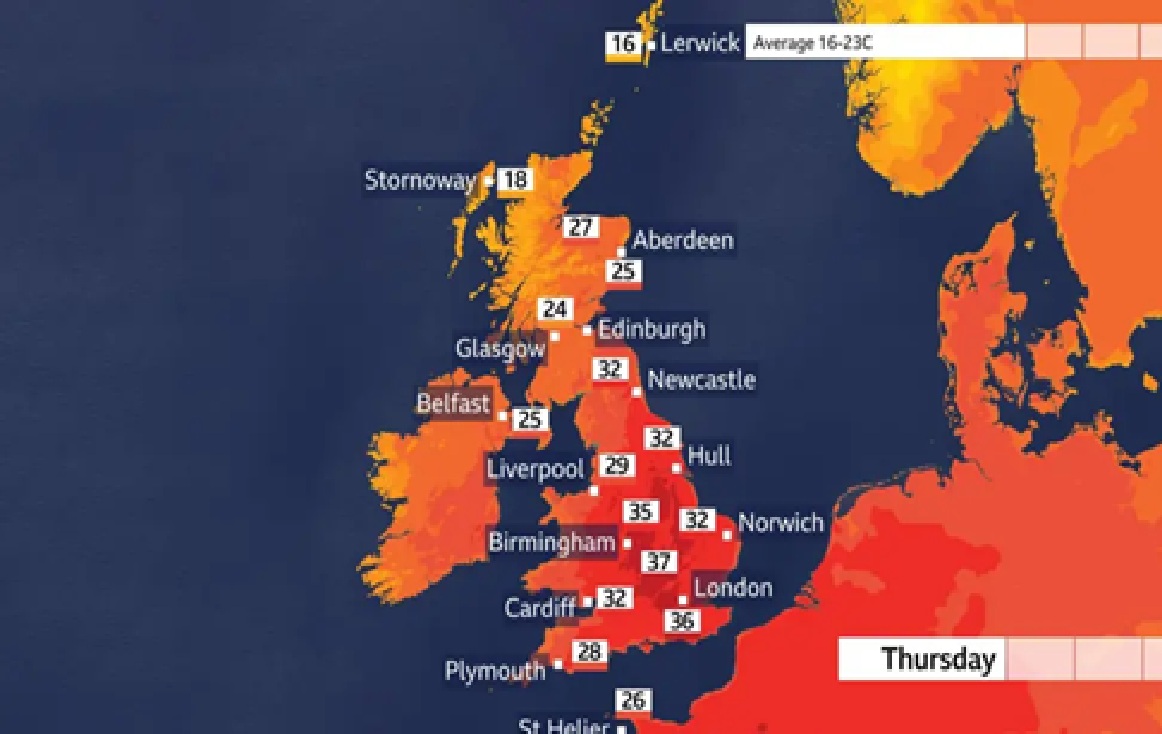
With the Met Office forecasting peaks of 37C to 38C (100F), potentially making Thursday the hottest day of the year so far, the narrative of the British summer has shifted from one of occasional discomfort to one of structural vulnerability. The scenery of this heatwave is not just crowded beaches and melted ice cream; it is sticky asphalt, submerged ruins, strained hospitals, and a workforce labouring under conditions for which the law has no provision.
The Contradiction: Fire And Rain
The meteorological picture is one of deep instability. While amber warnings for extreme heat cover London, the South East, the Midlands, and parts of Yorkshire, the Met Office has simultaneously issued a yellow thunderstorm warning for Northern Ireland, effective from 11 am Thursday to 6 am Friday. This juxtaposition of scorching heat in the east and potential flooding in the west illustrates the volatile nature of the climate crisis.
In Greater Manchester, the dry conditions have already sparked a significant incident. Firefighters are tackling a large blaze on Saddleworth Moor, with road closures in place and smoke visible across the region. Authorities have asked the public to avoid the area, a request that has become disturbingly routine in recent summers as moorland, tinder-dry from lack of rain, ignites.
This is not an isolated incident. A wildfire warning is in place for large swathes of Scotland, underscoring that the threat is national, not regional.
The Unseen Cost: A £4.4 Billion Hit And No Legal Limit On Heat
While the visual drama of wildfires and melting roads captures headlines, the deeper story lies in the economic and physiological toll of the heat. New analysis by the green Thinktank Verdant suggests that the repeated heatwaves of 2026 are likely to have cost the UK economy £4.4 billion in lost output by the end of July alone. This figure, which excludes the costs of fighting wildfires and increased energy consumption for cooling, paints a picture of a workforce struggling to function.
“The economic costs of climate change are already with us and set to worsen in future years. Action by the government to protect workers and businesses from the severe effects of extreme heat is well overdue,” said James Meadway, director of Verdant.
The mechanism is simple: workers are less productive when they are overheated. Verdant’s estimates, based on cross-European data, suggest that for every degree above 30C, workers’ output per hour declines by 3%. If current trends continue, the annual cost could top £25 billion by 2030.
The TUC is amplifying calls for a legal maximum working temperature. Paul Nowak, general secretary, stated: “As climate change causes more heatwaves, workers are suffering, and productivity is taking a hit too. Many of us have experienced this directly as we’ve struggled to keep working through the heat. Unions are calling for rules that require employers to take action to reduce temperatures when they exceed 24C, and for work to stop when temperatures reach 30C, or 27C for strenuous jobs.”
Currently, the UK has no such law, leaving workers in offices, kitchens, and factories with little recourse.
The Physical Breakdown: “Sticky” Roads And Failing Rails
The warnings from infrastructure bosses are stark. Edmund King, president of the AA, warned that the heat is putting the nation’s already “deteriorating roads under strain.” The dark asphalt absorbs heat, leading to surfaces softening.
“In prolonged hot weather, some road surfaces can soften, become sticky and, in places, start to rut under heavy traffic,” King explained. “The main risk for drivers isn’t that roads suddenly melt everywhere, but that already vulnerable patches can become tacky, uneven, or start to deteriorate. That can affect braking, steering and grip, and can throw up loose material.”
This comes as the UK already faces a pothole epidemic. King warns that this is no longer just a matter of repair bills: “Potholes and deteriorating surfaces are a road-safety issue.” He urged motorcyclists and cyclists to take particular care, as hitting an uneven surface can have “very serious consequences.”
The rail network is equally fragile. Steel rails are not designed for 35C+ heat. Several operators urged passengers to “only travel if necessary” on Thursday, anticipating speed restrictions and buckling risks.
Met Office forecaster Alex Burkill confirmed the threat: “Temperatures could reach highs of around 36, 37, possibly 38C. Now when you get these sorts of high temperatures, well that’s when we could see impacts to our infrastructure, our railway lines, our roads, they are not designed for this sort of heat.”
The Ghosts of Drought: History Resurfacing
The drought is altering the landscape in surreal ways. In the East Midlands, the exceptionally low water levels at Rutland Water reservoir have revealed the remains of Nether Hambleton, a village demolished and flooded in the 1970s to create the artificial lake.
Around half a century after it was submerged, stonework and foundations are visible again. This is not just a curiosity; it is a visual barometer of the nation’s water stress.
The scale of that stress is immense. The National Drought Group has declared that 71.3% of England is now officially in drought. Nine water companies have imposed hosepipe bans, affecting 45 million people. The landscape is dry enough to burn, and the water reserves are low enough to reveal our submerged history.
Health on the Line: The Silent Killer
The UK Health Security Agency (UKHSA) has issued amber heat health alerts for the entirety of England, warning of “significant impacts” including a rise in deaths, particularly among the over-65s and those with pre-existing conditions. The alerts are in effect until 21:00 BST on Friday.
The danger is compounded by the lack of relief at night. Forecasters warn of “tropical nights” in western areas, where temperatures fail to drop below 20C. This cumulative heat stress prevents the body from recovering, leading to heat exhaustion and heatstroke.
The warnings are clear: stay hydrated, avoid the sun during peak hours, and check on vulnerable neighbours. Yet, as with much of the UK’s heat response, individuals must survive the conditions, rather than the state mitigating them.
A Political Vacuum
As the country swelters, the political response remains notably subdued. Sadiq Khan, the Mayor of London, has pointed to the heat as proof that Labour must not waver on climate targets. “The climate emergency is here, and no one can say they didn’t see it coming,” he wrote.
This summer is on track to be the hottest on record in the UK, with the potential to surpass the previous record set just last year. If temperatures in London hit 38C, it would mark the second time this year the UK has reached that threshold, following the June heatwave.
The narrative surrounding “net zero” is often framed in terms of future cost. But the Verdant analysis, the crumbling roads, the lost productivity, and the strain on the NHS are not future costs. They are present-day expenditures.
Looking Ahead
The immediate forecast offers some relief: temperatures are expected to drop back to average by the weekend. But the structural issues will remain.
The UK is facing a “new normal” where 38C temperatures are a recurring event, not a freak anomaly. The AA’s warning about “sticky” roads is a metaphor for the wider situation: the foundations of British infrastructure and labour laws are softening under the pressure of a changing climate.
Unless there is a coordinated effort to invest in urban cooling, enforce maximum working temperatures, repair our infrastructure with heat-resistant materials, and fundamentally address the drivers of the climate crisis, these heatwaves will continue to exact an escalating economic and human toll.
The village of Nether Hambleton is a warning. The roads, the rails, the health system, and the economy are currently breaking, and their recovery may not be so easy.
Public Health Notice: Stay Hydrated And Keep Cool
Please take care of yourself during hot weather.
🌞 Stay hydrated and drink plenty of water throughout the day.
💧 Drink water regularly, even if you do not feel thirsty.
🧊 Keep your body cool by staying in shaded or well-ventilated areas where possible.
🏠 Avoid prolonged exposure to direct sunlight, particularly during the hottest parts of the day.
👕 Wear loose, lightweight clothing and take regular breaks to cool down.
Please also check on elderly relatives, children, neighbours, and anyone who may be vulnerable to hot weather.
Stay Safe. Stay Hydrated. Keep Cool.
Veritas Press Investigative Analysis
Independent journalism examining global affairs, power, diplomacy and accountability.
Source: Veritas Press C.I.C. | Multi-News Agencies
APPEAL: Help Support Our Work By Donating
Readers who believe that truth still matters have power over popular information. When just a few more people step up to support this work, it means more lies exposed, more corruption uncovered, and more accountability where it’s long overdue.
Help Protect Independent Journalism, Which Is Currently Under Attack.
If you believe journalism should serve the public, not the powerful, and you’re able to help, becoming a regular DONOR or a PAID SUBSCRIBER truly makes a difference.
DONATION APPEAL: If you found this reporting valuable, please consider supporting independent journalism.
Your support fuels our fearless, truth-driven journalism. In unity, we endeavour to amplify marginalised voices and champion justice, irrespective of geographical location. We operate independently, with no financial backing from billionaires; our readers support us.
But it’s also extremely important. One of Veritas Press’s greatest assets is its reader-funded model.
1. Reader funding means we can cover what we like. We’re not beholden to the political whims of a billionaire owner. We are a small, independent and impartial organisation. No one can tell us what not to say or what not to report.
2. Reader funding means we don’t have to chase clicks and traffic. We’re not desperately seeking your attention for its own sake; we pursue the stories that our editorial team deems important and believes are worthy of your time.
3. Reader Funding: enables us to keep our website and other social media channels open, allowing as many people as possible to access quality journalism from around the world, particularly those in places where the free press is under threat.
We know not everyone can afford to pay for news, but if you’ve been meaning to support us, now’s the time.
Your donation goes a long way. It helps us:
- Keep the lights on and sustain our day-to-day operations
- Hire new, talented, independent reporters
- Launch real-time live debates, community-focused shows, and on-the-ground reporting
- Cover the issues that matter most to our communities, in real time, with depth and integrity
Without your support, independent voices like ours will be silenced.
Further, we have plans to expand our work, but we can’t do it without your support. Every contribution, no matter the size, helps us stay independent and build a truly people-powered media platform.
If you believe in journalism that informs, empowers, and reflects the communities we serve, please donate today.
Submissions:
For the secure submission of documentation, testimonies, or exclusive investigative reports from any global location, please utilise the following contact details for our Investigations Desk: mailto:enquiries@veritaspress.co.uk or mailto:editor@veritaspress.co.uk
GENEVA — A United Nations fact-finding mission has concluded there are “reasonable grounds to believe”
Iran’s GDP is projected to contract by 5.4 to 6.1% in 2026, its worst performance

The Trump administration is preparing a $2.8 billion weapons package for Israel containing 40,000 2,000-pound

Film alleges mass civilian deaths are routinely built into military decisions amid Israel’s genocidal war

The Israeli rights group says violence, displacement, economic strangulation, and settlement expansion form part of

Houthi forces have captured the historic Red Sea port of Mocha and are advancing on
London’s historic sanctions against Israeli settlements mark a watershed moment in UK foreign policy, but
With 95% of Gaza’s population now wholly dependent on aid and more than 90% stripped
India calls for Kashmir and Ladakh to appear only on its official map after a
ISLAMABAD – In the high-stakes political theatre of Pakistan, the battleground has shifted from the




















axgyda
72wmfu