








Author:
Byline: Investigative Desk
Help support our mission, donate today and be the change. Every contribution goes directly toward driving real impact for the cause we believe in.
President Donald Trump was told that the war with Iran would be quick and decisive. Five months later, with missile stockpiles dangerously depleted by 80%, a furious Trump confronted his defence secretary at Camp David. Inside the hidden crisis reshaping American power.`
The Confrontation That Shook The War Cabinet:
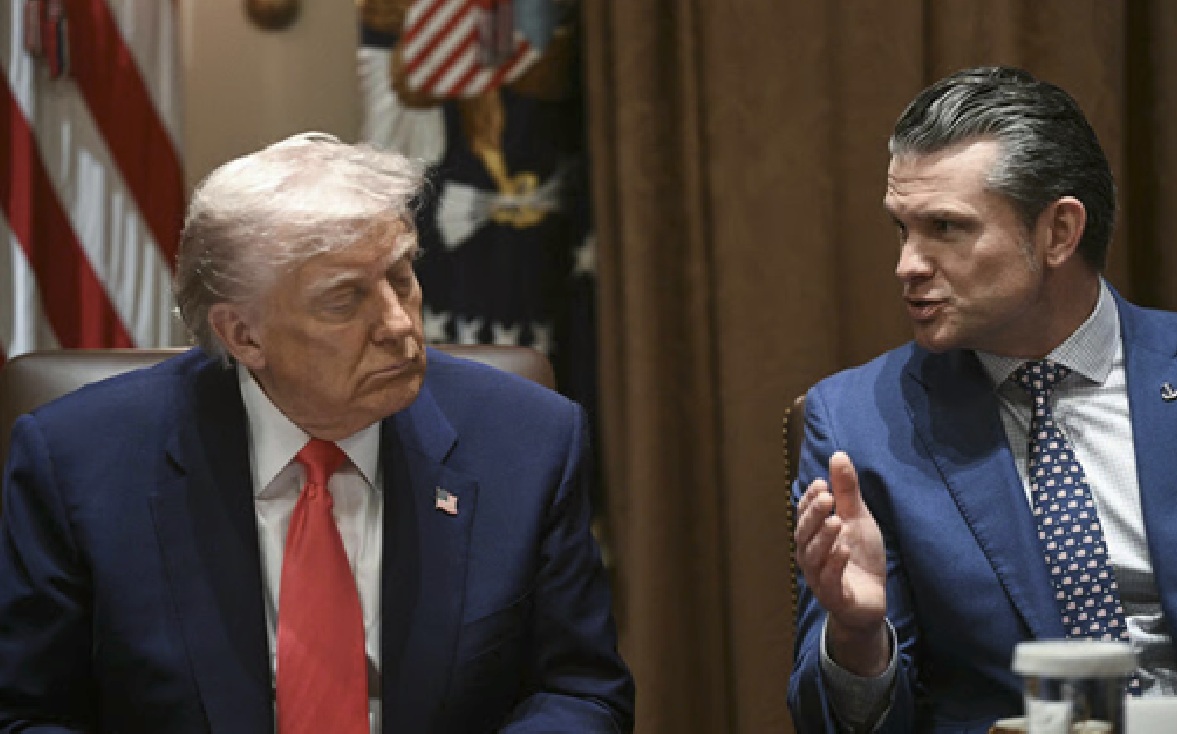
CAMP DAVID, MARYLAND — It was supposed to be a routine cabinet retreat, a chance for President Donald Trump and his top national security officials to take stock of the five-month-old war with Iran that has already killed 18 American service members, wounded hundreds more, and convulsed the global economy. What transpired last Friday, according to two people close to the situation, was an extraordinary confrontation that underscored the significant gap between the administration’s triumphant rhetoric and the dire circumstances of a military operating on depleted resources, with munitions stocks down by 80%.
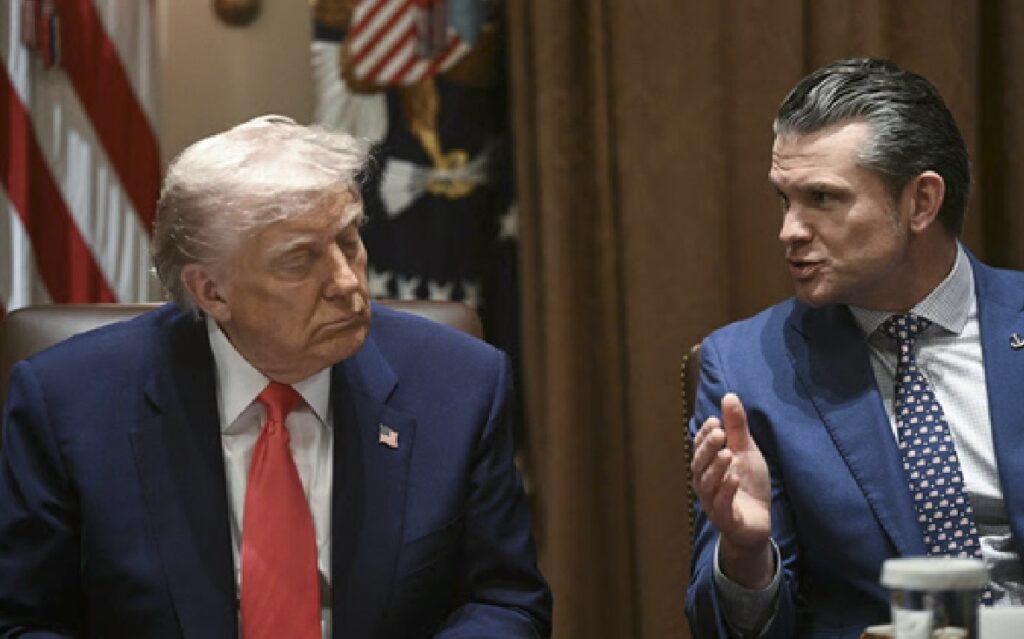
The Washington Post reported overnight Wednesday that Trump demanded answers from Defence Secretary Pete Hegseth over why he had apparently been given an “inaccurate picture” of U.S. military capabilities. The president’s anger, the sources said, centred on “extreme munitions shortages” that now threaten to limit military options against Iran, constraints Trump believed “had been fixed.”
“The president was blindsided,” one senior administration official, speaking on the condition of anonymity to describe the sensitive exchange, told The Post. “He thought this was handled months ago. To learn now, in the middle of a war, that we’re running out of the very missiles we need to both defend our troops and strike the enemy, it was volcanic.”
The shortages are not peripheral. They involve the Terminal High Altitude Area Defence (THAAD) system that protects American personnel stationed at bases that have come under repeated Iranian reprisal, as well as long-range guided missiles and Patriot interceptors. With Iranian forces having demonstrated, according to an earlier report by The Intercept, an increasing ability to combine attack drones with advanced ballistic missiles to strike U.S. military facilities across West Asia, the depletion of these stockpiles has become a strategic emergency.
Hegseth, a former Fox News host whose ascent to the Pentagon stunned the Washington establishment, did not absorb the blame. Instead, he pointed the finger at his deputy, Stephen Feinberg, claiming Feinberg had failed to keep the president fully apprised of the deteriorating supply situation. The deflection has only deepened the sense of a Pentagon leadership in disarray.
Within hours, the White House mounted a furious denial. Press Secretary Karoline Leavitt, who said she was physically present at Camp David with Trump and Hegseth, called the account “100% fake news” and added that “President Trump has the utmost confidence in Secretary Hegseth.” Pentagon chief spokesman Sean Parnell was equally emphatic: “Secretary Hegseth did not mislead anyone about our munitions posture, and he did not blame Deputy Secretary Feinberg. These claims about depleted stockpiles, internal disagreements, the Secretary’s position on Iran … are equally fictional.”
Yet the denials are running headlong into a growing body of evidence, much of it assembled by journalists and independent analysts, that the war’s appetite for precision munitions has far outstripped the Pentagon’s ability to sustain it.
Depletion By The Numbers: The Hollowing Of America’s Arsenal.
If the Camp David clash was the political earthquake, the seismic data had been accumulating for weeks. A Reuters investigation, drawing on internal U.S. military data, revealed that the United States had fired more than 850 Tomahawk cruise missiles and more than 1,000 Patriot and THAAD interceptors in just the first month of the conflict. By the initial phase of Operation Epic Fury, the joint U.S.-Israeli campaign that began on February 28, 2026, U.S. forces had already struck more than 13,000 targets inside Iran while fending off more than 8,500 incoming Iranian munitions and drones.
A separate assessment by the Centre for Strategic and International Studies (CSIS) published last week delivered its own devastating arithmetic: approximately 65% of Patriot interceptors in the U.S. inventory were expended between February and July, and the number of available THAAD interceptors had fallen by at least 38% compared to pre-war levels. Reuters noted that while it had not seen the supply figures itself, these estimates aligned with the U.S. government’s own internal tallies.
The most alarming shortfalls, however, involve ground-launched offensive missiles. The Army Tactical Missile System (ATACMS) and its successor, the Precision Strike Missile (PrSM), have been used at a staggering pace. One source told Reuters the United States used “almost all” of those weapons. A separate official, speaking to The Washington Post, was even more stark: of the ATACMS arsenal, “there’s basically none left.”
Brad Bowman, an Army veteran and senior director at the Foundation for Defence of Democracies, captured the predicament in stark terms. The war, he said, “has made those inadequacies even worse.” He pointed to the glacial pace of the defence industrial base: “We’re often talking years between spending what we need to spend, getting the contracts signed, and delivery. You don’t just flip the switch, and suddenly the munition appears in the hands of the warfighter.”
The production timelines underscore the crisis. Patriot interceptors can take up to two years to manufacture. Newly announced industry framework agreements, while heralded by the Pentagon as a solution, have yet to translate into actual contracts or appropriated funds. The administration’s record $1.5 trillion defence budget request, which includes tens of billions for missile production, remains stalled in Congress as Democrats baulk at the massive increase. Senate Republicans, meanwhile, have been unable to agree on a path forward for an additional $67 billion supplemental funding package that Hegseth told lawmakers was necessary to address “urgent, necessary” replenishment.
The net effect is a military increasingly forced to make real-time calculations about whether to shoot. A U.S. official told The Washington Post that before launching an interceptor, commanders now examine the estimated trajectory of an incoming missile or drone and the danger it poses, a triage designed to avoid wasting costly munitions on threats that may not strike vital targets. The official’s phrasing was chilling: they now determine if an incoming threat is “a factor” before deciding to engage. It is a peacetime accounting formula applied, for the first time, to a live-fire war.
A War Built On False Premises:
The Camp David confrontation carries special weight because of who Pete Hegseth is and what he represents. According to several officials, Hegseth was among the administration’s earliest and most influential advocates for war with Iran. At a moment when more cautious voices, including Chairman of the Joint Chiefs of Staff Gen. Dan Caine, were warning the president that the United States did not have sufficient munitions stockpiles to sustain a prolonged conflict, Hegseth was selling a vision of a swift and decisive campaign.
“He told the president this would be relatively quick and easy,” one former senior Pentagon official, who served during the transition and requested anonymity to speak freely, said in an interview. “The pitch was that American technological superiority would overwhelm Iranian air defences in days, and the regime would either capitulate or collapse. There was no Plan B for a grinding, months-long exchange of missile barrages.”
Caine’s pre-war warnings, multiple sources confirm, were explicit. The U.S. military, hollowed out by decades of counterinsurgency and then depleted further by years of supplying Ukraine and Israel, was not postured for a major theatre war against a state adversary with a sophisticated ballistic missile and drone capability. Hegseth, by contrast, was the face of confident aggression. In a July Senate hearing, he clashed with Democratic senators who pressed him on whether he had provided Trump with honest assessments of the risks. Hegseth refused to discuss his private counsel and blamed any inventory problems squarely on the Biden administration’s legacy, even as the current war was consuming munitions at a pace unseen since the 2003 invasion of Iraq.
The credibility of the Defence Secretary was already under a cloud. He was a central figure in the “Signalgate” scandal, in which classified information was transmitted over a commercial messaging app in a chat that inadvertently included a journalist. The episode, which prompted weeks of damaging headlines and a muted internal review, left a lasting impression of a Pentagon leadership team that played fast and loose with the most sensitive information.
Still, Trump consistently defended Hegseth in public, calling him straight out of “central casting” and musing that “he loves war.” The successful and audacious operation to capture former Venezuelan strongman Nicolás Maduro earlier this year appeared to cement Hegseth’s standing as the architect of Trump’s muscular foreign policy. Since taking office, Trump has ordered military operations in seven countries: Yemen, Somalia, Syria, Iran, Iraq, Nigeria and Venezuela.
But the stalemate with Iran, the indefinite closure of the Strait of Hormuz, and the cascading economic consequences have eroded the president’s confidence. “The Maduro operation was a win,” one person familiar with Trump’s thinking told Reuters. “Iran is not a win. It’s a quagmire. And the president hates quagmires.”
Strategic Paralysis And Global Fallout:
The munitions crisis is not a mere logistical irritant; it is actively constraining American strategy. Over the weekend, in a startling post on his Truth Social platform, Trump revealed that he had ordered and then abruptly cancelled what he described as “the biggest attack since World War II” against Iran. The United States, he wrote, was “locked and loaded to act against Tehran with a military force and strength not seen since World War II,” but had pulled back because “the outlines of a deal have been agreed upon.” He later elaborated that Iran and other regional states had requested restraint.
The subtext, multiple officials acknowledge, is the shortage of long-range precision strike missiles. Any major new offensive would require a sustained bombardment that the United States simply cannot mount without dangerously exposing other theatres. ATACMS and PrSM missiles, as Reuters sources underscored, are also critical to any conflict with China, particularly in the Pacific. The idea that the U.S. military could pivot rapidly to a Taiwan contingency is now openly questioned inside the Pentagon.
Iran, for its part, has not only survived the initial onslaught, which targeted nuclear sites during Operation Midnight Hammer, but has demonstrated its own capacity for retaliation on a wider scale. The Intercept, citing a U.S. official speaking on condition of anonymity, reported that since July 9, the Islamic Republic has carried out retaliatory strikes against at least nine U.S. military outposts across West Asia, several of which sustained “significant damage.” The ability to combine drones and ballistic missiles in saturation attacks has rendered traditional air defence architectures increasingly fragile.
On the diplomatic front, Iran announced Wednesday that it was in the “final stage” of drafting an agreement with Oman over the governance of the Strait of Hormuz. The waterway, chokepoint for a fifth of the world’s oil supply, has been effectively closed since the early days of the war, sending energy prices skyrocketing and triggering a global economic downturn. Trump has said a deal could be announced this week, but the terms remain contentious: Iran insists on some measure of formal control, while Washington has previously ruled out any arrangement that would cement Tehran’s grip over the strait. The result is a negotiation in which the United States holds a hand weakened by its own ammunition cupboards.
The ripple effects have reached Ukraine, a country already locked in an existential struggle against Russian aggression. Ukrainian officials have warned that their own stock of Patriot interceptors is running critically low, and the drawdown of U.S. stocks means Kyiv can expect little near-term replenishment. A Ukrainian defence official, speaking on condition of anonymity, said the situation was “desperate.” “We understand the Americans have their own war now, but we are being left exposed to Russia’s long-range missile attacks,” the official said. “If the Iran conflict continues to drain everything, it could be the difference between survival and defeat.”
Voices From The Ground And The Home Front:
Beyond the briefing rooms and the statistics, the human dimension of the crisis is sharpening.
In Goldsboro, North Carolina, Tamara Ewing, whose 24-year-old son, Army Specialist Marcus Ewing, was killed in a drone strike on al-Tanf garrison in April, said she had followed the Camp David reports with a mixture of grief and fury. “They told us this war was necessary to keep America safe,” she said in a telephone interview. “Now I’m reading that the generals didn’t even have enough missiles to protect my boy. What kind of planning is that? Somebody needs to be held to account.”
Anti-war activists have seized on the revelations. “The confrontation at Camp David is just the tip of the iceberg,” said Melvin Goodman, a senior fellow at the Centre for International Policy and a former CIA analyst. “What we’re witnessing is a fundamental breakdown of civilian control and strategic planning. The fact that the Secretary of Defence is blaming his own deputy for not telling the president the truth about the arsenal tells you everything about the culture of this Pentagon.”
On the streets of Tehran, residents who survived the punishing U.S. bombing campaign express a grim defiance. “We have endured sanctions, we have endured strikes, and now we hear that the Americans are running out of missiles,” said Amir, a 42-year-old shopkeeper in the city’s Grand Bazaar who asked that his family name not be used. “Perhaps this is why they are suddenly so interested in talks over the Strait. They are not negotiating from strength. They are negotiating from a position of weakness, and everyone knows it.”
In the Gulf Arab states, where luxury hotels sit eerily quiet, and shipping companies have rerouted vessels at enormous cost, the mood is one of barely suppressed panic. A Bahrain-based financier with extensive ties to regional governments, speaking on the condition of anonymity, said the war had become an economic catastrophe. “Every day the strait remains closed, billions are being lost. And now we hear the great American arsenal is depleted. So what happens if China decides this is the moment to test Taiwan? The umbrella we were promised is full of holes.”
The Credibility Gap:
The administration’s blanket denials of the Camp David confrontation are encountering a press corps that, five months into a war launched with assertions of overwhelming might, has learned to listen for the silences between the official pronouncements.
The Washington Post’s story was not a single-source leak; it was based on two people familiar with the exchange and was corroborated, in its broad outlines, by the cascade of data on munitions consumption that independent analysts have assembled. Reuters’ reporting on the near-total depletion of ATACMS was similarly sourced to multiple individuals with direct knowledge. The Post reported that its account had been “shopped to many outlets”, a claim echoed by Leavitt in her social media denial, in which she accused an unnamed party of trying to “disparage the Secretary.”
The framing of the story as an attempt to damage Hegseth, rather than to illuminate a genuine and strategic vulnerability, is itself a window into the factional dynamics at play. Within the administration, some see the defence secretary as a liability and those who view him as a firewall protecting the president. The fact that Hegseth shifted responsibility to Feinberg, a billionaire investor with deep ties to the military-industrial complex but no prior government experience, suggests that even allies are preparing sacrificial offerings.
For the press, the episode is a test. Leavitt’s statement that the report is “100% fake news” echoes a familiar rhetorical strategy, but the specificity of the underlying data makes a blanket dismissal increasingly untenable. “We are in a moment where the administration’s credibility is directly challenged by the physical reality of empty missile tubes and cancelled strikes,” said David Sanger, a veteran national security correspondent who has covered multiple administrations. “Journalists have to keep their eye on the facts on the ground and the numbers that can be independently verified. That’s our role. And those numbers paint a picture of a military in deep trouble.”
The Long Road To Reconstitution:
Even if a deal over the Strait of Hormuz materialises this week, the strategic damage will take years to repair. The Pentagon’s newly announced framework agreements with defence contractors are essentially declarations of intent. As Bowman noted, companies “aren’t going to start bending metal until you have a contract and congressional appropriations.” And with the supplemental funding request stalled and the overall defence budget mired in partisan gridlock, there is no clear path from aspiration to arsenal.
The math is brutal. Restoring the Patriot interceptor stockpile to pre-war levels could take until 2028 or beyond. Reconstituting ATACMS and PrSM inventories, especially given the complexity of the precision guidance systems, will require a sustained industrial mobilisation that the United States has not attempted since the Cold War. In the interim, any adversary observing the United States, whether in Beijing, Moscow, or Pyongyang, may calculate that the window of American vulnerability is open.
Some lawmakers are demanding answers. Senator Tom Cotton, a Republican hawk, has called for a full classified briefing on the state of the arsenal. But others, particularly on the Democratic side, are asking darker questions about whether the administration knowingly misled Congress and the public about the war’s sustainability. “If General Caine warned the president before the first bomb fell that we didn’t have the stocks for a long war, and Secretary Hegseth was telling a different story, then we have a profound breakdown of accountability,” said Senator Chris Murphy, a member of the Foreign Relations Committee. “The American people deserve the truth.”
Conclusion: A Reckoning Deferred
In the spring of this year, as the American armada converged on the Persian Gulf and the missiles began to fly, the prevailing narrative was one of restored American dominance. The capture of Maduro, the relentless bombing of Iranian nuclear facilities, the bravado of a president who said he had “liberated the world from the Iranian menace”, all of it broadcast a message of unassailable strength.
What the confrontation at Camp David reveals is that the edifice was hollow. Behind the scripted assurances, the Pentagon leadership presided over a rate of weapons expenditure that consumed in weeks what had taken decades to accumulate. The warnings of military professionals were marginalised. And when the day of reckoning arrived, the secretary of defence, confronted by an angry commander in chief, blamed his own number two.
As the war grinds into its sixth month, the United States finds itself in a paradoxical position: still the world’s preeminent military power, yet constrained by a munitions shortage so severe that the president has had to cancel strikes he publicly announced. The myth of effortless American force projection has collided with the unforgiving arithmetic of industrial production, and the sound of that collision is still reverberating across a nervous globe.
For the families of the fallen, for the troops still manning exposed bases, for the allies who bet their security on the U.S. umbrella, and for an American public told that this war would be a short and glorious triumph, the Camp David meeting is more than a palace intrigue story. It is a signal that the country’s leaders themselves are only now grasping the true cost of the conflict they chose to start. The question is whether that recognition will be accompanied by honesty, or whether the denials will continue until the last interceptor leaves its tube.
Veritas Press Investigative Analysis
Independent journalism examining global affairs, power, diplomacy and accountability.
Source: Veritas Press C.I.C. | Multi-News Agencies
APPEAL: Help Support Our Work By Donating
Readers who believe that truth still matters have power over popular information. When just a few more people step up to support this work, it means more lies exposed, more corruption uncovered, and more accountability where it’s long overdue.
Help Protect Independent Journalism, Which Is Currently Under Attack.
If you believe journalism should serve the public, not the powerful, and you’re able to help, becoming a regular DONOR or a PAID SUBSCRIBER truly makes a difference.
DONATION APPEAL: If you found this reporting valuable, please consider supporting independent journalism.
Your support fuels our fearless, truth-driven journalism. In unity, we endeavour to amplify marginalised voices and champion justice, irrespective of geographical location. We operate independently, with no financial backing from billionaires; our readers support us.
But it’s also extremely important. One of Veritas Press’s greatest assets is its reader-funded model.
1. Reader funding means we can cover what we like. We’re not beholden to the political whims of a billionaire owner. We are a small, independent and impartial organisation. No one can tell us what not to say or what not to report.
2. Reader funding means we don’t have to chase clicks and traffic. We’re not desperately seeking your attention for its own sake; we pursue the stories that our editorial team deems important and believes are worthy of your time.
3. Reader Funding: enables us to keep our website and other social media channels open, allowing as many people as possible to access quality journalism from around the world, particularly those in places where the free press is under threat.
We know not everyone can afford to pay for news, but if you’ve been meaning to support us, now’s the time.
Your donation goes a long way. It helps us:
- Keep the lights on and sustain our day-to-day operations
- Hire new, talented, independent reporters
- Launch real-time live debates, community-focused shows, and on-the-ground reporting
- Cover the issues that matter most to our communities, in real time, with depth and integrity
Without your support, independent voices like ours will be silenced.
Further, we have plans to expand our work, but we can’t do it without your support. Every contribution, no matter the size, helps us stay independent and build a truly people-powered media platform.
If you believe in journalism that informs, empowers, and reflects the communities we serve, please donate today.
Submissions:
For the secure submission of documentation, testimonies, or exclusive investigative reports from any global location, please utilise the following contact details for our Investigations Desk: mailto:enquiries@veritaspress.co.uk or mailto:editor@veritaspress.co.uk
GENEVA — A United Nations fact-finding mission has concluded there are “reasonable grounds to believe”
Iran’s GDP is projected to contract by 5.4 to 6.1% in 2026, its worst performance
The Trump administration is preparing a $2.8 billion weapons package for Israel containing 40,000 2,000-pound

Film alleges mass civilian deaths are routinely built into military decisions amid Israel’s genocidal war
The Israeli rights group says violence, displacement, economic strangulation, and settlement expansion form part of

Houthi forces have captured the historic Red Sea port of Mocha and are advancing on
London’s historic sanctions against Israeli settlements mark a watershed moment in UK foreign policy, but
With 95% of Gaza’s population now wholly dependent on aid and more than 90% stripped
India calls for Kashmir and Ladakh to appear only on its official map after a
ISLAMABAD – In the high-stakes political theatre of Pakistan, the battleground has shifted from the





















t6dtg2
ghioqn