




Author:
Help support our mission, donate today and be the change. Every contribution goes directly toward driving real impact for the cause we believe in.
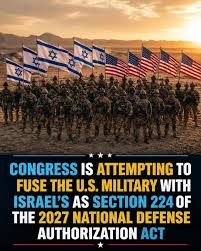
A special investigation into how Washington’s historic refusal to hold Israel accountable after a deadly attack on an American ship has evolved into a legislative push that would fuse the two nations’ military-industrial complexes, with the U.S. Congress driving the integration.
Background: The USS Liberty And The Birth Of A Fearful Asymmetry.
The attack on the USS Liberty remains one of the most shocking and controversial episodes in U.S.–Israel relations, and it established a pattern that many analysts describe as the United States “watching in fear”, not fear of Israel’s military power, but fear of the political consequences of confronting Israel.
On June 8, 1967, during the Six-Day War, the USS Liberty was a lightly armed American technical research ship in international waters off the Sinai Peninsula. Despite flying a large American flag and having clearly visible hull markings, it was subjected to a sustained, multi-wave assault by Israeli fighter jets and torpedo boats. The attack lasted over an hour, killing 34 American sailors and wounding 171. Israel later apologised, calling it a case of mistaken identity, though numerous survivors, intelligence officials, and declassified documents have cast serious doubt on that account.
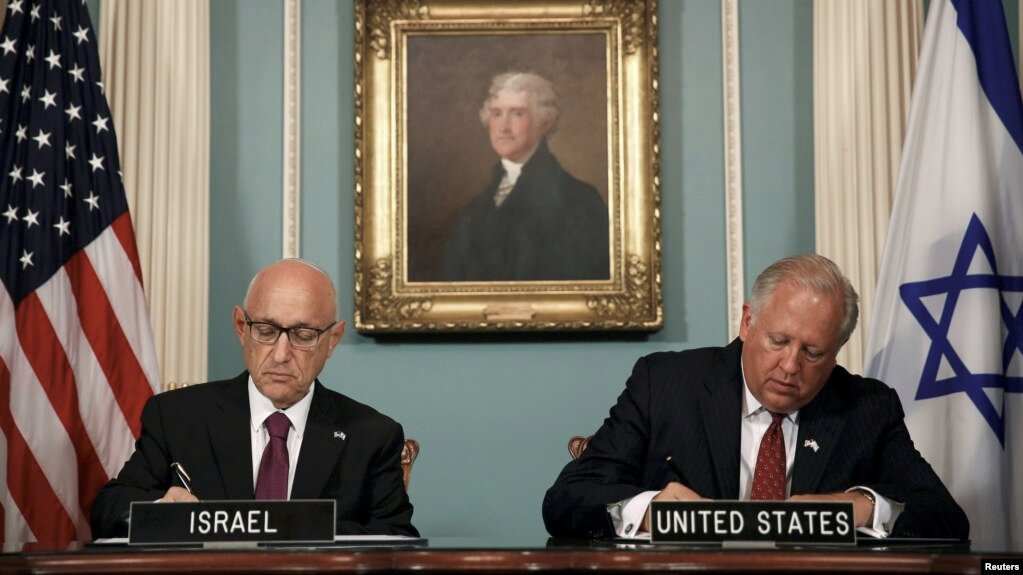
As the attack unfolded, the Liberty managed to radio for help. The U.S. Sixth Fleet dispatched fighter aircraft from nearby carriers to defend the ship. But in a move that has haunted survivors ever since, those rescue planes were recalled twice, on direct orders from the White House. Secretary of Defence Robert McNamara reportedly screamed that the planes must return, saying the U.S. would not “embarrass” an ally. President Lyndon Johnson personally told the Sixth Fleet commander that he did not care if the ship sank, so long as no one embarrassed Israel.
The U.S. government’s behaviour after the attack deepened the sense of fear-driven paralysis. Instead of a full public investigation or any punitive measures, the Johnson administration hastily accepted Israel’s apology and suppressed a thorough inquiry. A naval court of inquiry was ordered to find that the attack was accidental, even as evidence pointed to the contrary. Survivors were threatened with court-martial and imprisonment if they spoke publicly about what they had witnessed. The message was clear: the political cost of holding Israel accountable was deemed higher than the loss of American lives.
That original choice, to subordinate the lives of American servicemen to the political calculus of not irritating Israel, is the worm at the core of the relationship. It foretold a sixty-year drift in which the United States would learn to “watch in fear,” not of Israel’s military force, but of the domestic political machinery that makes real accountability virtually impossible.
A Precedent Of Impunity:
The USS Liberty incident established a durable precedent in U.S. foreign policy: that Israel can take military action directly against U.S. personnel and assets, and the United States will respond not with force or justice, but with a protective cover-up. This is not a one-off lapse but a recurring pattern that connects the Liberty to later events:
- Jonathan Pollard spy affair (1985): Israel ran a massive espionage operation against the U.S., stealing thousands of highly classified documents, some of which allegedly ended up in the Soviet Union. Despite the severity, U.S. administrations for decades blocked harsh measures, and Pollard was eventually freed under Israeli pressure. Former CIA Director R. James Woolsey later confirmed that the damage was catastrophic.
- Condemning but not acting: When Israel bombed Iraq’s Osirak reactor (1981) or annexed the Golan Heights (1981), the U.S. publicly criticised but never imposed meaningful costs. The pattern repeated itself countless times, from settlement expansions to the bombing of Damascus and Beirut.
- Killings of American citizens: When Israeli forces killed American activist Rachel Corrie (2003), or more recently, journalists and aid workers with U.S. ties in Gaza, the official U.S. response has been muted, with no independent investigation or accountability. Corrie’s family pursued justice through Israeli courts for years and received nothing but a whitewash. Shireen Abu Akleh, a Palestinian-American journalist killed in 2022, was acknowledged by the FBI to have likely been killed by Israeli fire, yet no action was taken.
- Modern arms supply: Even as Israel is accused of using American-supplied weapons in actions that violate international law, the U.S. continues near-unconditional military support, often circumventing congressional oversight through emergency provisions.
In each case, the root dynamic echoes the Liberty: a fear, whether of domestic political blowback, lobbying power, or a fractured U.S.–Israel “special relationship”, that prevents the American government from reacting as it would to any other nation that harmed its citizens.
Thus, the USS Liberty is far more than a tragic historical footnote. It is the original template for a deeply asymmetric alliance, one in which the United States too often chooses to “watch in fear” rather than risk the political fallout of demanding accountability.
Fear Becomes Structure: The Blueprint Expands.
The Liberty precedent did not end with Johnson. It taught every American president and Pentagon chief that the political cost of confronting Israel exceeded the cost of absorbing the blow, no matter how grievous. That lesson morphed into something far more structural: not just a refusal to hold Israel accountable, but an active integration of the two countries’ national security apparatuses so deep that separation would require a kind of surgical amputation the American political system is no longer capable of performing.
“Sixty years ago, they recalled the rescue planes. Today, they’re embedding the cockpit itself into the Israeli Air Force,” says retired U.S. Army Colonel and former diplomat Ann Wright, who resigned over the Iraq War and now works with CODEPINK. “The only thing that has changed is that they’ve stopped pretending there’s daylight between us.”
‘A Thing You Can Move Very Easily’:
The architecture of control that Israel exerts over American policy in the Middle East, and increasingly over domestic legislation, is not a conspiracy theory whispered in the margins. It is described openly by Israeli leaders themselves, meticulously documented by watchdog groups, and measured in billions of dollars of campaign spending that reshapes the U.S. Congress in real time.
In a now-infamous recording from 2001, Benjamin Netanyahu, then between terms as prime minister, was captured speaking candidly to a gathering of settlers in the occupied West Bank. He boasted of his success in derailing the Oslo peace process and of his ability to manipulate Washington. “I know what America is. America is a thing you can move very easily, move it in the right direction. They don’t bother us.” The video, broadcast on Israeli television, has since accumulated tens of millions of views online and is cited routinely by analysts as the most honest articulation of the power dynamic.
Netanyahu’s 2001 boast has found a twenty-first-century echo in Itamar Ben-Gvir, the far-right Israeli National Security Minister, whose political career has been built on anti-Palestinian incitement, the criminalisation of dissent, and open calls for the wholesale annexation of the occupied territories. In 2023, a video with fabricated subtitles went viral, appearing to show Ben-Gvir saying, “We are the masters of the country, and I’m sorry, but we control the United States.” While fact-checkers quickly debunked the specific translation, the fact that the claim was instantly believed by millions across the globe spoke to a widely held, lived perception. The fabricated quote seemed plausible because, to many observers, it accurately described the observable facts.
Ben-Gvir’s actual statements, calling for the expulsion of Palestinians, the annexation of the entire West Bank, and the imposition of full Israeli sovereignty over the Al-Aqsa Mosque compound, are delivered without the slightest regard for Washington’s supposed red lines. And why should they be? In April 2025, when Israeli forces launched a major operation in the Jenin refugee camp that killed over 40 Palestinians in a single week, the White House issued a statement urging “restraint” while simultaneously notifying Congress of an additional $8 billion in arms transfers. The phrase “masters of the country” may be a forgery, but the dynamic it describes is a matter of public record.
The Mother Of All Lobbies:
The mechanism by which America is “moved very easily” is not mysterious. The American Israel Public Affairs Committee (AIPAC) and its affiliated super PACs, notably the United Democracy Project (UDP), have systematically targeted and eliminated any member of Congress who dares to question the relationship. In the 2024 election cycle alone, AIPAC and its allied spending vehicles poured over $100 million into Democratic primaries to unseat Representatives Jamaal Bowman and Cori Bush, both vocal critics of Israel’s war in Gaza. Bowman, defeated by a landslide after an unprecedented advertising blitz in his New York district, was blunt in his concession speech: “AIPAC and its allied billionaires and trillionaires are destroying American democracy. They will stop at nothing to silence dissent.”
Cori Bush, a former Black Lives Matter activist from Missouri, lost her primary after AIPAC’s UDP spent nearly $9 million against her, a staggering sum for a single House race. In both cases, the message to the remaining members was unmistakable: criticise Israel and your career is over. “There is now a literal price tag on dissent on Capitol Hill,” says Trita Parsi, executive vice president of the Quincy Institute for Responsible Statecraft. “And everyone in the building knows exactly what that price tag buys.”
But the financial muscle extends far beyond campaign contributions. A vast ecosystem of pro-Israel think tanks, the Foundation for Defence of Democracies, the Jewish Institute for National Security of America (JINSA), and the Washington Institute for Near East Policy, furnishes the policy papers, the talking points, and the career pathways that shape the Beltway’s consensus. The revolving door spins perpetually: senior Pentagon officials leave government for fellowships at these institutions, then rotate back into decision-making roles, their ideological priors carefully calibrated to ensure Israel’s interests are never far from the centre of American strategic thought.
‘Who Controls The Narrative Controls The World’:
If the legislative machinery is the skeleton of Israel’s influence, the control of information is its nervous system. The claim that Israel and its allied organisations “control all media and news outlets, including social media” is frequently dismissed as anti-Semitic hyperbole, yet the empirical record of coordinated media pressure campaigns, institutional censorship, and algorithmic manipulation is extensive and undeniable. It is undeniable that “Israel Controls The US Government.”
The Israeli government maintains a multi-million dollar “Hasbara” apparatus, the Hebrew word for “explanation”, that coordinates messaging across embassies, social media platforms, and partner organisations worldwide. The Ministry of Diaspora Affairs and the Strategic Affairs Ministry have been documented running clandestine influence operations, including the 2018-2019 “Kela Shlomo” program, which used fake social media accounts to spread pro-Israel narratives and smear pro-Palestinian activists. A 2023 investigation by The Guardian and Haaretz revealed that a network of Israeli government-linked organisations had been systematically filing false reports to get Palestinian solidarity content removed from Meta, TikTok, and YouTube.
U.S. domestic groups, led by the Anti-Defamation League (ADL) and the Committee for Accuracy in Middle East Reporting in America (CAMERA), operate as full-time media watchdogs, bombarding editors, producers, and platform executives with demands to correct, retract, or remove any content deemed insufficiently favourable to Israel. The ADL, in particular, has increasingly equated anti-Zionism with anti-Semitism, deploying a controversial definition that critics say criminalises political speech. In 2025, the ADL launched a major campaign pressuring universities to adopt this definition, threatening loss of federal funding for institutions that fail to comply.
“The result is a climate of McCarthyite fear across American newsrooms and campuses,” says Nathan Thrall, author of A Day in the Life of Abed Salama, a Pulitzer Prize-winning book on the occupation. “Editors are terrified of being labelled anti-Semitic. So they self-censor. The most brutal aspects of the occupation, the settler violence, the child detentions, prisoner torture, annexation, the home demolitions, are systematically under-reported in the American press.”
Internal documents leaked from The New York Times in early 2024, published by The Intercept, showed that the paper’s Jerusalem bureau chief had been repeatedly overruled on stories about Israeli settler violence, with senior editors in New York citing concerns about “backlash” from pro-Israel groups. “We are not covering this conflict honestly, and we know it,” one Times journalist told The Intercept on condition of anonymity.
On social media, the suppression is automated. Former Meta content moderators, speaking to ProPublica in 2025, described how the platform’s algorithms were configured to disproportionately flag and remove Palestinian content, while Israel-centric accounts received “protected” status. A leaked internal memo from TikTok’s trust and safety team, obtained by The Verge in January 2026, acknowledged that the platform had been “over-enforcing” against pro-Palestinian hashtags at the request of an unnamed “foreign government partner,” widely understood to be Israel.
“When you control the news cycle, you control the boundaries of acceptable debate,” says Marc Lamont Hill, a professor at CUNY and former CNN contributor who was fired in 2018 after calling for Palestinian rights in a UN speech. “And when you control acceptable debate, you control policy outcomes. That’s the whole ballgame.”
The Annexation Project And The American Boot:
Nowhere is the subordination of American power to Israeli aims more tangible than in the accelerating, American-enabled annexation of Palestinian land. The Israeli settler movement, long the beneficiary of U.S. diplomatic protection at the United Nations, has seized on the post-October 7, 2023, environment to push forward a de facto and increasingly de jure annexation of the West Bank that the United States actively facilitates with weapons, intelligence, and political cover.
In 2024, the Israeli government approved the largest seizure of Palestinian land in the West Bank since the Oslo Accords, over 12,000 dunams (roughly 3,000 acres), while also retroactively “legalising” dozens of illegal settler outposts under the so-called “Regularisation Law.” Finance Minister Bezalel Smotrich, himself a settler, was granted sweeping new powers to accelerate settlement construction, bypassing the usual bureaucratic channels. Through it all, the United States issued sporadic statements of “concern” while the Boeing-built F-15s and F-35s continued to fly, the Caterpillar D9 bulldozers, purchased with U.S. military aid, continued to demolish Palestinian homes and infrastructure, and the intelligence from U.S. surveillance systems continued to flow.
“We watch the American planes fly overhead every day,” says Issa Amro, a human rights activist in Hebron, in a phone interview. “The settlers are burning our cars, attacking our children on the way to school, and the soldiers who protect them are carrying M16s stamped ‘Made in USA.’ The United States is not a mediator. It is a co-combatant.”
The use of U.S. military assets for Israel’s territorial expansion is not incidental; it is the explicit goal of an increasingly influential faction within both the Israeli and American right. In June 2024, Israel’s Channel 14, a pro-Netanyahu outlet with close ties to the prime minister’s office, broadcast a segment in which panellists openly called for the United States to provide “the arms and the political shield” for full annexation of the West Bank. The host, Yaakov Bardugo, a confidant of Netanyahu, stated: “We don’t need American permission. We need American supplies. And we will get them, because we are the ones who decide what happens in Washington.”
The Legislative Lock-In: Section 224 And The FUTURES Act.
If the informal mechanisms of influence represent the software of Israeli control, a pair of legislative initiatives currently working their way through the U.S. Congress are designed to hard-code the relationship into the hardware of the American state. Together, they represent the most sweeping attempt to permanently fuse the U.S. and Israeli defence establishments ever undertaken.
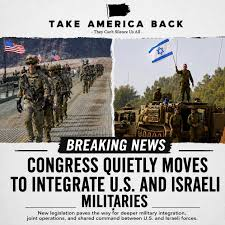
Section 224 of the National Defence Authorisation Act (NDAA) for Fiscal Year 2027 and the parallel United States-Israel Future of Unprecedented Technology, Research, and Economic Security (FUTURES) Act go far beyond the traditional model of annual foreign aid. They mandate what the legislative text calls “network integration” and “data fusion” between the two countries’ military systems, effectively giving Israel seamless access to U.S. defence capabilities across the most sensitive domains: artificial intelligence, cyber warfare, biotechnology, and autonomous weapons systems.
The legislation, introduced with bipartisan sponsorship in both chambers, directs the Department of Defence to “integrate Israeli defence technology into United States military supply chains,” shifting the bilateral relationship from a donor-recipient model to one of joint weapons development and co-production. The explicit goal, as stated in the committee report language, is to “create a permanent, mutually embedded defence industrial base that cannot be easily unwound by any future administration.”
“This is the end of any pretence of a sovereign American defence policy,” says William Hartung, senior research fellow at the Quincy Institute and author of Prophets of War, a history of the military-industrial complex. “What they are doing is locking the United States into a permanent military dependency on a foreign country. We will not be able to change administrations and change course, because the supply chains, the data links, the operational protocols will all be fused.”
The “accountability shift” that Hartung and other critics describe is central to the bills’ design. Under the traditional foreign aid model, Congress votes annually on military assistance to Israel, providing at least a theoretical opportunity for oversight and public debate. Under the new integration paradigm, the relationship moves into the black-box machinery of defence acquisition: long-term contracts, classified joint programs, and interwoven supply chains that are governed by the Pentagon’s byzantine procurement rules, not by public deliberation.
“Accountability is being moved from the visible, votable space into the realm of untouchable defence contracting,” says Representative Betty McCollum, Democrat of Minnesota, who has introduced legislation to condition U.S. aid to Israel on human rights compliance. “The goal is to make it so that no future Congress, no future president, no future popular movement can unwind what they’re building. It’s a ratchet that only turns one way.”
The integration is already well underway in the field. The U.S. Army has begun acquiring the SkyHunter interceptor, an Israeli-designed system for medium-range drone and missile defence, as a core component of its Indirect Fire Protection Capability. The Trophy Active Protection System, developed by Israel’s Rafael Advanced Defence Systems, is now deployed on Abrams main battle tanks, designed to intercept incoming rockets and anti-tank missiles. The U.S. Sixth Fleet, long based in Naples, now conducts such extensive joint operations with the Israeli Navy out of the port of Haifa that current and former Pentagon officials describe Haifa as a “de facto U.S. naval base.” Joint training exercises like Juniper Oak and Juniper Cobra have grown so large and complex that they blur the line between two distinct militaries and a single integrated force.
‘The Hostage Dynamic’:
The consequence of this deepening entanglement, critics argue, is that the United States has effectively handed Israel a structural veto over American foreign policy in the Middle East and beyond. If the U.S. supply chain depends on Israeli semiconductors for its missile guidance systems, and if U.S. cyber defences are co-developed with Israeli firms, then any American administration that seeks to pressure Israel, through sanctions, aid restrictions, or even public criticism, will find itself threatening its own military readiness.
“It’s a hostage dynamic,” says a senior Pentagon official who spoke on condition of anonymity because they were not authorised to discuss the matter publicly. “We are so deeply intertwined that when Israel escalates, we are automatically pulled in. We cannot credibly threaten to condition anything, because the condition cuts both ways. If we freeze a joint program, we are freezing our own capability.”
This dynamic has been on stark display throughout the wars that Israel has waged since October 7, 2023. In Gaza, where the Palestinian Ministry of Health reports that the death toll has now exceeded 100,000, a figure that a peer-reviewed study in The Lancet estimates is likely a significant undercount, the bombs falling on residential towers, schools, and hospitals have been overwhelmingly supplied by the United States. The Biden administration repeatedly bypassed congressional oversight to expedite arms transfers, invoking emergency declarations originally designed for extraordinary circumstances. At one point, the U.S. military was flying multiple C-17 cargo aircraft into Israel per day, a pace that one Air Force officer described as “sprint-level resupply for a war that is not ours.”
In October 2024, the administration deployed a Terminal High-Altitude Area Defence (THAAD) battery to Israel, placing approximately 100 U.S. soldiers on the ground to operate the system. It was a tripwire if ever there was one. “Once you put American boots on the ground to defend Israel from Iranian missiles,” says Stephen Wertheim, senior fellow at the Carnegie Endowment for International Peace, “you have made a de facto mutual defence commitment. Congress has never debated it. The American people have never consented to it. But it’s done.”
When Israel launched a massive bombing campaign across southern Lebanon in September 2024, levelling entire apartment blocks in Beirut’s southern suburbs and killing over 2,000 people in a matter of weeks, the United States provided the intelligence, the precision-guided munitions, and the diplomatic umbrella. At the UN Security Council, the United States stood alone or nearly alone in vetoing resolutions calling for a ceasefire, repeatedly citing Israel’s “right to self-defence” while the bombs it had supplied continued to fall.
The U.S. As A Stumbling Block In Negotiations:
“The United States is not an honest broker. The United States is not a mediator. The United States is Israel’s lawyer, its arms dealer, and its diplomatic shield,” says Tariq Kenney-Shawa, a policy fellow at Al-Shabaka, the Palestinian policy network. “Every time there is a negotiation, the U.S. role is to stall, to block, to prevent any meaningful accountability, and then to blame the Palestinians for the failure.”
This pattern has been most damaging in ceasefire negotiations. Multiple rounds of talks in Cairo, Doha, and Paris in 2024 and 2025 collapsed after Israel introduced new conditions, the continued control of the Philadelphi Corridor, the right to resume military operations after a hostage exchange, which were clearly designed to be dealbreakers. In each case, the United States refrained from publicly holding Israel responsible, instead issuing statements calling for “flexibility on all sides,” language that obscures the fundamental power asymmetry.
“Israel violates ceasefire agreements with impunity,” says Sarah Leah Whitson, executive director of Democracy for the Arab World Now (DAWN), a human rights organisation founded by Jamal Khashoggi. “And the United States enables every violation. If you look at the record, the continued blockade, the continued settlement expansion, the continued extrajudicial killings, these are all violations of international law and of ceasefire commitments. The U.S. response is always the same: a quiet word behind closed doors, and another arms shipment.”
The Wider Map: Regional Ambitions With American Logistics.
Israel’s ambitions extend far beyond the occupied territories. Israeli defence officials and strategists have long articulated a vision of regional military and economic dominance that stretches from Morocco to the Persian Gulf, and increasingly into the Caucasus, the Eastern Mediterranean, and even parts of Asia. The Abraham Accords, brokered by the Trump administration and expanded under Biden, were never merely about normalisation of diplomatic ties; they were the foundation of a U.S.-backed Israeli military-economic sphere of influence in which Arab states purchase Israeli surveillance technology, integrate their defence systems with Israel’s, and align their foreign policies accordingly.
The trilateral architecture of the India-Middle East-Europe Economic Corridor (IMEC), announced with great fanfare at the 2023 G20 summit, placed Israel at the geographic and logistical centre of a proposed trade route linking Asia to Europe via Israeli ports, bypassing Iran and Turkey. Israeli defence firms like Elbit Systems and Rafael have expanded their footprint across the Indo-Pacific, selling drones, cyber tools, and missile defence systems to India, the Philippines, Vietnam, and Singapore. The Israeli strategy, as described in a 2025 report by the Jerusalem Institute for Strategy and Security, is to create a “conditional performance” framework: nations seeking access to Israeli technology must align their foreign policies with Israeli interests, particularly on Iran and China.
“Israel wants to control the Middle East and extend its influence deep into Asia,” says Sami Hamdi, a political analyst and editor of The International Interest. “But it cannot do this without the United States. The American security umbrella, the American military logistics, and the American diplomatic weight at institutions like the IMF and the World Bank are what make Israeli regional hegemony possible. Israel sets the strategic objectives; the United States pays the bill and absorbs the blowback.”
‘They Are Binding Our Hands Forever’:
Back in Washington, the legislative machinery grinds forward. As of June 2026, the NDAA with Section 224 has passed the House Armed Services Committee on a near-party-line vote, with a handful of progressive Democrats joining libertarian-leaning Republicans in opposition. The FUTURES Act awaits markup in the Senate Foreign Relations Committee, where it enjoys strong bipartisan backing. A letter of opposition signed by over 60 progressive organisations, including Jewish Voice for Peace, IfNotNow, and the Council on American-Islamic Relations, received no formal response from committee leadership.
“We are witnessing the construction of an institutional lock that no future election can open,” says Phyllis Bennis, a fellow at the Institute for Policy Studies and a veteran observer of U.S.-Israel relations. “They are binding our hands forever. This is not about aid to a foreign country; this is about embedding that country’s interests so deeply into our own defence apparatus that to extricate them would require dismantling and rebuilding the Pentagon from scratch.”
The defence industry lobby, one of the most powerful forces in Washington, is fully aligned behind the bills. For American contractors like Lockheed Martin, Raytheon, and General Dynamics, the prospect of co-production agreements with Israeli firms like Rafael and Israel Aerospace Industries represents not just new revenue streams but access to battle-tested technologies and a guaranteed market. The merging of supply chains creates a classic “iron triangle” of mutual dependency: the Pentagon wants the technology, the contractors want the contracts, and Congress wants the jobs and the political cover.
“What you are seeing is the final stage of a sixty-year process,” says Andrew Cockburn, Washington editor of Harper’s Magazine and author of The Spoils of War, a critical history of the defence industry. “It began with the cover-up of the Liberty, the moment the United States decided that its own dead sailors mattered less than the political cost of confronting Israel. It continued through decades of unconditional aid, the Pollard spy scandal that was swept under the rug, the invasions and wars that Israel’s supporters sold to the American public. And now it ends, or begins its permanent phase, with a law that makes the merger complete and irreversible.”
The Unquiet Dead:
On a grey morning in Arlington National Cemetery, the headstones of the USS Liberty dead stand in neat rows, indistinguishable from the thousands of others. There is no special monument, no presidential apology, no official acknowledgement that these men were abandoned by their own government in the moment of their greatest need. The survivors, now in their eighties, continue to meet in small reunions, telling their story to anyone who will listen. They have learned over the decades that most people will not.
“We were the first,” says Ernest Gallo, a former Liberty crewman and president of the USS Liberty Veterans Association, in a 2025 interview with The Nation. “We were the first to see that when Israel does something to America, America does nothing. And we’ve been watching it happen over and over again ever since. The only difference is, now they’re writing it into law.”
As the NDAA moves toward a final floor vote and the FUTURES Act gathers momentum, the silence that descended over the Liberty in 1967 echoes through the corridors of the Capitol. The same political calculus that crossing Israel is political suicide, that the machinery of influence is too powerful to challenge, that the costs of accountability are higher than the costs of complicity, now governs decisions that will shape American defence policy for a generation or more.
“History will record this as the moment the American republic outsourced a core element of its sovereignty,” says Stephen Walt, professor of international relations at Harvard University and co-author of The Israel Lobby and U.S. Foreign Policy. “But history may also record that no one in a position of power had the courage to say no. Just like no one had the courage to let those rescue planes fly.”
The jets were recalled. The Liberty burned. And sixty years later, the merger that began with a cover-up is being cemented with a congressional stamp.
Conclusion:
What the legislative push to permanently fuse the U.S. and Israeli defence establishments ultimately reveals is not a foreign policy choice but the final surrender of the constitution and a republic’s sovereign will. Sixty years of investigation, from the abandoned sailors of the USS Liberty to the classified provisions of the 2027 NDAA, trace a pathology that the American political class refuses to name: a client state has become the silent architect of the patron’s military future, and it did so by understanding American power better than Americans themselves. The cover-up of dead sailors, the ritualised humiliation of congressional oversight, the algorithmic silencing of dissent, the veto-proof shield at the United Nations, the emergency arms pipelines that make a mockery of the law, none of these are anomalies. They are the diagnostic signs of a political system so thoroughly captured that it can no longer distinguish between its own interests and those of a foreign government whose most extreme ministers openly boast of their full control. The merger now being written into statute is not a treaty between two nations; it is an institutional coup executed through campaign checks, revolving doors, and the deliberate atrophy of democratic accountability. The Liberty survivors were told, in effect, that their lives were less valuable than Israel’s diplomatic comfort. The NDAA tells the American public, in legal code, that their sovereignty itself is now subject to the same calculus. The rescue planes were recalled once. The legislation currently advancing in Congress is designed to ensure they can never be scrambled again.
Source: Veritas Press C.I.C. | Multi News Agencies
Help Support Our Work By Donating:
Popular Information is powered by readers who believe that truth still matters. When just a few more people step up to support this work, it means more lies exposed, more corruption uncovered, and more accountability where it’s long overdue.
Help Protect Independent Journalism, Which Is Currently Under Attack.
If you believe journalism should serve the public, not the powerful, and you’re in a position to help, becoming a DONATOR or a PAID SUBSCRIBER truly makes a difference.
DONATION APPEAL: If You Found This Reporting Valuable, Please Consider Supporting Independent Journalism.
Help Support Our Work – We Know, We Know, We Know …
Seeing these messages is annoying. We know that. (Imagine what it’s like writing them … )
Your support fuels our fearless, truth-driven journalism. In unity, we endeavour to amplify marginalised voices and champion justice, irrespective of geographical location.
But it’s also extremely important. One of Veritas Press’s greatest assets is its reader-funded model.
1. Reader funding means we can cover what we like. We’re not beholden to the political whims of a billionaire owner. We are a small, independent and impartial organisation. No one can tell us what not to say or what not to report.
2. Reader funding means we don’t have to chase clicks and traffic. We’re not desperately seeking your attention for its own sake: we pursue the stories that our editorial team deems important and believe are worthy of your time.
3. Reader Funding: enables us to keep our website and other social media channels open, allowing as many people as possible to access quality journalism from around the world, particularly those in places where the free press is under threat.
We know not everyone can afford to pay for news, but if you’ve been meaning to support us, now’s the time.
Your donation goes a long way. It helps us:
- Keep the lights on and sustain our day-to-day operations
- Hire new, talented independent reporters
- Launch real-time live debates, community-focused shows, and on-the-ground reporting
- Cover the issues that matter most to our communities, in real time, with depth and integrity
We have plans to expand our work, but we can’t do it without your support. Every contribution, no matter the size, helps us stay independent and build a truly people-powered media platform.
If you believe in journalism that informs, empowers, and reflects the communities we serve, please donate today.
Help By Donating Today:
Submissions:
For The Secure Submission Of Documentation, Testimonies, Or Exclusive Investigative Reports From Any Global Location, Please Utilise The Following Contact Details For Our Investigations Desk: enquiries@veritaspress.co.uk or editor@veritaspress.co.uk
GENEVA — A United Nations fact-finding mission has concluded there are “reasonable grounds to believe”
Iran’s GDP is projected to contract by 5.4 to 6.1% in 2026, its worst performance
The Trump administration is preparing a $2.8 billion weapons package for Israel containing 40,000 2,000-pound

Film alleges mass civilian deaths are routinely built into military decisions amid Israel’s genocidal war
The Israeli rights group says violence, displacement, economic strangulation, and settlement expansion form part of

Houthi forces have captured the historic Red Sea port of Mocha and are advancing on
London’s historic sanctions against Israeli settlements mark a watershed moment in UK foreign policy, but

With 95% of Gaza’s population now wholly dependent on aid and more than 90% stripped
India calls for Kashmir and Ladakh to appear only on its official map after a
ISLAMABAD – In the high-stakes political theatre of Pakistan, the battleground has shifted from the