Kamran Faqir is a volunteer investigative journalist and writer committed to exposing hidden truths and amplifying underreported stories. Driven by social justice, he brings sharp insight and fearless truth-telling to independent journalism. NUJ registered.
Article Date Published:
Article Date Modified:
17 minutes
Post Views:188
Listen to this article
Help support our mission, donate today and be the change. Every contribution goes directly toward driving real impact for the cause we believe in.
BIRMINGHAM – A confidential document leaked to ITV News Central has laid bare an extraordinary plan by senior Birmingham City Council officers to sack the entire striking bin workforce behind the backs of elected councillors, igniting a firestorm over democratic accountability, union rights, and the creeping power of unelected commissioners in bankrupt local authorities. The explosive file, marked “confidential” and drawn up in March 2026 by the council’s permanent, unelected leadership, not only maps out a route to mass dismissal but explicitly recommends executing it in a narrow window between local elections and the swearing-in of a new administration, so that incoming politicians could “disown responsibility” while “nonetheless benefiting” from a strike-busting fait accompli.
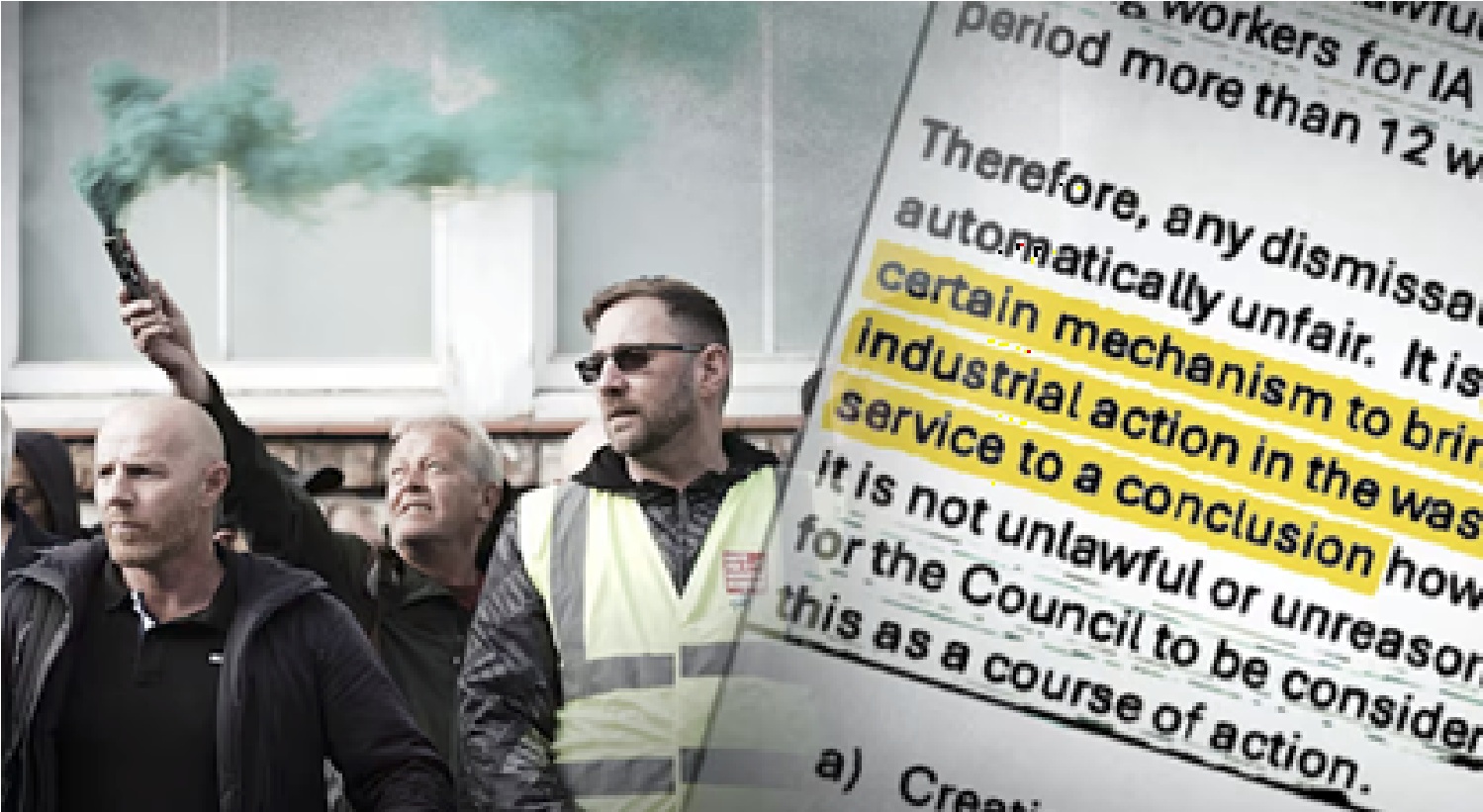
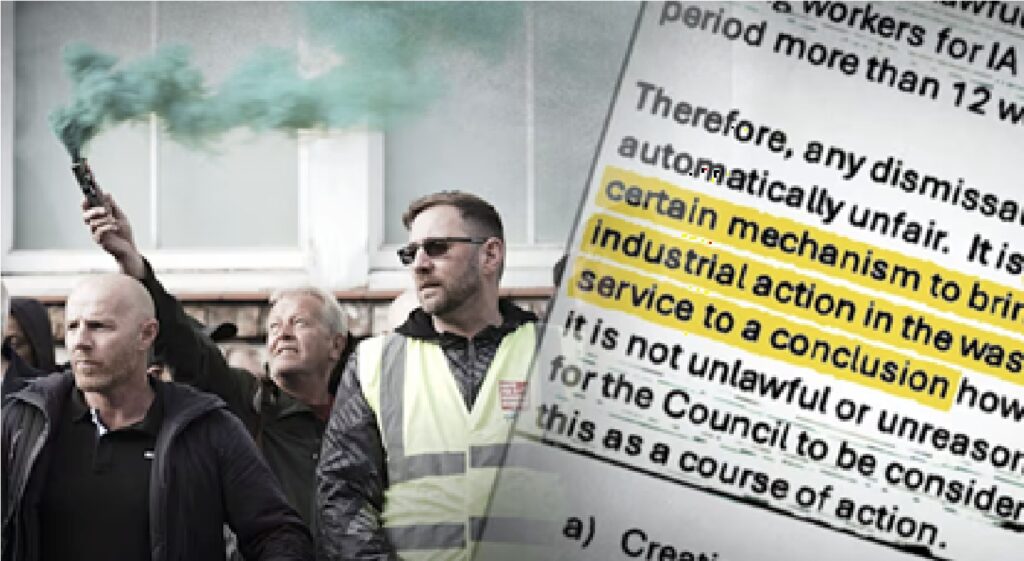
The document, obtained by ITV News Central, says dismissal ‘is the only option that achieves all of the objectives to swiftly resolve industrial action’ Credit: ITV News Central
The revelations have drawn condemnation from across the political spectrum, from the former Labour leader of the council, who calls the proposals “outrageous”, to Reform UK and the Conservatives, who warn of “flagrant disrespect to the democratic process”. Trade unions, meanwhile, say the document proves what they have argued for months: that senior officers and government-appointed commissioners never intended to negotiate a genuine settlement in a dispute that has left mountains of rotting waste on Birmingham’s streets, sent rat populations soaring, and already cost local taxpayers an estimated £40 million. Now, with the strike well into its second year and a fragile Liberal Democrat-led coalition at the helm, the leaked paper threatens to engulf not just the council but the entire model of post-bankruptcy governance imposed by Whitehall.
The Leak: A Blueprint For Strike-Breaking.
The internal report, seen in full by ITV News Central, runs to multiple pages of options analysis for ending the industrial action that began in January 2025 when more than 150 refuse workers, members of Unite the Union, walked out over pay, job roles, and the removal of a long-standing “task and finish” arrangement. From the start, the document all but dismisses every alternative to outright dismissal.
It states, unequivocally, that dismissal “is the only option that achieves all of the objectives to swiftly resolve industrial action” and is the only “certain” way to end the dispute. Other pathways-a negotiated settlement, restructuring, further talks-are systematically ruled out or, in the case of a settlement offer that officers anticipated Unite would reject, described as tools to “provoke” a reaction that could justify the ultimate push to sack workers. One passage chillingly notes that releasing details of a deliberately unappealing offer could leave workers “desperate to return”, while the paper’s authors presume throughout that “Unite will reject this offer.”
The document acknowledges openly that mass dismissals would be “automatically unfair” under the Employment Rights Act 2025, landmark legislation that was itself designed to prevent such fire-and-rehire tactics. The financial liability is estimated at up to £23 million before legal costs and transition expenses – yet dismissal is still framed as the logical endpoint if a negotiated solution fails.
But it is the proposed timing and political choreography that has truly horrified councillors and unions alike. The paper advises:
“It is advised that any dismissal of striking staff should occur in a defined window immediately following the local elections, but before a new administration formally takes office.”
The reason, spelt out in unvarnished language, is to allow the incoming administration to “disown responsibility for the decision, while nonetheless benefiting from the resolution of the strike.” The officers argue that after the election, “officers are unlikely to receive clear political authority to pursue dismissal once a new administration is in place”, and therefore “the most responsible course is for officers, with overt support from Commissioners, to take this difficult decision in the immediate post-election period.”
In effect, unelected bureaucrats, backed by commissioners appointed by the Secretary of State after the council’s effective bankruptcy in 2023, would trigger an irreversible workforce cull during a brief interregnum, robbing any new political leadership of the opportunity to chart a different course.
Political Reaction: ‘Outrageous’ And ‘Undemocratic’.
John Cotton, the Labour leader of the council until Labour lost its majority in the May 2026 elections, was shown the document in a restricted meeting in March. In his first interview since leaving office, he told ITV News Central:
“You cannot have a position where a decision of that magnitude is taken without the involvement and indeed the approval of the political leadership. … All the other potential options were dismissed for one reason or another, including a negotiated settlement. It reads as though it’s pushing towards one preferred outcome. I was very, very clear in my response that there was no way I was going to countenance the dismissal of the workforce. It was wholly unacceptable to place any politician, of whatever stripe, in the position where they had no say over a decision of that nature.”
Cotton revealed that the only political figure present at the March briefing was himself, alongside Executive Director of HR Katy Fox, Deputy Chief Executive Rishi Shori, and Chief Legal Officer Tony Cox. No other group leaders were informed. The then-council leader said he rejected the analysis outright. Yet the document continued to circulate among senior officials and was never formally withdrawn.
His successor, Liberal Democrat Roger Harmer, currently leading a coalition administration, has so far sought to distance himself from the previous regime’s failures. In a statement, Harmer said: “My focus is not to look back to a report written under the previous administration, which clearly failed to resolve the waste dispute. They can answer for their failures. I am committed to moving forward and doing everything possible to end the strike.”
But opposition figures are not prepared to let the matter rest. Labour group leader Nicky Brennan has broken ranks with her own party’s former leader to demand an independent investigation, calling the revelation “shocking” and insisting the new council leader cannot simply “wash his hands” of the affair.
Reform UK Group Leader Jex Parkin Was Blunt:
“It’s worrying that one of the most significant employment decisions in the council’s history could have been taken by unelected bureaucrats without any accountability. Councillors are elected for a reason. For officers to propose taking such significant decisions without consulting a newly formed administration is to show flagrant disrespect to the democratic process.”
Conservative group leader Robert Alden echoed that condemnation:
“Clearly, any attempt to bypass democratic channels to impose such a significant decision would have been completely unacceptable. If there is any suggestion that major decisions were intended to be taken in a way that avoided democratic oversight, that is something the Council needs to explain.”
The council’s Managing Director, Joanne Roney, appointed in 2025 to steer the crisis-hit authority, insisted the paper was merely an exhaustive options appraisal and had been “cherry-picked” to fit a narrative. “Because the document is necessarily comprehensive, it is very easy for someone to cherry-pick lines from it to fit their own agenda,” she said in a statement. “It was in no way intended to undermine or remove power from an incoming administration. It was purely to provide all options and pathways out of the industrial dispute.”
Yet that defence is difficult to square with the council’s own earlier, emphatic denial. On 5 June, Birmingham City Council told ITV News Central: “Officers have never recommended dismissal.” The leaked document does exactly that, in terms that leave little room for ambiguity.
The Commissioners’ Role: A Shadow Government?
For many critics, the paper is less about rogue officers and more about the extraordinary powers wielded by the government-appointed commissioners sent into Birmingham following its Section 114 notice, effectively a declaration of bankruptcy, in September 2023. The commissioners, led by Tony McArdle, were granted sweeping oversight of the council’s affairs, including financial decisions and governance. The document explicitly envisages officers acting “with overt support from Commissioners” to take the decision, stating: “It is advised that any dismissal of striking staff should occur … with overt support from Commissioners.”
McArdle’s Response To The Leak Is Robust. He Told ITV News Central:
“Good governance requires that cabinet members are presented with an evaluation of all options that are open to them, detailing the pros and cons of each. It also requires that officers make a recommendation on a preferred option. These things have not always happened in Birmingham’s history. This paper does all of these things properly, and the preferred option of a negotiated settlement continues to be pursued. There is nothing here to criticise officers for.”
This interpretation, however, ignores the paper’s own hierarchy of recommendations and its explicit call to bypass elected politicians. It also glosses over the staggering admission that the only “certain” way out is a legally dubious mass sacking, a statement that goes far beyond a neutral options appraisal.
The involvement of commissioners appointed directly by the Secretary of State raises profound constitutional questions. Birmingham is not the first council to be placed under such intervention, but the proposal to use that interventionist framework to enforce a major employment decision without political oversight is unprecedented. Local government experts warn it sets a dangerous precedent.
Professor Jane Holgate, an industrial relations specialist at the University of Leeds, describes the document as “a case study in democratic subversion. When unelected officials and Whitehall appointees can plan to sack an entire workforce in the gap between elections, we have moved beyond financial oversight and into a kind of municipal autocracy. It’s the logical endpoint of the commissioners’ regime.”
The Union Response: Sabotage, Not Incompetence.
For Unite, the leaked paper is nothing short of a vindication. General Secretary Sharon Graham, known for her uncompromising style, did not mince her words when presented with the documents:
“This document is an absolute abhorrence. It’s an abhorrence, and it’s a disgrace. And I have to say, probably some of the most hostile employers in Britain would absolutely blush at what is in this document. Right from the very beginning, I don’t think that these officers were serious about getting a deal. I was getting calls from the local union team saying ‘they’re meeting us once every week when there’s rubbish piling up outside, rats running around’. They didn’t seem serious from the beginning.”
Graham revealed that in May 2026, she personally had brokered the outline of a deal to end the dispute, only for it to collapse amid a blame game. “The CEO blamed the commissioners for blocking the deal, while the commissioners blamed the council officers. I said at the time this was either incompetence or sabotage. Now we know it was sabotage. They never wanted a deal, and that has been the problem with this dispute from the very beginning.”
The union leader pointed to the financial carnage already inflicted on a city that can ill afford it. “How have you got a situation where non-elected commissioners and non-elected officers have put us in a position where council taxpayers have paid £40 million for this dispute? The officers and commissioners haven’t lost one single penny, but residents have suffered, and workers have suffered. What needs to happen now is that we need to get the deal that’s on the table done.”
Recommended Stories:
Americas & North America, Asia, The South Pacific & Oceania, World News
Unite’s anger is shared by UNISON, the public service union that represents nearly 6,000 Birmingham City Council employees outside the waste service. Regional Secretary Ravi Subramanian told ITV News Central he was “gobsmacked” by the document:
“I’ve never, ever come across anything like this. I genuinely didn’t believe it, and when I saw it, I was absolutely gobsmacked. This is unelected council officers putting in writing a strategy to deliver a political decision without any politicians being involved in it.”
UNISON now says it has “zero trust and confidence” in council officers and the government-appointed commissioners, and Subramanian confirmed he is urging colleagues to write directly to the Secretary of State for Housing, Communities and Local Government to express their fears about the implications for all council workers.
The Human Cost: Residents Between Rubbish And Rats.
The bureaucratic power-play outlined in the leaked file stands in stark contrast to the daily reality for Birmingham’s 1.1 million residents, who have endured more than 18 months of sporadic and then continuous strike action. Side streets in inner-city wards like Sparkbrook, Alum Rock, and Lozells have seen bin bags piled higher than garden walls, attracting rats and foxes. The council’s own environmental health teams have reported a sharp increase in pest sightings and complaints, while local GPs have warned of the health risks of rotting food and soiled nappies in densely populated terraces.
Maryam Hussain, a mother of three in Small Heath, said she had stopped letting her children play outside. “Every morning I wake up and check the alleyway. The rats are getting bolder. I called the council so many times, and they just said it’s the strike. Now I read this, that the bosses were planning to sack the men who pick up our rubbish, all in secret, like a game. It makes me feel sick. We are just pawns.”
Local community organiser Hassan Farah, who runs a residents’ action group in Washwood Heath, said the leaked document confirmed long-held suspicions that residents’ suffering was being weaponised. “We felt for months that someone somewhere wanted the streets to get so bad that people would turn on the workers. This paper proves it. They wanted a crisis to break the union. But it’s our families who are living with the consequences: children with asthma, elderly people too scared to take the bins out. It’s monstrous.”
Democratic Undercurrents: The Crisis Of Legitimacy.
The Birmingham bin strike row sits at the intersection of several profound crises facing English local government. The city’s effective bankruptcy, driven by a toxic combination of an equal pay liability fiasco, a failed Oracle IT system costing £100 million, and years of central government funding cuts, left it uniquely vulnerable to Whitehall intervention. Yet the imposition of commissioners, appointed by the then-Conservative government and retained by Labour after the 2024 general election, has created what many describe as a democracy deficit.
The leaked document’s casual dismissal of councillors’ right to decide, “officers are unlikely to receive clear political authority to pursue dismissal once a new administration is in place”, reveals a mindset in which elected representatives are seen as obstacles rather than decision-makers. It evokes the darkest episodes of municipal history, where officer cabals have acted in the shadows. But here, that cabal appears to have the backing of state-appointed commissioners.
Joanne Roney, herself a highly experienced former chief executive of Manchester City Council, was brought in to steady the ship. Her statement that the document was not meant to undermine anyone will be tested in the court of public opinion and potentially in legal proceedings. Employment lawyers have already raised the possibility of judicial review and employment tribunal claims if any dismissal were ever enacted on the paper’s terms, especially given the explicit admission of “automatically unfair” conduct.
What Happens Now?
As of early July 2026, the strike grinds on. No dismissal notices have been issued, and the new Harmer administration, delicately balanced between Liberal Democrats, Greens, and independents, has signalled its desire to negotiate. Roger Harmer’s office says talks are “ongoing” but has declined to comment further on the leaked paper beyond the leader’s initial statement. Behind the scenes, senior councillors are said to be deeply uneasy. One coalition figure, speaking on condition of anonymity, told me: “We are discovering that a lot of things were being done that were never shown to us. The relationship between officers and commissioners is way too cosy. We need to get back to democracy, but we’re handcuffed by the intervention regime.”
The council’s lead commissioner, Tony McArdle, continues to enjoy the confidence of the government. The Ministry of Housing, Communities and Local Government said in a brief statement that it supports the commissioners’ work to “restore financial sustainability and good governance to Birmingham” and that it would be “inappropriate to comment on leaked documents.”
But pressure is building. On 4 July, Labour MP for Birmingham Perry Barr, Khalid Mahmood, tabled an urgent question in the House of Commons, demanding a debate on the “conduct of appointed commissioners and their relationship with council officers.” A cross-party group of West Midlands MPs is now writing to the Levelling Up, Housing and Communities Committee to request an inquiry. And UNISON has confirmed it will lodge a formal complaint with the Local Government Ombudsman.
For the bin workers themselves, the leaked plan is simultaneously terrifying and validating. Dave Evans, a striking loader with 22 years’ service, said: “I’ve missed wages, my family’s suffered, and all along they were planning to sack us like we were nothing. But now the truth is out. We just want our jobs back, with dignity.”
The coming weeks will test whether Birmingham’s new political leaders can wrest back control from the permanent state that attempted to orchestrate their irrelevance. If they fail, the consequences will extend far beyond the city limits. As Professor Holgate warns: “What happened in Birmingham was a test run. If it can happen here, it can happen anywhere there’s a commissioner. The next time a council goes bust, remember this document. It’s a blueprint for how to kill local democracy while pretending to fix the bins.”
Source:Veritas Press C.I.C. | Multi News Agencies
Help Support Our Work By Donating
Popular Information is powered by readers who believe that truth still matters. When just a few more people step up to support this work, it means more lies exposed, more corruption uncovered, and more accountability where it’s long overdue.
Help Protect Independent Journalism, Which Is Currently Under Attack.
If you believe journalism should serve the public, not the powerful, and you’re in a position to help, becoming a DONOR or a PAID SUBSCRIBER truly makes a difference.
DONATION APPEAL: If You Found This Reporting Valuable, Please Consider Supporting Independent Journalism.
Your support fuels our fearless, truth-driven journalism. In unity, we endeavour to amplify marginalised voices and champion justice, irrespective of geographical location. We operate independently, without any financial backing from billionaires.
But it’s also extremely important. One of Veritas Press’s greatest assets is its reader-funded model.
1. Reader funding means we can cover what we like. We’re not beholden to the political whims of a billionaire owner. We are a small, independent and impartial organisation. No one can tell us what not to say or what not to report.
2. Reader funding means we don’t have to chase clicks and traffic. We’re not desperately seeking your attention for its own sake: we pursue the stories that our editorial team deems important and believes are worthy of your time.
3. Reader Funding: enables us to keep our website and other social media channels open, allowing as many people as possible to access quality journalism from around the world, particularly those in places where the free press is under threat.
We know not everyone can afford to pay for news, but if you’ve been meaning to support us, now’s the time.
Your donation goes a long way. It helps us:
Keep the lights on and sustain our day-to-day operations
Hire new, talented independent reporters
Launch real-time live debates, community-focused shows, and on-the-ground reporting
Cover the issues that matter most to our communities, in real time, with depth and integrity
We have plans to expand our work, but we can’t do it without your support. Every contribution, no matter the size, helps us stay independent and build a truly people-powered media platform.
If you believe in journalism that informs, empowers, and reflects the communities we serve, please donate today.
Submissions:
For The Secure Submission Of Documentation, Testimonies, Or Exclusive Investigative Reports From Any Global Location, Please Utilise The Following Contact Details For Our Investigations Desk: enquiries@veritaspress.co.uk or editor@veritaspress.co.uk
Kamran Faqir is a volunteer investigative journalist and writer committed to exposing hidden truths and amplifying underreported stories. Driven by social justice, he brings sharp insight and fearless truth-telling to independent journalism. NUJ registered.
SEATTLE, TEHRAN — The U.S. Department of Homeland Security (DHS) will allow Iran’s national football team to enter the country 48 hours before their critical World Cup match against Egypt on Friday, a modest concession in a tournament where Team Melli’s travel conditions have sparked claims of oppression and competitive disadvantage.