





Author:
Help support our mission, donate today and be the change. Every contribution goes directly toward driving real impact for the cause we believe in.
From Jenin To Hebron, Simultaneous Military Raids And Armed C Left A Trail Of Arrests, Gunshot Wounds And Stolen Springs — A Coordinated Surge Of Violence That Palestinians And Rights Groups Call A State-Backed Campaign Of Dispossession, Executed With Near-Total Impunity While The World Looks Away.
RAMALLAH, WEST BANK — A coordinated surge of military raids and settler attacks swept across the occupied West Bank over the weekend, leaving a trail of arrested Palestinians, injured farmers, seized water resources and fresh demolition orders. The wave, which unfolded from the northern Jenin governorate to the southern hills of Hebron, marked one of the most concentrated 48‑hour periods of state and paramilitary violence in the territory since the start of the year, according to local officials, medics and human rights monitors.
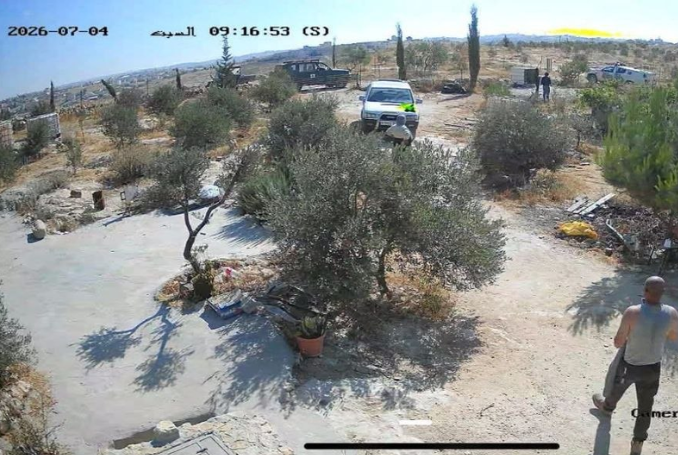
Palestinian communities described the simultaneous operations, dawn incursions by Israeli forces in multiple cities alongside settler rampages in at least half a dozen villages, as a deliberate pincer that tightened Israel’s grip on Palestinian land and lives while expanding the footprint of illegal settlements. The events, corroborated by the official Palestinian news agency WAFA, the Palestinian Red Crescent Society, local councils and Israeli human rights groups, reveal a system in which military power and settler militancy increasingly operate in lockstep, shielded by near‑total impunity.
Coordinated Military Raids And Mass Arrests:
In the early hours of Saturday, Israeli occupation forces launched house‑to‑house raids across the northern and central West Bank. In Jenin refugee camp, soldiers detained Nasr al-Din Sari Samour after storming his home, dragging him away for interrogation, a scene repeated in Nablus, Tubas, Qalqilya and the Jerusalem periphery.
In Nablus, troops arrested Awni al-Shakhshir, a former prisoner, during a raid on the Electricity Housing neighbourhood west of the city. Shortly afterwards, Ibrahim al-Fino was seized inside the Old Askar refugee camp. Raids also struck eastern al-Mazra’a, Qabatiya, the eastern neighbourhoods of Nablus, Azzun Atma south of Qalqilya, Aqaba, al-Far’a refugee camp and Biddu, northwest of occupied Jerusalem. Residents in Biddu reported that Israeli forces closed roads and disrupted movement for hours, effectively sealing the town.
“They came before dawn, breaking doors, pointing rifles at children,” said a resident of Jenin camp who asked not to be named for fear of reprisal. “Every family now sleeps expecting the knock. It is a war of attrition.”
The Palestinian Prisoners’ Society, which tracks detentions, noted that the latest arrests pushed the number of Palestinians held by Israel, excluding those from Gaza, to a record high, with thousands in administrative detention without charge or trial.
Settler Violence Under Military Protection:
Running parallel to the military operations, illegal settlers carried out a string of attacks that local leaders describe as an orchestrated campaign to drive Palestinians from strategic areas.
Near al‑Lubban al‑Sharqiya, south of Nablus, settlers opened heavy fire towards Palestinian homes on Saturday. Residents responded by burning a tent belonging to a nearby settlement outpost after they said settlers had besieged a vehicle carrying Palestinian youths and blocked the village entrance. No injuries were reported in the exchange, but the confrontation underscored the combustible dynamic in the area.
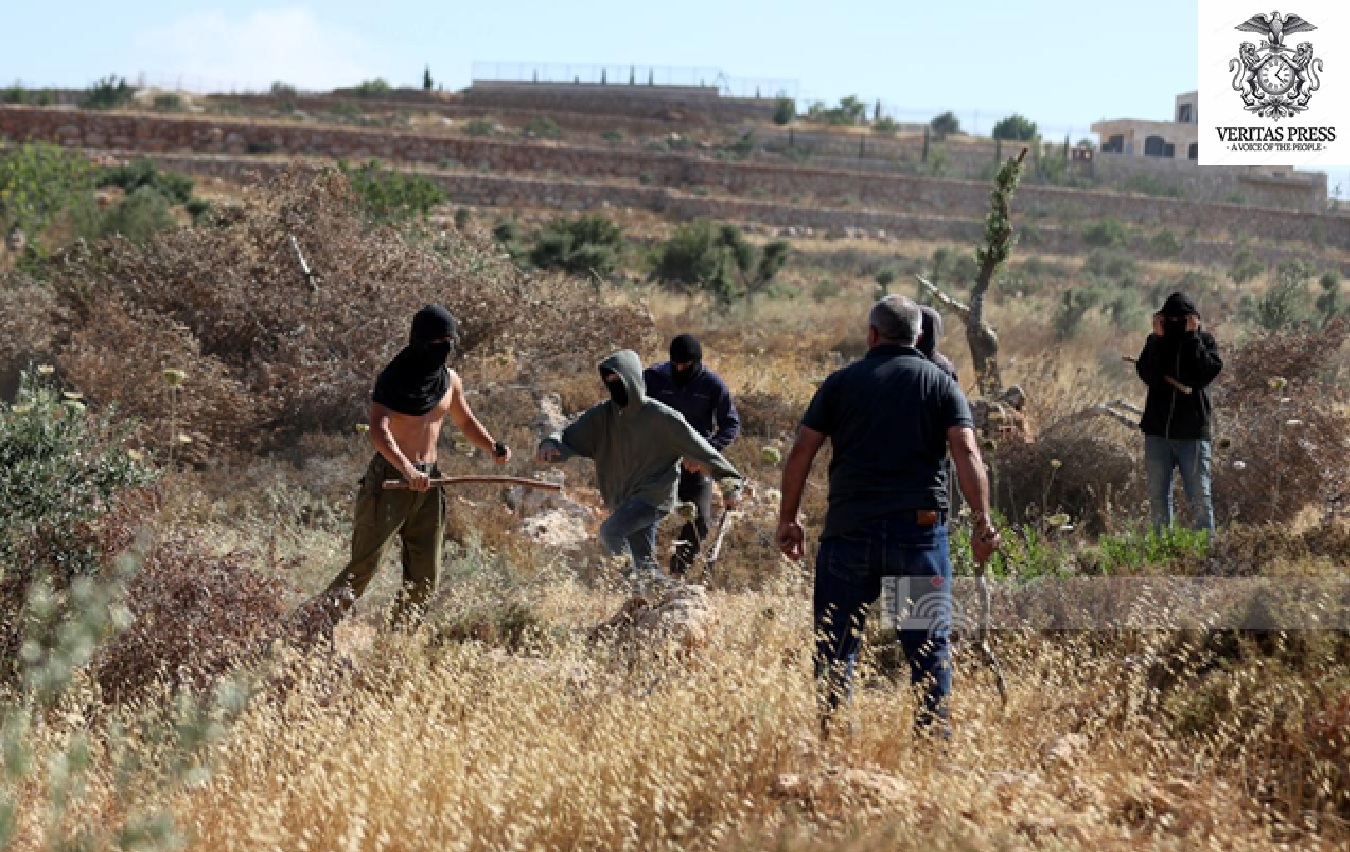
In Idhna, west of Hebron, a settler assault on Palestinian farmers turned violent under the gaze of Israeli soldiers. The Palestinian Red Crescent Society reported that troops fired rubber‑coated steel bullets, wounding a young Palestinian in the neck, while two elderly men suffered bruises as they tried to stop settlers from stealing their sheep. “The soldiers did nothing to stop the settlers; instead, they shot at us,” said Hassan Tumeh, 67, one of the injured shepherds, speaking from a Hebron hospital. “They protect the attackers and criminalise the victims.”
At Khan al-Ahmar, the Bedouin encampment east of Jerusalem that faces a long‑standing demolition order, settlers on motorcycles rammed two Palestinians and pepper‑sprayed others before attempting to steal livestock. Israeli police subsequently entered the village and detained four Palestinian youths who had tried to repel the attackers. Three residents were arrested, according to local witnesses. “We are attacked twice: first by settlers, then by the forces who are supposed to maintain law,” said Eid Jahalin, a community spokesman. “The message is clear: leave.”
Further east, near al-Minya southeast of Bethlehem, settlers roamed between Palestinian homes in an intimidation display, while another group seized Ein Rawabi spring, east of Anata, northeast of occupied Jerusalem. The Jerusalem Governorate warned that the spring is the sole reliable water source for dozens of Bedouin families and roughly 1,300 sheep. “Its seizure threatens the very existence of the shepherding communities that depend on it,” the governorate said in a statement.
In Yarza, east of Tubas, a settler attack on Friday left seven Palestinians injured, according to Mukhlis Masa’id, head of the village council. Masa’id told WAFA that colonists stormed the village and assaulted residents who had returned to inspect homes they were forced to abandon months earlier. Two of the wounded required hospital treatment, while Israeli occupation forces held the remaining casualties and prevented their evacuation, he said. “They want to empty this land of its people, step by step,” Masa’id added.
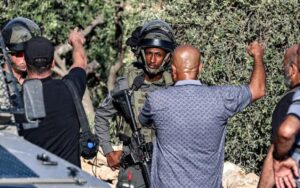
In Khirbet al-Homs, south of Yatta in the southern Hebron governorate, dozens of colonists attacked the Abed al-Masri family on Saturday, leaving two Palestinians with bruises and causing others to suffer tear‑gas inhalation. Israeli forces detained Samir Abed, who was injured during the attack, as well as several international solidarity activists who were supporting the residents, WAFA reported. “Samir was bleeding, and instead of receiving help, he was taken by soldiers,” said a European activist who was present and later released. “We were there as witnesses, and we became targets.”
In Arrabeh, south of Jenin, settlers entered the yard of a Palestinian home and attempted to steal a flock of sheep, residents said. The family managed to repel the theft, but the psychological toll was immediate.
Demolitions And Agricultural Strangulation:
The violence was compounded by an intensification of administrative measures that rights groups say are designed to force Palestinians off their land. In the village of Deir Abu Da’if, east of Jenin, occupation authorities delivered demolition notices for a 50‑square‑metre agricultural structure and a water well serving local farmland, both located in Area C, the 60% of the West Bank under full Israeli military and civil control. Such orders, routinely issued on grounds of lacking Israeli‑issued building permits that are almost impossible for Palestinians to obtain, have surged in 2025‑2026, according to the United Nations Office for the Coordination of Humanitarian Affairs (OCHA).
“They are not just demolishing structures; they are demolishing the possibility of a Palestinian livelihood,” said Dror Sadot, spokesperson for the Israeli human rights group B’Tselem. “The army, the Civil Administration and the settlers all work toward the same goal: maximum land, minimum Palestinians. The weekend’s events are a microcosm of that policy.”
Meanwhile, in Abu Njeim, southeast of Bethlehem, Israeli forces fired tear gas and stun grenades at worshippers leaving Friday prayers, causing numerous cases of tear gas inhalation. Medics at the scene described chaotic scenes as elderly men and children choked on the gas.
In Beit Fajjar, south of Bethlehem, a Palestinian was shot in the thigh during clashes with Israeli troops, medics said, another addition to a casualty toll that has been climbing sharply this year. By Saturday evening, the Palestinian Ministry of Health had recorded over 200 Palestinians killed in the West Bank since January 2026, including dozens of children, making it the deadliest year in the territory in two decades.
A Pattern Of Impunity: Analysis.
The weekend’s events did not occur in a vacuum. They fit a well‑documented pattern in which Israeli military operations and settler violence reinforce each other, creating a coercive environment that drives displacement and de facto annexation. The UN Independent International Commission of Inquiry on the Occupied Palestinian Territory noted in a June 2026 report that “settler violence is routinely carried out with the acquiescence and often the participation of Israeli security forces,” a finding echoed by Amnesty International and Human Rights Watch.
“What we saw this weekend was not a series of isolated incidents but a coordinated escalation,” said Ori Givati, advocacy director of Breaking the Silence, an Israeli veterans’ group. “Troops were raiding homes at the same time settlers were attacking villages just a few kilometres away. The timing and geography are not coincidental. This is a strategy of fragmentation and dispossession.”
Legal accountability for settler attacks remains vanishingly rare. Yesh Din, an Israeli legal rights group, found that over 93% of investigations into settler violence against Palestinians are closed without indictment. Even when soldiers are present and observe crimes, they seldom intervene, and in multiple cases documented over the weekend, they actively protected assailants or arrested victims. The U.S. and several European governments have imposed sanctions on a handful of violent settlers in recent years, but the measures have done little to stem the tide.
“The international community issues statements while families are driven from their homes,” said Mustafa Barghouti, head of the Palestinian National Initiative. “This weekend should be a wake‑up call: what is happening in the West Bank is not a conflict; it is an ethnic cleansing operation in slow motion, backed by a nuclear‑armed state.”
Israeli officials, for their part, routinely describe military operations as “counterterrorism” measures necessary to prevent attacks on Israelis. A statement from the Israeli army on Saturday said that its forces “conducted counterterrorism activities in several locations in Judea and Samaria to thwart imminent threats,” without addressing specific settler attacks. The statement said any incidents of violence by civilians would be examined. Settler leaders have long argued that they are reclaiming biblical lands and that Palestinian claims are politically motivated.
But for Palestinians on the ground, the distinction between soldier and settler is increasingly meaningless. As Khaled Abu Toameh, a Palestinian journalist with decades of experience covering the West Bank, noted: “When a settler fires a weapon and a soldier stands by, or when a military raid clears a path for a land seizure the next morning, the message is unified: this land is no longer yours.”
A Weekend’s Toll:
By Saturday morning, the cumulative toll was stark. At least nine Palestinians were arrested in military raids. More than a dozen were injured, including two with bullet wounds, several with fractures and bruises, and many more with tear gas inhalation. Livestock was stolen or threatened. A vital spring was lost to a settler takeover. Agricultural infrastructure was slated for demolition. And families in communities from Khan al-Ahmar to Khirbet al-Homs to Yarza faced the terrifying reality that their presence is being violently contested, day and night.
“We are a peaceful village of shepherds, but we are treated as enemies,” said Um Ahmad, a mother of five from Khirbet al-Homs, her voice trembling as she surveyed the damage to her family’s tent. “Where does the world want us to go? We have no other home.”
As the international gaze remains fixed on Gaza and regional geopolitics, the architecture of dispossession in the West Bank is being reinforced, one raid, one settler attack, one demolition order at a time. For those living under it, the weekend was not an aberration. It was an acceleration of a long‑standing plan, executed with the full force of a state and the fire of its most zealous civilians. The question that hangs over the hills of Hebron, Nablus and Jenin is not whether the world will act, but how much smaller Palestine must become before it does.
Conclusion: The Weekend’s Blueprint And The Unmaking Of Palestine.
The events that unfolded between Friday prayers and Saturday morning across the occupied West Bank were not a chaotic eruption of violence. They were a meticulously choreographed demonstration of how Israel’s military and paramilitary arms work in tandem to dismantle Palestinian life, farm by farm, spring by spring, family by family. In Jenin, troops broke down doors and dragged men away for interrogation. In Idhna, soldiers stood by as settlers beat elderly shepherds and fired at youths. Near Anata, a spring that sustained dozens of Bedouin families and over a thousand sheep was seized without consequence. In Deir Abu Da’if, a water well and a modest agricultural structure were handed demolition notices, part of a bureaucratic strangulation that leaves Palestinian farmers with an impossible choice: build illegally or perish economically. In Yarza, settlers stormed a village and injured seven, while soldiers prevented the wounded from reaching hospitals, a grotesque inversion of the duty to protect.
This is not a series of isolated incidents. It is a tightly integrated system of dispossession, one in which the military, the civil administration, and the settler movement function as complementary instruments of a single strategic objective: the maximal expansion of Israeli control over land with the minimal presence of Palestinians upon it. As Ori Givati of Breaking the Silence observed, the timing and geography of the raids and settler attacks were not coincidental. They were coordinated pressure points, designed to fragment communities, crush resistance, and render life so untenable that displacement becomes the only survival strategy. This is what Mustafa Barghouti called “ethnic cleansing in slow motion”, not an overnight campaign but a methodical, decades-long project that accelerates when global attention is diverted, as it has been to Gaza and the politics of normalisation.
What makes this architecture especially resilient is the near-total impunity that shields it. Israeli human rights group Yesh Din has documented that more than 93% of investigations into settler violence against Palestinians are closed without indictment. The weekend provided fresh corroboration: settlers opened fire near al-Lubban al-Sharqiya, yet no arrests were reported. Farmers were assaulted in Idhna while soldiers deployed rubber bullets against the victims, not the aggressors. In Khan al-Ahmar, police detained residents who tried to defend themselves, not the armed settlers who rammed them with motorcycles and pepper-sprayed them. This inversion of the law, where the occupied are criminalised and the occupiers are protected, is not a flaw in the system. It is the system’s core function.
The international community is not a bystander but an enabler. Condemnations are issued with ritual regularity, while arms shipments and diplomatic cover continue unabated. The United States and European powers occasionally sanction a handful of violent settlers, a gesture of accountability that serves mainly to mask their broader complicity. Meanwhile, the legal architecture of occupation, the denial of building permits in Area C, the designation of vast swathes of land as military zones or state property, the theft of water resources, the constant threat of demolition, grinds on, underwritten by billions of dollars in annual aid and trade. Every statement of “concern” that is not followed by concrete pressure is a green light for the next demolition notice, the next settler rampage, the next midnight arrest.
The consequences extend far beyond the immediate casualties. When the Ein Rawabi spring is seized, a community of shepherds loses its only reliable water source, a loss that cascades into malnutrition, economic collapse, and eventual forced displacement. When a water well in Deir Abu Da’if is marked for demolition, it is not just infrastructure that is destroyed; it is the possibility of a future. When soldiers detain international solidarity activists alongside injured Palestinians in Khirbet al-Homs, the message to the outside world is clear: witnesses will be punished, and the machinery of dispossession will operate in the dark. This is a deliberate strategy to erase not only Palestinian bodies and homes but also the very narrative of their existence.
For Palestinians, the weekend was a bitter reaffirmation of a reality they live every day: there is no refuge, no appeal, no protection. “Every family now sleeps expecting the knock,” said a resident of Jenin camp. “We have no other home,” whispered Um Ahmad from Khirbet al-Homs, surveying the wreckage of her family’s tent. These are not rhetorical laments; they are the lived experience of a people caught in a vice that tightens with every passing week. The occupation’s violence is not a temporary surge but a permanent condition, one that degrades not only physical safety but also hope, dignity, and the capacity to imagine a life free of fear.
If the international order were serious about its professed commitment to human rights and international law, this weekend would have triggered emergency sessions at the UN Security Council, asset freezes on settlement enterprises, and an immediate suspension of military cooperation. Instead, the machinery of dispossession received de facto endorsement through silence. The question that hangs over the hills of Hebron, Nablus and Jenin is the same one that hung there decades ago, only more urgent: how much smaller must Palestine become before the world decides that its erasure is unacceptable? The weekend’s events suggest that the answer, tragically, remains much smaller still. And by the time that reckoning comes, there may be nothing left to save but memory.
Source: Veritas Press C.I.C. | Multi News Agencies
Help Support Our Work By Donating
Popular Information is powered by readers who believe that truth still matters. When just a few more people step up to support this work, it means more lies exposed, more corruption uncovered, and more accountability where it’s long overdue.
Help Protect Independent Journalism, Which Is Currently Under Attack.
If you believe journalism should serve the public, not the powerful, and you’re in a position to help, becoming a DONOR or a PAID SUBSCRIBER truly makes a difference.
DONATION APPEAL: If You Found This Reporting Valuable, Please Consider Supporting Independent Journalism.
Your support fuels our fearless, truth-driven journalism. In unity, we endeavour to amplify marginalised voices and champion justice, irrespective of geographical location. We operate independently, without any financial backing from billionaires.
But it’s also extremely important. One of Veritas Press’s greatest assets is its reader-funded model.
1. Reader funding means we can cover what we like. We’re not beholden to the political whims of a billionaire owner. We are a small, independent and impartial organisation. No one can tell us what not to say or what not to report.
2. Reader funding means we don’t have to chase clicks and traffic. We’re not desperately seeking your attention for its own sake: we pursue the stories that our editorial team deems important and believes are worthy of your time.
3. Reader Funding: enables us to keep our website and other social media channels open, allowing as many people as possible to access quality journalism from around the world, particularly those in places where the free press is under threat.
We know not everyone can afford to pay for news, but if you’ve been meaning to support us, now’s the time.
Your donation goes a long way. It helps us:
- Keep the lights on and sustain our day-to-day operations
- Hire new, talented independent reporters
- Launch real-time live debates, community-focused shows, and on-the-ground reporting
- Cover the issues that matter most to our communities, in real time, with depth and integrity
We have plans to expand our work, but we can’t do it without your support. Every contribution, no matter the size, helps us stay independent and build a truly people-powered media platform.
If you believe in journalism that informs, empowers, and reflects the communities we serve, please donate today.
Submissions:
For The Secure Submission Of Documentation, Testimonies, Or Exclusive Investigative Reports From Any Global Location, Please Utilise The Following Contact Details For Our Investigations Desk: enquiries@veritaspress.co.uk or editor@veritaspress.co.uk
NEWCASTLE UPON TYNE — Health authorities have confirmed two separate cases of Hepatitis A among
Serbian Orthodox leader’s unprecedented intervention exposes the systematic erosion of Christianity’s oldest continuous community, and
GENEVA — A United Nations fact-finding mission has concluded there are “reasonable grounds to believe”
Iran’s GDP is projected to contract by 5.4 to 6.1% in 2026, its worst performance
The Trump administration is preparing a $2.8 billion weapons package for Israel containing 40,000 2,000-pound

Film alleges mass civilian deaths are routinely built into military decisions amid Israel’s genocidal war
The Israeli rights group says violence, displacement, economic strangulation, and settlement expansion form part of

Houthi forces have captured the historic Red Sea port of Mocha and are advancing on
London’s historic sanctions against Israeli settlements mark a watershed moment in UK foreign policy, but
With 95% of Gaza’s population now wholly dependent on aid and more than 90% stripped