Kamran Faqir is a volunteer investigative journalist and writer committed to exposing hidden truths and amplifying underreported stories. Driven by social justice, he brings sharp insight and fearless truth-telling to independent journalism. NUJ registered.
Listen to this article
Help support our mission, donate today and be the change. Every contribution goes directly toward driving real impact for the cause we believe in.
Article Date Published:
Article Date Modified:
18 minutes
Views:102
The DWP says regular payments are unaffected and there is no evidence of customer data loss. But as Universal Credit, pension and PIP services went dark, claimants were left borrowing money for food; the PCS warned that cuts to technology staff had left critical systems exposed, and MPs called the outage a “wake-up call” for a welfare state running on ageing digital infrastructure.
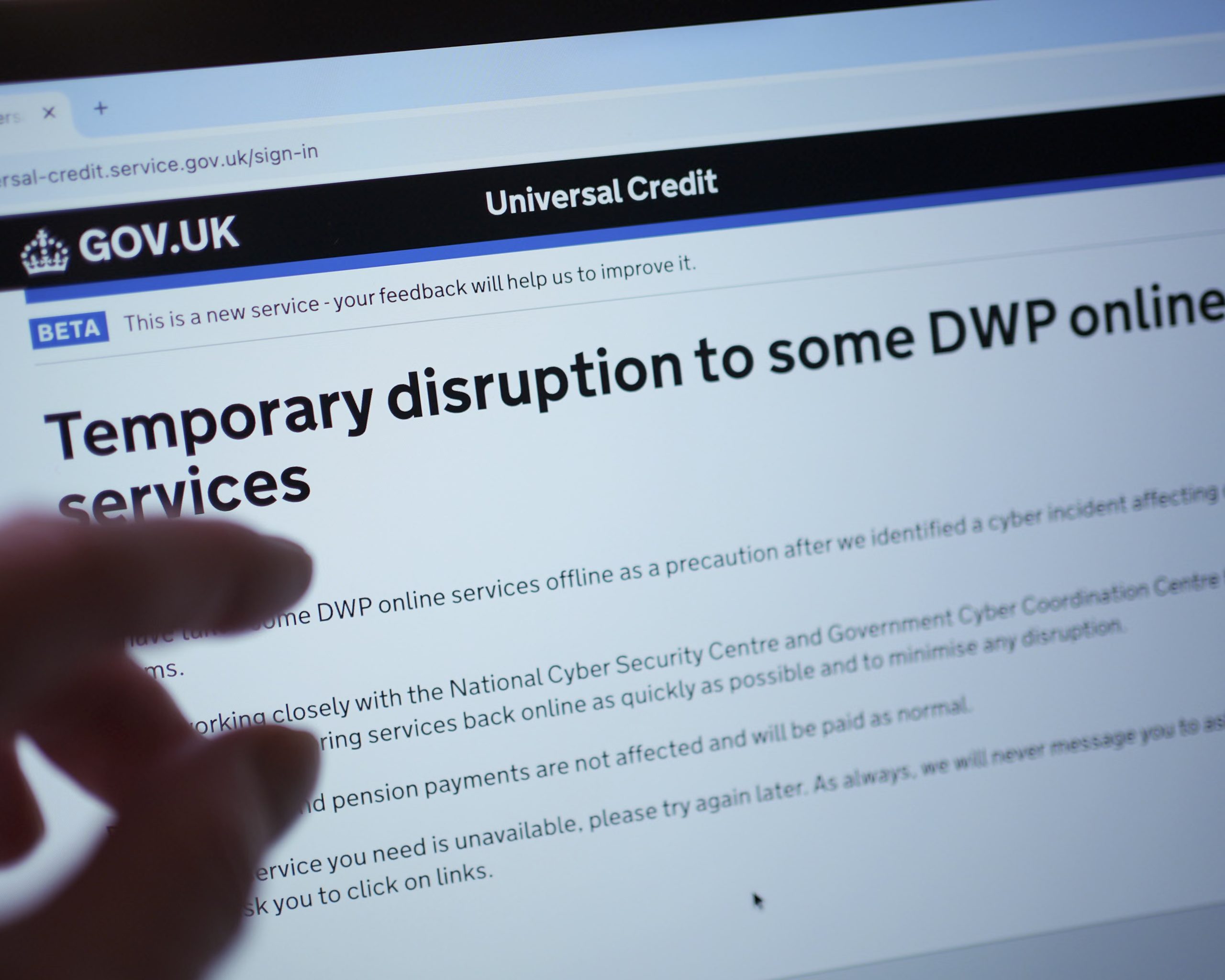
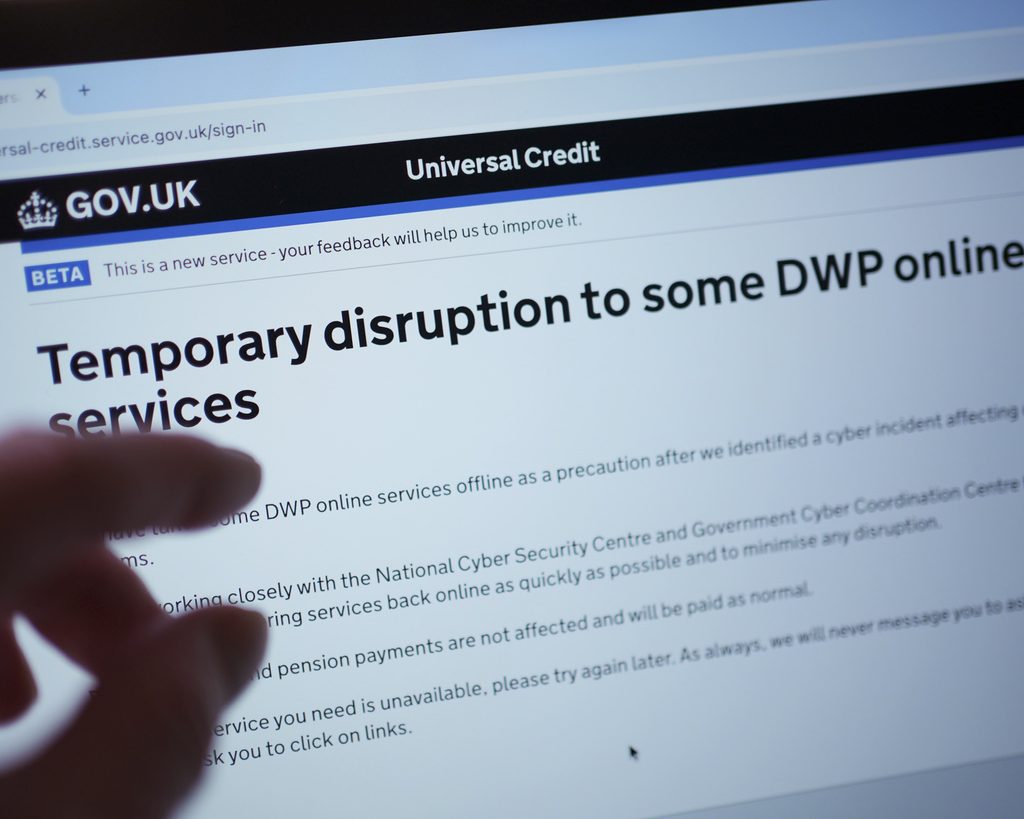
The DWP says it is working with the National Cyber Security Centre, which is tasked with protecting critical services from cyber-attacks. Photograph: Yui Mok/PA
At 8 am on Friday, Georgina Howarth did what millions of Universal Credit claimants do every month: she checked her bank balance. The payment was not there. By mid-morning, the 30-year-old from Plymouth had been on the phone to the Department for Work and Pensions “every hour since 8 am.” She told the BBC the response was always the same: “They said they can’t even get on the system.” Howarth had to ask her mother for money for food. In Bedford, another mother, Evie Merison, faced a similar void: “I have a weekly shop to do on Sunday and bills coming out by Monday. What am I meant to do?” In Leeds, Ian Marr had not received his pension payment or his winter heating allowance.
The government’s official line is that “regular benefit and pension payments are not affected and will be paid as normal.” But for a growing number of claimants, the assurance ring-fences the Treasury’s spreadsheet, not their lived reality. The gap between the statement and the bank balance is where the DWP’s “serious cyber incident” stops being an IT failure and becomes a political one. It exposes a department that, by its own permanent secretary’s admission, runs on “extremely old computer systems”, systems now so brittle that the only defensive move available was to switch almost the entire public-facing welfare state offline.
What Is Offline:
• Universal Credit: Applying for claims, signing in to accounts, and job searches are unavailable.
• Pensions & Benefits: Checking or applying for the State Pension, Pension Credit, and Personal Independence Payment (PIP) applications are disrupted.
• Tell Us Once: The online service used to report a death to government departments is down. Payments, Security & Investigation
• Payments: The DWP states regular benefit and pension payments will be paid as normal, with no restoration timeline announced yet. Some claimants have reported delayed payments.
• Data & Cause: Work and Pensions Secretary Pat McFadden and Downing Street say there is currently no evidence of customer data loss or that other government departments have been targeted, while declining to rule out a malicious attack.
• Investigation: The DWP is working with the National Cyber Security Centre (NCSC) and the Government Cyber Coordination Centre.
What Happened, And What The Government Won’t Say
The sequence of events is now clear, even if the cause is not. Unusual activity was detected on Thursday. By Friday morning, the DWP had taken down nearly all its online services as a “precaution”: Universal Credit applications and journals, State Pension and Pension Credit checks, Personal Independence Payment (PIP) applications, and even the “Tell Us Once” service used to report a death to government departments. The National Cyber Security Centre (NCSC) and the Government Cyber Coordination Centre are investigating. The Information Commissioner’s Office has confirmed it is “engaging with DWP to establish the circumstances.”
Work and Pensions Secretary Pat McFadden called it a “serious cyber incident” but insisted the department “did the right thing” by taking systems down “to protect the public, to protect their personal information.” Downing Street said there is “currently no evidence of customer data loss” and “no evidence to suggest that a malicious actor has targeted other government departments,” while pointedly refusing to rule out that the incident itself was a malicious attack. A No 10 spokeswoman said the investigation is “live and ongoing” and that she was “not going to get ahead of it.”
That caution is understandable. Less understandable is the lack of a timeline for restoration and the refusal to confront the structural questions the outage has forced into the open. The DWP holds about 27 petabytes of data—equivalent to 5.7 million DVDs, a stack four and a half miles high—containing “an awful lot of personal information about everybody in the UK,” including bank details. A department entrusted with that volume of sensitive data cannot credibly claim resilience when a single “unusual activity” event forces it to pull the plug on the welfare state’s digital front door.
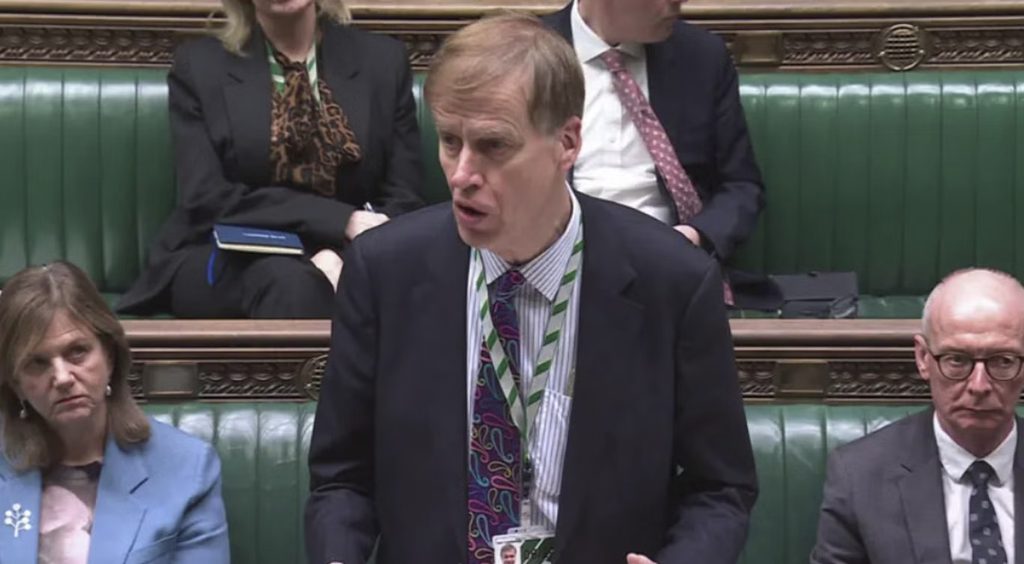
Secretary of State for Work and Pensions, Pat McFadden (Image: Anadolu, Anadolu via Getty Images)
The Union’s Charge: You Cannot Cut Your Way To Cybersecurity
The most incisive critique has come not from the opposition benches but from the union representing the very staff trying to hold the system together. The Public and Commercial Services (PCS) union revealed that the outage occurred just a week after the DWP announced a voluntary exit scheme within its technology services directorate—a scheme the union described as “seeking to reduce staffing in an area that is critical to maintaining secure and resilient digital services.”
“At a time when cyber threats are increasing, and public services are becoming ever more reliant on digital infrastructure, this is not the time to reduce capacity in such a vital part of the department,” a PCS spokeswoman said. “We believe reducing staffing levels in technology services is the wrong approach. The department should be investing in and strengthening this workforce, not reducing it.” The union added that the incident had “severely disrupted” DWP systems and demanded that “where necessary, payments must be made first and any outstanding issues resolved afterwards. Citizens who are already struggling, whether they are young, elderly, unemployed, sick or disabled, must not be left without the money they need to sustain their health, wellbeing and that of their families.”
The PCS has also called for Jobcentres to close because staff cannot carry out the necessary safety checks, and for outreach work to be suspended until further notice—a demand the department has yet to answer. The charge is not that the DWP caused the incident. It is that the department has spent years hollowing out the technical capacity required to prevent one, or to recover from one without inflicting hardship on the poorest claimants.
Parliamentary Comfort vs Public Consequence
The cross-party reaction has been notably gentle. Debbie Abrahams, the Labour chair of the Work and Pensions Committee, said it was a “great relief” that payments had not been affected and praised the DWP’s “swift action” as “absolutely the right thing to do.” She added that “the impact on service users from the outage must be investigated and analysed so that timely and accurate advice can be given to them.” For claimants like Howarth, Merison and Marr, that advice has so far amounted to being told to wait.
Dame Chi Onwurah, the Labour chair of the Science and Technology Committee, was more pointed. “Today’s disruption at DWP should be a wake-up call,” she said. “People rely on these systems for some of the state’s most essential services, and they should be able to trust that the tech and data underpinning them are secure and resilient. My committee has repeatedly warned that the government cannot achieve its digital transformation of public services without addressing weaknesses in its digital infrastructure and improving data-hygiene standards. Public bodies hold citizens’ data in trust, which demands the highest standards.”
Suzy Pallett, president of the Black Hat cybersecurity conference, framed the incident in existential terms: “What we’re seeing with the DWP incident today is a clear reminder that the question is no longer if an organisation will face a cyber incident, but when.”
A Pattern Of Exposure, And A Geopolitical Backdrop
This is not an isolated failure. It is the latest in a cascade of cyber incidents that have hit the UK’s public and private infrastructure with alarming regularity. Earlier this month, supermarket fridges in seven European countries malfunctioned after thermostats were remotely cranked up to 50C in what the EU condemned as “a deliberate attempt to disrupt our food supply chain.” Fashion retailers Next and Asos have both flagged unauthorised data access. Marks & Spencer suffered a major attack last year that halted online sales for six weeks. A severe attack on Jaguar Land Rover forced production to stop for five weeks at an estimated cost to the UK economy of almost £2 billion.
The DWP incident also comes days after the government issued an alert warning of an increased risk of Russian sabotage attacks in the UK, particularly against businesses supporting Ukraine. This week, MI5 and the Ministry of Defence warned UK military suppliers to Ukraine about rising sabotage attempts by Russia. Downing Street has not drawn a direct line between that warning and the DWP outage, and doing so without evidence would be irresponsible. But the coincidence reminds us that the department’s systems are not merely administrative plumbing; they are part of the national critical infrastructure that hostile actors may seek to probe.
The deeper vulnerability, however, may be domestic. As one cybersecurity expert told the BBC, public sector networks are “huge, interconnected and full of legacy systems,” so “when you can’t be sure how far an attacker has moved, the only safe option is to pull the plug.” He argued that the long-term goal “must be that an attack happens and the public doesn’t notice.” That goal is currently unimaginable for the DWP. Sarah Healey, the department’s permanent secretary, told the work and pensions select committee earlier this month that cybersecurity and resilience was one of the issues “that keeps a new permanent secretary awake”. This week’s events suggest her insomnia is well-founded.
The Question No One In Government Wants To Answer
The DWP has been careful to tell claimants that it “will never message you to ask for bank details or ask you to click on links.” That is sensible anti-phishing advice. But it also distracts from the larger question: why is the safety net for millions of vulnerable people dependent on a digital infrastructure so fragile that a single incident can take it offline, with no restoration timeline and no contingency for claimants who fall through the gap between a press release and a pending payment?
The government’s digital transformation of public services cannot be built on a foundation of ageing systems, shrinking technical staff, and a culture of reassurance that outpaces delivery. Until ministers confront the PCS’s warning, Dame Chi’s “wake-up call,” and the testimony of claimants who spent Friday borrowing money for food while the DWP’s systems were down, the next “cyber incident” is not a matter of if. It is a matter of when—and who will pay the price.
Conclusion: A Dry Run For The Digital Leviathan
The DWP’s “cyber incident” is not, in the end, a story about hackers. It is a story about architecture, and about what happens when the architecture of survival is consolidated into a single, brittle, digitised network that no one can fully see, fully staff, or fully defend.
The forensic facts are still emerging, but the structural facts are already on the record. The DWP spends 70–85% of its technology budget simply keeping the lights on in ageing systems, according to the government’s own State of Digital Government review. The National Audit Office has counted at least 228 legacy systems across Whitehall, 63 of which are red-rated, and 120 with no fully funded plan to fix them. The Cabinet Office’s playbook names ageing IT as “the government’s biggest cyber risk”. The department’s permanent secretary, Sarah Healey, told MPs this month that cybersecurity and resilience is one of the issues “that keep a new permanent secretary awake.”
That is the context in which the PCS union’s disclosure reads like an indictment. A week before the outage, the DWP announced a voluntary exit scheme within its technology services directorate, a scheme the union says was “seeking to reduce staffing in an area critical to maintaining secure and resilient digital services”. “At a time when cyber threats are increasing, and public services are becoming increasingly reliant on digital infrastructure,” the union warned, “this is not the time to reduce capacity in such a vital part of the department”. The department was not merely running on ageing plumbing. It was thinning the crew that knew how to patch it.
Dr Daniel Gardham of the University of Surrey’s Centre for Cyber Security put the systemic risk in plain terms: “Much of the government’s infrastructure is ageing, and legacy systems can be difficult to maintain, patch and secure. Integrating older technology with newer systems can also introduce vulnerabilities that are difficult to identify and address”. More pointedly, he described the DWP as “a particularly attractive target because of the sheer volume and sensitivity of the information it holds on millions of people”, financial details, National Insurance numbers, addresses, benefit records, all of it exploitable for identity theft and fraud. And then the sentence that should be printed on every ministerial briefing: “a single incident [can] disrupt multiple public services. When government systems share infrastructure, networks and data, a weakness in one area can have consequences far beyond its original point of entry”.
This is the deeper story. The DWP is not merely a benefits administrator. It is the payment rail for the bottom half of the British economy. Universal Credit alone reaches millions of households; the State Pension reaches millions more. When the digital front door closes, the state does not merely lose a customer-service channel. It loses the ability to see, verify, and transfer money to people with no buffer. Georgina Howarth had to ask her mother for money for food. Evie Merison had to raid her Christmas savings to cover a weekly shop and bills due on Monday. Ian Marr’s pension and winter heating allowance did not arrive. The government’s assurance that “regular payments are not affected” is true on the Treasury’s ledger but false in the claimant’s bank account. In a welfare system rebuilt around digital-by-default, the gap between the ledger and the bank account is the welfare state.
That gap is about to widen, and the architecture is about to become more concentrated. The government is building a GOV.UK digital identity wallet designed to be used for “applying for Universal Credit, claiming a state pension, checking eligibility for winter fuel payments,” and potentially linking identity directly to payment journeys. The same digital-ID infrastructure is being discussed alongside a retail central bank digital currency, a digital pound with the technical capacity for programmability, meaning the issuer could define not just who receives a payment but what the money can be spent on, where, and under what conditions. The Bank of England may say there is “no rush” to issue a digital pound. But the direction of travel is unmistakable: identity, eligibility, payment, and conditionality are being fused into a single digital stack, administered by the same department whose systems are so fragile that a single “unusual activity” event forced it to pull the plug on almost everything.
This is the question the outage has forced into the open, and no minister has yet answered it. If the DWP cannot keep a legacy Universal Credit portal online during a security scare, what confidence can anyone have in a future architecture that routes identity, benefits, tax, and potentially programmable currency through an even more tightly coupled network? The more functions stacked onto the same digital rails, the more catastrophic a single point of failure becomes. Dr Gardham’s warning that “a single incident” could disrupt “multiple public services” is not hypothetical. It describes the design principle now being pursued.
The government’s response to the incident has been a masterclass in reassurance without accountability. Downing Street says there is “no evidence” of data loss and “no evidence” that other departments were targeted, yet refuses to rule out a malicious attack. The Work and Pensions Secretary calls it “serious” but offers no timeline. The Information Commissioner’s Office is “engaging.” The Science and Technology Committee chair, Dame Chi Onwurah, has demanded “clarity about what happened at DWP,” transparency about “any impact on people’s services and data,” and a plan “to stop this happening again”. That is the minimum. But the greater demand is structural: a credible, funded, staffed programme to retire the legacy estate, rebuild resilience into the public-sector network, and stop treating cybersecurity as a perimeter problem rather than a design problem.
Suzy Pallett of Black Hat was right: “the question is no longer if an organisation will face a cyber incident, but when.” But the DWP’s incident exposes a harder truth. The question is not whether the welfare state will be digitised, it will be, and in many respects already is. The question is whether the digitisation of money, identity, and fiscal control will be built on a foundation designed to survive failure, or on a foundation that transfers every systemic risk onto the people with the least capacity to absorb it. The claimants who spent Friday borrowing money for food while the DWP’s systems were dark are not collateral damage in a technical failure. They are the human proof of what happens when the state consolidates its fiscal architecture faster than it secures it. The next outage will not be a test of the DWP’s IT. It will be a test of whether anyone in power has learned the difference between reassurance and resilience.
Veritas Press Investigative Analysis Independent journalism examining global affairs, power, diplomacy, and accountability.
Source:Veritas Press C.I.C. | Multi-News Agencies
Help Support Our Work
Readers who believe truth still matters can influence what gets out there. If just a few more people get on board, it means more lies come to light, more corruption is uncovered, and more accountability is achieved where it’s been utterly absent for far too long.
Help Protect Independent Journalism, Which Is Currently Under Attack.
If you think journalism should be for the public, not the powerful, and you can help, then becoming a regular DONOR or a PAID SUBSCRIBER makes a real difference.
DONATION REQUEST: If you’ve found this reporting useful, then please consider supporting independent journalism.
Your support is what enables our fearless, truth-based journalism. It’s our ambition to give a voice to the voiceless and to stand up for justice wherever it’s needed. We do this completely independently, with no billionaire backers. Our readers fund us.
But it’s absolutely vital. One of Veritas Press’s biggest assets is its reader-funded model.
1. Reader funding means we can do what we like. We’re not at the mercy of the political agenda of some billionaire owner. We’re a small, independent and completely impartial organisation. No one can tell us what not to say or what not to report.
2. Reader funding means we don’t have to chase clicks and traffic. We’re not out there desperately trying to get your attention for its own sake. We’re going to tell the stories our editorial team feels are important and worth your time.
3. Reader funding: enables us to keep our website and our other social media channels open so that as many people as possible can access quality journalism from around the world, especially in those places where the free press is under threat.
We know not everyone can afford to pay for the news, but if you’ve been wanting to get behind us, then this is the time.
Your donation goes a long way. It helps us:
Keep the lights on and sustain our day-to-day operations
Hire new, talented, independent reporters
Launch real-time live debates, community-focused shows, and on-the-ground reporting
Cover the issues that matter most to our communities, in real time, with depth and integrity
Without your support, independent voices like ours will be silenced.
We also intend to expand our work, but we can’t do that without your support. Every contribution, however big or small, helps us remain independent and build a genuinely people-powered media platform.
If you believe in journalism that informs, that empowers, and that reflects the communities we serve, please donate today.
You Can Make Direct Bank Transfer Donations To
Bank Name: Bank Of Scotland
Account Name: Veritas Press C.I.C.
Sort code: 80-22-60
Account Number: 27540469
IBAN #: GB18-BOFS-6027-5404-69
Donate Online
Submissions
To safely submit documentation, testimonies, or exclusive investigative reports from anywhere in the world, please use the following contact details for our Investigations Desk: mailto:enquiries@veritaspress.co.uk or mailto:editor@veritaspress.co.uk.
SEATTLE, TEHRAN — The U.S. Department of Homeland Security (DHS) will allow Iran’s national football team to enter the country 48 hours before their critical World Cup match against Egypt on Friday, a modest concession in a tournament where Team Melli’s travel conditions have sparked claims of oppression and competitive disadvantage.