Kamran Faqir is a volunteer investigative journalist and writer committed to exposing hidden truths and amplifying underreported stories. Driven by social justice, he brings sharp insight and fearless truth-telling to independent journalism. NUJ registered.
Listen to this article
Help support our mission, donate today and be the change. Every contribution goes directly toward driving real impact for the cause we believe in.
Article Date Published:
Article Date Modified:
12 minutes
Views:68
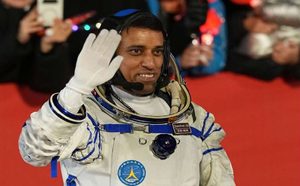
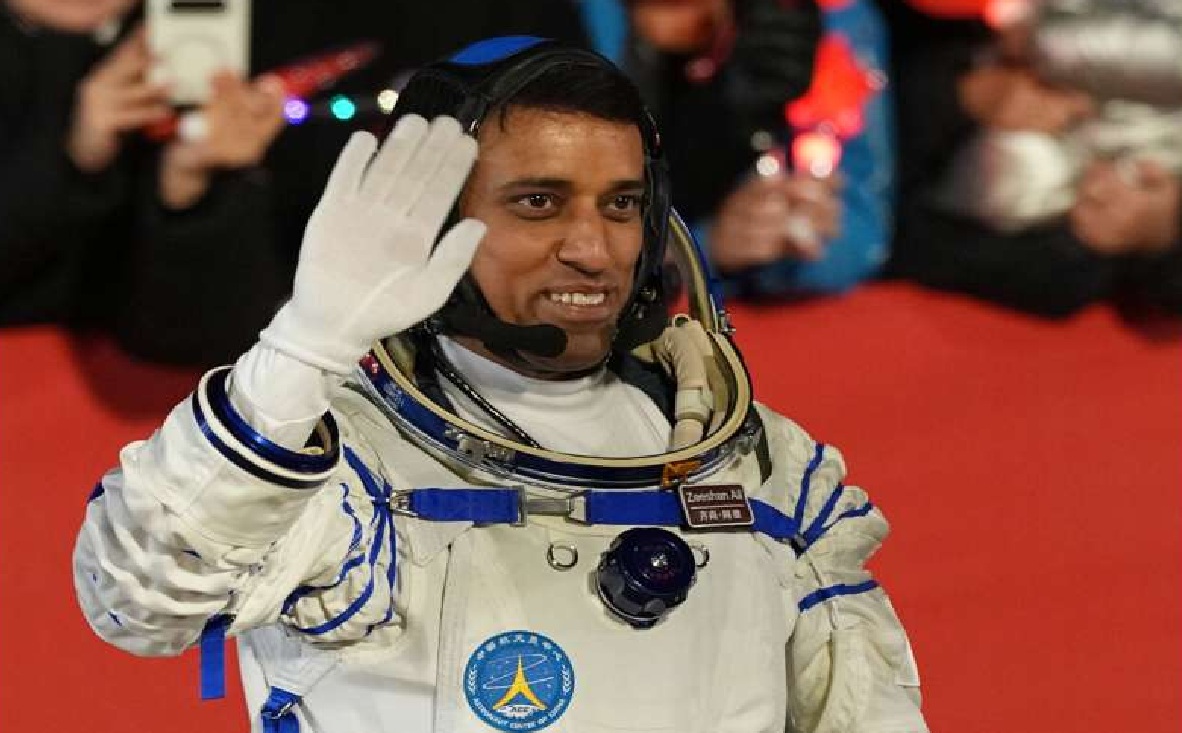
CHINA/PAKISTAN – At 12.18 am UK time on Wednesday, a Long March-2F rocket lifted off from the Jiuquan Satellite Launch Centre carrying two Chinese astronauts and one Pakistani. Within hours, Muhammad Zeeshan Ali, a 40-year-old pilot, became Pakistan’s first person in orbit and the first foreign national to enter China’s Tiangong space station. It was a genuine landmark and, by design, a diplomatic performance staged 400 kilometres above the Earth.
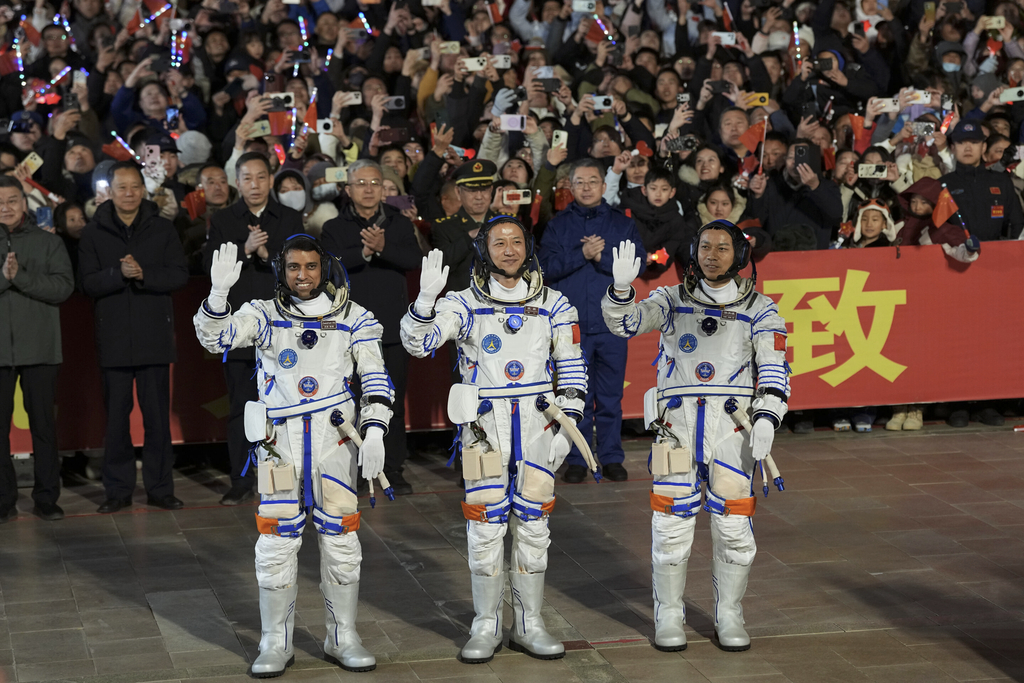
Shenzhou 24 astronaut Muhammad Zeeshan Ali of Pakistan waves as he attends a send-off ceremony for the crewed space mission with Wu Yi of China and Tang Hongbo of China at the Jiuquan Satellite Launch Center in northwestern China, Wednesday, Nov. 25, 2026. Credit: AP Photo/Andy Wong
The Launch And The Arrival
Shenzhou-24 separated cleanly from its rocket and entered its planned orbit. According to Pakistan’s Dunya News, citing the China Manned Space Agency (CMSA), the spacecraft reached Tiangong after about three and a half hours. The crew—commander Tang Hongbo, 51, pilot Wu Yi, 39, and Ali as payload specialist—joined the three Shenzhou-23 astronauts already aboard and posed for group photographs. According to CCTV, Tang became the first astronaut to board Tiangong three times; for Wu and Ali, it was their first spaceflight.
As he entered the station, Ali raised a fist and announced, in Chinese, “Chinese space station, here I come!” For roughly a week, Tiangong is hosting four astronauts from mainland China, one from Hong Kong and one from Pakistan. The Hong Kong astronaut, Lai Ka-ying, is the only woman aboard.
Ali’s stay is short by Chinese standards, between five and ten days compared to the usual six-month rotation. He will run four experiments in biotechnology and materials science, including one on photosynthetic cyanobacteria, according to Xinhua. He returns to Earth aboard Shenzhou-23 with Lai and Zhang Zhiyuan. Commander Zhu Yangzhu stays behind to complete China’s first full-year orbital stay, a test of endurance Beijing’s planners regard as essential for a crewed lunar landing targeted for 2030 and eventually Mars.
In Pakistan, the launch was a communal event. Associated Press described families far from the launch site watching on television, restaurant diners following the broadcast, and cries of “Long live Pakistan-China friendship!” as the craft climbed. Scientists watched together at the headquarters of the national space agency, Suparco, in Karachi. At Jiuquan, crowds held up phones at the send-off ceremony.
The official voices were predictably soaring. Prime Minister Shehbaz Sharif, writing on X, said the nation stood on the “threshold of a historic first” and called it “a moment that belongs to every Pakistani.” He credited President Xi Jinping’s “visionary” leadership for taking the friendship to an “unprecedented height”. He declared it was “surpassing the heights of the Himalayas, in its journey to outer space.” President Asif Ali Zardari called it a “landmark achievement” and quoted the national poet Allama Iqbal on worlds beyond the stars. Foreign Minister Ishaq Dar spoke of an “all-weather strategic cooperative partnership.”
Planning Minister Ahsan Iqbal, who attended the briefing in Jiuquan, offered the line that will be repeated most: “The sky is no longer our limit; it is our launching pad.” Asked by reporters whether Pakistan could one day send astronauts independently, he said: “Certainly that day will come.” Notably, he did not say when.
Ali himself struck a more personal note. He said he carried the hopes of 250 million Pakistanis, would take handwritten letters from his children and father, and would look for “the light of our home” when he first saw Earth. He also described learning Mandarin, rather than centrifuge training, as the real challenge of a one-year programme compressed into seven months, which also included calligraphy and table tennis. Tang, the Chinese commander, acknowledged that differences in language, culture, and psychology had made the training “more challenging,” a rare note of candour in an otherwise choreographed week.
What Beijing Gets
Xi’s message to Zardari framed Tiangong as a “boat” for peace, friendship, and cooperation, according to CCTV. The framing is deliberate. China was shut out of the International Space Station in 2011, when the United States barred NASA from working with Chinese space agencies. For fifteen years, Beijing has built an alternative: its own station, fully operational since late 2022 and intended to be inhabited for at least a decade, plus the International Lunar Research Station (ILRS), a Chinese-led rival to the US Artemis programme, which Pakistan joined in 2023.
The timing matters. With the ISS reportedly facing retirement around 2030, China is positioning Tiangong as the next hub for international cooperation. Tiangong is much smaller than the ISS, so the pitch is as much political as technical. Inviting a Pakistani first, rather than a European or a Gulf state, rewards a client with decades of loyalty. China is Pakistan’s largest trading partner and a major investor, and Beijing’s choice sends a signal to other prospective partners in the Belt and Road orbit.
Astronauts for the Shenzhou 24 mission, from left, Muhammad Zeeshan Ali of Pakistan, Wu Yi of China and Tang Hongbo of China, wave as they attend a send-off ceremony for their crewed space mission at the Jiuquan Satellite Launch Center in northwestern China, Wednesday, Nov. 25, 2026. Credit: AP Photo/Andy Wong
The anniversary symbolism is hard to miss, too. Ali noted that 2026 marks 75 years of diplomatic relations and of China-Pakistan space cooperation. Suparco and CMSA signed the astronaut agreement in February 2025. Two candidates, Ali and Khurram Daud, were named in April. Reuters reported in September that the two pilots had spent months in Beijing and that the mission had been conceived as far back as 2019.
The critique: partnership or dependency?
The celebrations sit uneasily beside a more sceptical analysis that has been building for months, including in Pakistan’s own press.
Dependency. A report in The Diplomat, summarised by Indian news agencies in May, warned that Suparco is becoming dangerously reliant on Chinese technology. Its five most recent indigenous satellites were launched from Chinese facilities, its astronaut training is Chinese, and it plans lunar rover rides on China’s Chang’e-8 mission in 2028. The worry is stark: if Beijing withdrew support, Pakistan’s programme would struggle to continue. Pakistani commentary has voiced a similar concern. A Tribune editorial said the country has relied on foreign assistance for both satellite launches and astronaut training, and urged domestic investment in research and training facilities. A separate Tribune feature on the programme noted that one reading, and it is not wrong, is that China acts for geopolitics rather than science. It also suggested the satellite programme may be the more consequential story.
The counter-argument comes from Suparco and its defenders. Amer Gilani, who oversees human spaceflight cooperation at the agency, has stressed China’s ability to design and build satellites and launchers indigenously. A Geo commentary argued that Islamabad is rationally leveraging an expensive field by partnering rather than building everything at home. That is a fair point for a country of Pakistan’s means, but it begs the question of what, precisely, will be built at home afterwards.
Substance versus symbolism. A one-week visit by a payload specialist running four experiments is not a human spaceflight capability. Pakistan has no launch vehicle, no crew capsule, and no astronaut corps beyond two trained pilots. Ali’s own framing, that “what comes after this flight matters more than the flight itself,” is the most honest sentence of the day. The test of this mission will be whether Pakistan’s scientific institutions, universities, and budget convert a headline into a pipeline.
Economics and priorities. Pakistan’s government has not published the cost of its share of the programme, and the figures that would let citizens judge value for money are absent from the coverage reviewed here. In a country with chronic fiscal stress, that opacity deserves questions from parliament and the press. The treasury’s real commitments, whether in training fees, hardware, or loans, remain unclear.
Geopolitics. In South Asia, space has become another theatre of rivalry with India, which has pursued its own lunar and crewed ambitions and joined the US-led Artemis Accords. Pakistani analysts quoted in the Arab News have already framed Pakistan’s satellite cooperation with China against that backdrop. Beijing’s astronaut gesture will be read in New Delhi and Washington as alignment. There is also a legacy to note: Suparco’s history includes US sanctions in the early 1990s over missile technology transfers involving Chinese firms, according to the Nuclear Threat Initiative. Today’s mission is civil and peaceful by every official account, but the agency’s dual-use past is why Western analysts will watch the relationship closely.
Transparency on the Chinese side. Beijing’s space programme operates under military oversight, and reporting on the mission has come overwhelmingly through state outlets such as Xinhua, CCTV and China Daily. Independent verification of claims like the “around 90 experiments” is, for now, limited.
The Race With Washington
The wider competition is plain. NASA aims to land astronauts on the Moon in 2028, and China targets 2030. Neither date is guaranteed, and both programmes have a history of slipping. Whatever the final order, the Tiangong invitation shows how China intends to compete: by assembling a coalition if the ILRS and Tiangong each draw in a handful of Global South partners, the space order of the 2030s may be defined less by who lands first than by who has more friends in orbit.
What to watch next
The return. Ali comes home aboard Shenzhou-23 in about a week. A safe landing completes the symbolism, and his post-flight debrief will be the first unscripted account of the mission.
A second seat. Does Daud, or another Pakistani, fly? Does China open Tiangong to other nations? Ali’s hope for “multiple joint flights to the Moon, Mars, and beyond” is an aspiration, not a schedule.
Chang’e-8, 2028. Suparco’s lunar rover is a more demanding test of scientific capability than a short orbital visit.
Accountability. Parliamentary and press scrutiny of costs and of how experiment results are shared will show whether this was an investment or a spectacle.
Nothing here should diminish what Ali has achieved: a pilot from a country with no human spaceflight history trained in a second language, in half the planned time, and reached orbit. The pride on display in Pakistan is real. But pride and dependency are not mutually exclusive, and the strongest sentence of the week belonged to Ali himself: this is a launch pad, not a finish line. Whether it becomes one depends on what Islamabad builds at home and whether the friendship “higher than the mountains” becomes a partnership of equals.
Veritas Press Investigative Analysis Independent journalism examining global affairs, power, diplomacy, and accountability.
Source:Veritas Press C.I.C. | Multi-News Agencies
Help Support Our Work
Readers who believe that truth still matters have power over popular information. When just a few more people step up to support this work, it means more lies exposed, more corruption uncovered, and more accountability where it’s long overdue.
Help Protect Independent Journalism, Which Is Currently Under Attack.
If you believe journalism should serve the public, not the powerful, and you’re able to help, becoming a regular DONOR or a PAID SUBSCRIBER truly makes a difference.
DONATION APPEAL: If you found this reporting valuable, please consider supporting independent journalism.
Your support fuels our fearless, truth-driven journalism. Together, we endeavour to amplify marginalised voices and champion justice, wherever it is. We operate independently, with no financial backing from billionaires; our readers support us.
But it’s also extremely important. One of Veritas Press’s greatest assets is its reader-funded model.
1. Reader funding means we can cover what we like. We’re not beholden to the political whims of a billionaire owner. We are a small, independent and impartial organisation. No one can tell us what not to say or what not to report.
2. Reader funding means we don’t have to chase clicks and traffic. We’re not desperately seeking your attention for its own sake; we pursue the stories our editorial team deems important and worthy of your time.
3. Reader Funding: enables us to keep our website and other social media channels open, allowing as many people as possible to access quality journalism from around the world, particularly those in places where the free press is under threat.
We know not everyone can afford to pay for news, but if you’ve been meaning to support us, now’s the time.
Your donation goes a long way. It helps us:
Keep the lights on and sustain our day-to-day operations
Hire new, talented, independent reporters
Launch real-time live debates, community-focused shows, and on-the-ground reporting
Cover the issues that matter most to our communities, in real time, with depth and integrity
Without your support, independent voices like ours will be silenced.
We also plan to expand our work, but we can’t do it without your support. Every contribution, no matter the size, helps us stay independent and build a truly people-powered media platform.
If you believe in journalism that informs, empowers, and reflects the communities we serve, please donate today.
You Can Make Direct Bank Transfer Donations To
Bank Name: Bank Of Scotland
Account Name: Veritas Press C.I.C.
Sort code: 80-22-60
Account Number: 27540469
IBAN #: GB18-BOFS-6027-5404-69
Donate Online
Submissions
To safely submit documentation, testimonies, or exclusive investigative reports from anywhere in the world, please use the following contact details for our Investigations Desk: mailto:enquiries@veritaspress.co.uk or mailto:editor@veritaspress.co.uk.
SEATTLE, TEHRAN — The U.S. Department of Homeland Security (DHS) will allow Iran’s national football team to enter the country 48 hours before their critical World Cup match against Egypt on Friday, a modest concession in a tournament where Team Melli’s travel conditions have sparked claims of oppression and competitive disadvantage.