Kamran Faqir is a volunteer investigative journalist and writer committed to exposing hidden truths and amplifying underreported stories. Driven by social justice, he brings sharp insight and fearless truth-telling to independent journalism. NUJ registered.
Listen to this article
Help support our mission, donate today and be the change. Every contribution goes directly toward driving real impact for the cause we believe in.
Article Date Published:
Article Date Modified:
17 minutes
Post Views:137
At the UN, Islamabad confronts a gathering crisis, and an increasingly assertive India.
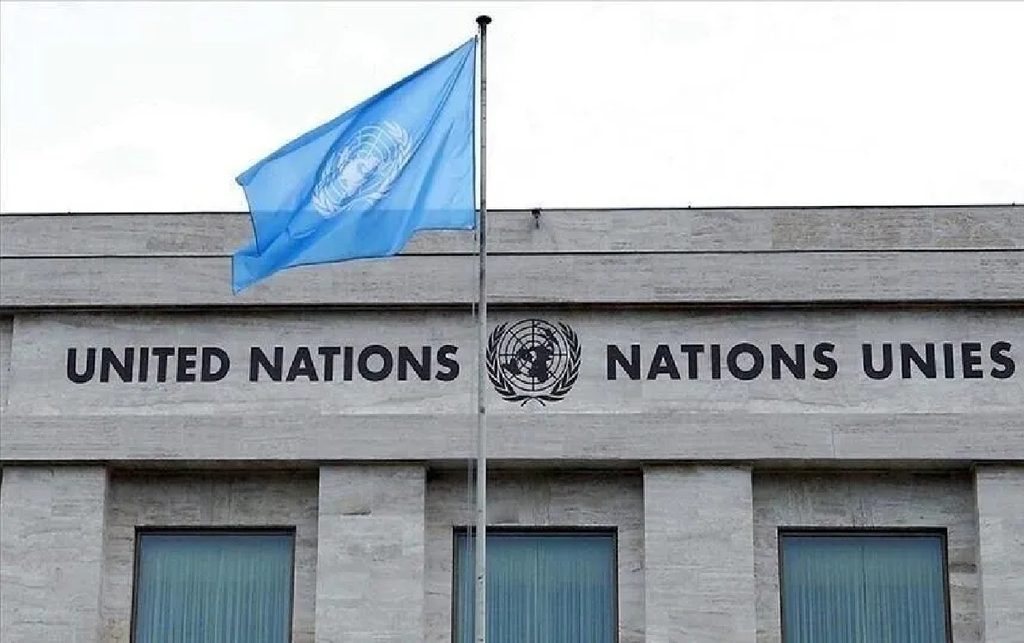
UNITED NATIONS / GENEVA — In the ornate chambers of the United Nations, where diplomatic language often masks the rawest of geopolitical tensions, Pakistan has launched a two-front diplomatic offensive that underscores a stark reality: the battle over water is no longer a future scenario. It is here.
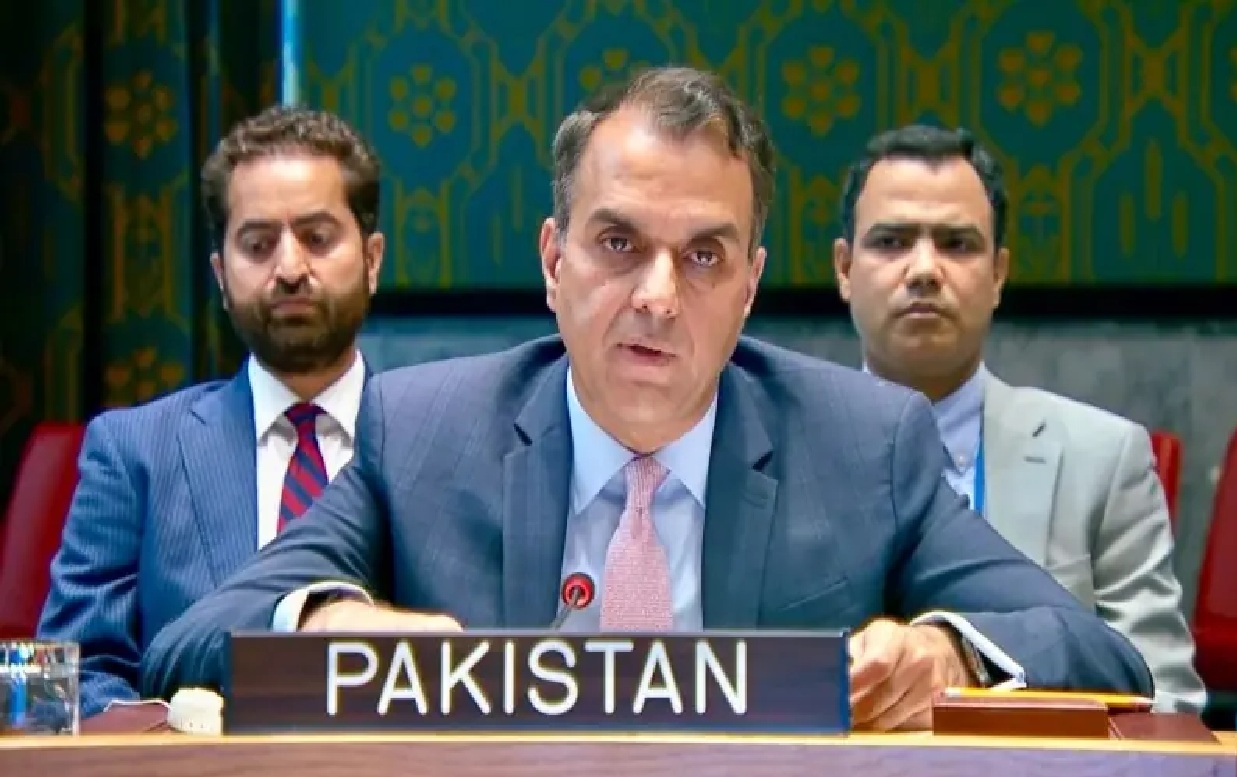
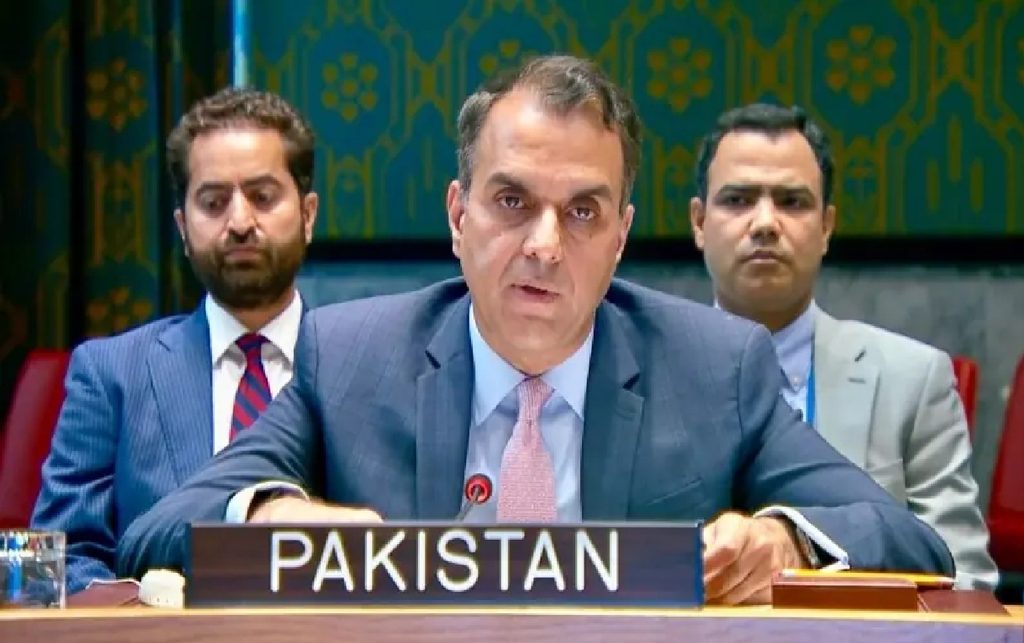
Speaking before the UN General Assembly’s Second Committee in October 2026, Pakistan’s Deputy Permanent Representative, Ambassador Usman Jadoon, issued a sweeping call for urgent international action on climate finance, debt reform, and most pointedly, the sanctity of transboundary water treaties. Days earlier in Geneva, Pakistan’s First Secretary Adeel Mumtaz Khokhar had used the UN Human Rights Council to accuse India of “weaponising water,” a charge that cuts to the heart of one of the world’s most dangerous flashpoints.
Together, the interventions represent a calculated diplomatic strategy: to elevate Pakistan’s existential water crisis from a bilateral dispute with India to a matter of international law, human rights, and global climate justice.
The $4 Trillion Chasm
The numbers are staggering. According to the United Nations, the annual financing gap for achieving the Sustainable Development Goals now stands at approximately $4 trillion. For Pakistan, a nation of 240 million people grappling with cascading climate disasters, mounting debt, and stagnant growth, that gap is not an abstraction. It is measured in flooded villages, failed crops, and children out of school.
Ambassador Jadoon laid out four priorities for closing the gap: greater support for domestic resource mobilisation, expansion of international public finance, comprehensive debt architecture reform, and the restoration of trade as an engine of development.
“The annual financing gap for achieving the Sustainable Development Goals is estimated at $4 trillion,” Jadoon told the committee, according to the official record. He called for “a credible pathway to mobilise $300 billion in climate finance, including through grants and concessional financing.”
That $300 billion figure, a target established at COP29 in Bak, represents the new collective quantified goal on climate finance. But for Pakistan, the gap between promise and delivery has been painfully wide.
A History Of Broken Promises
The 2009 Copenhagen Accord committed developed nations to mobilise $100 billion annually in climate finance by 2020. That target was missed. The 2015 Paris Agreement reaffirmed the commitment, yet by 2023, the OECD reported that climate finance had only just reached $115.9 billion, a figure that critics note is inflated by counting loans rather than grants, and by including pre-existing development assistance.
“For Pakistan, climate finance is not charity, it is compensation,” said Ali Tauqeer Sheikh, a climate policy analyst and former member of Pakistan’s Climate Change Council, in an interview. “We contribute less than 1% of global emissions, yet we consistently rank among the ten most vulnerable nations. The Loss and Damage Fund was supposed to address this injustice. Instead, it remains chronically undercapitalised.”
The Loss and Damage Fund, established at COP27 in Sharm el-Sheikh and operationalised at COP28 in Dubai, was hailed as a breakthrough. But as of late 2026, pledges total less than $800 million, a fraction of the estimated $400 billion in annual losses developing countries face from climate impacts.
Pakistan knows this reality intimately. The 2022 floods submerged one-third of the country, displaced 33 million people, and caused over $30 billion in damage. The 2024 floods in Sindh and Balochistan compounded the devastation. Each disaster pushes the country deeper into debt, forcing it to borrow at exorbitant rates to rebuild.
The Debt Trap
This is where Pakistan’s call for debt architecture reform becomes inseparable from its climate advocacy.
“Developed countries should honour their commitment to provide 0.7% of gross national income as official development assistance,” Jadoon said, referencing a UN target that has been met by only a handful of nations.
Pakistan’s external debt stands at approximately $130 billion, with debt servicing consuming nearly half of federal revenue in recent years. The International Monetary Fund’s repeated bailout packages have come with austerity conditions that critics say deepen poverty and undermine climate resilience.
“Debt and climate are two sides of the same coin,” said Dr. Attiya Waris, UN Independent Expert on Foreign Debt and Human Rights, in a statement to the Human Rights Council in 2025. “Countries like Pakistan are trapped in a vicious cycle: they borrow to recover from climate disasters, then cut social spending to service that debt, which makes them more vulnerable to the next disaster.”
Pakistan’s role as vice-chair of the working group that steered the launch of the Borrowers’ Platform, a coalition of debt-distressed nations advocating for fairer lending terms, reflects its growing assertiveness on this issue. Jadoon called for “an intergovernmental process on debt to begin without delay.”
The Water Question
But it is on water that Pakistan’s diplomatic offensive carries the greatest urgency, and the greatest risk.
In his remarks to the Second Committee, Jadoon urged the UN Water Conferences scheduled for 2026 and 2028 to “address the full range of water-related challenges, with particular emphasis on cooperation over shared waters.” He stressed “the need to respect international law and uphold the sanctity of existing treaties.”
The reference was unmistakable. Pakistan’s water security is inextricably linked to the Indus Waters Treaty of 1960, a World Bank-brokered agreement that allocated the western rivers (Indus, Jhelum, Chenab) to Pakistan and the eastern rivers (Ravi, Beas, Sutlej) to India. The treaty survived three wars and numerous crises, standing as a rare example of successful transboundary water management.
Until now.
India’s Escalation
Following the April 2025 Pahalgam attack that killed 26 civilians in Indian-administered Kashmir, an attack India blamed on Pakistan-based militants, New Delhi announced it would hold the Indus Waters Treaty “in abeyance.” The move, unprecedented in the treaty’s 65-year history, sent shockwaves through Pakistan’s water management establishment.
Under the treaty, Pakistan receives approximately 80% of its irrigation water from the Indus system. Any disruption would devastate agriculture, which employs 40% of the labour force and contributes 24% to GDP.
“India’s action is a clear violation of international law,” said Khokhar at the Human Rights Council. “No upstream country can use water as a tool of political pressure or influence. Water must never become an instrument of coercion, political leverage or war.”
Pakistan’s fears are not abstract. India has constructed numerous hydroelectric projects on the western rivers, many of which Pakistan has challenged through the treaty’s dispute resolution mechanisms. The Kishanganga and Ratle projects were the subject of prolonged arbitration. Now, with the treaty in abeyance, Pakistan’s legal recourse has been severely diminished.
The Human Rights Dimension
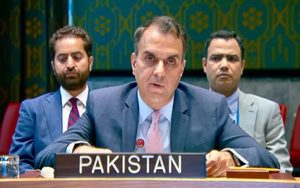
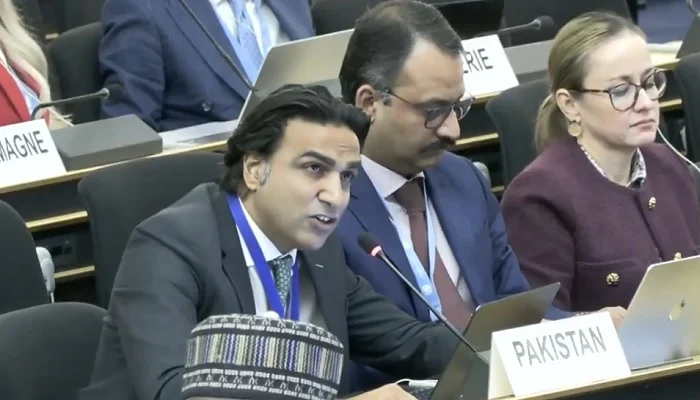
First Secretary Adeel Mumtaz Khokhar speaks at the 63rd session of the Human Rights Council in Geneva. — Screengrab via X/@PakUN_Geneva
Pakistan’s decision to raise the water issue at the Human Rights Council, rather than solely through bilateral or World Bank channels, represents a strategic shift. By framing transboundary water cooperation as directly linked to the human rights to safe drinking water and sanitation, Islamabad is seeking to internationalise the dispute and marshal global opinion against India.
The resolution on “The human rights to safe drinking water and sanitation” (A/HRC/63/L.34), presented by Germany and Spain, was adopted without a vote. But the battle over language was fierce.
According to diplomatic sources who spoke on condition of anonymity, India sought to remove an explicit reference to transboundary water cooperation from the resolution text, arguing that it fell outside the scope of a human rights resolution. Pakistan, supported by several other nations, fought to retain the reference.
“Where water is shared, responsibilities are also shared,” Khokhar told the council. “Cooperation over shared waters between neighbouring countries is not a matter of favour or concession, it is a shared responsibility.”
Two proposed amendments (L.39 and L.40) were rejected before the main text was adopted. Both received 10 votes in favour, 17 against, and nine abstentions.
Voices From The Ground
For farmers in Pakistan’s Punjab and Sindh provinces, the diplomatic manoeuvring in New York and Geneva translates into daily anxiety.
“The water levels in the canals have been dropping for years,” said Ghulam Rasool, a cotton farmer in Bahawalpur district, in a telephone interview. “We used to get water for our fields in April. Now it comes in May, and sometimes not at all. If India stops the water completely, we will starve.”
Rasool’s fears are echoed by millions across Pakistan’s agricultural heartland. The Indus Basin Irrigation System is the world’s largest contiguous irrigation network, supporting over 90% of the country’s food production. Its collapse would trigger a humanitarian catastrophe.
“The Indus Waters Treaty is not just a piece of paper; it is the lifeline of Pakistan,” said Simi Kamal, a water expert and chairperson of the Hisaar Foundation, a Karachi-based think tank. “Any attempt to weaponise water is a direct threat to the food security and livelihoods of millions of people. The international community must act.”
The water dispute is unfolding against the backdrop of accelerating climate change, which is altering precipitation patterns, accelerating glacier melt, and intensifying extreme weather events.
Pakistan’s glaciers in the Karakoram and Himalayan ranges are melting at an alarming rate. According to the International Centre for Integrated Mountain Development (ICIMOD), the region could lose up to 80% of its glacier volume by 2100 under high-emission scenarios. This would initially cause devastating floods, followed by chronic water scarcity as river flows decline.
“The Indus is one of the most vulnerable river basins in the world to climate change,” said Dr. Aditi Mukherji, a lead author of the IPCC’s Sixth Assessment Report and Director of the Climate Change Impact Platform at IWMI. “What we are seeing is a compounding crisis: reduced flows due to glacier melt, increased demand from population growth, and political tensions over allocation. This is a recipe for conflict.”
In this context, Pakistan’s call for “tripling adaptation finance” and “adequate capitalisation of the Loss and Damage Fund” is not merely a negotiating position; it is a survival strategy.
The AI Divide
Pakistan’s intervention at the Second Committee also addressed the emerging challenge of artificial intelligence, which Jadoon warned could become “the new face of the development divide.”
“Developing countries are at risk of falling further behind in access to technology, skills, infrastructure and investment,” he said, calling for “the operationalisation of the WSIS+20 AI capacity-building fellowship” and “concrete progress towards establishing a global fund for AI.”
The warning reflects a growing concern among developing nations that the AI revolution, dominated by the United States, China, and a handful of European countries, will entrench existing inequalities. Without access to computing infrastructure, data, and talent, countries like Pakistan risk being relegated to the role of raw data providers rather than participants in the AI economy.
“We are not asking for charity,” said a Pakistani diplomat who spoke on condition of anonymity. “We are asking for a seat at the table. The rules of the digital economy are being written now. If we are not part of that process, we will be rule-takers, not rule-makers.”
The WTO And Trade
Pakistan also called for the revitalisation of the World Trade Organisation, including the restoration of its two-tier dispute settlement mechanism, which has been paralysed since 2019 when the United States blocked appointments to the Appellate Body.
“The WTO’s dispute settlement system was the cornerstone of the rules-based trading order,” said Jadoon. “Its paralysis has emboldened unilateralism and protectionism, undermining the development prospects of countries like Pakistan.”
Pakistan’s concerns are particularly acute in agriculture, where it has long sought reductions in subsidies by developed countries and greater market access for its exports. The collapse of the Doha Round negotiations in 2008 left these issues unresolved, and subsequent bilateral and regional trade agreements have largely bypassed Pakistan’s interests.
A Call For ‘Delivery’
Pakistan’s support for Türkiye and Australia’s efforts to make COP31 a “COP of delivery” reflects a broader frustration with the gap between climate rhetoric and action.
COP31, scheduled for November 2026 in Antalya, Turkey, will be a critical test of the international community’s commitment to the Paris Agreement. The first Global Stocktake, concluded at COP28, revealed that current Nationally Determined Contributions (NDCs) put the world on track for 2.5-2.9°C of warming far above the 1.5°C target.
“For Pakistan, every fraction of a degree matters,” said Sheikh, the climate analyst. “We are already experiencing the impacts of 1.1°C of warming. At 2°C, parts of our country may become uninhabitable. At 3°C, the consequences are unimaginable.”
The Path Forward
Pakistan’s diplomatic offensive at the UN reflects a recognition that its challenges, climate, debt, water, trade, technology, are interconnected and cannot be addressed in isolation. By weaving these issues together in its interventions, Islamabad is articulating a comprehensive vision of global economic and environmental justice.
But rhetoric alone will not deliver results. The Second Committee’s deliberations will produce resolutions and frameworks, but their implementation depends on the political will of member states, particularly the major powers whose interests often diverge from those of developing countries.
“The UN is a mirror of the world’s power imbalances,” said a senior UN official who spoke on condition of anonymity. “Pakistan can use these forums to build coalitions and shame recalcitrant states. But ultimately, the decisions that matter most, on climate finance, debt relief, water sharing, are made in capitals, not in committee rooms.”
The Shadow Of Conflict
Perhaps the most troubling dimension of Pakistan’s water diplomacy is its entanglement with the broader India-Pakistan conflict. The two nuclear-armed neighbours have fought four wars since independence in 1947, and the disputed territory of Kashmir remains a flashpoint.
The Indus Waters Treaty was designed precisely to insulate water from politics, to ensure that even in times of war, the rivers would continue to flow. India’s decision to hold the treaty “in abeyance” after the Pahalgam attack represents a fundamental rupture in that understanding.
“If water becomes another front in the India-Pakistan conflict, the consequences will be catastrophic,” said Michael Kugelman, director of the South Asia Institute at the Wilson Centre in Washington. “Both countries have nuclear weapons. A water war could escalate into a shooting war, with unimaginable consequences.”
Pakistan has consistently called for the resolution of the Kashmir dispute through dialogue and adherence to UN Security Council resolutions. India, meanwhile, has rejected third-party mediation, insisting that Kashmir is a bilateral issue.
International Law And The ‘Sanctity Of Treaties’
Pakistan’s emphasis on “the sanctity of existing treaties” is a direct appeal to international law, particularly the Vienna Convention on the Law of Treaties (VCLT), which codifies the principle of pacta sunt servanda, agreements must be kept.
Under the VCLT, a state may not unilaterally suspend or terminate a treaty unless specific conditions are met, such as a material breach by another party or a fundamental change of circumstances. India’s invocation of the treaty’s “in abeyance” status, without formally withdrawing, appears designed to avoid the legal consequences of outright termination while achieving the same practical effect.
“This is a dangerous precedent,” said Dr. Maleiha Malik, a professor of law at King’s College London and an expert on international water law. “If states can simply suspend treaties that no longer suit them, the entire edifice of international law is undermined. The Indus Waters Treaty has been a model of successful transboundary water cooperation. Its collapse would be a tragedy, not just for Pakistan and India, but for the world.”
A Moment Of Reckoning
As the UN General Assembly’s 81st session continues, Pakistan’s interventions at the Second Committee and Human Rights Council have placed the country’s existential challenges squarely on the international agenda. But the gap between advocacy and action remains vast.
“The world is failing Pakistan,” said Kamal, the water expert. “We are on the front lines of a climate crisis we did not cause. Our rivers are being weaponised by a neighbour. Our economy is being crushed by a debt system we did not design. And yet, the international community continues to offer words, not resources.”
For the farmers of Bahawalpur, the diplomats of Islamabad, and the millions of Pakistanis whose lives hang in the balance, the stakes could not be higher.
“The water will not wait,” said Rasool, the cotton farmer. “The glaciers are melting. The rivers are shrinking. And our children are asking: what will you do?”
References and Sources
United Nations General Assembly, Second Committee, General Debate, 81st Session, October 2026
UN Human Rights Council, 63rd Session, Resolution A/HRC/63/L.34, “The human rights to safe drinking water and sanitation,” September-October 2026
Indus Waters Treaty, 1960, World Bank
Vienna Convention on the Law of Treaties, 1969
OECD, “Climate Finance Provided and Mobilised by Developed Countries in 2013-2023,” 2025
IPCC, Sixth Assessment Report, Working Group II, 2022
ICIMOD, “Hindu Kush Himalaya Assessment,” 2019
Interviews with Ali Tauqeer Sheikh, Simi Kamal, Ghulam Rasool, Michael Kugelman, and other sources
Statements from Dr. Attiya Waris, UN Independent Expert on Foreign Debt and Human Rights
Statements from Dr. Aditi Mukherji, IPCC Lead Author and IWMI Director
Statements from Dr. Maleiha Malik, King’s College London
Veritas Press Investigative Analysis Independent journalism examining global affairs, power, diplomacy, and accountability.
Source:Veritas Press C.I.C. | Multi-News Agencies
Help Support Our Work
Readers who believe that truth still matters have power over popular information. When just a few more people step up to support this work, it means more lies exposed, more corruption uncovered, and more accountability where it’s long overdue.
Help Protect Independent Journalism, Which Is Currently Under Attack.
If you believe journalism should serve the public, not the powerful, and you’re able to help, becoming a regular DONOR or a PAID SUBSCRIBER truly makes a difference.
DONATION APPEAL: If you found this reporting valuable, please consider supporting independent journalism.
Your support fuels our fearless, truth-driven journalism. In unity, we endeavour to amplify marginalised voices and champion justice, irrespective of geographical location. We operate independently, with no financial backing from billionaires; our readers support us.
But it’s also extremely important. One of Veritas Press’s greatest assets is its reader-funded model.
1. Reader funding means we can cover what we like. We’re not beholden to the political whims of a billionaire owner. We are a small, independent and impartial organisation. No one can tell us what not to say or what not to report.
2. Reader funding means we don’t have to chase clicks and traffic. We’re not desperately seeking your attention for its own sake; we pursue the stories that our editorial team deems important and believes are worthy of your time.
3. Reader Funding: enables us to keep our website and other social media channels open, allowing as many people as possible to access quality journalism from around the world, particularly those in places where the free press is under threat.
We know not everyone can afford to pay for news, but if you’ve been meaning to support us, now’s the time.
Your donation goes a long way. It helps us:
Keep the lights on and sustain our day-to-day operations
Hire new, talented, independent reporters
Launch real-time live debates, community-focused shows, and on-the-ground reporting
Cover the issues that matter most to our communities, in real time, with depth and integrity
Without your support, independent voices like ours will be silenced.
Furthermore, we have plans to expand our work, but we can’t do it without your support. Every contribution, no matter the size, helps us stay independent and build a truly people-powered media platform.
If you believe in journalism that informs, empowers, and reflects the communities we serve, please donate today.
Kamran Faqir is a volunteer investigative journalist and writer committed to exposing hidden truths and amplifying underreported stories. Driven by social justice, he brings sharp insight and fearless truth-telling to independent journalism. NUJ registered.
SEATTLE, TEHRAN — The U.S. Department of Homeland Security (DHS) will allow Iran’s national football team to enter the country 48 hours before their critical World Cup match against Egypt on Friday, a modest concession in a tournament where Team Melli’s travel conditions have sparked claims of oppression and competitive disadvantage.