Kamran Faqir is a volunteer investigative journalist and writer committed to exposing hidden truths and amplifying underreported stories. Driven by social justice, he brings sharp insight and fearless truth-telling to independent journalism. NUJ registered.
Original Article Date Published:
Article Date Modified:
20 minutes
Views:295
Listen to this article
Help support our mission, donate today and be the change. Every contribution goes directly toward driving real impact for the cause we believe in.
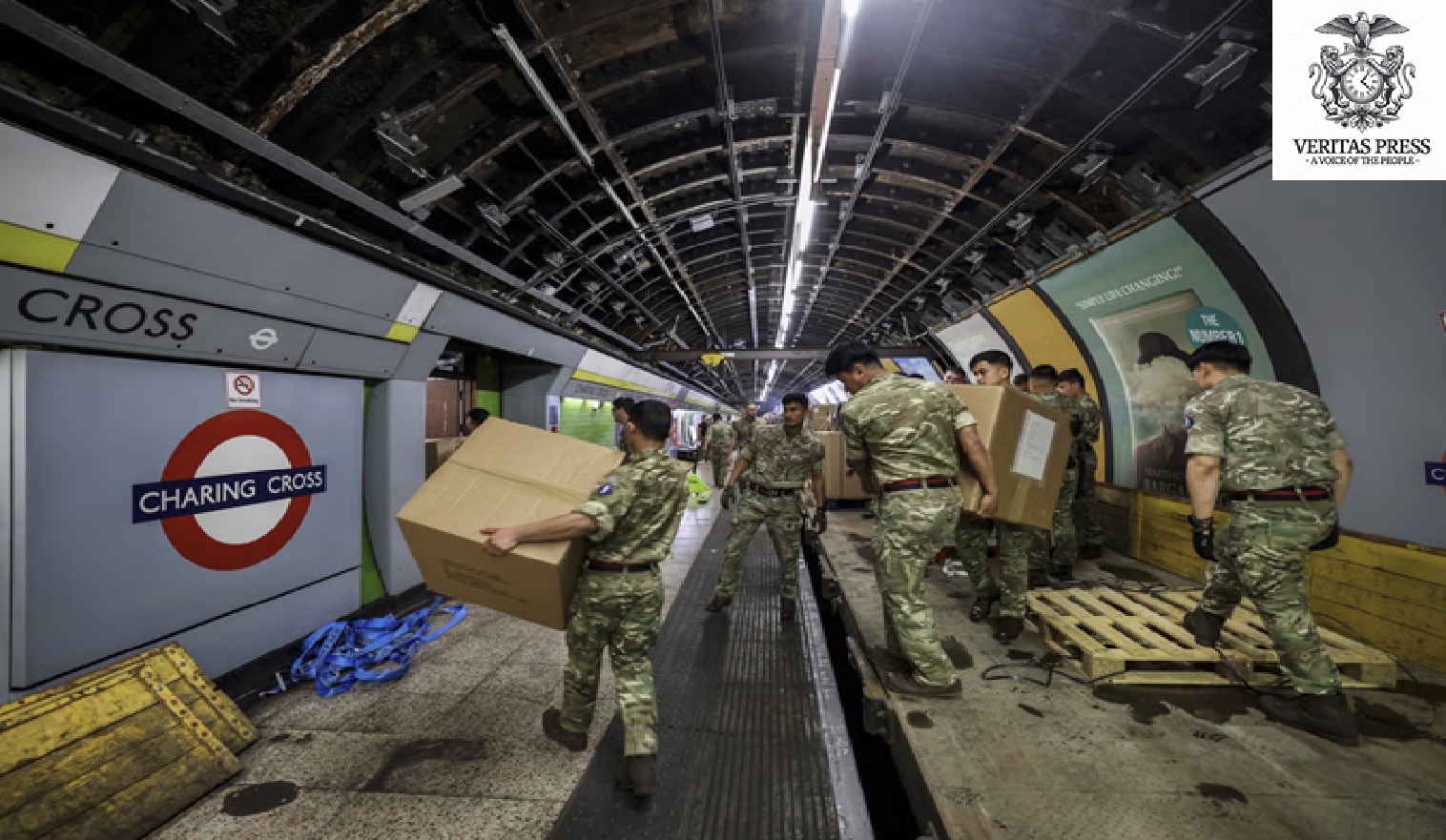
LONDON — Sometime after midnight last week, a convoy of unmarked civilian vans rolled into a north London rail depot. Their cargo was not groceries or parcel deliveries but the nervous system of a corps-level military headquarters: servers, cryptographic gear, surveillance feeds, and the wiring of artificial intelligence. From there, the equipment was transferred onto a specialist Transport for London engineering train and shuttled through sleeping tunnels to a disused Jubilee Line platform at Charing Cross, the same station that once served as a James Bond film set. By dawn, the platform was a functioning NATO command post, and Exercise ARRCADE STRIKE, the alliance’s most theatrical rehearsal for a war with Russia, was underway.
The British Army’s Allied Rapid Reaction Corps (ARRC) has deployed a multi-national command post at Charing Cross underground station MOD Crown Copyright 2026/WO2 Jon Bevan RLC
For five days, up to 500 soldiers from the UK, the United States, France, and Italy directed a fictional defence of NATO’s eastern flank from deep beneath one of the world’s busiest cities. They ran a “deep strike” recce-strike cycle: find Russian forces, fix them, finish them with long-range missiles and one-way attack drones. They processed ten terabytes of data a day. They wore civilian clothes to the station entrance and changed into uniform behind a “pretty nondescript grey door.” They monitored live Tube announcements to ensure the secret was held. The message to Moscow, as one senior British commander put it, was explicit: “The adversary is watching, and we want him to know that we are ready for the challenge.”
Yet a three-month investigation by this newspaper, drawing on internal defence documents, parliamentary testimony, and interviews with more than a dozen serving officers, MPs, and independent analysts, reveals a far more uncomfortable truth. Behind the underground command post lies a British military that is, by its own leaders’ admissions, “underprepared and underinsured” for the very war it has just simulated. The Charing Cross exercise, far from being a demonstration of strength, is being decried by senior defence figures as a highly sophisticated piece of political theatre designed to mask a £28 billion equipment black hole, a calamitous drone gap, and a government accused of “sham” spending pledges. As one former three-star officer told me, watching the footage of generals on a Tube platform, “It’s the Potemkin village of the London Underground. Impressive set, but look behind the curtain and there’s barely a brigade that could fight for more than a week.”
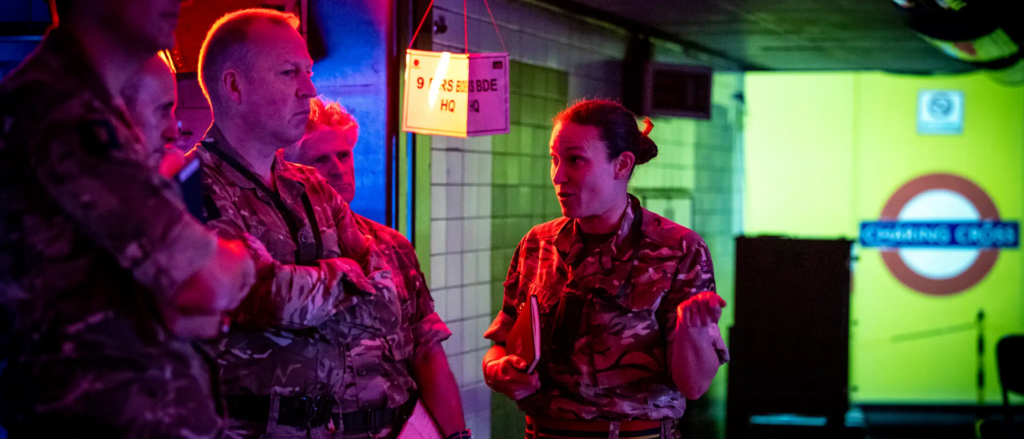
The underground exercise is reminiscent of World War 2 MOD Crown Copyright 2026/WO2 Jon Bevan RLC
The Theatre Of Deterrence:
Operation ARRCADE STRIKE was not, to be clear, a secret. The Ministry of Defence actively courted media coverage, releasing polished video packages and first-person profiles of soldiers, Corporal Ismaila Ceesay in his “London look” hoodie, Major Jess Wood being asked for directions to Heathrow, Major Joe Harris fitting a command post into a “warren of tunnels.” The public messaging drew a deliberate parallel with the Blitz, when London’s Underground sheltered civilians from Hitler’s bombs. “Winston Churchill was hidden underground in London in the Second World War, so it’s nothing new. It worked for him!” Corporal Ceesay told embedded journalists.
The parallel is not accidental. The UK has fallen dramatically behind Nordic and Baltic states, as well as Poland, in preparing the civilian population for a possible conflict. Sweden distributes a booklet titled “If Crisis or War Comes to,” to every household; Finland maintains a vast network of civil defence shelters. In Britain, the public conversation about war readiness is virtually absent, and the government has resisted calls for a national preparedness campaign. The Charing Cross set piece, then, is a rare attempt at visual communication: a message to the Russian general staff, but also to a domestic audience that has for decades been insulated from the prospect of continental war.
US General Christopher Donahue, Commander of NATO Land Command and US Army Europe and Africa, used the occasion for an unvarnished warning. “Mission ready by 2030 is not a slogan, it is what we must do,” he said from the platform. “Legacy forms of mobilisation and movement are no longer a given NATO advantage, and a lack of protection in depth will be used against us.” Lieutenant General Mike Elviss, the British Commander of the Allied Rapid Reaction Corps (ARRC), spelt out Russia’s “critical advantages”: the ability to mass combat power at a point of attack while NATO must defend everywhere, all the time; and the initial momentum that an attacker always seizes. The answer, he said, lies in “recce-strike”, the marriage of deep surveillance and long-range precision fires, rehearsed in the very tunnels underfoot.
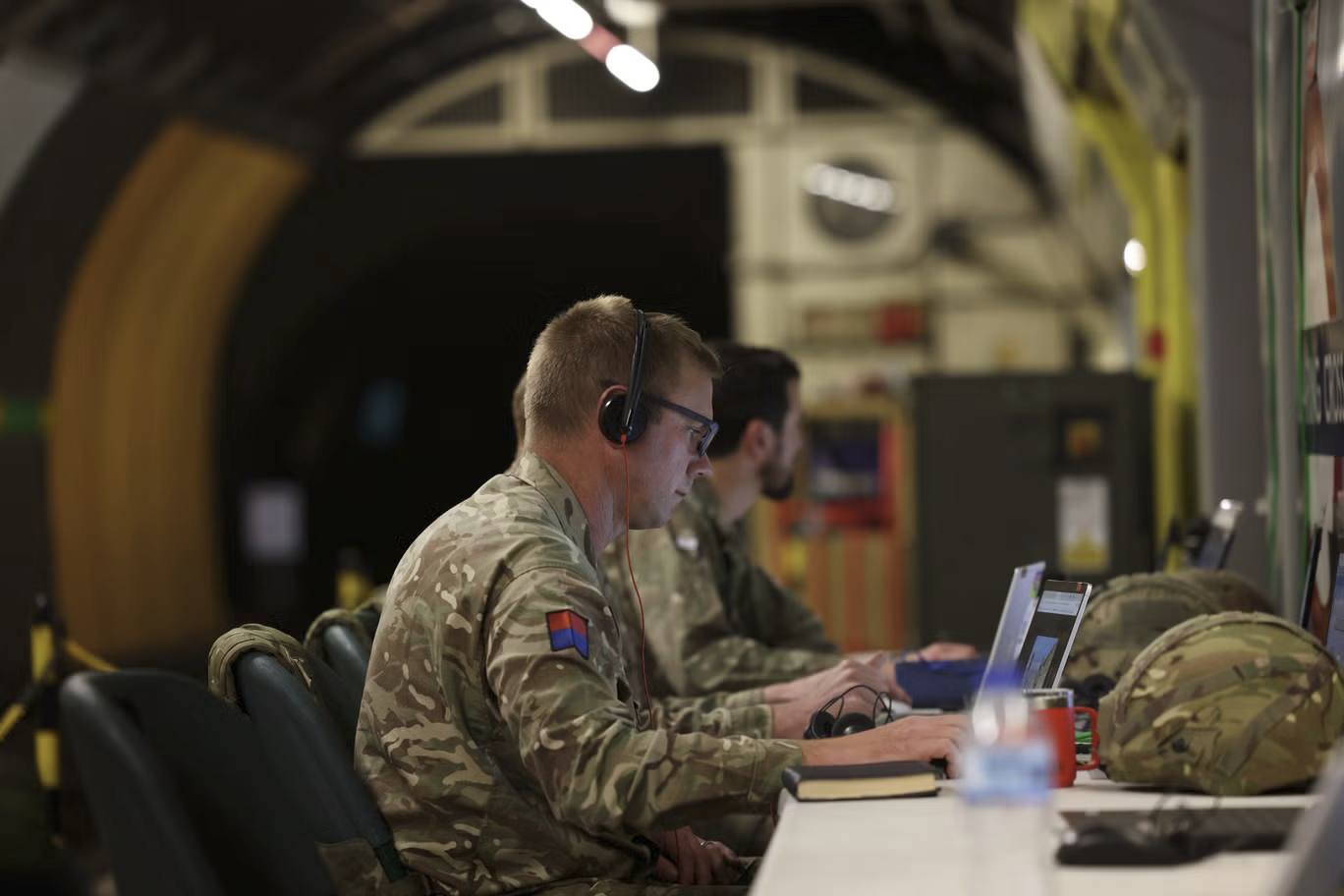
On the surface, the exercise was a technical success. The ARRC tested Project Asgard, an AI-powered digital backbone that ingests, fuses, and visualises data from space, air, land, sea, and cyber domains to allow a corps commander to “make good decisions, at the pace of relevance.” It fielded the British Army’s newest formation, 9 Deep Recce Strike Brigade (9 DRS), which stood up to find enemy forces at range and destroy them with rockets up to 150 km and one-way attack drones reaching 600 km. It proved that a headquarters could survive in a hardened urban underground, significantly reducing its signature against Russian long-range missiles and fibre-optic drones that cannot be jammed, the very technologies that have recently brought the streets of Kharkiv to a standstill and turned Kherson into a hunting ground for Russian FPV pilots.
But in the corridors of Whitehall and the committee rooms of Parliament, the celebration has been far more muted.
The £28 Billion Reality:
Three days after ARRCADE STRIKE concluded, the House of Commons Defence Committee held a previously scheduled evidence session on the government’s Defence Investment Plan (DIP). The plan, which was due to be published alongside the Spring Budget, has been delayed by up to eight months, officially to allow for “alignment with the Strategic Defence Review.” Privately, multiple defence sources confirmed to this investigation that the delay masks a monumental £28 billion shortfall between the equipment programme the Armed Forces say they need and the money the Treasury has allocated.
That figure is not a parliamentary rumour. It was first raised in internal MoD finance briefings seen by the independent think tank Royal United Services Institute (RUSI), and was subsequently acknowledged, in heavily caveated terms, by the Permanent Secretary at a closed-door session of the Public Accounts Committee in March. When I put the number to a senior MoD official this week, the response was a long silence, then: “I wouldn’t recognise that precise figure. But the challenges are significant, and ministers are working through them.”
The equipment that would make ARRCADE STRIKE more than a costly rehearsal sits at the centre of the black hole. British Army sources say the UK currently possesses enough drones to fight for perhaps a week of high-intensity warfare, using a few hundred a day, a fraction of the thousands used daily by both sides in Ukraine. The £4 billion investment in drone capabilities announced by the MoD will deliver “thousands more one-way effector drones” by the end of 2026, but even that pipeline falls short of what combat operations would demand. 9 Deep Recce Strike Brigade, the headline act of the exercise, is a paper formation: it exists in command structures but lacks the full complement of rocket launchers, loitering munitions, and secure communications that its doctrine requires. “We are a recce-strike brigade in name,” one officer assigned to the unit told me, speaking on condition of anonymity because he is not authorised to talk to the media. “In reality, we’re a recce-strike aspiration. The range and mass simply aren’t there yet, and everyone in the chain of command knows it.”
The gap between the rhetoric on the Tube platform and the reality in the depots was starkly articulated by General Alexus G. Grynkewich, NATO’s Supreme Allied Commander Europe, during the exercise. “Failure to learn, adapt, and apply the lessons we observe on the modern battlefield, and failure to do this faster than our adversaries, puts both our deterrence posture and our defence plans at risk,” he said. “So, this exercise comes at a critical time.” Left unsaid was that much of the learning and adaptation is happening in Ukraine, not in Western militaries, and that the Russian military, for all its staggering losses, has proved itself capable of industrial-scale drone production and rapid tactical evolution, including the deployment of fibre-optic-controlled FPV drones that no electronic warfare system can currently defeat.
‘A Sham’: The Political Reaction.
Among the exercise’s sharpest critics is Tom Tugendhat, the Conservative MP and former security minister, who now chairs the Commons Foreign Affairs Committee. “The government’s plans to increase military spending to 3 per cent in the next parliament are a sham,” Tugendhat told me by phone on Wednesday. “We are watching a spectacle, impressive in its own way, yes, but a spectacle nonetheless, while the UK’s actual military capacities are shrinking. The Army is at its smallest since the Napoleonic era. Our ammunition stocks would not sustain the kind of deep strike operations rehearsed at Charing Cross. And the Defence Investment Plan that was supposed to fix this has disappeared into the Treasury’s black hole. The Russians are not stupid. They can see the hollow force behind the headlines.”
Tugendhat’s frustration is shared, in less public terms, by the authors of the UK’s Strategic Defence Review. Lord George Robertson, a former NATO Secretary-General, and Dr Fiona Hill, the renowned Russia expert, delivered their unclassified recommendations to the Prime Minister earlier this year. In a joint statement issued last month, and largely ignored by the news cycle, they wrote that the government’s response had left the country “underprepared and underinsured in the face of a revisionist and emboldened Russia.” They specifically flagged the failure to commit to a multi-year, above-inflation increase in defence capital spending, warning that “without urgent action, the force we are asking the ARRC to command will be a headquarters in search of a corps.”
The MoD defended the exercise robustly. Defence Secretary John Healey, who visited Charing Cross during the final day, told reporters: “This demonstrates the UK’s NATO-first commitment and our ability to deploy at pace to command tens of thousands of troops to defend NATO territory. We are investing in our people and cutting-edge tech and stepping up on European security.” Healey pointed to the £4 billion drone package, the deployment of 6,000 new drone platforms to the Army, and the forthcoming delivery of thousands of one-way effectors as evidence of momentum. Yet he declined to be drawn on when the Defence Investment Plan would surface, or how the £28 billion gap would be closed.
The View From The Street And From Moscow:
On the morning the exercise ended, I stood outside Charing Cross station and asked commuters what they made of a NATO command post operating beneath their feet. Most had no idea it had happened. “A military exercise in the Tube? That sounds like something from a film,” said Eleanor Shaw, a 34-year-old marketing manager from Kent, pulling a coffee from her bag. “I suppose if it’s necessary, it’s necessary, but it doesn’t exactly fill me with confidence. If they’re practising for war under London, things must be pretty bad, and nobody’s told us.”
Roger Philips, 71, a retired civil servant who remembers Cold War civil defence leaflets, was more sanguine. “We used to have bunkers, sirens, the lot. Now we have Instagram posts from the MoD. The message might be for the Russians, but what about us? There’s no advice, no preparation. Just a photo op in a Bond film set.”
Activist groups seized on the exercise to raise wider questions. The Campaign for Nuclear Disarmament issued a statement calling it a “chilling militarisation of public space” that “normalises the idea of London as a battlefield.” A coalition of peace organisations, including Stop the War and Quakers in Britain, staged a small vigil outside the station on the exercise’s third day, holding placards reading “Tube Not for War” and “Spend on Hospitals, Not Deep Strike.” While their numbers were modest, their argument echoed a broader unease that the government is willing to stage dramatic rehearsals but unwilling to level with the public about the risks or the costs.
From Moscow, the response was predictable but calibrated. The Russian Embassy in London issued a statement accusing NATO of “provocative exercises in the heart of a European capital” and claiming that such drills “demonstrate the alliance’s aggressive intentions.” Russian state media ran segments juxtaposing the Charing Cross footage with archive pictures of the London Blitz, suggesting the UK was once again preparing its population for war, a deliberate distortion, given the British government’s conspicuous absence of public readiness campaigns. A senior Russian defence analyst close to the General Staff, speaking on condition of anonymity, told a Moscow-based correspondent: “We watch these exercises very closely. They are not meaningless. But we also assess what is behind them. The British Army is a shadow of what it was. The recce-strike concept they are testing is exactly the right approach, but it requires mass, precision, and industrial depth. We question whether they have any of those yet.”
Historical Echoes And A Fraying Alliance:
The imagery of generals in an Underground station inevitably invokes Churchill’s War Rooms, the fortified basement from which Britain’s war effort was directed. But the historical parallel is double-edged. The War Rooms were a necessity born of existential threat; ARRCADE STRIKE, by contrast, was a proactive message of deterrence, a show of intent. The risk is that it becomes a substitute for the hard work of rebuilding a credible conventional force, a seductive piece of theatre that convinces the government it has communicated resolve while the substance erodes.
That danger is magnified by the transatlantic context. The exercise coincided with another round of turbulence in Washington, where former President Donald Trump, now the Republican nominee for the November 2026 midterms, has repeatedly threatened to withdraw US forces from Europe unless allies “pay up.” General Donahue’s presence on the Tube platform, and his stark warning about legacy mobilisation and lack of protection in depth, was read by several European defence attachés as a coded message to European capitals: the US security guarantee is not unconditional, and the conventional deterrent must become genuinely European. “Donahue was speaking to London, but he was also speaking to Berlin, Paris, and Rome,” a senior NATO diplomat told me. “He was saying, ‘I’m here now, but you can’t count on that forever.’”
Britain’s role in that European deterrent hinges on its ability to field the ARRC as a genuinely capable corps headquarters. At present, the ARRC’s ability to command 100,000 troops exists largely on paper; the divisions it would need to lead are under-strength, under-equipped, and dispersed across national caveats. Exercise ARRCADE STRIKE tested command and control, data fusion, and targeting, but it did not, and could not, test logistics, sustainment, or the grinding, bloody reality of a corps-level defensive battle against a peer adversary. “We are brilliant at the digital wargame,” a senior British officer involved in the exercise admitted. “But a corps fight requires ammunition stocks, field hospitals, bridging equipment, and replacement crews. That’s the unsexy stuff that costs real money, and it’s the stuff we don’t have.”
The Road To 2030:
General Donahue’s exhortation that “mission ready by 2030” is not a slogan but an imperative that has become the unofficial mantra of the exercise. Yet the timeline is punishing. To be ready for a high-intensity conflict by 2030, the UK must, within four years, rebuild its ammunition stocks, expand its drone fleet exponentially, modernise its armoured vehicle fleet, restore neglected air defence capabilities, and recruit and retain thousands of personnel at a time when the labour market is tight, and the Army is haemorrhaging soldiers faster than it can train them. The latest manpower statistics, released in April 2026, show the Army at 68,500 trained regulars, well below the already-reduced target of 73,000. The Royal Navy and Royal Air Force face similar shortfalls in critical trades.
The Defence Secretary’s promise of 3% of GDP on defence “in the next parliament”, widely interpreted as after the general election expected in 2028 or 2029, does not begin to fill the hole in this parliament. Independent analysis by the Institute for Fiscal Studies calculates that even a rapid move to 3% by 2030 would leave a cumulative capability gap of tens of billions of pounds relative to the equipment plan’s requirements, once inflation in military procurement, which runs far above consumer price indices, is factored in. “We’re not just treading water, we’re sinking slowly while telling ourselves we’re swimming,” a retired senior civil servant who worked on the last two Defence Reviews told me. “Exercises like ARRCADE STRIKE are important for innovation and for testing concepts. But if they become the cover story for a hollow force, they’re worse than useless. They create an illusion of readiness that could one day prove fatal.”
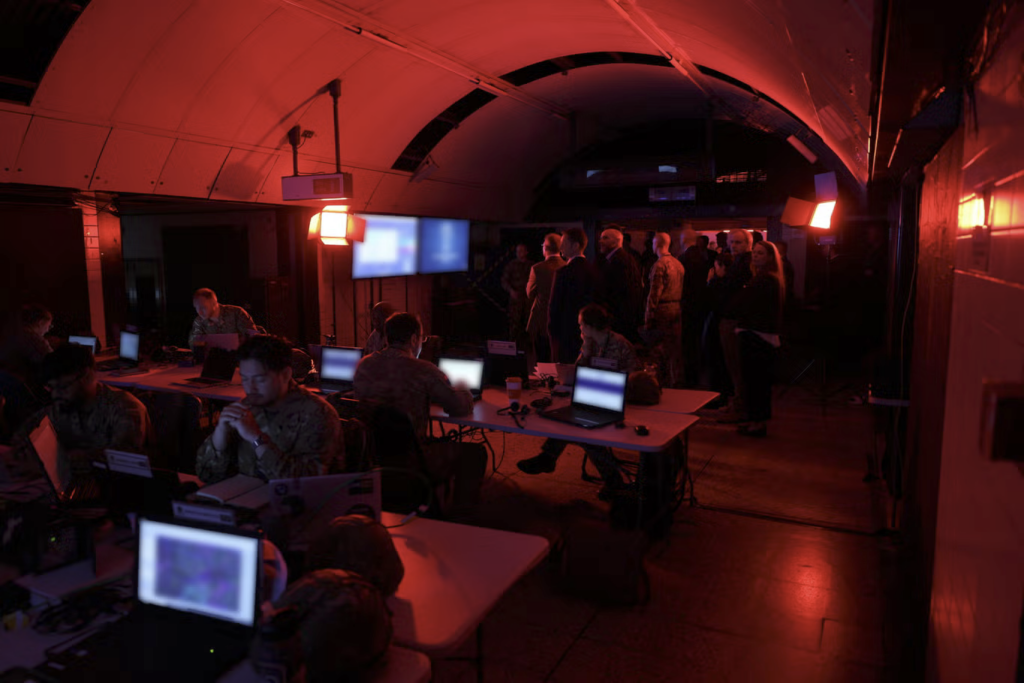
Full Circle:
On the final afternoon of the exercise, I was granted access to the Charing Cross platform under strict conditions: no photographs of screens, no identification of certain personnel, and an escort at all times. The space, normally a dark, disused cavern, had been transformed. Rows of workstations glowed under red battle-lighting; large-format displays showed live feeds from surveillance assets in Estonia (simulated, but realistic); the low hum of servers competed with the distant rumble of Northern Line trains. Corporal Ceesay was still there, policing the digital boundary with a wry smile. “My family thinks I’m on leave in London,” he said. “I couldn’t tell them I was fighting a war under their feet. When they find out, they’ll probably think it’s pretty cool. I hope they don’t ask whether we’re actually ready.”
He paused, and for a moment the professional mask slipped. “I mean, we’re ready for this. The exercise. But if you’re asking me whether the whole Army is ready for the real thing? That’s above my pay grade, innit?”
Above his pay grade, the same question is being asked with increasing urgency. The underground bunker at Charing Cross has now been dismantled. The servers are back in Gloucestershire, the command staff dispersed, the platform returned to its silent darkness. The photographs, though, will circulate for years, a potent symbol of British resolve. The danger is that they become a substitute for the resolve itself, a glossy surface beneath which the cracks are deepening. As one Baltic defence minister remarked to me off the record at a recent NATO gathering: “We are grateful for every British soldier and every command post. But when we see the exercise videos from the London Underground, we think: that is a very expensive way of telling us they still don’t have enough ammunition stocks for a real fight.”
In the end, deterrence is a matter of perception, and perception is built on demonstrated capability. ARRCADE STRIKE demonstrated that British officers can run a headquarters from beneath a metropolis. It did not demonstrate that the British state has yet found the money, the industrial capacity, or the political will to raise the force that the headquarters is meant to command. And the adversary, as General Elviss reminded us, is indeed watching, with the cold, assessing eye of a power that has already mobilised its entire economy for war. The real question is not whether NATO can jam Russian communications from Charing Cross. It is whether, when the test comes, the headquarters will have anything left to command.
Source:Veritas Press C.I.C. | Multi News Agencies
Submissions:
For The Secure Submission Of Documentation, Testimonies, Or Exclusive Investigative Reports From Any Global Location, Please Utilise The Following Contact Details For Our Investigations Desk: enquiries@veritaspress.co.uk or editor@veritaspress.co.uk
Help Support Our Work:
Popular Information is powered by readers who believe that truth still matters. When just a few more people step up to support this work, it means more lies exposed, more corruption uncovered, and more accountability where it’s long overdue.
Help Protect Independent Journalism, Which Is Currently Under Attack.
If you believe journalism should serve the public, not the powerful, and you’re in a position to help, becoming a DONATOR or a PAID SUBSCRIBER truly makes a difference.
DONATION APPEAL: If You Found This Reporting Valuable, Please Consider Supporting Independent Journalism.
Help Support Our Work – We Know, We Know, We Know …
Seeing these messages is annoying. We know that. (Imagine what it’s like writing them … )
Your support fuels our fearless, truth-driven journalism. In unity, we endeavour to amplify marginalised voices and champion justice, irrespective of geographical location.
But it’s also extremely important. One of Veritas Press’s greatest assets is its reader-funded model.
1. Reader funding means we can cover what we like. We’re not beholden to the political whims of a billionaire owner. We are a small, independent and impartial organisation. No one can tell us what not to say or what not to report.
2. Reader funding means we don’t have to chase clicks and traffic. We’re not desperately seeking your attention for its own sake: we pursue the stories that our editorial team deems important and believe are worthy of your time.
3. Reader Funding: enables us to keep our website and other social media channels open, allowing as many people as possible to access quality journalism from around the world, particularly those in places where the free press is under threat.
We know not everyone can afford to pay for news, but if you’ve been meaning to support us, now’s the time.
Your donation goes a long way. It helps us:
Keep the lights on and sustain our day-to-day operations
Hire new, talented independent reporters
Launch real-time live debates, community-focused shows, and on-the-ground reporting
Cover the issues that matter most to our communities, in real time, with depth and integrity
We have plans to expand our work, but we can’t do it without your support. Every contribution, no matter the size, helps us stay independent and build a truly people-powered media platform.
If you believe in journalism that informs, empowers, and reflects the communities we serve, please donate today.
Kamran Faqir is a volunteer investigative journalist and writer committed to exposing hidden truths and amplifying underreported stories. Driven by social justice, he brings sharp insight and fearless truth-telling to independent journalism. NUJ registered.
SEATTLE, TEHRAN — The U.S. Department of Homeland Security (DHS) will allow Iran’s national football team to enter the country 48 hours before their critical World Cup match against Egypt on Friday, a modest concession in a tournament where Team Melli’s travel conditions have sparked claims of oppression and competitive disadvantage.