Kamran Faqir is a volunteer investigative journalist and writer committed to exposing hidden truths and amplifying underreported stories. Driven by social justice, he brings sharp insight and fearless truth-telling to independent journalism. NUJ registered.
Original Article Date Published:
Article Date Modified:
20 minutes
Views:267
Listen to this article
Help support our mission, donate today and be the change. Every contribution goes directly toward driving real impact for the cause we believe in.
“A Video Showing Gaza Flotilla Activists Bound And Blindfolded Sparked Global Outrage And Ambassador Summons Across The World. How Did Different Countries Respond?”
A deeper investigation into the global fallout from Itamar Ben‑Gvir’s video of abducted Gaza flotilla activists, the legal and humanitarian crisis it exposed, and the widening cracks in international complicity.
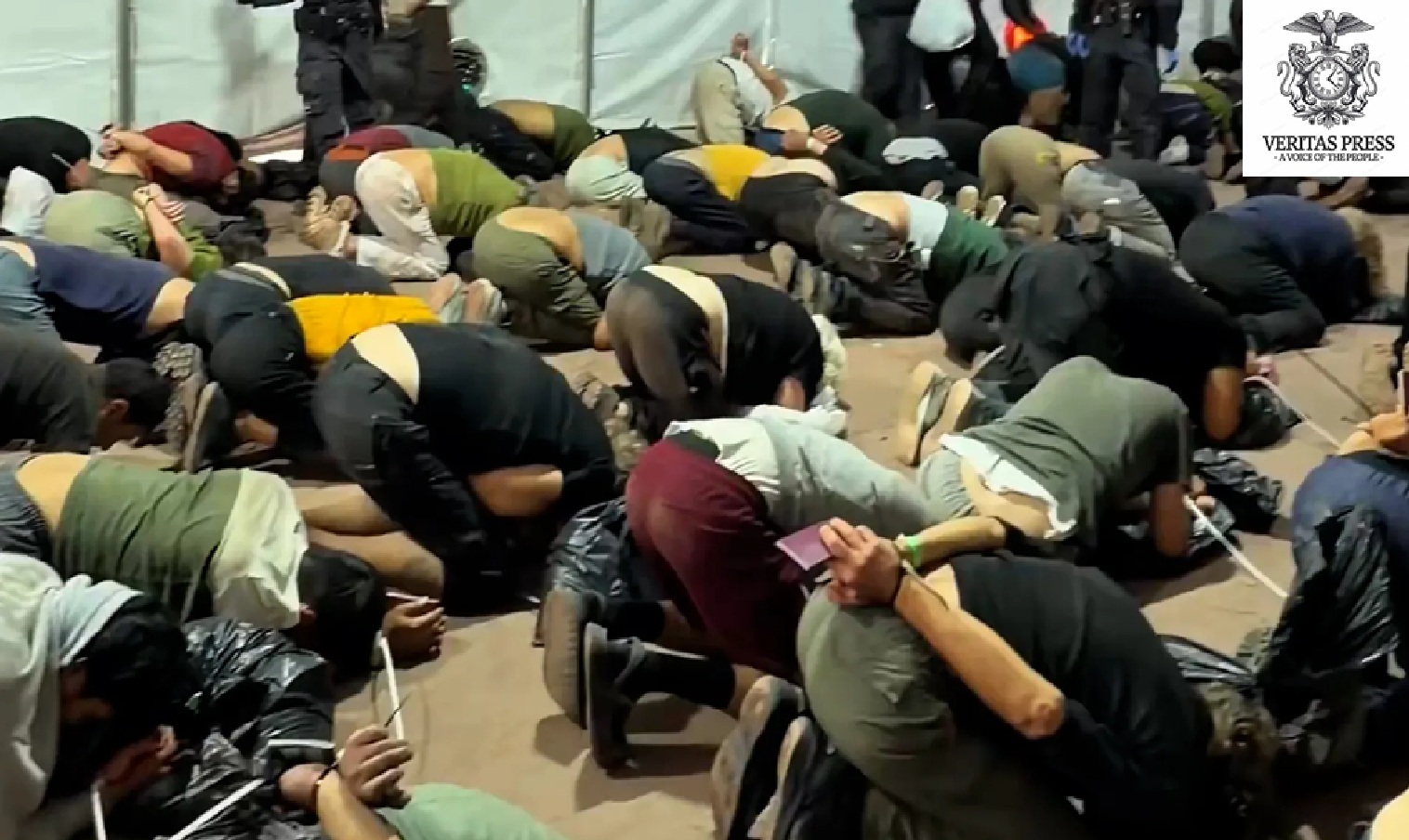
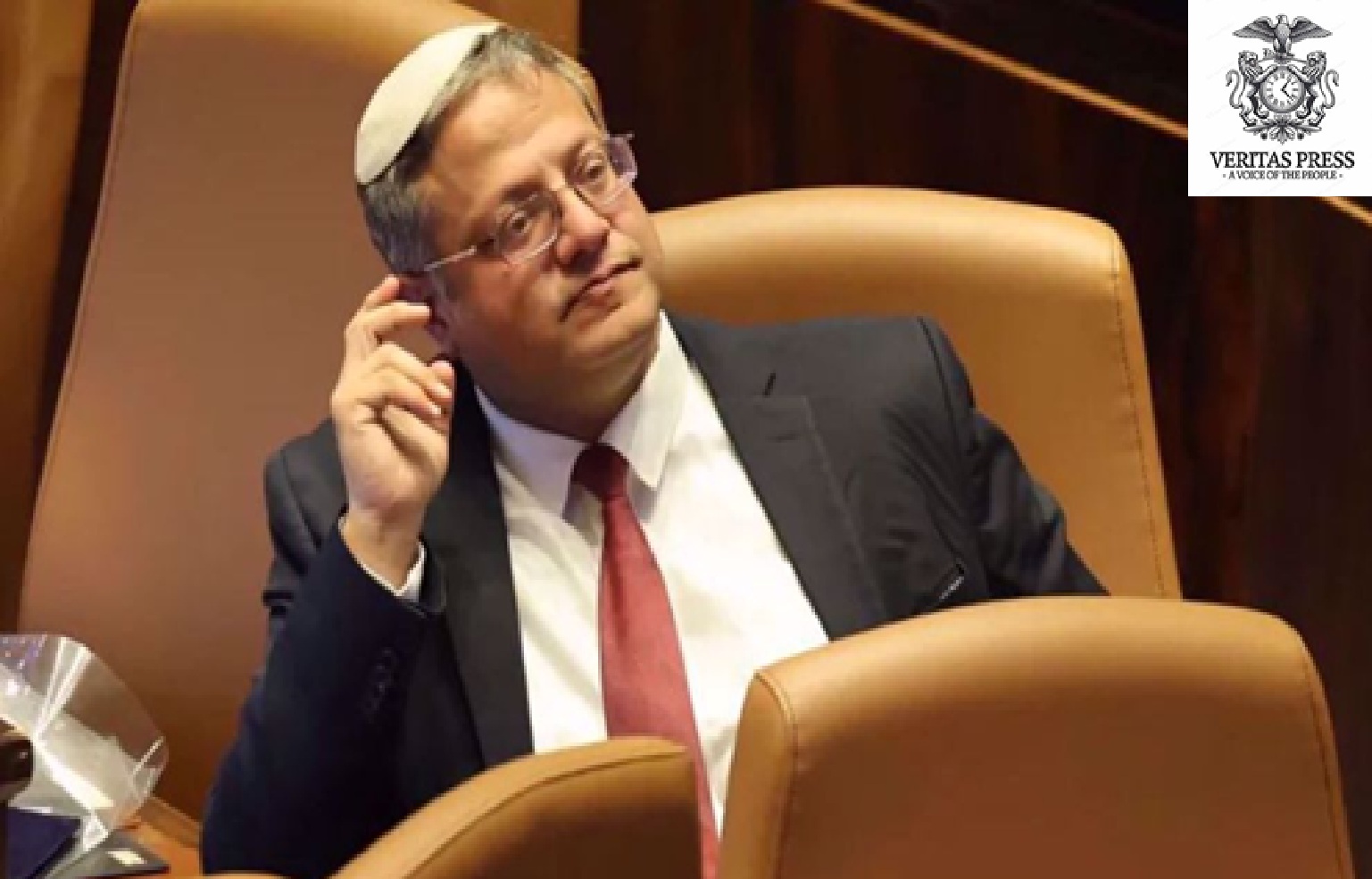
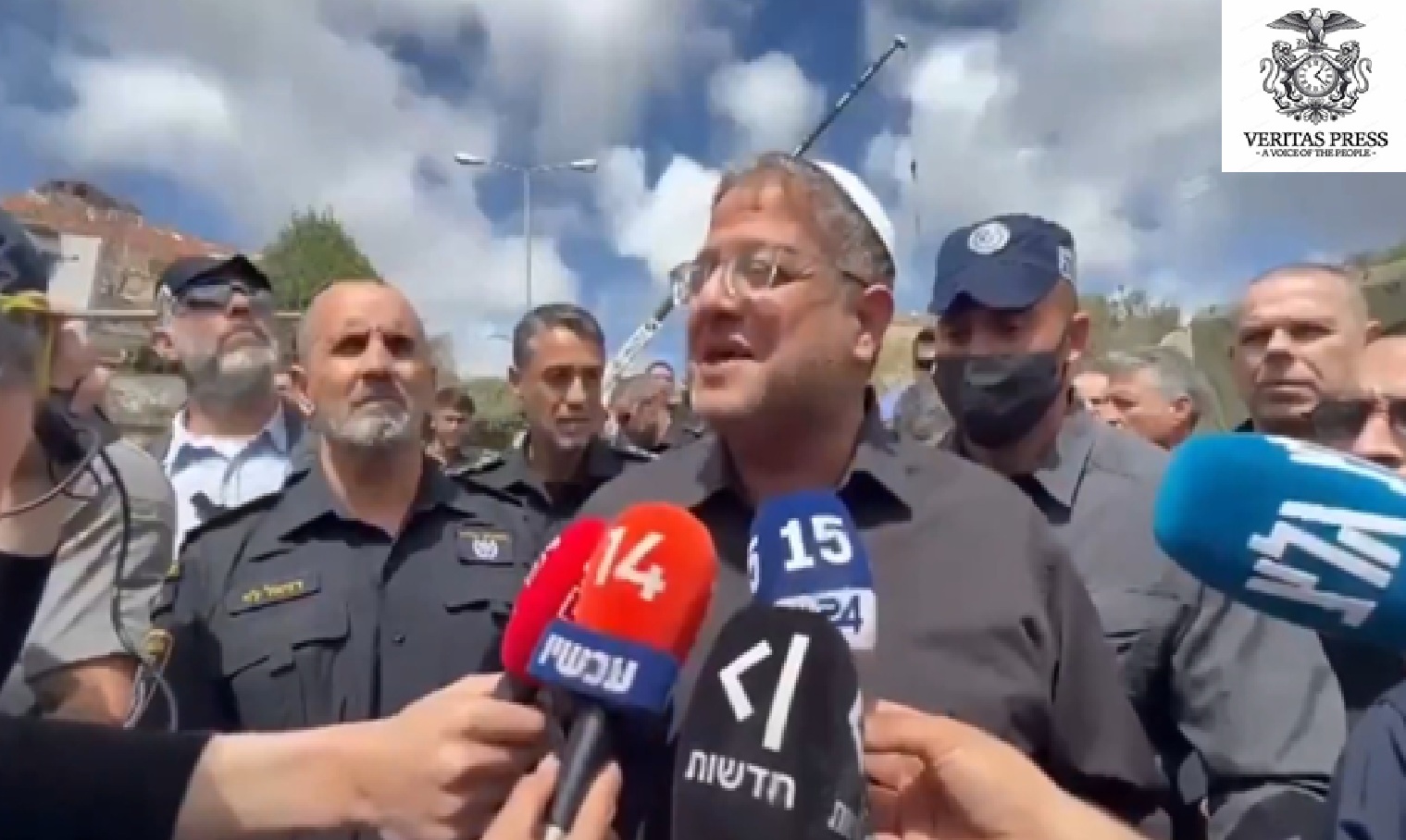
TEL AVIV / BRUSSELS / DUBLIN — The video lasts less than two minutes. Grainy, handheld, it shows men and women kneeling on the cold floor of what appears to be a makeshift holding pen at Ashdod Port. Their hands are bound behind their backs, blindfolds wrapped tightly over their eyes. Some tremble; others are pushed to the floor the moment they whisper a protest. Into this tableau of subjugation strolls Israel’s National Security Minister, Itamar Ben‑Gvir, waving a large Israeli flag like a victorious general and taunting his captives. “Welcome to Israel, we are the landlords,” he says. “They came with so much pride… look how they look now. Not heroes, not anything, terror supporters.”
That footage, first published by Ben‑Gvir himself on his social media accounts on 19 May 2026, has since ricocheted across the globe, triggering a diplomatic firestorm, a scramble for consular access, and, for the first time in years, a public, if brief, rift inside Israel’s far‑right government. But beyond the immediate shock and the choreographed condemnations, the video has laid bare something deeper: the normalisation of institutionalised humiliation as a tool of Israeli border enforcement, the impotence of Western diplomacy when confronted by an ally willing to weaponise cruelty for domestic political gain, and the selective moral vision of capitals that can summon outrage for their own citizens while remaining largely mute about the same treatment meted out daily to Palestinians.
This investigation, drawing on interviews with released detainees, legal monitors, diplomatic cables, and the internal correspondence of the “Global Sumud Flotilla” organisers, connects the dots between a single provocative video and a decades‑old system of impunity. It expands on the torrent of official reactions that have dominated headlines and updates the story with the latest developments, a hunger strike now entering its ninth day, an escalating fight inside the European Union over sanctions, and a growing body of medical and legal evidence that Israeli forces employed sexual humiliation, rubber‑bullet injuries, and stress positions during the interception and subsequent detention of the flotilla’s 437 participants.
I. The Interception: Piracy, Pr Stunt, Or Something Else?
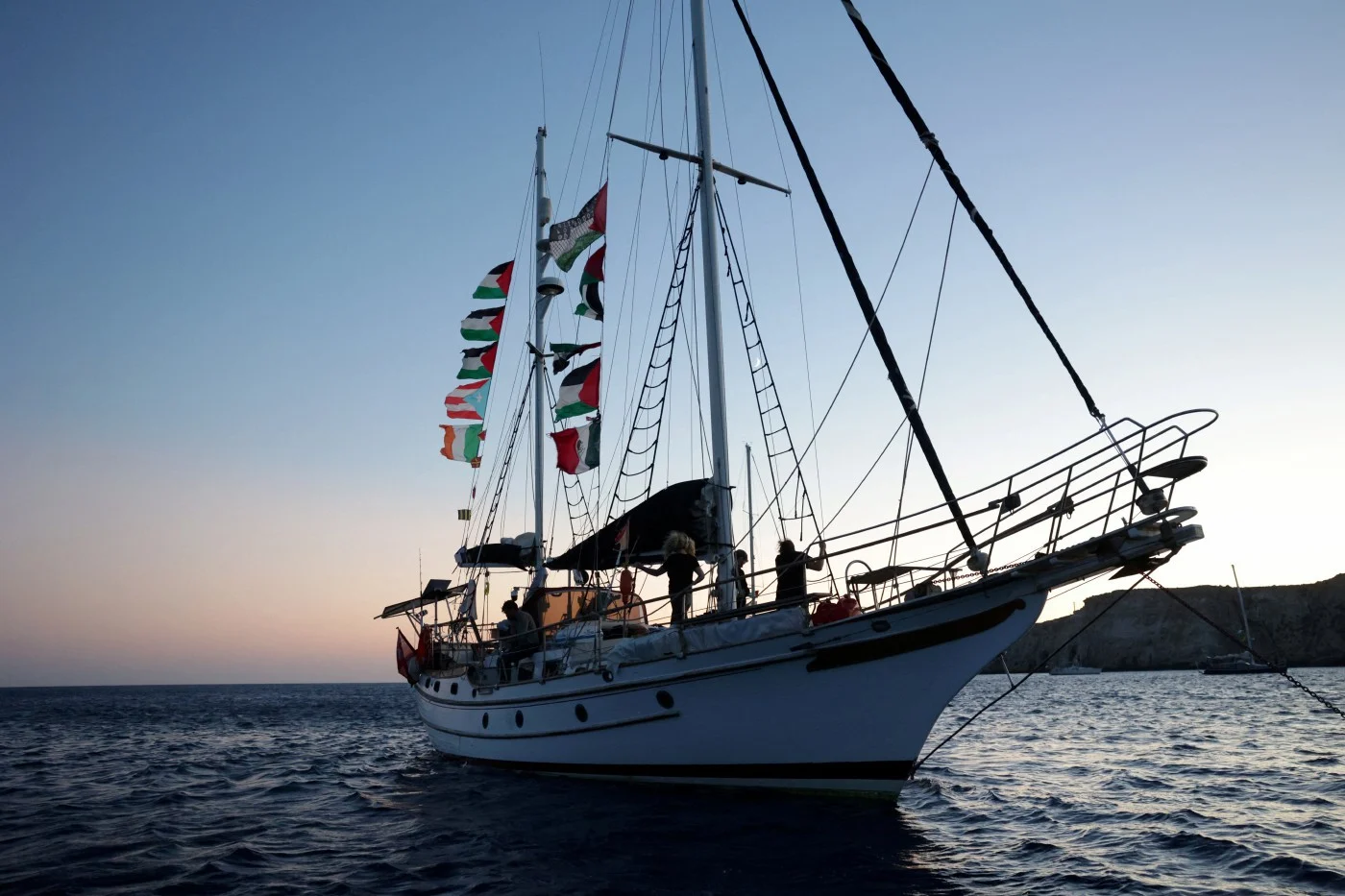
The Global Sumud Flotilla, “sumud” means steadfastness in Arabic, was the largest maritime attempt to breach Israel’s blockade of the Gaza Strip since the ill‑fated Mavi Marmara convoy of 2010. Organisers say more than 50 small vessels, ranging from fishing boats to sailing yachts, departed Marmaris, Türkiye, on 12 May, carrying over 400 activists from more than 30 countries and a symbolic cargo of medical supplies, baby formula, and solar panels. Their declared mission was twofold: to deliver humanitarian aid and, in the words of flotilla spokesperson Rania Batrice, “to remind the world that the blockade is illegal collective punishment and that Gaza’s 1.9 million people are being slowly strangled and targeted.”
Israel saw things differently. The Foreign Ministry in Jerusalem branded the flotilla “a Hamas‑sponsored PR stunt” and warned that the navy would “use all necessary measures” to prevent the vessels from reaching Gazan waters. On the morning of 18 May, Israeli missile boats and Shayetet 13 commandos intercepted the first vessels approximately 268 kilometres from the Gaza shoreline, well inside what maritime law considers international waters. Over the following 48 hours, the entire flotilla was boarded. Organisers reported that troops fired rubber bullets at several boats, injuring activists, and employed tasers during the takeovers. Israel’s military insisted that only “non‑lethal means” were used and that no live ammunition was fired.
But the seizure of civilian ships in international waters immediately revived an old legal debate. “Israel’s assertion of a right to intercept vessels on the high seas on the basis of a blockade imposed on a territory it occupies is legally dubious,” said Dr. Nimer Sultany, a reader in public law at the School of Oriental and African Studies in London. “Under the San Remo Manual on International Law Applicable to Armed Conflicts at Sea, a belligerent may establish a blockade, but only if it does not cause disproportionate harm to the civilian population. The UN, the ICRC, and numerous human‑rights bodies have all concluded that the Gaza blockade amounts to collective punishment. That taints every enforcement action that flows from it.”
It is a debate that has been smothered for years by geopolitical reality. The 2011 Palmer Report, commissioned by the UN Secretary‑General after the Mavi Marmara raid, found Israel’s naval blockade legal but lambasted the “excessive and unreasonable” force used against passengers, nine of whom were killed. That carefully calibrated verdict allowed Israel to maintain the blockade while paying a modest diplomatic price. The Sumud Flotilla was, in part, an attempt to reopen the question, this time with a far more diverse passenger list that included citizens of 14 EU member states, the UK, Canada, Australia, South Korea, Indonesia, South Africa, and Brazil.
II. The Video: A Minister As Ringmaster Of Humiliation.
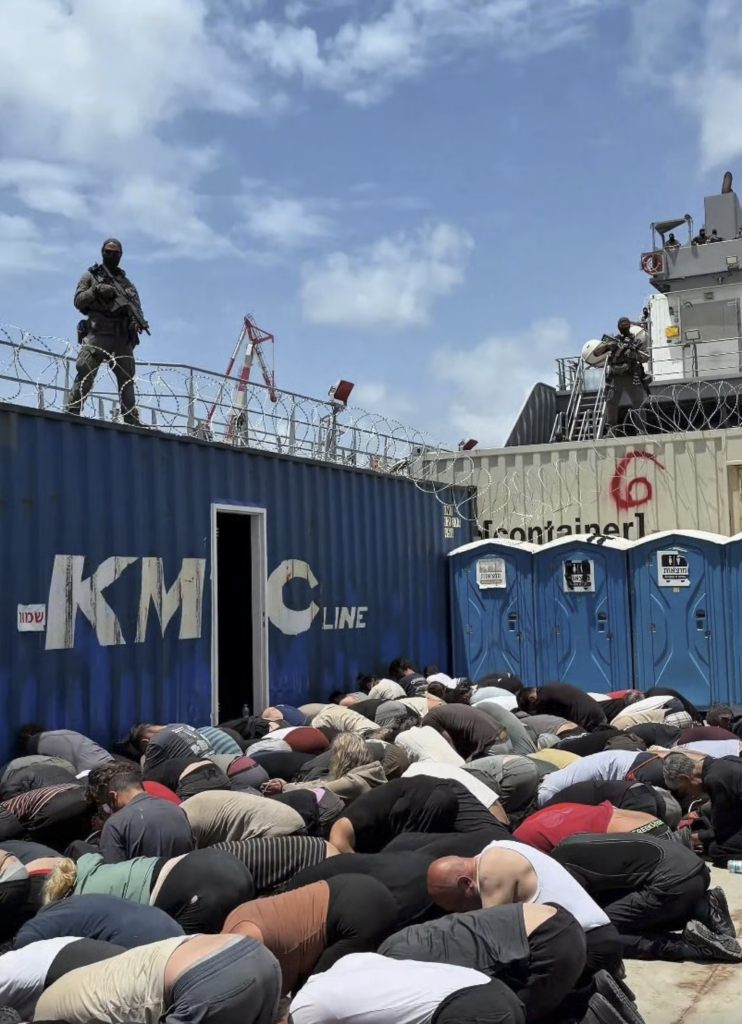
If the interdiction itself was routine in Israel’s playbook, what followed was not. On 20 May, Ben‑Gvir, the leader of the ultranationalist Otzma Yehudit party and a convicted supporter of Jewish terrorism before entering politics, arrived at Ashdod Port flanked by police and members of the Shin Bet security service. He was there, in his own words, “to see the terrorist supporters with my own eyes.” His aides filmed as he strode through rows of blindfolded detainees, some of whom had been forced onto their knees for hours.
In one sequence, a female activist, her hands cuffed, calls out “FREE PALESTINE.” A Shin Bet agent immediately seizes her by the shoulders and drives her face‑first into the floor. Ben‑Gvir does not flinch. In another clip, he leans toward a bound man and shouts, “Am Yisrael Chai”, the people of Israel live, as the national anthem plays from a portable speaker. Later, in remarks caught on the same video, he appeals directly to Prime Minister Benjamin Netanyahu: “Give them to me for a very long time in the terrorists’ prisons.”
The video was cut, captioned, and uploaded by the minister himself. The message was unmistakable. This was not a leak; it was a boast.
The reaction inside Israel was instantaneous and surprisingly fierce, not because of the treatment of the detainees, but because of the damage the spectacle inflicted on the country’s carefully managed image. Foreign Minister Gideon Saar, a political rival of Ben‑Gvir, wrote on X: “You knowingly caused harm to our State in this disgraceful display. No, you are not the face of Israel.” Prime Minister Netanyahu, who depends on Ben‑Gvir’s six Knesset seats to sustain his coalition, issued a rare public scold, saying the minister’s conduct was “not in line with Israel’s values and norms,” while simultaneously insisting that Israel had every right to stop “provocative flotillas of Hamas terrorist supporters.” Netanyahu gave orders that the activists be deported “as soon as possible.”
Ben‑Gvir was unrepentant. In the Knesset, he accused Saar of “bowing to the terrorists” and warned that any Israeli apology would signal “weakness, submission, and surrender.” The spat exposed the profound tension between a government that relies on ultranationalist muscle to survive and the diplomatic establishment that must manage the consequences. Yet, for all the intra‑coalition theatre, the immediate practical result was that the minister responsible for the police force that guards detainees was allowed to continue his role unhindered, his video still pinned to the top of his Twitter feed.
A screengrab of a video posted by Israel’s National Security Minister Itamar Ben-Gvir shows the detained activists. Photo: @itamarbengvir via X
III.The World Reacts: A Directory Of Diplomatic Fury.
Within hours, a cascade of statements, summonses, and demands for answers poured out of foreign ministries. The breadth and speed of the reaction reflected a simple fact: this time, the faces under the blindfolds belonged not to Palestinians but to the sons and daughters of influential capitals.
Belgium was among the first to move. Foreign Minister Maxime Prévot called the images “deeply disturbing,” saying they showed “people held captive, bound, and forced face down while an Israeli minister publicly humiliated them online.” Brussels summoned the Israeli ambassador and demanded immediate consular access for Belgian nationals and the release of all hostages.
Italy’s right‑wing Prime Minister Giorgia Meloni, whose government had been one of Israel’s staunchest European supporters since the October 2023 war, described the treatment as “unacceptable” and revealed that Italian citizens were among the detainees. Rome demanded an official apology over what Meloni termed a “complete disregard for the Italian government’s requests.” The Israeli ambassador was summoned.
France summoned the Israeli ambassador, with Foreign Minister Jean‑Noël Barrot labelling Ben‑Gvir’s conduct “inadmissible.” Yet the French response was immediately assailed at home. Left‑wing MP Manuel Bompard of La France Insoumise asked: “Where are the sanctions against this government?” Fellow MP Clémence Guetté questioned, “How long governments will continue tolerating such actions?” Their critiques pointed to the fundamental gap between ritual summonses and concrete punishment.
Ireland’s Foreign Minister Helen McEntee said she felt “appalled and shocked.” Dublin confirmed that around 15 Irish citizens remained in custody, including Margaret Connolly, the sister of the Speaker of Dáil Éireann, Catherine Connolly. Ireland demanded immediate guarantees for the detainees’ safety under international law.
Spain went further than any other European capital. Prime Minister Pedro Sánchez recalled that as early as September 2025, Spain had imposed a unilateral entry ban on Ben‑Gvir. “Now we are going to push in Brussels for these sanctions to be elevated to the European scale on an urgent basis,” Sánchez declared. Foreign Minister José Manuel Albares reportedly called the treatment of the activists “monstrous.” The Catalan regional government, too, condemned the humiliation of citizens from Catalonia.
Canada summoned the Israeli ambassador, with Foreign Minister Anita Anand calling the incident “extremely serious.” The Netherlands followed suit, with Minister Tom Berendsen stating that the treatment “violated basic human dignity.” Australia, New Zealand, Poland, and Greece also lodged formal protests. South Korean President Lee Jae‑myung, whose country holds several of the abducted citizens, questioned the legal basis for the interception in international waters: “Is that Israeli land?”
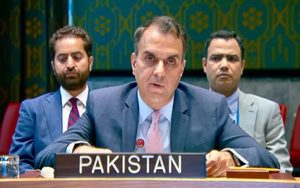
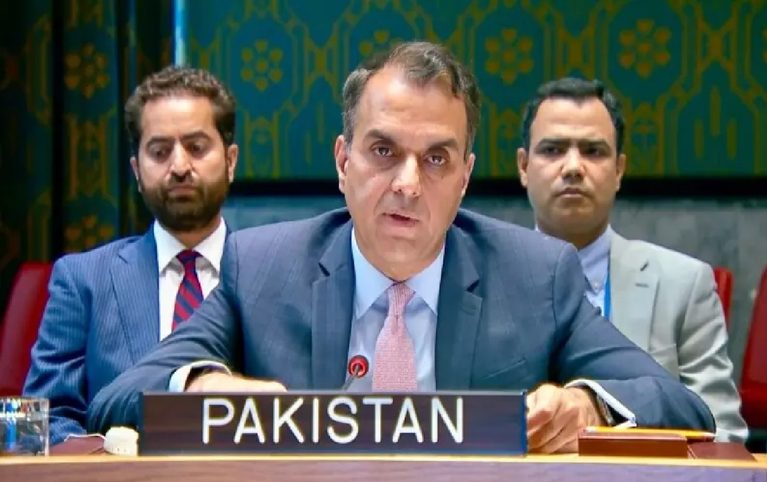
Türkiye, from whose shores the flotilla sailed, issued a statement describing the Israeli government’s behaviour as “the violent and barbaric mindset” that it claimed was openly demonstrated to the world. Indonesia confirmed nine of its nationals were among those “kidnapped” and demanded the immediate release of all vessels and activists. Jordan, Pakistan, Bangladesh, Brazil, Colombia, Libya, and the Maldives joined a broader chorus condemning the interception as a “blatant violation of international law and international humanitarian law.”
The United Kingdom’s Foreign Secretary, Yvette Cooper, condemned a video that “violates the most basic standards of respect and dignity” and demanded an explanation from Israeli authorities. Even the United States, whose ambassador to Israel, Mike Huckabee, called Ben‑Gvir’s actions “despicable,” found itself in an awkward contortion: while Huckabee denounced the “betrayal of dignity” by the Israeli minister, the US Treasury simultaneously imposed sanctions against several European activists aboard the flotilla, with Secretary Scott Bessent labelling them “pro‑terror.” The dissonance was stark.
IV.Inside The Detention: Lawyers Document Systemic Abuse.
While governments fought diplomatic battles, a quieter, more disturbing picture was being assembled by a team of 11 lawyers from Adalah, the Legal Centre for Arab Minority Rights in Israel. Granted partial access to detainees at Ashdod Port on the evening of 20 May, they conducted dozens of preliminary interviews before most activists were transferred to Ktziot Prison in the Negev desert for immigration processing.
Adalah’s subsequent report, shared with this publication, documents what it calls “systemic violations of due process and widespread physical and psychological abuse.”
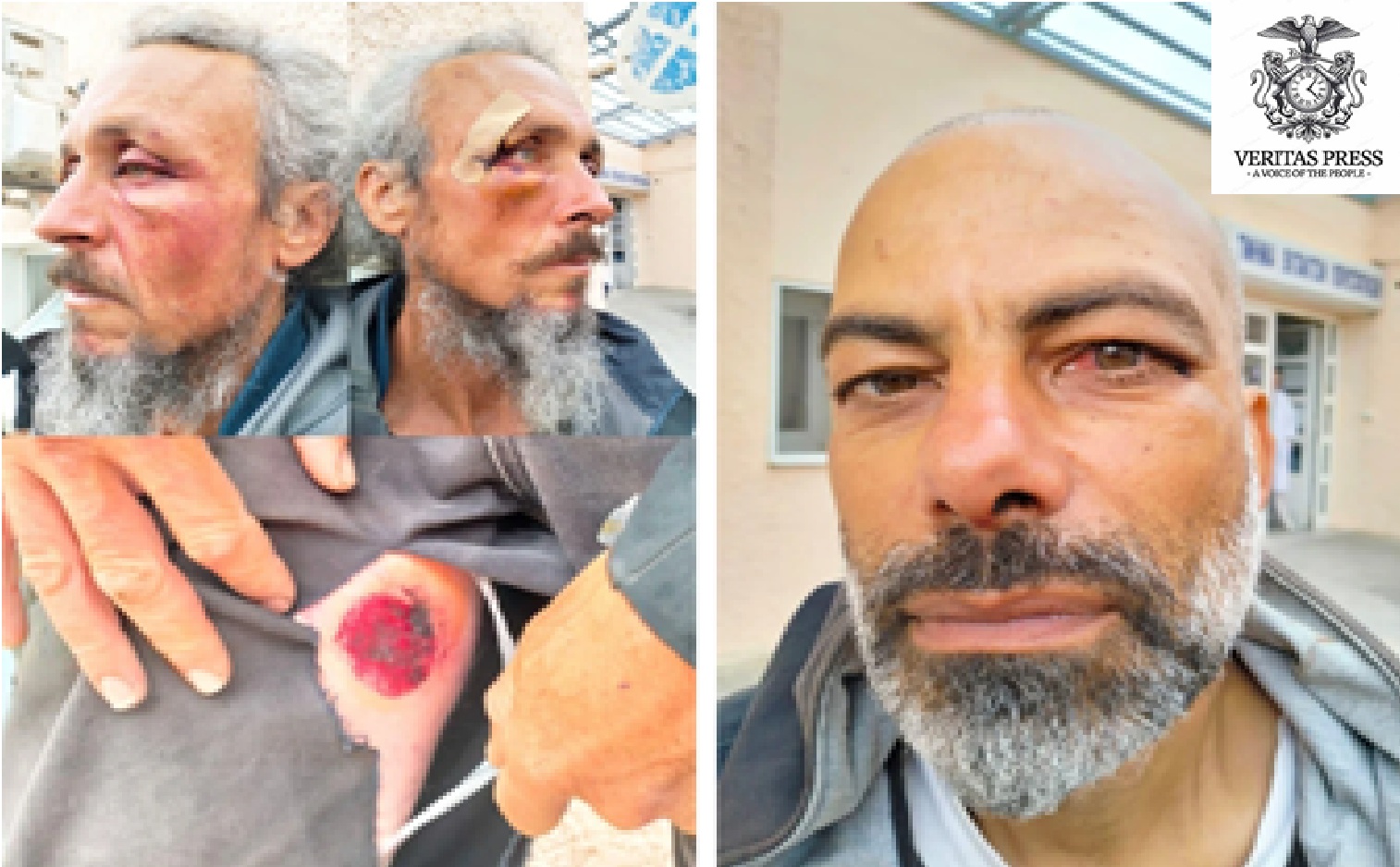
At least three activists required hospital treatment before being returned to custody. One, a 41‑year‑old Belgian physiotherapist, had been struck in the back with a rubber bullet fired at close range during the naval boarding; she was vomiting from concussion when lawyers saw her. Two others, a South African engineer and an Italian paramedic, had suspected broken ribs.
“We documented dozens of cases of beatings, taser shocks, and rubber‑bullet injuries sustained not only during the interception at sea but also later, during transfer to Israeli military vessels and at the port itself,” said Adalah attorney Suhad Bishara in an interview with the Associated Press. “The violence did not stop once they were in custody. On the contrary, it became more performative.”
Numerous detainees described being forced into stress positions: made to walk bent forward while guards pushed their backs down, or compelled to kneel on hard floors for hours. Women recounted having their hijabs forcibly removed by personnel who, the lawyers recorded, mocked them in Hebrew. Adalah categorised these incidents as a “pattern of severe degradation, sexual harassment, and sexual humiliation.” One Irish woman in her sixties told a lawyer that a female soldier had laughed while yanking off her headscarf and said something she could not understand, but which a fellow detainee later translated as “now you look like a proper terrorist.”
“These narratives echo almost exactly what Palestinian detainees have described for years,” Bishara noted. “The difference is that this time the victims carry European passports, and the minister responsible filmed himself enjoying the show.”
Adalah filed an urgent petition with the Israeli Supreme Court seeking an immediate halt to the deportations pending a full investigation into the alleged abuses, a demand for the preservation of CCTV footage from the port, and a request that the detainees be granted proper legal representation during the tribunal hearings that would determine their deportation. As of 21 May, the court had agreed to hear the petition but had not issued an interim order.
V. Hunger Strike And The Slow Machinery Of Deportation:
Inside Ktziot Prison, the mood turned desperate. On 19 May, even before Ben‑Gvir’s video was published, 87 activists had begun a hunger strike. Organisers inside the prison, communicating through lawyers, said the strike was a twin protest: against the “illegal abduction” of the flotilla and in solidarity with the more than 9,500 Palestinians held in Israeli jails, many under administrative detention without charge.
By 21 May, that number had swelled to 143, according to a flotilla spokesperson. Two detainees, a Canadian nurse and an Indonesian journalist, were reported to have collapsed and were transferred to the prison clinic. Adalah warned that if prompt medical intervention was not provided, the situation could deteriorate rapidly.
Israel’s Interior Ministry had pledged swift deportation. Netanyahu’s office confirmed that the Prime Minister had given instructions for the activists to be expelled “as soon as possible.” Yet the process was bogged down by the sheer number of nationalities involved, the refusal of some detainees to sign voluntary departure forms, and the legal challenges mounted by Adalah. A senior Israeli official, speaking on condition of anonymity, acknowledged that “Ben‑Gvir’s grandstanding has turned what would normally be a three‑day administrative procedure into an international spectacle. Every consular officer in the country is now involved.”
The first deportations began late on 20 May, with small groups of Spaniards, Italians, and Australians put on commercial flights. But dozens of others, particularly those who had refused to identify themselves or had claimed asylum, remained in legal limbo. Ireland’s ambassador obtained consular access on 21 May and reported that the Irish detainees were “traumatised but physically intact, save for bruising and what appears to be post‑traumatic stress.”
Margaret Connolly, whose status as the sister of Ireland’s parliamentary speaker had turned her into a high‑profile captive, was released on the evening of 21 May and flown home. In brief remarks at Dublin Airport, she was too shaken to speak at length but told reporters: “They treated us like less than human. An Israeli minister stood over us, laughing. If that is what they do to Europeans, I cannot imagine the daily hell of our Palestinian brothers and sisters. This must end.”
VI.The Brussels Battle: Towards EU Sanctions?
The most consequential political fallout is now unfolding in Brussels. Spain’s Pedro Sánchez, who has emerged as Europe’s most forthright critic of the Netanyahu government since the 2023 war, is pushing for the European Union to adopt a union‑wide travel ban and asset freeze on Ben‑Gvir and other officials “directly complicit in the humiliation and torture of EU citizens.” As of 21 May, an internal discussion paper circulated by the Spanish delegation to the Political and Security Committee proposes using the EU’s Global Human Rights Sanctions Regime, originally designed to target Russian and Chinese officials, against an Israeli minister for the first time.
The proposal faces significant obstacles. Hungary, the Czech Republic, and Austria have signalled reservations, arguing that the EU should not impose sanctions on a partner government. Germany, whose post‑Holocaust guilt continues to shape its Middle East policy, is caught in a familiar paralysis. Chancellor Friedrich Merz, who took office in late 2025, has publicly deplored the Ben‑Gvir video but stopped short of endorsing sanctions. Foreign Ministry officials say that while Berlin will not block the measure if a qualified majority emerges, it will not actively support it either.
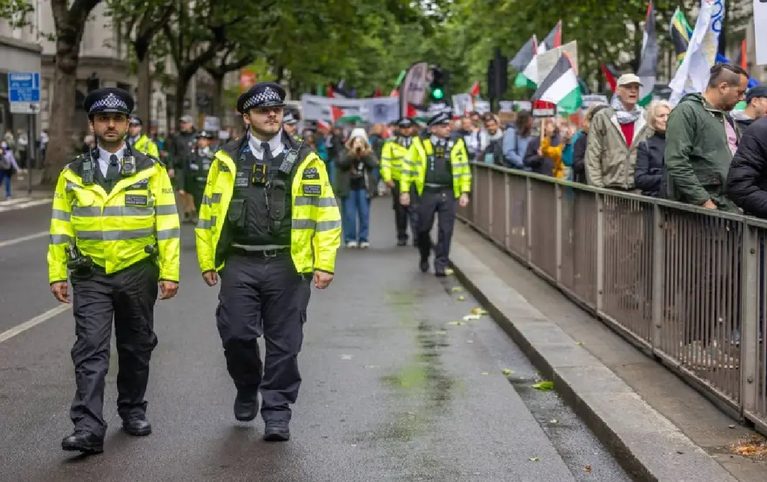
Yet the political calculus is shifting, propelled by public opinion. In France, large demonstrations in Paris and Marseille over the weekend drew protesters chanting “Sanctions now!” In Ireland, the Dáil passed a non‑binding motion calling for the expulsion of the Israeli ambassador. Belgium’s parliament is debating a bill that would prohibit arms‑trade and dual‑use exports to Israel. Even in Italy, where Meloni’s coalition includes pro‑Israel hardliners, the Prime Minister’s frustration at being publicly snubbed by Ben‑Gvir has hardened her government’s language.
“This is a watershed moment,” said Hugh Lovatt, a senior policy fellow at the European Council on Foreign Relations. “The video has done what years of advocacy by Palestinian human‑rights groups could not: it has personalised Israel’s system of abuse in the form of a grinning minister standing over blindfolded Western nationals. It is much harder for European leaders to look away when their own voters can see themselves in the victims.”
VII.The Crux Of Impunity: What The Outrage Misses
But the flurry of diplomatic activity masks a deeper, more uncomfortable truth. The same governments now demanding explanations and threatening sanctions have, for years, supplied Israel with the weapons, the intelligence, and the diplomatic cover that make operations like the Sumud Flotilla interception possible. The US provides $3.8 billion in annual military aid. Germany is the second‑largest arms exporter to Israel. The UK, Italy, and Spain continue to sell components for the F‑35 fighter jets that patrol Gazan skies.
As Adalah’s Suhad Bishara put it, “Israel faced zero accountability after the 2010 Mavi Marmara, zero after the 2018 Great March of Return killings, and zero after thousands of Palestinian administrative detainees were tortured. The international reaction now is welcome, but it also highlights a racist hierarchy of victimhood. Governments move heaven and earth for their passport holders; they issue tepid statements when the victims are Palestinian.”
The flotilla spokesperson, Rania Batrice, echoed that sentiment. “If they’re doing that to Europeans and Americans and people from South Africa and all over the world, imagine what they’re doing to the Palestinian people,” she said. “Strongly worded letters are not what we need right now. We need action.”
The UN Special Rapporteur on the occupied Palestinian territories, Francesca Albanese, stated on 21 May that the footage showed “the sadistic joy of a high‑level official in the dehumanisation of civilians” and called for an International Criminal Court investigation into the incident as part of its existing probe into the situation in Palestine. “When a state official films himself committing degrading treatment, the evidentiary burden becomes rather light,” she said.
VIII. Epilogue: The Test Ahead.
As of this writing, 143 hunger strikers remain inside Ktziot Prison. Adalah’s Supreme Court petition awaits a hearing. The EU’s foreign ministers are scheduled to hold an emergency videoconference on 23 May to discuss the sanctions proposal. Ben‑Gvir, far from being reined in, posted a follow‑up video on 21 May in which he mocked the foreign protests and vowed to “continue to crush the terrorists and their apologists.”
For the global community, the Sumud Flotilla crisis is a test of whether the rules‑based international order can impose a cost on a close ally when the evidence of abuse is not just reported but gleefully broadcast by the abuser himself. The answer will determine not only the fate of the remaining detainees but also the credibility of every future condemnation uttered by the capitals that must now choose between strongly worded letters and painful action.
Source:Veritas Press C.I.C. | Multi News Agencies
Submissions:
For The Secure Submission Of Documentation, Testimonies, Or Exclusive Investigative Reports From Any Global Location, Please Utilise The Following Contact Details For Our Investigations Desk: enquiries@veritaspress.co.uk or editor@veritaspress.co.uk
Help Support Our Work:
Popular Information is powered by readers who believe that truth still matters. When just a few more people step up to support this work, it means more lies exposed, more corruption uncovered, and more accountability where it’s long overdue.
Help Protect Independent Journalism, Which Is Currently Under Attack.
If you believe journalism should serve the public, not the powerful, and you’re in a position to help, becoming a DONATOR or a PAID SUBSCRIBER truly makes a difference.
DONATION APPEAL: If You Found This Reporting Valuable, Please Consider Supporting Independent Journalism.
Help Support Our Work – We Know, We Know, We Know …
Seeing these messages is annoying. We know that. (Imagine what it’s like writing them … )
Your support fuels our fearless, truth-driven journalism. In unity, we endeavour to amplify marginalised voices and champion justice, irrespective of geographical location.
But it’s also extremely important. One of Veritas Press’s greatest assets is its reader-funded model.
1. Reader funding means we can cover what we like. We’re not beholden to the political whims of a billionaire owner. We are a small, independent and impartial organisation. No one can tell us what not to say or what not to report.
2. Reader funding means we don’t have to chase clicks and traffic. We’re not desperately seeking your attention for its own sake: we pursue the stories that our editorial team deems important and believe are worthy of your time.
3. Reader Funding: enables us to keep our website and other social media channels open, allowing as many people as possible to access quality journalism from around the world, particularly those in places where the free press is under threat.
We know not everyone can afford to pay for news, but if you’ve been meaning to support us, now’s the time.
Your donation goes a long way. It helps us:
Keep the lights on and sustain our day-to-day operations
Hire new, talented independent reporters
Launch real-time live debates, community-focused shows, and on-the-ground reporting
Cover the issues that matter most to our communities, in real time, with depth and integrity
We have plans to expand our work, but we can’t do it without your support. Every contribution, no matter the size, helps us stay independent and build a truly people-powered media platform.
If you believe in journalism that informs, empowers, and reflects the communities we serve, please donate today.
Kamran Faqir is a volunteer investigative journalist and writer committed to exposing hidden truths and amplifying underreported stories. Driven by social justice, he brings sharp insight and fearless truth-telling to independent journalism. NUJ registered.
SEATTLE, TEHRAN — The U.S. Department of Homeland Security (DHS) will allow Iran’s national football team to enter the country 48 hours before their critical World Cup match against Egypt on Friday, a modest concession in a tournament where Team Melli’s travel conditions have sparked claims of oppression and competitive disadvantage.