Kamran Faqir is a volunteer investigative journalist and writer committed to exposing hidden truths and amplifying underreported stories. Driven by social justice, he brings sharp insight and fearless truth-telling to independent journalism. NUJ registered.
Original Article Date Published:
Article Date Modified:
17 minutes
Views:368
Listen to this article
Help support our mission, donate today and be the change. Every contribution goes directly toward driving real impact for the cause we believe in.
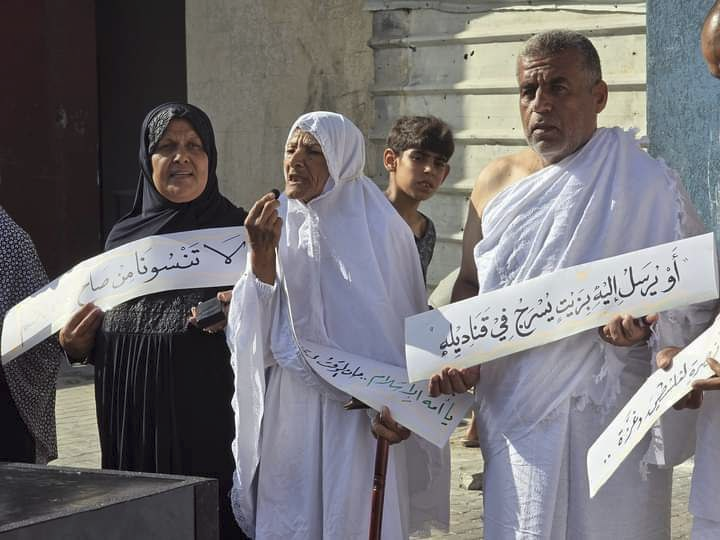
The Ministry of Awqaf and Religious Affairs in the Gaza Strip said on Thursday that more than 10,000 Palestinians from the Strip were deprived of performing the Hajj pilgrimage during three years of the Israeli war of genocide.
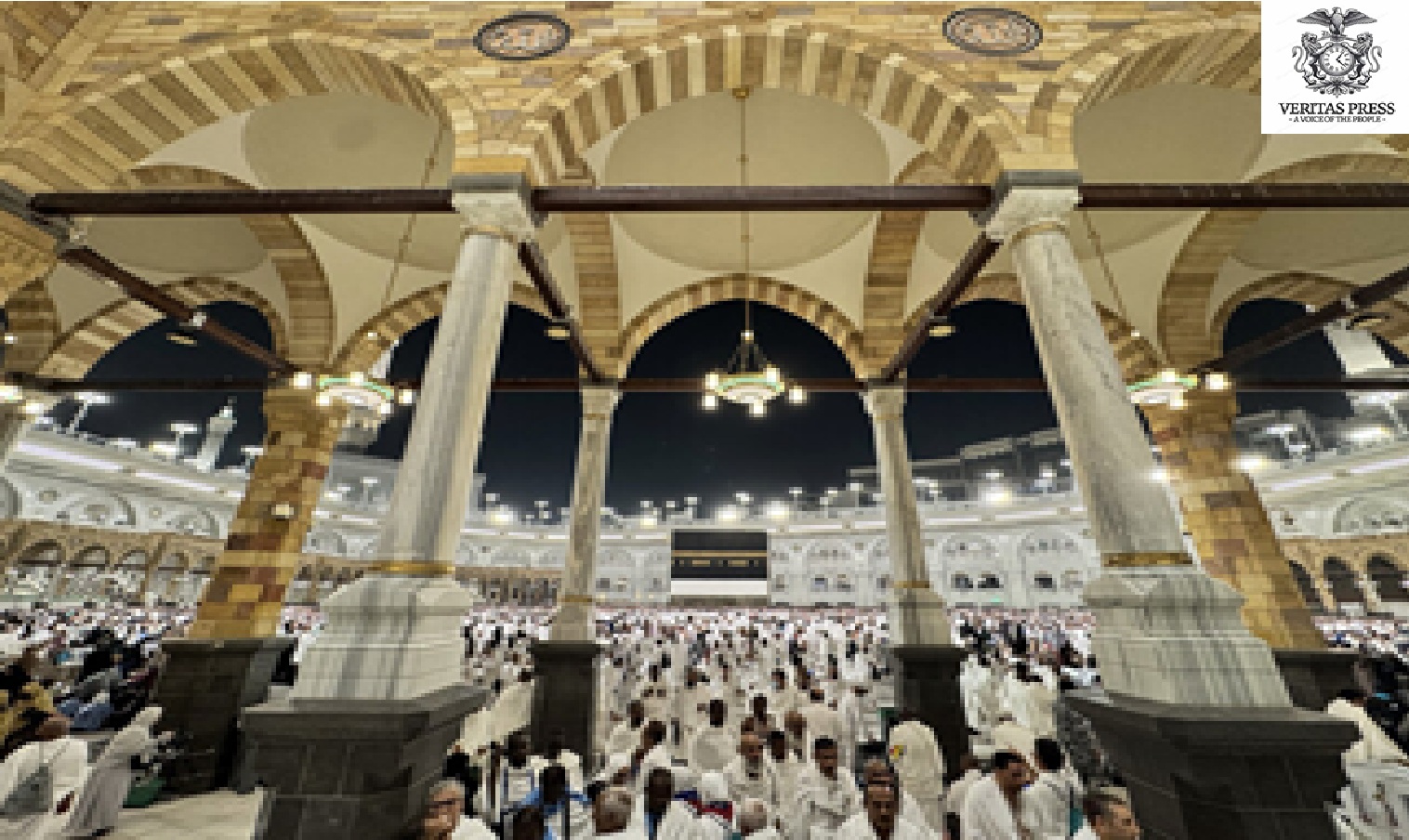
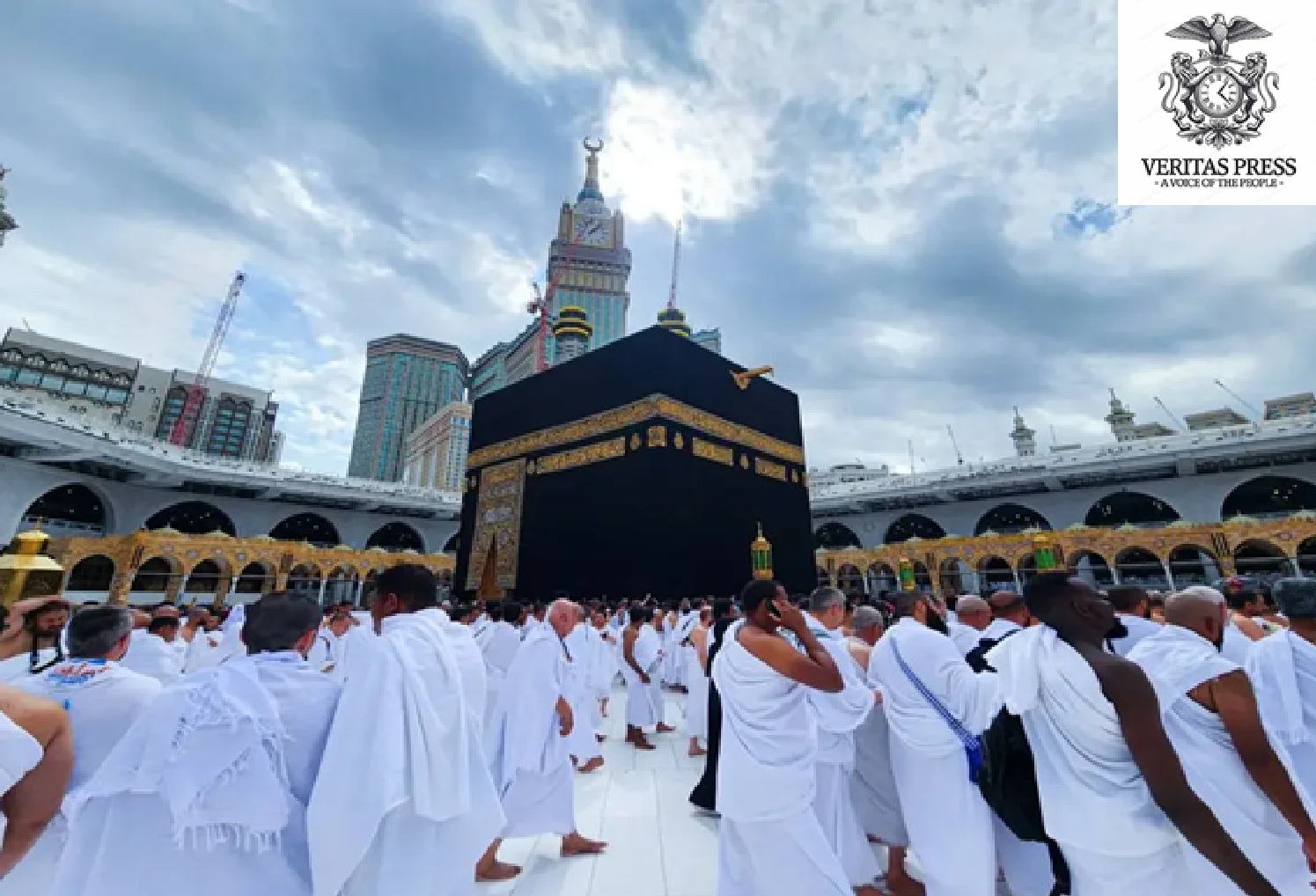
GAZA CITY / MECCA – As nearly two million pilgrims from across the globe converge on the plains of Arafat and circle the Kaaba in Mecca this week, a parallel congregation exists only in memory and longing. In the shattered streets of Gaza, in tent encampments and rubble-strewn neighbourhoods, thousands of Palestinians who had once held valid Hajj permits now watch the rituals on cracked phone screens, their pilgrimage deferred indefinitely by a border that has become an instrument of collective punishment.
For the third consecutive year, not a single Palestinian from the Gaza Strip will stand on Mount Arafat. The Hajj, one of the five pillars of Islam, a once-in-a-lifetime obligation for every Muslim who is physically and financially able, has been rendered impossible by an Israeli siege that long predates the October 2023 war, but which that war has transformed into a near-absolute prohibition on movement.
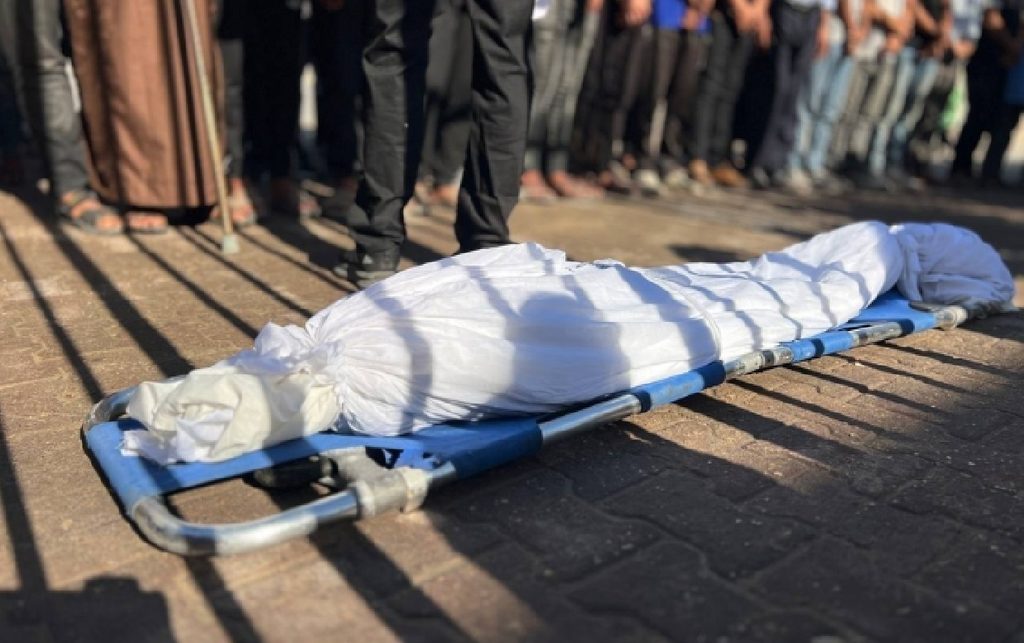
The numbers, compiled from the Gaza Ministry of Awqaf and Religious Affairs and corroborated by multiple sources, paint a portrait of systematic denial: more than 10,000 Palestinians from Gaza have been prevented from performing Hajj over the past three years. Of 2,473 individuals who had passed the Hajj lottery and were waiting to travel since 2013, 71 have died, some in Israeli airstrikes, others from illness and age, without ever reaching the holy sites. The remaining 2,402 remain trapped, their names on a list that increasingly reads like a registry of loss.
A Quota Transferred, A People Erased:
On 3 March 2026, the Palestinian Ministry of Awqaf in Ramallah announced what it described as an “exceptional and temporary measure”: the remaining share of Gaza’s Hajj allocation, 38% of Palestine’s total quota of 6,600 pilgrims, or approximately 2,508 places, would be transferred to the West Bank and East Jerusalem. The justification was the “narrowness of the time specified according to the Hajj protocol,” which set 20 March as the final deadline for visa issuance.
The announcement passed with little international notice. Yet for Gaza’s religious officials, it represented something closer to an erasure. “The Hajj represents a fundamental religious and human right, which Muslims wait for with great longing,” Amir Abu al-Amrain, Director of Public Relations at Gaza’s Ministry of Awqaf, told reporters at a press conference in Deir al-Balah on 15 May. “But Gaza pilgrims are deprived of it for the third year running due to the war, the siege, and the closure of crossings.”
Abu al-Amrain’s figure, 10,000 deprived, expands the frame beyond the lottery list. It encompasses those who registered, those who saved, and those who would have been eligible under normal administrative cycles. His demand was direct: “We call on the international community, Saudi Arabia, and Egypt to intervene urgently to ensure that Gaza pilgrims are enabled to travel, and to work on opening the crossings for humanitarian and religious purposes.”
The transfer of the quota, however, signals something more ominous: an institutional accommodation to the permanence of closure.
The Border As Weapon: Rafah And The Architecture Of Denial.
To understand how Hajj became impossible, one must trace the geography of Gaza’s isolation. Before the war, the pilgrimage route was arduous but functional: pilgrims would exit through the Rafah border crossing into Egypt, travel by bus to Cairo International Airport, and fly to Saudi Arabia. The Ministry of Awqaf coordinated with Egyptian and Saudi authorities, while Hajj and Umrah companies handled logistics.
That fragile system ended on 7 May 2024, when Israeli forces occupied and sealed the Palestinian side of Rafah. The crossing, Gaza’s sole outlet to the outside world, not controlled by Israel, was transformed into a military installation. It remained hermetically closed until 2 February 2026, when a limited reopening allowed a trickle of medical evacuees.
“The border crossing is closed. Why is this happening to pilgrims? They want to fulfil their Hajj obligation, they do not want to do anything else,” Najia Abu Lehia, a 64-year-old woman living in a tent in Khan Younis, told Reuters. She and her husband had registered and been selected for Hajj before the war. He died a year ago, his pilgrimage unfulfilled. “I am worried I’ll follow him while I’m longing to perform the Hajj. But God willing, we hope to perform the Hajj despite the constraints, despite the siege.”
COGAT, the Israeli military agency overseeing access to Gaza, stated that the Rafah agreement permits passage only for humanitarian cases, with traveller lists determined by Egyptian authorities and approved by Israeli security services. In practice, Gaza’s Hamas-run media office reported that only 5,304 people had travelled in either direction since February — less than one-third of the expected numbers under the ceasefire framework. None were pilgrims.
Israel’s control over the crossing, even after the partial reopening, constitutes a form of population management that extends far beyond security. It determines who may leave, who may return, who may seek medical care, education, family reunification, and who may worship.
“I Spent The Money On Displacement And Food”
The financial architecture of Hajj for Gazans reveals another dimension of loss. Pilgrims typically spent years accumulating the thousands of dollars required, not merely for travel costs, but for the Hajj fees paid to the Ministry of Awqaf. The war erased those savings through the destruction of homes, the collapse of employment, and the predatory inflation of a siege economy.
Salwa Akila, a 65-year-old woman from Gaza, told Middle East Eye: “It took me five years to save Hajj money. Then the war came, and I spent the money on displacement and food.”
Akila and her husband had been approved for Hajj in 2024. Their home was destroyed in an Israeli bombardment. They now survive in a displacement camp. The money that was meant to transport them to the spiritual centre of their faith was instead consumed by the daily calculus of survival, flour, water, and a tent covering.
The same Middle East Eye report, written by a Gazan journalist whose name has been withheld for security reasons, captured the spiritual vertigo of watching the pilgrimage from within a cage. “A friend recently shared photos with me of pilgrims gathering in Mecca, crying tears of joy as they prepared to visit the house of God. ‘I hope we will have our turn soon,’ my friend wrote. For many Muslims in Gaza, such images are both moving and a painful reminder of what we are missing out on.”
The journalist’s analysis cut to the core: “Israel’s assault thus not only deprives Palestinians of food, medicine and safety. It also robs them of experiences that could help to restore dignity, hope and emotional healing after years of brutal bombardment.”
The Widow At Yarmouk Stadium:
Perhaps no story illustrates the compound tragedy more starkly than that of Suad Hajjaj, whose account was first reported by Anadolu Agency. Before the war, Hajjaj had registered for Hajj alongside her husband, brother, and sister-in-law. The family’s preparations spanned years, savings accumulated, paperwork completed, and a shared anticipation of circling the Kaaba together.
The war dismantled that future. Her husband was killed in an Israeli airstrike. Her brother went missing, his fate unknown. Their home, containing the money saved for Hajj, was destroyed. Hajjaj escaped from beneath the rubble with her children, losing everything.
Now displaced at Yarmouk Stadium east of Gaza City, she told Anadolu: “I had dreamed of circling the Kaaba and standing on Mount Arafat, but the war and the closure of crossings deprived Gaza’s residents of performing the pilgrimage and moving freely like other Muslims.”
Her loss, she said, “was not limited to money or the chance to perform Hajj. I also lost my husband and the life I had planned.” Still, she holds onto a thread of hope that one day she will perform the pilgrimage, even as the years pass, even as her children grow in a landscape of ruin.
The Livestock And The Feast: Eid Without Sacrifice.
The deprivation extends beyond Hajj into the celebration that follows it. Eid al-Adha, the Feast of Sacrifice, commemorates the Prophet Ibrahim’s willingness to sacrifice his son and is traditionally marked by the slaughter of sheep or cattle, with the meat shared among family, neighbours, and the poor. For a third straight year, Gaza’s Muslims will mark Eid without this ritual.
Gaza’s Ministry of Agriculture stated that Israel’s military campaign since October 2023 had led to the “systematic destruction of the livestock sector,” with farms, barns, veterinary facilities, and feed warehouses struck. Before the war, Gaza imported 10,000 to 20,000 calves and 30,000 to 40,000 sheep annually for the Eid season. Now, virtually none enter.
COGAT claims it facilitates imports of meat, poultry, eggs, and dairy, with nearly 8,000 tons delivered in the past month. But it explicitly states that no livestock are permitted. The distinction is telling: processed meat may enter, but the means of ritual observance, the living animal, the communal slaughter, and the distribution of fresh meat, is systematically blocked.
Hamas officials say aid deliveries have dropped to roughly one-quarter of expected levels in May, despite repeated calls from United Nations officials for unhindered access. COGAT rejects what it calls misleading claims of a humanitarian crisis, asserting that around 600 aid trucks enter Gaza daily, most carrying food. Yet the absence of sacrificial animals for the third consecutive Eid is not a matter of aid logistics; it is a matter of religious practice rendered impossible by siege architecture.
The Brokers Of Pilgrimage: An Economy Destroyed.
Often overlooked in the narrative of blocked pilgrimage are the Hajj and Umrah service providers, the small business owners who once formed the backbone of Gaza’s pilgrimage economy. These were men like Saleh Jabr, a Hajj company owner who spoke at the Deir al-Balah press conference, his words carrying the weight of both personal and communal catastrophe.
“Thousands of Palestinians were deprived of their natural and inherent right to perform the Hajj pillar,” Jabr said, “in light of humanitarian conditions that are catastrophic.” He noted that dozens of pilgrims had died during the years of waiting, and called for “finding exceptional and urgent mechanisms that ensure the travel of pilgrims and not losing their historical opportunity to perform the fifth pillar of Islam.”
Before the war, these companies navigated a complex logistical chain, coordinating with Egyptian bus operators, Saudi visa processors, and local families. The war devastated that economy. Some owners were killed. Others lost their capital when physical offices were destroyed, and savings evaporated. The social fabric that connected them to their clients, elderly pilgrims who had trusted them with life savings, was severed.
The Legal And Moral Architecture Of Denial:
From a legal perspective, the blocking of religious pilgrimage constitutes a distinct category of harm within the broader apparatus of siege. International humanitarian law, particularly the Fourth Geneva Convention, prohibits collective punishment and requires occupying powers to facilitate the free practice of religion. The International Covenant on Civil and Political Rights, to which Israel is a party, guarantees the right to manifest one’s religion in worship, observance, and practice.
Yet these instruments have proven hollow for Gaza’s Muslims. The closure of Rafah, maintained under the pretence of security, functions as a form of administrative strangulation that targets not combatants but civilians, the elderly seeking to fulfil a final religious obligation, the widows who saved for years, the sons hoping to perform Hajj for deceased parents.
The transfer of Gaza’s Hajj quota to the West Bank, while framed as a pragmatic necessity, carries an uncomfortable subtext: the gradual normalisation of Gaza’s exclusion from the transnational Muslim community. If a quota can be reallocated once without international objection, it can be reallocated again. The precedent hollows out the principle that Gaza’s Muslims possess equal rights to worship.
Rami Abu Staitah, Director General of Hajj and Umrah at Gaza’s Ministry of Awqaf, described the multi-year denial as “a major setback” for Muslims in the enclave. His department continues to receive calls from citizens seeking assurance that their names and rights will be preserved “when conditions allow.” But the phrase “when conditions allow” has become a euphemism for an indefinite waiting room, a purgatory administered by a military bureaucracy.
The Silence Of The Ummah:
One of the most striking features of this crisis is the relative quiet that surrounds it. The Organisation of Islamic Cooperation has issued statements of concern. Saudi Arabia’s Custodian of the Two Holy Mosques grants a limited number of pilgrimage slots to families of Palestinian martyrs, a gesture that Abu al-Amrain urged be expanded. Yet no diplomatic mechanism has been created to extract Gaza’s pilgrims through Egypt under international supervision. No coalition of Muslim-majority states has threatened consequences for the continued denial of religious access.
In previous years, the spectacle of pilgrims stranded at borders would provoke outcry. In Gaza’s case, the crisis has been normalised, absorbed into the broader landscape of suffering that the international community has proven unwilling or unable to arrest.
The Gazan journalist writing for Middle East Eye captured this layered grief: “People on the outside might perceive this crisis to be less urgent than the collapsing economy, the broken healthcare system or the blockade on food supplies. But as Muslims in Gaza, we view Hajj as a fundamental right and a vital part of our life’s journey. We are not asking for money, food or material aid, but rather for something more basic and fundamental: an open door, with the ability for a safe departure and return home, in order to fulfil a sacred pillar of the Islamic faith.”
The Demographic Clock:
Beneath the immediate crisis ticks a demographic reality that gives the closure its terminal quality. Gaza’s waiting pilgrims are disproportionately elderly. The Hajj lottery system, which has operated since 2013, meant that those who registered early were already advanced in age. Now, after three years of war, siege, malnutrition, and collapsing healthcare, many have died. Others have developed medical conditions that make the physically demanding pilgrimage impossible.
“As time passes, many elderly people who long dreamed of visiting Mecca are now physically unable to make the journey,” the Middle East Eye report noted. “Some are living with health conditions that require constant care, and the Hajj pilgrimage is no longer safe for them.”
The 71 deaths recorded among lottery winners represent only those known to the ministry. The true number of Gazans who died with Hajj in their hearts, those who had begun saving, those who had only the intention, is incalculable.
Ceasefire Without Movement:
The ceasefire announced on 10 October 2025 halted the most intensive phase of military operations. Yet it has not halted the genocide’s structural mechanisms. Since the ceasefire, Israel has continued to restrict humanitarian aid, conduct daily strikes that have killed 883 Palestinians and wounded 2,648 others, most of them women and children, according to Gaza health authorities, and maintain the suffocating control over movement that makes pilgrimage impossible.
The United Nations estimates that 90% of Gaza’s infrastructure has been destroyed, with reconstruction costs at approximately $70 billion. About 1.5 million of the enclave’s roughly 2.4 million residents are homeless.
Within this landscape, the denial of Hajj might appear as a secondary concern. But for the faithful, it is inseparable from the whole. The inability to perform the pilgrimage is not an isolated deprivation; it is woven into the fabric of displacement, bereavement, and the calculated destruction of the means of life. It is, in the language of human rights documentation, a form of spiritual violence, the weaponisation of the sacred.
Epilogue: The Door That Never Opens.
In a tent in Khan Younis, Najia Abu Lehia watches footage of pilgrims on her phone. The white-robed figures circling the Kaaba, the multitudes on Arafat, the stoning of the pillars, these rituals, transmitted through a cracked screen, are simultaneously a comfort and a wound.
“We were supposed to be there,” she said. “We were supposed to be there in these holy days.”
Her husband’s grave lies somewhere in Gaza, unmarked by a pilgrimage he never made. Her own name remains on a list that the Ministry of Awqaf preserves, in case, against all evidence, the crossing opens, the siege lifts, and the door that has remained sealed for three years finally swings ajar.
But as the Hajj of 2026 commences without a single pilgrim from Gaza, the question that haunts the enclave is not merely when the door will open, but whether the world has already accepted its permanent closure as the price of a peace that remains spectral.
For Gaza’s Muslims, the Kaaba is not merely distant. It is behind a border that has become a theological barrier, a line across which the sacred is permitted to pass only in the form of broadcast images, while the bodies and souls of the faithful remain trapped, watching a pilgrimage they may never join.
Source:Veritas Press C.I.C. | Multi News Agencies –AdditionalReporting incorporates dispatches from Anadolu Agency, Reuters, Middle East Eye, the Gaza Ministry of Awqaf and Religious Affairs, and statements from COGAT, Palestinian officials, and displaced residents.
Submissions:
For The Secure Submission Of Documentation, Testimonies, Or Exclusive Investigative Reports From Any Global Location, Please Utilise The Following Contact Details For Our Investigations Desk: enquiries@veritaspress.co.uk or editor@veritaspress.co.uk
Help Support Our Work:
Popular Information is powered by readers who believe that truth still matters. When just a few more people step up to support this work, it means more lies exposed, more corruption uncovered, and more accountability where it’s long overdue.
Help Protect Independent Journalism, Which Is Currently Under Attack.
If you believe journalism should serve the public, not the powerful, and you’re in a position to help, becoming a DONATOR or a PAID SUBSCRIBER truly makes a difference.
DONATION APPEAL: If You Found This Reporting Valuable, Please Consider Supporting Independent Journalism.
Help Support Our Work – We Know, We Know, We Know …
Seeing these messages is annoying. We know that. (Imagine what it’s like writing them … )
Your support fuels our fearless, truth-driven journalism. In unity, we endeavour to amplify marginalised voices and champion justice, irrespective of geographical location.
But it’s also extremely important. One of Veritas Press’s greatest assets is its reader-funded model.
1. Reader funding means we can cover what we like. We’re not beholden to the political whims of a billionaire owner. We are a small, independent and impartial organisation. No one can tell us what not to say or what not to report.
2. Reader funding means we don’t have to chase clicks and traffic. We’re not desperately seeking your attention for its own sake: we pursue the stories that our editorial team deems important and believe are worthy of your time.
3. Reader Funding: enables us to keep our website and other social media channels open, allowing as many people as possible to access quality journalism from around the world, particularly those in places where the free press is under threat.
We know not everyone can afford to pay for news, but if you’ve been meaning to support us, now’s the time.
Your donation goes a long way. It helps us:
Keep the lights on and sustain our day-to-day operations
Hire new, talented independent reporters
Launch real-time live debates, community-focused shows, and on-the-ground reporting
Cover the issues that matter most to our communities, in real time, with depth and integrity
We have plans to expand our work, but we can’t do it without your support. Every contribution, no matter the size, helps us stay independent and build a truly people-powered media platform.
If you believe in journalism that informs, empowers, and reflects the communities we serve, please donate today.
Kamran Faqir is a volunteer investigative journalist and writer committed to exposing hidden truths and amplifying underreported stories. Driven by social justice, he brings sharp insight and fearless truth-telling to independent journalism. NUJ registered.
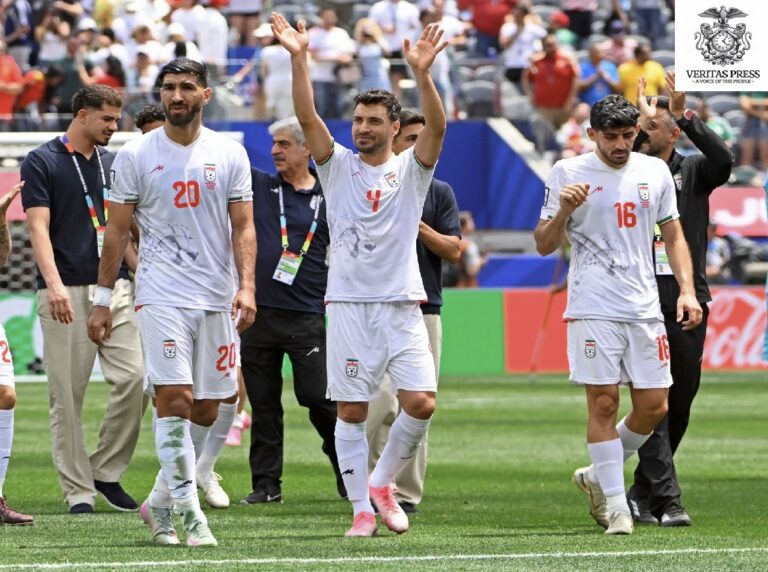
SEATTLE, TEHRAN — The U.S. Department of Homeland Security (DHS) will allow Iran’s national football team to enter the country 48 hours before their critical World Cup match against Egypt on Friday, a modest concession in a tournament where Team Melli’s travel conditions have sparked claims of oppression and competitive disadvantage.