Kamran Faqir is a volunteer investigative journalist and writer committed to exposing hidden truths and amplifying underreported stories. Driven by social justice, he brings sharp insight and fearless truth-telling to independent journalism. NUJ registered.
Original Article Date Published:
Article Date Modified:
19 minutes
Views:389
Listen to this article
Help support our mission, donate today and be the change. Every contribution goes directly toward driving real impact for the cause we believe in.
BEIJING, TEHRAN – The U.S.-sanctioned tanker Rich Starry slipped through the Strait of Hormuz in the early hours of April 14, 2026, carrying 250,000 barrels of methanol from the UAE’s Hamriyah port to China. For a few hours, it appeared to be the first vessel to successfully breach President Donald Trump’s much-touted naval blockade. Then, just as abruptly as it had exited the Persian Gulf, the ship turned around. By April 15, shipping data showed the Chinese-owned tanker making its way back toward the strait, having failed to break through the American cordon.
This brief, dramatic voyage, and its equally dramatic reversal, encapsulate the strange, ambiguous, and deeply contested reality of the first 48 hours of the U.S. naval blockade of Iran. It is a story of deceptive tracking signals, conflicting official narratives, legal challenges, and the quiet but unmistakable emergence of China as a central, if reluctant, player in the escalating confrontation between Washington and Tehran.
I. “No Ships Made It Past”, Except They Did.
The Trump administration’s announcement of a naval blockade came swiftly after the collapse of 21 hours of high-stakes negotiations in Islamabad between a U.S. delegation led by Vice President JD Vance and an Iranian team headed by parliamentary Speaker Mohammad Bagher Ghalibaf. The talks, the highest-level face-to-face contact between the two nations since the 1979 Islamic revolution, foundered on the future of Iran’s nuclear program and control of the Strait of Hormuz.
Within hours, President Trump declared on Truth Social that the U.S. Navy would “immediately” begin blockading ships entering or leaving the strait, warning that any Iranian vessels challenging the blockade “will be immediately eliminated.” U.S. Central Command (CENTCOM) followed with a formal proclamation: the blockade would be “enforced impartially against vessels of all nations entering or departing Iranian ports and coastal areas,” effective 10 a.m. Eastern Time on April 13.
But what actually happened in the first 24 hours depends entirely on whom you ask, and which data you trust.
CENTCOM declared that “no ships made it past the US blockade” and that six merchant vessels “complied with direction from US forces to turn around to re-enter an Iranian port.” Admiral Brad Cooper, the CENTCOM commander, proclaimed that “in less than 36 hours since the blockade was implemented, US forces have completely halted economic trade going into and out of Iran by sea.”
Yet shipping data from multiple commercial trackers told a markedly different story. Reuters, citing LSEG and Kpler data, reported that at least eight ships transited the strait on the first full day of the blockade, including three Iran-linked tankers. The Wall Street Journal, citing two U.S. officials, reported that approximately 20 commercial ships, cargo, container, and tanker vessels had passed through the strait in the first 24 hours.
The contradiction is not merely semantic. It reveals the fundamental ambiguity at the heart of the blockade itself. As Fabrizio Coticchia, professor of political science at the University of Genoa, explained to Reuters: “The United States does not need to block every type of ship or enter the Strait of Hormuz; it can carry out an intermittent blockade. Ships will not be attacked, but rather diverted.” He added that U.S. warships were positioned outside the strait in the Gulf of Oman, where they could interdict vessels at a safer distance from Iranian coastal defences.
In other words, the blockade is not a wall but a sieve, designed less to physically prevent all transit than to create a climate of uncertainty and deterrence. And in that climate, the Rich Starry became the first high-profile test case.
II. The Rich Starry: A Vessel With A History.
The Rich Starry is no ordinary tanker. The 188-meter oil and chemical products carrier is owned by Shanghai Xuanrun Shipping Co Ltd., a Chinese firm that was blacklisted by the U.S. Treasury’s Office of Foreign Assets Control (OFAC) in 2023 for its involvement in transporting Iranian crude. The vessel itself, formerly known as Full Star, was added to the sanctions list under its previous name.
According to shipping data, the Rich Starry departed from the Sharjah anchorage in the UAE and was showing China as its destination. It was carrying approximately 250,000 barrels of methanol loaded at Hamriyah port, not an Iranian port, which, under CENTCOM’s own stated rules, should have allowed it free passage.
But the Rich Starry has a documented history of deceptive practices. Maritime security analysts at Pole Star Global noted that the vessel was “falsely flying the Malawi flag” and had a record of falsifying its Automatic Identification System (AIS) data. TankerTrackers.com described it as “a serial AIS spoofer and a designated sanctions violator with a history of transporting Iranian refined products.”
AIS spoofing, manipulating the transponder signals that broadcast a ship’s identity, location, and route, has become a hallmark of the so-called “dark fleet” or “shadow fleet” that transports sanctioned oil from Iran, Russia, and Venezuela. Analysis of shadow fleet behaviour shows these vessels go dark roughly a quarter of the time, with ships carrying sanctioned cargo switching off transponders in approximately 40% of cases.
In the case of the Rich Starry, Lloyd’s List reported that the vessel had falsified AIS signals between April 3 and April 14, suggesting it “very likely loaded Iranian cargo during this period”. The ship’s abrupt reversal after exiting the Gulf, captured in AIS data from Pole Star Global, showing it “abruptly turning north and heading back towards the Strait of Hormuz instead of continuing into the Arabian Sea”, appeared to confirm that U.S. naval forces had intercepted it once it entered the Gulf of Oman.
Martin Kelly, head of advisory at EOS Marine, said bluntly in a social media post: “The US blockade seems to be in force.”
III. The Cat-And-Mouse Game At Sea.
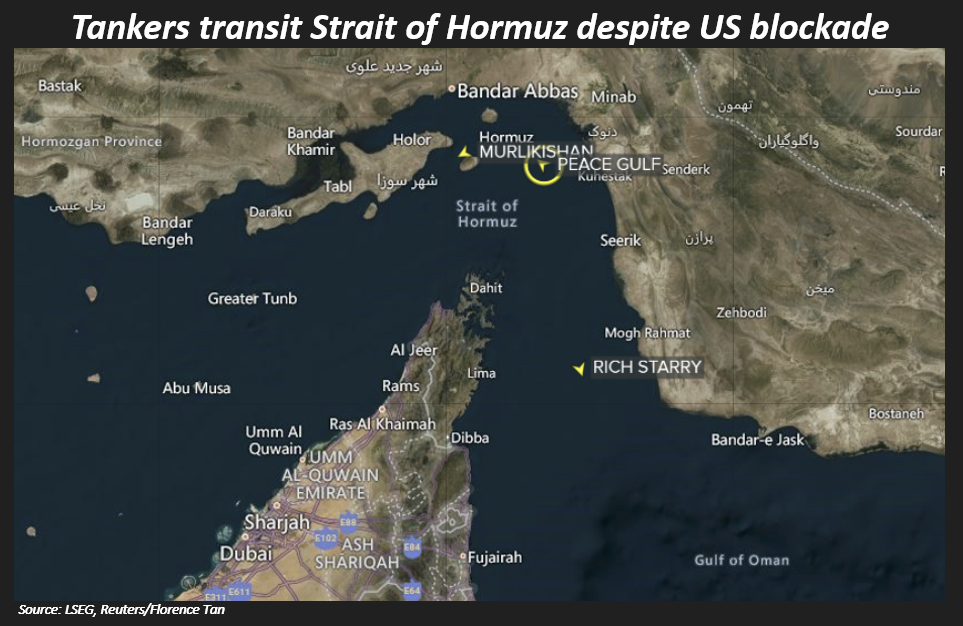
The Rich Starry was not alone. Another sanctioned vessel, the handy tanker Murlikishan (formerly MKA), also transited the strait on the first day of the blockade. The Madagascar-flagged ship, which has previously transported both Russian and Iranian oil, was heading to Iraq to load fuel oil. Because its destination was Iraq, not Iran, it fell outside the blockade’s stated scope.
A third vessel, the Panama-flagged Peace Gulf, also crossed the strait en route to the UAE’s Hamriyah port. The ship typically transports Iranian-origin naphtha to other Middle Eastern ports for onward export to Asia.
These movements underscore a central challenge for U.S. enforcement: the blockade’s geographic and legal boundaries are porous. Vessels can spoof tracking data, switch flags, change names, and operate in legal grey zones that complicate interdiction. Even as Washington signals control over access to Iranian ports, the persistence of such activity suggests enforcement is partial, contested, and dependent on constant monitoring.
TankerTrackers reported spotting a tanker departing Iran’s Kharg Island oil terminal while spoofing its AIS signal to suggest it had left Saudi Arabia instead. Such tactics are becoming routine. “Dark Fleet tankers in particular may change names and flags,” TankerTrackers noted, urging journalists to rely on IMO numbers, the unique identifiers assigned to each vessel, to track ships reliably.
The European Union’s Maritime Security Centre – Indian Ocean has warned of “heavy GPS and AIS spoofing” in the Strait of Hormuz and Gulf of Oman, with disruptions also affecting communications and radar systems. The centre now advises ships to avoid transiting the strait until the security situation improves.
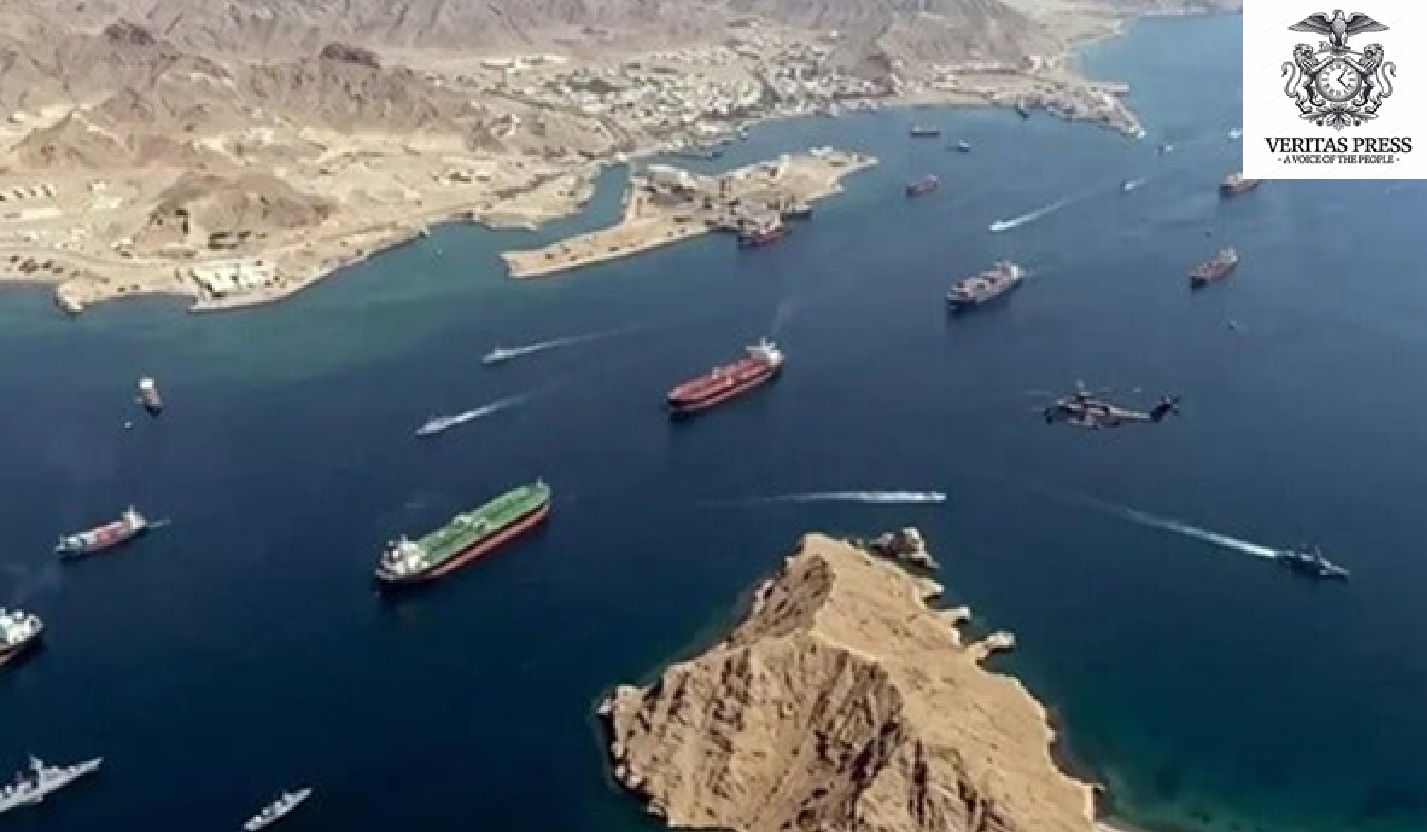
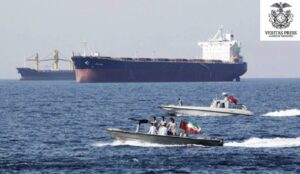
Tankers transit Strait of Hormuz despite US blockade. Image Reuters.
IV. China’s Calculated Ambiguity:
The passage of the Rich Starry, however brief, placed Beijing in an uncomfortable spotlight. China is Iran’s largest oil buyer, importing an estimated 90% of Iranian crude exports. Approximately 40% of China’s total oil imports pass through the Strait of Hormuz. The blockade, in other words, strikes directly at China’s energy security.
Beijing’s official response was swift and sharp. Chinese Foreign Ministry spokesperson Guo Jiakun called the U.S. blockade “dangerous and irresponsible,” warning that it would “only aggravate confrontation, escalate tension and undermine the fragile ceasefire.” Foreign Minister Wang Yi, speaking during a meeting with UAE officials in Beijing, said that blocking the Strait of Hormuz “does not serve the common interests of the international community.”
Yet China has carefully avoided any direct confirmation that its vessels are involved. When asked whether Chinese ships were among those transiting the strait, the foreign ministry declined to comment. This studied ambiguity reflects Beijing’s delicate balancing act: it must protect its energy interests and its strategic partnership with Iran while avoiding a direct confrontation with the United States.
Professor Zhang Lun of CY Cergy-Paris University told DW that Washington’s blockade is also intended to “force China onto the stage.” He explained that the White House might be able to find an off-ramp from the conflict and save face if it can push Beijing to apply pressure on Tehran to accept U.S. terms. “Given Trump’s transactional style,” Zhang suggested, “if China were to ‘give Trump this win,’ Beijing would gain leverage in future negotiations on issues such as Taiwan.”
Chinese state media has framed the U.S. blockade as part of a “hegemonic logic” and a “blockade in response to a blockade,” likening it to “failing to steal a bicycle and then adding another lock.” The official narrative portrays Washington as “eager for a graceful exit” from a conflict it cannot win, even resorting to “packaging victory” by claiming it had achieved its objectives.
But beneath the rhetorical posturing lies genuine anxiety. Canadian geopolitical expert Dimitri Lascaris observed: “The Trump regime already tried to deny China access to Venezuelan oil. Now it’s trying to deny China access to Iranian oil. This is not only an escalation against Iran. It is also an escalation against China.”
V. Iran’s Defiance And The Threat Of Escalation:
Tehran’s response to the blockade has been characteristically defiant. Iran’s navy chief, Shahram Irani, dismissed Trump’s threat as “ridiculous and laughable,” insisting that the waterway falls within Iran’s strategic control and “cannot be dictated by foreign powers.”
Parliamentary Speaker Mohammad Bagher Ghalibaf, returning from the failed Islamabad talks, struck an even more confrontational tone: “If they fight, we will fight, and if they come forward with logic, we will deal with logic. We will not bow to any threats. Let them test our will once again so that we can teach them a bigger lesson.”
Iran’s ambassador to the United Nations, Amir Saeid Iravani, sent a letter to UN Secretary-General Antonio Guterres denouncing the blockade as a “grave violation of the sovereignty and territorial integrity of the Islamic Republic of Iran” and a “serious violation of the fundamental principles of the international law of the sea.”
Foreign Ministry spokesperson Esmail Baghaei went further, condemning the blockade as “revenge against the global economy” and asking rhetorically: “Can an illegal ‘war of choice’ be justified as a ‘revenge of choice’ against the global economy?!”
Iranian state media reported that the country’s armed forces had warned that if Iran’s port security is threatened, “no port in the Persian Gulf region would remain safe.” Tehran has also reiterated that it will continue to control access through the strait, permitting passage only to vessels it deems friendly, a list that prominently includes China.
The risk of miscalculation is acute. As military observers note, the continued pressure of the blockade “increases the likelihood of Iranian attacks” that could shatter the fragile two-week ceasefire that began on April 8.
VI. Legal Questions And International Isolation:
The blockade has also drawn sharp legal rebuke. Arsenio Dominguez, head of the UN’s International Maritime Organisation (IMO), stated unequivocally that no state has a legal right to obstruct shipping through the Strait of Hormuz. He tied the dispute to established maritime law, noting that the UN Convention on the Law of the Sea provides that transit through straits used for international navigation cannot be suspended.
Legal scholars have gone further. An analysis by Responsible Statecraft noted that under Article 3(c) of the UN General Assembly’s Definition of Aggression (1974), a naval blockade of a sovereign state’s coasts is considered an act of armed aggression, entitling the blockaded state to use “all necessary means to defend itself.”
“Wishcasting disguised as strategy” is how the analysis described the blockade, arguing that Trump’s move “sweeps aside the new, fragile status quo where some traffic continued under Iranian acquiescence” and “further strengthens this chokehold” on global energy supplies.
The international response has been notably tepid. European leaders have ruled out sending warships to the strait, despite Trump’s threats that NATO faces a “very bad” future if allies fail to help reopen the chokepoint. Turkey’s foreign minister, Hakan Fidan, said neither Iran nor the United States should impose new regulations on transit through Hormuz, arguing that the waterway should be reopened through diplomacy rather than force.
VII. The Economic Fallout: Oil At $150 And Counting
The economic stakes could hardly be higher. The Strait of Hormuz normally handles roughly 20% of global oil supply, with pre-war daily crossings averaging more than 130 vessels. Since the U.S.-Israeli air campaign against Iran began on February 28, traffic has collapsed to a fraction of that level.
According to the International Energy Agency, global oil supply plunged by 10.1 million barrels per day in March, the largest disruption in history. Shipments through the strait averaged around 3.8 million b/d in early April, compared with more than 20 million b/d in February.
Physical oil prices surged to a historic $148.87 per barrel on April 13, reflecting immediate supply shortages even as Brent crude futures hovered just above $100. S&P Global Energy has warned that Brent could reach $200 per barrel if the crisis persists unresolved over the next two months.
The IEA has sharply cut its demand forecasts, projecting that global oil demand will actually decline by 80,000 b/d in 2026, a downward revision of 730,000 b/d from the previous month’s forecast. The agency warned that the second quarter of 2026 could see the sharpest year-on-year drop in demand since the COVID-19 pandemic.
War-risk insurance costs remain at hundreds of thousands of dollars in additional weekly expenses, with cover typically reviewed by underwriters every 48 hours. Ship broker BRS concluded in a report: “A return to ‘normality’ in the Middle East arguably now appears more distant than it did one week ago, especially given that the U.S. Navy has started a blockade. It is anticipated that there will be little or no commercial traffic in the strait for the foreseeable future.”
The human cost is mounting. According to the IMO, approximately 20,000 seafarers and roughly 1,600 vessels are currently stuck in the Gulf, extending a traffic freeze that has gripped the strait since the conflict began. The energy minister from the UAE has issued a stark warning, indicating that approximately 800 commercial vessels, a significant portion of which comprises nearly 400 oil tankers, are currently facing an inability to transit safely, a situation that has been brought about by actions attributed to the U.S., which poses a considerable threat not only to global energy markets but also to the integrity of food supply chains and overall economic stability, while simultaneously further eroding what little credibility the U.S. may still possess.
VIII. What The Rich Starry Reveals:
The saga of the Rich Starry, its brief, hopeful transit followed by its ignominious return, reveals more about the nature of this conflict than any official statement could. The ship’s owner, Shanghai Xuanrun Shipping, could not be reached for comment. But the vessel’s movements speak volumes.
First, the episode demonstrates that the U.S. blockade is real and is being enforced, but selectively and at a distance. The Rich Starry was allowed to transit the strait itself, only to be turned back once it reached the open waters of the Gulf of Oman, where U.S. warships are positioned beyond the range of Iranian coastal defences. This “intermittent blockade” strategy, as Professor Coticchia described it, allows Washington to claim enforcement while minimising the risk of direct confrontation with Iranian forces.
Second, the incident exposes the gap between Washington’s rhetorical maximalism and operational reality. Trump declared that “other countries will be involved with this blockade” and that Iranian ships “will be immediately eliminated.” CENTCOM claimed that “no ships made it past.” Yet shipping data shows multiple vessels transiting daily, including Iran-linked tankers. The blockade is less an impenetrable wall than a carefully managed bottleneck, effective enough to deter most commercial traffic but porous enough to allow some sanctioned vessels to test its limits.
Third, the Rich Starry highlights the central role of China in this unfolding drama. Beijing’s carefully calibrated response, condemning the blockade as “dangerous and irresponsible” while studiously avoiding comment on whether its own ships are involved, reflects a strategic dilemma. China depends on Iranian oil and the free flow of energy through Hormuz, but it cannot afford a direct military confrontation with the United States. The result is a posture of studied ambiguity that allows Beijing to protect its interests while preserving deniability.
Finally, the episode underscores the enduring power of the “dark fleet” and the cat-and-mouse game of sanctions evasion. The Rich Starry is a known AIS spoofer with a history of falsifying its position and flag. Its brief success in transiting the strait, before being intercepted in open water, suggests that the U.S. Navy’s interdiction capabilities are more effective beyond the narrow confines of the strait itself. But the fact that such vessels continue to operate, and that buyers like India are reportedly refusing to accept Iranian crude even when it arrives, points to a broader climate of risk that is already reshaping global oil markets.
Conclusion: A Blockade Without A Strategy?
As the second week of the blockade unfolds, the fundamental questions remain unresolved. The fragile ceasefire is set to expire on April 22, and both sides have signalled openness to further talks. Trump told the New York Post that “something could be happening over the next two days”. But the core sticking points that derailed the Islamabad negotiations, Iran’s nuclear program and control of the Strait of Hormuz, appear no closer to resolution.
The blockade, for all its dramatic optics and high-stakes enforcement, may ultimately prove to be a tactical manoeuvre in search of a strategic purpose. As the Responsible Statecraft analysis concluded: “A blockade is not a clever alternative to military strikes. It is, in fact, an act of war, and one that carries serious risks.”
For now, the Rich Starry sits somewhere in the Gulf, its 250,000 barrels of methanol still aboard, its destination uncertain. It is a floating symbol of the new, ambiguous normal in the world’s most critical energy chokepoint, a place where the rules are being rewritten in real time, where ships vanish from tracking screens and reappear under new flags, and where the world’s most powerful navy can declare victory even as sanctioned tankers continue to slip through the cracks.
Source: Multiple News Agencies
Submissions:
For The Secure Submission Of Documentation, Testimonies, Or Exclusive Investigative Reports From Any Global Location, Please Utilise The Following Contact Details For Our Investigations Desk: enquiries@veritaspress.co.uk or editor@veritaspress.co.uk
Help Support Our Work:
Popular Information is powered by readers who believe that truth still matters. When just a few more people step up to support this work, it means more lies exposed, more corruption uncovered, and more accountability where it’s long overdue.
Help Protect Independent Journalism, Which Is Currently Under Attack.
If you believe journalism should serve the public, not the powerful, and you’re in a position to help, becoming a DONATOR or a PAID SUBSCRIBER truly makes a difference.
DONATION APPEAL: If You Found This Reporting Valuable, Please Consider Supporting Independent Journalism.
Help Support Our Work – We Know, We Know, We Know …
Seeing these messages is annoying. We know that. (Imagine what it’s like writing them … )
Your support fuels our fearless, truth-driven journalism. In unity, we endeavour to amplify marginalised voices and champion justice, irrespective of geographical location.
But it’s also extremely important. One of Veritas Press’s greatest assets is its reader-funded model.
1. Reader funding means we can cover what we like. We’re not beholden to the political whims of a billionaire owner. We are a small, independent and impartial organisation. No one can tell us what not to say or what not to report.
2. Reader funding means we don’t have to chase clicks and traffic. We’re not desperately seeking your attention for its own sake: we pursue the stories that our editorial team deems important and believe are worthy of your time.
3. Reader Funding: enables us to keep our website and other social media channels open, allowing as many people as possible to access quality journalism from around the world, particularly those in places where the free press is under threat.
We know not everyone can afford to pay for news, but if you’ve been meaning to support us, now’s the time.
Your donation goes a long way. It helps us:
Keep the lights on and sustain our day-to-day operations
Hire new, talented independent reporters
Launch real-time live debates, community-focused shows, and on-the-ground reporting
Cover the issues that matter most to our communities, in real time, with depth and integrity
We have plans to expand our work, but we can’t do it without your support. Every contribution, no matter the size, helps us stay independent and build a truly people-powered media platform.
If you believe in journalism that informs, empowers, and reflects the communities we serve, please donate today.
Kamran Faqir is a volunteer investigative journalist and writer committed to exposing hidden truths and amplifying underreported stories. Driven by social justice, he brings sharp insight and fearless truth-telling to independent journalism. NUJ registered.
SEATTLE, TEHRAN — The U.S. Department of Homeland Security (DHS) will allow Iran’s national football team to enter the country 48 hours before their critical World Cup match against Egypt on Friday, a modest concession in a tournament where Team Melli’s travel conditions have sparked claims of oppression and competitive disadvantage.