Kamran Faqir is a volunteer investigative journalist and writer committed to exposing hidden truths and amplifying underreported stories. Driven by social justice, he brings sharp insight and fearless truth-telling to independent journalism. NUJ registered.
Original Article Day Published:
Article Date Modified:
23 minutes
Views:626
Listen to this article
Help support our mission, donate today and be the change. Every contribution goes directly toward driving real impact for the cause we believe in.
The Dust That Settles On A New World:
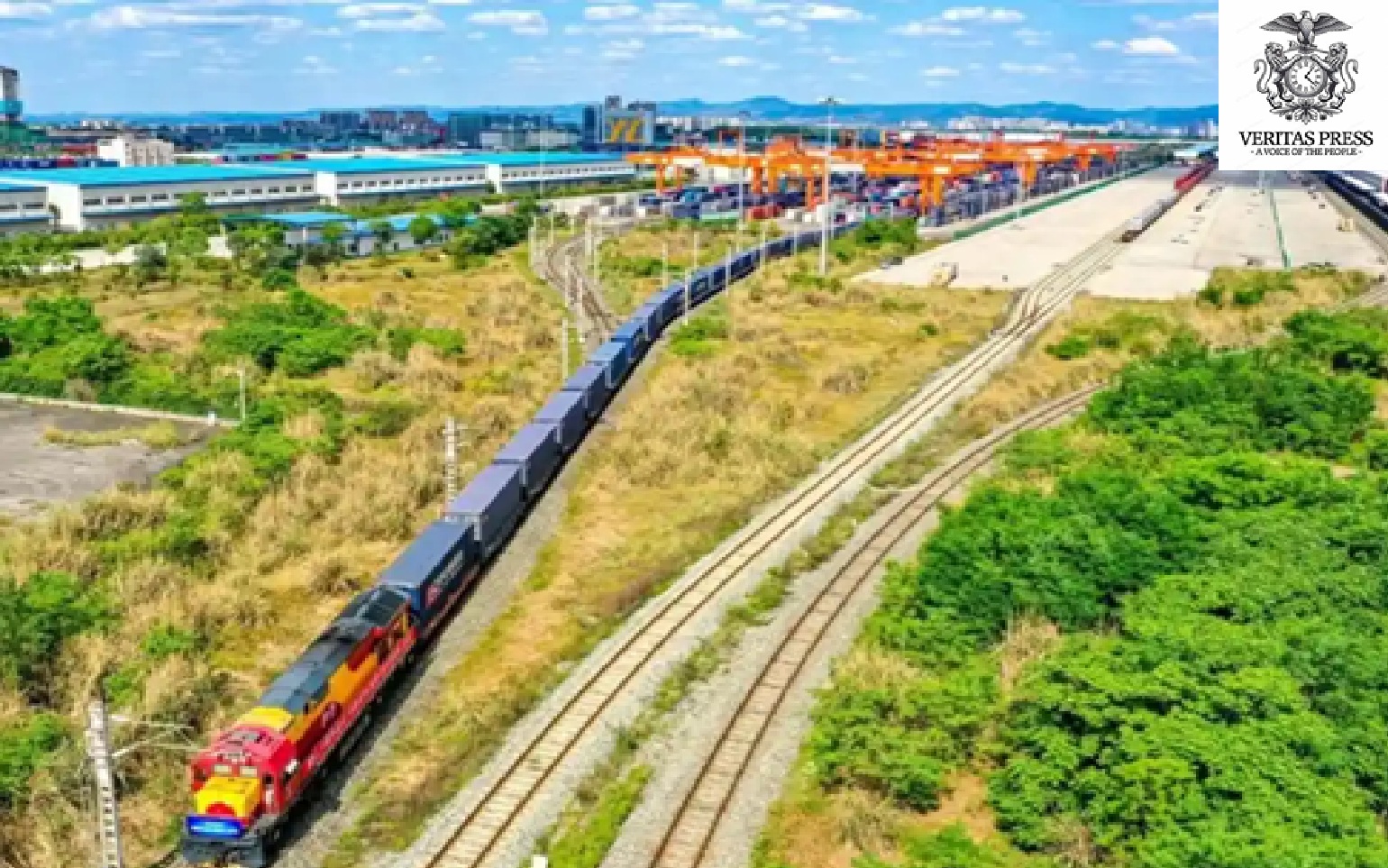
BEIJING, TEHRAN – A year ago, on a sweltering May afternoon in 2025, a freight train painted in the livery of the China-Europe Railway Express negotiated the final kilometre of the vast Dasht-e Kavir and shuddered to a halt at the Aprin dry port in Eslamshahr, on Tehran’s dusty southern outskirts. On its flatbed wagons were not the arms or sanctioned components that the West’s intelligence agencies might have feared, but something perhaps more revolutionary: 32 containers of Chinese-manufactured solar panels. The symbolism was not lost on observers. In an Islamic Republic that has, for decades, been starved of Western technology and capital, the means of energy independence arrived not via the Persian Gulf, but via a 10,400-kilometre ribbon of steel stretching back through the cotton fields of Turkmenistan and the steppes of Kazakhstan to the industrial heartland of Xi’an.
Today, that ribbon of steel has become both a lifeline and a geopolitical earthquake. Facing what oil markets are calling the most severe supply dislocation since the 1970s, the Islamic Republic is now scrambling to do what trade theorists have posited for years, but engineers have struggled to realise: export crude oil to China via overland rail. According to the Iranian Oil Exporters Union, Tehran is actively testing rail exports as a partial hedge against the American naval blockade currently strangling its maritime terminals. Hamid Hosseini, the union’s spokesman, confirmed that “Iran is attempting to send oil to China by rail… connecting Tehran with the Chinese cities of Yiwu and Xi’an,” noting that while this route is usually shorter in distance than the maritime voyage, it still requires weeks of transit time.
This is the terminal phase of a drama that reached its apogee in the early hours of February 28, 2026, when the world’s attention turned to the Persian Gulf. Today, 72 hours from a Congressionally mandated deadline that could trigger a new phase of the American military intervention, the global oil architecture rests on a question that no major power anticipated a decade ago: Can a railway replace a super-tanker?
The Strait, The Blockade, And The Market.
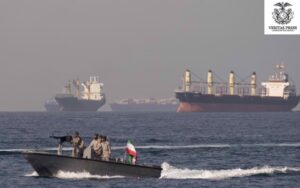
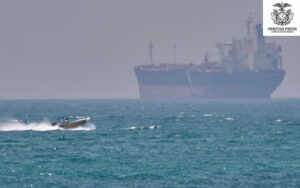
To understand the desperation of Iran’s gambit, one must first understand the physics and the psychology of the Hormuz closure. On April 13, the United States Navy, acting under a Presidential order described by Secretary of State Marco Rubio as “the final tourniquet on the theocratic economy,” began physically interdicting all commercial shipping bound for or departing Iranian ports. The effect was immediate and calibrated to inflict maximal economic asphyxiation.
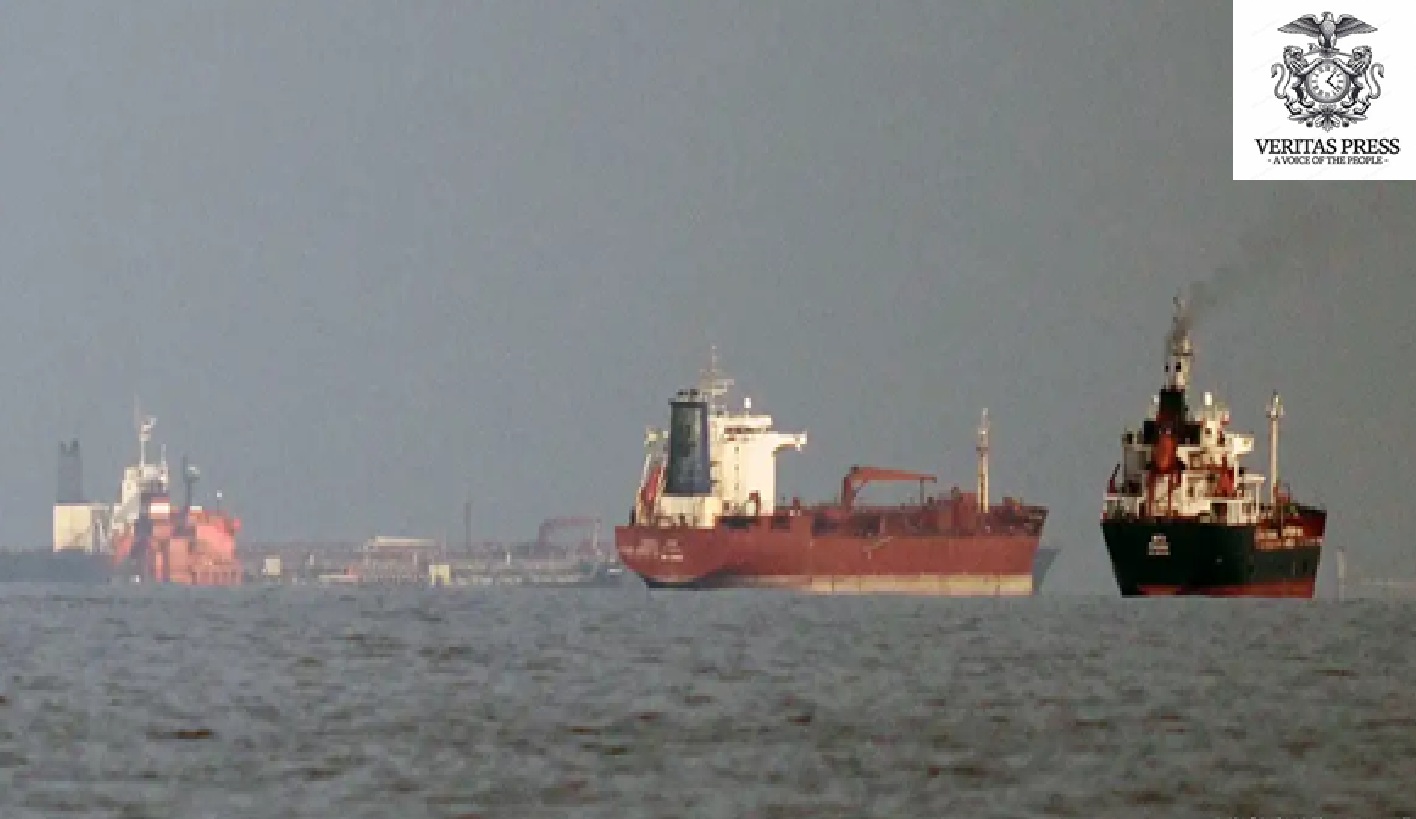
Data from commodity intelligence firm Kpler reveals the scale of the rupture. Between April 1 and April 13, prior to the blockade’s enforcement, Iran was loading crude and condensate at an average rate of 2.1 million barrels per day (bpd). In the ten days following the blockade’s implementation, average loadings collapsed to 567,000 bpd, a cataclysmic 73% decline. The shadow fleet of ageing tankers that had, for years, moved sanctioned Iranian crude through the Strait of Hormuz, conducting ship-to-ship transfers under cover of darkness, was suddenly rendered inert. Kpler’s satellite imagery now tracks a phalanx of idle VLCCs sitting in the Gulf, loaded with an estimated 15 million barrels that have nowhere to go.
The existential problem is storage, not production. Kpler warns that Iran’s unused onshore storage capacity will be exhausted in 12 to 22 days, a condition known in the industry as “tank tops”. Once storage is saturated, Tehran will be forced to cap its wells, a process that can permanently damage reservoir integrity. Goldman Sachs estimates that Iran has already cut as much as 2.5 million bpd of crude production, with further involuntary curtailments of another 1.5 million bpd possible by mid-May.
Initially, global prediction markets reacted to the Hormuz closure with a spike in the probability of the West Texas Intermediate (WTI) benchmark reaching $160 per barrel within the April delivery window. On some days, this implied probability touched 1.4 54,256 face value, with actual dollar liquidity of just $506, a microscopic pool in which even a single institutional-sized trade can swing implied odds by five percentage points. The dramatic collapse in the odds reflects not a resolution of the geopolitical crisis, but a dawning recognition among quantitatively minded traders that the “tail risk” of a total Iranian export wipeout may be mitigated, however marginally, by iron wheels.
Yet, the physical market tells a more sobering story. Brent crude futures, which reflect the global seaborne benchmark, have surged past $107 per barrel and remain structurally elevated. The rail alternative, while strategically disruptive, is currently a teacup trying to drain an ocean.
The Capacity Gap: Physics vs. Geopolitics.
The rail corridor’s significance is not found in its current throughput, but in what it represents for the psychology of sanctions architecture that has governed global finance for three decades.
The China-Iran rail network, which entered full operational service with the May 2025 inauguration, follows a route through Kazakhstan, Uzbekistan, and Turkmenistan before reaching the Aprin dry port near Tehran. The transit time of 15 days from Xi’an to Tehran, recently demonstrated by a second freight train from Zhengzhou in June 2025, is roughly half the 30 to 40 days required by the maritime route through the Malacca Strait. However, the comparison between a ten-thousand-ton rail consignment and a two-million-barrel supertanker cargo reveals the stark logistical asymmetry. A single unit train transporting crude oil might carry 60 to 80 tank cars, each holding approximately 500 to 600 barrels. This translates into a total train cargo of roughly 30,000 to 48,000 barrels per train, less than 2.5% of the capacity of a single Suezmax tanker, and a rounding error compared to Iran’s pre-blockade export volume of two million barrels per day.
The railway’s Iranian proponents are aware of this chasm. The director of the Islamic Republic of Iran Railways (RAI), Jabbar-Ali Zakeri, told Hamshahri Online that “if the coordination and investment are properly targeted, the annual capacity of this route can be increased to several hundred thousand tons”. Even if the line operates at maximum theoretical capacity for both containerised petrochemicals and bulk liquid parcels, it would struggle to move more than a few percentage points of Iran’s pre-blockade 1.38 million bpd that Chinese refiners were receiving via the sea route in 2025. The Bruegel Institute, in a March 2026 analysis, cautioned that “rail transport has its limitations: Iran’s exports to China are nearly 90% oil and petroleum or mineral products, and bulk crude still relies primarily on sea transport… rail cannot carry large-scale crude oil volumes”.
RailFreight.com‘s analyst Dennis van der Laan was more blunt. In his March 2026 assessment, he noted that Iran achieved a record-breaking 5 million tonnes of rail freight transit in 2025, a figure that includes all bulk, containerised, and liquid cargoes traversing Iran’s network. “Even this record-breaking figure,” van der Laan wrote, “is modest in absolute terms… and 2026 almost certainly won’t see a repeat, because sanctions and pressures have now turned kinetic”.
The supply-side picture is thus one of an oil industry in a race between the depletion of storage capacity and the painfully slow ramp-up of a terrestrial alternative. According to Kpler’s modelling, Iran’s unused storage tanks have at most 22 days of capacity remaining; by the second half of May 2026, involuntary production cuts of catastrophic proportions may be unavoidable. The rail option, in this context, is a political signal, not a commercial substitute, at least not yet.
The Strategic Architecture: BRI, BRICS, And The “Nightmare Of The US”.
Yet, to dismiss the rail corridor as a marginal logistical curiosity would be to fundamentally misread the tectonic plates shifting beneath the global economic order. The railway is in the assessment of Russian and Chinese strategic thinkers, the manifestation of something far more durable than a sanctions-busting workaround: it is the physical reinforcement of a parallel financial and diplomatic universe. Additionally, it would represent a strategically planned humiliation for the US-Israel illegal blockade of the Strait of Hormuz.
The rail corridor’s role in enabling a non-dollar, non-SWIFT trade ecosystem is its most subversive attribute. The 2021 25-year Comprehensive Strategic Partnership between China and Iran, which stipulated $400 billion in Chinese investment in exchange for cut-rate Iranian oil, became fully operational in 2025 through an opaque oil-for-infrastructure barter mechanism. In October 2025, OilPrice.com confirmed that Beijing and Tehran had formalised a barter-style framework in which crude oil shipments are exchanged not for cash, but for Chinese construction and industrial projects. The payment mechanism, as the Times of Oman reported, uses China’s Cross-Border Interbank Payment System (CIPS) to bypass the dollar-centric SWIFT system entirely. The Wall Street Journal, in a separate investigation, identified a mysterious financial entity named “Chuxin” as a key intermediary in these triangular transactions.
The corridor’s integration into the BRICS framework accelerates its geopolitical gravity. Iran’s formal accession to the BRICS bloc in 2024, combined with Russo-Iranian strategic alignment deepened by the conflict in Ukraine, has transformed the railway from a bilateral project into a multilateral corridor of Eurasian economic integration. On November 25, 2025, six nations, Iran, China, Kazakhstan, Uzbekistan, Turkmenistan, and Turkey, signed a landmark agreement in Istanbul to jointly develop and tariff the southern section of the China-Europe rail corridor. This was followed, in December 2025, by a tripartite memorandum among Iran, Russia, and Azerbaijan to operationalise the western spur of the International North-South Transport Corridor (INSTC) via the Rasht-Astara link.
For Washington and Tel Aviv, this convergence is not merely alarming but, in the words of former Israel Defense Forces intelligence analysts, “existentially threatening.” The South China Morning Post, in a June 2025 analysis, noted that for the US and Israel, “Tehran’s deeper integration into Eurasian infrastructure is alarming… critically, it would enable Iran to evade sanctions, bolster its regional influence and advance broader ambitions, including its contentious nuclear programme”. An analysis published by Intellinews in June 2025 provocatively argued that the very existence of the rail link “played a role in provoking the 12-day war” launched by Israel on June 12, 2025. In that conflict, Israeli strikes targeted not only Iran’s Natanz and Arak nuclear facilities but also, according to Tehran’s claims, portions of the new railway infrastructure itself. “The launch of this corridor is a major step forward in diversifying Iran’s trade routes and strengthening its position in regional transit,” Iranian Minister of Roads and Urban Development Mehrdad Bazrpash declared shortly before the Israeli attack.
Majid Reza Hariri, chairman of the Iran-China Joint Chamber of Commerce, underscored the economic centrality of the connection in an August 2025 interview: “China accounts for 65-70 billion worth of Iran’s foreign trade each year… Summing up the figures, around 65-70 billion worth of Iran’s oil and non-oil trade is with China”. Hariri further noted that “China buys more than 92% of Iran’s oil exports”. Data from the first half of 2025 showed that Chinese refiners, particularly the independent “teapot” refineries in Shandong, imported an average of 1.38 million bpd of Iranian crude, accounting for 13.6% of China’s total oil imports and making Iran China’s third-largest supplier after Russia and Saudi Arabia.
Despite these structural dynamics, official trade data for 2025 reveals a more complex picture. China’s General Administration of Customs reported that bilateral trade volumes plunged 24% in the first 11 months of 2025, to $9.09 billion, with Chinese exports to Iran declining 22% and imports falling 27%. Trade analysts attribute this decline partly to the increasing opacity of transactions; crude oil flows are often recorded under third-country blends or omitted entirely from official statistics, as well as banking constraints driven by fears of secondary US Treasury sanctions. The formal data, in other words, captures only a fraction of the actual economic relationship.
The Current Crisis: Diplomacy At The Edge Of War.
The rail corridor’s importance has been magnified exponentially by the war that has engulfed the Persian Gulf since late February 2026. As of today, April 28, 2026, the United States and Iran remain locked in a diplomatic death spiral, mediated by Pakistan after direct talks in Islamabad on April 11 collapsed without a breakthrough.
Iran’s Foreign Minister, Abbas Araghchi, concluded a whirlwind three-country diplomatic tour on April 27, meeting with Vladimir Putin in Saint Petersburg after shuttling between Oman and Islamabad. Araghchi’s message, as articulated by the Fars news agency linked to the Islamic Revolutionary Guard Corps, was stark: Tehran is prepared to reopen the Strait of Hormuz and cease hostilities, but only if Washington reciprocates by lifting its naval blockade, and only if the nuclear file is deferred to a later stage of negotiations.
Washington’s response has been publicly dismissive. White House Spokesperson Olivia Wales declared on April 27 that the Administration “will not negotiate through the press” and “will only reach an agreement that puts the interests of the American people first, never allowing Iran to possess nuclear weapons”. President Donald Trump, in a Fox News interview on April 27, told host Maria Bartiromo that “they can’t have nuclear weapons. Otherwise, there would be no reason to meet,” though he noted that Tehran was “always welcome to contact me”. Secretary of State Marco Rubio was unequivocal on Fox News on April 27: “We can’t let them get away with it… We have to ensure that any deal that is made, any agreement that is made, is one that definitively prevents them from sprinting towards a nuclear weapon at any point”.
The arithmetic is complicated by a statutory deadline. Under the 1973 War Powers Resolution, President Trump faces a May 1, 2026, deadline to obtain Congressional authorisation to continue military operations against Iran, now in their ninth week. Failure to secure authorisation would raise significant constitutional and political questions about the legality of the ongoing blockade.
The human and strategic costs are escalating. The UN Conference on Trade and Development (UNCTAD) has warned that shipping activity through the Strait of Hormuz has “fallen to a near halt”. The US Navy’s Central Command (CENTCOM) reports that the blockade has turned back 38 commercial vessels attempting to reach Iranian ports since April 13. Polymarket’s prediction contract for the Strait of Hormuz returning to normal commercial operations by May 15 trades at a grim 14.5% YES, implying that the market considers sustained closure the baseline scenario for the next three weeks.
The Local Perspective: Voices From The Aprin Dry Port.
At the Aprin dry port, where the first Chinese freight trains arrived a year ago, the mood among logistics workers, customs officials, and local businessmen oscillates between defiant optimism and quiet despair.
Mir-Hassan Mousavi Dizaji, the Deputy Head of RAI who presided over the arrival of the solar panel shipment in May 2025, told assembled journalists at the time: “The launch of Aprin customs is a key step toward facilitating international trade for the country… Two more trains carrying solar panels have already entered Iran, and thanks to our talks with our Chinese partners, we expect daily rail shipments from China in the near future”. His words, captured by the Tehran Times, reflected the official narrative: that the rail link would transform Iran from a pariah state into a “logistics and value-add hub”.
By the summer of 2025, Shahriar Naghizadeh, a representative of Iran Railways, was telling Iranian media that “countries that transit their goods through Iran are in the crosshairs of US sanctions and European Union sanctions, and this has made our work very difficult. However, we have also multiplied our efforts to neutralise these sanctions”. Naghizadeh’s statement captures the duality at the heart of Iran’s rail strategy: it is both a physical corridor for goods and a geopolitical assertion of sovereignty against a sanctions regime designed to isolate Iran entirely.
On the ground in the southern oil hubs of Ahvaz and Asaluyeh, however, the situation is increasingly desperate. The Wall Street Journal reported in late April 2026 that Iranian engineers are reactivating abandoned storage facilities, rusting tanker farms mothballed during previous rounds of sanctions, and using makeshift containers to store the mounting glut of unsellable crude. “They are utilising every cubic meter of storage they can find,” an unnamed Kpler analyst told the Journal. Some oil is even being transferred onto idle tankers functioning as floating storage, though satellite tracking shows their utility is limited since these vessels cannot exit the Gulf to reach global markets.
A cargo train driver at the Aprin facility, who spoke on condition of anonymity to Radio Farda, offered a more ground-level assessment. “Yes, we see more trains, and yes, some of them carry industrial equipment that is clearly connected to the oil sector, but anyone who thinks a few trains a week can replace the tanker queue at Kharg Island is either lying to themselves or working in the propaganda department,” he said. “A train carries what a small pipeline can move in an hour. We cannot replace a strait with a railroad; mathematics does not permit it.”
The Counter-Voice: Advocacy Groups And The Nuclear Question.
The Iran rail corridor’s emergence has also galvanised a renewed push from advocacy organisations focusing on Iran’s nuclear program and human rights record.
United Against Nuclear Iran (UANI), a Washington-based advocacy group, issued a statement on March 14, 2026, asserting that “the China-Iran rail corridor is fundamentally a nuclear logistics conduit disguised as a Belt and Road initiative. Tehran and Beijing are betting that Western democracies lack the political will to stop a train the way they can stop a tanker.” UANI’s CEO, Mark Wallace, told Fox Business that “the Biden administration’s strategic ambiguity regarding Chinese sanctions enforcement has enabled this covert nuclear infrastructure; it is time for Congress to impose secondary sanctions on every entity involved in the corridor’s construction and operation.”
The Foundation for Defence of Democracies (FDD), meanwhile, published a report in October 2025 analysing Iran’s sanctions evasion tactics and noting that Iran’s October 2025 oil exports had actually reached “a 2025 peak” of over 1.6 million bpd, primarily to Chinese refiners using the shadow fleet. The report concluded that “the failure of secondary sanctions to deter Chinese purchases of Iranian crude is the single greatest financial enabler of Iran’s nuclear and missile programs” and called for “extraterritorial enforcement actions against Chinese state-owned banks facilitating the barter mechanism.”
The International Atomic Energy Agency (IAEA), for its part, reported in June 2025 that Israeli strikes had directly hit the Natanz underground enrichment facility, complicating verification efforts. IAEA Director General Rafael Grossi told a special Board of Governors meeting on March 15, 2026, that the Agency’s “continuity of knowledge” regarding Iran’s nuclear material inventory had been “severely compromised” and that Iran’s enrichment of uranium to 60% purity, just a short technical step from weapons-grade, had continued at a reduced but still operational pace at the Fordow facility.
The Road Ahead: Rail As A Geopolitical Underwriter.
As global policymakers look beyond the immediate Hormuz crisis, the Iran-China railway looms as a structural challenge to the architecture of economic coercion that has defined American foreign policy since the end of the Cold War.
The rail corridor does not, as we have seen, provide a volumetric substitute for the 1.38 million bpd of seaborne crude that Chinese “teapot” refineries consumed in 2025. Its true significance lies in a more conceptual realm: it is a physical underwriting of the BRICS narrative that an alternative to the dollar-based, United Nations-sanctioned maritime trading system is technically and politically feasible. China’s ambassador to Tehran, Chang Hua, said at a Belt and Road Forum in September 2025: “The rail link between our nations is not a sanctions evasion tool, it is a permanent corridor of legal trade under international law, connecting the world’s largest energy consumer to the world’s largest energy reserves through sovereign territory, without passing through any maritime chokepoint that is under the control of a single hegemon.” This language, “sovereign territory,” “legal trade,” “hegemon”, is a rhetorical rejection of the entire post-1945 liberal trading order.
If the Rasht-Astara railway is completed as planned by 2028, the North-South Corridor linking Russia, Iran, and India will become a contiguous railway from Mumbai to Moscow, potentially adding another vector for overland commodity flows that bypasses both the Suez Canal and the Cape of Good Hope. The Istanbul-Islamabad railway, revived in 2025 negotiations between Turkey, Iran, and Pakistan, would further integrate the system. With the China-Kyrgyzstan-Uzbekistan railway now under active construction as of late 2024, shortening the China-Iran transit route by approximately 1,000 kilometres, the geopolitical landscape of Eurasian transport is being reshaped under the very nose of a Western alliance system that remains predominantly focused on maritime and aerial power projection.
The market, as prediction contracts indicate, is not pricing in a dramatic oil price spike to $160 within the current April window. What it is pricing in is something potentially more profound: a permanent increase in the premium placed on supply routes that are less susceptible to Western naval interdiction, and a corresponding erosion of the “sanctions premium” that has, for decades, allowed Washington to enforce compliance without firing a shot.
Conclusion: The Train Has Left The Station.
The rail corridor connecting Xi’an to Tehran is, in measurable volumetric terms, a pebble dropped into the ocean of global oil logistics. But pebbles dropped into the right geopolitical waters can generate tsunamis. On April 28, 2026, as President Trump deliberates whether to accept or reject Iran’s offer to reopen the Strait of Hormuz in exchange for a lifting of the naval blockade and deferral of nuclear negotiations, the railway stands as a silent testament to the limits of maritime coercion in the 21st century. Ships can be intercepted; trains, passing through the sovereign territory of six non-sanctioning nations, China, Kazakhstan, Uzbekistan, Turkmenistan, and Turkey, cannot.
Hamid Hosseini, the Iranian Oil Exporters Union spokesman, stated with characteristic bluntness: “The American blockade has not stopped Iranian oil; it has merely forced us to move it by different means to the same buyer. The railway is slow, it is expensive, but it is open, and it will remain open”. That sentiment, that the blockade has catalysed rather than crushed Iranian logistical diversification, may be the most consequential strategic lesson of this crisis.
In the teahouses of North Tehran, the mood is anxious but not hopeless. “For forty years they have tried to strangle us,” an off-duty IRGC logistics officer told The Salarmy in an interview published on April 14, 2026, “and for forty years we have found a way to breathe. The train is not a weapon; it is a tube, an iron tube for air. As long as China needs oil and we need what China builds, trains will find a way. It does not matter what the American Navy does.”
The steel Silk Road, in the final analysis, is not a replacement for the Strait of Hormuz. Nothing short of a geo-engineering project of pharaonic proportions could be. But as a psychological and political counterpunch to the doctrine of maritime primacy, it has already achieved far more than its physical tonnage would suggest. In the language of option markets: the rail corridor is a long-dated call option on Iranian economic resilience, written in iron and purchased by a Sino-Russian axis that has judged, correctly, that the cost of building it is far lower than the cost of being excluded from a Persian Gulf reordered by American arms. The expiry date on that option? Not six days, not six months, but perhaps a full generation, the 25-year horizon of the Iran-China strategic partnership that made it possible.
Hormoz Ghasemi, an Aprin dry port dispatcher interviewed by the author, summed up the moment as he watched a line of flatbed wagons being loaded with petrochemical products bound for Kashgar. “You journalists come here looking for a dramatic story about oil tankers on rails. You will not find it. What you will find is something quieter but more permanent: a thousand small shipments, every month, every year, adding up to a bridge that the Americans cannot bomb because it sits on our land, on our sovereignty. Give it ten years, and the idea of controlling Iran from the sea will look as foolish as the idea of controlling the Internet by blocking a single cable. This is what real resistance looks like. It is slow, it is heavy, it runs on time, and it never stops.”
Source: Multiple News Agencies
Submissions:
For The Secure Submission Of Documentation, Testimonies, Or Exclusive Investigative Reports From Any Global Location, Please Utilise The Following Contact Details For Our Investigations Desk: enquiries@veritaspress.co.uk or editor@veritaspress.co.uk
Help Support Our Work:
Popular Information is powered by readers who believe that truth still matters. When just a few more people step up to support this work, it means more lies exposed, more corruption uncovered, and more accountability where it’s long overdue.
Help Protect Independent Journalism, Which Is Currently Under Attack.
If you believe journalism should serve the public, not the powerful, and you’re in a position to help, becoming a DONATOR or a PAID SUBSCRIBER truly makes a difference.
DONATION APPEAL: If You Found This Reporting Valuable, Please Consider Supporting Independent Journalism.
Help Support Our Work – We Know, We Know, We Know …
Seeing these messages is annoying. We know that. (Imagine what it’s like writing them … )
Your support fuels our fearless, truth-driven journalism. In unity, we endeavour to amplify marginalised voices and champion justice, irrespective of geographical location.
But it’s also extremely important. One of Veritas Press’s greatest assets is its reader-funded model.
1. Reader funding means we can cover what we like. We’re not beholden to the political whims of a billionaire owner. We are a small, independent and impartial organisation. No one can tell us what not to say or what not to report.
2. Reader funding means we don’t have to chase clicks and traffic. We’re not desperately seeking your attention for its own sake: we pursue the stories that our editorial team deems important and believe are worthy of your time.
3. Reader Funding: enables us to keep our website and other social media channels open, allowing as many people as possible to access quality journalism from around the world, particularly those in places where the free press is under threat.
We know not everyone can afford to pay for news, but if you’ve been meaning to support us, now’s the time.
Your donation goes a long way. It helps us:
Keep the lights on and sustain our day-to-day operations
Hire new, talented independent reporters
Launch real-time live debates, community-focused shows, and on-the-ground reporting
Cover the issues that matter most to our communities, in real time, with depth and integrity
We have plans to expand our work, but we can’t do it without your support. Every contribution, no matter the size, helps us stay independent and build a truly people-powered media platform.
If you believe in journalism that informs, empowers, and reflects the communities we serve, please donate today.
Kamran Faqir is a volunteer investigative journalist and writer committed to exposing hidden truths and amplifying underreported stories. Driven by social justice, he brings sharp insight and fearless truth-telling to independent journalism. NUJ registered.
SEATTLE, TEHRAN — The U.S. Department of Homeland Security (DHS) will allow Iran’s national football team to enter the country 48 hours before their critical World Cup match against Egypt on Friday, a modest concession in a tournament where Team Melli’s travel conditions have sparked claims of oppression and competitive disadvantage.