




Author:
Help support our mission, donate today and be the change. Every contribution goes directly toward driving real impact for the cause we believe in.
As Ankara And Tel Aviv Trade Accusations, Yerevan And Baku Turn Their Backs, Exposing The Cynical Timing Of A Decades-Delayed Vote, And Israel’s Own Glaring Blind Spot Over Gaza.
JERUSALEM / YEREVAN / ANKARA — On a sweltering Sunday afternoon at the end of June, Israel’s cabinet gathered for a vote that would, in the words of Foreign Minister Gideon Sa’ar, “fulfil a moral duty by recognising the historical truth.” The truth in question was the systematic slaughter and deportation of Ottoman Armenians between 1915 and 1916, a campaign that historians say left up to 1.2 million dead. After decades of diplomatic equivocation, Israel would finally call it a genocide.
Yet within hours, the supposed beneficiaries of that recognition, the Armenian government, delivered a response that landed like a cold, deliberate snub. “We see no need to respond,” Prime Minister Nikol Pashinyan told reporters in Yerevan, making clear that Armenia had no interest in what he called the “weaponisation” of the 1915 events. By the next day, the only enthusiastic reaction came from a chorus of critics who charged that Israel, facing its own genocide trial at the International Court of Justice, had reached into the darkest chapter of Ottoman history not out of moral clarity, but to settle scores with a Muslim-led NATO power that has become its loudest international accuser.
The cabinet resolution, which still requires ratification by the Knesset, a step far from guaranteed, marks a watershed in Israeli state memory. It is also a textbook case of the weaponisation of historical trauma, analysts and diplomats say, exposing both the cynicism of realpolitik and the deep hypocrisy of a government that refuses to countenance the word “genocide” for the Holodomor in Ukraine, let alone for its own military campaign in Gaza, where the International Criminal Court prosecutor and a growing body of UN experts have described acts of extermination.
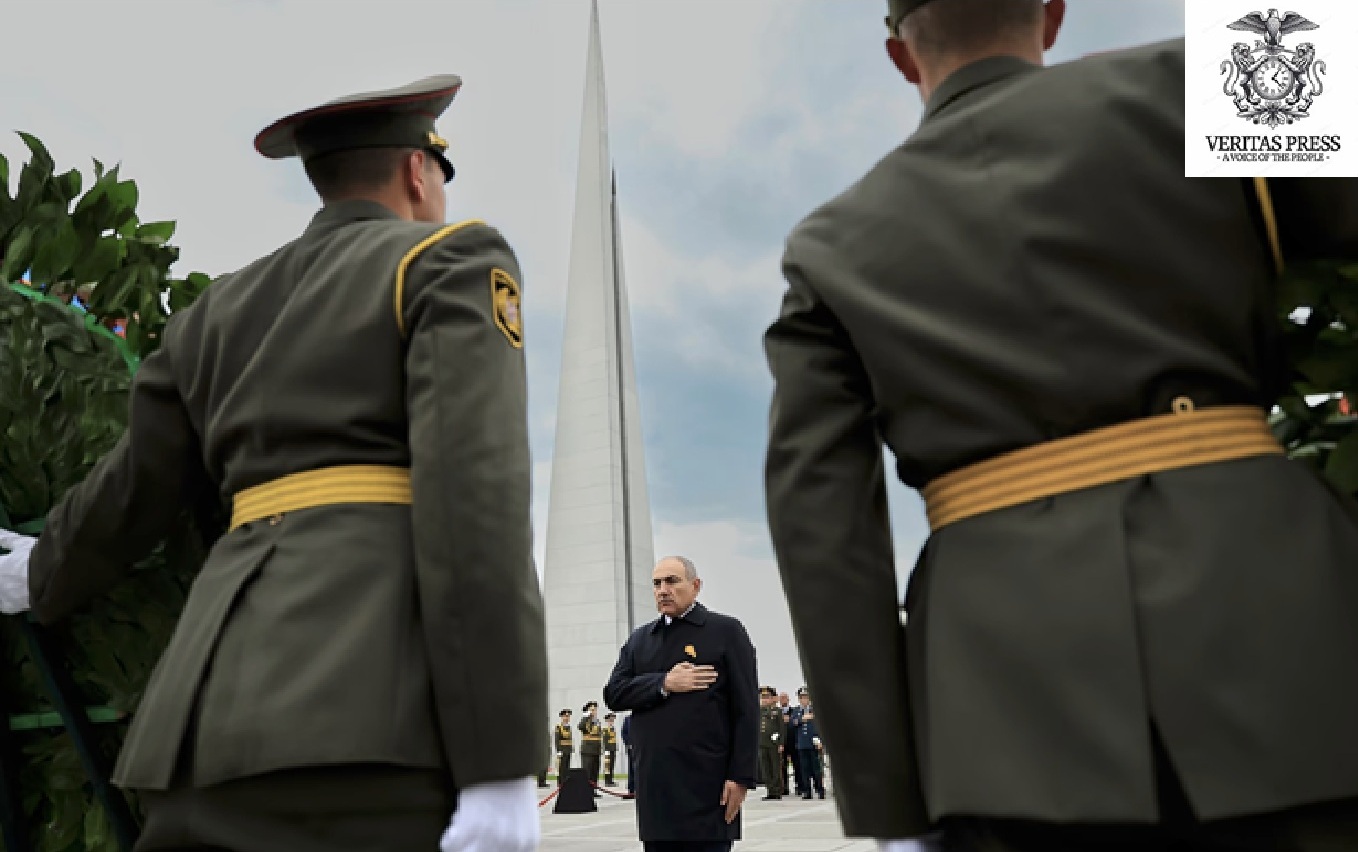
Getty Images
A Moral Duty, Suspiciously Timed:
Foreign Minister Sa’ar was unambiguous in his framing. “The Armenian Genocide remains to this day the subject of an institutionalised campaign of denial and minimisation, including a manipulative rewriting of history, mainly by the Turkish government,” he told the cabinet, according to a press release from his office. “I think the time has come for Israel, as a Jewish state, to formally accept this position.” On social media, he thanked Prime Minister Benjamin Netanyahu for backing a move that would “reject attempts to deny it.”
What Sa’ar did not mention was that Israel had, for more than seven decades, been a quiet participant in that very campaign of denial, burying parliamentary bills, muzzling its own historians and calibrating its silence to protect strategic ties first with Turkey and, later, with Azerbaijan. The abrupt reversal coincides, not accidentally, with the sharpest rupture in Israeli-Turkish relations since the founding of the two states. Since the Hamas-led attack of 7 October 2023 and Israel’s subsequent pulverisation of Gaza, President Recep Tayyip Erdoğan has recast himself as the region’s most strident anti-Israel voice. Ankara has cut trade, withdrawn ambassadors, and compared Netanyahu to Hitler. In Israeli defence circles, Turkey is now routinely described as “the next Iran”, a frame that the convicted spy Jonathan Pollard echoed publicly this year when he suggested that Turkey and Egypt would be Israel’s next military targets.
Against that backdrop, the genocide recognition reads not as a reckoning with history but as an asymmetric strike: a political weapon designed to wound Erdoğan on the most sensitive nerve of the Turkish state. “The timing is an insult to the memory of the victims,” said Aris Nalci, an Istanbul-based Armenian journalist and editor at the bilingual weekly Agos. “For a century, Israel looked the other way. Now, when it needs leverage, our pain becomes a useful coin. That is not solidarity; it is exploitation.”
The Armenian Cold Shoulder:
If the architects of the Israeli resolution hoped for a chorus of gratitude from Yerevan, they gravely miscalculated. Prime Minister Pashinyan has staked his political survival on a doctrine of “Real Armenia”, an attempt to break out of the victimhood narrative that has locked his country into decades of isolation, poverty and war with neighbours. Key to that project are painstaking normalisation talks with Turkey and a fragile peace process with Azerbaijan. An Israeli declaration that inflames Turkish nationalism is the last thing his government needs.
Speaking at a press briefing the day after the Israeli vote, Pashinyan underlined that “avoiding the politicisation of the issue is in Armenia’s interest. We see no need to respond.” Privately, Armenian diplomats are more blunt: the gesture is worthless if it risks the opening of the land border with Turkey and reignites revanchist opposition at home. For Yerevan, the Israeli move is at best an unhelpful distraction; at worst, it provides ammunition to nationalist hardliners in Ankara who have never wanted reconciliation.
“Pashinyan’s reaction was a masterclass in restraint, but also a message,” said Richard Giragosian, director of the Regional Studies Centre in Yerevan. “He’s essentially telling Israel: ‘We won’t be your proxy against Turkey. Our foreign policy is no longer for rent.’”
Azerbaijan Breaks Ranks:
Even more revealing was the response from Baku. Azerbaijan is one of Israel’s closest Muslim-majority partners, a major supplier of oil and a steadfast buyer of Israeli drones, missile systems and intelligence technology, a relationship that proved decisive during the 2020 Nagorno-Karabakh war. Yet within a day of the Israeli cabinet vote, the Azerbaijani foreign ministry publicly called on Israel to reconsider, describing the decision as a distortion of history that threatened regional stability.
“The rebuke signals just how reckless Israel’s move was perceived to be,” said Zaur Shiriyev, a Baku-based analyst for the International Crisis Group. “Baku cannot afford to be seen as complicit in a gesture aimed at Turkey, its strategic guarantor. Solidarity with Ankara trumps even the most lucrative defence contracts.” That solidarity is now codified in the Shusha Declaration and cemented by joint military drills, energy corridors and a shared position on Gaza, where both Baku and Ankara have condemned what they term Israeli genocide.
For Israel, the Azerbaijani protest is a tangible political cost. Jerusalem has spent years cultivating the Aliyev regime as a counterweight to Iran, using Azerbaijani airspace and intelligence assets on the Islamic Republic’s northern border. To see even Baku break ranks, analysts note, demonstrates how swiftly the weaponisation of the Armenian tragedy can boomerang, alienating a partner whose silence had been bought at a high price.
A Mirror Held Up To Israel:
Nowhere is the moral contradiction starker than in the domain where Israel most insists on its exceptionalism. The state that was built on the memory of the Shoah, and which has made the “absolute uniqueness” of the Holocaust a pillar of its diplomatic identity, now formally accuses another nation of genocide, while simultaneously fighting allegations of the same crime before the ICJ. The South African petition charging Israel with violating the Genocide Convention cites mass killing of Palestinian civilians, starvation as a method of war and statements from senior Israeli officials calling for the annihilation of Gaza. The International Criminal Court has issued arrest warrants for Netanyahu and former defence minister Yoav Gallant. United Nations special rapporteurs have documented acts that “amount to extermination.”
In the face of such evidence, Israel’s sudden ardour for the Armenian dead invites accusations of a cynical displacement strategy. “There’s a double perversion here,” said Raz Segal, an Israeli historian of genocide at Stockton University. “First, the state instrumentalises the memory of one genocide to attack a political rival. Second, it does so while erasing its own ongoing crimes. The effect is to hollow out the very concept of genocide, turning it into a diplomatic weapon rather than a legal and moral category with universal application.”
This selectivity has a further, less discussed dimension: Israel’s steadfast refusal to recognise the Holodomor, the Soviet-engineered famine of 1932-33 that killed millions of Ukrainians, as a genocide. The Knesset has blocked such recognition for years. Ihor Semyvolos, executive director of the Centre for Middle Eastern Studies in Kyiv, argues that Israel’s stance rests on two pillars: “a zealous defence of the absolute uniqueness of the Shoah, and pragmatic dealings with the Kremlin. As long as Israel thinks in terms of immediate tactical threats, the historical tragedies of other nations, whether Armenian or Ukrainian, will continue to be viewed in Tel Aviv’s offices not through the lens of universal morality, but as assets or risks on the current chessboard.”
A History Of Denial, Suddenly Ended:
To appreciate the cynicism of the moment, it is necessary to recall Israel’s decades-long record. Successive governments actively avoided the term “genocide,” fearing Turkish retaliation and the disruption of military-industrial ties with Azerbaijan. In 1982, Israel refused to participate in an international conference on the Holocaust and genocide for fear that the Armenian case would be mentioned. As recently as 2018, a Knesset bill to mark an official Armenian Genocide Remembrance Day was shelved after the foreign ministry warned that it would “harm Israel’s diplomatic interests.” Even the state’s own Holocaust museum, Yad Vashem, for years used euphemisms until a quiet shift in language in the early 2000s.
The moral gymnastics required for this posture have long been documented by activists. “The Israeli establishment has always known what happened to the Armenians,” said historian Tom Segev. “The refusal to name it was a political choice, not an epistemic one. That makes today’s resolution not a correction of a mistake, but the revelation of a transactional logic.”
Ankara’s Fury And The Diplomatic Fallout:
Turkey’s reaction was swift and furious. The foreign ministry issued a statement accusing Israel of “trying to cover up its own crimes in Gaza” and warned that the resolution would “poison the atmosphere of regional dialogue.” Ankara has long rejected the genocide label, describing 1915 as a mutual tragedy in which both Muslim and Christian communities suffered, and has repeatedly called for a joint commission of Turkish, Armenian and international historians to examine archival records.
“This is not about history,” said a senior Turkish diplomat who spoke on condition of anonymity. “This is Netanyahu’s cabinet, cornered by international law, lashing out at the country that has led the charge for accountability. They are trying to turn our own history into a weapon. It won’t work.”
Erdoğan’s government is now expected to ramp up its diplomatic offensive, likely appealing to Washington and European capitals to remind them that a politically motivated genocide recognition risks destabilising the South Caucasus just as the region inches toward peace. Turkey may also lean on Azerbaijan to harden its stance toward Israel, a development that could threaten Israeli overflight rights and intelligence cooperation along the Iranian border.
Knesset Hurdles And The Lobbying Ahead:
Despite Sunday’s unanimous cabinet vote, the resolution is not yet law. It must pass the Knesset, where the government’s coalition arithmetic is tight and where behind-the-scenes lobbying has already begun. Azerbaijan’s Jewish community, which enjoys close ties to Israel, is reportedly mobilising. Energy and defence contractors, wary of jeopardising the Baku pipeline, are also applying quiet pressure. Past experience suggests that a full parliamentary vote could be deferred indefinitely, a tactic that would give Israel the propaganda benefit of the cabinet statement while avoiding the irreversible diplomatic damage of formal legislation.
“Netanyahu’s history on this issue is one of symbolic gestures without legal follow-through,” said Anat Ben Nun, a lecturer in genocide studies at Tel Aviv University. “He gets the headline but not the law. It’s a pattern that allows Israel to posture as the conscience of the world while maintaining every strategic interest.”
Conclusion: Memory As A Missile.
In the end, the Israeli cabinet’s recognition of the Armenian genocide reveals more about the present than the past. It is a diplomatic missile aimed at Ankara, a test of loyalty for Baku, and a wedge intended to disrupt a slowly healing South Caucasus. That Yerevan, the supposed beneficiary, publicly dismissed it as an unnecessary provocation speaks volumes about how far Israel’s credibility has fallen. That the move comes from a government accused of extermination in its own right makes the moral pageantry impossible to ignore.
Armenian suffering was real; the historical record is overwhelming. But in the hands of a cabinet facing genocide charges and searching for ways to strike at a Muslim-led rival, that suffering is reduced to mere ammunition. As Prime Minister Pashinyan’s cold shoulder suggests, some gifts are not worth accepting, especially when they come wrapped in the blood of another people.
Source: Veritas Press C.I.C. | Multi News Agencies
Help Support Our Work By Donating
Popular Information is powered by readers who believe that truth still matters. When just a few more people step up to support this work, it means more lies exposed, more corruption uncovered, and more accountability where it’s long overdue.
Help Protect Independent Journalism, Which Is Currently Under Attack.
If you believe journalism should serve the public, not the powerful, and you’re in a position to help, becoming a DONATOR or a PAID SUBSCRIBER truly makes a difference.
DONATION APPEAL: If You Found This Reporting Valuable, Please Consider Supporting Independent Journalism.
Your support fuels our fearless, truth-driven journalism. In unity, we endeavour to amplify marginalised voices and champion justice, irrespective of geographical location. We operate independently, without any financial backing from billionaires.
But it’s also extremely important. One of Veritas Press’s greatest assets is its reader-funded model.
1. Reader funding means we can cover what we like. We’re not beholden to the political whims of a billionaire owner. We are a small, independent and impartial organisation. No one can tell us what not to say or what not to report.
2. Reader funding means we don’t have to chase clicks and traffic. We’re not desperately seeking your attention for its own sake: we pursue the stories that our editorial team deems important and believe are worthy of your time.
3. Reader Funding: enables us to keep our website and other social media channels open, allowing as many people as possible to access quality journalism from around the world, particularly those in places where the free press is under threat.
We know not everyone can afford to pay for news, but if you’ve been meaning to support us, now’s the time.
Your donation goes a long way. It helps us:
- Keep the lights on and sustain our day-to-day operations
- Hire new, talented independent reporters
- Launch real-time live debates, community-focused shows, and on-the-ground reporting
- Cover the issues that matter most to our communities, in real time, with depth and integrity
We have plans to expand our work, but we can’t do it without your support. Every contribution, no matter the size, helps us stay independent and build a truly people-powered media platform.
If you believe in journalism that informs, empowers, and reflects the communities we serve, please donate today.
Help By Donating Today
Submissions:
For The Secure Submission Of Documentation, Testimonies, Or Exclusive Investigative Reports From Any Global Location, Please Utilise The Following Contact Details For Our Investigations Desk: enquiries@veritaspress.co.uk or editor@veritaspress.co.uk
GENEVA — A United Nations fact-finding mission has concluded there are “reasonable grounds to believe”
Iran’s GDP is projected to contract by 5.4 to 6.1% in 2026, its worst performance
The Trump administration is preparing a $2.8 billion weapons package for Israel containing 40,000 2,000-pound

Film alleges mass civilian deaths are routinely built into military decisions amid Israel’s genocidal war
The Israeli rights group says violence, displacement, economic strangulation, and settlement expansion form part of

Houthi forces have captured the historic Red Sea port of Mocha and are advancing on
London’s historic sanctions against Israeli settlements mark a watershed moment in UK foreign policy, but
With 95% of Gaza’s population now wholly dependent on aid and more than 90% stripped
India calls for Kashmir and Ladakh to appear only on its official map after a
ISLAMABAD – In the high-stakes political theatre of Pakistan, the battleground has shifted from the




















wq7dwb
eh3gd5
fr68y8
xzk1zk
ah8989
t9vtjm