




Author:
Help support our mission, donate today and be the change. Every contribution goes directly toward driving real impact for the cause we believe in.
A Protest Movement Ignited By A Jared Kushner-Linked Luxury Development On Protected Coastline Has Erupted Into A Nationwide Civic Uprising Demanding The Resignation Of Prime Minister Edi Rama, Exposing Corruption, Oligarchic Capture, And The Fraying Legitimacy Of Albania’s Post-Communist Order.
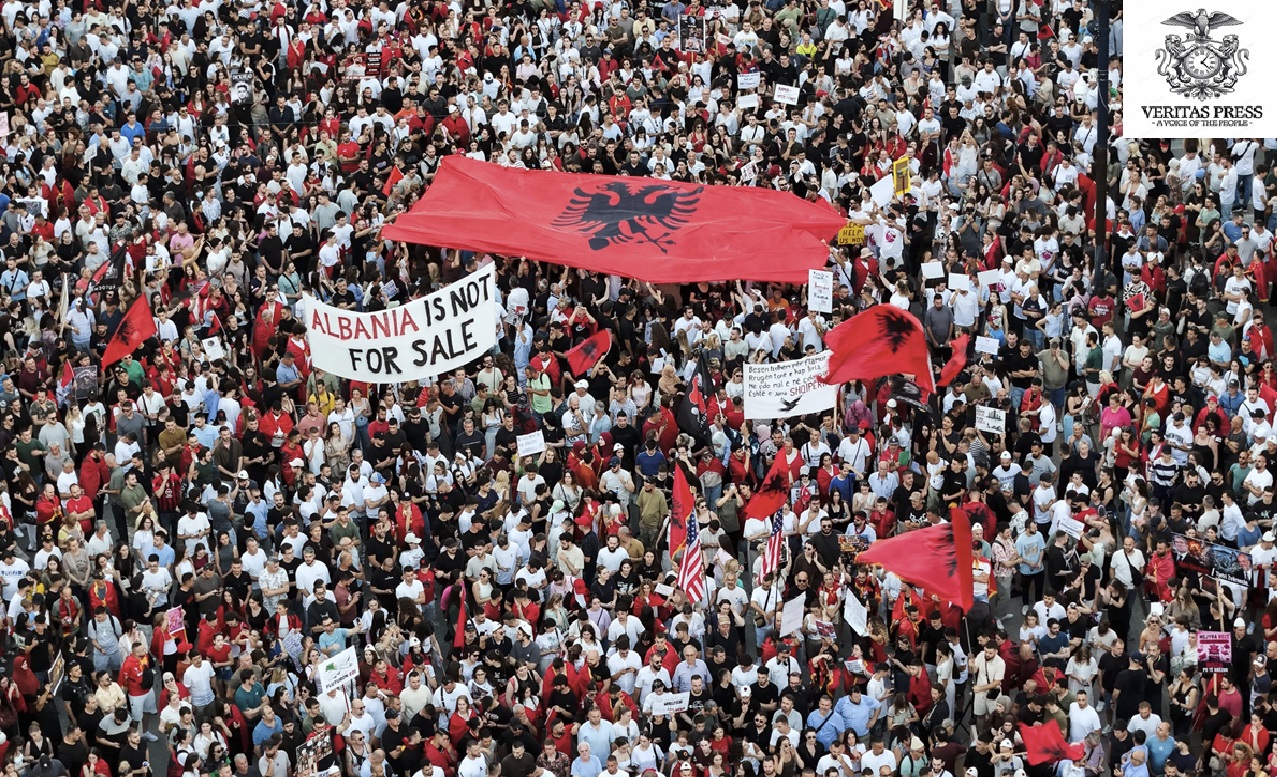
TIRANA, ALBANIA — On the fifteenth consecutive evening of protest, as thousands massed on Dëshmorët e Kombit Boulevard under a canopy of flamingo cut-outs, dubbed the flamingo revolution, and Albanian flags, a secondary-school teacher from Korça stepped to a makeshift microphone. Her voice, hoarse but steady, carried over the crowd and, within hours, across social media platforms that have become the movement’s circulatory system. “We must not be afraid,” she said. “We must kill fear. The corrupt rulers, criminals and thieves should be afraid, not us.”
The roar that answered her was not merely for a halted construction project or a contested environmental permit. It was the sound of a society that, after three decades of post-communist transition, emigration, and deepening disillusionment, has rediscovered a language of collective refusal. What began in late May 2026 as a localised objection to heavy machinery entering the protected Narta Lagoon near Zvërnec has metastasised into the most significant civic mobilisation Albania has witnessed in years, one that is now explicitly demanding the resignation of Socialist Prime Minister Edi Rama, fresh elections, and a reckoning with a political economy that protesters denounce as oligarchic, extractive, and detached from public accountability.
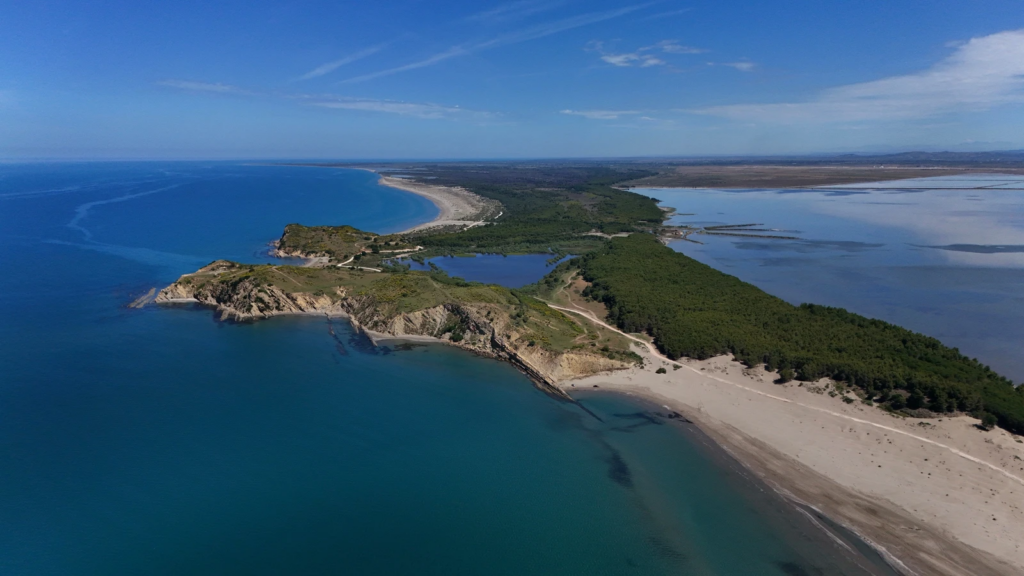
The immediate trigger is a proposed $4 billion luxury resort development spanning the uninhabited island of Sazan, a former Soviet submarine base and chemical weapons testing ground, and a five-mile stretch of beachfront on the Zvërnec peninsula, across the water from the island. The project has been granted strategic investment status by Rama’s government and is linked to Affinity Partners, the investment firm founded by Jared Kushner, son-in-law of U.S. President Donald Trump. In a podcast interview with David Senra earlier this month, Ivanka Trump described the couple’s “captivating” discovery of Sazan during a barefoot hike years ago, saying they “developed the opportunity” to transform it. “Not only the island, but we have five miles of beachfront directly across from the island,” she said. “This beautiful peninsula with a lagoon on one side, the ocean on the other, and beautiful white sand beaches.”
For many Albanians, that breezy narrative encapsulates everything wrong with a development model that treats public coastlines as discoverable assets for transnational capital while ordinary citizens are treated as obstacles. “It started with a national area being closed off to the public and having big lorries and trucks starting to build in a protected area,” said protester Eden Hosha. “We’re tired of these guys stealing from us. Stealing our resources. Selling things that are not theirs to sell.” Albi Batozi, a 34-year-old software engineer who grew up swimming at Zvërnec, stood on the sand holding a flag. “Public land is for everybody, not for just the small 1% of people,” he said. “I don’t want anyone to build here because this is our land.”
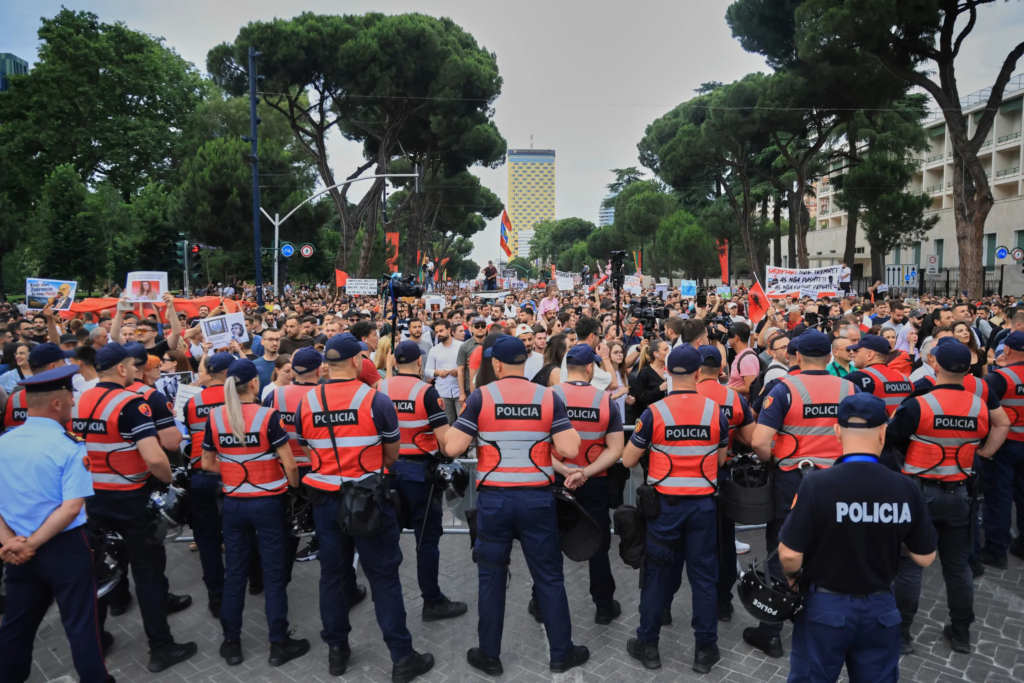
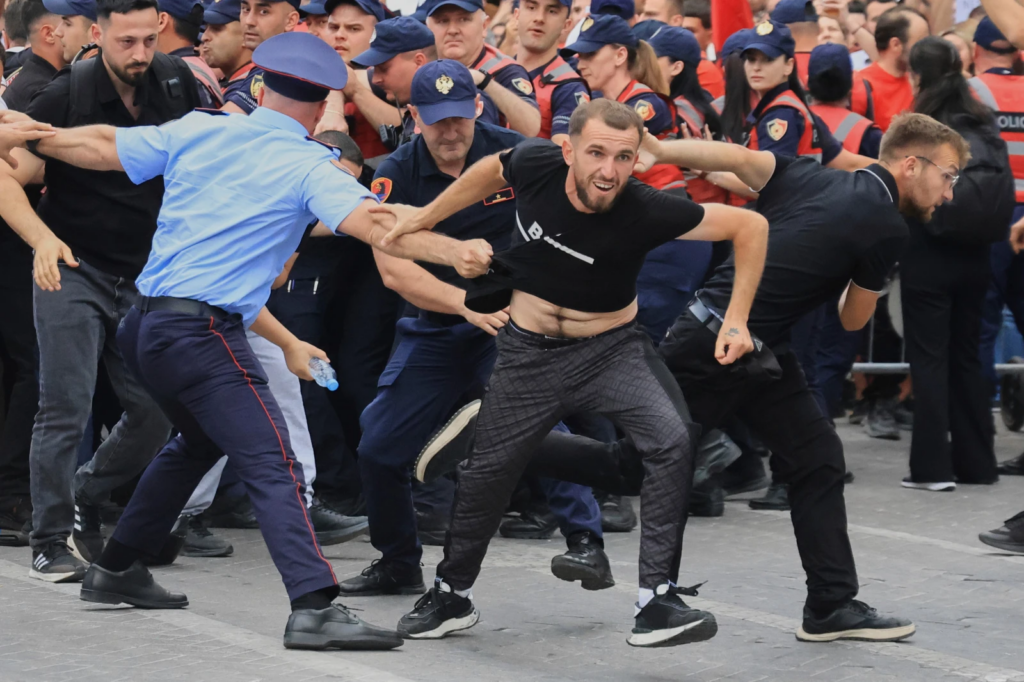
The protest movement has evolved with striking velocity. By the second week of June, rallies had spread from Tirana to Vlora, Durrës, Korça, and diaspora communities in Greece and other European countries. Demonstrators blow whistles, brandish cardboard flamingos, a symbol of the Narta Lagoon’s famed migratory birds, and chant “Albania is not for sale” and “Edi Rama out!” On June 3, police deployed water cannon to disperse crowds in the capital, and clashes erupted when private security guards were filmed dragging an activist at the construction site. The footage, widely circulated, became an accelerant.
An Ecosystem Under Siege:
At the heart of the environmental dimension is the Narta Lagoon, part of the Vjosa-Narta protected area, a critical stopover on the Adriatic flyway. Taulant Bino, head of the Albanian Ornithological Society, has catalogued over 250 bird species here: black-winged stilts, common and little terns, egrets, and greater flamingos that wade through the salinas, the glaringly white salt flats that shimmer beside the lagoon. When I met Bino on a desolate dirt track flanked by wetlands, he pointed to an access road bulldozed through the breeding zone. “Building an access road in the middle of the breeding season, for a lot of species, it’s horrendous,” he said. “It not only interrupts the breeding season, but it might also crush animals like amphibians and reptiles.” He described the project plans, up to 10,000 rooms, tall buildings, as “a new city rather than an environmental project.”
Dorian Matlija, a lawyer representing a coalition of environmental organisations that has filed legal challenges, underlined that the area is protected under multiple international frameworks, including the EU’s Natura 2000 ecological network, despite Albania not yet being a member state. “All of these say one thing: that you don’t develop anything big,” he explained. “You can only use the land or the area itself for agriculture, traditional agriculture, not intensive. You could also use it for fishing, but also traditional fishing, of course.” Yet in 2024, Rama’s government passed legislation stripping the area’s protection to allow for five-star hotel construction, designed and built for the elite, a move Matlija argues violates both Albanian and EU law. “This is also endangering our longtime dream [of] joining the EU,” he said. “If somebody tries to go to the court against that, they have a high chance of winning, and that’s a big problem for the investors.”
The European Commission has issued a pointed reminder that progress toward membership depends on adherence to environmental standards. Rama has dismissed environmental objections as “ideological nonsense” and insisted the project does not jeopardise Albania’s European aspirations. In an interview with the Associated Press, he vowed not to “step back” and defended his administration’s environmental record. “Albania should not be a country that fears an extraordinary project like this one, where exceptional partners have come together to invest 4 billion euros ($4.6 billion),” he said. “There is no chance for this investment to stop as long as I am here.”
The Shell Company Labyrinth:
As legal and environmental battles mount, investigative journalists have unearthed a corporate architecture of striking opacity behind the development. Lindita Cela, one of Albania’s most decorated investigative reporters, has spent months tracing a chain of shell companies stretching from Albania to the Netherlands. “You see one company, and you’ll see that ‘who owns this company?’ and it’s another company,” she said. “If you go to this company, then another one, and then you’ll find another one. This other company still brings you not any names, but to another company. You just need to keep digging, digging, digging.”
The trail, she said, resembles a set of Russian matryoshka dolls. Multiple entities share an address in Amsterdam and are capitalised at one euro each. At the centre is Interroyal BV, established in 2004 with €18,000 by a Russian citizen, Nikita Maximovich Vinogradov, and a Bulgarian citizen, Zoya Georgieva Gyurova, each holding 25%. Neither has a discernible public profile, yet on paper, they control hundreds of millions of euros’ worth of Albanian property. “From Albanian documents, it’s impossible to find out” who the ultimate beneficial owners are, Cela said. A representative of Sazan Real Estate Development, responding on behalf of Kushner’s Affinity Partners, stated that the firm “has no role in this project” and that “partners are involved as investors in their personal capacity.” The statement, attributed to businessman Asher Abehsera, added: “Our focus remains on responsible stewardship, environmental enhancement, job creation, and creating long-term value for local communities.”
But the opacity is now intersecting with a criminal investigation. On June 2, Albania’s Special Anti-Corruption Structure (SPAK) froze bank accounts and ordered the seizure of assets worth €138 million linked to Albania Land Development LLC, a company owned by the prominent Qatari brothers Moutaz and Ramez Al-Khayyat, who are helping finance the resort. The seizure relates to land sale contracts in Zvërnec, and SPAK is probing fraudulent property titles and suspected money laundering. According to material cited in the investigation, prosecutors are examining connections between land transactions in Zvërnec, construction projects in Tirana, and proceeds from international cocaine trafficking. SPAK has reportedly issued security measures against several figures. All suspects are presumed innocent, but the case has electrified the protests by connecting luxury coastal development, the tower boom in the capital, and illicit financial flows in the public imagination.
“We Must Remove The Regime”
What has transformed the protest from an environmental dispute into a political crisis is its explicit reframing as a challenge not just to a single project, or even a single leader, but to an entire system of governance. “We are not simply asking to remove Edi Rama,” one protester in Tirana said. “The prime minister has already fallen morally and politically. We must remove the regime that he and others have built.”
This language of “regime” has deep resonance. For many Albanians, the post-communist transition promised democracy, rule of law, and European integration, but delivered instead what critics describe as a captured state: centralised power, party control over institutions, public wealth channelled to a narrow elite, and a pervasive culture of fear that suppressed dissent. Under Rama’s decade-long rule, opponents and independent analysts say these tendencies have accelerated. The economy has become disproportionately dependent on construction and real estate, sectors that economists and foreign law enforcement officials have long warned are inflated by money of unclear origin. In Tirana, towers rise even as apartments stand empty and prices soar beyond the reach of average citizens. The skyline, detractors say, is a monument not to modernisation but to the power of unaccountable capital.
The protests have drawn a broad cross-section of society: Generation Z students, professionals, pensioners, mothers with children, and people with no prior party affiliation. An Albanian professor who had recently arrived from London described the atmosphere as almost miraculous. “What is happening is wonderful,” he said. “We never thought this would happen. Hope for change had almost disappeared. The idea that citizens would rise again against arrogance and fear seemed almost impossible.”
This emotional register, of a population that had protested for years in the tragic form of mass emigration, is central to the movement’s identity. Albania has lost an extraordinary share of its population in peacetime, not through war but through poverty, corruption, and the absence of hope. An expert on international relations noted that “Albanians have been protesting for years, but in a tragic way. They were leaving their country.” Now, many who might have left are staying to fill the squares.
Cracks In The Edifice:
The protests have begun to breach the walls of the ruling Socialist Party itself. On the fifteenth day of demonstrations, a Socialist MP announced she was leaving the parliamentary group to sit as an independent, declaring that her boundaries were set by the ideals she held before entering party politics. Former Foreign Minister Arta Dade refused an invitation and a medal during the party’s 35th-anniversary celebrations, calling the event an “anti-rally” and siding publicly with “young people in the square protesting for dignity and social rights.” Former Foreign Minister Ditmir Bushati labelled the demonstrations “protests of dignity” and warned that Rama was “playing with fire” by mocking public anger, adding that freedom inside the party had been extinguished. Former Finance Minister Arben Malaj went further, declaring the prime minister’s resignation a realistic objective because “Rama’s personal government is rotten and everything rotten eventually falls.”
These defections do not yet constitute an organised rebellion, but they signal that the movement’s moral authority has penetrated the political camp that sustained Rama’s long dominance. For a prime minister who has governed by concentrating personal power and marginalising internal dissent, the sight of former loyalists breaking ranks is a significant psychological blow.
Rama’s Counter-Narrative: Disinformation And Foreign Enemies.
Rama’s response has been to delegitimise the protests as the product of digital manipulation and hostile foreign interests. In his speech at the Socialist Party anniversary, he claimed that initial sincere concerns had been transformed by “half-truths and false claims about skyscrapers, wildlife and environmental damage.” He accused Iran, with which Albania severed diplomatic relations after a 2022 cyberattack, of exploiting public anger through online networks, and suggested that regional competitors like Greece, Croatia, and Montenegro had an interest in blocking Albania’s entry into high-end tourism. He also warned that the protests were harming the economy by triggering cancellations in Vlora and Durrës, and condemned online bullying against dissenters as “a fascist spirit” that needs no uniforms.
Protesters and independent analysts see these accusations as a familiar playbook: dismiss civic grievance as foreign manipulation, avoid engaging with the substance, and paint opposition as a threat to national stability. “There is a lot of manipulation. There are a lot of half-truths that become bigger and bigger lies by the hour,” Rama told the AP, specifically naming Iran. The government also issued a lengthy statement asserting that “the ambition is to create a new benchmark for sustainable Mediterranean development” and that “the government understands that major investments can generate public debate and differing opinions.”
Yet the strategy may be faltering. The demonstrations have persisted and grown, and the emergence of SPAK’s investigations has made the narrative of “foreign manipulation” harder to sustain. When anti-corruption prosecutors, the very institution that Western embassies have championed as the centrepiece of justice reform, are probing land fraud and money laundering connected to the project, the government’s insistence that all is well rings hollow.
The International Community’s Calculated Silence:
Western governments, particularly the United States and the European Union, have invested heavily in Albania’s justice reform and have consistently praised SPAK’s work. That support remains crucial. But local observers note a marked asymmetry: while embassies are vocal about the fight against corruption and organised crime, they have been far more circumspect when it comes to the political and economic system that enabled those phenomena to flourish. The silence, critics argue, amounts to complicity. By prioritising geopolitical stability and transactional cooperation, Albania is a NATO member, a reliable partner on migration, and a voice aligned with Western policy on Ukraine, international actors have effectively underwritten a system that speaks the language of Europe abroad while hollowing out democracy at home.
The question the protests pose to the EU is acute. Accession cannot be reduced to technical chapters and diplomatic photo-ops if the candidate country’s citizens are in the streets denouncing state capture. The European Commission’s mild rebuke on environmental standards stands in contrast to its relative quiet on the broader democratic backsliding that protesters are decrying. For the U.S., the optics are particularly delicate given that the project is tied to the president’s son-in-law, even if indirectly. An investment that appears to benefit a Trump family affiliate while ordinary Albanians are pushed aside risks feeding perceptions of a new form of great-power extraction dressed in the language of development.
A Cautionary Tale From Serbia:
The Zvërnec-Sazan saga is not without precedent in the region. In Serbia, a remarkably similar luxury development backed by Kushner’s investment firm, planned for a bombed-out military complex in Belgrade, collapsed last year after the organised crime prosecutor charged four people, including a government minister, with abuse of office and falsifying documents to strip the site’s heritage protection. Kushner subsequently withdrew from that multimillion-euro venture. The parallel is instructive: when legal protections are dismantled to accommodate politically connected investors, the fallout can extend from the courtroom to the street. In Albania, protesters are determined to ensure that this time, the street is heard before the concrete is poured.
The End Of Transition?
For analysts, the protests may mark the symbolic end of Albania’s protracted post-communist transition. The elite that emerged from the collapse of the dictatorship promised European modernity but reproduced many features of the old system, centralisation, personality cults, party patronage, and the fusion of political and economic power, under new guises. Now, a generation that has known only this dispensation is refusing to accept that emigration or silence are the only options.
“What is happening is not simply a protest against a resort,” said one commentator. “It is a referendum on a model of power that has exhausted the country.” Whether the movement can sustain its momentum, navigate internal divisions, and translate street energy into institutional change remains uncertain. But whatever the immediate outcome, the uprising has already achieved something that seemed improbable weeks ago: it has shattered the fear that for decades kept Albanians compliant, quiet, or on boats heading west. The flamingo has become an unlikely revolutionary symbol, and for the first time in a long while, many Albanians are looking not at the horizon but at each other, believing that the country they want is still worth fighting for.
Source: Veritas Press C.I.C. | Multi News Agencies
Help Support Our Work By Donating
Popular Information is powered by readers who believe that truth still matters. When just a few more people step up to support this work, it means more lies exposed, more corruption uncovered, and more accountability where it’s long overdue.
Help Protect Independent Journalism, Which Is Currently Under Attack.
If you believe journalism should serve the public, not the powerful, and you’re in a position to help, becoming a DONATOR or a PAID SUBSCRIBER truly makes a difference.
DONATION APPEAL: If You Found This Reporting Valuable, Please Consider Supporting Independent Journalism.
Your support fuels our fearless, truth-driven journalism. In unity, we endeavour to amplify marginalised voices and champion justice, irrespective of geographical location. We operate independently, without any financial backing from billionaires.
But it’s also extremely important. One of Veritas Press’s greatest assets is its reader-funded model.
1. Reader funding means we can cover what we like. We’re not beholden to the political whims of a billionaire owner. We are a small, independent and impartial organisation. No one can tell us what not to say or what not to report.
2. Reader funding means we don’t have to chase clicks and traffic. We’re not desperately seeking your attention for its own sake: we pursue the stories that our editorial team deems important and believe are worthy of your time.
3. Reader Funding: enables us to keep our website and other social media channels open, allowing as many people as possible to access quality journalism from around the world, particularly those in places where the free press is under threat.
We know not everyone can afford to pay for news, but if you’ve been meaning to support us, now’s the time.
Your donation goes a long way. It helps us:
- Keep the lights on and sustain our day-to-day operations
- Hire new, talented independent reporters
- Launch real-time live debates, community-focused shows, and on-the-ground reporting
- Cover the issues that matter most to our communities, in real time, with depth and integrity
We have plans to expand our work, but we can’t do it without your support. Every contribution, no matter the size, helps us stay independent and build a truly people-powered media platform.
If you believe in journalism that informs, empowers, and reflects the communities we serve, please donate today.
Help By Donating Today
Submissions:
For The Secure Submission Of Documentation, Testimonies, Or Exclusive Investigative Reports From Any Global Location, Please Utilise The Following Contact Details For Our Investigations Desk: enquiries@veritaspress.co.uk or editor@veritaspress.co.uk

The Trump administration is preparing a $2.8 billion weapons package for Israel containing 40,000 2,000-pound
Film alleges mass civilian deaths are routinely built into military decisions amid Israel’s genocidal war
The Israeli rights group says violence, displacement, economic strangulation, and settlement expansion form part of

Houthi forces have captured the historic Red Sea port of Mocha and are advancing on
London’s historic sanctions against Israeli settlements mark a watershed moment in UK foreign policy, but
With 95% of Gaza’s population now wholly dependent on aid and more than 90% stripped
India calls for Kashmir and Ladakh to appear only on its official map after a
ISLAMABAD – In the high-stakes political theatre of Pakistan, the battleground has shifted from the
Francesca Albanese says third states have an ICJ-mandated obligation to end Israel’s occupation. But with
As Israeli jets bomb a Syrian air base over alleged Turkish deployment plans, Ankara, Washington
















tfn611
2m40g1
i2036n