






Author:
Byline: Investigative Desk
Help support our mission, donate today and be the change. Every contribution goes directly toward driving real impact for the cause we believe in.
More than 99% of the Strip shows indicators of potential contamination from heavy metals, asbestos, explosive residues and raw sewage. A landmark Oxfam/CEOBS investigation reveals a crisis that will shape Palestinian health and survival for generations, and raises hard questions about accountability, reconstruction, and the weaponisation of the environment itself.
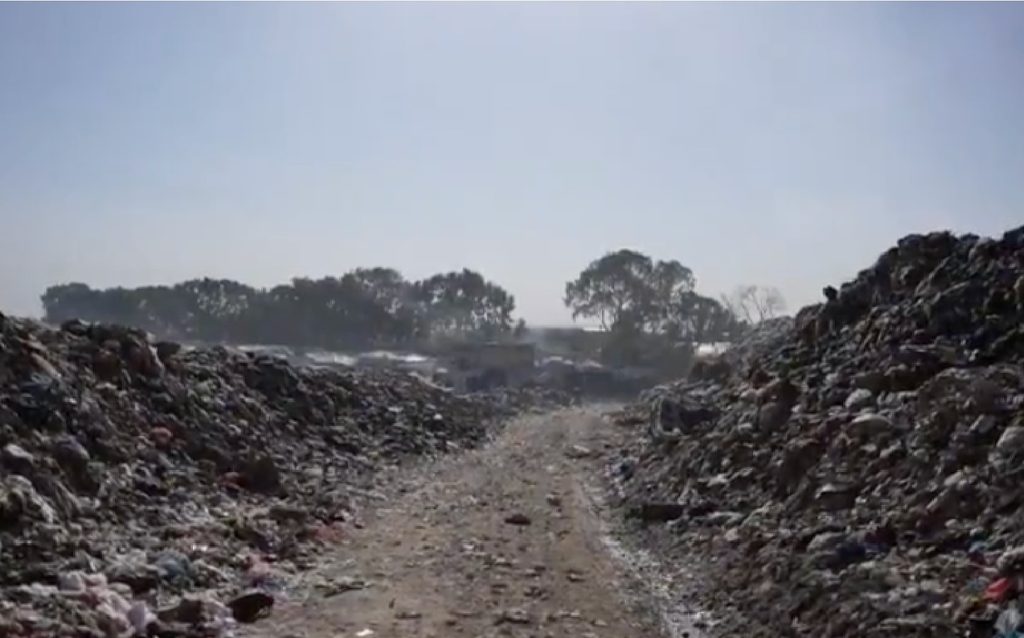
GAZA – On 23 November 2026, as world leaders were still recalibrating after the collapse of climate talks at COP31, Oxfam and the UK-based Conflict and Environment Observatory (CEOBS) released the most comprehensive spatial assessment to date of what three years of Israeli military assault have done to Gaza’s environment. The report’s title is blunt: Environmental War Crimes: How Israel’s military assault has turned Gaza into a toxic wasteland, threatening human survival. Its central finding is equally blunt. Indicators of potential contamination are present across more than 99% of the Gaza Strip, while the direct physical impact of Israel’s onslaught has affected approximately 78% of Gaza’s land area.
This is not a narrow pollution incident. It is the systemic degradation of the environmental life-support systems, air, soil, water, food, on which 2.3 million Palestinians depend. And it is happening in a territory so small, so densely populated, and so tightly sealed that escape from exposure is impossible. “It is horrifying to begin to understand the extent of toxic contamination being faced by the population, who can neither escape nor protect themselves properly from the dangers,” said Amitabh Behar, Executive Director of Oxfam International. “In an area as small, oppressed and densely populated as Gaza, continuous exposure is inevitable, with people surrounded by waste and sewage, spreading pests and the risk of disease growing.”
The report’s authors are careful with language: they identify indicators of potential contamination, not confirmed contamination at every point. But they argue that the evidence already available, satellite imagery, remote sensing, open-source data, and scientific analysis of conflict pollution and the decomposed bodies left buried beneath the mountains of rubble from other contexts is sufficient to conclude that contamination is “widespread, severe and consequential, with serious implications for public health and civilian survival.” Crucially, a full field-level assessment has been prevented by Israel’s continued refusal of independent access and restrictions on testing equipment and technical expertise. The world is being asked to plan Gaza’s reconstruction in the dark about the poisons buried in its rubble, soil and groundwater.
A Geography Of Poison
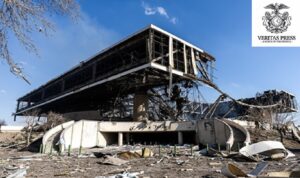
The Oxfam/CEOBS analysis maps a landscape of overlapping hazards. The highest levels of potential contamination are concentrated in Gaza City, Khan Younis, Rafah, Jabalia, and along the Salah al-Din Road, reflecting the combined impact of bombardment, widespread destruction, and multiple pollution sources. The contaminants are not abstract: heavy metals from munitions and destroyed industry; explosive residues from the more than 200,000 tonnes of explosives dropped on the Strip, a quantity a UN special rapporteur described as equivalent to the energy of roughly 13 Hiroshima-type nuclear bombs; asbestos from the destruction of older buildings, particularly in refugee camps where asbestos roofing was widespread; dioxins from fires; and biological pollutants from sewage and decaying organic matter.
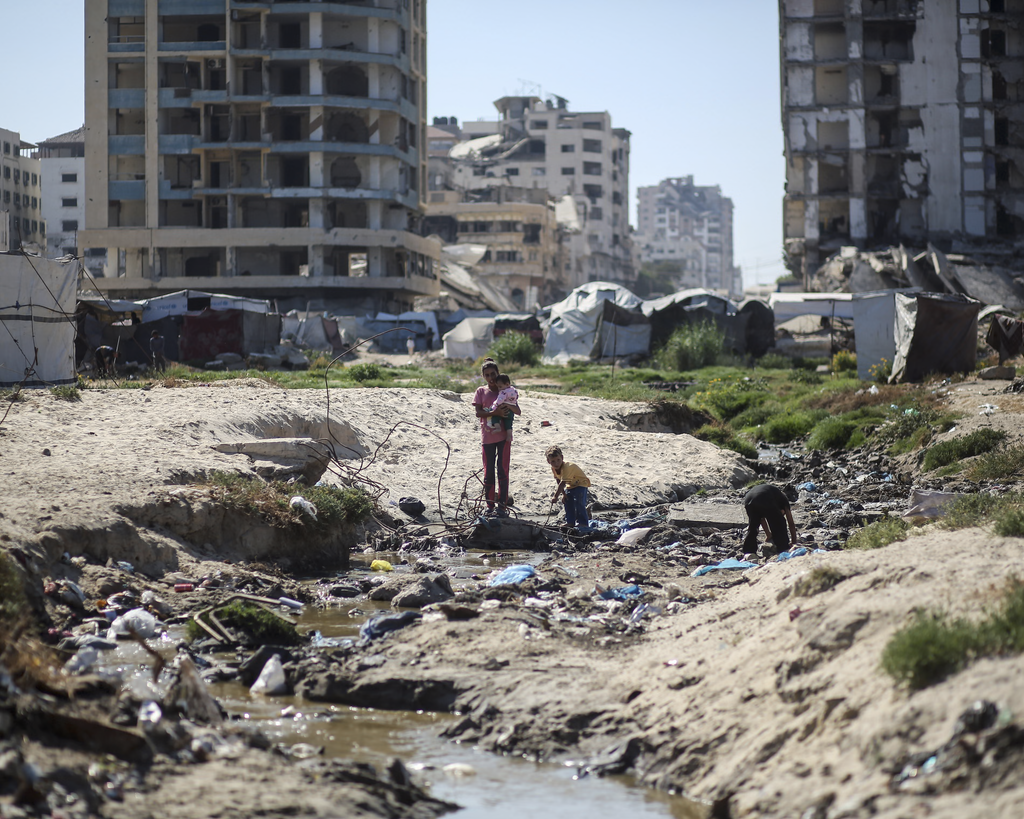
The debris alone is staggering. UNEP estimates that Israel’s military operations have generated more than 61 million tonnes of rubble, approximately 29 tonnes per person currently living in Gaza. Oxfam calculates this would require 2.1 million dump-truck loads to clear, equivalent to 736 trips around the circumference of the planet. This is not inert waste. It is a vast reservoir of hazardous materials, and every wind, every vehicle, every attempt at debris clearance sends contaminated dust back into the air that people breathe.
The Water Crisis: ‘We Wake Up To The Smell Of Sewage Instead Of The Sea Breeze’
Water is perhaps the most immediate vector of harm. Gaza’s Coastal Aquifer historically supplied 81% of the territory’s water, but even before October 2023, 97% of it was already chemically polluted due to overpumping under Israel’s blockade. The war has pushed it far beyond crisis. In July 2026, faecal coliform bacteria were detected in 19% of 79 groundwater wells sampled across Gaza, nearly ten times the 2% contamination rate reported in 2021. In North Gaza, Gaza City, and Deir al-Balah, the overlap of damaged infrastructure, vulnerable groundwater, accumulated debris, and sewage overflow creates the highest risks of drinking-water contamination.
The sanitation system has collapsed. Only 19% of sewage pumping stations remain functional, and just 30% of the wastewater network has any operational capacity. The result is that approximately 40,000 cubic metres of raw sewage pour into the Mediterranean Sea every day, with a further 15,000 cubic metres lost daily through cesspits and leakage into the ground. All six of Gaza’s wastewater treatment plants are out of operation.
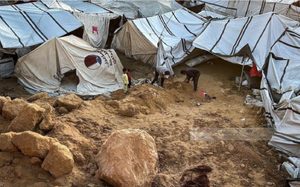
For Palestinians living in displacement camps, the consequences are visceral. “We wake up to the smell of sewage instead of the sea breeze,” Asaad Al-Najjar, a resident of Al-Shati refugee camp, told Felesteen newspaper. In al-Mawasi, Khan Younis, 45-year-old Omar Abu Salah lives with his four children in a worn-out tent surrounded by pools of wastewater. Mahmoud Abdel Nabi told WAFA that he was forced to dig a cesspit beside his tent because there is no functioning sewage network: “We wake up to the smell of sewage instead of the sea breeze”. Ahmed Al-Shayeb, 44, displaced from northern Gaza to a tent near Deir al-Balah, described the water he queues for hours as “salty like the sea,” leaving a dry white layer on children’s bodies that causes constant itching and skin infections.
The health data is already tracking this exposure. In January and February 2026 alone, Gaza recorded more than 1.9 million cases of acute respiratory infection and about 81,000 cases of acute watery diarrhoea, with more than 36,000 of the diarrhoea cases among children under five. In 2024, vaccine-derived poliovirus type 2 was detected in Gaza’s wastewater, and a child was later diagnosed with paralytic polio, the first reported case in Gaza in 25 years.
Children, Dust And The ‘Silent Epidemic’
The report identifies Gaza City, Jabalia, and the North Gaza Governorate as facing the highest risks of air contamination, as pollutants from bombardment and destroyed buildings are resuspended as dust by wind, vehicle movement, and debris clearance. This dust is not merely nuisance particulate matter. It carries asbestos fibres, silica, heavy metals, and combustion byproducts. Exposure is prolonged, inescapable, and compounded by malnutrition, displacement, and the systematic destruction of health infrastructure, a combination researchers writing in The Lancet have termed “siege pollution exposure respiratory syndrome” (SPERS), warning of “unprecedented intergenerational respiratory morbidity” because exposure is occurring during critical windows of fetal and child lung development.
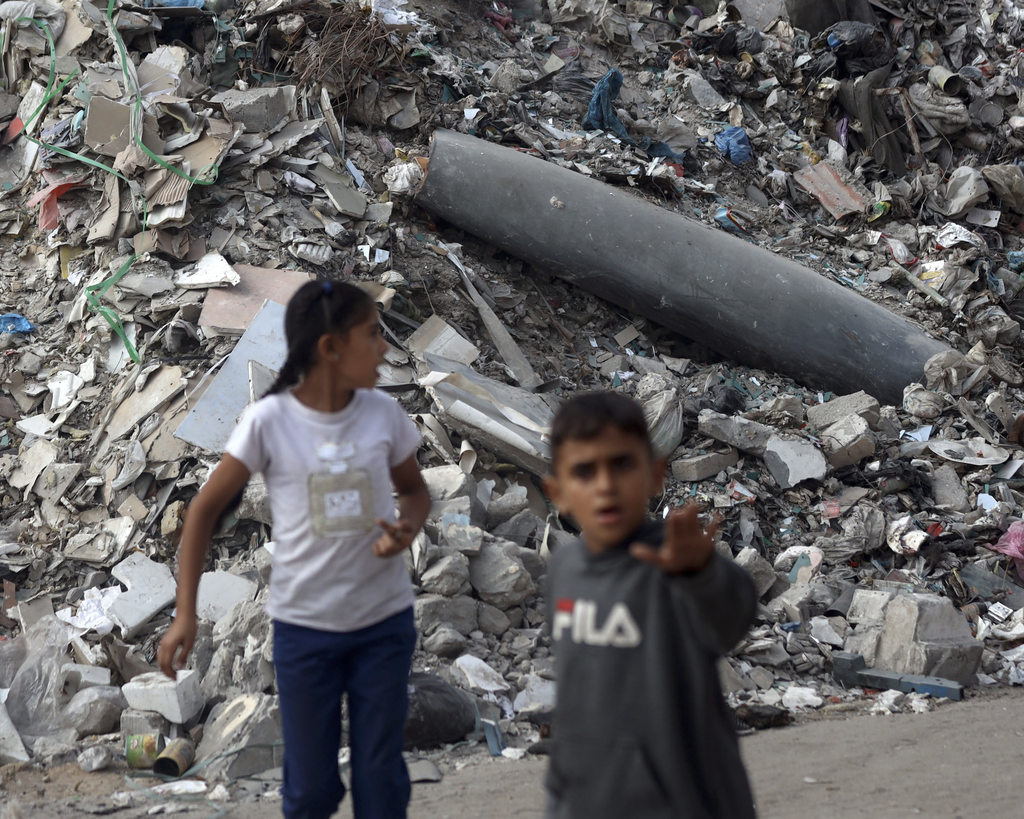
“There are going to be chronic health impacts that are long term because a lot of these contaminants are persistent in the environment,” Lama Abdul Samad, the report’s lead author and Oxfam’s global water and sanitation specialist, told the BBC. She warned that Gazans are likely to suffer from increased respiratory diseases, cancers, organ damage, and a rise in birth defects and stillbirths.
Doctors on the ground are already seeing the consequences. Dr. Alaa Abu Hajar, a Palestinian dermatologist, told the BBC he has seen a five-fold increase in chronic skin diseases since the start of the war, attributing it to environmental pollution and overcrowded, unhygienic living conditions in tents and displacement camps. “There are rodents, rubbish and sewage that spread through the streets,” he said. “Unfortunately, the age group most affected is children.” The World Health Organization has reported that acute respiratory infections in Gaza are 33,000 cases higher than at the same time the previous year, with heavy rains flooding tens of thousands of tents and worsening the crisis.
Food, Soil And The Destruction Of Livelihoods
Before October 2023, Gaza’s farms supplied about 95% of the fresh vegetables people ate. By late 2025, more than 87% of cropland was damaged, and only 3% was accessible and undamaged. More than one million olive trees had been uprooted by October 2024. Oxfam identified more than 7,200 damaged greenhouses and documented the destruction of facilities that preserved and distributed Palestinian seeds.
The report warns of a longer-term threat: around Beit Hanoun, Wadi Gaza, and northeastern Khan Younis, clay-rich soils are more likely to retain pollutants, increasing the risk of long-term contamination that could undermine agricultural production and food safety when farming resumes. Contaminants could enter crops and seafood, meaning that even as Palestinians attempt to rebuild their food system, they may be growing poison.
The fisheries, once producing about 4,660 tonnes of fish a year, have collapsed. The average daily catch from October 2023 to April 2024 was 7.3% of its 2022 level. Fisherman Abu al-Abed Sultan described the sea as a dumping ground: “Sewage and wastewater are discharged into the sea without treatment, and this is a great disaster. There is also rubble from destroyed houses that’s dumped into the sea. When we lower our nets, we catch rubble and garbage. This harms the marine environment; the fish are affected and so are the fishermen.”
The Legal Reckoning: Genocide, Ecocide And ‘Environmental War Crimes’
Oxfam does not shy away from legal characterisation. Behar explicitly frames the assault on Gaza’s environment as part of an “ongoing genocide” and describes it as “environmental war crimes threatening life now and for generations to come.” The report states that the destruction and contamination “would breach Israel’s legal obligations under international humanitarian and human rights law.” It further notes that the destruction of Gaza’s water, food, and sanitation systems may be relevant to alleged crimes under the Rome Statute and to assessing whether Israel violated the Genocide Convention.
This legal framing connects to a broader body of expert opinion. In September 2025, the UN independent international commission of inquiry found that Israel had committed genocide in Gaza. The International Court of Justice has said it is plausible that Israel has committed genocide. Separately, legal analysts have argued that the scale of environmental destruction also supports a case for ecocide, a crime not yet prosecutable at the ICC but increasingly recognised in international discourse. “Environmental destruction in Gaza is a calculated military strategy,” one analysis noted. “By poisoning the land and water, Israel is ensuring a calculated permanent and toxic genocide.”
Israel rejects these characterisations. In response to the genocide case at the ICJ, it has called the accusations “baseless and distorted” and maintains that its campaign is an act of self-defence against Hamas, claiming it takes steps to mitigate civilian harm. The Israeli mission in Geneva dismissed the UN commission of inquiry’s findings as a “libellous sham”. But the environmental data assembled by Oxfam and CEOBS is difficult to dismiss as rhetoric. It is spatial, measurable, and cumulative, and it points to a deliberate pattern of destruction that extends far beyond immediate military objectives.
Reconstruction Without Remediation Is A Public Health Trap
The report lands at a moment when international attention is shifting toward reconstruction. A joint World Bank, EU, and UN assessment has put direct physical damage at $35.2 billion** and economic losses at **$22.7 billion by October 2025, with recovery and reconstruction needs estimated at $71.4 billion over a decade. But Oxfam warns that rebuilding without first understanding and addressing contamination risks creating “long-term public health consequences for generations to come.”
“Fixing Gaza’s environment will be highly challenging because contamination is dispersed across the urban rubble, farmlands, water systems and soils, while unexploded ordnance continues to restrict safe access to most areas,” Abdul Samad said. She called for Israel to grant access for a detailed environmental assessment to clarify risks and identify urgent harm-reduction measures. Oxfam’s five-stage plan, securing access and reducing exposure, testing, screening and essential repairs, treating contaminated sites and managing hazardous waste, then rebuilding with safeguards and long-term monitoring, is a blueprint for a remediation process that could take years, if not decades, and that has no precedent in modern urban warfare.
“Rebuilding Gaza without simultaneously understanding and addressing the extent of environmental contamination risks creating long-term public health consequences for generations to come,” Behar said. Environmental recovery, he argued, “must not be treated as an afterthought, but as a vital undertaking in parallel.”
Conclusion: A Wasteland The World Helped Create
The Oxfam/CEOBS report is not an isolated warning. It is a synthesis of what Palestinian doctors, water engineers, farmers, fishers, and displaced families have been saying for three years: that Gaza is being made uninhabitable not only through bombs and displacement, but through the systematic poisoning of the air, water, soil, and food systems on which life depends. The report’s most damning implication is that this contamination is cumulative and persistent. Heavy metals do not degrade. Asbestos fibres lodge in lungs for decades. Faecal coliforms in groundwater are a marker of a sanitation collapse that will take years to reverse. And the rubble continues to leach.
The international community now faces a choice. It can fund a reconstruction that buries the toxins under new concrete and calls it recovery, or it can demand unfettered access for independent environmental assessment and Palestinian-led remediation before the first new foundations are laid. It can treat the environmental destruction of Gaza as collateral damage, or it can recognise it, as Oxfam and a growing number of legal experts do, as a continuum of violence that targets the very conditions of survival. The people of Gaza are already living with the consequences. The question is whether the world will look away from the science, the testimony, and the law, or whether it will finally hold accountable those who turned a homeland into a toxic wasteland.
Veritas Press Investigative Analysis
Independent journalism examining global affairs, power, diplomacy, and accountability.
Source: Veritas Press C.I.C. | Multi-News Agencies
Help Support Our Work
Readers who believe that truth still matters have power over popular information. When just a few more people step up to support this work, it means more lies exposed, more corruption uncovered, and more accountability where it’s long overdue.
Help Protect Independent Journalism, Which Is Currently Under Attack.
If you believe journalism should serve the public, not the powerful, and you’re able to help, becoming a regular DONOR or a PAID SUBSCRIBER truly makes a difference.
DONATION APPEAL: If you found this reporting valuable, please consider supporting independent journalism.
Your support fuels our fearless, truth-driven journalism. In unity, we endeavour to amplify marginalised voices and champion justice, irrespective of geographical location. We operate independently, with no financial backing from billionaires; our readers support us.
But it’s also extremely important. One of Veritas Press’s greatest assets is its reader-funded model.
1. Reader funding means we can cover what we like. We’re not beholden to the political whims of a billionaire owner. We are a small, independent and impartial organisation. No one can tell us what not to say or what not to report.
2. Reader funding means we don’t have to chase clicks and traffic. We’re not desperately seeking your attention for its own sake; we pursue the stories that our editorial team deems important and believes are worthy of your time.
3. Reader Funding: enables us to keep our website and other social media channels open, allowing as many people as possible to access quality journalism from around the world, particularly those in places where the free press is under threat.
We know not everyone can afford to pay for news, but if you’ve been meaning to support us, now’s the time.
Your donation goes a long way. It helps us:
- Keep the lights on and sustain our day-to-day operations
- Hire new, talented, independent reporters
- Launch real-time live debates, community-focused shows, and on-the-ground reporting
- Cover the issues that matter most to our communities, in real time, with depth and integrity
Without your support, independent voices like ours will be silenced.
Furthermore, we have plans to expand our work, but we can’t do it without your support. Every contribution, no matter the size, helps us stay independent and build a truly people-powered media platform.
If you believe in journalism that informs, empowers, and reflects the communities we serve, please donate today.
You Can Make Direct Bank Transfer Donations To
Bank Name: Bank Of Scotland
Account Name: Veritas Press C.I.C.
Sort code: 80-22-60
Account Number: 27540469
IBAN #: GB18-BOFS-6027-5404-69
Donate Online
Submissions
For the safe submission of documentation, testimonies, or exclusive investigative reports from anywhere in the world, please use the following contact details for our Investigations Desk: mailto:enquiries@veritaspress.co.uk or mailto:editor@veritaspress.co.uk.

Should the government decide what Americans are allowed to eat, especially when the food comes
More than 99% of the Strip shows indicators of potential contamination from heavy metals, asbestos,
Brussels Reset or Brexit Return? Downing Street calls it a done deal, but the SPS,
Three attacks, one system: how incitement from the top and impunity on the ground turned

No knives were found in the Operation Advance sweep, so the case for the tactic

Fuel at record highs, a Bank of England rate rise, and a January energy-bill jump
As Khan warns of a brain haemorrhage and Bushra Bibi petitions over her failing sight,
With Welsh Labour reeling from a historic Senedd defeat and Welsh exporters still counting the
COP31’s Credibility Gap: From a $305 Billion Adaptation Need to a $30 Billion Trickle, From
As Denmark’s Supreme Court weighs whether “non-Western” is a neutral statistic or a racial proxy,