Kamran Faqir is a volunteer investigative journalist and writer committed to exposing hidden truths and amplifying underreported stories. Driven by social justice, he brings sharp insight and fearless truth-telling to independent journalism. NUJ registered.
Original Article Date Published:
Article Date Modified:
Listen to this article
Help support our mission—donate today and be the change. Every contribution goes directly toward driving real impact for the cause we believe in.
A flagship UN report redefines the global water crisis, not as a series of temporary emergencies, but as a permanent state of insolvency. With half the world’s food production at risk and billions already affected, scientists call for a fundamental reset of how humanity governs its most precious resource.
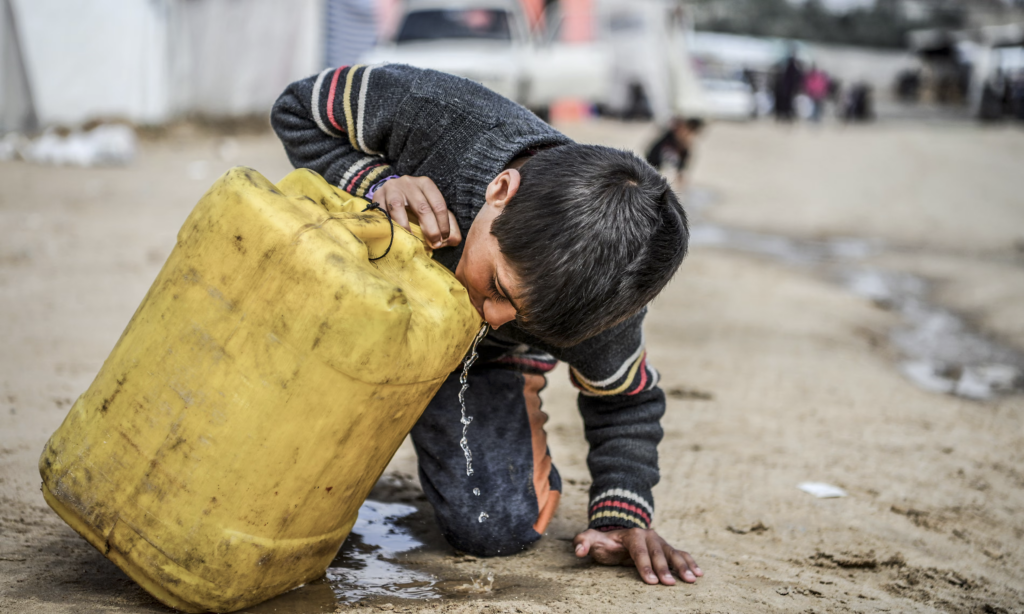
A child drinks from a plastic container in Gaza. More than 2 billion people lack access to safe drinking water. Photograph: Abed Zagout/Anadolu via Getty Images
For decades, the world has spoken of a “water crisis”, a term that implies a temporary shock, a disaster from which recovery is possible. On January 20, 2026, United Nations scientists shattered that paradigm. In a landmark report that has sent ripples through the halls of power from Washington to New Delhi, researchers formally declared that humanity has exited the era of crisis and entered the age of “Global Water Bankruptcy.”
The report, Global Water Bankruptcy: Living Beyond Our Hydrological Means in the Post-Crisis Era, published by the UN University’s Institute for Water, Environment and Health (UNU-INWEH), is not merely another warning. It is an obituary for “normal.” It is a forensic accounting of a planet that has systematically looted its own natural capital, leaving a legacy of collapsed aquifers, desiccated wetlands, and a future defined by permanent scarcity for billions.
“This report tells an uncomfortable truth: many regions are living beyond their hydrological means, and many critical water systems are already bankrupt,” said lead author Kaveh Madani, Director of UNU-INWEH. “If we continue to manage these failures as temporary crises with short-term fixes, we will only deepen the ecological damage and fuel social conflicts”.
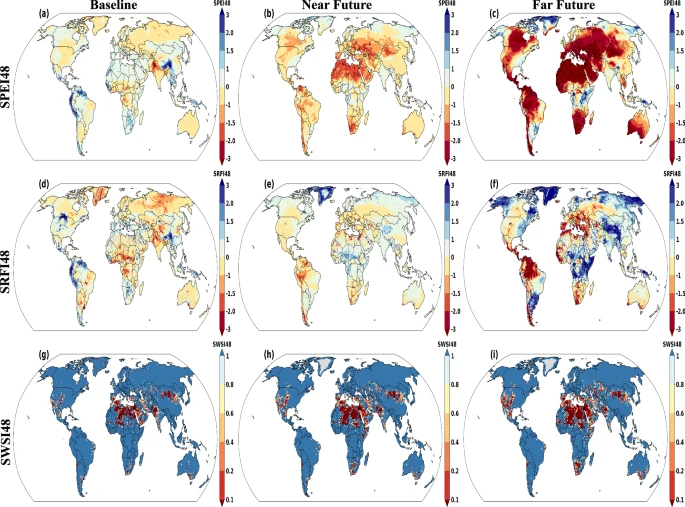
The first column panel shows the ensemble mean of water stress for the pre-industrial period (1850–1899), which is considered as the baseline period, the second column panel for the near future (2020–2050), and the third column panel for the far future (2070–2100). a–c Present the Standardised Precipitation-Evapotranspiration Index (SPEI48), indicating long-term climatic water balance at a 48-month timescale. d–f Show the Standardised River Flow Index (SRFI48), capturing hydrological drought conditions at a 48-month timescale. g–i Depict the Standardised Water Scarcity Index (SWSI48), reflecting the ratio of total water supply to total water consumption at a 48-month timescale. Each panel represents the ensemble mean, illustrating the spatial pattern and severity of compound water stress indicators over time. Negative values of SPEI48 and SRFI48 indicate increasingly dry conditions, while lower SWSI48 values (i.e., supply-to-demand ratios below normal) signal intensifying water scarcity driven by growing demand. Together, these projections reveal areas at high risk of compound, long-term water stress under future climate and socio-economic scenarios.
Beyond Crisis: Defining A New Reality.
The report’s core innovation is its rigorous definition of “water bankruptcy.” Moving beyond the colloquial, it establishes two distinct criteria:
Insolvency: The persistent over-withdrawal and pollution of surface and groundwater relative to renewable inflows and safe depletion limits.
Irreversibility: The resulting loss of water-related natural capital (glaciers, groundwater reserves, wetlands) that is either permanent or prohibitively expensive to restore.
This distinction is critical. “Water stress” is reversible. A “water crisis” implies an acute shock that can be overcome. “Water bankruptcy,” however, describes a post-crisis failure state. It means the rivers of the American Southwest, the aquifers beneath the breadbaskets of South Asia, and the glaciers feeding the great rivers of Asia cannot be brought back to their 20th-century baselines. The “savings accounts” of the planet, the ancient groundwater and ice, have been spent, and the “checking account” of annual rainfall is no longer sufficient to cover the bills.
While the report stops short of declaring the entire planet insolvent, it warns that enough critical systems have crossed this threshold to fundamentally alter the global risk landscape. These systems are interconnected through trade, migration, and climate feedbacks; a drought that bankrupts a farm in Punjab now ripples through global food prices and geopolitical stability.
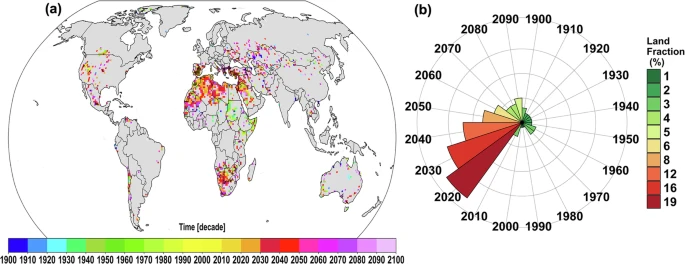
a Spatial distribution of the decadal ToFE of DZD events across the globe from 1900 to 2100. Colored shading indicates the first decade during which DZD becomes statistically attributable to anthropogenic climate change, defined as the first decade in which the Fraction of Attributable Risk is greater than 0.99 (FAR ≥ 0.99). Gray regions indicate grid cells where no DZD event attributable to anthropogenic climate change is projected to emerge before 2100. For regions with reservoirs, the ToFE is considered to be the first decade after the year of completion (Supplementary Fig. 6) of their respective reservoirs, when all DZD criteria are simultaneously met. By aligning the emergence timing with the operational onset of water storage infrastructure to reflect the real-world system resilience dynamics. The black stars denote the locations of the reservoirs threatened by DZD emergence. b Circular diagram illustrating the temporal distribution of ToFE by decades. The colour scale indicates the percentages of grid cells (land areas) experiencing their ToFE distribution in each decade from 1900 to 2100. It provides a temporal overview of how the ToFE is distributed over time and the trends in DZD emergence.
A World In The Red: The Data Of Desiccation.
The statistical evidence presented in the report paints a stark picture of a world in hydrological deficit, updated with the latest scientific evidence :
The Vanishing Savings Account: More than 50% of the world’s large lakes have lost water since the early 1990s. In the same period, humanity has erased 410 million hectares of natural wetlands, an area nearly the size of the European Union. The ecosystem services lost are valued at over $5.1 trillion annually.
Groundwater Collapse: With 70% of major aquifers in long-term decline, the world’s backup water supply is failing. This has triggered land subsidence affecting 2 billion people, with some cities like Rafsanjan, Iran, sinking by 30 cm per year. In the U.S., parts of California’s Central Valley are dropping precipitously, permanently reducing the storage capacity of the aquifer.
The Human Toll: Nearly 4 billion people face severe water scarcity for at least one month each year. Approximately 2.2 billion people lack safely managed drinking water, and 3.5 billion lack safely managed sanitation, making a mockery of Sustainable Development Goal 6. UN data now confirms that progress towards this goal has shifted from “off track” to entirely “unattainable”.
The Food System on the Brink: Agriculture, which accounts for 70% of global freshwater withdrawals, is both the cause and the victim of this bankruptcy. Over 170 million hectares of irrigated cropland, equivalent to the combined area of France, Spain, Germany, and Italy, are under high water stress. Crucially, more than half of global food production occurs in areas where total water storage is declining or unstable.
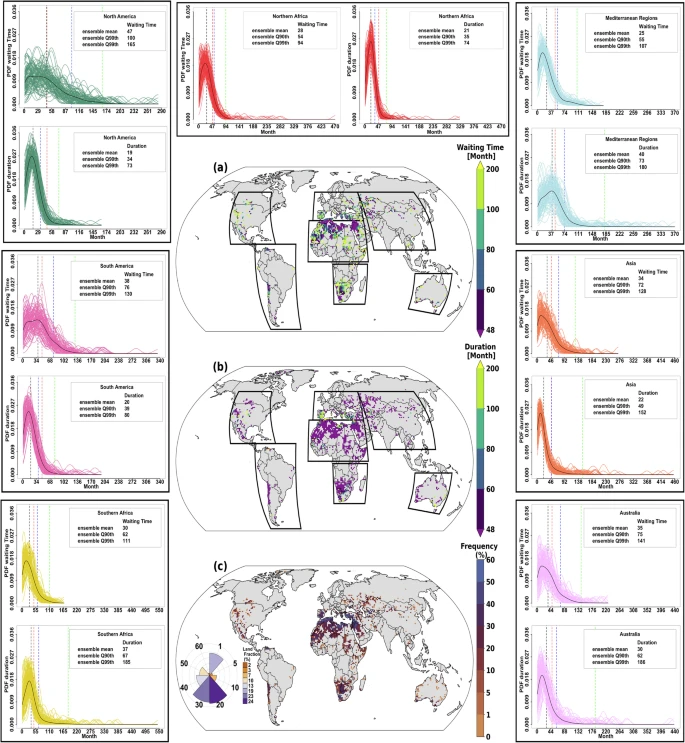
The central spatial map shows the spatial distribution of the ensemble-mean waiting time (a) and duration (b) of DZD events, respectively, following the Time of First Emergence (ToFE) at each grid point of DZD-prone regions across the globe. c represents the spatial distribution of the frequency (%) of extreme DZD events, defined as those where the event duration exceeds the waiting time, indicating prolonged water scarcity impact and short recovery period. The accompanying inset circular diagram of c illustrates the distribution of these events, with the colour scale indicating the proportion (percentages) of grid cells experiencing such conditions. This visualisation highlights where and how frequently extreme DZD conditions with long duration and short waiting time emerge. The surrounding paired panels depict the Probability Density Function (PDF) of waiting time and duration for DZD events across seven DZD-prone regions. Colored lines represent the PDF of each ensemble of 100 CESM2-LE, while the black line is the ensemble mean of the respective PDF. The vertical dashed lines mark the ensemble mean (black), 90th percentile (blue), and 99th percentile (green) for each region. The red dashed line represents the monthly scale of the compound extreme event, which is 48 months. The period considered for each grid point started from the month after each decade of their respective ToFE and continued until 2100.
The New Geopolitics Of Thirst:
As water systems fail, the political landscape is fracturing. The updated 2026 Water Conflict Chronology, maintained by the Pacific Institute, documents a dramatic surge in water-related violence, rising from 235 incidents in 2022 to 419 in 2024. Water is no longer just a weapon of war, as seen in conflicts in Gaza and Ukraine; it is becoming a direct driver of social unrest.
“In East Africa and the Sahel, people are moving into new areas to access water, which in itself can trigger competition and conflict with the host population,” said Joanna Trevor, Oxfam’s water security lead.
Kaveh Madani highlights Iran as a case study in hydrological collapse leading to political instability. Years of drought, the near-total loss of Lake Urmia, and the depletion of groundwater have contributed directly to widespread protests, demonstrating how water bankruptcy can quickly become an existential threat to regimes. Meanwhile, in the western United States, negotiations over the Colorado River remain deadlocked, with experts warning that its reservoirs could hit “dead pool”, a level so low that water cannot flow through dams, as soon as 2027.
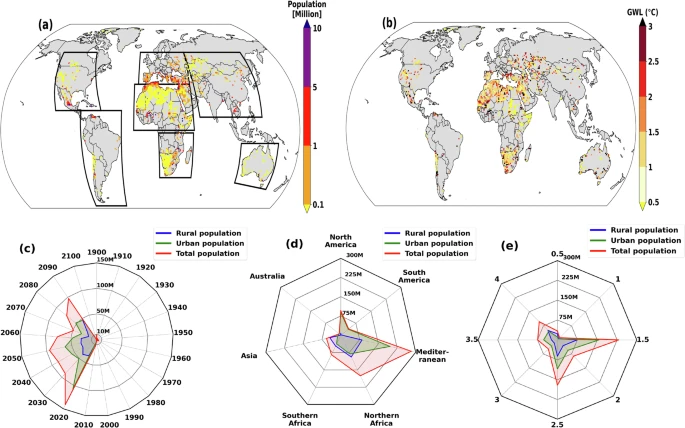
a Spatial distribution of the total population exposure at the ToFE of DZD across the global DZD-prone regions. The colour scale indicates the total population (urban and rural) exposed when DZD first emerges in each grid cell. b Global distribution of the Global Warming Level (GWL, in °C above preindustrial) corresponding to the ToFE of DZD, providing insight into the warming levels associated with the onset of DZD events. c Circular diagram illustrating the rural, urban, and total population exposure to DZD at the ToFE, spanning the period from 1900 to 2100. d Regional distribution of rural, urban, and total populations affected by DZD, computed as the sum of exposed respective rural, urban, and total population within each regional hotspot (demarcated black box in a) at their respective ToFE. e Distribution of population exposure relative to the GWL at ToFE. Radar plots c–e emphasize the relative contributions of rural and urban populations to total exposure, highlighting disparities in vulnerability and exposure across both time and regions.
Dakar To Abu Dhabi: A New Agenda Or More Of The Same?
The report’s release was timed to influence a high-level preparatory meeting in Dakar, Senegal, in late January, which set the stage for the UN 2026 Water Conference in December, co-hosted by Senegal and the UAE in Abu Dhabi.
In Dakar, the rhetoric shifted. Henk Ovink, the former Dutch envoy, framed the coming months as a critical window for action. The co-chairs of the conference’s Interactive Dialogues presented a grim assessment. Ghana and Switzerland, leading the “Water for People” dialogue, stated bluntly that achieving universal access to water and sanitation is now an “unattainable” goal without a massive escalation in political will and a move beyond outdated financial models.
This sets the stage for a high-stakes conference in Abu Dhabi. The central question is whether the “bankruptcy” framework will lead to radical change. The UNU report demands a new global agenda that:
Formally recognises the state of water bankruptcy.
Rebalances water rights to match degraded carrying capacity, a politically explosive proposition in water-hungry economies.
Treats water as an upstream investment in climate action and peacebuilding, rather than a downstream victim of other crises.
Critique And Counterpoint: Is “Bankruptcy” The Right Word?
While the scientific community largely supports the report’s findings, the terminology itself has sparked debate. An opinion piece on illuminem argues that while the “natural capital” analogy is useful, declaring “bankruptcy” carries significant risks. It could be misconstrued as an admission of defeat, implying that mitigation efforts are pointless and potentially leading the international community to write off entire regions as unsalvageable. The author, echoing a sentiment of “radical optimism,” worries that the term is counterproductive, even if the diagnosis is accurate.
Others point to the “elephant in the room”: population growth. Dr. Jonathan Paul of Royal Holloway, University of London, argues that addressing unsustainable population increases is more fundamental than “tinkering with outdated water resource management frameworks”. The report acknowledges this tension, placing the need for “just transitions” for vulnerable communities, smallholder farmers, Indigenous Peoples, and women at the heart of its policy prescriptions, noting that those who benefited least from the era of overuse are suffering most from its end.
Local Consequences In A Globalised World:
The concept of global bankruptcy is hitting home even in regions traditionally considered water-secure. In Canada, which holds 20% of the world’s surface freshwater, the illusion of abundance is being challenged. By the end of 2025, 77% of the country was abnormally dry. The Great Lakes, while vast, are far more delicate than they appear, with only 1% of their water replenished annually. Rising industrial demand, particularly from data centres serving the AI boom, is placing new stress on groundwater aquifers, drawing comparisons to the intensive water use seen in the Netherlands.
For the Anishinabek Nation in the Great Lakes basin, this new era is a confirmation of longstanding concerns. Grand Council Chief Linda Debassige has raised alarms over Ontario’s permit system, which she argues allows corporations to assume large-scale water takings without meaningful consultation or environmental assessment. “Water is sacred,” she stated. “It is not a commodity to be transferred between corporations without scrutiny, consent or accountability” This tension between commodification and rights-based governance lies at the heart of the coming political struggle over water.
Conclusion: Managing Insolvency, Not Crisis
“We cannot rebuild vanished glaciers or reinflate acutely compacted aquifers,” Madani concedes. “But we can prevent further loss of our remaining natural capital, and redesign institutions to live within new hydrological limits”.
The era of global water bankruptcy is not a prediction; it is a declaration of the present. The world’s response to its own insolvency, whether it chooses managed decline, conflict, or a cooperative restructuring of its water economy, will define the 21st century. The UN’s message is clear: the time for crisis management is over. The long, difficult work of bankruptcy management has begun.
Kamran Faqir is a volunteer investigative journalist and writer committed to exposing hidden truths and amplifying underreported stories. Driven by social justice, he brings sharp insight and fearless truth-telling to independent journalism. NUJ registered.
SEATTLE, TEHRAN — The U.S. Department of Homeland Security (DHS) will allow Iran’s national football team to enter the country 48 hours before their critical World Cup match against Egypt on Friday, a modest concession in a tournament where Team Melli’s travel conditions have sparked claims of oppression and competitive disadvantage.