Kamran Faqir is a volunteer investigative journalist and writer committed to exposing hidden truths and amplifying underreported stories. Driven by social justice, he brings sharp insight and fearless truth-telling to independent journalism. NUJ registered.
Article Date Published:
Article Date Modified:
18 minutes
Views:346
Listen to this article
Help support our mission, donate today and be the change. Every contribution goes directly toward driving real impact for the cause we believe in.
WASHINGTON, D.C.— In the chaotic, high-stakes ecosystem of Donald Trump’s White House, a small army of aides orchestrates the daily theatre of the presidency. Among the most invisible yet vital is the teleprompter operator, a technician who must navigate the President’s mercurial relationship with prepared remarks. For nearly a decade, Gabriel “Gabe” Perez was that ghost in the machine, a constant, trusted presence who was, as Trump himself once mused, “really like gold.” Today, Perez is gold no more. He is the central figure in a scandal that is not merely a tale of personal greed but a flashpoint in a sprawling legal and ethical war over the future of gambling, insider trading, and the presidency itself.
A joint investigation by ABC News and subsequent confirmations from federal sources have revealed that Perez, 46, a veteran Deputy Assistant to the President earning $175,000 a year, is under a federal probe for allegedly orchestrating an audacious insider betting scheme. By exploiting his advance access to the President’s speeches, investigators believe Perez turned the teleprompter’s scrolling text into a personal ticker tape, wagering on the very words he was preparing to project to the world. The Commodity Futures Trading Commission (CFTC) is now in settlement talks with Perez, who is accused of illicitly generating nearly $100,000 on the federally regulated prediction platform Kalshi.
The scheme, unprecedented in its breach of the Oval Office’s inner sanctum, has triggered a criminal referral, a Secret Service review of insider threats, and a firestorm of debate over an industry the Trump family has personally championed.
A Betrayal In Real-Time:
The mechanics of the alleged fraud were both simple and ingeniously tailored to the Trumpian era. Kalshi, the first CFTC-regulated prediction market launched in 2021, offers contracts on “Mentions” markets, where users wager on whether a public figure will utter a specific word or phrase during a slated event. For a president famous for verbal digs like “rigged election,” “fake news,” or geopolitical callouts like “Hormuz,” these markets are a volatile digital colosseum, with odds swinging wildly based on the latest news cycle.
According to two individuals with direct knowledge of the probe who spoke on condition of anonymity because they were not allowed to discuss it publicly, Perez placed bets on more than a dozen of Trump’s speeches over a three-month window. His targets included high-profile addresses such as the President’s January remarks to the World Economic Forum in Davos and the crucial February State of the Union address.
It was during these live performances that Perez’s edge became egregiously apparent. Trump, a politician who has elevated ad-libbing to an art form, frequently abandons his script. Sources say CFTC investigators identified multiple instances where Perez, manning his console just feet from the commander-in-chief, would cancel or “back out” of bets mid-speech. When Trump skipped a section containing a word Perez had wagered on, the operator would seamlessly exit his position on his device before the market could resolve against him, a manoeuvre impossible without knowing what the President was not about to say.
“This wasn’t a smart hunch based on cable news,” a source familiar with the probe’s forensic audit told us. “The timing of the trades, synced to the millisecond against the prepared script’s delivery, and the mid-speech cancellations when the President riffed off-script, create a statistical pattern indistinguishable from someone using non-public information. He had the script, and he traded against it.”
Kalshi’s internal surveillance systems first flagged the anomalous activity. Robert DeNault, Kalshi’s lead enforcement lawyer, stated, “Our surveillance team promptly flagged and referred these trades to the CFTC after an exchange investigation. We have been assisting regulators on this matter and provided evidence we collected, as we do in any referral.” The platform froze Perez’s account, trapping roughly $90,000 in profits before he could withdraw them, and permanently banned him. In total, his winning streak was projected to have crossed the $100,000 threshold.
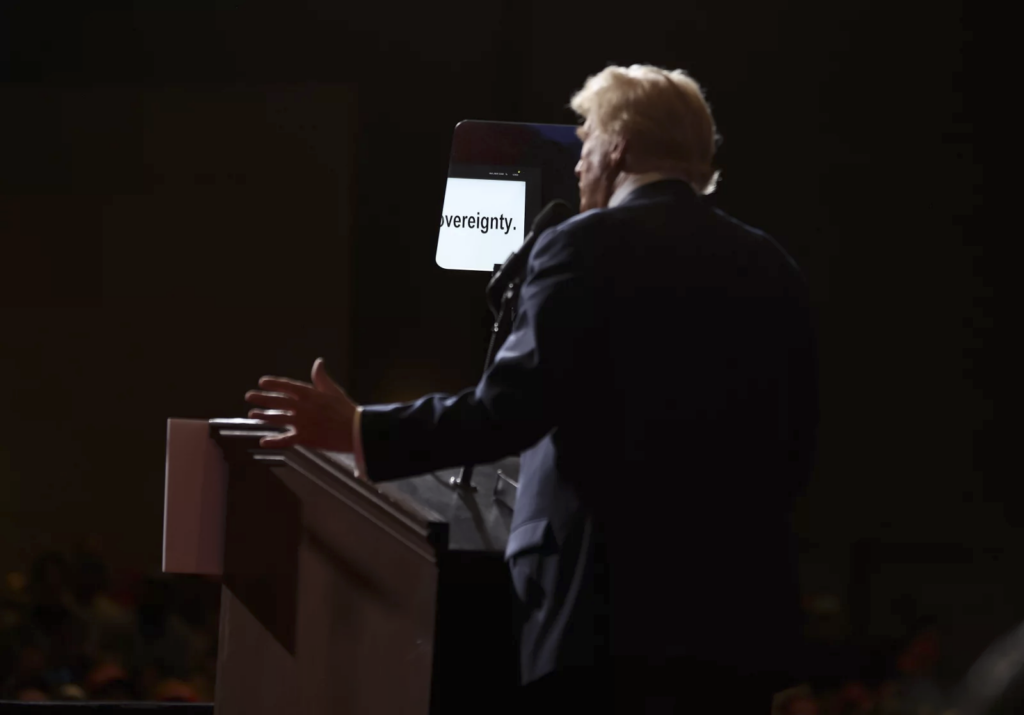
Then-candidate Trump speaking in front of a teleprompter during a campaign rally in Reno, Nevada in 2024. Justin Sullivan/Getty Images
“A Disgrace”: The White House Responds.
The scandal has pierced the West Wing’s carefully managed ethos of loyalty. White House Press Secretary Karoline Leavitt, in a tense Thursday briefing, confirmed the joint CFTC investigation and announced Perez had been placed on unpaid administrative leave. Her statement, unusually direct in its condemnation, suggested the President felt a personal sting from the betrayal.
“I discussed this matter with the President, and he called it a ‘disgrace’ and personally made the decision to suspend Mr. Perez,” Leavitt said. She pointed to a March memo sent to all White House staff, a document that now reads as a prophetic warning, that explicitly forbade using non-public government information to place bets on platforms like Kalshi and its offshore rival, Polymarket. “There are very strict ethical guidelines here at the White House that explicitly state not to do this. And if they are violated, people will pay the consequences for that, as you’re seeing with this case. Mr. Perez will no longer work at the White House.”
The irony is thick. Trump’s own public admiration for Perez, once a lighthearted anecdote on the campaign trail, now underscores the depth of the breach. In a 2024 stop in Reno, Nevada, Trump elaborated on the craft of the teleprompter operator: “I have a guy, Gabe, he’s excellent. I’ve had some real bad ones… some of the bad ones, they go so fast. I will go, and I say, slow the damn thing. No, a good one is really like gold.”
That golden operator, it seems, was melting down his privileged access for digital coin.
A Web Of Insider Bets From The Pentagon To The White House:
The Perez case does not exist in a vacuum. It is the most politically explosive manifestation of a systemic integrity crisis facing the booming prediction market industry. The Department of Justice has recently filed a cascade of landmark insider trading cases on these platforms, establishing a new frontier for white-collar and national security crime.
Just weeks before the Perez story broke, federal prosecutors charged a U.S. special forces soldier with using classified military intelligence to bet on Polymarket contracts regarding the alleged abduction of Venezuelan President Nicolás Maduro. In another case, a Google employee was charged with using internal corporate data to wager on user search activity, netting $1.2 million. The DOJ is also investigating former Congressman George Santos for insider trading on Kalshi.
“We are seeing the gamification of insider information,” said Danielle Caputo, a legal counsel at the Campaign Legal Centre, a nonpartisan ethics watchdog. “This isn’t just a financial issue; it’s a national security one. When government officials, from soldiers to White House staff, see classified or non-public information as a path to a quick payday on a betting app, the very definition of public trust is corrupted. The Perez case is the apotheosis of that—someone in the room where it happens, trading on the very words about to be spoken.”
The Family Business And A Legal Time Bomb:
The scandal arrives at a precarious moment for the prediction market industry, which has aggressively lobbied the Trump administration for favourable treatment while facing a bipartisan legal revolt from the states. This fight is now deeply entangled with the Trump family’s business interests.
Donald Trump Jr. serves as a strategic adviser to Kalshi and holds a direct financial stake in Polymarket through his investment firm, 1789 Capital. Last year, Trump Media & Technology Group announced plans to launch its own prediction market on Truth Social, a vertical integration of political influence and sportsbook-style wagering that ethics experts have decried as a sprawling conflict of interest. The President’s administration has backed the CFTC as the sole regulator for these platforms, a move that would override state-level consumer protections.
More than 40 state attorneys general, a bipartisan coalition, argue these platforms are not financial exchanges but unregulated sportsbooks that sidestep state gambling laws, age verification, tax revenue, and addiction safeguards. They have responded with lawsuits, cease-and-desist orders, and outright bans. The dispute is widely expected to reach the Supreme Court.
“It’s a breathtaking conflict of interest,” said Senator Elizabeth Warren (D-MA), a vocal critic of the industry. “The President’s son is a paid adviser to the very platform a White House staffer is now accused of defrauding. The White House is pushing for a regulatory framework that financially benefits the President’s family, even as a senior aide allegedly commits what looks like textbook insider trading on that same platform. The stench of corruption is undeniable.”
When asked about the inherent conflicts, Kalshi has pointed to the robust compliance systems that caught Perez. “This case proves that the regulated, transparent nature of a CFTC-monitored exchange is superior to offshore, illegal alternatives,” a Kalshi representative stated, arguing the episode validates their model. The company has cooperated fully with the government, providing forensic trading data that effectively sealed Perez’s fate.
The Operator In The Shadows:
The investigation also opens a window into the strange, often overlooked world of the people who run the prompter. Former White House aides describe the role as uniquely demanding. Perez wasn’t just a technician scrolling text; he was a behavioural analyst, learning the President’s cadence to slow or speed the glass panels on instinct, anticipating the moment Trump would detour from policy into grievance. This hyper-proximity gave him a predictive power no offshore trader with a TV antenna could ever match.
On Thursday night, as Perez was negotiating his settlement and potential criminal liability with the CFTC, traders on Kalshi had already wagered more than $800,000 on the words Trump would use in his upcoming address. The markets buzz with speculation: Will he say “witch hunt”? “Bidenomics”? The invisible man who once controlled the very words is now, himself, a cautionary tale.
The Secret Service has been briefed and is conducting a separate review of how a staffer in the President’s immediate vicinity was allegedly able to execute these trades in real-time from a handheld device during the execution of his official duties. For an agency tasked with eliminating threats in the Oval Office, the digital heist from a trusted aide represents a nightmarish new vulnerability.
“This wasn’t a leak to a reporter for a flattering profile. This was a transaction, a silent, digital betrayal for personal profit, executed while the President was speaking,” a former senior White House ethics lawyer reflected. “It shows that the rule of law is just wallpaper to some in that building unless it’s enforced. The question now is whether the DOJ will treat this as the serious criminal fraud it appears to be, or whether the President’s family ties to the industry will throw a shadow over the pursuit of justice.”
As Perez fades from the White House, the scandal leaves behind a market addicted to inside information, a legal battle over its very existence, and a political family caught between its policy ambitions and its personal balance sheet. The teleprompter operator’s screen has gone dark, but the crisis of confidence it illuminated has only just begun.
Conclusion: The Architecture Of Insider Capitalism.
Beneath the tawdry spectacle of a teleprompter operator tapping his phone mid-speech lies a far more disturbing reality. Gabriel Perez is not an aberration; he is a logical, almost predictable, product of an administration that has systematically dismantled the boundary between public service and private profit. If Perez’s alleged scheme was a street-level mugging of the public trust, the administration’s broader relationship with market-moving information is the blueprint for a sophisticated heist.
The prosecution of Perez, however justified, risks becoming a convenient decapitation of a problem whose body remains very much alive and thriving. Despite the prosecution of Perez, however justified, potentially serving as a convenient decapitation of a problem whose body remains very much alive and thriving, the highest levels of power have normalised a far more lucrative and ethically corrosive transaction: the sale of government economic data to a handpicked elite before the public can see it.
This is not a metaphor. Under the Trump administration, the practice of providing preferential, advance access to market-sensitive government information has been elevated from a whispered allegation to a brazen feature of economic governance. Documented reports show that select Wall Street billionaires and hedge fund managers gained early access to critical economic data, inflation figures, jobs reports, and GDP revisions, which move billions of dollars in global markets within milliseconds of their release. This is not a prediction market where retail traders wager small sums on a presidential phrase. This is the real market, where foreknowledge of a single data point can generate fortunes measured in the hundreds of millions.
The architecture is simple and devastatingly effective. By the time the Bureau of Labor Statistics or the Bureau of Economic Analysis releases data to the general public through established, embargoed press channels, a select circle of politically connected financiers has already positioned their trades. They have shorted, longed, hedged, and leveraged based on information that, in a functioning democracy, belongs to every citizen simultaneously. The playing field is not tilted; it is vertical, with the public at the bottom, scrabbling for crumbs of information that have already been consumed by the apex predators.
This is corruption dressed in the language of “access” and “investor confidence.” It is insider trading on a macroeconomic scale, perpetrated not by a rogue staffer with a gambling problem but by the very architects of economic policy. And unlike Perez’s clumsy, traceable Kalshi account, this form of pillage leaves almost no fingerprints. High-frequency algorithms bury the transactions in the noise. Normal fluctuations of “smart” investing launder the windfalls. Everyone who owns a 401(k), pays for groceries, or tries to buy a home in a market where rentiers write the rules becomes a victim.
The connection between Perez’s “Mentions” markets and the sale of advance economic data is not incidental; it is ideological. Both are expressions of a governing philosophy that treats information not as a public good but as a private asset to be monetised. The message from the White House has been consistent: if you are close to power, information is a commodity. If you are an ordinary citizen, you are the product, the liquidity, the mark.
The Trump family’s deep entanglement with this philosophy makes any claim of ethical enforcement hollow. Donald Trump Jr.’s advisory role at Kalshi and financial stake in Polymarket are not mere business arrangements; they are signals to an entire ecosystem that the family is open for business, that the revolving door between the Oval Office and the betting floor is not just unlocked but has been removed from its hinges. This vertical integration of political power and gambling infrastructure is completed by the planned Truth Social prediction market. The President’s words will move markets, and his family’s platforms will profit from the movement. Participants only question whether they can trade on inside information or if prosecutors will prosecute them for it a distinction that seems to depend on how close they are to the family.
“What we are witnessing is the privatisation of the public information commons,” says Dr. Zephyr Teachout, a legal scholar and author of Corruption in America. “When a government sells early access to economic data, or when a President’s family owns a platform that profits from the President’s own speech, we are no longer in a democracy. We are in a kleptocracy where the state’s information infrastructure is being strip-mined for private gain. The Perez case is a convenient scapegoat, a small fish sacrificed to create the illusion of accountability while the whales swim freely through the regulatory nets.”
The Department of Justice and the CFTC can pat themselves on the back for catching a teleprompter operator. They can point to the frozen Kalshi account, the administrative leave, the stern words from the podium. But this is justice as theatre, a morality play designed to distract from the morality-free zone that the administration has constructed. If the government were serious about information integrity, it would investigate the advance distribution of economic data with the same vigour it has applied to Perez. It would subpoena the trading records of the billionaires who received those early calls. It would examine whether prediction markets owned by the President’s allies have ever benefited from non-public information flowing from the West Wing.
None of this will happen. The real scandal is not that a staffer placed illegal bets on the President’s words. The real scandal is that this administration has turned the entire machinery of government information into a casino, and only the well-connected are allowed to count cards. Gabriel Perez will likely face consequences—he should. But he will fall as a foot soldier in an army of looters whose generals dine with the President and whose plunder is measured not in thousands but in billions.
The teleprompter operator had the script. So did the hedge fund managers. The difference is that one group knew the rules were a façade, and the other was stupid enough to believe they applied to everyone. In the Trump era, the ultimate insider trade is not betting on what the President will say. It is betting that the system of justice will remain too compromised, too conflicted, and too captured to do anything about the far greater crime. That bet, so far, is paying out handsomely.
Source:Veritas Press C.I.C. | Multi-News Agencies
Help Support Our Work By Donating
Readers who believe that truth still matters power popular information. When just a few more people step up to support this work, it means more lies exposed, more corruption uncovered, and more accountability where it’s long overdue.
Help Protect Independent Journalism, Which Is Currently Under Attack.
If you believe journalism should serve the public, not the powerful, and you’re in a position to help, becoming a DONOR or a PAID SUBSCRIBER truly makes a difference.
DONATION APPEAL: If You Found This Reporting Valuable, Please Consider Supporting Independent Journalism.
Your support fuels our fearless, truth-driven journalism. In unity, we endeavour to amplify marginalised voices and champion justice, irrespective of geographical location. We operate independently, with no financial backing from billionaires; our readers support us.
But it’s also extremely important. One of Veritas Press’s greatest assets is its reader-funded model.
1. Reader funding means we can cover what we like. We’re not beholden to the political whims of a billionaire owner. We are a small, independent and impartial organisation. No one can tell us what not to say or what not to report.
2. Reader funding means we don’t have to chase clicks and traffic. We’re not desperately seeking your attention for its own sake; we pursue the stories that our editorial team deems important and believes are worthy of your time.
3. Reader Funding: enables us to keep our website and other social media channels open, allowing as many people as possible to access quality journalism from around the world, particularly those in places where the free press is under threat.
We know not everyone can afford to pay for news, but if you’ve been meaning to support us, now’s the time.
Your donation goes a long way. It helps us:
Keep the lights on and sustain our day-to-day operations
Hire new, talented, independent reporters
Launch real-time live debates, community-focused shows, and on-the-ground reporting
Cover the issues that matter most to our communities, in real time, with depth and integrity
We have plans to expand our work, but we can’t do it without your support. Every contribution, no matter the size, helps us stay independent and build a truly people-powered media platform.
If you believe in journalism that informs, empowers, and reflects the communities we serve, please donate today.
Submissions:
For The Secure Submission Of Documentation, Testimonies, Or Exclusive Investigative Reports From Any Global Location, Please Utilise The Following Contact Details For Our Investigations Desk: enquiries@veritaspress.co.uk or editor@veritaspress.co.uk
Kamran Faqir is a volunteer investigative journalist and writer committed to exposing hidden truths and amplifying underreported stories. Driven by social justice, he brings sharp insight and fearless truth-telling to independent journalism. NUJ registered.
SEATTLE, TEHRAN — The U.S. Department of Homeland Security (DHS) will allow Iran’s national football team to enter the country 48 hours before their critical World Cup match against Egypt on Friday, a modest concession in a tournament where Team Melli’s travel conditions have sparked claims of oppression and competitive disadvantage.



























































8bn5d2
mangjq