Kamran Faqir is a volunteer investigative journalist and writer committed to exposing hidden truths and amplifying underreported stories. Driven by social justice, he brings sharp insight and fearless truth-telling to independent journalism. NUJ registered.
Listen to this article
Help support our mission, donate today and be the change. Every contribution goes directly toward driving real impact for the cause we believe in.
Article Date Published:
Article Date Modified:
18 minutes
Views:98
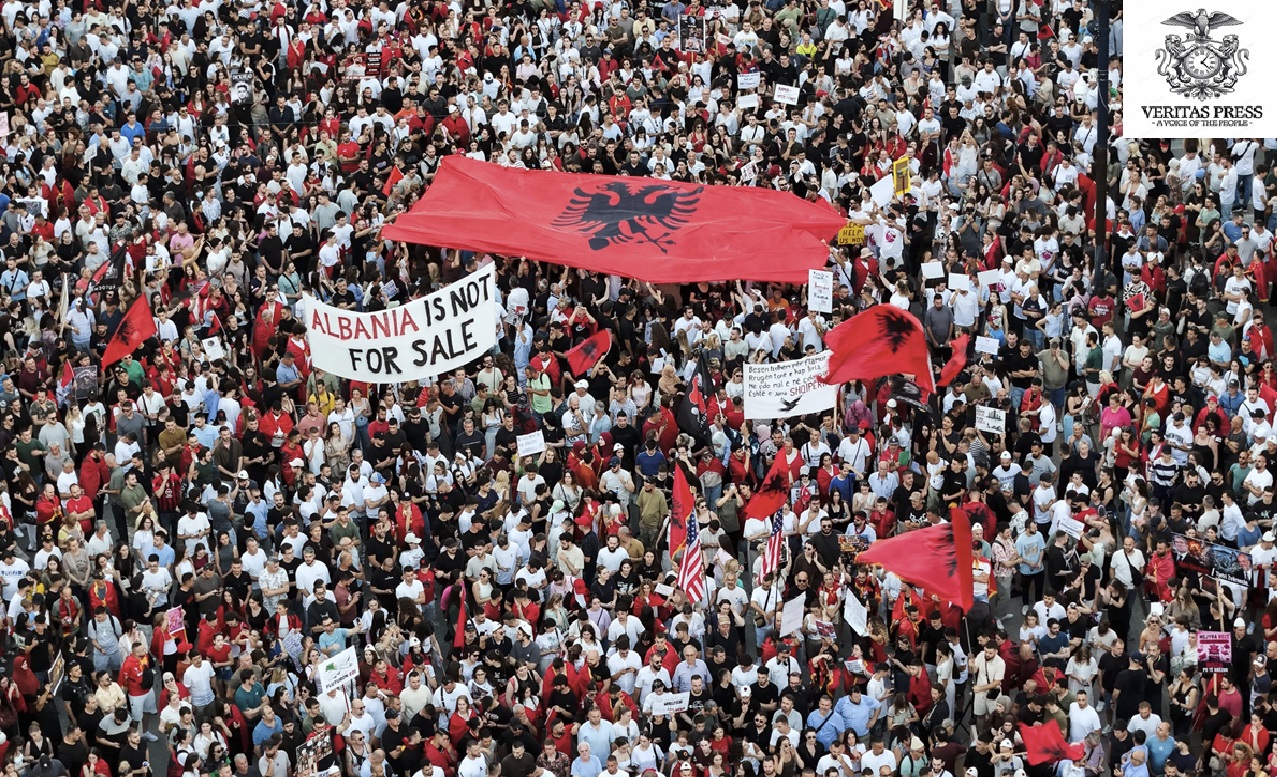
TIRANA — Albania’s capital entered a fifth consecutive day of violent clashes on Saturday as a student-led anti-government movement demanding Prime Minister Edi Rama’s resignation spread from the Education Ministry to streets across Tirana, and beyond to the coastal city of Durres. What began months ago as a localised protest against a luxury coastal development linked to Jared Kushner, U.S. President Donald Trump’s son-in-law, has now widened into a broader youth uprising over education, tuition fees, corruption, jobs and emigration, and into the most serious challenge yet to Rama’s fourth-term government.
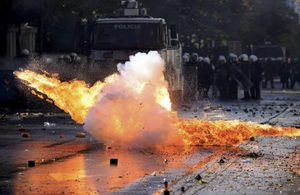
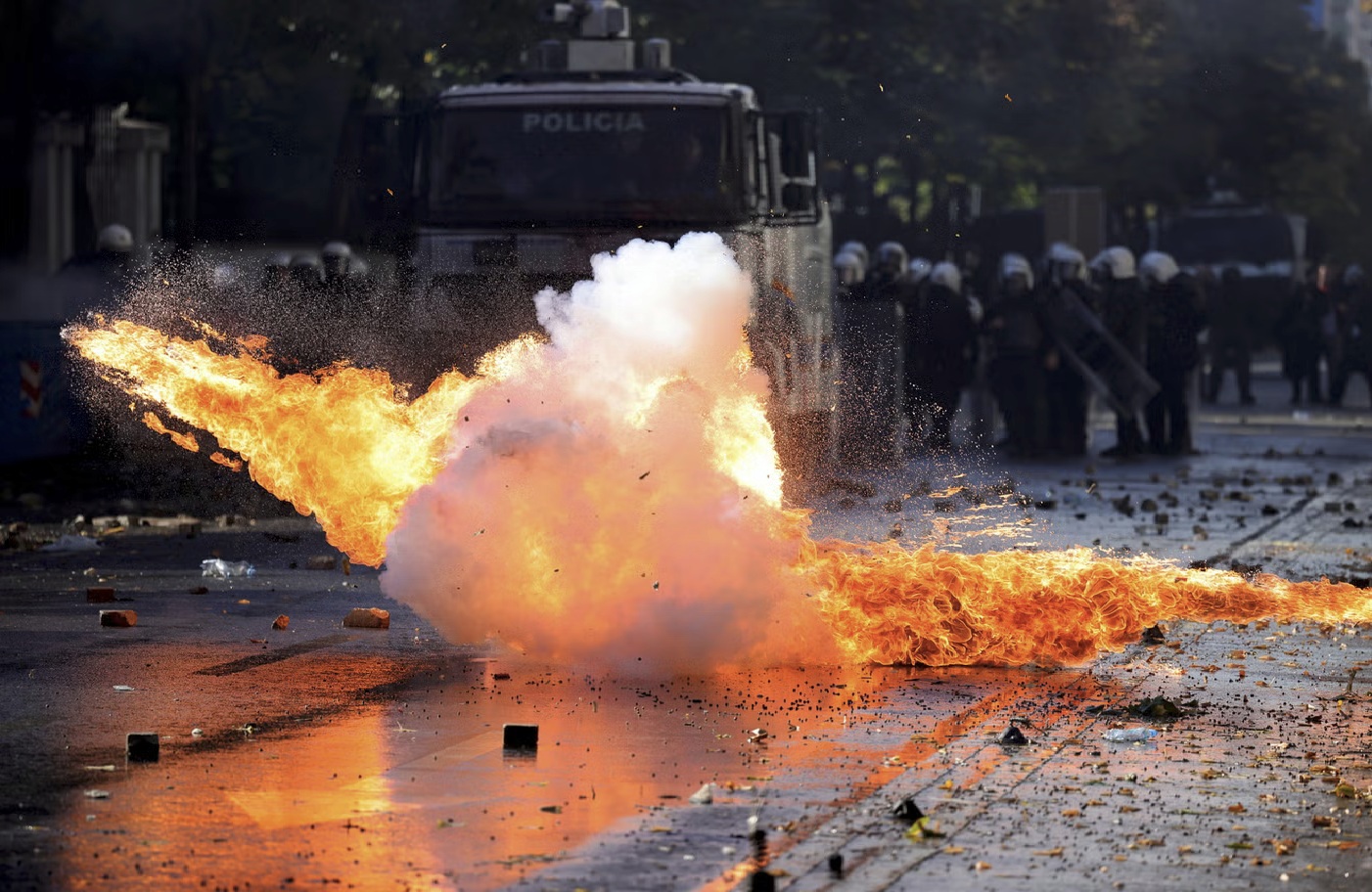
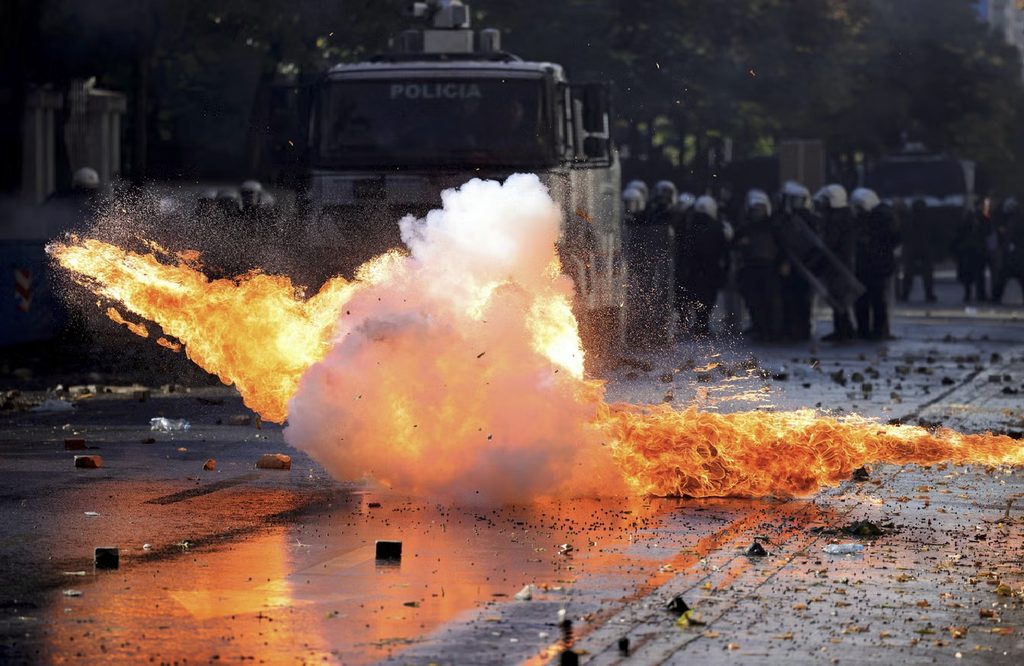
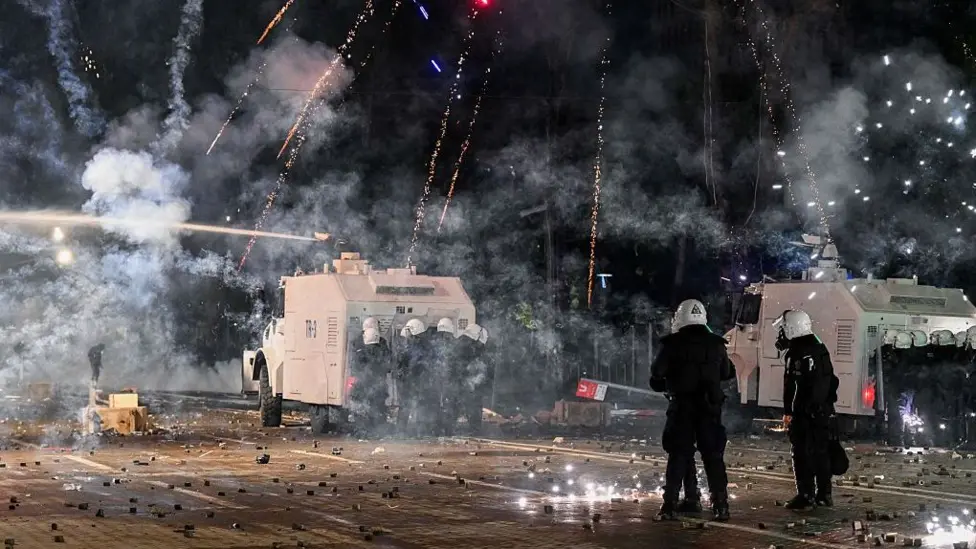
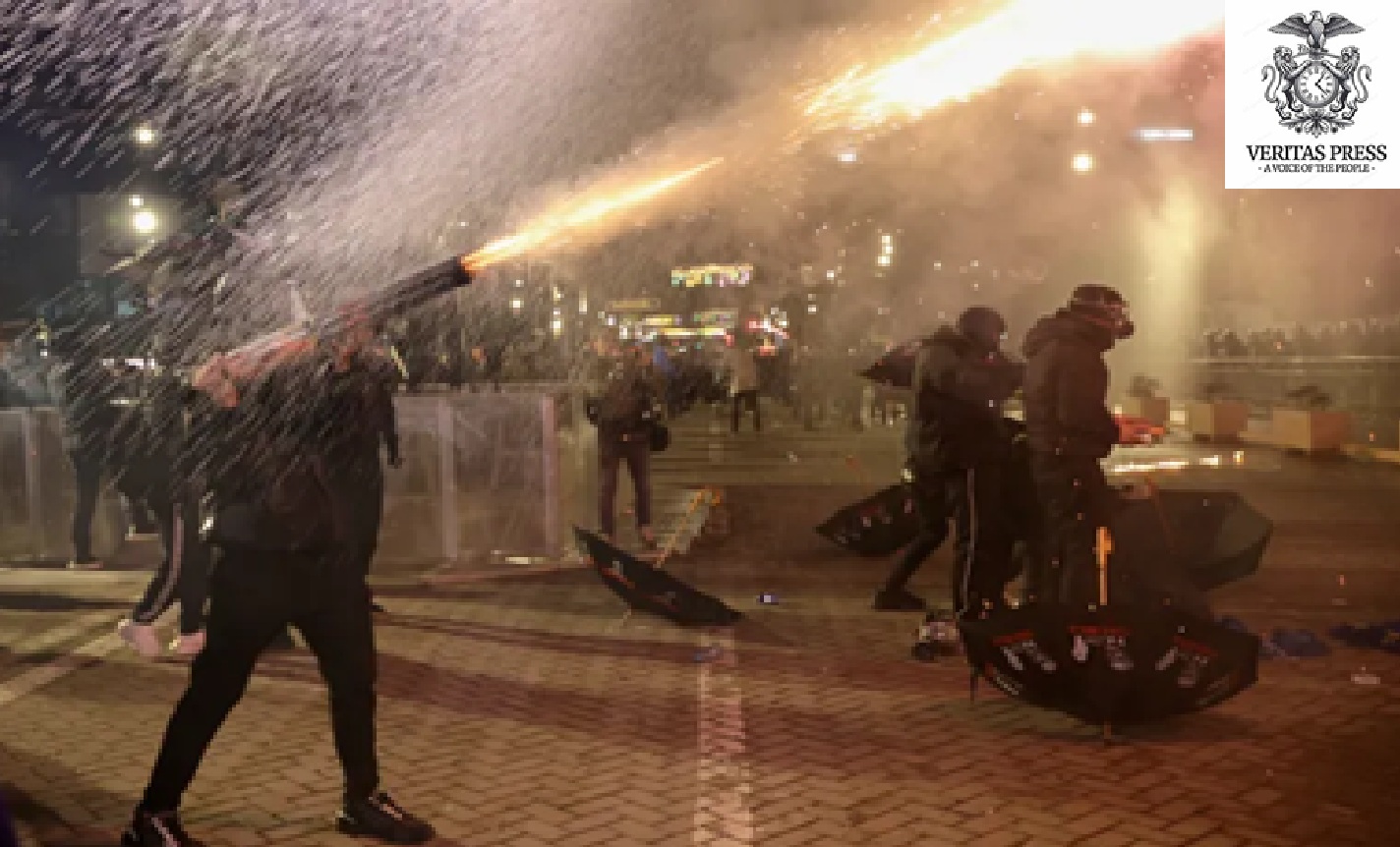
The latest reporting, drawn from AFP, Reuters, KAN News, local Albanian media and official statements, shows a confrontation that has escalated in both tactics and political stakes. Protesters have hurled rocks, petrol bombs, flares and fireworks; police have responded with tear gas, water cannon, pepper spray and, for the first time in this wave, what appeared to be rubber bullets. Rubber pellets hit two Reuters journalists and several protesters, according to Reuters, leaving round marks. AFP journalists on the ground also witnessed police using rubber bullets for the first time during these protests.
Riots in Tirana enter a fifth day as Albania’s anti-government protests escalate
“Today, for the first time since the protests began, the police used rubber bullets — an extreme measure, considering that there are minors aged 16 to 17 among the protesters,” sport student Redi Taku told AFP.
The police chief, Skender Hita, did not deny the use of rubber bullets when asked at a Saturday news conference. “All means that were used were employed in a limited manner, including the most recent ones,” he said. Hita said seven police officers had been suspended and were facing disciplinary investigations for “exceeding their authority” and “failure to respect the principle of proportionality” in dealing with protesters. He did not specify which incidents led to the suspensions.
That admission is significant. It suggests the police hierarchy itself recognises possible excesses, even as it defends the overall operation. But the suspensions are narrow, and the government’s broader message has been to condemn violence by protesters while presenting the security response as measured. Hita framed the week’s policing in stark terms: “For five days, the national police have been facing acts of violence during rallies, where masked and violent individuals have attacked police officers and public institutions for long hours, damaging public and private property.”
A Movement That Outgrew Its Original Trigger
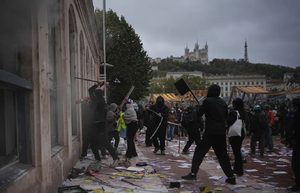
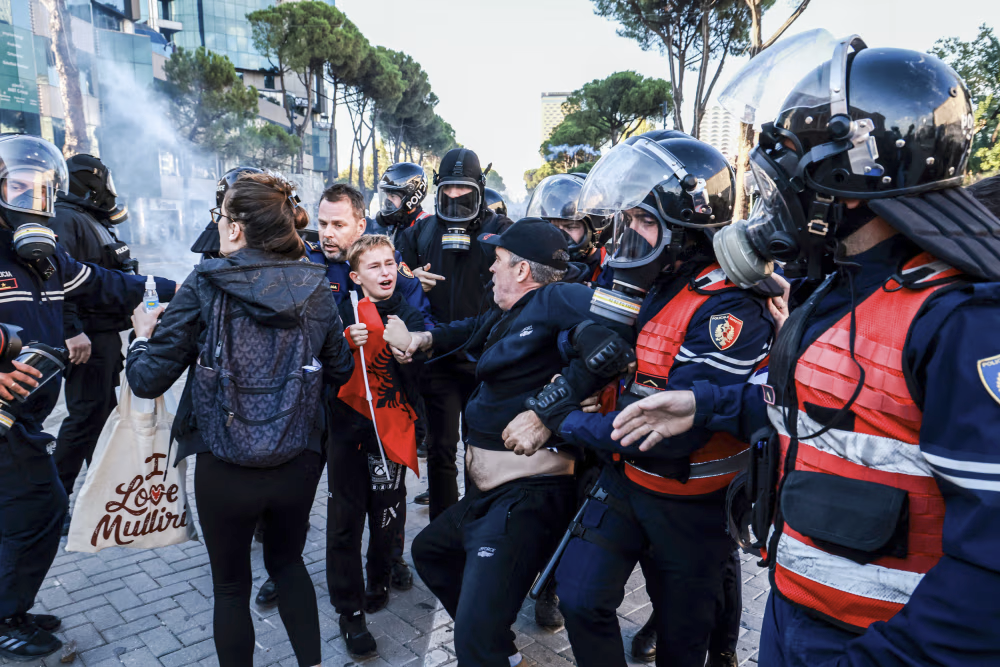
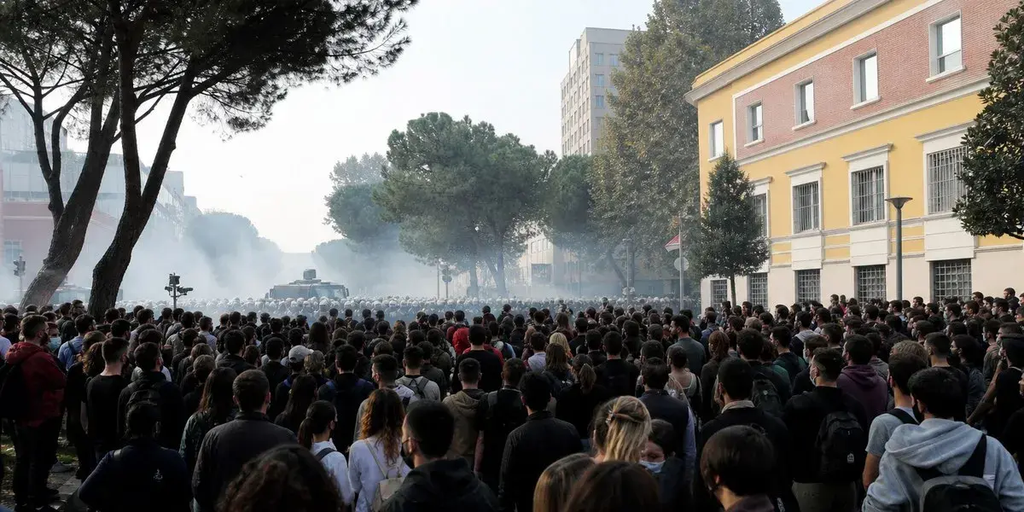
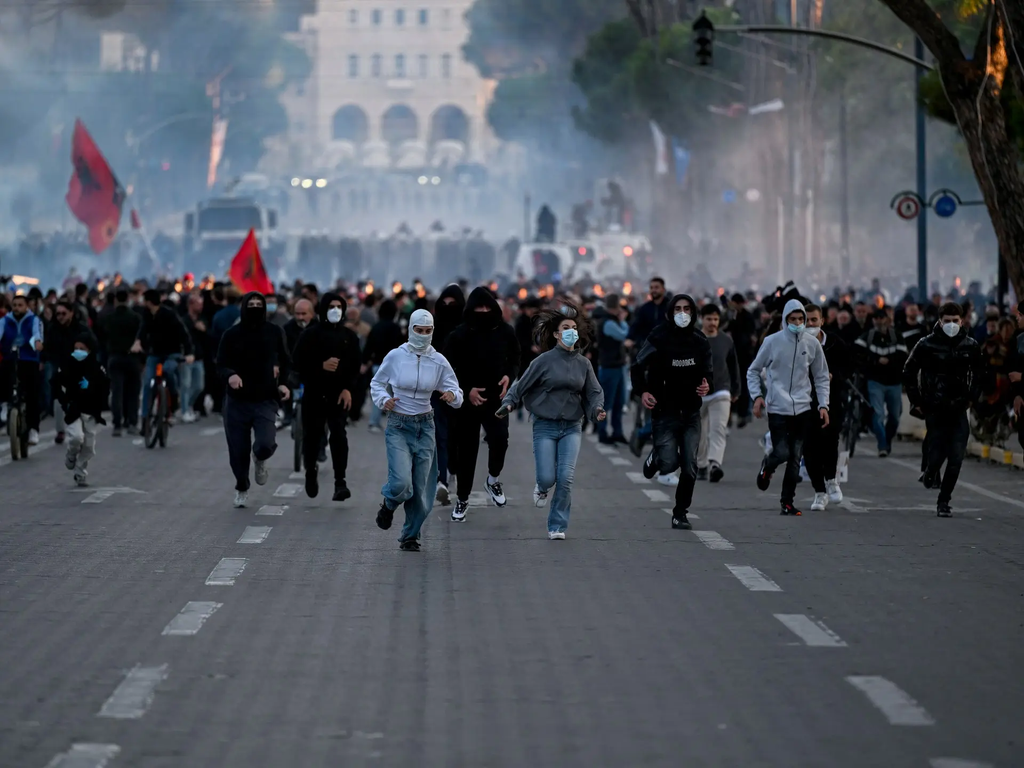
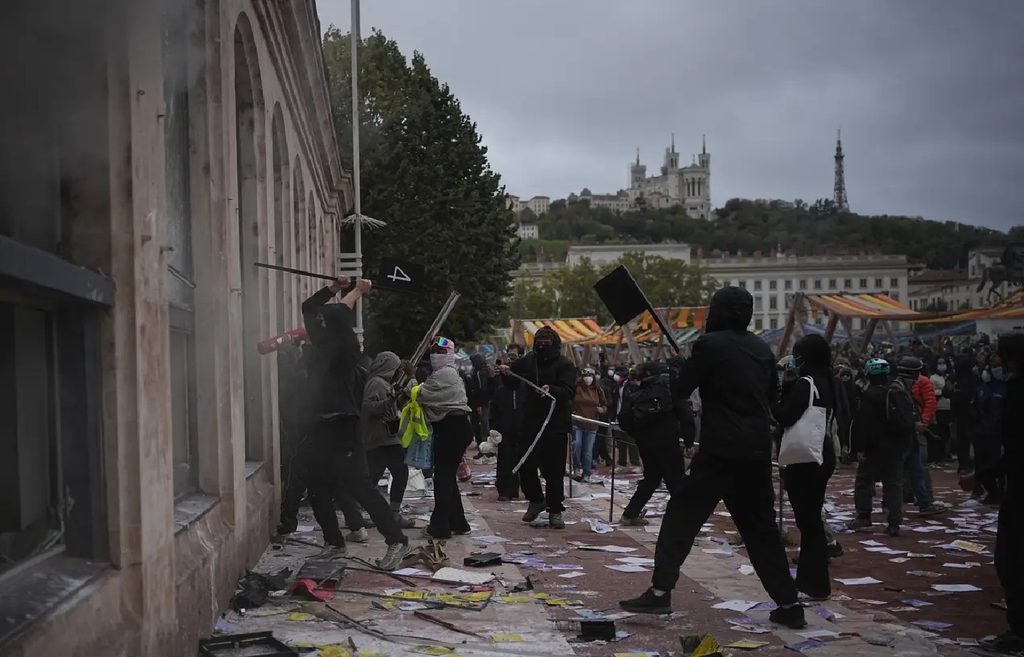
The protests began on Tuesday with thousands of young people demanding Rama’s resignation over university conditions and high tuition fees. By Saturday, several hundred people, some masked, gathered around noon in front of the Education Ministry before crowds spread across the city. Protesters threw rocks at police, set litter bins on fire and used them as barricades. Police used megaphones to call on the crowd to stop, then water cannons and tear gas to disperse them temporarily. As night fell, clashes continued in central Tirana; streets were littered with rocks, and tear gas and smoke from burning trash bins filled the air. Youths set cars on fire, attacked government offices and pushed against police cordons, often forcing officers to retreat.
At the start of the protest, demonstrators set a suitcase on fire and threw it into the Education Ministry courtyard, a symbol, they said, that they do not want to leave Albania.
“This is a reaction to express discontent at the silence of our government,” journalism student Sinan Billa told AFP. “Young people have awoken for our parents, too. We are not asking for privileges. We are demanding our rights, our future and a better country.”
The unrest is emerging as the biggest threat to Prime Minister Edi Rama, who has governed since 2013.Vlasov Sulaj / NurPhoto via Getty
Another protester, 18-year-old Ledia, put it plainly: “We are not criminals. We simply want a better life for our parents and ourselves. We do not want to leave Albania.”
The movement’s demands have expanded beyond tuition and university conditions. A 22-year-old medical student, Juri Taullahu, told Reuters: “It’s been 13 years of corruption and 13 years of doing nothing and empty promises. So the jar is filled, and we are here for our rights.” An unnamed high school student said: “The government’s indifference and arrogance since the beginning of our movement have been unbearable and have made the situation worse.”
The initial spark, however, was not education policy. Months of anti-government protests were organised by the so-called Flamingo movement, launched in opposition to a major luxury tourism development on Albania’s southern coast linked to an investment firm founded by Jared Kushner. The project, linked also to Ivanka Trump, became a symbol of alleged corruption and inequality, a flashpoint over land, foreign investment and who benefits from Albania’s tourism boom.
Reuters reported in July that villagers said their land had been wrongfully sold for the Kushner-backed development on a pristine stretch of coast. Reuters later reported that the man who sold the land was wanted by prosecutors on suspicion of drug trafficking; his lawyer denied the accusations. Reuters found no evidence of wrongdoing by Kushner, who is not directly involved in the villagers’ dispute. Rama has denied wrongdoing and told Reuters this week he would not step down.
That land dispute matters because it connects the protest’s original grievance to the broader themes now driving the unrest: opacity in large development deals, weak accountability, and a perception that political and economic elites are insulated from ordinary Albanians’ struggles. The government’s critics say the Kushner-linked project became a metaphor for a wider problem, not because of Kushner himself, but because of how Albanian institutions handled land, contracts and public trust.
Police, Protesters And A Contested Set Of Facts
The official accounts of the unrest have shifted and, at times, conflicted. Police said 167 people had been arrested and 132 officers injured during the unrest. Hita later said 1,067 people had been arrested and 388 criminally prosecuted, with scores of police officers and protesters injured. Police also said 10 people were arrested after Friday’s demonstrations, with criminal proceedings lodged against a further 22, and that 160 people were detained following violent incidents on Thursday evening. The Health Ministry said 25 people, including nine police officers, sustained minor injuries during clashes in Tirana, Vlora and Lezha on Friday.
Those figures are difficult to reconcile without clearer timelines and definitions. Are they daily, cumulative, or incident-specific? Are “detained,” “arrested” and “criminally prosecuted” being used interchangeably? The lack of transparency matters in a polarised environment: official statistics become part of the political battle, and the public has little independent way to verify the scale of injury, arrest or alleged excess.
The same is true of the use of force. Albanian law allows police to use rubber bullets during protests only in extreme cases, according to AFP. The appearance of rubber pellets, and the fact that journalists were hit, raises questions about proportionality, crowd management and the safety of minors. Paula, who helped set up a provisional first-aid station in a lawyer’s office with other young people, told AFP that three people had been treated for head, eye and leg injuries allegedly from rubber bullets. Reuters reporters found rubber pellets on the ground; pellets hit two Reuters journalists and several protesters.
There have been violent scenes involving protesters and police in central Tirana
The Israeli embassy in Tirana announced its temporary closure on Friday as thousands of Albanians took to the streets, according to KAN News. The embassy did not specify when it would reopen but said resumption would “be considered in accordance with events.” The closure underscores how quickly the unrest has become an international story, and how anxious foreign missions are about the security environment.
Rama’s Dual Message: Listening And Law And Order
Rama has responded with a dual message. On one hand, he has pledged to listen. While visiting local businesses damaged in the demonstrations, he said he respected the students and that “their right to protest must and will be protected.” He added: “Their voices, the voices of young people and of every citizen who has taken part in protests today, must and will be heard with respect.”
On the other hand, he has framed the violence as the work of political opponents and “foreign hands.” In a Facebook video, he said: “These are foreign hands that do not wish for Albania to be at peace. All of this is the work of the very same hand, the hand that has gripped the Albanian opposition by the throat, the hand that has burned and destroyed Albania more than once.” He also accused his conservative opponents of inciting the clashes.
“I will not allow anyone to jeopardise the future of this country … not for the political gain of those who use their wicked hand to create disorder and destruction,” Rama said. “My responsibility is clear in these difficult hours: to protect our citizens, guarantee justice and move Albania forward.”
That rhetoric is a familiar governing strategy in times of unrest: concede the legitimacy of peaceful grievance while delegitimising the broader movement by associating it with violence and hidden forces. But Rama has not publicly offered evidence for the “foreign hands” claim, and the accusation risks obscuring the domestic grievances that even his own conciliatory statements acknowledge. The government’s challenge is that the protesters’ core demands, education funding, tuition relief, jobs, accountability, are not foreign imports. They are Albanian problems.
Image: UA.NEWS
Rama’s Socialist Party won a fourth consecutive election victory last year; the next parliamentary elections are not scheduled until 2029. His government says it aims for Albania to join the European Union by 2028, though Rama later referenced 2030 in a Facebook message, saying his governing majority holds “a very clear mandate: to see Albania in the European Union by 2030.” Along with Montenegro, Albania is leading the EU accession process among Balkan countries. That makes the unrest more than a domestic crisis: it tests the government’s claim to be a stable, reform-oriented EU candidate.
The European Union delegation in Albania called on Wednesday for a proportionate response from authorities, expressing concern over “the violent escalation at the protest in Tirana.” That statement was carefully balanced, but the underlying message was clear: Brussels is watching. If police are seen using rubber bullets against minors or hitting journalists, Albania’s accession credibility, already complicated by corruption concerns, will face sharper scrutiny.
The Deeper Story: Corruption, Inequality And Youth Flight
The investigative context is not incidental. Rama’s administration has been dogged by corruption scandals, while analysts say Albania has become a hub for gangs seeking to launder money from drug and weapons trafficking, complicating the country’s efforts to join the European Union. The government denies wrongdoing. But the perception of impunity is central to the protests: young people are not only angry about tuition; they are angry about a system they believe rewards connections and punishes ordinary citizens.
The Kushner-linked resort controversy fits that narrative. The project became a symbol of alleged corruption and inequality, and the land dispute gave it a human face. The fact that the seller was wanted on suspicion of drug trafficking, an accusation his lawyer denied, added another layer of unease. Reuters found no evidence of wrongdoing by Kushner, who is not directly involved in the villagers’ dispute. But the controversy is less about Kushner’s personal conduct than about Albanian governance: how land is sold, how contracts are awarded, and whether citizens have meaningful recourse.
The youth dimension is equally important. Protesters repeatedly say they do not want to leave Albania. The burning suitcase was a symbol of refusal, a rejection of the idea that emigration is the only answer. But the demands for jobs, education and a better future reflect the economic precarity that has pushed many young Albanians abroad. The protests are, in that sense, a demand for a reason to stay.
Regional Echo
Albania’s unrest coincides with growing street protests elsewhere in Europe. In France, student protests demanding more teachers and better facilities have spread into a broader wave of unrest. In Spain, protests against high rents and a lack of housing prompted the government to call a snap election. The comparison is not exact. Albania’s crisis has its own political and post-communist context, but the common thread is youth frustration, economic insecurity, and a sense that established institutions are not responding.
For Rama, the immediate challenge is to restore order without further alienating the students who have become the moral core of the movement. For the protesters, the challenge is to sustain a broad coalition while condemning the violence that has given the government a law-and-order narrative. For the police, the challenge is proportionality, and credibility. The suspension of seven officers is a start, but the public still lacks a full account of what happened, who was injured and why rubber bullets were used.
Image: Al Jazeera
What Comes Next
The fifth day of clashes marks a turning point. What began as a summer protest against a luxury resort has become a youth-led anti-government uprising that touches education, corruption, land, jobs and Albania’s European future. The government’s response, conciliatory words, law-and-order framing, allegations of foreign interference and limited police accountability, has so far failed to calm the streets.
The central question is whether Rama’s promise to listen will be matched by concrete action: education funding, tuition reform, transparency over the Kushner-linked development, independent investigations into police conduct and a serious anti-corruption agenda. Without that, the gap between the government’s rhetoric and the protesters’ lived experience will only widen.
As one student told AFP, “We are not asking for privileges. We are demanding our rights, our future and a better country.” That demand is now the measure of Albania’s crisis, and of whether Rama’s fourth term can survive it.
Conclusion: The Real Crisis Is Not The Violence, It Is The Credibility Gap
The fifth day of clashes in Tirana should not be read simply as a law-and-order emergency, nor as a spontaneous explosion of youth anger. It is the visible symptom of a deeper governing crisis: a government that has learned to speak the language of listening while retaining the architecture of impunity. Prime Minister Edi Rama’s conciliatory words, that students’ “voices … must and will be heard with respect”, sit uneasily beside his unsubstantiated claim that “foreign hands” are behind the unrest, and beside a police response that has now included rubber bullets, injured journalists and injured protesters, with only seven officers suspended and no full public accounting of what happened.
That gap between rhetoric and accountability is the story. The government has condemned violence by protesters while offering no independent investigation into allegations of excessive force. It has acknowledged the students’ right to protest while framing the movement as the instrument of unnamed enemies. It has promised a European future while failing to explain how a country can join the EU by 2028 or 2030 without resolving the very corruption and land-governance questions that first brought protesters into the streets. The Kushner-linked resort controversy is not a distraction from the “real” protests, it is the origin point of a movement that has since widened into a demand for basic accountability. The land dispute, the wanted land seller, the villagers who say they were wrongfully dispossessed: these are not foreign intrigues. They are Albanian governance failures.
The official statistics are equally troubling. Police have offered shifting figures: 167 arrested and 132 officers injured; later, 1,067 arrested and 388 criminally prosecuted; then 10 arrests and 22 criminal proceedings after Friday’s demonstrations; 160 detained after Thursday’s incidents. These numbers may be reconcilable, but the public has not been given the timeline or definitions needed to reconcile them. In a polarised environment, contested statistics become political weapons. The same is true of the use of rubber bullets: Albanian law permits them only in extreme cases, yet AFP and Reuters both documented their use, including against crowds containing minors and with journalists among the injured. The suspension of seven officers for “exceeding their authority” is a tacit admission that something went wrong. It is not a substitute for a transparent, independent inquiry.
The EU delegation’s call for proportionality was careful, but Brussels should be under no illusion: Albania’s accession credibility is now entangled with how Tirana handles this crisis. A government that cannot or will not investigate its own police, disclose the full facts of the unrest, or address the grievances that sparked it cannot credibly claim to be building the institutions EU membership requires. The protesters’ demand, “We are not asking for privileges. We are demanding our rights, our future and a better country”, is not radical. It is the minimum test of democratic governance.
Rama’s fourth term will not be stabilised by blaming foreign hands or by treating rubber bullets as a limited tactic. It will be stabilised only if the government moves from listening to accounting: an independent probe into police conduct; full disclosure of arrest and injury data; transparency over the Kushner-linked development and the land deals surrounding it; and a serious response to the education, jobs and emigration crisis that brought young people into the streets. Until then, the burning suitcase in the Education Ministry courtyard will remain what it was meant to be, a symbol not of disorder, but of a generation refusing to be told that leaving is the only answer. The burden of proof is now on the government, not the students.
Veritas Press Investigative Analysis Independent journalism examining global affairs, power, diplomacy, and accountability.
Source:Veritas Press C.I.C. | Multi-News Agencies
Help Support Our Work
Readers who believe that truth still matters have power over popular information. When just a few more people step up to support this work, it means more lies exposed, more corruption uncovered, and more accountability where it’s long overdue.
Help Protect Independent Journalism, Which Is Currently Under Attack.
If you believe journalism should serve the public, not the powerful, and you’re able to help, becoming a regular DONOR or a PAID SUBSCRIBER truly makes a difference.
DONATION APPEAL: If you found this reporting valuable, please consider supporting independent journalism.
Your support fuels our fearless, truth-driven journalism. In unity, we endeavour to amplify marginalised voices and champion justice, irrespective of geographical location. We operate independently, with no financial backing from billionaires; our readers support us.
But it’s also extremely important. One of Veritas Press’s greatest assets is its reader-funded model.
1. Reader funding means we can cover what we like. We’re not beholden to the political whims of a billionaire owner. We are a small, independent and impartial organisation. No one can tell us what not to say or what not to report.
2. Reader funding means we don’t have to chase clicks and traffic. We’re not desperately seeking your attention for its own sake; we pursue the stories that our editorial team deems important and believes are worthy of your time.
3. Reader Funding: enables us to keep our website and other social media channels open, allowing as many people as possible to access quality journalism from around the world, particularly those in places where the free press is under threat.
We know not everyone can afford to pay for news, but if you’ve been meaning to support us, now’s the time.
Your donation goes a long way. It helps us:
Keep the lights on and sustain our day-to-day operations
Hire new, talented, independent reporters
Launch real-time live debates, community-focused shows, and on-the-ground reporting
Cover the issues that matter most to our communities, in real time, with depth and integrity
Without your support, independent voices like ours will be silenced.
Furthermore, we have plans to expand our work, but we can’t do it without your support. Every contribution, no matter the size, helps us stay independent and build a truly people-powered media platform.
If you believe in journalism that informs, empowers, and reflects the communities we serve, please donate today.
Submissions
For the safe submission of documentation, testimonies, or exclusive investigative reports from anywhere in the world, please use the following contact details for our Investigations Desk: mailto:enquiries@veritaspress.co.uk or mailto:editor@veritaspress.co.uk.
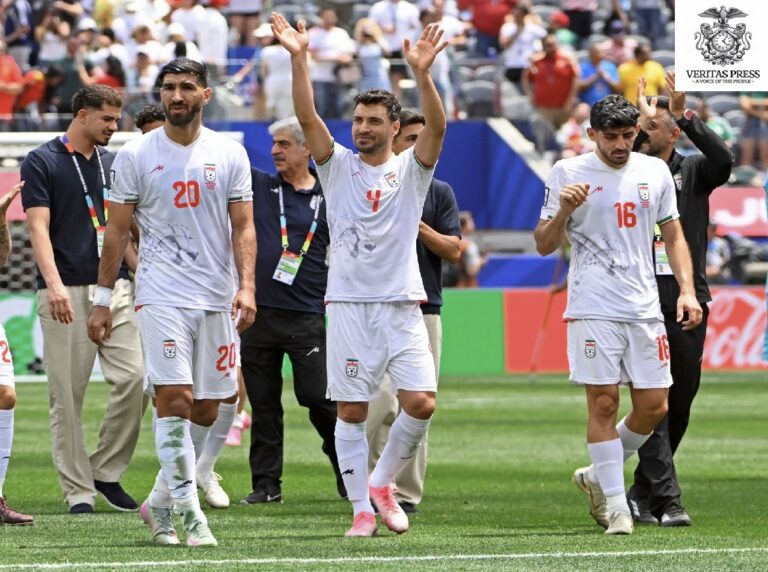
SEATTLE, TEHRAN — The U.S. Department of Homeland Security (DHS) will allow Iran’s national football team to enter the country 48 hours before their critical World Cup match against Egypt on Friday, a modest concession in a tournament where Team Melli’s travel conditions have sparked claims of oppression and competitive disadvantage.