




Help support our mission, donate today and be the change. Every contribution goes directly toward driving real impact for the cause we believe in.
As Washington Hosts A Third Round Of Talks Ostensibly Designed To Cement A Lasting Truce, The Israeli Military Is Issuing Serial Orders For Entire Villages To Flee, Pushing A Policy Of Mass Displacement That Aid Workers, Legal Experts And Lebanese Officials Now Call A Deliberate Strategy Of Depopulation.
BEIRUT / TYRE, 16 May 2026 — On Saturday morning, residents of nine villages in southern Lebanon awoke to a terse, terrifying demand delivered through social media, airdropped leaflets, and radio intercepts: leave your homes immediately or be considered combatants. The warning, issued by Israeli military spokesman Col. Avichay Adraee, named the towns of Qaaqaaiyet al-Snoubar, Kaouthariyet El Saiyad, Merouaniyeh, Ghassaniyeh, Tefahta, Irzay, Babliyeh, Insar and al-Baisariyah, instructing the population to move at least one kilometre out of the area ahead of what the army called “airstrikes targeting the Hezbollah terror group.”
The Saturday ultimatum came barely twenty-four hours after a similar order had been slapped on five villages closer to the coastal city of Tyre: Shabriha, Hamadiyeh, Zaqouq al-Mafdi, Maashouq and al-Housh. Together, the two waves of evacuation warnings have now placed tens of thousands of civilians under direct threat, ordering them to abandon their homes, fields, and the last vestiges of their livelihoods at a moment when Lebanon’s health ministry says more than 380 people have been killed since a temporary ceasefire came into effect on 17 April.
“This is not a military operation against armed targets; it is collective punishment dressed in the language of self-defence,” said Hala Noureddine, a Tyre-based field coordinator with the Lebanese Council for Disaster Management, speaking to this correspondent by telephone as families streamed north towards already overcrowded shelters in Saida and Nabatieh. “People are running with their children, their documents, nothing else. The Israelis give them ten minutes, sometimes half an hour, then the bombing starts. Half of these villages are agricultural; there is nothing military there.”
The evacuation orders are the most visible edge of a far larger campaign that, according to a report published this week by Lebanon’s National Centre for Natural Hazards and Early Warning and the National Council for Scientific Research, saw Israel commit 3,318 ceasefire violations and 2,324 airspace violations between 17 April and 11 May alone. The data, gathered through field monitoring and satellite analysis, lay bare a systematic dismantling of the cessation of hostilities even as diplomats shake hands in Washington.
On Friday, while the five-village warning was being broadcast, a third round of Lebanon–Israel negotiations convened in the US capital with higher-level representation from Beirut. The Lebanese delegation, according to official sources speaking to The New Arab, made a single overriding demand: a “complete and final” ceasefire, not the “fragile and repeatedly violated” arrangement that has governed the last four weeks. Beirut is asking for a full Israeli withdrawal, the release of Lebanese prisoners, the deployment of the Lebanese Armed Forces throughout the south, and an immediate halt to the bulldozing and demolition operations that have erased entire border hamlets.
Parliament Speaker Nabih Berri, the chief interlocutor with Hezbollah and Washington’s indispensable Lebanese channel, struck an unusually bleak tone on the eve of the talks. “The negotiations begin today at nine o’clock Washington time,” he told the daily Ad-Diyar, “and if a real ceasefire is not achieved, that means everything has collapsed.” Berri insisted that Lebanon would accept “nothing less than the withdrawal of the Israeli occupation army, followed by reconstruction, the deployment of the Lebanese army, and the return of residents.”
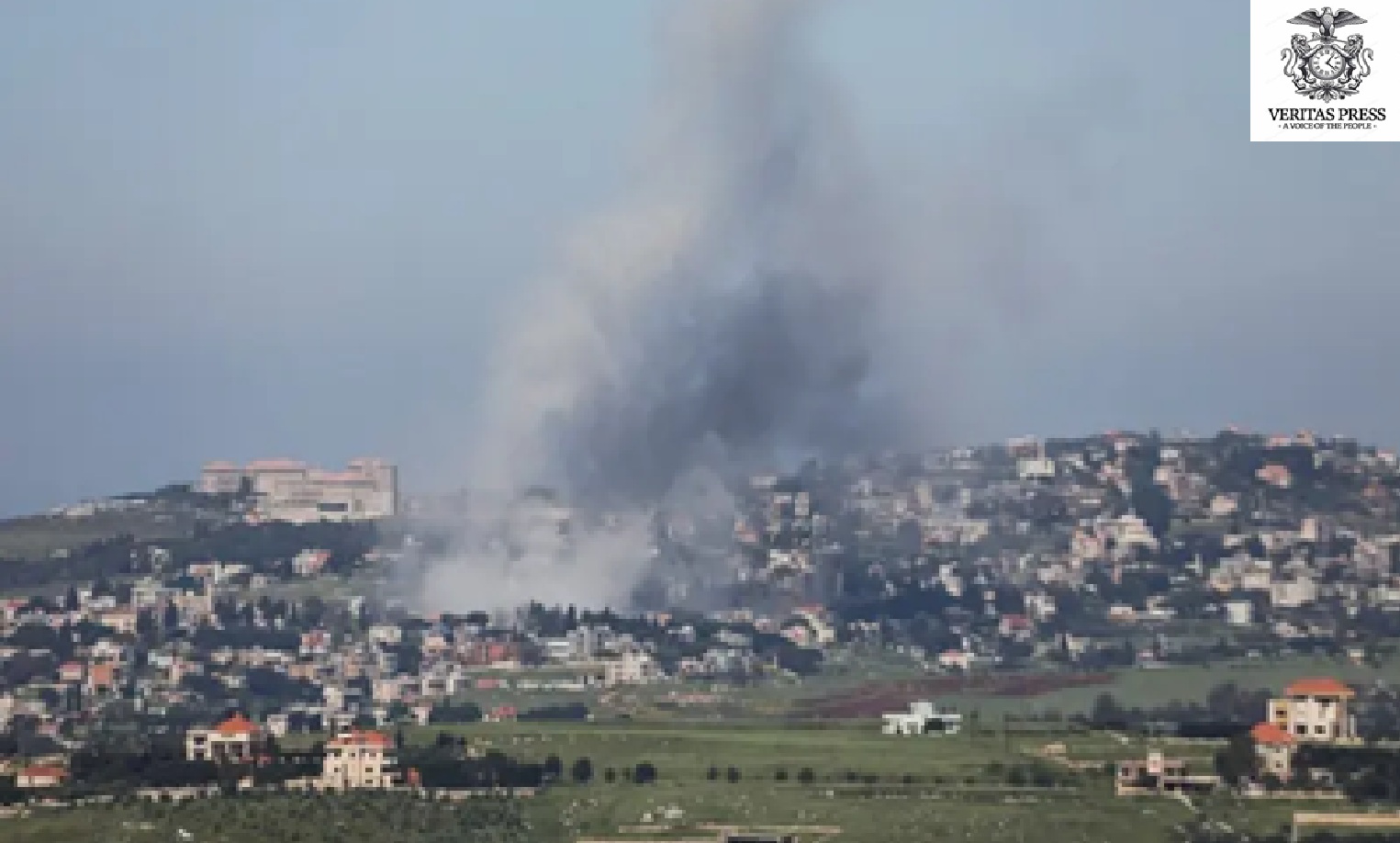
Yet on the ground, the reality is moving in the opposite direction. Overnight Thursday into Friday, Israeli warplanes struck the outskirts of Froun and Ghandouriyeh in the Bint Jbeil district. On Friday morning, an airstrike hit the town of al-Qusaybah, and a series of raids destroyed a neighbourhood in Nabatieh al-Fawqa that included the municipal building and several residential blocks. Heavy artillery pounded the vicinity of an orphanage in Mefdoun and the outskirts of Nabatieh al-Fawqa, sending plumes of smoke over a landscape already scarred by months of war. Lebanon’s National News Agency reported the details in raw, itemised dispatches that have become a grim daily ritual.
In the border villages, the evacuation orders are experienced not as a warning but as a sentence. “They told us to go at least one kilometre away,” said Umm Hassan, a 54-year-old widow from Kouthariyet al-Siyad, standing beside a battered Renault packed with blankets and cooking pots. “One kilometre? My son is disabled, and we have no car that works. We walked. They bombed the road behind us. This is the third time I have left my house since March. I don’t think there will be a house to return to.” Her story is repeated in a dozen dialects across the south, a population that has already endured the displacement of an estimated 1.5 million since the full-scale Israeli military campaign began on 2 March, after the collapse of the earlier, precarious truce.
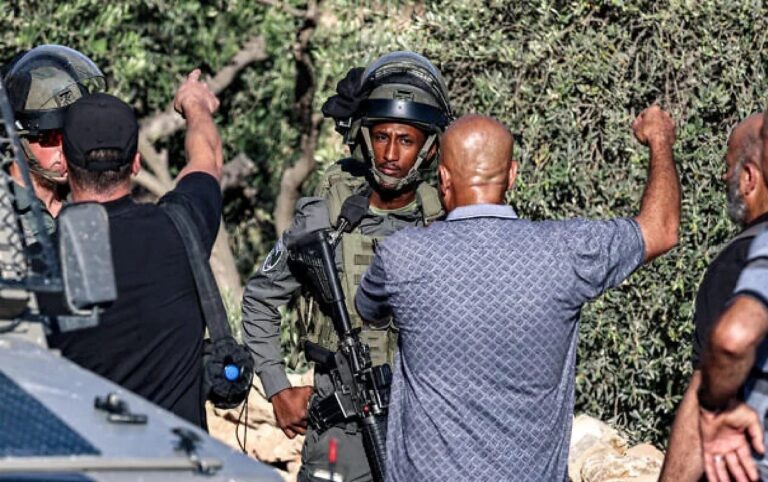
The Israeli military’s narrative, delivered via Col. Adraee’s multilingual social media accounts, frames each evacuation order as a humanitarian gesture forced upon the army by Hezbollah’s violations of the ceasefire agreement. “In light of the Hezbollah terror organisation’s violations … the IDF is forced to act against it with force and does not intend to harm you,” the Saturday warning read. But human rights organisations and UN agencies have repeatedly warned that blanket evacuation orders, particularly when issued with little notice, no safe routes, and no guarantee of return, may amount to forced displacement in violation of international humanitarian law. The orders also appear to treat entire villages as legitimate military objectives, blurring the critical distinction between civilians and combatants that the laws of war are meant to uphold.
“The pattern is clear,” said Lama Fakih, Middle East director at Human Rights Watch, speaking earlier this week at a press conference in Beirut. “Israel is using the language of ‘evacuation’ to empty a swath of southern Lebanon under the cover of a ceasefire that it violates every day. When you couple these orders with the systematic bulldozing of villages, the destruction of civilian infrastructure, and the killing of over 380 people since the ceasefire started, you have to ask whether the real objective is not security but permanent demographic change along the border.”
The body count tells its own story. The Israeli army acknowledged on Friday that Staff Sergeant Negev Dagan, 20, “fell during combat in southern Lebanon,” bringing the total number of Israeli military personnel and civilian contractors killed since the March escalation to 20. On the Lebanese side, the health minister’s figure of more than 380 dead since 17 April accounts only for those whose bodies have reached hospitals and morgues; rescue workers say dozens more remain trapped under the rubble of neighbourhoods pulverised by airstrikes that often follow the evacuation orders within minutes.
Hezbollah, for its part, has announced a series of operations that it says are defensive responses to continued Israeli ground incursions and aerial attacks. The group claims to have struck Israeli troop concentrations and armoured bulldozers with rockets, anti-tank missiles, and explosive devices, and to have fired surface-to-air missiles at Israeli drones over southern Lebanon. These exchanges, however asymmetrical, provide Israel with the pretext to label every Hezbollah action a ceasefire violation, while its own daily overflights, artillery barrages, and strikes, documented by the thousands in the Lebanese scientific council’s report, are presented as lawful counterterrorism.
The Washington talks are being sold by US diplomats as the “best way” to reach a lasting security arrangement. A State Department official, speaking on background to The New Arab, accused Hezbollah of trying to “obstruct negotiations through attacks and threats.” But the sequencing of events tells a different story: on Friday, as negotiators sat down, Israel issued the five-village warning and struck Nabatieh al-Fawqa. On Saturday, as follow-up sessions continued, the nine-village order was broadcast. Diplomacy, it appears, is running parallel to a military logic that is carving out facts on the ground that no agreement will easily reverse.
A senior Lebanese security source, speaking anonymously because of the sensitivity of the talks, said the government in Beirut is caught between two fires. “We are being asked to negotiate a permanent peace while the South burns. Every evacuation order, every new strike, weakens the hand of those who want a diplomatic solution and strengthens those who say only resistance will protect the land. This is a cycle the Americans seem unwilling or unable to break.”
The consequences are already spilling beyond the border zone. The municipality of Saida has registered more than 12,000 newly displaced families since Friday alone, overwhelming schools and unfinished buildings that were already sheltering families from earlier waves of war. Aid agencies warn of an unfolding humanitarian catastrophe as the summer heat sets in, with clean water, sanitation, and medical supplies dangerously low. “We are at breaking point,” said a field officer from Médecins Sans Frontières working in a mobile clinic near Tyre. “Every day there’s a new evacuation order, a new wave of terrified people, and less capacity to absorb them. The ceasefire is a fiction.”
The fiction is sustained by a diplomatic language that speaks of “extensions” and “guarantees”, while the mechanism to enforce calm, the tripartite monitoring committee, remains toothless. Israeli officials insist they will not fully withdraw while Hezbollah remains armed, and they reserve the right to strike any “imminent or planned” attack. In practice, that reservation has swallowed the rule: every rocket launch, real or alleged, triggers a disproportionate response that reshapes the human geography of the south.
As the Washington talks continue, the families of Qaqaait al-Snobar, Kouthariyet al-Siyad, and the other newly condemned villages are learning what thousands before them have already learned: that an evacuation order is the prelude to ruin. “I looked back from the top of the hill,” said Umm Hassan, still trembling. “I saw the dust rising where my house used to be. They call this a warning. I call it an obituary for a whole region.”
Source: Multiple News Agencies
Submissions:
For The Secure Submission Of Documentation, Testimonies, Or Exclusive Investigative Reports From Any Global Location, Please Utilise The Following Contact Details For Our Investigations Desk: enquiries@veritaspress.co.uk or editor@veritaspress.co.uk
Help Support Our Work:
Popular Information is powered by readers who believe that truth still matters. When just a few more people step up to support this work, it means more lies exposed, more corruption uncovered, and more accountability where it’s long overdue.
Help Protect Independent Journalism, Which Is Currently Under Attack.
If you believe journalism should serve the public, not the powerful, and you’re in a position to help, becoming a DONATOR or a PAID SUBSCRIBER truly makes a difference.
DONATION APPEAL: If You Found This Reporting Valuable, Please Consider Supporting Independent Journalism.
Help Support Our Work – We Know, We Know, We Know …
Seeing these messages is annoying. We know that. (Imagine what it’s like writing them … )
Your support fuels our fearless, truth-driven journalism. In unity, we endeavour to amplify marginalised voices and champion justice, irrespective of geographical location.
But it’s also extremely important. One of Veritas Press’s greatest assets is its reader-funded model.
1. Reader funding means we can cover what we like. We’re not beholden to the political whims of a billionaire owner. We are a small, independent and impartial organisation. No one can tell us what not to say or what not to report.
2. Reader funding means we don’t have to chase clicks and traffic. We’re not desperately seeking your attention for its own sake: we pursue the stories that our editorial team deems important and believe are worthy of your time.
3. Reader Funding: enables us to keep our website and other social media channels open, allowing as many people as possible to access quality journalism from around the world, particularly those in places where the free press is under threat.
We know not everyone can afford to pay for news, but if you’ve been meaning to support us, now’s the time.
Your donation goes a long way. It helps us:
- Keep the lights on and sustain our day-to-day operations
- Hire new, talented independent reporters
- Launch real-time live debates, community-focused shows, and on-the-ground reporting
- Cover the issues that matter most to our communities, in real time, with depth and integrity
We have plans to expand our work, but we can’t do it without your support. Every contribution, no matter the size, helps us stay independent and build a truly people-powered media platform.
If you believe in journalism that informs, empowers, and reflects the communities we serve, please donate today.
Donate Today:
GENEVA — A United Nations fact-finding mission has concluded there are “reasonable grounds to believe”
Iran’s GDP is projected to contract by 5.4 to 6.1% in 2026, its worst performance
The Trump administration is preparing a $2.8 billion weapons package for Israel containing 40,000 2,000-pound

Film alleges mass civilian deaths are routinely built into military decisions amid Israel’s genocidal war
The Israeli rights group says violence, displacement, economic strangulation, and settlement expansion form part of

Houthi forces have captured the historic Red Sea port of Mocha and are advancing on
London’s historic sanctions against Israeli settlements mark a watershed moment in UK foreign policy, but
With 95% of Gaza’s population now wholly dependent on aid and more than 90% stripped
India calls for Kashmir and Ladakh to appear only on its official map after a
ISLAMABAD – In the high-stakes political theatre of Pakistan, the battleground has shifted from the