



Help support our mission, donate today and be the change. Every contribution goes directly toward driving real impact for the cause we believe in.
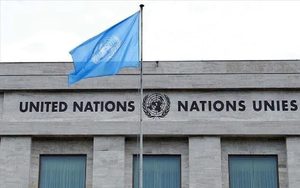
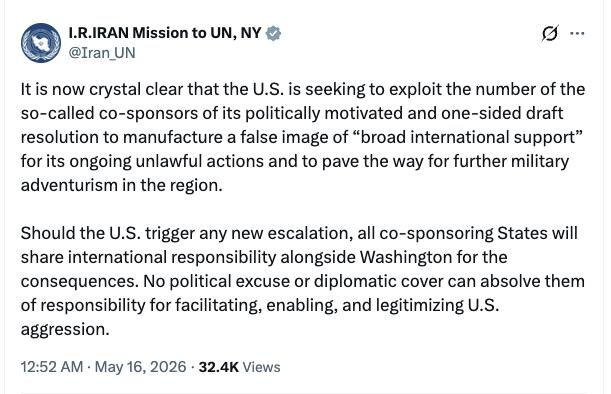
TEHRAN/WASHINGTON – A single message posted on X early Saturday morning crystallised a diplomatic standoff that has been simmering since the guns largely fell silent across the Gulf region last month. Iran’s permanent mission to the United Nations, in unusually blunt language, warned that any country co-sponsoring the United States’ proposed Security Council resolution on the Strait of Hormuz would “share international responsibility” for whatever escalation Washington triggers next.
The warning marked more than another exchange of rhetoric between Tehran and Washington. It signalled a new phase in the confrontation, one in which Iran appears increasingly determined to frame responsibility not solely around the United States but around a broader network of governments supporting American policy.
The message represented a noticeable shift in Tehran’s diplomatic strategy. Throughout previous rounds of confrontation, Iranian officials frequently focused on direct accusations against Washington and Tel Aviv. Now the circle of accountability is being widened to include Gulf partners and international actors that Tehran believes are helping legitimise future actions against the Islamic Republic.
According To The Iranian Mission:
“It is now crystal clear that the U.S. is seeking to exploit the number of the so-called co-sponsors of its politically motivated and one-sided draft resolution to manufacture a false image of broad international support for its ongoing unlawful actions and to pave the way for further military adventurism in the region.”
The statement did not stop there.
“Should the U.S. trigger any new escalation, all co-sponsoring States will share international responsibility alongside Washington for the consequences.”
Iranian officials later reiterated that “no political excuse or diplomatic cover” could absolve states from responsibility for “facilitating, enabling and legitimising” aggression.
A Diplomatic Offensive Presented As Freedom Of Navigation:
The immediate trigger behind Tehran’s warning was a draft resolution circulated by the United States with support from Bahrain, Saudi Arabia, the United Arab Emirates, Kuwait and Qatar.
Washington and its allies have publicly described the initiative as an attempt to preserve freedom of navigation and secure maritime routes through the Strait of Hormuz, one of the world’s most strategically significant waterways.
But Tehran argues that the language masks broader intentions.
Iranian officials insist that the resolution does not merely concern shipping security but may instead function as a diplomatic instrument capable of retroactively legitimising future military action.
Diplomatic analysts note that this concern is rooted in longstanding Iranian suspicions regarding international institutions. Since the Iraq war and previous regional interventions, Tehran has repeatedly argued that legal mechanisms and international resolutions can become instruments through which military campaigns gain political cover.
“The concern from Tehran’s perspective is not simply ships moving through Hormuz,” explained Dr. Maryam Sadeghi, a political economy scholar in Tehran.
“The concern is who controls the narrative of legality. If military pressure is repackaged as international consensus, then diplomacy itself becomes part of the battlefield.”
This appears increasingly to be the central Iranian argument: that the confrontation is no longer occurring only through missiles and airstrikes but through legal frameworks, sanctions architecture and international institutions.
From Open Warfare To Economic Siege:
The broader dispute unfolds against a fragile ceasefire environment that emerged after weeks of military confrontation earlier this year.
Although direct hostilities have largely subsided, core disagreements remain unresolved.
Negotiations mediated through Islamabad reportedly stalled amid disputes over sanctions, maritime restrictions and security guarantees.
Iranian Foreign Minister Abbas Araghchi has maintained a dual message: resistance against military pressure while simultaneously presenting diplomacy as possible under altered conditions.
Speaking at the BRICS foreign ministers’ meeting in New Delhi, Araghchi said:
“We are accustomed to these threats. They themselves know they have achieved nothing and will achieve nothing through threats or even through the war they launched.”
His message later expanded beyond governments and directly targeted ordinary Americans through social media.
“Put aside gas price hike and stock market bubble. Real pain begins when U.S. debt and mortgage rates start to jump.”
The comments reflected Tehran’s increasingly visible effort to frame confrontation with Iran not merely as a regional security issue but as one carrying broader economic consequences.
“The Foreign Minister is trying to shift the audience,” said one regional analyst speaking to journalists in New Delhi.
“Instead of speaking only to diplomats, he is speaking to citizens and consumers. The argument is simple: instability in the Gulf does not remain in the Gulf.”
Human Costs Beneath Geopolitical Calculations:
Lost amid discussions of resolutions, sanctions and strategic waterways are civilians living through the consequences of prolonged uncertainty.
Aid organisations have warned that continuing disruptions and restrictions are affecting supply chains, medical imports and local economies.
Residents in coastal communities have described mounting pressures.
“We have not returned to normal,” said Hossein Kamali, a fisherman from Bandar Abbas.
“People talk about ships and oil and politics. But for us, this is food, work and survival.”
Human rights advocates have also warned against reducing the crisis to state narratives alone.
Iranian activist Narges Mohammadi argued that ordinary people continue carrying the consequences of decisions made by governments and military establishments.
“There is anger, there is fear, and there is exhaustion,” she said.
“People ask how long ordinary citizens are expected to absorb the cost.”
Gulf states are increasingly caught between alliance and vulnerability
For Gulf states supporting the US initiative, the calculations remain deeply complicated.
Publicly, they continue to insist that the issue concerns protecting maritime commerce and preserving international norms.
Privately, regional analysts suggest concerns are more complex.
Several Gulf governments remain acutely aware that previous confrontations demonstrated how quickly regional infrastructure and cities could become exposed to retaliatory attacks.
A senior Gulf official speaking anonymously to regional media described the position bluntly:
“Security relationships with Washington are important, but everyone also remembers what happened during previous escalations. Geography does not allow distance.”
That tension appears to be exactly what Tehran seeks to exploit.
Iran’s warning is not simply legal language; it also functions as deterrence messaging directed at governments considering deeper alignment with Washington’s strategy.
A Ceasefire Without A Settlement:
The immediate issue may be a Security Council vote and the future of the Strait of Hormuz.
The larger struggle, however, concerns competing visions of regional order.
Washington frames its position around navigation rights and maritime security.
Tehran frames the dispute around sovereignty, sanctions and what it sees as externally imposed coercion.
Neither side currently appears willing to move significantly from those positions.
The missiles may have become quieter.
The struggle over who shapes the Gulf’s political and security architecture has not.
As diplomats prepare for another round of negotiations and Security Council manoeuvring, the question is no longer whether the conflict continues.
It already does.
The question is whether its next battlefield will be military, economic, legal, or all three at once.
Conclusion:
The danger buried beneath the diplomatic language now circulating through New York is that the confrontation over the Strait of Hormuz is no longer fundamentally about ships, oil tankers or even freedom of navigation. Those have become the public vocabulary through which a wider struggle over power, legitimacy and regional order is being fought.
Behind the carefully worded Security Council drafts and official press statements sits a far more consequential reality: a military confrontation that failed to produce a decisive outcome appears to be re-emerging through legal mechanisms, economic pressure and competing narratives of international legitimacy. The battlefield has not disappeared; it has simply moved into courtrooms, sanctions regimes, financial markets and diplomatic chambers.
Iran’s warning that co-sponsors of the US-backed initiative will “share responsibility” is therefore more than a rhetorical escalation. It reflects an attempt to redefine accountability itself. Tehran is effectively arguing that states cannot publicly describe themselves as neutral defenders of international order while simultaneously providing political endorsement, strategic access or military infrastructure for actions that may expand the conflict. Whether international law ultimately supports that position may be debated by scholars and tribunals. But politically, the accusation strikes at an uncomfortable reality that Gulf capitals understand well: alliances can provide security guarantees, but they can also transfer risk.
That risk is becoming increasingly visible. Gulf governments advocating maritime stability are simultaneously hosting foreign military infrastructure that makes them potential targets in any renewed confrontation. Western governments calling for de-escalation continue pursuing policies Tehran describes as coercive pressure. International institutions claiming neutrality are being accused by one side of functioning as instruments of geopolitical power. Meanwhile, ordinary civilians, Iranian fishermen in Bandar Abbas, workers in Gulf port cities, families confronting inflation and disrupted livelihoods, remain trapped beneath decisions made thousands of miles away in presidential offices and diplomatic corridors.
There is also a deeper contradiction at the centre of this crisis that few officials publicly acknowledge. Nearly every actor involved claims to be defending stability while pursuing policies that repeatedly generate instability. Washington speaks of deterrence while increasing pressure; Tehran speaks of resistance while escalating its own retaliatory posture; Gulf states speak of security while navigating competing military and economic dependencies. The language differs, but the cycle often remains the same.
The result is a ceasefire without settlement, diplomacy without trust, and negotiations without consensus on the underlying causes of confrontation.
The question facing the international community is therefore larger than whether the Strait of Hormuz reopens or whether a Security Council resolution passes. The more difficult question is whether international institutions are being used to resolve conflicts or to legitimise the next phase of them.
Because history repeatedly shows that wars do not always end when missiles stop falling. Sometimes they survive in quieter forms, through sanctions, blockades, diplomatic manoeuvres and legal arguments that continue the struggle by different means.
And if Tehran’s latest warning reveals anything, it is that Iran increasingly believes the next war may not begin with bombs.
It may begin with signatures.
Source: Multiple News Agencies
Submissions:
For The Secure Submission Of Documentation, Testimonies, Or Exclusive Investigative Reports From Any Global Location, Please Utilise The Following Contact Details For Our Investigations Desk: enquiries@veritaspress.co.uk or editor@veritaspress.co.uk
Help Support Our Work:
Popular Information is powered by readers who believe that truth still matters. When just a few more people step up to support this work, it means more lies exposed, more corruption uncovered, and more accountability where it’s long overdue.
Help Protect Independent Journalism, Which Is Currently Under Attack.
If you believe journalism should serve the public, not the powerful, and you’re in a position to help, becoming a DONATOR or a PAID SUBSCRIBER truly makes a difference.
DONATION APPEAL: If You Found This Reporting Valuable, Please Consider Supporting Independent Journalism.
Help Support Our Work – We Know, We Know, We Know …
Seeing these messages is annoying. We know that. (Imagine what it’s like writing them … )
Your support fuels our fearless, truth-driven journalism. In unity, we endeavour to amplify marginalised voices and champion justice, irrespective of geographical location.
But it’s also extremely important. One of Veritas Press’s greatest assets is its reader-funded model.
1. Reader funding means we can cover what we like. We’re not beholden to the political whims of a billionaire owner. We are a small, independent and impartial organisation. No one can tell us what not to say or what not to report.
2. Reader funding means we don’t have to chase clicks and traffic. We’re not desperately seeking your attention for its own sake: we pursue the stories that our editorial team deems important and believe are worthy of your time.
3. Reader Funding: enables us to keep our website and other social media channels open, allowing as many people as possible to access quality journalism from around the world, particularly those in places where the free press is under threat.
We know not everyone can afford to pay for news, but if you’ve been meaning to support us, now’s the time.
Your donation goes a long way. It helps us:
- Keep the lights on and sustain our day-to-day operations
- Hire new, talented independent reporters
- Launch real-time live debates, community-focused shows, and on-the-ground reporting
- Cover the issues that matter most to our communities, in real time, with depth and integrity
We have plans to expand our work, but we can’t do it without your support. Every contribution, no matter the size, helps us stay independent and build a truly people-powered media platform.
If you believe in journalism that informs, empowers, and reflects the communities we serve, please donate today.
Donate Today:
GENEVA — A United Nations fact-finding mission has concluded there are “reasonable grounds to believe”
Iran’s GDP is projected to contract by 5.4 to 6.1% in 2026, its worst performance
The Trump administration is preparing a $2.8 billion weapons package for Israel containing 40,000 2,000-pound

Film alleges mass civilian deaths are routinely built into military decisions amid Israel’s genocidal war
The Israeli rights group says violence, displacement, economic strangulation, and settlement expansion form part of

Houthi forces have captured the historic Red Sea port of Mocha and are advancing on
London’s historic sanctions against Israeli settlements mark a watershed moment in UK foreign policy, but
With 95% of Gaza’s population now wholly dependent on aid and more than 90% stripped
India calls for Kashmir and Ladakh to appear only on its official map after a
ISLAMABAD – In the high-stakes political theatre of Pakistan, the battleground has shifted from the