Kamran Faqir is a volunteer investigative journalist and writer committed to exposing hidden truths and amplifying underreported stories. Driven by social justice, he brings sharp insight and fearless truth-telling to independent journalism. NUJ registered.
Original Article Date Published:
Article Date Modified:
23 minutes
Views:494
Listen to this article
Help support our mission, donate today and be the change. Every contribution goes directly toward driving real impact for the cause we believe in.
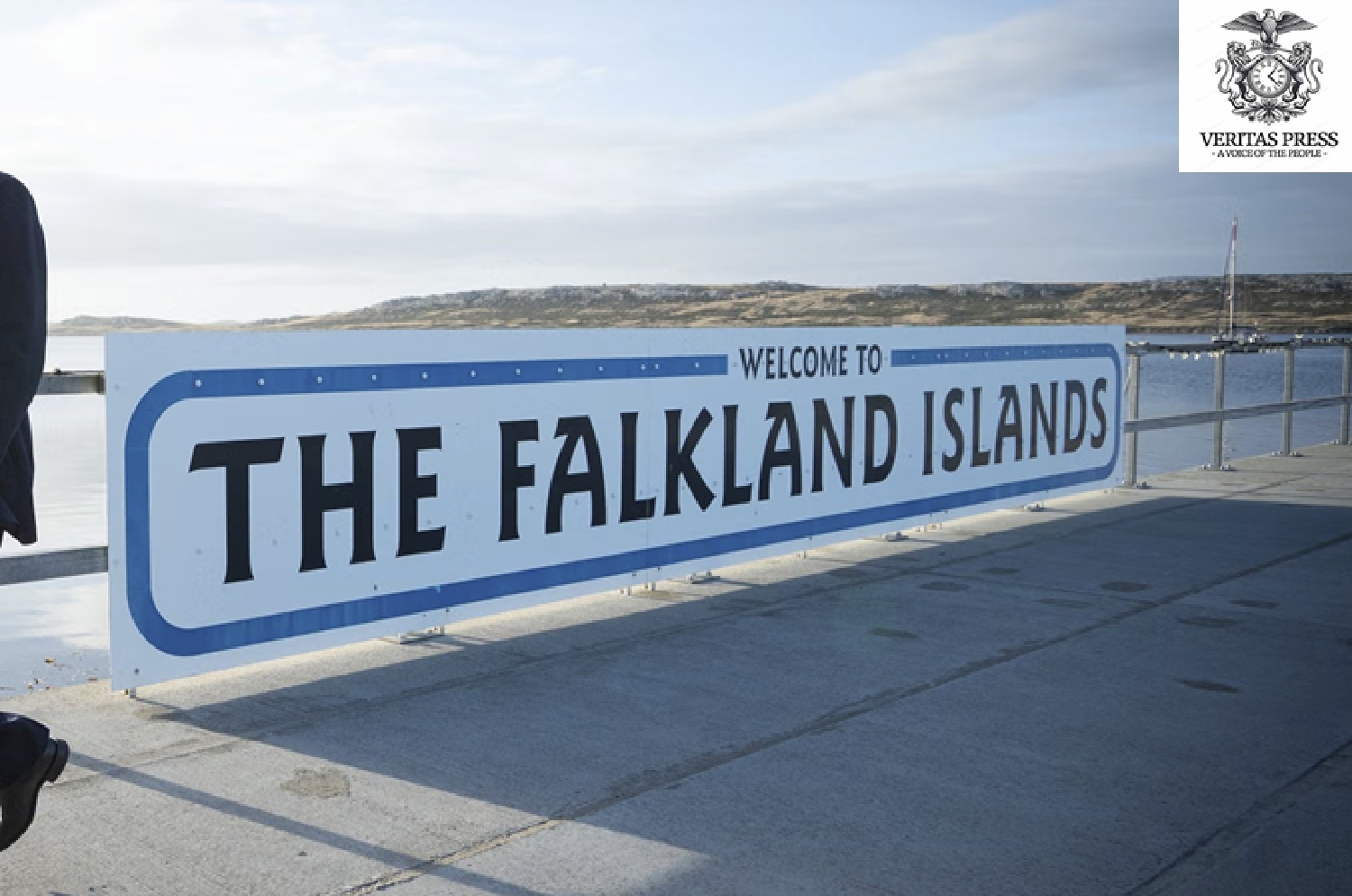
LONDON/WASHINGTON – The unthinkable question is being whispered in the halls of Whitehall, debated in the mess rooms of the British Forces South Atlantic Islands, and discussed in the pubs of Stanley: Could a disintegrating “special relationship” between Washington and London, poisoned by a bitter disagreement over a war in the Middle East, ultimately spell the end of British sovereignty over the Falkland Islands? What was once a historical hypothetical has, in the spring of 2026, become a strategic anxiety. A leaked Pentagon memorandum, reported by Reuters, suggests the Trump administration is actively considering withdrawing its diplomatic support for the UK’s claim to the Falklands as retribution for Britain’s refusal to fully endorse the US campaign against Iran.
The outcome is not merely a bilateral squabble but a prism through which to view the crumbling of the post-1945 international order, a crisis that encompasses the weaponisation of decolonisation, the contested principle of self-determination, and the raw transactional reality of 21st-century power politics. This investigation dissects the anatomy of that crisis: from the bloody history of 1982 and the legal architecture of international law, to the oil beneath the South Atlantic, the military balance of power, and the voices of the 3,600 islanders caught in the middle.
The Spark: The Iran War.
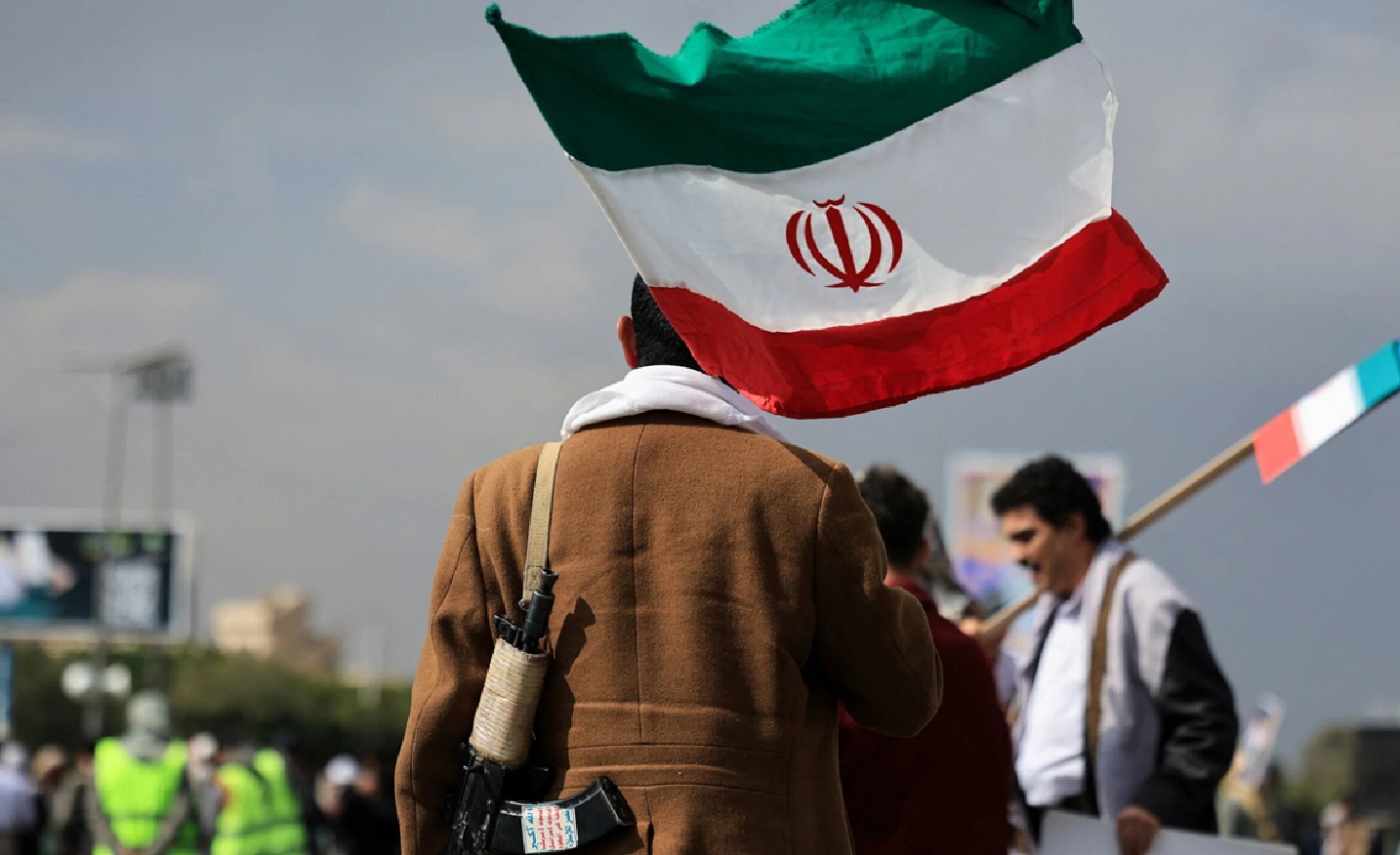
On 28 February 2026, President Trump announced “major combat operations” against Iran, unleashing massive joint US-Israeli strikes targeting military and government sites across the Islamic Republic. The 38-day bombing campaign, known as Operation Epic Fury, was launched without prior consultation with NATO allies, a fact that would prove deeply consequential in the weeks that followed. European allies, including the United Kingdom, Germany, and Spain, promptly declared they would not participate in offensive strikes on Iran, with NATO Secretary General Mark Rutte stating that “this is clearly a campaign led by the Americans and the Israelis,” and that Alliance forces would not be drawn into a joint military operation.
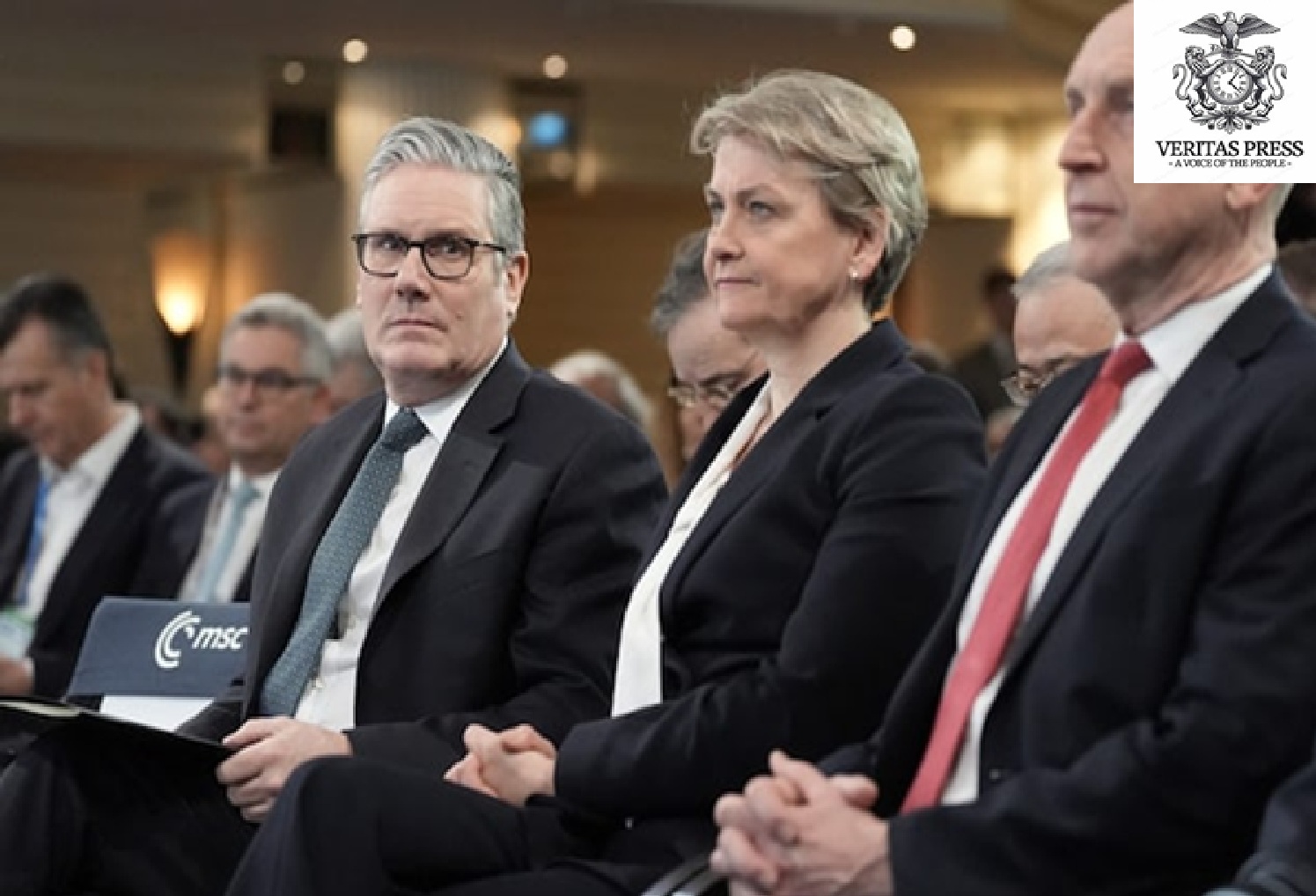
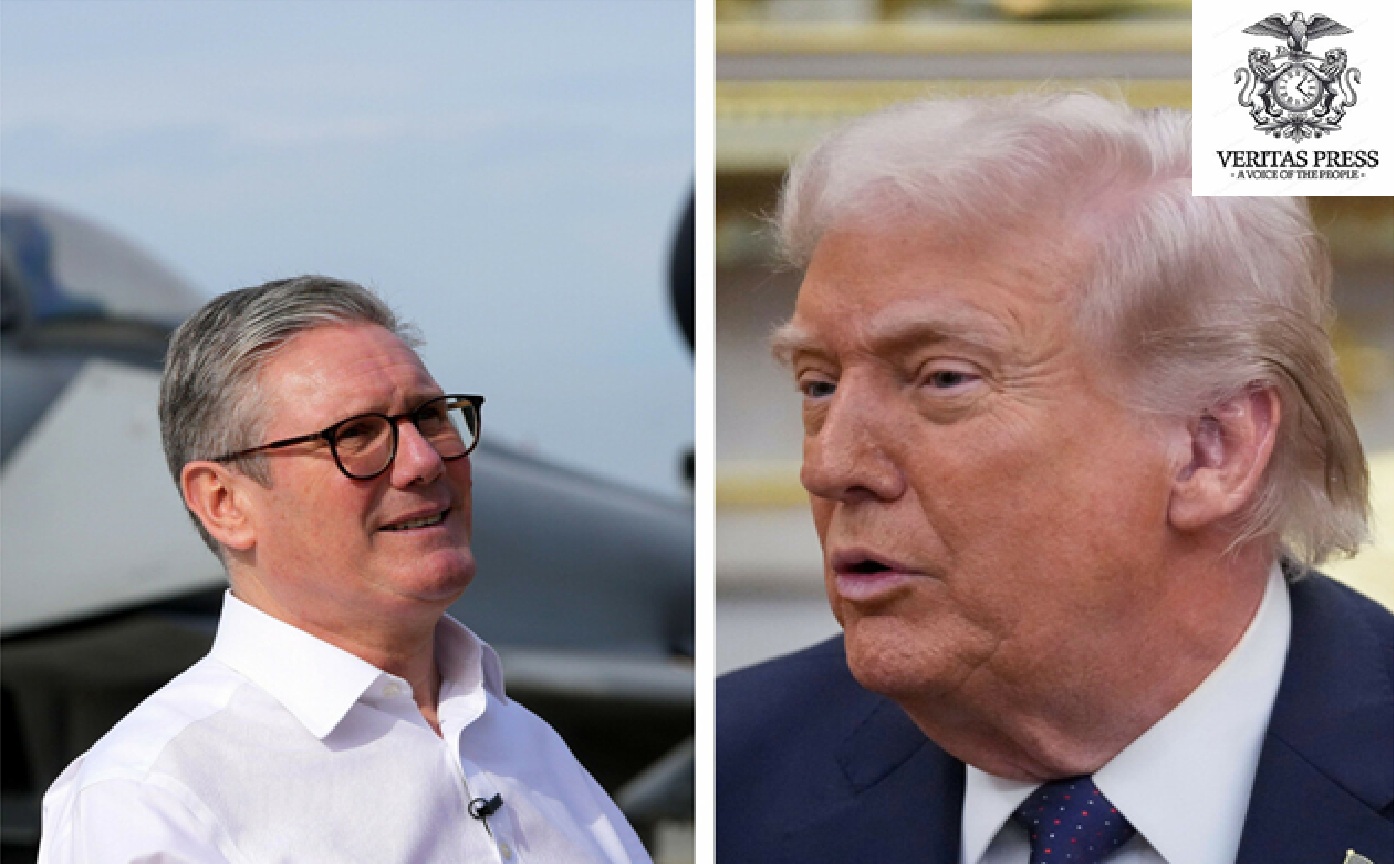
Trump’s response was swift and characteristically blunt. He branded NATO a “paper tiger” and threatened to withdraw the United States from the alliance altogether, telling The Telegraph he was “strongly considering” pulling out. His ire fell particularly heavily on British Prime Minister Keir Starmer, whom he branded “no Winston Churchill” after Starmer initially refused to grant US forces access to British bases, including RAF Fairford in Gloucestershire and Diego Garcia in the British Indian Ocean Territory, to launch offensive strikes. Starmer’s calibrated middle path, granting limited permission for defensive operations only after Iranian retaliation began, did little to mollify the White House.
The economic backdrop lent urgency to the diplomatic rupture. The near-closure of the Strait of Hormuz, through which roughly 20 per cent of the world’s fossil fuels pass, sent oil prices spiking, erasing previously expected global demand growth and triggering stern warnings from the IMF, IEA, and World Bank of “substantial, global and highly asymmetric” impacts, including the spectre of a global recession under severe scenarios. It was against this volatile backdrop of military stalemate, economic distress, and diplomatic bitterness that the leaked Pentagon memo landed like a depth charge.
The Memo: A Strategic Warning Shot.
The internal Pentagon email, first described by Reuters on 24 April 2026, laid out a menu of options for punishing NATO allies perceived as having failed to support the Iran campaign. Among the most provocative proposals was a reassessment of US diplomatic support for longstanding European “imperial possessions”, with the Falkland Islands singled out by name. The memo also suggested that Spain be suspended from NATO for refusing to allow US warplanes to use its bases or airspace during the operation.
Pentagon Press Secretary Kingsley Wilson refused to confirm or deny the proposals directly but offered a statement that was far from reassuring. “As President Trump has said, despite everything that the United States has done for our NATO allies, they were not there for us,” Wilson declared. “The war department will ensure that the president has credible options to ensure that our allies are no longer a paper tiger and instead do their part.”
For those in London and Stanley who recall the hard-won victory of 1982, the reference to the Falklands was deliberately designed to provoke. The Guardian noted that while “the Falklands proposal looks vague and there is no immediate sign of it being adopted, the reference to the islands appears deliberately designed to provoke a reaction in the UK, where memories of the 1982 war linger.” Ben Judah, who served as a special adviser to former Foreign Secretary David Lammy, confirmed that the potential for such a shift had been considered within the Foreign Office, though it had been treated as a “hypothetical scenario.”
A War Remembered: 1982 And The Ghosts That Haunt.
To understand why the Pentagon’s threat reverberated with such force, one must revisit the spring of 1982. On 2 April of that year, Argentine forces under the military junta of General Leopoldo Galtieri invaded the Falkland Islands, overwhelming the small garrison of Royal Marines stationed there. What followed was a 74-day conflict that became a defining chapter of British post-war history. By the time Argentine forces surrendered on 14 June, 255 British service members, 649 Argentines, and three Falkland Islanders lay dead.
The US role in that conflict remains a point of enduring debate and sensitivity. While the Reagan administration publicly positioned itself as a neutral mediator, Secretary of State Alexander Haig famously “shuttled” between London and Buenos Aires, the reality was very different. Declassified CIA files, later corroborated by former Navy Secretary John Lehman, revealed that the United States provided extensive covert support to Britain, including 200 Sidewinder air-to-air missiles, Stinger anti-aircraft systems, Harpoon anti-ship missiles, satellite and signals intelligence, and the use of the American air base on Ascension Island.
Lehman was startlingly candid about the decisiveness of this assistance. “In my judgment, the outcome would have been very different if it weren’t for the support and the flow of intelligence, of logistics, of technical support, of communications and of things like Sidewinders from the United States to the Royal Navy,” he stated in a 1988 BBC interview. He was even blunter: “Britain would have had to have withdrawn from the Falklands” without the American aid.
This history underscores why any US shift on the Falklands is far from academic. During the 1982 war, American diplomatic backing and material support were pivotal. While today’s context differs markedly, Argentina is a democracy under Javier Milei, not a military junta, and its armed forces have atrophied significantly since the 1980s; the principle remains: Washington’s stance on the Falklands has real, material consequences for the balance of power in the South Atlantic.
Britain’s Military Posture: A Fortress Without A Drawbridge?
The British military presence on the Falklands is, on paper, formidable. RAF Mount Pleasant, built in the aftermath of the 1982 war and opened in 1985, serves as one of the most potent British military installations outside the UK itself. The base hosts No. 1435 Flight RAF, a unit of four Eurofighter Typhoon fighter jets maintained on permanent Quick Reaction Alert, ready to scramble within minutes to intercept any threat. Ground-based air defence is provided by the 16th Regiment Royal Artillery, equipped with modern surface-to-air missile systems. Between 1,300 and 1,700 British military and civilian personnel are stationed there at any given time.
The Royal Navy maintains a permanent patrol vessel, HMS Medway, in the South Atlantic, and regular live-fire exercises, such as Operation Firic conducted by the Royal Irish Regiment in January 2026, are designed to visibly demonstrate the UK’s willingness and ability to defend the islands. “Patrols and exercises such as the final exercise serve a dual purpose: developing soldiers in one of the most demanding environments the Army operates in, while reassuring the local population and reinforcing UK sovereignty,” the Ministry of Defence stated.
Yet beneath the surface of this robust posture, defence analysts paint a far more sobering picture. Dr Benjamin Martill, senior lecturer in politics and international relations at Edinburgh University, told The i Paper that the loss of American backing would “complicate matters significantly” for British defence of the Falklands, adding bluntly: “The UK arguably does not have the capabilities to mount a sustained military expedition in the south Atlantic, not least when its resources are stretched by the current war in Ukraine and with Iran.” Defence policy consultant Toby Dickinson was similarly pessimistic, asserting that Britain had not possessed the independent means to protect the islands for 30 years.
Dr Carlos Solar, senior research fellow in Latin American security at the Royal United Services Institute (RUSI), offered a nuanced but telling assessment: “The RAF’s four Typhoon jet fighters and the Royal Navy’s HMS Medway are not there to wage war, but to patrol British interests at the scale of what is essentially needed.” He emphasised that “at the operational level, security for the Falkland Islands is done solely by a British contingent of army, navy and air force troops and they do not rely on US or NATO partners to do so.” However, he acknowledged that a withdrawal of US diplomatic support would signal a rupture “at the highest strategic level.”
Dr Johanna Amaya-Panche, of Liverpool John Moore University, stressed that while Argentina was unlikely to launch another military invasion, its armed forces lack the necessary resources and logistics, “supportive or ambiguous signals from Washington could nonetheless reshape Argentina’s perception of opportunity. Under such conditions, the government of Javier Milei may adopt a more assertive diplomatic or legal strategy, seeking to internationalise the dispute and mobilise external support. This shift would likely operate at the level of rhetoric and diplomacy rather than military planning.”
Admiral Lord West of Spithead, former First Sea Lord and commander of HMS Ardent, the frigate sunk beneath him in Falkland Sound in 1982, dismissed the US threats with the defiant confidence of a veteran who had seen the worst of war. “The recognition or otherwise by the US does not make the islands less secure,” he told The Independent, calling the threatened review an “insult to the autonomous, self-reliant and free people of the Falkland Islands,” adding: “How dare they!”
The Argentine Calculus: Milei, Malvinas, And The Trump Connection.
If the Pentagon memo was designed to unsettle London, it was undoubtedly welcome news in Buenos Aires. Argentine President Javier Milei, the libertarian firebrand who has forged a close ideological and personal alliance with Donald Trump, has maintained Argentina’s historic sovereignty claim over what it calls the Islas Malvinas while framing the issue as one of decolonisation rather than military confrontation.
On 2 April 2026, Milei marked the anniversary of the 1982 war, the Día del Veterano y de los Caídos en la Guerra de Malvinas, a national holiday in Argentina, with a speech that reaffirmed the claim in unmistakable terms. He described the dispute as a “special and particular colonial situation” recognised by the United Nations and called for “mature and sincere dialogue” with London. He also announced that his government would allocate “10 per cent of fiscal revenues” from the privatisation of state firms to strengthening Argentina’s armed forces.
Crucially, Milei also trained his sights on the economic prize beneath the South Atlantic waters. He explicitly warned that Argentina would “respond with all necessary diplomatic measures” to oil exploration around the Falklands, directly referencing the Sea Lion project, a massive offshore oil development being advanced by UK-listed Rockhopper Exploration and Israel’s Navitas Petroleum.
The Sea Lion field, discovered in 2010 approximately 220 kilometres north of the Falklands, represents a transformative economic asset. Rockhopper holds a 35% working interest, and the project reached its final investment decision in December 2025, with first oil expected in early 2028. The field is estimated to hold some 313.8 million barrels of proved and probable oil, with an additional 94.3 million barrels possible, making it one of the largest undeveloped offshore discoveries in the region. The Falkland Islands Government, which approved the development programme, stands to reap substantial tax revenues and royalties from the project.
Argentina’s Foreign Ministry has filed strong protests against the project, arguing that any unilateral exploitation of natural resources in disputed territory violates United Nations resolutions. For Buenos Aires, the potential shift in US policy presents an opening not merely to revive a dormant sovereignty claim but to challenge the legal basis on which the Falkland Islands’ economic future is being built.
Milei’s position was further bolstered by a formal declaration of support from Chilean President José Antonio Kast, who, during a state visit to Buenos Aires on 7 April 2026, “reiterated the support of the Government of Chile for the legitimate sovereign rights of the Argentine Republic” over the Falklands/Malvinas and called for the resumption of negotiations between Argentina and the United Kingdom.
The broader regional diplomatic landscape is equally challenging for the UK. In late June 2025, the Organisation of American States (OAS) adopted a unanimous declaration at its General Assembly in Antigua and Barbuda, supporting Argentina’s sovereignty claim and urging the United Kingdom to resume bilateral negotiations “as soon as possible.” Argentina’s representative to the OAS, Carlos Cherniak, accused the UK of “continuing to take unilateral decisions” and of granting “licences and concessions for the exploration and exploitation of natural resources.” That the OAS acts by consensus, meaning the United States, under previous administrations, has at times declined to block such resolutions, adds a further layer of complexity to Washington’s current posture under Trump.
The Referendum And The Right To Self-Determination:
At the heart of the British position lies a single, powerful weapon: the 2013 referendum. When the Falkland Islanders were asked whether they wished to retain their status as a British Overseas Territory, 99.85% voted “yes”, just three people voted “no” out of a turnout of 92%. For the UK government, this result is the ultimate trump card, proof positive that the islanders have exercised their right to self-determination, a principle enshrined in the UN Charter and the International Covenant on Civil and Political Rights.
Downing Street invoked the referendum repeatedly in its response to the Pentagon leak. “The Falkland Islands have voted overwhelmingly in favour of remaining a UK overseas territory, and we’ve always stood behind the islanders’ right to self-determination and the fact that sovereignty rests with the UK,” a No 10 spokesperson stated. “We could not be clearer about the UK’s position on the Falkland Islands. It’s longstanding. It’s unchanged. Sovereignty rests with the UK, and the islands’ right to self-determination is paramount.”
Mark Pollard, an elected member of the Falkland Islands Legislative Assembly, addressed the UN Special Committee on Decolonisation directly in 2025. “I speak for Falkland Islanders,” he declared. “We are not a pawn in a political game or a footnote in someone else’s history. We are a people.” He added that his “ancestors arrived not as conquerors, but as caretakers, custodians of our environment, taming the land, raising families and building homes,” and insisted, “We are here to stay.”
Peter Biggs, another Legislative Assembly member, described the 1982 invasion in starkly personal terms: “We were invaded by Argentina,” he said, noting that his wife was five months pregnant at the time. He argued that the Falklands are not a colony but have evolved “by choice and mutual agreement between the Governments of the United Kingdom and the Falklands into a British overseas territory.”
Argentina, however, rejects the applicability of the self-determination principle to the Falklands. Buenos Aires argues that the current population was “implanted” by the colonising power after the original Argentine population was expelled by British forces in 1833, and that the UN resolutions on the matter frame the issue as a sovereignty dispute between two states, not a question of self-determination for the inhabitants. The UN Special Committee on Decolonisation (C-24) has consistently sided with this interpretation, adopting annual resolutions that call for Argentina and the United Kingdom to resume negotiations “as soon as possible” to find a peaceful solution to the sovereignty dispute.
The tension between these two legal frameworks, territorial integrity and self-determination, forms the central contradiction of the Falklands dispute and explains why the US position carries such weight: Washington has historically acted as a mediator, and its diplomatic endorsement of one side over the other has the capacity to tip the scales at international forums, if not in the islands’ defence, then in the critical arena of global legitimacy.
The Special Relationship In Tatters:
The leaked Pentagon memo is merely the latest, and arguably most dangerous, manifestation of a special relationship that has been systematically degraded over the past year. Trump’s frustration with Starmer was sealed when the British Prime Minister refused to grant unrestricted access to RAF bases for offensive strikes against Iran. “The American people have been shocked at just how much the British Government has been unreliable. The US Department of War has been frustrated that they can’t properly partner with a country that is supposed to be our greatest ally,” a source close to the administration told The Telegraph.
Trump’s personal disdain for Starmer has been unmistakable. He has dismissed the Labour leader as “no Winston Churchill,” publicly questioned his competence, and suggested that the Prime Minister could only “recover” politically if he “opened the North Sea and if his immigration policies became strong, which right now they’re not.”
The diplomatic freeze frames the awkward timing of the state visit of King Charles III and Queen Camilla to the United States, scheduled to begin on Monday, 28 April 2026, four days after the Pentagon leak became public. The visit, intended to mark the 250th anniversary of American independence and to serve as a showcase of the enduring bonds between the two nations, has instead been overshadowed by the Falklands controversy. The King is scheduled to address Congress and attend a state dinner at the White House, but he now arrives not as the head of state of America’s closest ally but as a monarch navigating a diplomatic minefield.
Trump, for his part, lavished praise on the monarch, calling him a “great man” and a “brave man,” while conspicuously remaining muted on Starmer. The contrast was deliberate and telling.
The political fallout in the UK was immediate and cross-partisan. Conservative leader Kemi Badenoch branded the potential US review “absolute nonsense,” comparing it to Trump’s earlier threat to annex Greenland: “The Falkland Islands are British. They have been for a very long time. The sovereignty is British sovereignty. I don’t know what Donald Trump is talking about.”
Liberal Democrat leader Sir Ed Davey went further, calling for the King’s state visit to be cancelled outright. “The state visit should clearly be pulled; this unreliable, damaging President cannot keep insulting our country,” he declared, reflecting a growing sentiment on the British left that the special relationship has become a vehicle for American bullying.
Nigel Farage, the Reform UK leader and a long-time Trump ally, sought a middle path, insisting that Falklands sovereignty was “utterly non-negotiable,” while pledging to raise the issue directly with both the Americans and President Milei during his planned visit to Argentina later in the year.
The Daily Mail captured the public mood with its front-page headline: “Fury at ‘schoolyard bully’ Trump threatening to help Argentina’s claim to Falklands.” Falklands war veteran Simon Weston, who suffered horrific burns during the conflict, accused Trump of acting like a “schoolyard bully,” warning that Argentina could use the shift as an excuse for another invasion.
A Blueprint For The Future: International Law And The Weaponisation Of Decolonisation.
Beneath the immediate diplomatic crisis lies a deeper and more consequential struggle for London: the battle over the very legitimacy of its remaining Overseas Territories in international law and global opinion. The Trump administration’s explicit framing of the Falklands as a European “imperial possession” represents a direct assault on Britain’s carefully constructed narrative that these territories are not colonies but communities that have freely chosen their political status through the exercise of self-determination.
This framing matters far beyond the South Atlantic. The UN’s Special Committee on Decolonisation (C-24) continues to list the Falkland Islands as one of 17 remaining “Non-Self-Governing Territories” whose decolonisation remains incomplete. In February 2026, UN Secretary-General António Guterres addressed the C-24, acknowledging that “decolonisation has been an objective of the United Nations since its earliest days” and that “more people than ever now enjoy the right and the dignity of self-determination.” Yet he also noted the “legacy of colonialism has left profound scars through deeply rooted mechanisms of economic exploitation.”
Argentina has skillfully exploited this institutional architecture, securing annual resolutions from the C-24 that call for negotiations, resolutions that the United Kingdom routinely rejects, arguing that the committee does not represent the views of the Falkland Islanders themselves. The OAS resolutions, similarly, have become an annual diplomatic ritual, with the organisation backing Argentina’s claim by acclamation year after year.
For the UK, the challenge is crystallised in a single question: What happens if the United States decides to stop blocking or abstaining on these resolutions and instead begins to support them? The legal and diplomatic architecture that Britain has relied upon for decades to sustain its sovereignty claims would begin to erode, not through invasion, but through the slow, grinding mechanisms of international law and multilateral diplomacy.
Ben Judah, who served as a special adviser to Foreign Secretary David Lammy, proposed a radical long-term solution: converting the Overseas Territories into “overseas kingdoms,” similar to the French model, with elected representation at Westminster. “If this were already the case, His Majesty would be visiting Washington to see Trump this week as King of the Kingdom of the Falklands,” Judah remarked. His comment, though made partly in jest, highlighted the deep constitutional vulnerability at the heart of Britain’s relationship with its remaining territories.
The Pentagon memo, in other words, has not created a new vulnerability for the Falklands; it has exposed one that has existed for decades, concealed by the protective umbrella of American diplomatic support. Now that this umbrella appears to be closing, the UK must confront the possibility that the international legal order, which it helped to build and sustain, could be turned against it.
Conclusion: The House That Reagan Built.
When British troops recaptured Stanley in June 1982, they did so with American missiles in their aircraft wings and American satellite intelligence guiding their ships. The victory was British in blood and courage, but American in the sinews of war. The relationship that enabled that victory, the special relationship forged by Churchill and Roosevelt, tempered in the Cold War, and cemented by Reagan and Thatcher, has been the bedrock of British defence policy for four decades.
Now, that bedrock is cracking, not because of a resurgence of Argentine militarism, but because of a war in Iran that Britain chose not to join and an American president who views alliances as transactional ledgers. The ultimate irony is stark: the very principle of self-determination that Britain deploys to defend its claim to the Falklands is the same principle that Starmer invoked to justify his refusal to be drawn into Trump’s Iran war. “I have to act in our national interests,” Starmer said. “This is not our war.”
The Falkland Islanders, for their part, are preparing to vote in another referendum to reaffirm their British identity, a move that will undoubtedly be dismissed by Buenos Aires as a publicity stunt but that speaks to the genuine existential anxiety now coursing through the community of 3,600. As Mark Pollard told the UN: “Self-determination is neither a slogan nor up for sale. It is our right, it is our voice, it is our future.” Whether that future remains British, or becomes something else entirely, now depends less on the will of the islanders themselves than on the whims of a US president who has discovered that the Falklands are a useful lever in a larger game of geopolitical chess, and on whether the UK can summon the strategic clarity to defend not just a windswept archipelago in the South Atlantic, but the very principles upon which its claim to that territory rests.
Source: Multiple News Agencies
Submissions:
For The Secure Submission Of Documentation, Testimonies, Or Exclusive Investigative Reports From Any Global Location, Please Utilise The Following Contact Details For Our Investigations Desk: enquiries@veritaspress.co.uk or editor@veritaspress.co.uk
Help Support Our Work:
Popular Information is powered by readers who believe that truth still matters. When just a few more people step up to support this work, it means more lies exposed, more corruption uncovered, and more accountability where it’s long overdue.
Help Protect Independent Journalism, Which Is Currently Under Attack.
If you believe journalism should serve the public, not the powerful, and you’re in a position to help, becoming a DONATOR or a PAID SUBSCRIBER truly makes a difference.
DONATION APPEAL: If You Found This Reporting Valuable, Please Consider Supporting Independent Journalism.
Help Support Our Work – We Know, We Know, We Know …
Seeing these messages is annoying. We know that. (Imagine what it’s like writing them … )
Your support fuels our fearless, truth-driven journalism. In unity, we endeavour to amplify marginalised voices and champion justice, irrespective of geographical location.
But it’s also extremely important. One of Veritas Press’s greatest assets is its reader-funded model.
1. Reader funding means we can cover what we like. We’re not beholden to the political whims of a billionaire owner. We are a small, independent and impartial organisation. No one can tell us what not to say or what not to report.
2. Reader funding means we don’t have to chase clicks and traffic. We’re not desperately seeking your attention for its own sake: we pursue the stories that our editorial team deems important and believe are worthy of your time.
3. Reader Funding: enables us to keep our website and other social media channels open, allowing as many people as possible to access quality journalism from around the world, particularly those in places where the free press is under threat.
We know not everyone can afford to pay for news, but if you’ve been meaning to support us, now’s the time.
Your donation goes a long way. It helps us:
Keep the lights on and sustain our day-to-day operations
Hire new, talented independent reporters
Launch real-time live debates, community-focused shows, and on-the-ground reporting
Cover the issues that matter most to our communities, in real time, with depth and integrity
We have plans to expand our work, but we can’t do it without your support. Every contribution, no matter the size, helps us stay independent and build a truly people-powered media platform.
If you believe in journalism that informs, empowers, and reflects the communities we serve, please donate today.
Kamran Faqir is a volunteer investigative journalist and writer committed to exposing hidden truths and amplifying underreported stories. Driven by social justice, he brings sharp insight and fearless truth-telling to independent journalism. NUJ registered.
SEATTLE, TEHRAN — The U.S. Department of Homeland Security (DHS) will allow Iran’s national football team to enter the country 48 hours before their critical World Cup match against Egypt on Friday, a modest concession in a tournament where Team Melli’s travel conditions have sparked claims of oppression and competitive disadvantage.