Kamran Faqir is a volunteer investigative journalist and writer committed to exposing hidden truths and amplifying underreported stories. Driven by social justice, he brings sharp insight and fearless truth-telling to independent journalism. NUJ registered.
Listen to this article
Help support our mission, donate today and be the change. Every contribution goes directly toward driving real impact for the cause we believe in.
Article Date Published
Article Date Modified:
13 minutes
Views:144
Mass Protests Erupt Over Removal of 133 Million Names from Electoral Lists, Allegations of Minority Targeting, and Police Crackdown on Journalists and Opposition Leaders
NEW DELHI — Thousands of protesters defied a sweeping security lockdown to march through India’s capital on Monday, demanding the resignation of the country’s chief election commissioner over what critics describe as the largest purge of voters in democratic history, a revision that has stripped more than 133 million names from electoral rolls and sparked allegations of systematic disenfranchisement targeting religious minorities.
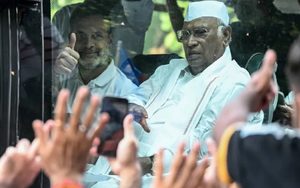
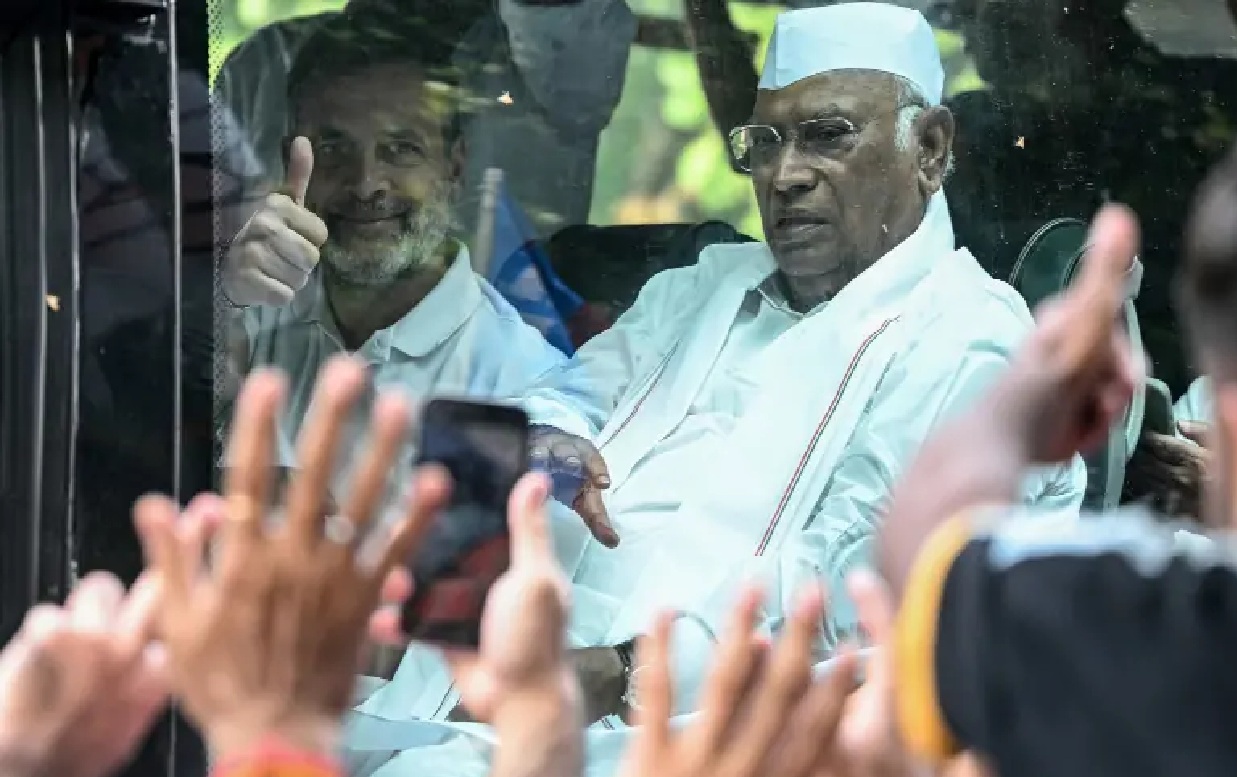
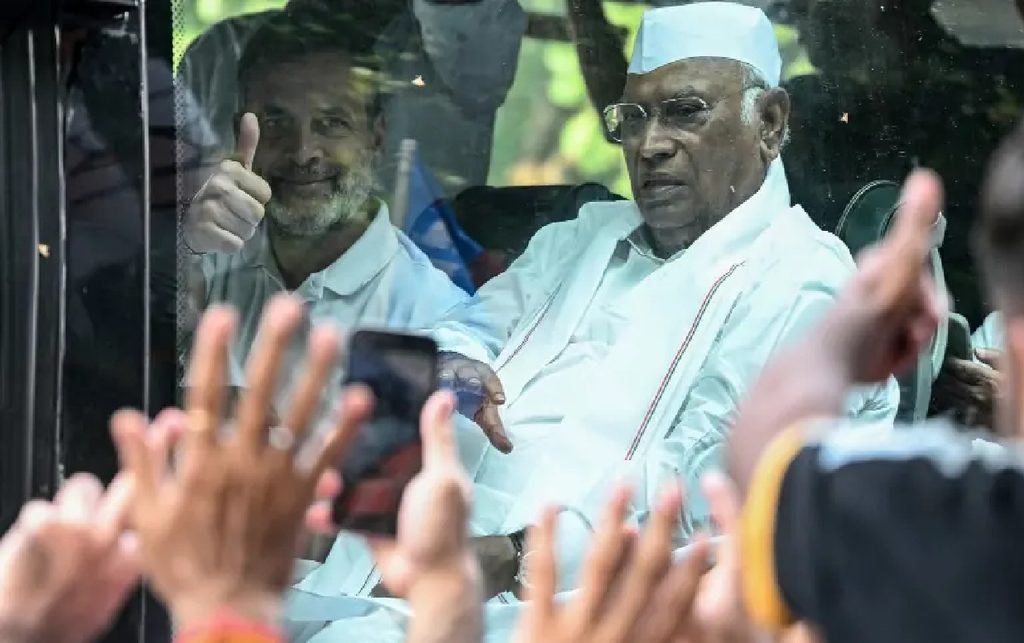
India’s Congress party leader Rahul Gandhi (L), sitting inside a bus, greets his supporters during a protest march demanding the resignation of India’s Chief Election Commissioner Gyanesh Kumar over alleged voter roll irregularities linked to the “special intensive revision” in New Delhi on October 12, 2026. — AFP
The demonstration, organised by opposition parties and the youth-led Cockroach Janta Party (CJP), converged on the Supreme Court as protesters chanted slogans and waved placards condemning Election Commissioner Gyanesh Kumar, who they accuse of orchestrating a voter roll revision designed to benefit Prime Minister Narendra Modi’s ruling Bharatiya Janata Party (BJP).
“You can see how big the crowd is already,” demonstrator Abhay Aryan, 28, told AFP as the crowd marched through central Delhi. “The government has to listen to the voice of the people.”
The protests mark the most serious challenge to Modi’s decade-long dominance of Indian politics, drawing together an unprecedented coalition of opposition parties, student organisations, and civil society groups angered by what they characterise as an assault on democratic institutions in the world’s most populous nation.
A Voter Roll In Crisis: The Numbers Behind The Controversy
At the heart of the protests lies a staggering statistic: more than 133 million names removed from India’s electoral lists, according to media reports, a figure equivalent to approximately 15% of the country’s registered voters and larger than the entire population of Japan.
The Election Commission of India (ECI), which oversees voting in a nation of 1.4 billion people, maintains the revision was a routine administrative exercise intended to eliminate duplicate, deceased, and fraudulent entries. But critics contend the process has been weaponised to systematically remove minority voters, particularly Muslims, from the electoral rolls ahead of upcoming elections.
“This is not merely an administrative exercise,” said Asim Ali, a political analyst based in New Delhi, speaking to Al Jazeera. “The scale and demographic patterns of these deletions raise serious questions about whether this is about cleaning up voter rolls or shaping the electorate.”
Analysis of the removed names suggests a disproportionate impact on Muslim-majority constituencies, according to rights advocates and opposition politicians who have reviewed partial data. The government has not released comprehensive demographic breakdowns of those removed.
A protester who identified himself only as Mehvaish expressed the fear shared by many in the crowd: “We want removal of this government because of all the injustices we have suffered in the past 12-13 years. Now if they take away our right to vote, what is left with us?”
‘Delhi Has Been Made Into A Fortress’: The Security Crackdown
Authorities deployed thousands of security personnel across central Delhi for a third consecutive day, erecting hundreds of yellow metal barricades on roads leading to the city centre and shutting down six major metro stations. The heavy security presence transformed the capital’s normally bustling arteries into a maze of checkpoints and restricted zones.
“People are being stopped from reaching Delhi,” opposition leader Rahul Gandhi said at a news conference on Monday. “Delhi has been made into a fortress… There is police everywhere.”
Gandhi, heir to India’s most influential political dynasty, accused Modi of personally shielding the election commissioner from accountability. The Congress party leader has sought to transform what began as a summer youth uprising into a broader political movement challenging the BJP’s electoral dominance.
The weekend protests turned chaotic as police detained thousands of demonstrators, including organisers and top leaders of the Cockroach Janta Party. Most of those detained have since been released, but opposition figures have accused authorities of attempting to suppress dissent through mass detentions and custodial violence.
“The crackdown this time on students is making it apparent that it would be tougher for young protesters this time,” Ali told Al Jazeera. “Students can’t get beaten up and dragged violently daily.”
‘An Assault On Democratic Freedoms’: Parliamentarians And Journalists Targeted
The police response has drawn condemnation from an unusual coalition of parliamentarians, media organisations, and human rights groups, who allege that authorities targeted not just protesters but also elected officials and journalists covering the demonstrations.
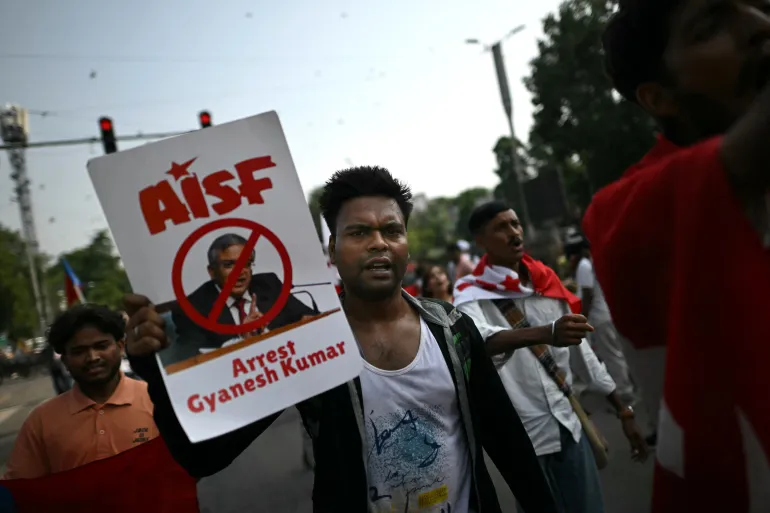
A demonstrator holds a placard during a protest demanding the resignation of India’s Chief Election Commissioner Gyanesh Kumar, in New Delhi, India October 12 [AFP]
Parliamentarian John Brittas of the Communist Party of India (Marxist) alleged he was “manhandled, dragged, assaulted” by police during Sunday’s demonstrations.
“This is not merely an assault on an MP. It is an assault on democratic freedoms and the rule of law,” Brittas said in a statement.
Police did not respond to questions about detentions or their actions during a news conference on Sunday, according to AFP.
Several journalists covering the protests reported being detained despite prominently displaying their press credentials. Nitin Katiyar, a digital journalist, told The Times of India that a police official had punched him in the eye, a charge AFP could not immediately verify.
Media rights group Reporters Without Borders (RSF) said at least 16 journalists were detained during the weekend protests, calling the police action “unacceptable” and demanding their immediate release.
The targeting of journalists has raised alarms about press freedom in India, which has fallen sharply in international rankings during Modi’s tenure. Rights advocates and critics say Modi’s government has systematically eroded democratic freedoms during more than a decade in power, citing pressure on journalists, civil society groups, and political opponents, allegations the government categorically rejects.
The Cockroach Janta Party: A Youth Movement Emerges
At the forefront of the protests stands the Cockroach Janta Party, a satirical movement that has amassed millions of social media followers and galvanised young Indians frustrated with corruption, unemployment, and what they perceive as the erosion of democratic norms.
The movement’s leaders have pledged to continue protests until Election Commissioner Kumar steps down. On Monday, CJP leaders met with Delhi Police to demand a date for a peaceful protest, threatening to announce a new protest call if no date is given within 24 hours.
Among the most visible faces of the movement is Neha Bora, 29, the national president of the left-wing All India Students’ Association. The doctoral student has emerged as a powerful voice criticising the government and police response to demonstrators, her speeches circulating widely online.
Bora first gained national attention during protests in July over alleged leaks of exam papers, when she fasted with other activists to demand the resignation of the education minister, who subsequently stepped down. She has since become a fixture at demonstrations, returning to the streets despite repeated detentions.
“Going forward, the opposition parties stand to be the front face of the protests, and they need to lead from the front,” Ali told Al Jazeera, noting that the involvement of established political parties could sustain the movement beyond the initial youth-led surge.
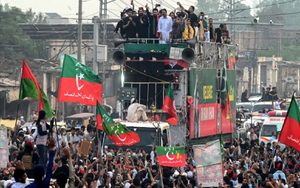
Thousands of young protesters gather near India’s Supreme Court in New Delhi on October 12, 2026 [Yashraj Sharma/Al Jazeera]
Opposition Unites: ‘March For Democracy’
Monday’s demonstration saw India’s usually fractious opposition parties unite in an unprecedented display of solidarity. The Indian National Congress, led by Rahul Gandhi, joined forces with the Communist Party of India (Marxist), the Indian National Developmental Inclusive Alliance (INDIA) bloc, and other regional parties.
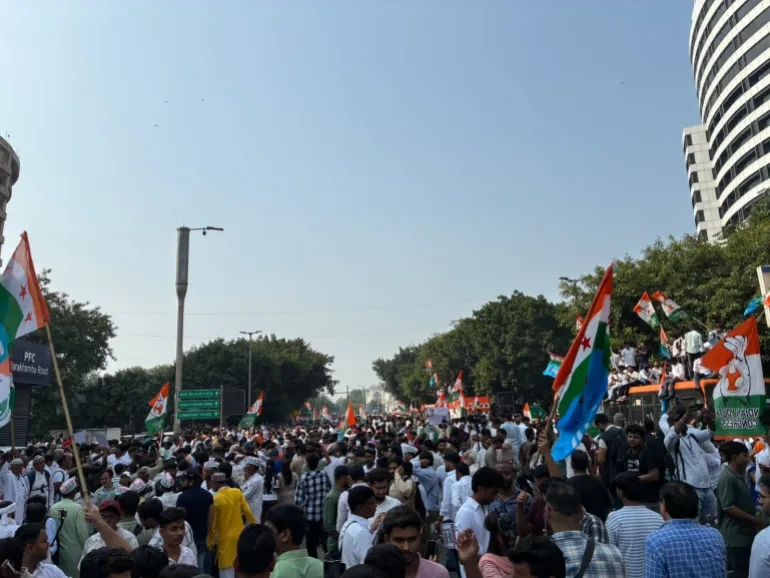
Footage shared by the Congress party on X showed a large crowd of protesters marching through Delhi’s Barakhamba area, holding signs and waving flags.
“Today, all of India is marching towards the Supreme Court,” the party posted. “To protect the Constitution. To safeguard the right to vote.”
Communist Party of India leader D Raja told reporters he was marching alongside other opposition politicians. “Inside the Supreme Court, 10 leaders will sign the petition and submit it on behalf of the INDIA bloc,” he said. “I am one of the signatories.”
However, the opposition’s attempt to submit a memorandum to the Supreme Court hit an obstacle when Chief Justice Surya Kant refused to meet with opposition leaders, stating that cases related to the electoral roll revision are already pending before the top court.
BJP Strikes Back: ‘Attacking The Constitution’
The ruling BJP has dismissed the opposition’s claims, portraying the protests as the desperate tactics of a party unable to win elections democratically.
“For the past few years, the Congress has taken to attacking the Constitution,” Indian Agriculture Minister Shivraj Singh Chouhan said at a BJP party headquarters news conference on Monday. “And when they lose elections, they blame constitutional institutions.”
Chouhan’s remarks referenced the Election Commission, which has faced intense criticism from opposition parties and civil society groups over the voter roll revision.
“But they can’t remove the love in the hearts of 1.4 billion Indians for Prime Minister Modi,” Chouhan said. “I say this with sadness, but the Congress today is among the forces that are trying to break India.”
The BJP’s counter-narrative frames the protests as an attack on India’s democratic institutions by parties unwilling to accept electoral defeat. The party points to Modi’s continued popularity and recent electoral victories as evidence that the government retains broad public support.
A Pattern Of Democratic Backsliding?
The current crisis unfolds against a backdrop of what rights organisations describe as a systematic erosion of democratic freedoms in India under Modi’s leadership.
In recent years, India has fallen dramatically in global press freedom rankings, with journalists facing harassment, legal threats, and physical violence for reporting critically on the government. Civil society organisations have faced increased scrutiny and restrictions on foreign funding. Political opponents have been subjected to tax investigations, criminal charges, and in some cases, imprisonment.
The government rejects these characterisations, maintaining that India remains a vibrant democracy with robust institutions and a free press.
Yet the scenes unfolding in Delhi, the mass detentions, the targeting of journalists, the barricading of the capital, have drawn comparisons to authoritarian crackdowns in other parts of the world.
“This is not merely an assault on an MP,” Brittas, the parliamentarian, said of his treatment by police. “It is an assault on democratic freedoms and the rule of law.”
The Road Ahead
As protests enter their second week, the standoff between the government and the opposition shows no signs of resolution. The Cockroach Janta Party has vowed to continue demonstrations until Election Commissioner Kumar resigns. Opposition parties have pledged to pursue legal challenges to the voter roll revision.
The Modi government, meanwhile, has shown no indication it will back down, maintaining that the electoral roll revision was necessary and lawful.
“The mobilisation of the wider opposition would not stop, but the Modi government was unlikely to back down,” Ali, the political analyst, told Al Jazeera, capturing the prevailing sentiment in the capital.
For millions of Indians whose names have been removed from electoral rolls, the stakes could not be higher. Their right to vote, the fundamental expression of citizenship in the world’s largest democracy, hangs in the balance.
“Now if they take away our right to vote, what is left with us?” asked Mehvaish, the protester, his voice carrying the weight of that question through the barricaded streets of Delhi.
Timeline Of Events
July 2025: Youth-led protests erupt over alleged exam paper leaks; Education Minister resigns
Weeks prior: Election Commission completes voter roll revision, removing 133 million names.
Saturday: Thousands detained as police crack down on protesters; CJP leaders arrested
Sunday: Parliamentarian John Brittas allegedly assaulted; 16 journalists detained
Monday: Opposition parties lead “March for Democracy” to Supreme Court; Chief Justice refuses meeting
Ongoing: CJP demands protest date from Delhi Police within 24 hours.
Veritas Press Investigative Analysis Independent journalism examining global affairs, power, diplomacy, and accountability.Source:Veritas Press C.I.C. | Multi-News Agencies
Help Support Our Work
Readers who believe that truth still matters have power over popular information. When just a few more people step up to support this work, it means more lies exposed, more corruption uncovered, and more accountability where it’s long overdue.
Help Protect Independent Journalism, Which Is Currently Under Attack.
If you believe journalism should serve the public, not the powerful, and you’re able to help, becoming a regular DONOR or a PAID SUBSCRIBER truly makes a difference.
DONATION APPEAL: If you found this reporting valuable, please consider supporting independent journalism.
Your support fuels our fearless, truth-driven journalism. In unity, we endeavour to amplify marginalised voices and champion justice, irrespective of geographical location. We operate independently, with no financial backing from billionaires; our readers support us.
But it’s also extremely important. One of Veritas Press’s greatest assets is its reader-funded model.
1. Reader funding means we can cover what we like. We’re not beholden to the political whims of a billionaire owner. We are a small, independent and impartial organisation. No one can tell us what not to say or what not to report.
2. Reader funding means we don’t have to chase clicks and traffic. We’re not desperately seeking your attention for its own sake; we pursue the stories that our editorial team deems important and believes are worthy of your time.
3. Reader Funding: enables us to keep our website and other social media channels open, allowing as many people as possible to access quality journalism from around the world, particularly those in places where the free press is under threat.
We know not everyone can afford to pay for news, but if you’ve been meaning to support us, now’s the time.
Your donation goes a long way. It helps us:
Keep the lights on and sustain our day-to-day operations
Hire new, talented, independent reporters
Launch real-time live debates, community-focused shows, and on-the-ground reporting
Cover the issues that matter most to our communities, in real time, with depth and integrity
Without your support, independent voices like ours will be silenced.
Furthermore, we have plans to expand our work, but we can’t do it without your support. Every contribution, no matter the size, helps us stay independent and build a truly people-powered media platform.
If you believe in journalism that informs, empowers, and reflects the communities we serve, please donate today.
October 12, 2026 | Author : Kamran Faqir | Categories: Climate Change, Environment, Public Opinion, UK News, World News
As Storm Chandler devastates Somerset and a new Flood and Drought Resilience Taskforce convenes, ministers promise £4.2 billion and a “one-stop shop” for flood advice, but shadow ministers, activists and
October 12, 2026 | Author : Kamran Faqir | Categories: Asia, The South Pacific & Oceania, Human Rights, World News
Mass Protests Erupt Over Removal of 133 Million Names from Electoral Lists, Allegations of Minority Targeting, and Police Crackdown on Journalists and Opposition Leaders
October 10, 2026 | Author : Kamran Faqir | Categories: Asia, The South Pacific & Oceania, Economy, Human Rights, World News
From Peshawar to Swabi, thousands of Imran Khan’s supporters are marching to force the jailed former prime minister’s release, defying government warnings, internet blackouts, and accusations of militant collusion, in
October 8, 2026 | Author : Kamran Faqir | Categories: Americas & North America, Asia, The South Pacific & Oceania, World News
Exclusive videos and witness accounts expose how Iranian missiles, drones, and F-5 fighter jets overwhelmed Camp Buehring, leaving American forces critically low on ammunition and raising questions about why no
October 8, 2026 | Author : Kamran Faqir | Categories: Human Rights, Middle East, World News
A year of documented violations, blocked aid, forced displacement, and failed mediation has turned the Gaza ceasefire into a mechanism of impunity: 1,467 killed, 5,355 violations, and a population confined
October 7, 2026 | Author : Kamran Faqir | Categories: Asia, The South Pacific & Oceania, Europe, Human Rights, World News
Iran has questioned France’s response to the nationwide student protests, accusing Paris of applying double standards to the right to protest and human rights.
October 7, 2026 | Author : Kamran Faqir | Categories: Asia, The South Pacific & Oceania, Business & Finance, Climate Change, Oceania, Public Opinion, United Nations, World News
At the UN, Islamabad confronts a gathering crisis, and an increasingly assertive India.
SEATTLE, TEHRAN — The U.S. Department of Homeland Security (DHS) will allow Iran’s national football team to enter the country 48 hours before their critical World Cup match against Egypt on Friday, a modest concession in a tournament where Team Melli’s travel conditions have sparked claims of oppression and competitive disadvantage.