Kamran Faqir is a volunteer investigative journalist and writer committed to exposing hidden truths and amplifying underreported stories. Driven by social justice, he brings sharp insight and fearless truth-telling to independent journalism. NUJ registered.
Article Date Published:
Article Date Modified:
16 minutes
Views:337
Listen to this article
Help support our mission, donate today and be the change. Every contribution goes directly toward driving real impact for the cause we believe in.a
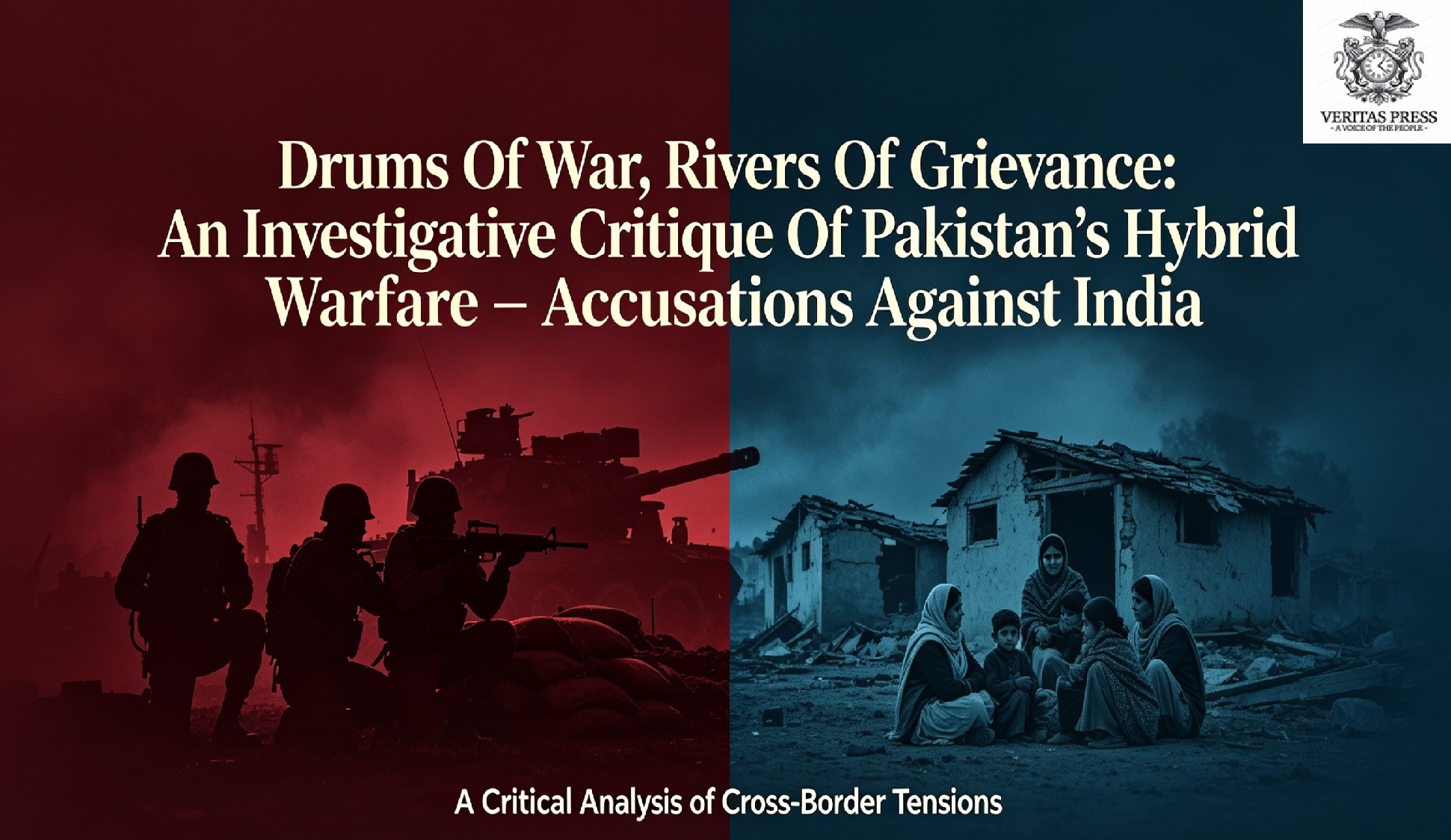
ISLAMABAD/ NEW DELHI/ KABUL –The subcontinent’s great rivalry is once again simmering at a dangerous boil. In Islamabad, senior military and civilian officials are amplifying an intricate set of accusations: India is waging a multi-front hybrid war, using water as a weapon, nurturing proxies in Afghanistan and Balochistan, and choreographing a possible false-flag operation to justify a military offensive. New Delhi dismisses these claims as a “distractionary fantasy” from a state that harbours terrorists. As the drums grow louder, this investigation unpacks the narratives, places them alongside the latest evidence, and asks what is real and what is weaponised paranoia.
1. The Two‑Front Nightmare: Afghanistan As India’s Proxy
For years, Pakistan’s military establishment has warned that India seeks to encircle it by opening a second front from Afghan soil. Since the Taliban’s return to Kabul in August 2021, that warning has been repeated with increasing urgency. “India is using Afghan territory to orchestrate terrorism inside Pakistan,” Pakistan’s Defence Minister Khawaja Asif alleged before the National Assembly in March 2026, citing a spike in attacks by the banned Tehreek‑e‑Taliban Pakistan (TTP).
The charges are not new, but the context is. India’s 2022 decision to reopen its embassy in Kabul, the delivery of 50,000 metric tonnes of wheat, and quiet engagement with the Taliban’s interim administration have all been interpreted by Rawalpindi as a strategic encirclement. When a TTP faction claimed the February 2026 suicide bombing in Peshawar that killed 84 people, Pakistani Interior Minister Mohsin Naqvi declared that “traces lead directly to handlers sitting in Indian consulates in Afghanistan.” No forensic evidence was released publicly.
Indian officials swiftly reject such claims. “Pakistan’s habit of externalising its internal pathologies is tired and predictable,” India’s External Affairs Minister S. Jaishankar said at a March 2026 press conference in New Delhi. “The Taliban government knows very well that our presence is purely humanitarian and diplomatic.”
Expert analysis suggests a more opaque picture. Ayesha Siddiqa, a Pakistani scholar and author of Military Inc., told the BBC in April 2026: “The accusation serves a domestic purpose; it unifies a polarised political landscape against an external enemy. But there is probably some tactical-level contact between Indian intelligence and anti‑Pakistan elements. Whether that translates into a state‑sanctioned proxy war is unproven.” A May 2026 United Nations Analytical Support and Sanctions Monitoring Team report noted ‘allegations’ of cross‑border support but said it had not received “independently verifiable material” confirming an Indian role in the recent TTP attacks.
Former Indian high commissioner to Pakistan, Ajay Bisaria, offered a caveat in The Wire: “Delhi would be foolish to open a front from Afghanistan. It would alienate the Taliban, upon whose goodwill our limited presence depends. Pakistan is projecting its own historical playbook onto India.” Nevertheless, Islamabad’s accusation remains a pillar of its public diplomacy.
2. “Hydro‑Terrorism” And The Indus Waters Treaty:
No phrase has inflamed Pakistan’s official language in recent years quite like “hydro‑terrorism.” First used by Prime Minister Shehbaz Sharif in a 2023 speech at the United Nations, it accuses India of weaponising the waters of the Indus basin, shared under the 1960 Indus Waters Treaty (IWT), to strangle Pakistan’s agriculture and economy.
“The construction of run‑of‑the‑river hydroelectric projects, especially Ratle and Kishanganga, has systematically reduced our flows,” Sharif told parliament in January 2026 after a dry‑season crisis left Punjab’s canals dangerously low. “This is a slow‑motion act of war against our people.” Pakistan has requested the Permanent Court of Arbitration in The Hague to intervene; India boycotts the proceedings, insisting on a neutral expert process under the World Bank.
Data presents a nuanced reality. The World Bank, the treaty’s custodian, has acknowledged that climate‑induced glacial retreat and erratic monsoons are altering the basin’s hydrology, and a 2025 study by the International Water Management Institute found that upstream Indian withdrawals remained within the treaty’s limits for domestic and agricultural use. Yet Pakistan’s perception of theft is politically resonant. “When a Pakistani farmer sees a dry canal, he is told ‘India stole your water’,” noted Michael Kugelman of the Wilson Centre. “The truth is more about mismanagement and climate, but the narrative is intoxicating.”
India’s notice in August 2024 seeking to modify the IWT, citing changed demographics, clean energy needs, and cross‑border terrorism, sent alarm bells ringing in Islamabad. “Modification can become a coercive tool,” warned Pakistani climate diplomat Sherry Rehman. “India holds the headworks; we hold the anxiety.” By May 2026, back‑channel discussions brokered by the UAE had apparently stalled, with both sides publicly hardening their positions.
3. Kashmir: The Crucible.
All other narratives orbit around Kashmir. Pakistan’s position, repeated at every diplomatic forum, is that India’s 5 August 2019 revocation of Article 370 was an illegal annexation and a demographic re‑engineering of the Muslim‑majority region. India insists the reorganisation of Jammu and Kashmir into two Union Territories was an internal constitutional measure to integrate the region and curb terrorism.
The situation on the ground continues to feed the narrative. A February 2026 report by the UN High Commissioner for Human Rights described “continued restrictions on press freedom, arbitrary detentions, and a climate of fear in the Kashmir Valley.” While local elections in September–October 2024 saw a 58% voter turnout and the formation of a new legislative assembly, cited by India as proof of normalcy, Islamabad dismissed the polls as “a farce under occupation.” Prime Minister Sharif addressed a special session of the Pakistan‑administered Kashmir assembly on 5 May 2026, repeating the pledge: “We will never abandon our Kashmiri brothers and sisters; India’s occupation cannot be normalised.”
Indian officials return fire by pointing to terrorism. “More than forty security personnel have been killed in Jammu and Kashmir in 2025 alone, and the cross‑border infiltration continues,” Home Minister Amit Shah stated in April 2026. “Pakistan cannot be allowed to lecture on human rights while harbouring UN‑designated terrorist leaders.” The tussle over Kashmir thus becomes the justificatory engine for every other strand of Pakistani accusation, a deep‑seated grievance that fuels the rhetoric of proxy war, water theft, and an alleged Indian desire to “bleed Pakistan.”
4. Balochistan And Afghanistan: The Alleged Proxies.
The most emotive Pakistani accusation is that India actively arms and funds insurgent groups in Balochistan and uses Afghan soil to destabilise the country’s western reaches. “India’s involvement in Balochistan is an open secret,” claimed a senior Pakistan Army officer in a background briefing to journalists in March 2026, speaking on condition of anonymity. “Recovered weapons, captured militants, and intercepted communications all point to RAW.”
Two high‑profile incidents intensified the charge. In November 2025, an attack on the Chinese‑financed Gwadar port left eight security personnel dead; the Baloch Liberation Army claimed responsibility, and Pakistan immediately alleged “foreign hands.” Two months later, a suicide bombing on a convoy of Chinese engineers near Dasu Dam was followed by a familiar script: Islamabad briefed diplomats that “Indian fingerprints” had been found.
The evidence, however, remains largely opaque. Confessions from captured militants, often televised, are dismissed by human‑rights groups and independent journalists as suspect. A February 2026 investigation by The New York Times quoted a Western diplomat in Islamabad: “We have seen intelligence dossiers, but they are threadbare. It’s often a matter of one or two SIM cards being traced to an Indian‑registered number, which could mean anything.” India’s Ministry of External Affairs consistently denies any involvement, with spokesperson Randhir Jaiswal calling the accusations “a smokescreen for Pakistan’s own failure to protect its ethnic minorities.”
Baloch activists themselves are more cautious. Speaking to Deutsche Welle from exile in Geneva, Baloch human‑rights defender Mahnaz Rahman said: “We have no evidence that India is helping us. Pakistan’s state narrative is meant to delegitimise a genuine indigenous struggle by painting it as a foreign conspiracy.” Still, a handful of reports, including a 2025 Royal United Services Institute paper, suggest that Indian intelligence maintains some contacts with Baloch diaspora figures as a long‑term strategic hedge, though “the leap from contact to materiel support remains unsubstantiated.”
5. Modi’s Push To Isolate Pakistan:
Since assuming office in 2014, Prime Minister Narendra Modi has made the diplomatic and economic isolation of Pakistan a signature goal. The 2019 Pulwama‑Balakot crisis was followed by an intense campaign to “name and shame” Pakistan as the epicentre of global terror, leading to its grey‑listing by the Financial Action Task Force (FATF) between 2018 and 2022.
“Pakistan has been put on notice: you cannot remain a state that exports jihad and expect normal trade relations,” a senior Indian diplomat told The Hindu in April 2026. India has successfully excluded Pakistan from key regional connectivity projects, bypassing it through the Chabahar port in Iran and the International North‑South Transport Corridor, and used its presidency of the G20 in 2023 to host meetings in Jammu and Kashmir, a move Pakistan called “provocative branding.” The Abraham Accords and growing India‑Israel‑UAE tri‑laterals have further shrunk Pakistan’s diplomatic room.
Yet isolation is not total. China remains Pakistan’s steadfast “all‑weather friend,” with the China‑Pakistan Economic Corridor now entering its second phase. Russia, seeking to balance its relationships, has expanded energy ties with Islamabad, and the Shanghai Cooperation Organisation continues to provide Pakistan a multilateral platform. “India has succeeded in stigmatising Pakistan, but not in completely isolating it,” observed Husain Haqqani, a former Pakistani ambassador to the US and scholar at the Hudson Institute. “Islamabad still retains a few strong cards—especially its geography for China’s Belt and Road ambitions.”
The isolation narrative, therefore, is something of a double‑edged sword for Pakistan: it substantiates the belief that India is encircling the country, but it also fuels a sense of victimhood that can be mobilised domestically.
6. The False‑Flag Prophecy:
One of the most incendiary and hardest to verify Pakistani claims is that India plans a false‑flag operation to justify a full‑scale military strike. The scenario has been invoked repeatedly by the Inter‑Services Public Relations (ISPR) since the 2019 Balakot airstrike. In a January 2026 press conference, DG ISPR Lieutenant General Ahmed Sharif warned: “We have credible intelligence that India may stage an attack on its own soil, or on the Line of Control, and blame Pakistan, thereby creating a casus belli for a short, sharp war.”
Indian officials call the allegation “a mark of a guilty conscience.” National Security Advisor Ajit Doval has reportedly dismissed the theory as an attempt to “pre‑emptively cry wolf” and deter India from any future surgical or air strikes. However, the persistent claim taps into a deep current of suspicion. “Pakistan knows its own vulnerabilities,” wrote strategic analyst Shuja Nawaz in Dawn in February 2026. “If a major terrorist strike hits an Indian city, Pakistan will be blamed within minutes. Crying ‘false flag’ is a pre‑emptive insurance policy for a state that cannot fully control the militant proxies it has historically nurtured.”
Historical examples are sparse. India has never been credibly shown to have conducted a false‑flag against Pakistan, though the contested narrative of the 2016 surgical strikes (which India says crossed the LoC and Pakistan denies occurred) shows how disputed such operations become. To many neutral observers, the false‑flag narrative is a projection of Islamabad’s deepest fear, not a forecast based on evidence.
7. Hate Rhetoric And The War Drums:
Pakistani diplomacy routinely cites the bellicose language of Indian ruling‑party leaders as proof of malign intent. Prime Minister Modi’s 2016 warning that “blood and water cannot flow together” under the Indus Treaty, his reference to giving a “muh‑tod jawab” (face‑breaking reply) after the 2019 Pulwama attack, and Uttar Pradesh Chief Minister Yogi Adityanath’s frequent invocations of a “Hindu rashtra” and the need to “deal with Pakistan in its own language” are compiled in Islamabad’s briefing files.
“Such rhetoric is not incidental; it is a deliberate instrument of a Hindu‑nationalist project that needs an external Muslim enemy,” Pakistan’s Federal Minister for Information Attaullah Tarar said at a press conference in Islamabad on 10 May 2026. “When Indian television anchors openly talk of ‘sending Pakistan to the Stone Age’, and the prime minister does not rein them in, the message is clear.”
Indian analysts and opposition figures concede that hate speech has escalated, but they question its direct foreign‑policy translation. “BJP’s electoral machinery feeds on communal polarisation, and Pakistan‑bashing is a proven vote‑getter,” political scientist Niraja Gopal Jayal wrote in The Caravan. “However, the military brass in Delhi, wary of a nuclear Pakistan, has so far acted with professional restraint.”
Human‑rights organisations have also flagged the rhetoric. A March 2026 Amnesty International statement called on the Indian government to “immediately cease language that incites discrimination and hostility against Muslims, whether domestic or across the border.” The narrative, therefore, serves both sides: for Pakistan, it is evidence of genocidal intent; for India’s opposition, it is a sign of democratic backsliding.
8. India’s Military Doctrine: Proactive Strikes And Two‑Front Readiness.
The final narrative is that India’s military posture is explicitly designed to punish Pakistan and, more broadly, prepare for a two‑front war with China and Pakistan simultaneously. The 2016 surgical strikes, launched after the Uri attack, and the 2019 Balakot airstrike are cited by Pakistan as proof that India has abandoned strategic restraint in favour of a “proactive offensive doctrine.”
“India’s Cold Start doctrine, though never officially acknowledged, has now morphed into a ‘proactive calibrated response’ that openly claims the right to strike across the Line of Control or international border for any terror incident,” Pakistani strategic analyst Maria Sultan told Al Jazeera in February 2026. “This is not a defensive posture; it is a declaratory policy of escalation dominance.”
In Indian military circles, the evolution is described more cautiously. Chief of the Army Staff General Upendra Dwivedi said in his 2025 Army Day address that “the army is fully capable of meeting simultaneous threats on the northern and western fronts.” The 2025 edition of the Indian Army’s Land Warfare Doctrine emphasised “integrated battle groups” and “multi‑domain deep strikes,” language that Islamabad interprets as a blueprint for limited war under the nuclear threshold. India’s testing of the Agni‑VI ICBM in April 2026 and the commissioning of the indigenous aircraft carrier INS Vishal reinforced the message of comprehensive power projection.
Nevertheless, many international security experts view the two‑front capability as aspirational. “India has made remarkable strides, but logistics, budget constraints, and the reality of Chinese military mass mean that a full two‑front conflict is a planning scenario, not an imminent operational possibility,” said Ashley Tellis of the Carnegie Endowment in a May 2026 lecture. Pakistan, meanwhile, counters India’s conventional superiority with its full‑spectrum deterrence, developing short‑range tactical nuclear weapons like the Nasr missile precisely to signal that any Indian “surgical” adventure could spiral uncontrollably.
The tragedy, as a former Indian Navy chief put it privately to this author, “is that both sides are investing in capabilities while refusing to invest in dialogue. The result is a structural instability where a single miscalculation could tip the subcontinent into catastrophe.”
Conclusion: Narratives As Weapons.
What emerges from this survey is a dense, mutually reinforcing ecosystem of accusation. Pakistan’s construction of India as a hydra‑headed aggressor using water, proxies, diplomatic isolation, false flags, and hate speech reflects a genuine strategic anxiety. Still, it also functions as a sophisticated domestic and international communications strategy. By externalising blame, Islamabad manages its own fragilities, from a sputtering economy to a resurgent internal terrorism challenge.
India’s parallel narrative, that Pakistan remains the world’s terrorism hub and that its own military activism is a necessary response, has been successful in changing the global conversation. Still, it has not eliminated the underlying drivers of conflict. As of May 2026, the two nuclear‑armed states are not talking, their respective intelligence agencies are locked in a shadow war, and their publics are fed a steady diet of existential threat.
“The real danger is that narratives, over time, become self‑fulfilling,” warned a retired Pakistani lieutenant general, speaking on condition of anonymity, over tea in a Rawalpindi drawing room. “If you constantly tell your people that the other side is planning a false‑flag and a two‑front war, any small border incident gets read as confirmation, and then the pressure to respond becomes unbearable.”
On the 31st of May 2026, with the Indus running low, another terrorist attack being investigated in Jammu’s Kathua district, and both sides rehearsing their prepared lines, that warning has never felt more urgent.
Source:Veritas Press C.I.C. | Multi News Agencies
Submissions:
For The Secure Submission Of Documentation, Testimonies, Or Exclusive Investigative Reports From Any Global Location, Please Utilise The Following Contact Details For Our Investigations Desk: enquiries@veritaspress.co.uk or editor@veritaspress.co.uk
Help Support Our Work:
Popular Information is powered by readers who believe that truth still matters. When just a few more people step up to support this work, it means more lies exposed, more corruption uncovered, and more accountability where it’s long overdue.
Help Protect Independent Journalism, Which Is Currently Under Attack.
If you believe journalism should serve the public, not the powerful, and you’re in a position to help, becoming a DONATOR or a PAID SUBSCRIBER truly makes a difference.
DONATION APPEAL: If You Found This Reporting Valuable, Please Consider Supporting Independent Journalism.
Help Support Our Work – We Know, We Know, We Know …
Seeing these messages is annoying. We know that. (Imagine what it’s like writing them … )
Your support fuels our fearless, truth-driven journalism. In unity, we endeavour to amplify marginalised voices and champion justice, irrespective of geographical location.
But it’s also extremely important. One of Veritas Press’s greatest assets is its reader-funded model.
1. Reader funding means we can cover what we like. We’re not beholden to the political whims of a billionaire owner. We are a small, independent and impartial organisation. No one can tell us what not to say or what not to report.
2. Reader funding means we don’t have to chase clicks and traffic. We’re not desperately seeking your attention for its own sake: we pursue the stories that our editorial team deems important and believe are worthy of your time.
3. Reader Funding: enables us to keep our website and other social media channels open, allowing as many people as possible to access quality journalism from around the world, particularly those in places where the free press is under threat.
We know not everyone can afford to pay for news, but if you’ve been meaning to support us, now’s the time.
Your donation goes a long way. It helps us:
Keep the lights on and sustain our day-to-day operations
Hire new, talented independent reporters
Launch real-time live debates, community-focused shows, and on-the-ground reporting
Cover the issues that matter most to our communities, in real time, with depth and integrity
We have plans to expand our work, but we can’t do it without your support. Every contribution, no matter the size, helps us stay independent and build a truly people-powered media platform.
If you believe in journalism that informs, empowers, and reflects the communities we serve, please donate today.
Kamran Faqir is a volunteer investigative journalist and writer committed to exposing hidden truths and amplifying underreported stories. Driven by social justice, he brings sharp insight and fearless truth-telling to independent journalism. NUJ registered.
SEATTLE, TEHRAN — The U.S. Department of Homeland Security (DHS) will allow Iran’s national football team to enter the country 48 hours before their critical World Cup match against Egypt on Friday, a modest concession in a tournament where Team Melli’s travel conditions have sparked claims of oppression and competitive disadvantage.