Kamran Faqir is a volunteer investigative journalist and writer committed to exposing hidden truths and amplifying underreported stories. Driven by social justice, he brings sharp insight and fearless truth-telling to independent journalism. NUJ registered.
Original Article Date Published:
Article Date Modified:
29 minutes
Views:322
Listen to this article
Help support our mission, donate today and be the change. Every contribution goes directly toward driving real impact for the cause we believe in.
A Strategic Betrayal Or Hard-Nosed Realism?
In the annals of American foreign policy, few moments have laid bare the tectonic shift in Washington’s global posture as starkly as the current crisis in the Strait of Hormuz. As the world watches, nearly one-fifth of global oil supplies remain trapped behind an Iranian blockade, President Donald Trump has reportedly signalled a willingness to conclude the US military campaign against Iran even if the Strait remains closed, a decision that experts warn could unleash prolonged economic chaos across the globe while forcing America’s traditional allies to fend for themselves.
The Wall Street Journal reported on Monday that Trump told aides he would accept an end to hostilities without re-opening the vital waterway, prioritising his self-imposed timeline of four to six weeks over the strategic imperative of restoring freedom of navigation. According to administration officials, a full-scale military operation to forcibly reopen the strait would extend the conflict beyond the president’s preferred duration, a constraint that now appears to be shaping US grand strategy in ways that alarm both regional partners and transatlantic allies.
Suzanne Maloney, Deputy Director of the Brookings Institution, delivered a blistering assessment of this approach: “Ending military operations before the strait reopens is unbelievably irresponsible. Energy markets are inherently global, and the US cannot remain immune to economic damage if the blockade continues”.
This investigative critique examines the unfolding crisis through multiple lenses: the strategic calculation in Washington, the mounting anxiety in Gulf capitals, the economic fallout spreading across global markets, and the deepening rift between the United States and its traditional European allies. Drawing on the latest news reports, official statements, and expert analysis, this article reveals how Trump’s “America First” doctrine is being stress-tested in the crucible of the Persian Gulf, with consequences that may redefine international security for a generation.
Part I: The Trump Doctrine On Display
“Go Take It”: The President’s Ultimatum To Allies
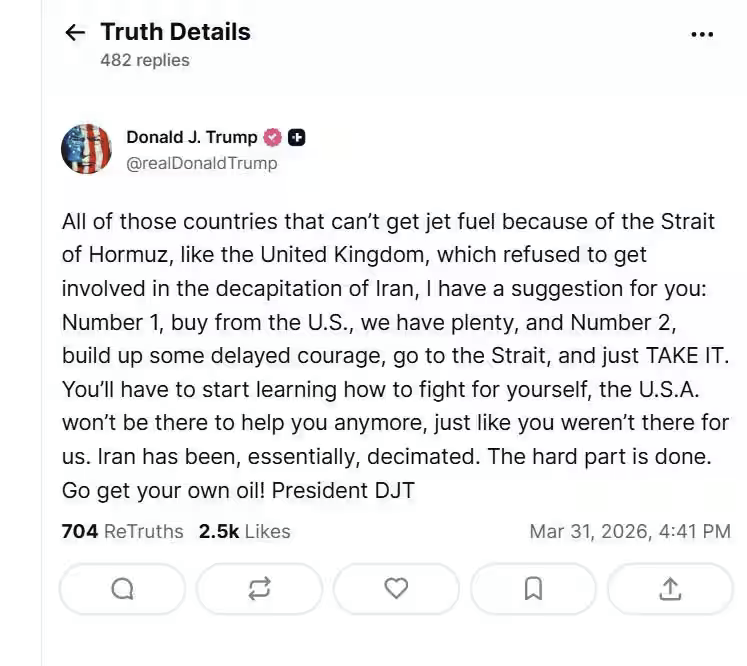
In a series of Truth Social posts on Tuesday morning, President Trump crystallised his administration’s position with characteristic bluntness. Addressing nations struggling with fuel shortages caused by the Hormuz blockade, specifically calling out the United Kingdom, Trump offered a stark choice:
“All of those countries that can’t get jet fuel because of the Strait of Hormuz, like the United Kingdom, which refused to get involved in the decapitation of Iran, I have a suggestion for you: Number 1, buy from the U.S., we have plenty, and Number 2, build up some delayed courage, go to the Strait, and just TAKE IT”.
The president’s message carried an unmistakable warning about the future of transatlantic security cooperation:
“You’ll have to start learning how to fight for yourself. The U.S.A. won’t be there to help you anymore, just like you weren’t there for us. Iran has been, essentially, decimated. The hard part is done. Go get your own oil!”
France did not escape Trump’s wrath. In a separate post, he accused Paris of being “VERY UNHELPFUL” for refusing overflight rights to military supply aircraft headed to Israel, adding ominously: “The U.S.A. will REMEMBER”.
These statements represent more than diplomatic petulance. They signal a fundamental recalibration of US security guarantees that have underpinned Western alliance structures since World War II. The message to European and Gulf partners is unambiguous: the era of American naval supremacy guaranteeing free passage through global chokepoints is ending.
The Strategic Calculus: Time vs. Victory
According to administration officials who spoke to the Wall Street Journal, Trump’s reluctance to pursue a full-scale military reopening of the Strait stems from a cold-eyed assessment of operational timelines. Any campaign focused on forcibly reopening the waterway would, by Pentagon estimates, require between four and six weeks of sustained combat operations, essentially consuming the entirety of the president’s intended conflict duration.
Instead, Trump has reportedly decided to concentrate US military efforts on dismantling Iran’s navy and missile stocks while pursuing diplomatic leverage to pressure Tehran into resuming normal trade flows. If that approach fails, the president expects European and Gulf allies, nations with far more at stake in terms of economic dependency on the strait, to take the lead in prying it open.
White House Press Secretary Karoline Leavitt reinforced this hierarchy of objectives during a Monday briefing. Asked whether restoring full freedom of navigation in the Strait of Hormuz constituted a core war aim, Leavitt stated that while the administration was “working towards” normal operations, she stopped short of defining it as a central objective.
The administration’s official war goals, as articulated by Leavitt, include:
The destruction of Iran’s navy
The elimination of Iran’s ballistic missile arsenal
The dismantling of defence-industrial infrastructure
Preventing Iran from obtaining nuclear weapons
Notably absent from this list: ensuring the free flow of commerce through one of the world’s most critical maritime chokepoints.
Rubio’s Framework: Weeks, Not Months
Secretary of State Marco Rubio offered additional clarity in an interview with Al Jazeera on Monday, outlining the administration’s timeline and conditions for ending the conflict. Rubio stated that US forces were “well on our way or ahead of schedule” in achieving their stated objectives and that military operations would conclude “in weeks, not months”.
On the Strait of Hormuz, Rubio struck a more assertive tone than his boss, declaring: “No one in the world can accept” Iranian control of the waterway. “The United States will not accept that condition. It’s an illegal condition that they’re demanding. That’s just not going to happen”.
Yet Rubio’s insistence that the strait “will be open one way or another” left ambiguous who would bear the responsibility for reopening it, the United States or a coalition of other nations.
The secretary also expressed frustration with NATO allies who denied basing and overflight rights during the operation, warning that such relationships would need to be “re-examined”.
Part II: Economic Warfare And Market Tremors
The Tollbooth Strategy: Iran’s Maritime Revenue Scheme
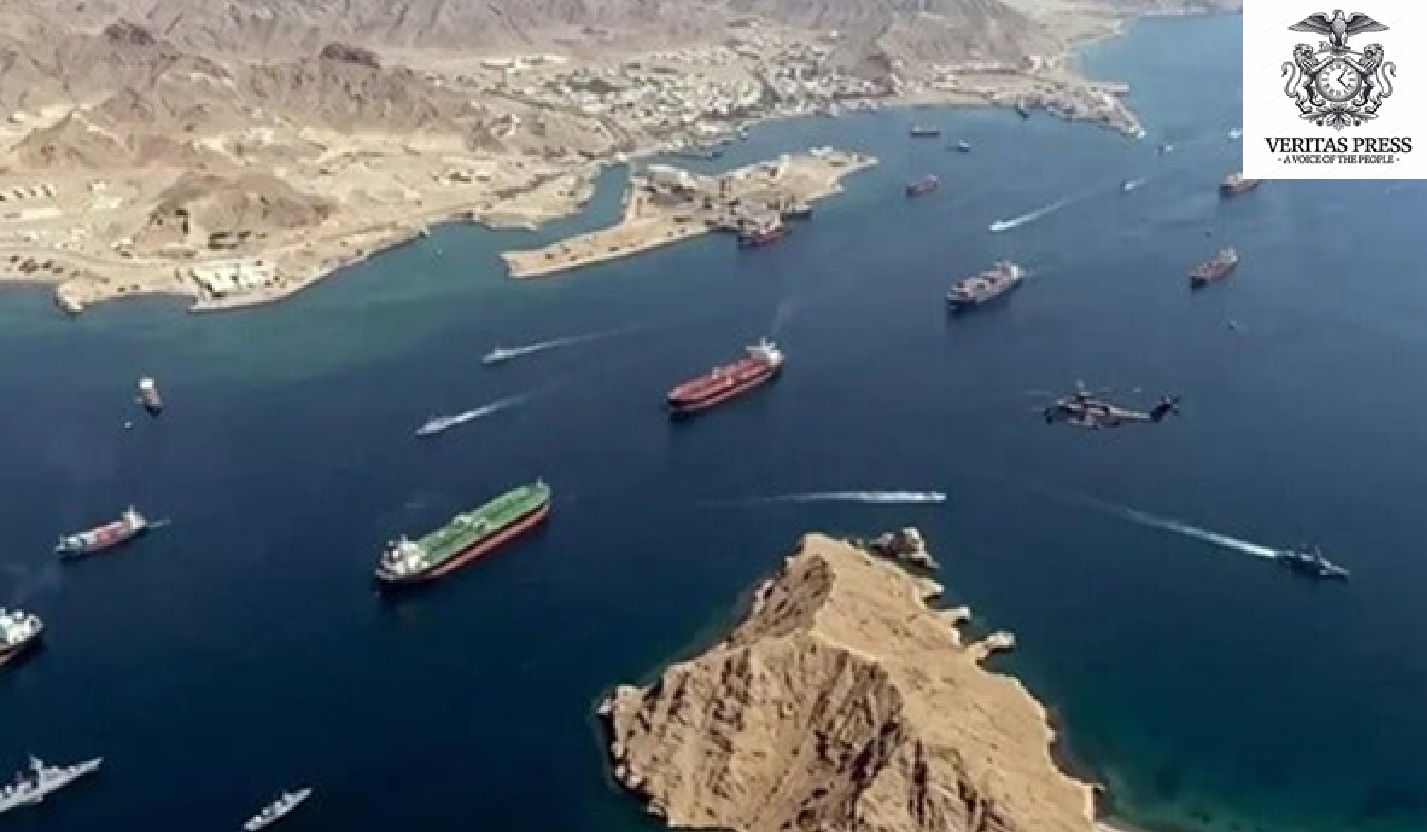
Iran has transformed the Strait of Hormuz from a global shipping lane into a toll road under its control. According to multiple reports, the Islamic Republic has implemented a de facto blockade, allowing only pre-approved vessels to transit through a route apparently approved by Tehran around Larak Island, just off Iran’s coast.
Leading shipping journal Lloyd’s List reported last week that at least 34 ships had been tracked using this Iranian-approved corridor. The Revolutionary Guards announced the route is closed to vessels travelling to and from ports linked to Iran’s “enemies”.
Even more significantly, Iran has formalised its control through legislation. On March 30, the Iranian parliament passed a law officially imposing transit fees on commercial ships passing through the strait, legalising a toll system that Iranian authorities had implemented on a temporary basis since early March.
Mohammadreza Rezaei Kouchi, chairman of the Civil Affairs Committee of the Iranian Parliament, described the move as purely commercial, stating: “The parliament is pursuing a plan to formalise Iran’s sovereignty, control, and surveillance of the Strait of Hormuz, while also generating revenue from fees”.
However, this legal manoeuvre has drawn sharp condemnation from Gulf states and international maritime law experts. Jasem Mohamed Al-Budaiwi, Secretary-General of the Gulf Cooperation Council, stated that the fee collection violates the United Nations Convention on the Law of the Sea (UNCLOS).
James Kraska, a professor of international maritime law at the US Naval War College, delivered a definitive rebuttal to Iran’s legal justification: “There is no legal basis under international law for a coastal state to collect fees in an international strait”.
Iran argues that UNCLOS does not bind Tehran because the country signed but never ratified the convention. However, Kraska and other experts note that many provisions of UNCLOS are considered customary international law, binding on all nations regardless of ratification status.
The Shipping Paralysis: By The Numbers
The impact of Iran’s blockade is starkly illustrated by shipping data. According to maritime intelligence firm Kpler, just four vessels crossed the Strait on Monday, a catastrophic decline from the peacetime average of approximately 120 daily transits.
From March 1 to 31, commodities carriers made only 201 crossings, a 95% decrease from normal traffic levels. Of these, 121 were by oil tankers and gas carriers, with most travelling east, exiting the strait rather than entering.
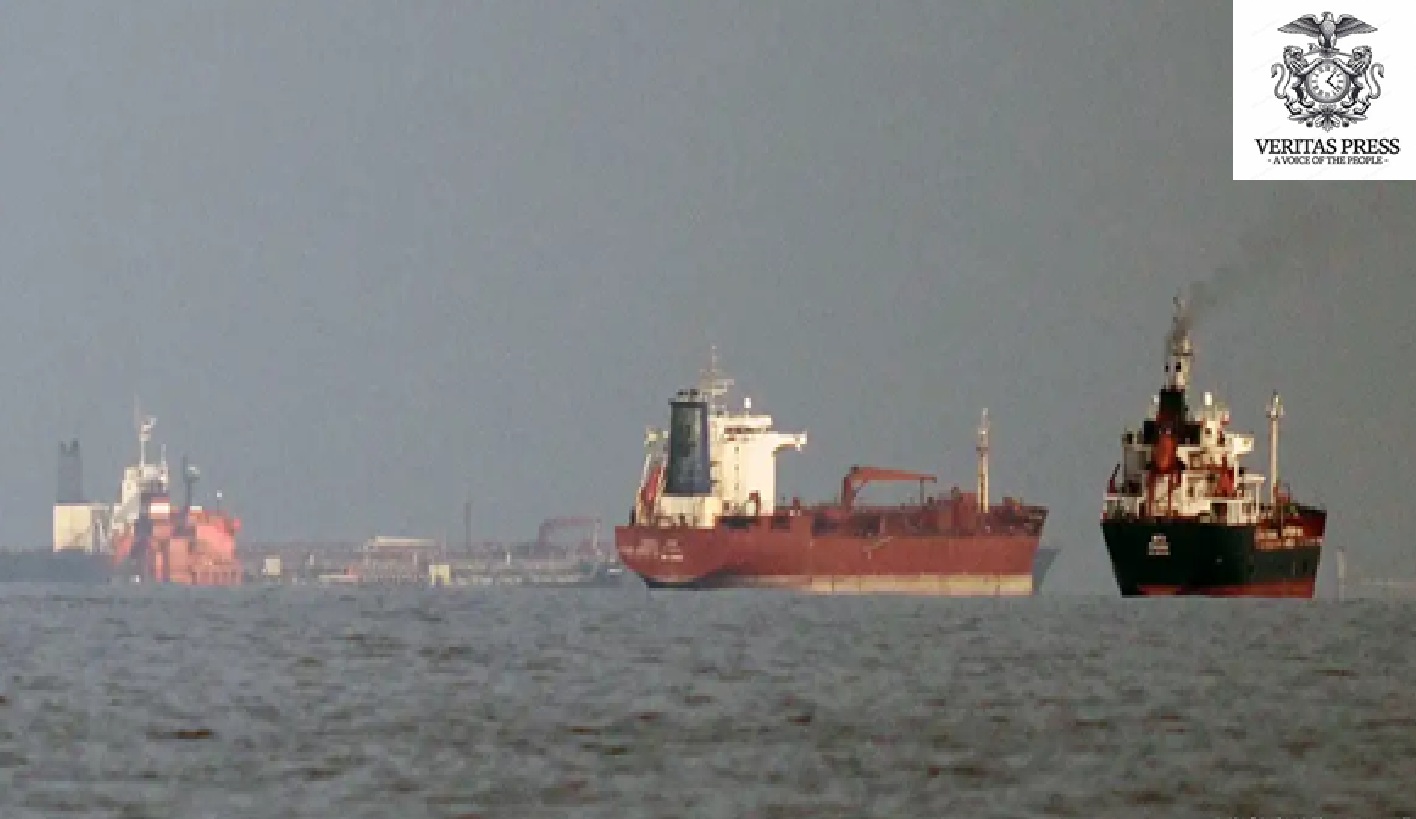
The congestion on the western side of the strait has reached staggering proportions. Bloomberg data showed on Tuesday that 2,459 vessels were anchored in the Gulf west of the Strait of Hormuz, waiting for permission to transit. Among these, 362 were oil and gas vessels, including 11 very large gas carriers and 60 very large crude carriers.
The human toll is equally devastating. The International Maritime Organisation (IMO) reports that at least eight seafarers or dock workers have been killed in incidents across the region since the conflict began, with a further ten injured. Approximately 20,000 seafarers remain affected by the crisis.
Oil Markets On The Edge
The closure of the Strait of Hormuz, through which approximately 20% of global oil supplies normally pass, has sent shockwaves through energy markets. Brent crude futures for June 2026 delivery surpassed $115 per barrel on March 30 before settling at $112.78.
But analysts warn that the worst may be yet to come. Bruce Kasman, chief economist at JP Morgan, told The Times that a prolonged closure could push prices to levels not seen in modern history:
“A scenario in which the strait remains closed for another month would be consistent with oil prices rising to around $150 a barrel and causing restrictions on energy supplies for industrial consumers”.
Such price levels would have profound implications for the global economy, potentially reigniting inflationary pressures that central banks have struggled to contain throughout the post-pandemic era.
Treasury Secretary Scott Bessent sought to downplay the economic impact in a Fox News interview on Monday, claiming: “The market is well-supplied, and we are seeing more and more ships go through on a daily basis as individual countries cut deals with the Iranian regime for the time being”.
Bessent added that the US would eventually “retake control of the straits” through either American or multinational escorts—but offered no timeline for such operations.
The China Factor: Selective Access
Perhaps the most revealing indicator of Iran’s strategic calculus is its selective enforcement of the blockade. While US, European, and Gulf shipping faces severe restrictions, vessels from countries maintaining friendly relations with Tehran have been permitted to transit.
China’s foreign ministry confirmed that three Chinese ships had successfully transited the strait. Maritime tracker MarineTraffic identified two ultra-large container vessels owned by Chinese shipping giant Cosco that crossed after an aborted attempt last week, interpreting their passage as “signalling a potential shift in conditions for commercial shipping”.
Iranian Foreign Minister Abbas Araghchi announced on March 25 that Iran had allowed friendly countries, including Russia, India, Iraq, China, and Pakistan, to pass through the Strait. This selective access strategy serves multiple purposes: maintaining economic relationships with key partners, demonstrating that the blockade is a political rather than technical constraint, and creating a two-tier system that rewards nations aligned with Tehran’s interests.
Part III: Gulf Allies In Panic
“A Historic Opportunity” Slipping Away
While President Trump appears eager to wind down military operations, America’s Gulf allies are increasingly alarmed by what they see as a premature end to the conflict. According to sources familiar with the discussions, Saudi Crown Prince Mohammed bin Salman and UAE President Mohammed bin Zayed have warned Trump in recent days against ending the war without securing meaningful constraints on Tehran’s regional capabilities.
One source described the Gulf anxiety to the Jerusalem Post:
“No one knows how or when Trump will decide to end the war, and therefore all the Gulf states are worried”.
The Associated Press reported that Gulf officials from Saudi Arabia, the UAE, Kuwait, and Bahrain have privately stated they do not want the operation to end until there are major changes in Iran’s leadership or fundamental shifts in its behaviour. What began as frustration over being excluded from initial planning has transformed into urgent lobbying for sustained military pressure.
Anwar Gargash, diplomatic adviser to the UAE president, has articulated Abu Dhabi’s position with unusual public clarity. According to Gargash, any political resolution must include:
“Guarantees against renewed attacks, as well as compensation for loss of life and damage to critical infrastructure”.
More significantly, Gargash insisted that the conflict should not end with a ceasefire alone but with concrete limits on Iran’s nuclear program, drones, missiles, and conduct in the Strait of Hormuz, a direct rejoinder to reports that Trump may accept continued Iranian control of the waterway.
Divisions Within The Gulf
While the UAE and Saudi Arabia have taken the hardest line, pushing for sustained military pressure and even a ground invasion, according to some reports, other Gulf states have adopted more cautious positions.
Oman and Qatar, both of which have historically maintained more balanced relationships with Tehran, favour a diplomatic resolution to the conflict. The AP reported that support for the war varies significantly among Gulf states, with Saudi Arabia and the UAE pushing hardest for greater military pressure while Oman and Qatar advocate for de-escalation.
This divergence reflects deeper strategic differences within the Gulf Cooperation Council. The UAE has reportedly taken an especially hard line, pressing for a ground invasion alongside Kuwait and Bahrain. Saudi Arabia, while sharing the objective of neutralising Iran’s nuclear program and ballistic missiles, has emphasised the need to protect civilians and critical infrastructure as the conflict continues.
One Saudi official, speaking anonymously to AP, framed the stakes in existential terms: “Further weakening Iran is in the region’s long-term interest”.
The Ground Invasion Debate
The question of whether to commit ground forces to Iran has emerged as a central point of contention. According to Reuters, no decision has been made regarding American boots on the ground, though thousands of soldiers from the US Army’s elite 82nd Airborne Division have arrived in the Middle East for potential future operations.
Gulf states appear divided on this issue. The UAE, Kuwait, and Bahrain have reportedly pressed for a ground invasion, viewing it as necessary to achieve decisive results. Saudi Arabia has been more cautious, emphasising civilian protection while still advocating for continued military pressure.
The arrival of the USS Tripoli and the 31st Marine Expeditionary Unit over the weekend suggests the US military is positioning itself for multiple contingencies, though officials stress that no final decision has been made regarding ground operations.
Part IV: European Allies In The Crossfire
The Transatlantic Rupture
President Trump’s Truth Social posts targeting the United Kingdom and France represent more than diplomatic venting; they signal a fundamental rupture in transatlantic security cooperation that may outlast the current conflict.
Trump’s criticism of the UK centred on its refusal to participate in what he termed the “decapitation of Iran”, a reference to the February 28 airstrikes that killed Iran’s then-Supreme Leader Ali Khamenei. The president’s characterisation of this operation as a “decapitation” strategy is significant, as it confirms that leadership targeting was a central component of the initial US-Israeli strikes.
France drew an even sharper rebuke. Trump accused Paris of being “VERY UNHELPFUL” for denying overflight rights to military supply aircraft bound for Israel, adding that the US would “REMEMBER” this slight.
Secretary of State Rubio amplified this criticism, expressing frustration with NATO allies who denied basing and overflight access during the operation. “If NATO is just about us defending Europe… but then denying us basing rights when we need them, that’s not a very good arrangement”, Rubio told Al Jazeera, warning that the relationship would have to be “reexamined”.
European Response: Diplomatic Distance
The European response to the crisis has been notably measured. On March 30, a group of countries, including the UK, France, and Germany, issued a joint statement expressing their “readiness to contribute to appropriate efforts to ensure safe passage through the [Hormuz] Strait”.
This carefully worded statement stops well short of committing European forces to combat operations. It reflects the deep European reluctance to become entangled in a conflict that many European leaders view as a US-Israeli initiative undertaken without adequate consultation or planning.
The contrast with European rhetoric on previous Middle East crises is striking. During the 2019 tanker attacks in the Gulf, European nations were quick to join US-led maritime security initiatives. Today, their hesitation reflects both the unique dangers of direct conflict with Iran and growing European scepticism about US strategic priorities under Trump.
Netanyahu’s Alternative Vision
Amid the chaos, Israeli Prime Minister Benjamin Netanyahu has offered a long-term strategic alternative that may appeal to European and Gulf leaders seeking to reduce dependency on the Strait of Hormuz.
In an interview with Newsmax, Netanyahu suggested:
“Long-term solutions include rerouting energy pipelines westward, across Saudi Arabia to the Red Sea and Mediterranean, bypassing Iran’s geographic choke point”.
This vision, connecting Gulf oil and gas fields to European markets via overland pipelines, has been discussed for decades but has never achieved political or financial viability. The current crisis may provide new impetus for such infrastructure projects, though they would require massive investment and regional cooperation that remains elusive.
Part V: The Battlefield Reality
The Kuwaiti Tanker Attack
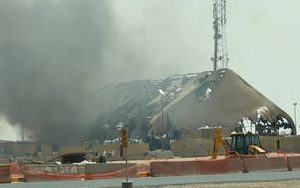
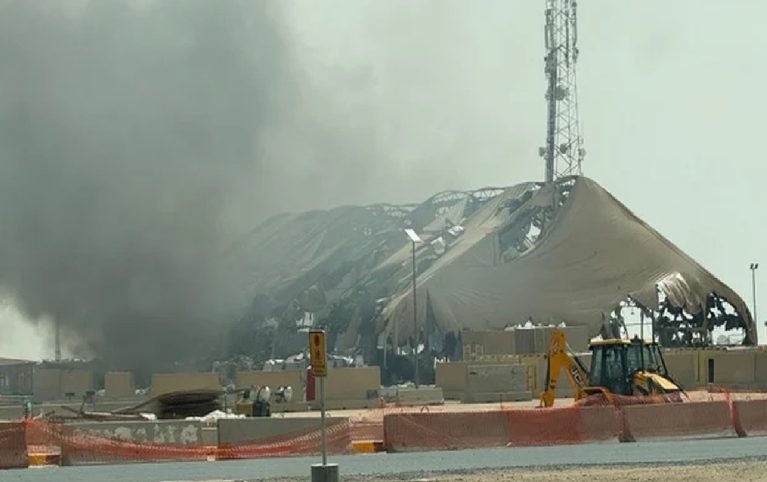
On Tuesday, Kuwait Petroleum Corporation announced that one of its giant crude oil tankers, the Al Salmi, was directly targeted in what it described as an Iranian attack while anchored at Dubai port in the United Arab Emirates.
The corporation stated that the tanker was fully loaded at the time of the incident, warning of a possible oil spill in the surrounding waters. Dubai authorities reported that firefighters extinguished the blaze, and no casualties or oil spill were reported.
The attack on the Al Salmi represents a significant escalation in Iran’s maritime campaign. By striking a tanker at anchor in a UAE port, rather than in transit through the Strait, Iran has demonstrated its ability to project power beyond the immediate chokepoint and into the waters of neighbouring Gulf states.
Security intelligence firm Vanguard confirmed the vessel’s identity and noted that authorities were investigating the incident. Iranian media, meanwhile, reported that strikes had hit a desalination plant on Iran’s Qeshm island in the Strait, putting it out of service.
US Strikes On Isfahan
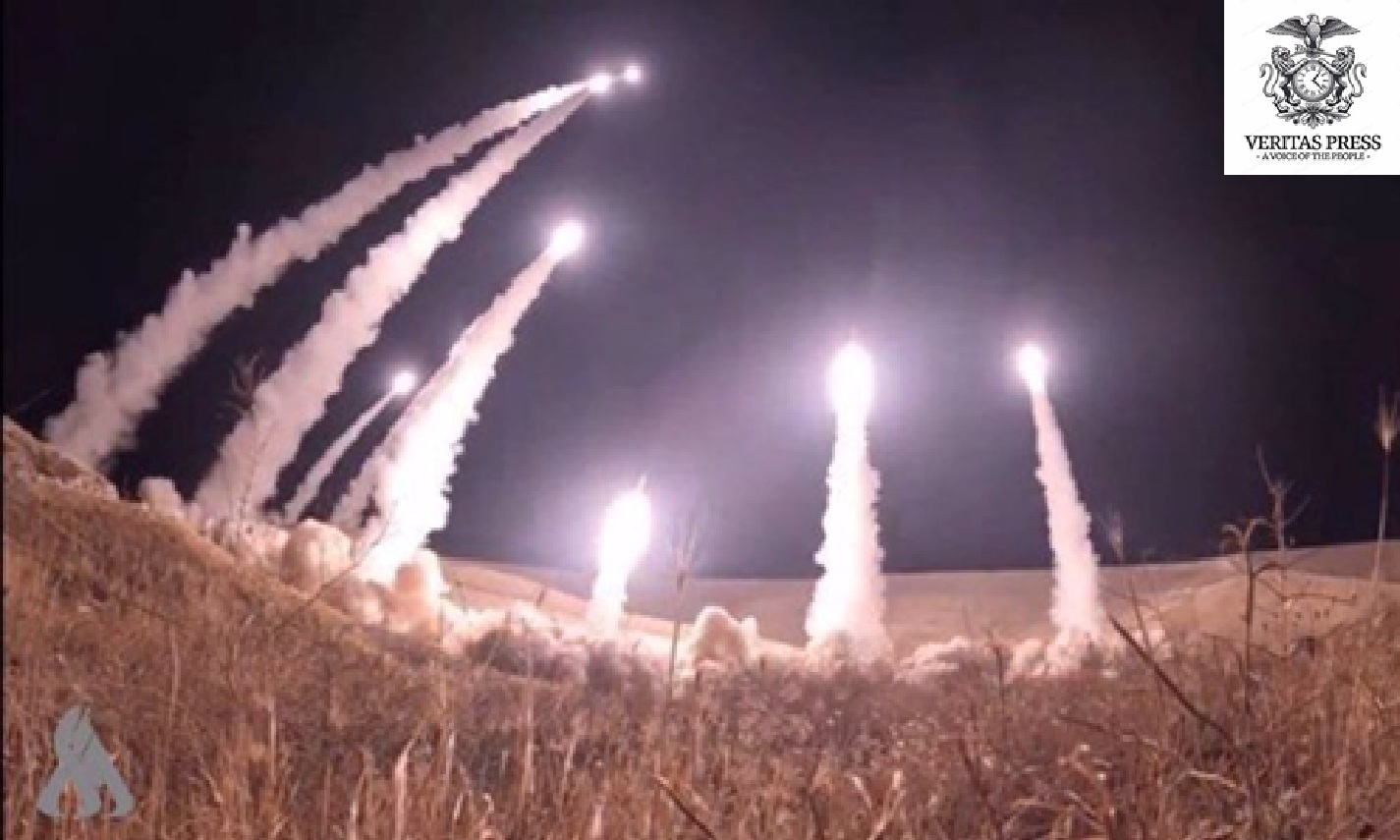
The US military has intensified its air campaign against Iranian military infrastructure. According to reports, American forces dropped bunker-buster bombs on what was described as an “Iranian ammunition depot” in Isfahan.
The Isfahan region is a key hub for Iran’s nuclear and missile programs, housing uranium stockpiles and one of the regime’s largest missile production complexes. Repeated US and Israeli strikes have reportedly dealt a severe blow to Iran’s ability to launch attacks, with some analysts suggesting parts of its arsenal may now be buried in destroyed underground facilities.
President Trump posted an uncaptioned video on Truth Social showing the strike, with a chain of explosions lighting up the night sky, a visual confirmation of the operation’s scale and success.
“Project Haman”: Reports Of A Coordinated Plan
Iranian media and security outlets have alleged the existence of a joint US-Israel plan codenamed “Haman” for a comprehensive strike against Iran. According to the security outlet Iran IntlWatch, the plan, named after the historical figure in the biblical story of Esther, focuses on decapitating Iran’s leadership and swiftly ending the war.
The report, which should be treated with appropriate scepticism given its source, claims that the plan’s principles were agreed upon in a briefing for several US Congress members. It alleges that operations would involve:
4,000 US troops are positioned in Azerbaijan
250 US troops in Bahrain and Pakistan to secure Chabahar
Takfiri militants and Kurdish groups stationed in Iraq’s Kurdistan Region
Strikes on southern Iran’s power infrastructure and the Bushehr nuclear plant
Potential use of unconventional weapons against the Natanz and Fordow nuclear facilities
Military analysts cited in the report caution that such plans underestimate Iran’s capabilities, noting Israel’s inability to defeat Hamas in Gaza despite months of heavy operations and repeated US failures in Iraq and Afghanistan. “Iran’s capabilities far exceed those of actors previously targeted by similar scenarios”, the analysis concluded.
Part VI: The Human Cost
Casualties And Displacement
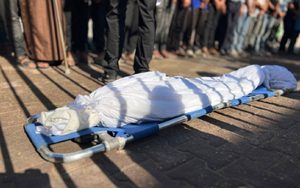
The human toll of the conflict continues to mount. Anadolu Agency reports that over 1,340 people have been killed in US-Israeli strikes on Iran since February 28. Iran’s retaliatory strikes targeting Israel, Jordan, Iraq, and Gulf countries hosting US military assets have caused additional casualties and significant damage to civilian infrastructure.
The International Maritime Organisation’s report of eight seafarers killed and 20,000 affected underscores the often-overlooked human dimension of maritime warfare. Merchant mariners, largely from developing nations, find themselves caught in the crossfire of a conflict not of their making, their vessels transformed into floating targets in a strategic game of geopolitical chess.
Infrastructure Damage
Iran has not been the only target. The regime’s retaliatory strikes have hit civilian and economic infrastructure across the region. Secretary Rubio catalogued these attacks in his Al Jazeera interview, citing strikes on “embassies, diplomatic facilities… airports… energy infrastructure”, actions he described as “unheard of”.
The strike on the Qeshm island desalination plant, reported by Iranian media, highlights the vulnerability of critical civilian infrastructure to military operations. Desalination plants provide essential drinking water throughout the Gulf region, and their destruction would have immediate humanitarian consequences.
Part VII: Strategic Analysis
The Logic Of Limitation
President Trump’s approach to the Iran conflict reflects a consistent pattern in his strategic thinking: define achievable objectives, set strict timelines, and shift burdens to allies. This approach has produced results in other contexts, the defeat of ISIS, the Abraham Accords, and the withdrawal from Afghanistan, but its application to Iran carries unique risks.
The administration’s focus on destroying Iran’s navy, eliminating its ballistic missiles, and preventing nuclear weapons development represents a plausible set of military objectives that can be achieved within a compressed timeline. Air power and cruise missiles can degrade these capabilities without requiring the sustained ground campaign that would be necessary to secure the Strait of Hormuz.
However, the decision to accept continued Iranian control of the strait fundamentally changes the strategic equation. By allowing Iran to maintain its “tollbooth” system, the administration is effectively ceding control of a global commons to a hostile power, a precedent with implications far beyond the Persian Gulf.
As Suzanne Maloney of Brookings warned: “Energy markets are inherently global, and the US cannot remain immune to economic damage if the blockade continues”. The $150 oil price scenario outlined by JP Morgan would hit American consumers and businesses as surely as it would Europe and Asia.
The Ally Problem
The administration’s confrontational posture toward European and Gulf allies reflects a deeper tension in US strategy. Trump has explicitly conditioned security guarantees on allied cooperation, a departure from the post-World War II model in which the United States provided security as a public good.
The president’s message to allies is clear: contribute to US-led operations or lose US protection. This approach may produce short-term compliance from some nations, but it also encourages the development of alternative security arrangements, including, potentially, European or Gulf-led defence structures that reduce dependence on Washington.
The reported Gulf divisions, with Saudi Arabia and the UAE pressing for continued conflict while Oman and Qatar advocate for diplomacy, illustrate the fragmentation that can result when American leadership is no longer the unifying force in regional security.
Iran’s Endgame
For Iran, the conflict presents both an existential threat and a strategic opportunity. The regime has survived a month of devastating airstrikes, including the loss of its supreme leader, while maintaining control over the Strait of Hormuz, its most powerful economic weapon.
By implementing a formal toll system, Iran has transformed a wartime measure into a potentially permanent revenue stream. The legislation passed by parliament on March 30 signals Tehran’s intention to maintain control over the strait even after hostilities end.
Iran’s selective approach to shipping, allowing friendly nations to transit while blocking adversaries, serves multiple strategic purposes. It maintains economic relationships with key partners like China and India, demonstrates that the blockade is political rather than logistical, and creates powerful incentives for nations to align with Tehran.
The regime’s calculation appears to be that the United States, despite its overwhelming military superiority, lacks the appetite for a prolonged conflict. Trump’s reported willingness to end the war without reopening the strait confirms this assessment, and may encourage Iran to adopt similarly maximalist positions in future crises.
Part VIII:The Road Ahead
Scenarios For Resolution
Three broad scenarios for resolving the crisis appear possible:
Scenario One: Coordinated Reopening – The United States assembles a multinational coalition, including European and Gulf navies, to forcibly reopen the strait. This operation would require sustained military commitment, risks direct confrontation with Iranian forces, and would likely extend the conflict beyond Trump’s timeline.
Scenario Two: Diplomatic Settlement – Iran agrees to relax the blockade in exchange for economic incentives or security guarantees. The toll system could be maintained in a modified form, with revenues potentially funding reconstruction. This scenario would require significant concessions from the United States and its allies.
Scenario Three: Protracted Stalemate – The United States winds down military operations while Iran maintains control of the strait. A de facto arrangement emerges in which some shipping continues under Iranian supervision, but global oil markets remain distorted by reduced supply and elevated prices.
The administration’s current trajectory points toward Scenario Three, an outcome that would represent a strategic defeat for US interests in the region, even if the administration frames it as a successful conclusion to its limited military objectives.
Market Implications
For global energy markets, the worst-case scenario remains prolonged closure. JP Morgan’s $150 oil projection would have cascading effects across the global economy, reigniting inflation, straining household budgets, and potentially triggering recession in energy-importing nations.
Even a partial reopening would likely leave the strait’s operations permanently altered. The Iranian toll system, once established, will be difficult to dismantle. International law prohibits such fees, as Professor Kraska and others have noted, but enforcement of international law requires the willingness of powerful nations to act as enforcers, a willingness that appears in short supply.
The Alliance Question
Perhaps the most enduring impact of the crisis will be on alliance structures. President Trump’s explicit statement that the “U.S.A. won’t be there to help you anymore” represents a fundamental challenge to post-World War II security architecture.
For European nations, the message reinforces the imperative of strategic autonomy, the capacity to act militarily without American support. For Gulf states, it raises uncomfortable questions about the reliability of US security guarantees that have underwritten their defence for generations.
Secretary Rubio’s warning that NATO relationships would need to be “reexamined” suggests that the administration is prepared to follow its rhetoric with concrete policy changes, potentially including the reduction of US force levels in Europe and the Middle East.
Conclusion: The Price Of Abandonment
As the conflict enters its second month, the contours of a new strategic order are emerging from the smoke and fire of the Persian Gulf. The United States has demonstrated its ability to inflict devastating military damage on Iran, degrading its navy, air force, and missile capabilities in ways that will take years to rebuild.
But the administration has also signalled its unwillingness to pay the full price of victory. By accepting continued Iranian control of the Strait of Hormuz, President Trump has chosen the constraints of his timeline over the imperatives of global commerce and alliance cohesion.
The irony is stark: after a month of war that has killed over 1,300 Iranians, disrupted global energy markets, and strained alliances to the breaking point, Iran retains control of the strategic chokepoint that precipitated the crisis. Its tollbooth system, formalised by parliamentary legislation, provides a revenue stream and a measure of international legitimacy for its maritime claims.
For America’s Gulf allies, the message is sobering. The United States has demonstrated its willingness to fight for its interests in the region, but not to fight for theirs. The distinction may prove decisive in the years ahead as Gulf states recalibrate their security strategies in an era of uncertain American commitment.
For European allies, the lesson is equally stark. When push came to shove, the United States expected European support for its military operations, and punished its absence with threats of abandonment. The transatlantic alliance, already strained by years of trade disputes and strategic disagreements, has been further damaged by a crisis that many European leaders believe was avoidable.
And for the global economy, the costs are only beginning to be counted. A month of restricted shipping has already transformed energy markets, with prices hovering above $100 per barrel. A second month would push them toward $150, with inflationary consequences that would be felt in every corner of the world.
The central question now is whether President Trump’s gamble pays off. If Iran, its military degraded and its leadership decapitated, can be persuaded to relax its blockade through diplomatic pressure, then the administration’s limited-war strategy may be vindicated. If not, the president’s chosen path leads to a world in which a hostile power controls one of the world’s most important waterways, and America’s allies must fend for themselves.
As Suzanne Maloney told the Wall Street Journal: “Ending military operations before the strait reopens is unbelievably irresponsible”. Whether that irresponsibility proves manageable or catastrophic will be determined in the weeks ahead.
Key Sources And Statements:
President Donald Trump (Truth Social, March 31, 2026):
“All of those countries that can’t get jet fuel because of the Strait of Hormuz, like the United Kingdom, which refused to get involved in the decapitation of Iran, I have a suggestion for you: Number 1, buy from the U.S., we have plenty, and Number 2, build up some delayed courage, go to the Strait, and just TAKE IT.”
Secretary of State Marco Rubio (Al Jazeera, March 30, 2026):
“No one in the world can accept [Iranian control of the strait]. The United States will not accept that condition. It’s an illegal condition that they’re demanding. That’s just not going to happen.”
Suzanne Maloney, Brookings Institution (Wall Street Journal, March 30, 2026):
“Ending military operations before the strait reopens is unbelievably irresponsible. Energy markets are inherently global, and the US cannot remain immune to economic damage if the blockade continues.”
Anwar Gargash, UAE Diplomatic Adviser:
“The situation must conclude with curbing the nuclear threat, drones, missiles, and Iranian aggression in the Strait of Hormuz.”
Bruce Kasman, JP Morgan Chief Economist:
“A scenario in which the strait remains closed for another month would be consistent with oil prices rising to around $150 a barrel.”
James Kraska, US Naval War College:
“There is no legal basis under international law for a coastal state to collect fees in an international strait.”
Source: Multiple News Agencies
Submissions:
For The Secure Submission Of Documentation, Testimonies, Or Exclusive Investigative Reports From Any Global Location, Please Utilise The Following Contact Details For Our Investigations Desk: enquiries@veritaspress.co.uk or editor@veritaspress.co.uk
Help Support Our Work:
Popular Information is powered by readers who believe that truth still matters. When just a few more people step up to support this work, it means more lies exposed, more corruption uncovered, and more accountability where it’s long overdue.
Help Protect Independent Journalism, Which Is Currently Under Attack.
If you believe journalism should serve the public, not the powerful, and you’re in a position to help, becoming a DONATOR or a PAID SUBSCRIBER truly makes a difference.
DONATION APPEAL: If You Found This Reporting Valuable, Please Consider Supporting Independent Journalism.
Help Support Our Work – We Know, We Know, We Know …
Seeing these messages is annoying. We know that. (Imagine what it’s like writing them … )
Your support fuels our fearless, truth-driven journalism. In unity, we endeavour to amplify marginalised voices and champion justice, irrespective of geographical location.
But it’s also extremely important. One of Veritas Press’s greatest assets is its reader-funded model.
1. Reader funding means we can cover what we like. We’re not beholden to the political whims of a billionaire owner. We are a small, independent and impartial organisation. No one can tell us what not to say or what not to report.
2. Reader funding means we don’t have to chase clicks and traffic. We’re not desperately seeking your attention for its own sake: we pursue the stories that our editorial team deems important and believe are worthy of your time.
3. Reader Funding: enables us to keep our website and other social media channels open, allowing as many people as possible to access quality journalism from around the world, particularly those in places where the free press is under threat.
We know not everyone can afford to pay for news, but if you’ve been meaning to support us, now’s the time.
Your donation goes a long way. It helps us:
Keep the lights on and sustain our day-to-day operations
Hire new, talented independent reporters
Launch real-time live debates, community-focused shows, and on-the-ground reporting
Cover the issues that matter most to our communities, in real time, with depth and integrity
We have plans to expand our work, but we can’t do it without your support. Every contribution, no matter the size, helps us stay independent and build a truly people-powered media platform. If you believe in journalism that informs, empowers, and reflects the communities we serve, please donate today.
Kamran Faqir is a volunteer investigative journalist and writer committed to exposing hidden truths and amplifying underreported stories. Driven by social justice, he brings sharp insight and fearless truth-telling to independent journalism. NUJ registered.
SEATTLE, TEHRAN — The U.S. Department of Homeland Security (DHS) will allow Iran’s national football team to enter the country 48 hours before their critical World Cup match against Egypt on Friday, a modest concession in a tournament where Team Melli’s travel conditions have sparked claims of oppression and competitive disadvantage.