Kamran Faqir is a volunteer investigative journalist and writer committed to exposing hidden truths and amplifying underreported stories. Driven by social justice, he brings sharp insight and fearless truth-telling to independent journalism. NUJ registered.
Original Article Date Published:
Article Date Modified:
Listen to this article
Help support our mission, donate today and be the change. Every contribution goes directly toward driving real impact for the cause we believe in.
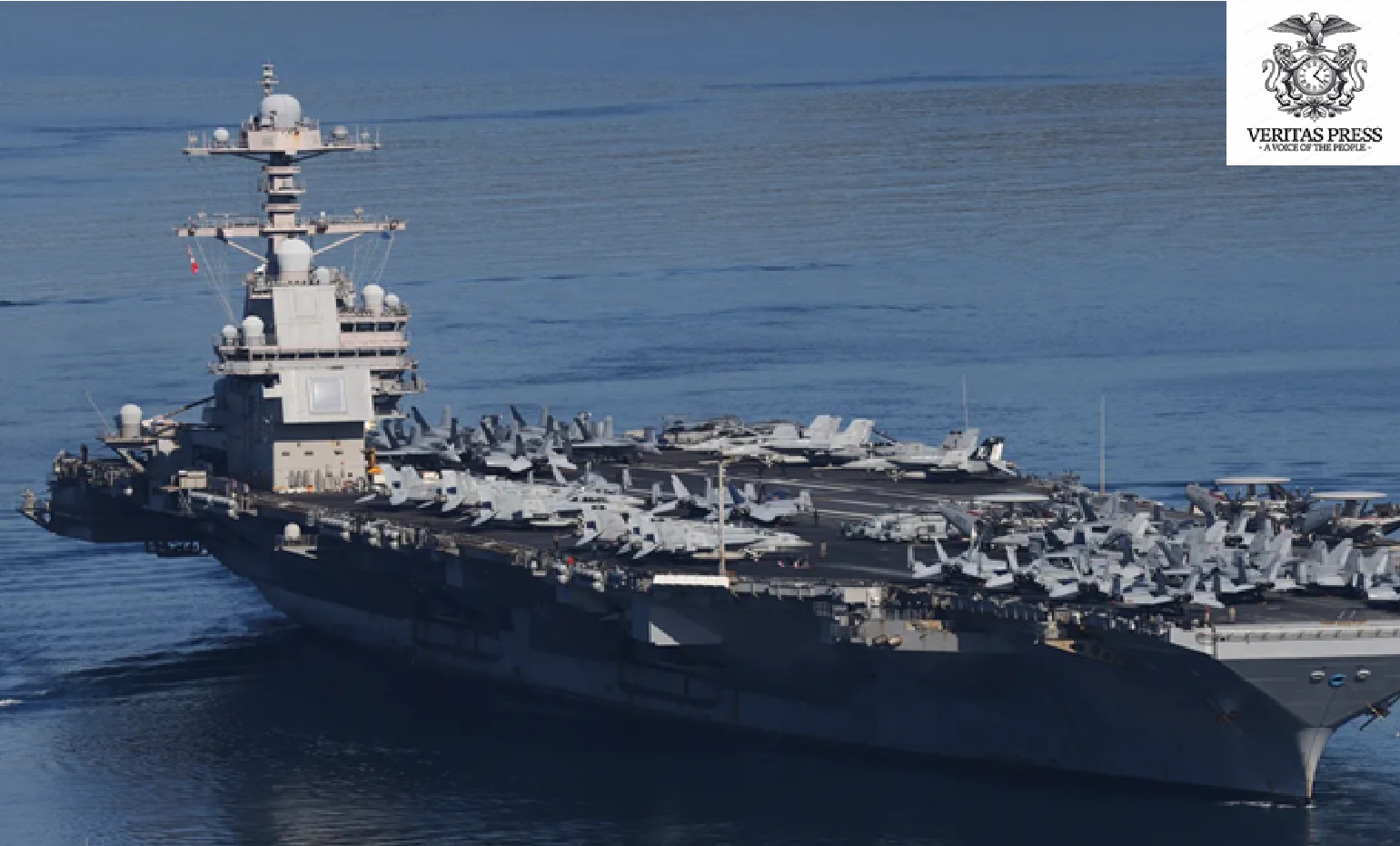
US/IRAN – In a significant escalation of American military posture in the Middle East, the world’s largest and most advanced aircraft carrier, the USS Gerald R. Ford, has arrived off the northern coast of Israel near Haifa, completing a high-speed transit from the Mediterranean. This movement, confirmed by local Greek port authorities and Israeli media on Friday, marks a pivotal moment in the burgeoning confrontation with Iran, placing a second American carrier strike group within striking distance of the Islamic Republic just as crucial diplomatic negotiations hang in the balance.
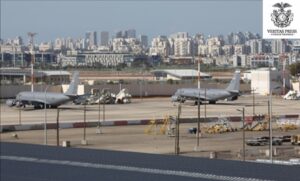
While the Pentagon has maintained a conspicuous silence regarding the deployment, Israeli Channel 12 and the Israeli Broadcasting Authority have detailed a frenetic 24 hours of American military logistics, including the landing of approximately 20 US KC-46A Pegasus refuelling aircraft at Ben Gurion Airport near Tel Aviv. This aerial bridge, combined with the arrival of 11 F-22 Raptor stealth fighters at Ovda Air Base earlier this week, forms what analysts are calling the most significant American show of force in the region since the 2003 invasion of Iraq.
The “Fire Brigade” Arrives: A Warship Stretched Thin.
The USS Gerald R. Ford (CVN-78) is not merely a symbol of power; it is a highly specific tool of coercion. Having departed a NATO naval support base in Souda Bay, Crete, early Thursday morning, the 100,000-ton vessel and its escort of three Arleigh Burke-class destroyers are expected to take up a station in the Eastern Mediterranean. This position allows its payload of F-35C Lightning II and F/A-18E/F Super Hornet aircraft to strike targets deep inside Iran, particularly if supported by the very refuelling tankers now parked in Israel.
However, an investigative look into the vessel’s readiness raises questions about the sustainability of this deployment. Defence analysts note that the Ford has been on an unprecedented, extended patrol since June 24, 2025, operating continuously for over eight months. Originally scheduled to return to Norfolk for repairs after participating in operations off the coast of Venezuela, including the controversial January 3 strike in Caracas that led to the capture of President Nicolás Maduro, the carrier was instead ordered back to the Middle East by President Donald Trump earlier this month.
This relentless pace has raised eyebrows among naval observers. “The USS Gerald R. Ford is being used like a fire brigade, rushing from crisis to crisis,” military analysts noted this week. “This is the carrier’s second eastbound Atlantic crossing in less than a year. There is a clear shortage of available hulls, and we are pushing the fleet to its breaking point”. Compounding these concerns, reports have surfaced regarding technical problems aboard the vessel, specifically relating to its advanced onboard sewage system, a minor but telling detail that points to the strain of prolonged deployment on its 4,600 crew members.
The “Elephant In The Room”: A Buildup Of Unprecedented Scale.
The Ford’s arrival is the “final piece of the puzzle” in a US military buildup that experts now confirm is the largest since the Iraq War. According to open-source intelligence analysed by Chinese state-affiliated media, the US has already stationed an estimated 280 tactical aircraft in the region, spread across bases in Israel, Jordan, Saudi Arabia, Qatar, and the UAE, as well as the two carrier strike groups.
The logistical footprint is staggering: over 100 aerial refuelling aircraft, including the KC-46s now in Israel, have been prepositioned to enable sustained deep-strike missions. Furthermore, satellite imagery has confirmed the movement of B-2 Spirit stealth bombers to the forward operating base on Diego Garcia, while E-3 Sentry AWACS and RC-135 Rivet Joint surveillance aircraft maintain a constant orbit near Iranian airspace.
“The US has gone beyond a defensive deterrence posture and is now in an offensive readiness stance,” a military analysis published by The Paper concluded. “They have the ability to launch a multi-axis, multi-domain strike against Iran involving ‘left-of-launch’ cyber operations, Tomahawk cruise missiles, and penetrating bombers”.
The Israeli Dilemma: Pushing For War Or Hiding Behind The US Shield?
While the deployment is ostensibly American, the location, off the coast of Haifa, anchors Israel directly into the centre of the target zone. Experts suggest that Prime Minister Benjamin Netanyahu’s government has been actively encouraging Washington to adopt a maximalist approach.
Rob Geist Pinfold, a lecturer in international security at King’s College London, provided a sharp critique of the current dynamic. “If the US does strike Iran, the Israelis will likely cheer them on and advocate for the operation continuing as long as possible to do the maximum damage. In short, when and if an operation begins, Israel will want the US to go for broke”.
However, Pinfold points out a paradox: Israel itself appears unprepared to lead such a charge. “The Israelis are now in a strange position where the US is being more hawkish than they are,” he noted. “This is not because of a strategic or ideological pivot, but because they feel like they aren’t ready for this kind of operation yet.” Following a 12-day war with Iran last year, Israel’s missile defence stocks, including interceptors for the Iron Dome, David’s Sling, and Arrow systems, are reportedly depleted, and its military focus remains fragmented across multiple fronts.
This dependency creates a significant vulnerability. Political analyst Ahron Bregman warned that while Israel might hope to sit back and let the US degrade Iranian capabilities, geography dictates otherwise. “If Israel does engage in the conflict, it is almost certain that Iran will retaliate against Israel. The Iranians are right that any campaign will be destructive for Israel; there will be many civilian casualties, particularly if this is a prolonged campaign”.
Tehran’s Red Lines And Geneva’s Last Gasp:
The military build-up is unfolding against the backdrop of a diplomatic dance in Geneva, where US and Iranian envoys concluded their third round of indirect talks on Thursday. While mediators described the tone as “positive,” the presence of the USS Ford steaming toward the Levant suggests a starkly different track.
President Trump has been explicit in his threats. Over the weekend, he stated that a “very bad day” could come for Iran if it fails to reach a deal, and reports from the Wall Street Journal have confirmed that the administration is actively considering “limited strikes” to force Tehran to accept more stringent nuclear restrictions.
Tehran has responded with defiance and its own military readiness. The Iranian mission to the UN issued a stark warning: in the case of an American attack, “all bases, facilities, and assets of the hostile force in the region would constitute legitimate targets”. This includes the very bases in Qatar, Kuwait, and the UAE that are hosting the US buildup. According to a report in The New York Times, the US is acutely aware of this vulnerability, acknowledging that the 30,000 to 40,000 American troops spread across eight permanent bases in the region have “limited air defences” to shield them from the kind of massive missile and drone barrages Iran has perfected.
Scenarios For Conflict:
Analysts are now gaming out potential triggers. The most discussed scenario involves a “surgical” strike on Iran’s nuclear facilities at Fordow and Natanz, likely using B-2 bombers equipped with GBU-57 Massive Ordnance Penetrators (“Bunker Busters”). This “small” option would be paired with strikes on Iranian radar and air defence sites to establish air superiority.
A “medium” scenario would expand the target set to include Iran’s ballistic missile arsenals and drone production facilities, the very tools Tehran would use to retaliate against Israel and US bases. The most severe “large” scenario, which analysts deem unlikely, would target the foundations of the Iranian regime itself, including the IRGC leadership and critical infrastructure.
Conclusion:
As the USS Gerald R. Ford drops anchor near Haifa, the question is no longer whether the United States can strike Iran, but whether the current diplomatic track in Geneva is merely a formality before the trigger is pulled. With a stretched but formidable US Navy holding the line, a depleted Israeli military hoping for American firepower, and an Iranian leadership vowing to turn the region into a “hellscape” for any attacker, the Eastern Mediterranean has become the deck of a loaded gun.
For the residents of Haifa and Northern Israel, watching the massive silhouette of the Ford on the horizon, the presence of the world’s largest warship offers a cold comfort: they are now the shield, but also the primary target. Pushing the region into conflict and instability. The accumulation of military equipment is a sign of impending direct conflict with Iran, as the Geneva talks were merely a tactic that allowed the US and Israel to bolster their military presence in the region for war.
Help Support Our Work.
For The Secure Submission Of Documentation, Testimonies, Or Exclusive Investigative Reports From Any Global Location, Please Utilise The Following Contact Details For Our Investigations Desk: enquiries@veritaspress.co.uk or editor@veritaspress.co.uk
Popular Information is powered by readers who believe that truth still matters. When just a few more people step up to support this work, it means more lies exposed, more corruption uncovered, and more accountability where it’s long overdue.
If you believe journalism should serve the public, not the powerful, and you’re in a position to help, becoming a DONATOR or a PAID SUBSCRIBER truly makes a difference.
DONATION APPEAL: If You Found This Reporting Valuable, Please Consider Supporting Independent Journalism.
Help Support Our Work – We Know, We Know, We Know …
Seeing these messages is annoying. We know that. (Imagine what it’s like writing them … )
Your support fuels our fearless, truth-driven journalism. In unity, we endeavour to amplify marginalised voices and champion justice, irrespective of geographical location.
But it’s also extremely important. One of Veritas Press’s greatest assets is its reader-funded model.
1. Reader funding means we can cover what we like. We’re not beholden to the political whims of a billionaire owner. We are a small, independent and impartial organisation. No one can tell us what not to say or what not to report.
2. Reader funding means we don’t have to chase clicks and traffic. We’re not desperately seeking your attention for its own sake: we pursue the stories that our editorial team deems important and believe are worthy of your time.
3. Reader Funding: enables us to keep our website and other social media channels open, allowing as many people as possible to access quality journalism from around the world, particularly those in places where the free press is under threat.
We know not everyone can afford to pay for news, but if you’ve been meaning to support us, now’s the time.
Your donation goes a long way. It helps us:
Keep the lights on and sustain our day-to-day operations
Hire new, talented independent reporters
Launch real-time live debates, community-focused shows, and on-the-ground reporting
Cover the issues that matter most to our communities, in real time, with depth and integrity
We have plans to expand our work, but we can’t do it without your support. Every contribution, no matter the size, helps us stay independent and build a truly people-powered media platform.
If you believe in journalism that informs, empowers, and reflects the communities we serve, please donate today.
Kamran Faqir is a volunteer investigative journalist and writer committed to exposing hidden truths and amplifying underreported stories. Driven by social justice, he brings sharp insight and fearless truth-telling to independent journalism. NUJ registered.
SEATTLE, TEHRAN — The U.S. Department of Homeland Security (DHS) will allow Iran’s national football team to enter the country 48 hours before their critical World Cup match against Egypt on Friday, a modest concession in a tournament where Team Melli’s travel conditions have sparked claims of oppression and competitive disadvantage.