



Author:
Help support our mission, donate today and be the change. Every contribution goes directly toward driving real impact for the cause we believe in.
Six Days After The Twin Earthquakes, The Official Death Toll Of 1,943 Masks A Far Grimmer Reality, As Decomposing Bodies Pile Up At Los Silos, Families Bribe Soldiers For Access To Their Loved Ones, And Independent Estimates Suggest As Many As 8,000 May Have Perished.
The Silence Of The Rubble:
Six days after twin earthquakes, 7.2 and 7.5 magnitude, reduced vast swaths of Venezuela’s northern coast to dust and debris, the stench of decomposition still hangs over Caraballeda like a shroud. The sea breeze does little to dissipate it. Neither do the US Marine Corps helicopters thundering overhead. In Los Silos, La Guaira’s makeshift morgue, bodies lie on the ground under plastic sheets, processing far outpaced by the sheer volume of the dead. By June 29, approximately 150 corpses had accumulated there, some naked, mutilated, decomposing in heat comparable to Florida’s.
“We have to stay strong, even without food, without sleep,” Ana Rada, a woman who has kept vigil at a rescue site for days, told ABC News. “Until I see the body, I still have hope.”
The official death toll, as of June 30, stands at 1,943, with 10,571 injured. But these numbers tell only a fraction of the story. The US Geological Survey initially estimated that earthquakes of this magnitude in such a densely populated area could kill between 10,000 and 100,000 people. Independent estimates, based on population density and survival rates in La Guaira, point toward approximately 8,000 dead. Online platforms tracking missing persons estimate that around 50,000 people remain unaccounted for.
“The number of buildings damaged or destroyed has risen to 774,” National Assembly President Jorge Rodríguez announced on June 29. Of those, 189 have completely collapsed. Some 855 buildings have been damaged overall, along with 38 hospitals, 44 shopping malls, and 1,645 road structures.
What is unfolding in Venezuela is not merely a natural disaster. It is a man-made catastrophe layered atop geological violence, a tragedy in which a hollowed-out state, stripped of capacity by years of crisis, now stands exposed before a grieving population.
“Venezuela Is Not Alone”: A Diplomatic Lifeline
On June 25, Foreign Minister Yvan Gil announced the launch of the “Venezuela Is Not Alone!” (¡Venezuela no está sola!) solidarity platform, a website designed to coordinate international financial donations and humanitarian flights. The initiative channels monetary contributions through the Development Bank of Latin America and the Caribbean (CAF) and facilitates institutional aid via aircraft carrying donations to Caracas.
“Venezuela Is Not Alone! You can join this solidarity initiative and accompany us through these difficult times,” Gil stressed.
The response has been overwhelming. More than 3,660 foreign rescuers from 27 countries are now on the ground, supported by 26,000 Venezuelan military personnel and 15,467 volunteers. Over 6,000 people have been rescued, and 80,870 families have received aid.
The United Nations has mobilised aggressively. UN Emergency Relief Coordinator Tom Fletcher allocated $15 million from the Central Emergency Response Fund.UN Secretary-General Antonio Guterres pledged “*the full cooperation of the UN system*” in support of relief efforts. The World Food Programme has enough supplies to feed more than 10,000 families for two months. The International Federation of Red Cross and Red Crescent Societies launched an emergency appeal for 50 million Swiss francs ($61.8 million) to assist 300,000 people.
Spain has emerged as one of the most significant contributors. On June 30, Foreign Minister Jose Manuel Albares confirmed the dispatch of a Spanish field hospital operated by AECID’s START (Technical Team for Aid and Emergency Response) team. The contingent of 44 volunteers includes trauma specialists and surgeons, and the hospital, capable of treating 100 patients per day, can become operational within 36 hours. Spain has also provided an initial €1 million in financial support. Queen Letizia personally bid farewell to the team at Barajas Airport.
Vietnam sent a 124-strong rescue team. Acting President Delcy Rodríguez thanked the Socialist Republic for “its solidarity and support during this difficult time.”China, Turkey, Iran, Qatar, Italy, France, Canada, Costa Rica, Portugal, Algeria, Russia, and dozens of other nations have offered condolences and assistance.
“Venezuela sincerely thanks the messages of solidarity from various international organisations, including the UN and its agencies,” Gil stated.
But beneath this diplomatic chorus lies a more complicated reality.
The American Presence: Aid Or Occupation?
The United States has deployed what amounts to a military intervention disguised as humanitarian assistance. Following the January capture of former President Nicolás Maduro, described by Donald Trump as a “one-day war”, US-Venezuela relations have undergone a dramatic reversal. Sanctions on Venezuelan oil have been lifted, diplomatic ties restored, and the Trump administration now works with an interim government led by Delcy Rodríguez.
The US Southern Command (SOUTHCOM) has mobilised extensively. The amphibious transport dock USS Fort Lauderdale is docked at La Guaira’s port, which US military engineers repaired and declared operational on June 29.“A specialised team of Marines” worked “around the clock” to reopen the facility.US C-17 Globemaster and C-130 Hercules transport aircraft, along with MV-22 Ospreys and UH-1Y Venom helicopters, are conducting aerial surveys and ferrying rescue teams and supplies.
Colonel Ryan Lynch, commanding officer of Littoral Combat Force 24, framed the operation in stark terms: “In a disaster of this magnitude, the first 72 hours are a race against the clock. Roads are destroyed, airports are damaged, and infrastructure collapses. LCF-24 brings the ability to bypass those obstacles. By operating from the sea and forward nodes, we can insert experts, equipment, and medical support directly into the hardest-hit areas.”
The US has deployed more than 900 troops, four urban search-and-rescue teams comprising over 300 first responders, and nearly two dozen search dogs. Financial support now exceeds $300 million, up from an initial $150 million commitment. These funds are channelled through partner organisations including Samaritan’s Purse, Catholic Relief Services, the International Organisation for Migration, and the Red Cross.
“We’re helping Venezuela. They had a tremendous earthquake, a lot of people killed—unbelievable—in Caracas, and we have a lot of people over there helping,” Trump told reporters.
Yet the administration has not offered any relief from the broader economic sanctions regime, issuing only a time-limited license allowing earthquake relief-related transactions. Washington retains control over Venezuelan oil export revenues, with disbursement timings and amounts left at US officials’ discretion. The question haunts the relief effort: Is this humanitarian solidarity, or is it the consolidation of geopolitical control disguised as compassion?
“They Are There Just To Loot”:
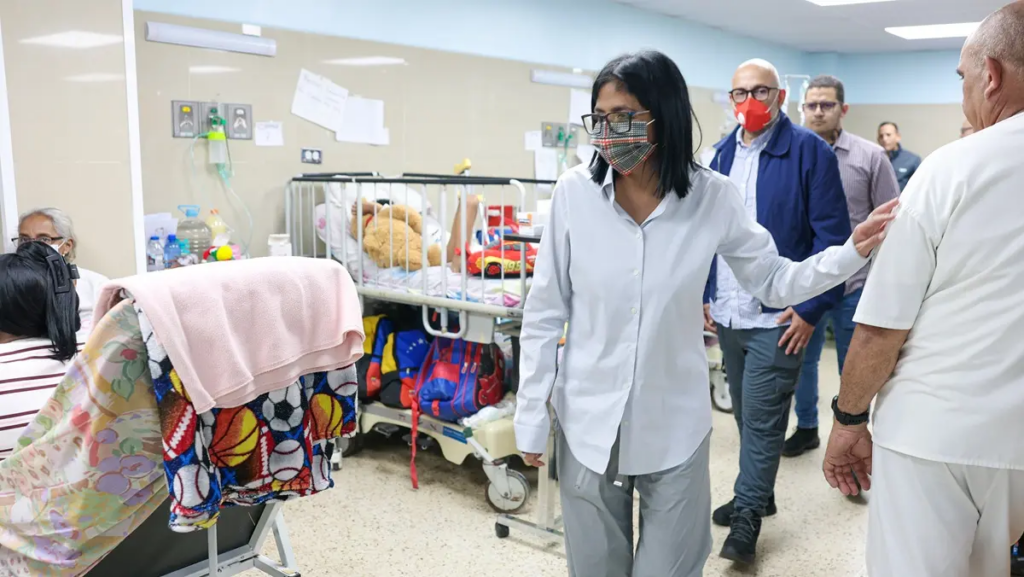
On the ground, the narrative is far less polished. Acting President Delcy Rodríguez has been overseeing health facilities and frontline response, maintaining direct contact with medical personnel, patients, and families.“We continue to stand with affected families and directly oversee response and recovery efforts in La Guaira,” she said. “The National Government remains fully deployed, working in coordination with all state agencies.”
But testimonies from survivors paint a different picture. Residents report that military and police personnel are present not to rescue, but to loot, or worse, to block families from digging for their own dead. Soldiers and police are allegedly charging bribes of $450 to deliver a body, and $2,000 to allow heavy machinery access to sites where rubble must be cleared to uncover the dead.
There is the story of a man who found only the severed arm of his daughter and went to bury it. Others have had to transport corpses on bicycles and in cars to morgues or funeral homes. Volunteers abroad are posting instructions on how to purchase body bags and safety masks on Amazon.
The government has restricted access to La Guaira, enforced the use of credentials for anyone attempting to enter, and corralled foreign rescuers and journalists into militarised incursions to selected zones. On June 27, Jorge Rodríguez announced 1,430 dead and 3,238 injured. The following day, despite images of devastation spreading worldwide and NASA’s damage assessments, he revised the figures to 1,450 dead and 3,150 injured, fewer injured than the day before.
On Monday, Rodríguez said the death toll had risen to 1,719, with 5,034 injured. Even so, the government has consistently sought to downgrade the human cost. Once videos and articles appeared in the global press documenting organisational chaos and the fury of relatives against authorities, the regime cancelled all press access to La Guaira for 48 hours, citing “sanitary risk” and the need to “reduce the noise” to find survivors.
“Here we are again, back in the street. I don’t know when we’ll have a moment of true peace,” Concepción Hernández, who evacuated her apartment building in Caracas after a 4.6-magnitude aftershock on June 29, told ABC News.
The Housing Crisis: Traffic Lights And Transitional Camps.
On June 28, the government announced the creation of a Presidential Commission for the Assessment of Housing and Infrastructure Habitability, chaired by structural engineer Francisco Garcés. The commission has deployed teams of engineers and architects to La Guaira, Miranda, and Caracas to evaluate damaged structures using a traffic light system: green for habitable, yellow for repairable but unsafe until work is completed, and red for total loss or critical structural damage.
“We have found buildings whose structural systems, beams, columns, and frame structures—have not sustained significant damage. However, the masonry has been severely affected. This means these buildings are repairable but cannot be inhabited until damaged walls and enclosure elements are removed and rebuilt,” Garcés explained.
Acting President Rodríguez also announced plans to build thousands of new homes by year’s end and the creation of “transitional camps” to house the displaced.“We already have a classification of those who lost their homes and must be attended to immediately in these transitional camps,” she said. “There are thousands of solutions before the end of this year.”
A separate General Staff for Transitional Camps and Housing Projects, led by Jorge Rodríguez, has been established to coordinate these efforts.
Corporate media outlets have launched claims that buildings from Venezuela’s Great Housing Mission (GMVV), the massive program launched by Hugo Chávez in 2011 to provide housing for working-class families, were especially damaged. However, open-source analysis of damaged buildings shows that only a very small percentage of affected structures belong to the housing mission.
The Politics Of Grief:
For all the international solidarity, for all the foreign rescue teams and military transports, for all the official pronouncements of unity and resilience, a fundamental truth remains inescapable: the Venezuelan state was criminally, deliberately hollowed out long before the earth shook.
The regime that stands accused of emptying the State of its capabilities is the same regime now directing the response. As it did with Hugo Chávez, as it did with Nicolás Maduro, the third chavista iteration is repeating the same behaviour: hiding what they can, lying about what they cannot hide, and deflecting blame onto others.
Just as with the 1999 landslides, we will likely never have a precise, reliable figure of how many people were killed by the earthquakes of June 2026. The government, unable or unwilling to coordinate anything other than the arrival of foreign help, cannot possibly produce an accurate total. Especially when its main features include the manipulation of reality.
We will have to complete the picture with oral history and art: novels, films, visual arts, songs.
“We continue to stand with affected families,” Rodríguez says. But the families tell a different story. They speak of bribes for bodies. They speak of blocked access. They speak of soldiers who loot while the dead rot under the sun. They speak of a government that has abandoned them and is now using the rubble as a stage for propaganda.
As the last faint voices of the survivors grow scarce beneath the rubble, the bad news spreads on social media and WhatsApp. Entire families have been erased. Dozens of children were orphaned or killed alongside their parents.
A Nation Forced To Grieve:
Once again, tragedy has increased the death toll for a nation forced to grieve year after year. And the regime responsible is still there.
But so too is the solidarity. So too are the rescue teams from 27 nations. So too are the volunteers, 15,467 of them, registered and working. So too are the families who refuse to give up hope, who dig through concrete with their bare hands, who carry the bodies of their loved ones on bicycles because no one else will help.
“We are deeply grateful for the solidarity shown by countries, organisations and international teams that have stood by Venezuela during these days,” Rodríguez said. “Their support reminds us that we are not alone. With unity, solidarity, and hard work, we will overcome this tragedy and move forward.”
Perhaps. But overcoming this tragedy will require more than unity and hard work. It will require accountability. It will require a reckoning with the failures, both structural and political, that turned a natural disaster into a humanitarian catastrophe. And it will require the world to look beyond the official narratives and see the bodies on the ground, the families at the rubble, the children who will grow up without parents, and the parents who will never know what became of their children.
Venezuela is not alone. But being surrounded by the world does not mean being saved by it. The salvation, if it comes, must come from within, from a people who have endured more than any people should have to endure, and who continue, against all odds, to hope.
Source: Veritas Press C.I.C. | Multi News Agencies
Help Support Our Work By Donating
Popular Information is powered by readers who believe that truth still matters. When just a few more people step up to support this work, it means more lies exposed, more corruption uncovered, and more accountability where it’s long overdue.
Help Protect Independent Journalism, Which Is Currently Under Attack.
If you believe journalism should serve the public, not the powerful, and you’re in a position to help, becoming a DONOR or a PAID SUBSCRIBER truly makes a difference.
DONATION APPEAL: If You Found This Reporting Valuable, Please Consider Supporting Independent Journalism.
Your support fuels our fearless, truth-driven journalism. In unity, we endeavour to amplify marginalised voices and champion justice, irrespective of geographical location. We operate independently, without any financial backing from billionaires.
But it’s also extremely important. One of Veritas Press’s greatest assets is its reader-funded model.
1. Reader funding means we can cover what we like. We’re not beholden to the political whims of a billionaire owner. We are a small, independent and impartial organisation. No one can tell us what not to say or what not to report.
2. Reader funding means we don’t have to chase clicks and traffic. We’re not desperately seeking your attention for its own sake: we pursue the stories that our editorial team deems important and believes are worthy of your time.
3. Reader Funding: enables us to keep our website and other social media channels open, allowing as many people as possible to access quality journalism from around the world, particularly those in places where the free press is under threat.
We know not everyone can afford to pay for news, but if you’ve been meaning to support us, now’s the time.
Your donation goes a long way. It helps us:
- Keep the lights on and sustain our day-to-day operations
- Hire new, talented independent reporters
- Launch real-time live debates, community-focused shows, and on-the-ground reporting
- Cover the issues that matter most to our communities, in real time, with depth and integrity
We have plans to expand our work, but we can’t do it without your support. Every contribution, no matter the size, helps us stay independent and build a truly people-powered media platform.
If you believe in journalism that informs, empowers, and reflects the communities we serve, please donate today.
Help By Donating Today
Submissions:
For The Secure Submission Of Documentation, Testimonies, Or Exclusive Investigative Reports From Any Global Location, Please Utilise The Following Contact Details For Our Investigations Desk: enquiries@veritaspress.co.uk or editor@veritaspress.co.uk
GENEVA — A United Nations fact-finding mission has concluded there are “reasonable grounds to believe”
Iran’s GDP is projected to contract by 5.4 to 6.1% in 2026, its worst performance
The Trump administration is preparing a $2.8 billion weapons package for Israel containing 40,000 2,000-pound
Film alleges mass civilian deaths are routinely built into military decisions amid Israel’s genocidal war
The Israeli rights group says violence, displacement, economic strangulation, and settlement expansion form part of

Houthi forces have captured the historic Red Sea port of Mocha and are advancing on
London’s historic sanctions against Israeli settlements mark a watershed moment in UK foreign policy, but
With 95% of Gaza’s population now wholly dependent on aid and more than 90% stripped
India calls for Kashmir and Ladakh to appear only on its official map after a
ISLAMABAD – In the high-stakes political theatre of Pakistan, the battleground has shifted from the














91m1xf
aeykdr
7ofvw9