



Help support our mission, donate today and be the change. Every contribution goes directly toward driving real impact for the cause we believe in.
How 69 Individuals, And Their Children, Were Stripped Of Nationality Without Trial, The Lawmakers Who Dared To Question It, And What This Says About The Future Of Rule Of Law In The Gulf Kingdom.
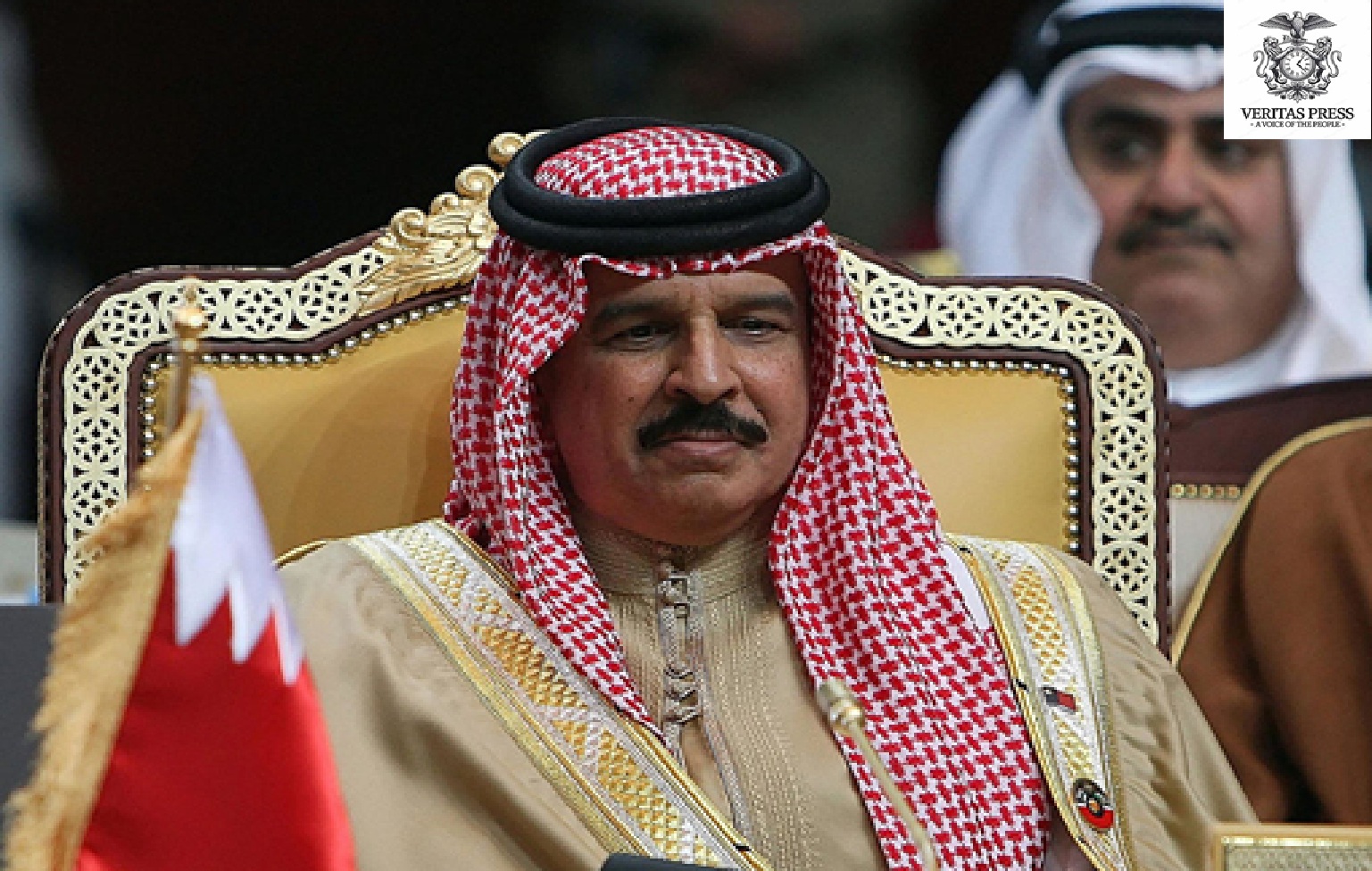
Manama, 10 May 2026 — When the decree was published in Bahrain’s Official Gazette on 27 April, it contained no names. No charges. No court rulings. Just a single paragraph announcing that 69 individuals and their families had been stripped of their citizenship by the sovereign order of King Hamad bin Isa Al Khalifa. The stated offence: “expressing support for Iran” during the ongoing US-Israeli military campaign against the Islamic Republic, and “glorifying and sympathising with” regional resistance movements on social media.
What followed over the next two weeks has peeled back the veneer of constitutional monarchy to reveal an increasingly authoritarian reality, one in which citizenship, that most fundamental legal bond between individual and state, has been transformed into a revocable privilege dispensed and withdrawn at the absolute discretion of the sovereign. The development has triggered a rare parliamentary confrontation, an extraordinary royal warning of martial law, and a wave of forced denationalisation that rights groups say includes infants and children.
Now, with three parliamentarians facing expulsion for merely questioning the legality of the process, and tribal and regional leaders rushing to pledge fealty to the throne, Bahrain stands at a crossroads that observers say could define the kingdom’s trajectory for a generation.
Ground Zero: A Decree-Law That Removed The Judges.
To understand how 69 people, and by extension their spouses, children, and in some cases infants, lost their nationality overnight, one must go back to Decree-Law No. 13 of 2024, a legislative amendment that passed largely under the radar but has now revealed its full significance.
Prior to the amendment, Article 7 of Bahrain’s Judiciary Authority Law placed disputes over citizenship and nationality within the jurisdiction of the High Civil Court. An individual stripped of citizenship had, at least in theory, recourse to an independent judicial body where evidence could be examined and legal arguments heard. The 2024 decree-law removed that jurisdiction entirely. Nationality matters were reclassified as “sovereign acts”, decisions belonging exclusively to the king and his royal court, immune from judicial review, unconstrained by evidentiary standards, and not subject to appeal.
The implications were profound but, until last month, largely abstract. On 27 April, they became devastatingly concrete.
“The concern is that removing the judiciary from cases touching a fundamental legal status such as citizenship is an enormously significant matter,” First Deputy Speaker Abdulnabi Salman Nasser told parliament last Tuesday, in remarks that would soon place his own political career in jeopardy. “It may open the door to a wider discretionary space that could sometimes be crossed, and this affects the flow of justice in specific cases.”
Nasser was careful, almost deferential, in his phrasing. He acknowledged that citizenship was a “sovereign matter” requiring organisation. But his core point was unmistakable: when “the necessary guarantees for protecting individuals and families from potentially arbitrary decisions are absent,” the rule of law itself is threatened.
Services Committee Chairman Mamdouh Al Saleh went further, invoking both secular law and Islamic jurisprudence. “We understand that justice knows no favouritism. But the punishment does not extend beyond the offender,” he said. “The law is clear, and the Sharia is clearer. And reason says: If I make a mistake, why should my children be punished? If I sin, why should my family carry my burden?”
These were not radicals. These were elected parliamentarians speaking within the bounds of the kingdom’s political framework, careful to affirm their loyalty even as they raised uncomfortable questions. Yet within days, all three, Nasser, Al Saleh, and MP Mahdi Abdulaziz Al Showaikh, would be fighting for their political survival.
“This Is Not A Punishment”: The Government’s Logic.
Justice and Islamic Affairs Minister Nawaf bin Mohammed Al Maawda offered parliament a starkly different interpretation. Citizenship, he argued, is not a right but a grant, and its revocation is not a punishment but a sovereign prerogative.
“The purpose of this decree is to give the state sovereignty over citizenship,” Al Maawda told lawmakers. “In such matters, the judiciary does not intervene in any country. These are matters related to security and the higher interest of the country. They are not presented to the judiciary, not discussed before the judiciary and not disclosed to the judiciary at all. This is a sovereign matter, and it is so in every country; it is not something strange.”
The minister’s assertion that such practices are universal is, at best, misleading. While many states reserve broad executive discretion over the granting of citizenship, the arbitrary revocation of nationality, particularly when it renders individuals stateless, is expressly prohibited under international law. Article 15 of the Universal Declaration of Human Rights, to which Bahrain is a signatory, states unequivocally: “No one shall be arbitrarily deprived of his nationality.” The 1961 Convention on the Reduction of Statelessness, the International Covenant on Civil and Political Rights, and the Convention on the Rights of the Child all contain provisions that directly contradict the minister’s characterisation.
More immediately, Al Maawda’s argument that citizenship revocation is “not a punishment” collapses under the weight of its own consequences. Those stripped of Bahraini nationality lose not only their passports but their right to reside in the kingdom, their access to free or subsidised housing, healthcare, and employment benefits. Their children are expelled from schools. Their bank accounts are frozen. In a country where citizenship also determines access to land, business licences, and government employment, denationalisation is, for all practical purposes, economic and social annihilation.
The Children: Collective Punishment By Another Name.
Among the most troubling aspects of the 27 April decree is the inclusion of dependents, what Iran’s High Council for Human Rights, in a strongly-worded statement published on Sunday, described as “even children and infants.”
The Bahraini Interior Ministry’s original announcement stated that the 69 individuals’ “families” were also affected, a formulation that rights groups say deliberately obscures the scale of the measure. While exact numbers remain unconfirmed, human rights organisations monitoring the case estimate that the total number of people rendered stateless could exceed 200 when spouses and children are counted.
“The inclusion of infants in the decision not only violated human rights standards but also constituted ‘forced denationalisation’ and ‘collective punishment,’ practices that have been strongly prohibited by UN monitoring bodies,” the Iranian human rights body stated, citing multiple UN treaty body findings that penalising family members for the alleged acts of a relative breaches the principle of individual criminal responsibility.
The accusation of “collective punishment” carries particular weight under international humanitarian law, where it is explicitly prohibited by Article 33 of the Fourth Geneva Convention. While Bahrain is not in a state of armed conflict, the principle that punishment must be individualised is a cornerstone of modern legal systems.
“I ask for explicit affirmation, through this decree, of the principle of individual criminal responsibility, protecting children and families from any consequences they are not guilty of,” MP Al Saleh pleaded in parliament. The minister did not directly respond to this point.
Sayyid Ahmed Al-Wadaei, director of advocacy at the Bahrain Institute for Rights and Democracy (BIRD), told this publication: “What we are witnessing is the weaponisation of nationality. The Bahraini government has systematically used citizenship revocation as a tool of political repression since 2011, but this latest wave is unprecedented in its scope and in its explicit targeting of family members. To strip an infant of citizenship because of a social media post allegedly made by a parent is not justice; it is vindictiveness dressed in the language of national security.”
Iran Responds, And The King Strikes Back:
The revocation order might have remained a largely domestic affair had it not drawn a sharp response from Tehran. On 4 May, Iranian Foreign Ministry spokesperson Esmaeil Baqaei issued a statement calling the measure “a serious human rights violation” and a “flagrant breach of human rights,” accusing the Bahraini government of a “discriminatory approach toward their own people.”
“The Bahraini government cannot, through such smear campaigns, divert public opinion in the country and the region from its direct responsibility in supporting and accompanying US-Israeli aggressors against the Iranian people,” Baqaei said, referencing Manama’s strategic alignment with Washington and its hosting of the US Navy’s Fifth Fleet.
The Iranian statement was predictably self-serving. Tehran has long sought to position itself as the protector of Bahrain’s Shia majority against the Sunni Al Khalifa monarchy, but it touched a nerve in Manama. On Thursday, 7 May, King Hamad delivered an extraordinary address that marked a sharp escalation in both rhetoric and implied threat.
“His Majesty stressed that these deterrent measures are not vindictive, but rather a mercy to the vast majority of the loyal sons of the nation, and a safety valve that prevents the leadership of the valiant armed forces from having to take over matters according to military rulings,” read the official transcript published by the Bahrain News Agency.
The reference to “military rulings” was widely interpreted as a threat to impose martial law, a spectre that hangs heavily over a country that experienced a brutal security crackdown during the 2011 Arab Spring uprising, when Saudi and Emirati forces crossed the causeway to help suppress pro-democracy protests.
More pointedly, the king denounced those “whom the people had elected to represent them, standing alongside traitors,” a direct reference to the three MPs who had raised questions about the citizenship decree. The language was carefully chosen: the Arabic term for “traitor” carries profound resonance in Gulf political culture, implying not merely disloyalty but apostasy against the legitimate order.
The Parliament Purges Itself:
What followed the king’s speech was a cascade of retractions, apologies, and declarations of loyalty that laid bare the near-absolute power of the monarchy over even the elected branches of government.
Within hours, Nasser, Al Saleh, and Al Showaikh issued profuse public apologies. Their colleagues in the Council of Representatives, 37 of the 40 members, signed a letter calling for their dismissal. Pledges of allegiance poured in from royal family members, government ministers, and the heads of Bahrain’s powerful tribes, all affirming the “validity” of the citizenship revocations and renewing their fealty to the sovereign.
Even the Gulf Cooperation Council weighed in. GCC Secretary-General Jasem Mohamed Al Budaiwi issued a statement endorsing Bahrain’s right to take “all necessary measures to preserve its national security and sovereignty”, a move that underscored the regional bloc’s reflex to close ranks around member states facing internal dissent, particularly when Iran is invoked.
On Thursday, 7 May, as scheduled, parliament voted to expel the three dissenting members. The vote was a formality; the outcome had been predetermined from the moment the king spoke. What remains unclear is whether the expulsion will expose the former MPs to further legal jeopardy. Under Bahraini law, parliamentarians enjoy limited immunity for opinions expressed in the chamber, but that protection evaporates once they leave office.
“The message is unmistakable,” said Brian Dooley, senior advisor at Human Rights First and a long-time observer of Bahraini politics. “If you question the king’s absolute authority over citizenship, you lose your job, your reputation, and potentially your liberty. It is a textbook case of authoritarian consolidation disguised as constitutional procedure.”
A Pattern Of Statelessness As State Policy:
The 27 April revocations did not emerge from a vacuum. Since the 2011 uprising, Bahrain has systematically deployed citizenship stripping as a tool of political control, relying on Article 10 of the Bahraini Citizenship Law, which permits revocation “in the event of causing damage to the interests of the Kingdom or acting in a manner that contradicts the duty of loyalty to it.”
The provision’s deliberate vagueness has allowed successive governments to target a wide range of dissidents: political activists, human rights defenders, clerics, journalists, and now social media users accused of pro-Iranian sentiment. According to data compiled by BIRD and the Americans for Democracy and Human Rights in Bahrain (ADHRB), more than 700 individuals have been stripped of citizenship since 2011, often without judicial process, even before the 2024 decree-law eliminated court oversight.
What distinguishes the latest wave is its timing and its targets. The ongoing US-Israeli military campaign against Iran, which has included strikes on Iranian nuclear facilities and proxy forces across the region, has placed Bahrain, as a host to American military assets, in a delicate position. Manama has publicly aligned with Washington while privately fearing both Iranian retaliation and domestic unrest among its Shia population, which has historically maintained cultural and religious ties to Iran.
“The government is using the war as a pretext to crush any expression of sentiment that deviates from official narratives,” said Zainab Al-Khawaja, a prominent Bahraini human rights activist now in exile in Denmark. “Posting sympathy for civilians under bombardment, or criticising Israeli military operations, is being reframed as ‘support for Iran’ and therefore as treason. It is a deliberate conflation designed to silence dissent.”
The Interior Ministry’s statement announcing the revocations explicitly linked the measures to social media posts made during the Iran conflict, posts that, according to the ministry, “glorified” attacks on US and Israeli assets or expressed solidarity with populations affected by the war. Whether such expressions constitute a genuine threat to national security, or merely a convenient justification for expanding the state’s repressive apparatus, is a question the government has no interest in answering.
“This is not about security; it is about control,” Al-Wadaei said. “The government knows that international attention is focused on the Iran conflict, and it is exploiting that distraction to accelerate its domestic crackdown. The revocation of citizenship, the intimidation of parliamentarians, the tribal loyalty pledges, all of it is choreographed to demonstrate absolute power at a moment of regional crisis.”
The Human Toll: Stories From The Stateless.
While the political drama plays out in Manama’s corridors of power, the human consequences of the decree are already unfolding in homes, schools, and workplaces across the kingdom. Because the revocations were implemented without individual notification or legal process, many affected families learned of their statelessness through social media or word of mouth.
One woman, who spoke to this publication on condition of anonymity for fear of further reprisals, described receiving a call from her husband’s employer informing him that his work permit had been cancelled and his salary frozen. “We had no warning,” she said. “My husband had posted a message of condolence on his private Instagram account when news broke of civilian casualties in the strikes. He didn’t call for anything; he simply expressed sadness. Now we are being told to leave the country within 30 days, but where do we go? Our children were born here. This is the only home they know.”
The woman’s situation is complicated by the fact that revoking her husband’s citizenship automatically revoked hers and their three children’s, as dependents under Bahraini law. “My youngest is eight months old,” she said. “She is now stateless. What did she do? What crime can an infant commit?”
International law is clear that statelessness should be avoided at all costs and that children have a right to a nationality. The UN Committee on the Rights of the Child has repeatedly called on Bahrain to ensure that no child is left stateless. The committee’s most recent concluding observations, issued in 2023, expressed “serious concern” about reports of citizenship revocation affecting children and urged Bahrain to “review its legislation and practice” to comply with its obligations under the Convention on the Rights of the Child.
Those recommendations appear to have been ignored.
On Sunday, Iran’s High Council for Human Rights formally called on UN human rights bodies, specifically the Office of the High Commissioner for Human Rights, the Human Rights Council, and the Committee on the Rights of the Child, as well as the Organisation of Islamic Cooperation, to “formally and immediately condemn Bahrain’s action.” The council urged that the citizenship of all affected individuals be restored “without delay,” especially that of children and infants, and warned that “silence or minimal international response would embolden repressive regimes to continue violating citizens’ rights.”
The statement added that Iran reserved its right to pursue the matter in international forums and called for Bahraini officials responsible to be identified as “gross violators of human rights.”
The irony of Tehran, itself a country with a documented record of arbitrary denationalisation, particularly targeting political dissidents and ethnic minorities, lecturing Manama on human rights was not lost on observers. But as Dooley noted: “The messenger may be compromised, but the message remains valid. The core facts are not in dispute: 69 people have been stripped of citizenship without trial, their families have been punished, and the parliamentarians who raised questions have been purged. That is a human rights crisis regardless of who calls it out.”
The Wider Regional Context: Gulf Autocracies And The Security Narrative.
Bahrain’s actions are part of a broader pattern across the Gulf monarchies, where the language of national security has increasingly been deployed to justify the erosion of civil liberties and the concentration of executive power.
In Saudi Arabia, Crown Prince Mohammed bin Salman’s consolidation of power has been accompanied by a systematic crackdown on dissent, the use of counterterrorism courts to prosecute activists, and the 2018 assassination of journalist Jamal Khashoggi, an act that continues to cast a shadow over Riyadh’s human rights record despite Western governments’ eagerness to resume business as usual.
In the United Arab Emirates, a sprawling network of surveillance and detention underpins a political system that tolerates no organised opposition, with citizenship rights similarly contingent on loyalty and, in the case of the country’s stateless bidoon population, often denied entirely.
The GCC’s swift endorsement of Bahrain’s citizenship revocations, issued through Secretary-General Al Budaiwi’s statement, reflects a collective understanding among Gulf rulers that challenges to one monarchy’s absolute authority are challenges to all. The bloc’s solidarity in the face of the 2011 protests, which saw Saudi and Emirati forces intervene in Bahrain and the GCC collectively fund a multi-billion-dollar development package for both Bahrain and Oman, demonstrated that the preservation of the monarchical order trumps any nominal differences.
“What we are seeing in Bahrain is the regional system working as designed,” said Kristin Smith Diwan, a senior resident scholar at the Arab Gulf States Institute in Washington. “The GCC states will back each other against any perceived threat to regime stability. The fact that this incident involves Iran gives them an even stronger incentive to present a united front. The human rights dimension is simply not a priority in this calculus.”
The Media’s Role: Narratives And Counter-Narratives.
The battle over the citizenship revocations is being fought not only in parliament and international forums but in the information space, where competing narratives reflect the deepening geopolitical divisions in the region.
Iranian state media, including PressTV and the Islamic Republic News Agency (IRNA), have given prominent coverage to the revocations, framing them as evidence of the Al Khalifa regime’s “discriminatory” and “repressive” nature. The Iranian narrative emphasises the sectarian dimension, the targeting of Bahrain’s Shia majority, and positions Tehran as a defender of the oppressed against “US-backed” Gulf autocracies.
Bahraini state media, by contrast, has portrayed the revocations as a necessary measure to protect national security during a period of external threat. The king’s speech was broadcast in full, the parliamentary apologies were prominently reported, and the tribal loyalty pledges were presented as evidence of a nation united behind its leadership.
Independent coverage has been limited by Bahrain’s restrictive media environment, which saw the kingdom rank 165th out of 180 countries in Reporters Without Borders’ 2025 World Press Freedom Index. International media with correspondents in Manama operate under significant constraints, and several journalists have been expelled or denied accreditation in recent years.
“The government understands the power of narrative control,” said a Bahraini journalist now working for a Gulf-based outlet, who asked not to be named. “The story they want told is one of a nation under threat, of a wise king taking necessary decisions, of traitors being justly punished. Any deviation from that script is treated as either naivety or sedition.”
Where Does This Lead? The Implications For Bahrain’s Future.
The immediate question is what happens to the three expelled parliamentarians. While they have apologised and professed their loyalty, the precedent of stripping former MPs of citizenship, or worse, is well established in Bahrain’s recent history. In 2017, the government dissolved the main opposition society, Al-Wefaq, and the following year stripped its spiritual leader, Sheikh Isa Qassim, of his citizenship. Several former parliamentarians from the 2011 opposition bloc have since been imprisoned, exiled, or denationalised.
“There is no safety in apology,” said Al-Wadaei. “The system demands not just compliance but the utter annihilation of any independent voice. The three MPs are now vulnerable, and everyone watching knows it.”
The wider question concerns the rule of law. By formally removing the judiciary from citizenship disputes, the Bahraini government has severed one of the last remaining checks on executive power in a system that was already heavily weighted toward the palace. If citizenship, the foundation on which all other legal rights depend, can be withdrawn without evidence, without trial, without appeal, then no right is safe.
Human rights organisations are calling for targeted sanctions against Bahraini officials responsible for the revocations, including travel bans and asset freezes under the UK’s Magnitsky Act framework and equivalents in the EU and US. The Biden administration, now in its final months, has shown limited appetite for confronting Gulf allies on human rights, preferring to focus on security cooperation and economic ties. The Trump administration, should it return to office, is expected to be even less inclined to criticise.
“We are at a tipping point,” said Dooley. “If the international community does not respond to this with concrete measures, sanctions, public condemnation, and diplomatic pressure, the message to every authoritarian ruler in the region will be clear: you can strip your citizens of their most fundamental rights, and the world will look the other way.”
For the 69 individuals and their families, the immediate priority is survival. Some have begun appealing privately to influential contacts within the royal court, hoping for a discretionary exemption. Others are preparing to leave, seeking refuge in countries where Shia diaspora communities might offer support. A few are considering litigation before international bodies, though the path to any enforceable remedy is long and uncertain.
What none of them can recover is the sense of belonging that citizenship once conferred, the knowledge that one’s place in the national community was secure, not contingent on the shifting judgments of a sovereign power.
As the woman with the eight-month-old daughter put it: “They have taken our home, our future, our identity. And for what? For a moment of human compassion expressed in a private message. If that is now a crime, then what is left of Bahrain?”
Timeline of Key Events
- April 2024: Bahrain passes Decree-Law No. 13, removing citizenship disputes from judicial oversight and reclassifying them as sovereign acts of the king.
- 27 April 2026: Interior Ministry announces revocation of citizenship for 69 individuals and their families for “expressing support for Iran.”
- 4 May 2026: Iranian Foreign Ministry condemns the revocations as a “gross violation of human rights.”
- 5 May 2026: Three Bahraini MPs raise concerns in parliament about due process and the impact on families; an amendment reaffirming sovereign authority passes 34-3.
- 7 May 2026: King Hamad delivers a speech warning against internal dissent and referencing potential military rule; the three MPs are expelled from parliament in a formal vote.
- 8-10 May 2026: Tribal leaders, GCC officials, and government figures issue loyalty pledges; human rights organisations escalate calls for international action.
Source: Multiple News Agencies
Submissions:
For The Secure Submission Of Documentation, Testimonies, Or Exclusive Investigative Reports From Any Global Location, Please Utilise The Following Contact Details For Our Investigations Desk: enquiries@veritaspress.co.uk or editor@veritaspress.co.uk
Help Support Our Work:
Popular Information is powered by readers who believe that truth still matters. When just a few more people step up to support this work, it means more lies exposed, more corruption uncovered, and more accountability where it’s long overdue.
Help Protect Independent Journalism, Which Is Currently Under Attack.
If you believe journalism should serve the public, not the powerful, and you’re in a position to help, becoming a DONATOR or a PAID SUBSCRIBER truly makes a difference.
DONATION APPEAL: If You Found This Reporting Valuable, Please Consider Supporting Independent Journalism.
Help Support Our Work – We Know, We Know, We Know …
Seeing these messages is annoying. We know that. (Imagine what it’s like writing them … )
Your support fuels our fearless, truth-driven journalism. In unity, we endeavour to amplify marginalised voices and champion justice, irrespective of geographical location.
But it’s also extremely important. One of Veritas Press’s greatest assets is its reader-funded model.
1. Reader funding means we can cover what we like. We’re not beholden to the political whims of a billionaire owner. We are a small, independent and impartial organisation. No one can tell us what not to say or what not to report.
2. Reader funding means we don’t have to chase clicks and traffic. We’re not desperately seeking your attention for its own sake: we pursue the stories that our editorial team deems important and believe are worthy of your time.
3. Reader Funding: enables us to keep our website and other social media channels open, allowing as many people as possible to access quality journalism from around the world, particularly those in places where the free press is under threat.
We know not everyone can afford to pay for news, but if you’ve been meaning to support us, now’s the time.
Your donation goes a long way. It helps us:
- Keep the lights on and sustain our day-to-day operations
- Hire new, talented independent reporters
- Launch real-time live debates, community-focused shows, and on-the-ground reporting
- Cover the issues that matter most to our communities, in real time, with depth and integrity
We have plans to expand our work, but we can’t do it without your support. Every contribution, no matter the size, helps us stay independent and build a truly people-powered media platform.
If you believe in journalism that informs, empowers, and reflects the communities we serve, please donate today.
Donate Today:
GENEVA — A United Nations fact-finding mission has concluded there are “reasonable grounds to believe”
Iran’s GDP is projected to contract by 5.4 to 6.1% in 2026, its worst performance
The Trump administration is preparing a $2.8 billion weapons package for Israel containing 40,000 2,000-pound

Film alleges mass civilian deaths are routinely built into military decisions amid Israel’s genocidal war
The Israeli rights group says violence, displacement, economic strangulation, and settlement expansion form part of

Houthi forces have captured the historic Red Sea port of Mocha and are advancing on
London’s historic sanctions against Israeli settlements mark a watershed moment in UK foreign policy, but
With 95% of Gaza’s population now wholly dependent on aid and more than 90% stripped
India calls for Kashmir and Ladakh to appear only on its official map after a
ISLAMABAD – In the high-stakes political theatre of Pakistan, the battleground has shifted from the