








Help support our mission, donate today and be the change. Every contribution goes directly toward driving real impact for the cause we believe in.
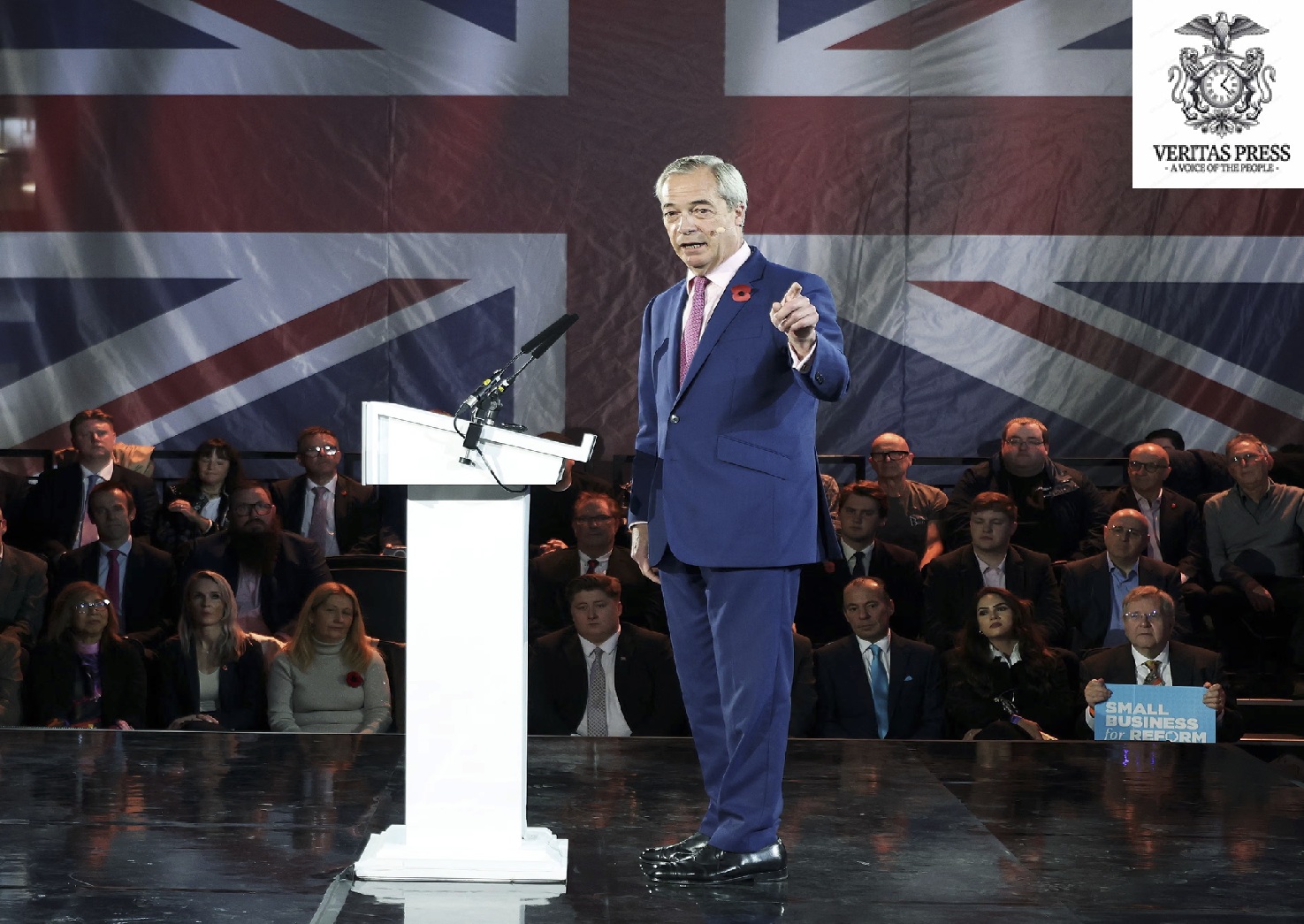
LONDON, 6 MAY 2026 – When Nigel Farage walked through the door of 10 Downing Street a year ago this week, his first act was to promise “the biggest return of illegal migrants this country has ever seen”. Twelve months on, the consequences of that pledge, and the policies now cascading from it, are being measured not just in deportation numbers, but in hospital wards stripped of staff, university budgets slashed, investment decision letters sent from Tokyo to Berlin cancelling UK projects, and a creeping sense among many minority Britons that, for all their born-and-bred belonging, they may no longer have a future here.
What was forecast in these pages and by economists across the spectrum as a significant risk to the UK economy has rapidly materialised into a multi-front destabilisation. Combined with Reform UK’s weaponisation of visa powers over slavery reparations and its openly punitive siting of migrant detention centres, the government’s agenda has replaced all ordered debate about net migration with something altogether more destructive: a climate of fear, an instrument of political reward and punishment, and a direct hit to the country’s growth potential.
The Triple Threat: Deportation, Detention, And Visa Blackmail.
The architecture of Reform’s immigration policy rests on three pillars, each sharpened in the run-up to the May 2025 election and now being implemented with the speed of a party eager to prove its radical credentials.
Pillar one is mass deportation. Zia Yusuf, now Spokesperson for Home Affairs, quantified the ambition during the campaign: detention centres capable of holding 24,000 people at any one time, with an eventual removals target that the party’s own statements suggest could affect at least two million individuals, a figure far exceeding earlier talk of deporting 600,000. The goal, Yusuf said repeatedly, was “democratic consent” through the expulsion of all illegal migrants, and a sharp reduction in legal migration.
Pillar two is the deliberate geographical punishment embedded in that detention infrastructure. In a now-notorious social media post from March 2025, Yusuf promised: “A Reform government will not put any migrant detention facilities in any constituency with a Reform MP. Nor will we put them where Reform controls the council. And of the remaining areas, we will prioritise Green-controlled parliamentary constituencies and Green-controlled councils.” He added the slogan “Vote Green, Get Illegals”. The policy, unprecedented in modern British political history, explicitly uses state infrastructure to reward electoral allies and penalise opponents – a move that Simon Clarke, the Conservative former business secretary, called at the time “abhorrent” and “an appalling waste of public money” likely to be struck down in court.
Pillar three, outlined just weeks before polling day, ties British visa policy to a global culture war: a blanket ban on new visas for citizens of any country that makes a formal demand for reparations over the transatlantic slave trade. “From this point forward, should any country formally demand reparations from the United Kingdom, a Reform government will respond immediately. We will halt the issuance of all new visas to its nationals,” Yusuf wrote in the Telegraph. The measure, he said, was a response to what he termed “insulting” demands from Jamaica, Nigeria, Ghana and others. “Instead of gratitude for leading the world out of that dark chapter, we are met with demands for more cash.”
All three pillars are now live. The Home Office confirmed last month that, following formal reparations claims submitted by Nigeria, Jamaica, and Trinidad and Tobago through the African Union-Caricom joint mechanism, visa issuance to those countries has been suspended “pending review”. “Review” in practice means an immediate stop: last year Nigerians alone received 156,913 UK visas. The halt affects everyone from Nigerian nurses recruited by NHS trusts to the family members of British citizens, students paying £20,000-a-year in international fees, and even cultural figures – the Caribbean leg, should Rihanna wish to perform in London, now hinges on political clearance.
The Exodus Begins, And The NHS Feels It First:
“I have been here eighteen years,” says Dr Amara Obi, a consultant nephrologist at a major Birmingham hospital whose parents came from Enugu. “I trained here, my children were born here. But last month, after a patient told me to ‘go home’ and the trust said it could not guarantee my long-term status if the Home Office changed the rules again, my husband and I started looking at positions in Canada. Many of my colleagues are doing the same. It is heartbreaking.”
Data backs up the anecdotal dread. The Royal College of Nursing (RCN) released survey results last week showing that 43% of its members born outside the UK are “actively pursuing” employment abroad, up from 12% in 2024. The General Medical Council recorded a 67% year-on-year increase in applications for certificates of good standing – the document needed to practise medicine overseas – from Black and minority ethnic doctors. One NHS trust CEO in the East Midlands, speaking on condition of anonymity, said: “We are haemorrhaging talent. The government talks about bringing down waiting lists, but every nurse that leaves pushes the list longer. Recruitment from overseas has collapsed – not because we aren’t trying, but because the visa system is now a tool of foreign policy punishment.”
The Home Office’s own numbers are stark. In the year to March 2026, the number of Health and Care Worker visas granted to non-UK nationals fell 58% compared with the previous twelve months. The specific visa suspension for reparations-claimant countries wiped out the Nigerian pipeline overnight; in 2025, Nigerians had been granted 30,204 sponsored study visas, many of which fed into healthcare courses. “We’ve gone from a managed, predictable taper to a cold-turkey cut-off,” says Prof Helen Drake, a migration economist at the University of Oxford. “That kind of shock propagates across the whole labour market. Social care providers are already failing. In some boroughs, the ratio of care workers to clients has halved since the election.”
The government’s answer – that the UK should train its own nurses and end “dependency” on foreign labour – ignores the decade-long lead times required to produce a fully qualified consultant. As NHS waiting lists in England edge again toward 8 million, the financial watchdog, the Office for Budget Responsibility (OBR), warned in its March 2026 forecast that “labour supply constraints emanating from tighter migration policy” lopped 0.4 percentage points off potential GDP growth, while simultaneously adding to inflation through wage pressures in public services.
The Wider Economy: Investment, Universities, And Property.
The chill extends well beyond healthcare. When the economist who first sounded the alarm in this newspaper a year ago described the likely impact of Reform UK policies as “akin to the large, adverse impact on the Ugandan economy of the forced expulsions by Idi Amin in the early 1970s”, some dismissed it as hyperbole. Fewer are dismissive now.
Corporate decision-makers in Tokyo, Mumbai, and New York are absorbing the signal. “When a British Home Secretary announces that which countries get visas depends on whether they make historical claims against Britain, the message to a Japanese executive is: the rules are arbitrary and political,” says Rahul Mehta, head of European operations for a major Indian IT services firm that had planned a 500-person UK expansion. “Last month our board froze that investment. We are looking at Poland instead. Why would we locate key staff in a place where their ability to stay could suddenly vanish because of a diplomatic row they had nothing to do with?”
Foreign direct investment announcements in the first quarter of 2026 fell by 28% compared with the same period in 2024, according to the Department for Business and Trade’s own data, with the professional services, tech, and higher education sectors hardest hit. The London property market, long seen as a safe harbour for global capital, has seen prime central London transaction volumes drop by a third. Estate agent Savills says some international buyers are now asking for clauses that allow them to exit if visa rules change, something unheard of before 2025.
British universities, which collectively earn roughly £20bn annually from international students, are in open crisis. The suspension of visas for Nigerian applicants alone, combined with the broader hostile environment rhetoric, has triggered a collapse in deposits from Africa and the Caribbean. Universities UK estimates the sector could lose £3.5bn in fee income next academic year. Vice-chancellors are already drawing up plans for redundancies. “This is a self-inflicted severing of the UK’s intellectual and cultural links with entire continents,” complains Prof David Eastwood, vice-chancellor of a Russell Group university. “The damage will take a generation to repair, if it can be repaired at all.”
Tourism, too, is feeling the squeeze. VisitBritain reported a 15% drop in forward flight bookings from the Caribbean and West Africa for summer 2026, and a distinct cooling of interest from the African diaspora in North America. “We have seen entire charter flights cancelled,” says a spokesperson for the Barbados-based tourism association. “The message is simple: if you treat our citizens as political pawns, our people will spend their money elsewhere.”
Detention Centres As Political Reward, The Backlash Grows:
Perhaps no policy symbolises the new government’s approach more graphically than the detention centre siting strategy. In February, the Home Office confirmed the first three sites under the programme: one on the edge of Brighton Pavilion, Britain’s only Green-held parliamentary constituency; another in Lancaster, where the Greens control the city council; and a third near Stroud, a Green-run district. Tenders for construction were fast-tracked, bypassing local planning vetoes under new emergency powers.
The reaction on the ground has been furious. Mothin Ali, the Green Party co-deputy leader, told a rally in Brighton last month: “This is not governance, it is thuggery. Reform is punishing communities that dared to vote for a different vision of Britain. They are using human suffering as a political weapon.” Outside the planned Lancaster site, a permanent vigil has been mounted by a coalition of church leaders, trade unionists, and local residents waving banners reading “Not in Our Name”. The bishop of Lancaster, Rt Rev Jill Duff, said: “To place a large detention facility not on grounds of operational suitability, but explicitly to cause hurt to a local population who voted Green, is morally repellent.”
Legal challenges are preparing to climb through the courts. A cross-party group of MPs, including the Conservative Kemi Badenoch, who last year denounced the plan as “abhorrent” and an “abuse of ministerial power”, has signed a motion declaring the siting process a breach of the equality duty and an action ultra vires. “This is a blatant attempt to politicise the civil service and punish democratic expression,” Badenoch said on Wednesday. “Even if one agrees with strong immigration controls, the method is corrupting our constitutional norms.”
Even former Reform figures have expressed unease. But Yusuf has been unrepentant. “We were absolutely clear with the British people,” he told the House of Commons last week. “If you vote Green, you get illegals. Democratic consent is the foundation of this policy. The old parties gave you open borders and then placed all the costs on working-class communities. We are restoring accountability. Your vote has consequences.”
Markets, Gilt Yields, And The Ghost Of Truss:
Financial markets have not missed a beat. The yield on 10-year UK government bonds, the benchmark for public borrowing and corporate loans, has risen by 0.8 percentage points since May 2025 to levels not sustained since the depth of the 2022 sovereign debt panic. Analysts point to a toxic combination: the inflationary impulse of labour shortages, the fiscal drain of a larger detention and deportation apparatus, and, critically, a sharp loss of institutional credibility. “Investors are repricing UK-specific political risk,” explains a senior fixed-income strategist at a major City investment bank. “When the Home Secretary begins selective visa bans and openly runs detention policy on a spoils system, you question how far other branches of the state will be politicised. The OBR? The Bank of England? We remember that Farage called the Truss budget ‘the best Conservative budget since 1986’. The markets are demanding a premium for that memory.”
Chancellor Robert Jenrick has repeated his pledge that the OBR will remain independent, and Downing Street insiders insist the Prime Minister is “in lockstep” with the fiscal orthodoxy. But the early evidence is mixed. In March’s spring statement, the government wrote off the shortfall from collapsing visa fee revenues as “a temporary recalibration”, but refused to publish internal forecasts of the deportation programme’s net costs. The OBR itself noted with unusual sharpness that “provided information on the fiscal consequences of immigration policy remains incomplete, projections will be subject to greater uncertainty”.
A Road Not Taken: The Electoral Reform What-If?
Embedded in the economic diagnosis offered a year ago was a political observation that now reads like the wisdom after the event. The article noted that moving away from the first-past-the-post system to proportional representation “might provide UK businesses confidence that the broad policy thrust will remain unchanged over the medium term and thereby increase growth”. Reform UK won a clear majority on 38% of the vote in 2025, a distortion that allowed a sudden, radical rupture with the previous order. Under a proportional system, Reform would have had to negotiate with other parties, moderating its most dislocating instincts. Businesses, universities, and international partners would have seen stability, not a cliff-edge.
“This is exactly the sort of policy volatility that my colleague and I warned about,” says Prof Stephen Nickell of Oxford, whose work on the UK’s post-2008 productivity collapse identified Brexit, high energy prices, tax complexity, and the difficulty of building anything as headwinds, now compounded by the immigration shock. “Public investment has been re-channelled to detention centres, regulation is being rewritten at speed, and the government is picking fights with the very countries we need as trading partners. Accelerating growth is impossible when every quarter brings a new storm.”
The government, for its part, has largely abandoned the language of growth in favour of “sovereignty” and “cultural restoration”. Its much-trumpeted pivot to Europe, attempting to smooth trade frictions as a way to lift OBR forecasts, is hampered by the spectacle of the UK threatening visa reprisals against Commonwealth allies. “You can’t seek warmer relations in Brussels while cold-shouldering the entire African Union,” a European diplomat noted drily. “It’s not a serious posture.”
The View From The Front Line:
In Lewisham, south London, the Nigerian community centre is unusually busy on a Tuesday afternoon. Retired engineers, church pastors, and market traders sit in a circle, discussing dual nationalities, citizenship applications, and routes to Canada, Sierra Leone, and the Republic of Ireland. “My son wants to go to university this autumn, to study law,” says Grace Okonkwo, a British citizen who arrived as a student thirty years ago. “He was born in London. But he is so frightened – he hears the Prime Minister say that even people born here could be in danger if their parents came illegally at any point. It is madness. Now he says he will study in Ontario and never come back. All that potential, gone. I weep for this country.”
A mile away, at a home care agency, the owner, Mike Foster, has three cases unfilled. “All my experienced carers from Ghana and Nigeria are either gone or making plans. Some have been here fifteen years, have indefinite leave to remain, but they don’t feel safe. When the Home Office suspends all visas for their country, they think: who’s next? Their children ask: are we British or are we just tolerated? I had to turn away a 96-year-old woman with dementia this morning because I had nobody to send. She’s on her own. That’s the real-world consequence of a policy designed for headlines.”
The Open Questions:
The scale of the ongoing disruption is now the subject of urgent, quiet conversations in Whitehall, in the City, and in diplomatic missions. Former cabinet secretaries, speaking privately, warn that the politicisation of the immigration system risks hollowing out the civil service’s impartiality; several senior Home Office officials have already taken early retirement or moved to the private sector, replaced by external appointees with Reform affiliations. “You’re losing institutional memory at the very moment policy is most volatile,” says Lord Jonathan Evans, a former head of MI5 and now a crossbench peer. “That creates blind spots that any hostile actor could exploit.”
Meanwhile, the reparations row is opening a fissure in the Commonwealth. At a Commonwealth heads of government meeting in Kigali last month, several Caribbean leaders walked out of a session on migration, calling the UK’s visa suspension “neo-imperial coercion”. The Prime Minister of Barbados, speaking to the Guardian, said: “Britain once enslaved our people, then compensated the slave owners and not the enslaved. Now it threatens us with travel bans for asking for a conversation. What moral authority does such a government have?” The diplomatic rift complicates future trade negotiations and military cooperation at a time when strategic competition is intense.
A Decade To Mend:
The economist who originally framed the comparison, Uganda under Amin, driven to collapse by the violent expulsion of its Asian minority, versus the gradualist, ordered reduction in Kenya, has since updated the model. “I initially thought a Reform government would be like Kenya if we were lucky, but the evidence of the past twelve months points squarely to the Amin scenario,” he said this week, requesting anonymity given the sensitivity of government relations. “The exodus is not a million people in ninety days, but it is large enough to destabilise specific sectors completely. The climate of fear is real. Children are being withdrawn from schools, house purchases are stalled, entire family networks are cutting their ties. That is the macroeconomic story: you lose not just workers, but consumers, investors, and taxpayers. The fiscal hole widens, the incentive to invest collapses, and what was a slow-burn fall in GDP becomes a self-reinforcing spiral.”
Pulling out of that spiral, he suggested, will take at least a decade of policy stability and an explicit, cross-party commitment to rebuilding institutional trust. That, in turn, may require electoral reform of the very kind that could have prevented the current crisis. “The experience of 2025-2026 should be taught in constitutional textbooks for a hundred years: when you combine a winner-takes-all electoral system with populist pledges to punish opponents via state power, you are laying the foundations of a disaster.”
A Closing Note:
Back in Brighton, outside the half-built detention centre, the evening vigil hums with shared flasks of tea and acoustic guitars. A large digital screen displays a live counter, claiming to count nurses who have left the NHS since the election: today the number passed 15,000. A retired social worker, wearing a Green rosette, told us: “Zia Yusuf says ‘Vote Green, Get Illegals’. I say: Vote Reform, lose your doctor, your carer, your child’s university, your status in the world. It turns out the illegals were never the problem. The problem was politicians who saw division as a strategy. Now we are all paying the price.”
And in the gilt market, the closing yield ticked up another two basis points.
Source: Multiple News Agencies
Submissions:
For The Secure Submission Of Documentation, Testimonies, Or Exclusive Investigative Reports From Any Global Location, Please Utilise The Following Contact Details For Our Investigations Desk: enquiries@veritaspress.co.uk or editor@veritaspress.co.uk
Help Support Our Work:
Popular Information is powered by readers who believe that truth still matters. When just a few more people step up to support this work, it means more lies exposed, more corruption uncovered, and more accountability where it’s long overdue.
Help Protect Independent Journalism, Which Is Currently Under Attack.
If you believe journalism should serve the public, not the powerful, and you’re in a position to help, becoming a DONATOR or a PAID SUBSCRIBER truly makes a difference.
DONATION APPEAL: If You Found This Reporting Valuable, Please Consider Supporting Independent Journalism.
Help Support Our Work – We Know, We Know, We Know …
Seeing these messages is annoying. We know that. (Imagine what it’s like writing them … )
Your support fuels our fearless, truth-driven journalism. In unity, we endeavour to amplify marginalised voices and champion justice, irrespective of geographical location.
But it’s also extremely important. One of Veritas Press’s greatest assets is its reader-funded model.
1. Reader funding means we can cover what we like. We’re not beholden to the political whims of a billionaire owner. We are a small, independent and impartial organisation. No one can tell us what not to say or what not to report.
2. Reader funding means we don’t have to chase clicks and traffic. We’re not desperately seeking your attention for its own sake: we pursue the stories that our editorial team deems important and believe are worthy of your time.
3. Reader Funding: enables us to keep our website and other social media channels open, allowing as many people as possible to access quality journalism from around the world, particularly those in places where the free press is under threat.
We know not everyone can afford to pay for news, but if you’ve been meaning to support us, now’s the time.
Your donation goes a long way. It helps us:
- Keep the lights on and sustain our day-to-day operations
- Hire new, talented independent reporters
- Launch real-time live debates, community-focused shows, and on-the-ground reporting
- Cover the issues that matter most to our communities, in real time, with depth and integrity
We have plans to expand our work, but we can’t do it without your support. Every contribution, no matter the size, helps us stay independent and build a truly people-powered media platform.
If you believe in journalism that informs, empowers, and reflects the communities we serve, please donate today.
GENEVA — A United Nations fact-finding mission has concluded there are “reasonable grounds to believe”

Iran’s GDP is projected to contract by 5.4 to 6.1% in 2026, its worst performance

The Trump administration is preparing a $2.8 billion weapons package for Israel containing 40,000 2,000-pound

Film alleges mass civilian deaths are routinely built into military decisions amid Israel’s genocidal war

The Israeli rights group says violence, displacement, economic strangulation, and settlement expansion form part of

Houthi forces have captured the historic Red Sea port of Mocha and are advancing on
London’s historic sanctions against Israeli settlements mark a watershed moment in UK foreign policy, but
With 95% of Gaza’s population now wholly dependent on aid and more than 90% stripped
India calls for Kashmir and Ladakh to appear only on its official map after a
ISLAMABAD – In the high-stakes political theatre of Pakistan, the battleground has shifted from the