





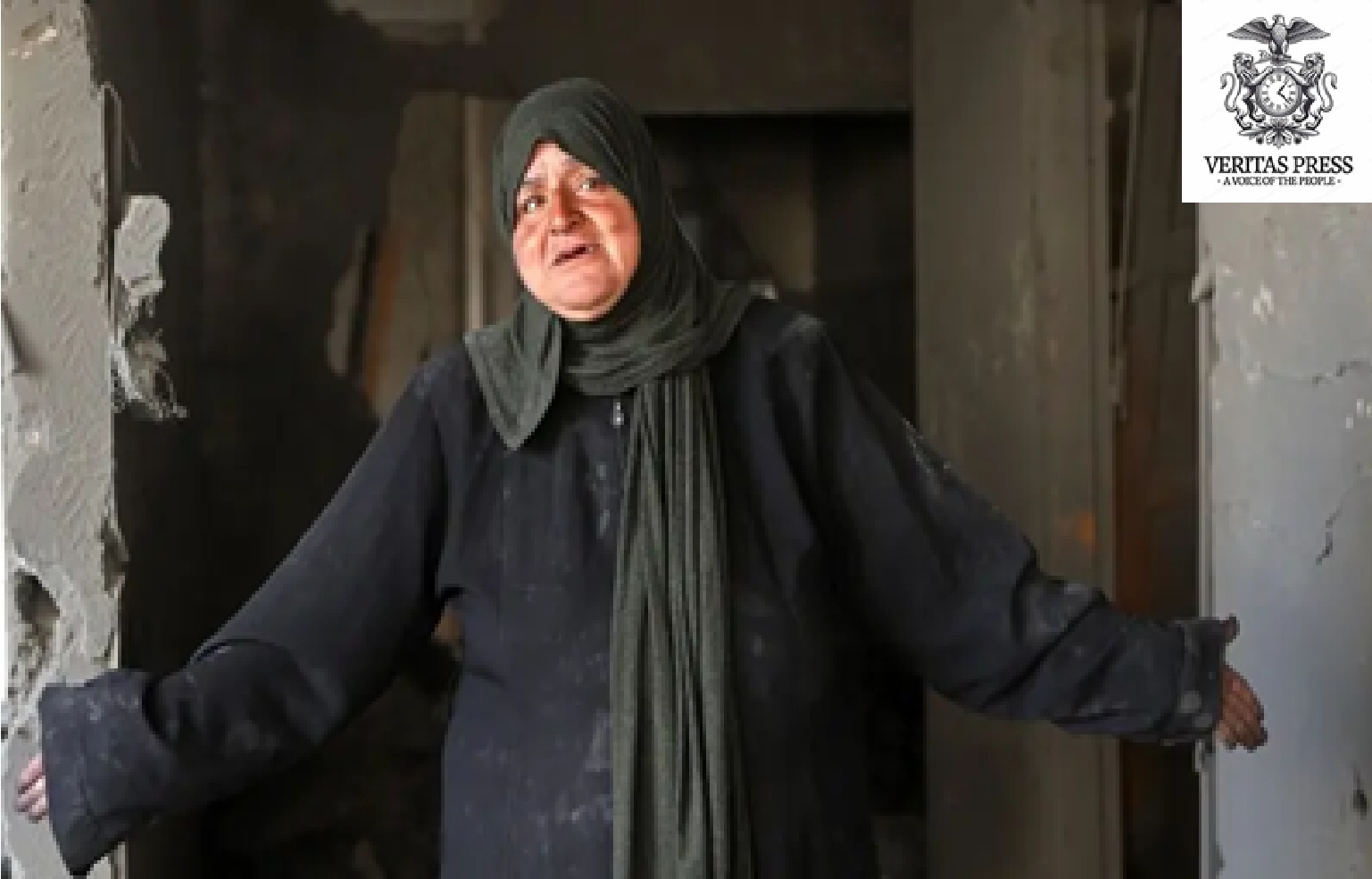

Help support our mission, donate today and be the change. Every contribution goes directly toward driving real impact for the cause we believe in.
NABLUS, OCCUPIED WEST BANK — Under the concrete bleachers of Nablus city stadium, in a converted changing room that smells of damp and detergent, a dozen men from Gaza have carved out a life in limbo. More than two and a half years since the Hamas-led attack of October 7, 2023, triggered a war that has shattered their homeland, they remain stranded in the West Bank, forbidden from returning, unable to bring their families, and haunted by the question of what, if anything, remains of home.
Sameer Abu Salah, 54, smooths a hand over a tiny dresser he built from scavenged cardboard boxes. On the wall above it hang Palestinian flags and a faded portrait of Yasser Arafat he found discarded on a street sweep. “I entered Israel only four days before the war,” he says, recalling the work permit that allowed him to take odd jobs in Tel Aviv, where wages dwarfed those in his native Khan Yunis. “I was respected and honoured. Then the war happened.” He gestures around the cramped space he now shares with other displaced men. “Look at me now, I live in a tent. We used to live with dignity, while here we’ve been thrown aside like dogs.”
Abu Salah’s fall from working-class respectability to subsisting on recycled scrap is not unique. All across the central and northern West Bank, several thousand Gazans are trapped in a legal and humanitarian no-man ’s-land, severed from their families and from a homeland that has been largely reduced to rubble. The Palestinian Authority’s labour ministry said in March 2026 that it had provided emergency cash assistance to 4,605 stranded Gazans, but the real number is likely higher, as many live in the shadows, terrified that any contact with officialdom could lead to arrest or deportation.
A War That Never Ended For The Displaced:
The latest war in Gaza ended, or paused, with a US-brokered ceasefire in October 2025, but for the men under the bleachers, the conflict never really stopped. Israel still controls roughly half of the Gaza Strip, and according to United Nations monitors, Israeli forces have killed at least 846 Palestinians since the truce began. The ceasefire has not brought reconstruction, nor has it allowed the displaced to return to what the UN says is a landscape where 81% of structures are destroyed. Unemployment inside Gaza stands at 80%, and prices for basic goods have soared, partly due to severe Israeli restrictions on truck entries.
“This place is boring, but what can we do? We’re in a jail,” says Sameh, a father who asked that his last name not be used for fear of retribution. He arrived in the West Bank just ten days before the war, seeking medical care for his son that was unavailable in blockaded Gaza. The son went back; Sameh stayed, hoping to earn money to support his family. Now he sleeps behind a sheet hung from a rope, a deliberate echo of the tent camps that have become the default shelter for Gaza’s internally displaced. “To live like my family,” he says softly. He, like all the men AFP spoke to, has lost his home in an airstrike. He carries on his phone videos of a house that once stood, and images of the pile of grey debris that marks its grave.
Nahed al-Hilou, 43, was luckier in timing but equally severed from his old life. A businessman from Gaza City’s affluent Rimal neighbourhood, he left the Strip two days before October 7 on a permit to import goods. He had a restaurant employing thirty people. When the war made a return impossible, he found his way to Ramallah and opened a downtown falafel shop. “I turned to what I know: my work, my profession, something I love,” he says, ladling Gaza-style spicy hummus. He now employs nine workers, all Gazans, and sends money to his family, who, by a miracle, survived. Yet the separation corrodes him. “We spent 20 days not knowing anything about them,” he says. When asked about going back, he dismisses the idea with a weary wave. “Of course, Gaza is dearer than here, but there, there is no home left, nothing.”
Permits, Checkpoints And The Threat Of Forcible Return:
The men under the stadium are perpetually afraid. Leaving Nablus’s municipal boundaries is technically tolerated by the PA, but they know the roads are dotted with Israeli military checkpoints. Several friends who ventured out, they say, were stopped, detained and sent back to Gaza, effectively a forced transfer into an active war zone and humanitarian disaster zone. “They were sent back to the hell we escaped,” says Abu Salah. “And for what? Because they tried to find work?”
International humanitarian law is unambiguous: the forcible transfer of protected persons from occupied territory is a grave breach of the Fourth Geneva Convention. Human rights organisations have long argued that Israel’s policy of revoking permits for Gazans and forcing them back to a devastated Gaza amounts to collective punishment and, in many cases, refoulement. “Sending these individuals to a place where they face serious threats to life and where structures are uninhabitable is a clear violation,” said Jessica Montell, director of the Israeli human rights group HaMoked, which has petitioned courts on behalf of stranded Gazans. “Israel is using its permit regime as a weapon of displacement.”
The Israeli military’s Coordination of Government Activities in the Territories (COGAT) did not respond to a request for comment on the status of Gazans in the West Bank. In previous statements, it has insisted that all entry permits were revoked for security reasons after October 7 and that individuals present illegally are subject to enforcement. Israeli officials have also argued that the ceasefire framework does not obligate them to allow the stranded to remain in the West Bank, a territory they have increasingly treated as a separate administrative zone.
In April 2026, international concern spiked after Israeli forces conducted a sweep in the Nablus area, arresting at least 15 Gazans and deporting seven through the Erez crossing. The UN Office for the Coordination of Humanitarian Affairs (OCHA) confirmed the operation, warning that “forcible transfer of Palestinians from the West Bank to Gaza may amount to a war crime.” UNRWA spokesperson Juliette Touma stated: “These men, women and children are protected persons. Forcing them back to a place where there is no housing, no functioning health system, and ongoing military operations would compound an already catastrophic humanitarian situation.”
The PA’s Paralysis And The Shadow Of Annexation:
The Palestinian Authority, itself teetering on the edge of financial collapse, has been unable to offer more than modest cash handouts, equivalent to a few hundred dollars per person, and occasional shelter referrals. “We are doing everything we can with empty pockets,” said Nasri Abu Jaish, the PA labour minister, in an interview. “Our budget has been gutted by Israel’s withholding of tax revenues, and international aid is not enough to cover the needs of our own West Bank population, let alone those stranded from Gaza. The world must pressure Israel to allow these people to reunite with their families, whether here or in Gaza, but with dignity and safety.”
Yet the political horizon offers little hope. Israel’s current government, the most right-wing in the country’s history, has accelerated settlement expansion and openly speaks of the formal annexation of large parts of the West Bank. In a May 2026 cabinet meeting, Finance Minister Bezalel Smotrich reiterated that “there will be no return of Gazan workers to Israel or to Judea and Samaria, they are a security threat.” The message is clear: the stranded Gazans are to be erased from the demographic equation, permanently separated from both the West Bank and any future Palestinian entity.
For Shahdeh Zaarb, 45, the contradiction is embodied in his own ID card. Originally from Beit Lahia in northern Gaza, known before the war for its strawberry fields, he holds West Bank residency thanks to two decades of working in the territory. He has managed to open a small farm in Qalqilya, cultivating produce that reminds him of home. Yet the residency that shields him from deportation cannot bridge the family divide. “My children are in one place, I’m in another, and I can’t bring them here because of the crossings,” he says. His wife’s Gaza ID means she is barred from entering the West Bank. “They prevent her from leaving because her identity is registered as being from Gaza.” He hasn’t embraced his children since 2021.
Living On The Margins, Looking Toward A Vanished Home:
The paradox of the stranded Gazans is that they are simultaneously inside Palestine and utterly foreign. In Nablus, municipal authorities have tacitly accepted the men in the stadium, but they are not integrated; they are charity cases lodged out of sight. Abu Salah, obsessed with cleanliness, sweeps his tiny patch meticulously, trying to hold onto a shred of the dignity he remembers. The care he takes in arranging his cardboard dresser, his flags and his Arafat portrait is a small act of defiance against the indignity of displacement. “I want to show that I am still human,” he says.
The war’s ripples have also transformed Ramallah’s food scene. Al-Hilou’s falafel joint, “Rimal Flavours,” has become a sort of culinary embassy of loss, staffed entirely by Gazans who serve the spicy, dill-laden recipes of the coast to West Bankers who may never have tasted authentic Gaza cuisine. “We bring a piece of Gaza here,” Al-Hilou says. “But it’s a piece that is disappearing.” He scrolls through photos on his phone: a bustling restaurant with tiled floors, now pancaked into a grey smear. “81% of structures destroyed,” he repeats, as if the number is a mantra he still cannot believe.
The UN’s latest report, released in late April 2026, paints an even grimmer picture: beyond the physical destruction, Gaza’s economy has contracted to less than a sixth of its pre-war size. The blockade, tightened during the war, has barely eased under the ceasefire. “The deliberate stifling of Gaza’s economy has created a situation of de-development that will take generations to reverse,” said the UN Conference on Trade and Development (UNCTAD) in a statement. For those stuck in the West Bank, the report’s finding that “there is no home left” is not a metaphor; it is a documentary reality backed by satellite imagery and death tolls.
A Test For International Justice:
Legal experts argue that the plight of the stranded Gazans encapsulates the larger failure of the international community to enforce accountability. The International Criminal Court (ICC) is currently investigating alleged war crimes committed by both Israeli forces and Palestinian armed groups during the 2023-2025 war. In March 2026, the ICC prosecutor issued a statement indicating that investigations now covered “the forced displacement of Gazans from the West Bank and the continued denial of their right to return.” The International Court of Justice (ICJ) has separately ruled that Israel’s occupation of Palestinian territories is unlawful and must end, but its advisory opinion lacks an enforcement mechanism.
“Without pressure, these individual tragedies will be replicated thousands of times over,” said Shawan Jabarin, general director of the Palestinian human rights organisation Al-Haq. “Israel is not just waging a military campaign; it is redesigning the demographic map of the entire territory. The stranded are the canary in the coal mine.”
Abu Salah, for his part, has stopped hoping for international intervention. He earns about 20 shekels a day recycling plastic and metal, a fraction of the 400 shekels he once made in Tel Aviv. Two of his sons were killed in airstrikes; he learned of their deaths from a WhatsApp message while sitting in this very changing room. “I cried, and then I went out to collect cans,” he recalls, his voice flat. “What else could I do?” He sends whatever he can to his surviving family via money transfer services that still operate intermittently.
“Maybe one day I will see them again,” Abu Salah says, looking at the picture of Arafat on the wall, the man who promised a state and died without one. “But return to Gaza? To what? There is no home left.” Outside the stadium, the sun sets over the hills of Nablus, and the men of the bleachers prepare another night in a country that is theirs, but whose borders, drawn by checkpoints, permits and war, keep them forever at arm’s length from the ruins that wait for them.
Source: Multiple News Agencies
Submissions:
For The Secure Submission Of Documentation, Testimonies, Or Exclusive Investigative Reports From Any Global Location, Please Utilise The Following Contact Details For Our Investigations Desk: enquiries@veritaspress.co.uk or editor@veritaspress.co.uk
Help Support Our Work:
Popular Information is powered by readers who believe that truth still matters. When just a few more people step up to support this work, it means more lies exposed, more corruption uncovered, and more accountability where it’s long overdue.
Help Protect Independent Journalism, Which Is Currently Under Attack.
If you believe journalism should serve the public, not the powerful, and you’re in a position to help, becoming a DONATOR or a PAID SUBSCRIBER truly makes a difference.
DONATION APPEAL: If You Found This Reporting Valuable, Please Consider Supporting Independent Journalism.
Help Support Our Work – We Know, We Know, We Know …
Seeing these messages is annoying. We know that. (Imagine what it’s like writing them … )
Your support fuels our fearless, truth-driven journalism. In unity, we endeavour to amplify marginalised voices and champion justice, irrespective of geographical location.
But it’s also extremely important. One of Veritas Press’s greatest assets is its reader-funded model.
1. Reader funding means we can cover what we like. We’re not beholden to the political whims of a billionaire owner. We are a small, independent and impartial organisation. No one can tell us what not to say or what not to report.
2. Reader funding means we don’t have to chase clicks and traffic. We’re not desperately seeking your attention for its own sake: we pursue the stories that our editorial team deems important and believe are worthy of your time.
3. Reader Funding: enables us to keep our website and other social media channels open, allowing as many people as possible to access quality journalism from around the world, particularly those in places where the free press is under threat.
We know not everyone can afford to pay for news, but if you’ve been meaning to support us, now’s the time.
Your donation goes a long way. It helps us:
- Keep the lights on and sustain our day-to-day operations
- Hire new, talented independent reporters
- Launch real-time live debates, community-focused shows, and on-the-ground reporting
- Cover the issues that matter most to our communities, in real time, with depth and integrity
We have plans to expand our work, but we can’t do it without your support. Every contribution, no matter the size, helps us stay independent and build a truly people-powered media platform.
If you believe in journalism that informs, empowers, and reflects the communities we serve, please donate today.
Donate Today.
GENEVA — A United Nations fact-finding mission has concluded there are “reasonable grounds to believe”
Iran’s GDP is projected to contract by 5.4 to 6.1% in 2026, its worst performance

The Trump administration is preparing a $2.8 billion weapons package for Israel containing 40,000 2,000-pound

Film alleges mass civilian deaths are routinely built into military decisions amid Israel’s genocidal war
The Israeli rights group says violence, displacement, economic strangulation, and settlement expansion form part of

Houthi forces have captured the historic Red Sea port of Mocha and are advancing on

London’s historic sanctions against Israeli settlements mark a watershed moment in UK foreign policy, but
With 95% of Gaza’s population now wholly dependent on aid and more than 90% stripped
India calls for Kashmir and Ladakh to appear only on its official map after a
ISLAMABAD – In the high-stakes political theatre of Pakistan, the battleground has shifted from the