






Author:
Byline: Investigative Desk
Help support our mission, donate today and be the change. Every contribution goes directly toward driving real impact for the cause we believe in.
As Iran locks down the Strait of Hormuz and its Houthi allies turn the Bab el‑Mandeb into a no‑go zone, an audacious three-party blueprint is taking shape: a $5 billion Omani refinery and export hub beyond Tehran’s reach, a revived India–Middle East–Europe rail corridor, and a clandestine Saudi‑to‑Israel pipeline built on the buried secrets of a Cold War deal with the Shah. But there is a fourth prong, less discussed yet no less transformational: a planned Leviathan gas pipeline that would funnel Israeli hydrocarbons directly to Europe via Turkey, starving Egypt of transit revenues and cementing Israel’s role as the region’s indispensable energy hub. This investigation reveals the U.S.‑ led gamble to weaponise infrastructure, redraw the energy map, and force a reckoning, while risking a wider war that could consume the very chokepoints it hopes to bypass.
The world’s two most critical oil arteries are in an iron grip. Since the U.S.–Israeli “Operation Epic Fury” strikes on 28 February, Iran has transformed decades of bluster into hard reality: the Strait of Hormuz is effectively closed to unsanctioned traffic, and the Bab el-Mandeb is a shooting gallery policed by Tehran’s Houthi allies. Tanker captains now speak of the Persian Gulf as a “trapped lake,” while spot Brent crude has lurched above $140 a barrel for the sixth month running. But behind the market chaos, a web of emergency plans is taking shape, schemes that would redraw the energy map of the Middle East, entangle old enemies in shared infrastructure, and, if they ever work, strip Iran of its most potent geopolitical weapon.
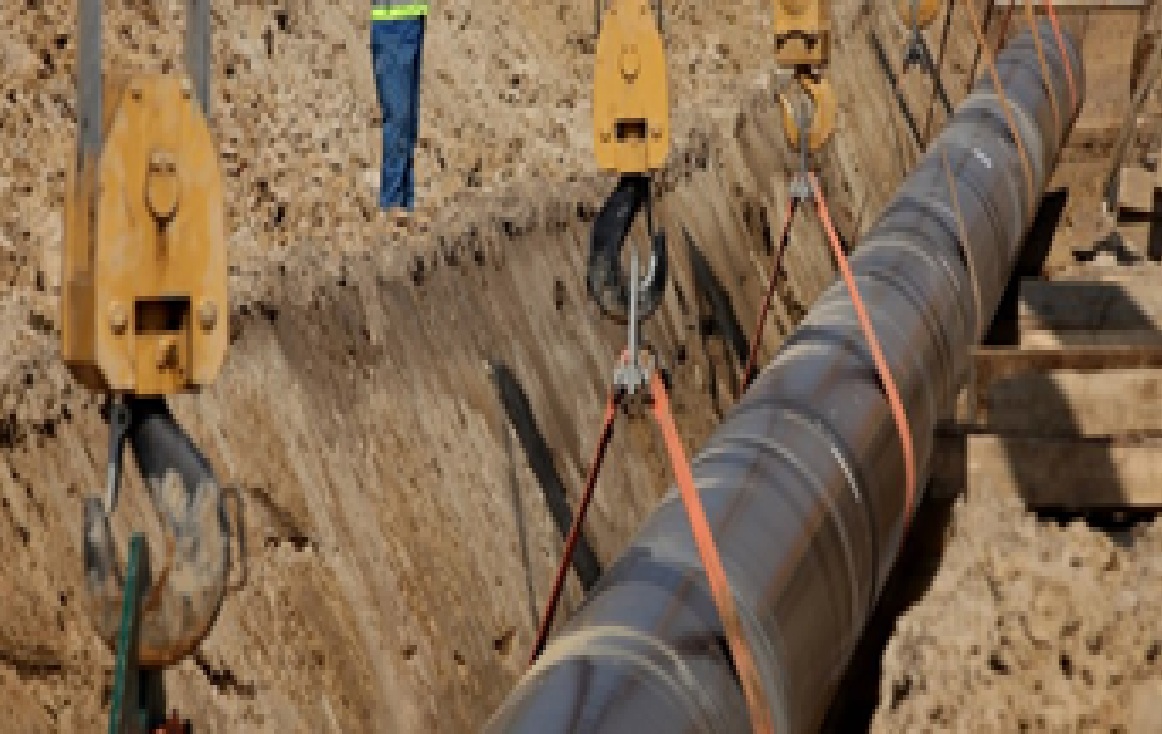
This investigation, based on interviews with officials, analysts, activists and leaked planning documents, reveals the contours of a three-part strategy: a $5-billion “Hormuz-bypass” refinery and export hub now homing in on Oman; an ambitious overland rail corridor linking India to Europe via Israel; and the most explosive idea of all, a Saudi-to-Israel pipeline that would pump Gulf crude straight to the Mediterranean, using an almost forgotten piece of Cold War infrastructure built in secret by Israel and the Shah of Iran. Together they amount to an unprecedented attempt to cut the Islamic Republic out of global energy flows. The question is whether any of it can survive the region’s politics, missiles, and history.
The Chokepoint Conundrum:
On a scorching July afternoon at the Fujairah bunkering terminal, a Greek supertanker master, Captain Michalis, watched empty berths and shook his head. “Three months ago we’d queue for a pilot. Now, nothing. Owners won’t risk the Strait unless they have a full Iranian navy escort, and that comes with a price: literally, an Iranian official takes a cut. The alternative is to sit here and wait for a miracle.” His ship, the Aegean Glory, has been idling off the UAE coast for 47 days, burning $20,000 a day in holding costs.
Before February, over 20 million barrels of crude and products passed through Hormuz daily. Tehran’s closure, backed by swarms of fast-attack craft, coastal missile batteries, and mines, has slashed that figure by an estimated 70%, according to tracking data from Vortexa. The Bab el-Mandeb, the narrow gate between Yemen and Djibouti, is no safer. Houthi drones and anti-ship missiles have hit at least nine tankers in 2026 alone, including a Saudi-flagged VLCC that limped into Aden with a gaping hole at the waterline. “We are witnessing the first sustained, simultaneous denial of both major Middle Eastern chokepoints in modern history,” says Dr. Sara Vakhshouri, president of SVB Energy International. “Iran has operationalised what it always threatened.”
The White House’s immediate response, a surge of carrier strike groups and a flurry of sabre-rattling, has done little to reopen the waterways. Instead, it has accelerated a parallel track: using American capital, Saudi money, and Israeli logistics to build permanent bypasses. Geopolitical fantasy once considered these plans. Now they are being briefed in Washington, Riyadh and Tel Aviv as an urgent necessity.
The Omani Anchorage: MERA And The IMEC Redesign.
The most concrete piece of the puzzle is a $5-billion integrated refinery and export terminal being pushed by a private consortium called MERA Oil, a joint venture between U.S. firm MWG Enterprises, the Patel Family Office, and PWS, an associate of the Saudi-headquartered AHQ Group. After three years of feasibility studies, the consortium confirmed in a 4 August 2026 statement that it has entered final site negotiations with the Omani government for a 200,000-barrel-per-day facility at the Special Economic Zone in Duqm, on the Arabian Sea. The choice is strategic: Duqm sits far outside both Hormuz and the Bab el-Mandeb, offering unrestricted access to the Indian Ocean. “Phase One will target mechanical completion by end-2029,” the statement said, adding that the hub would include deepwater jetties, tank farms for 10 million barrels, and a direct connection to Oman’s planned national rail network.
Duqm’s selection ties directly into a grander vision that has quietly evolved since its unveiling at the 2023 G20 summit: the India–Middle East–Europe Economic Corridor (IMEC). The 2026 wartime redesign, described by a senior EU security official who spoke to this reporter last week, has made two critical adjustments. First, the eastern maritime leg now anchors in Oman rather than the UAE, allowing Indian container ships to discharge entirely outside the Persian Gulf. From Duqm, cargo would travel overland via a new Saudi-Omani rail link into the Arabian Peninsula grid, then north through Jordan to the Israeli port of Haifa. Short-sea shipping would carry goods onward to Greece, formally designated as Europe’s entry hub under the U.S. Senate’s Eastern Mediterranean Gateway Act, signed into law in March 2026.
U.S. planners believe IMEC could divert up to 60% of container traffic that currently risks the Strait of Hormuz. “It turns the Gulf from a maritime cul-de-sac into a transcontinental bridge,” says the EU official, who requested anonymity because they were not authorised to speak publicly. The official added that additional “IMEC Plus” nodes through Egypt and Syria are under discussion, though they remain hostage to those countries’ stability.
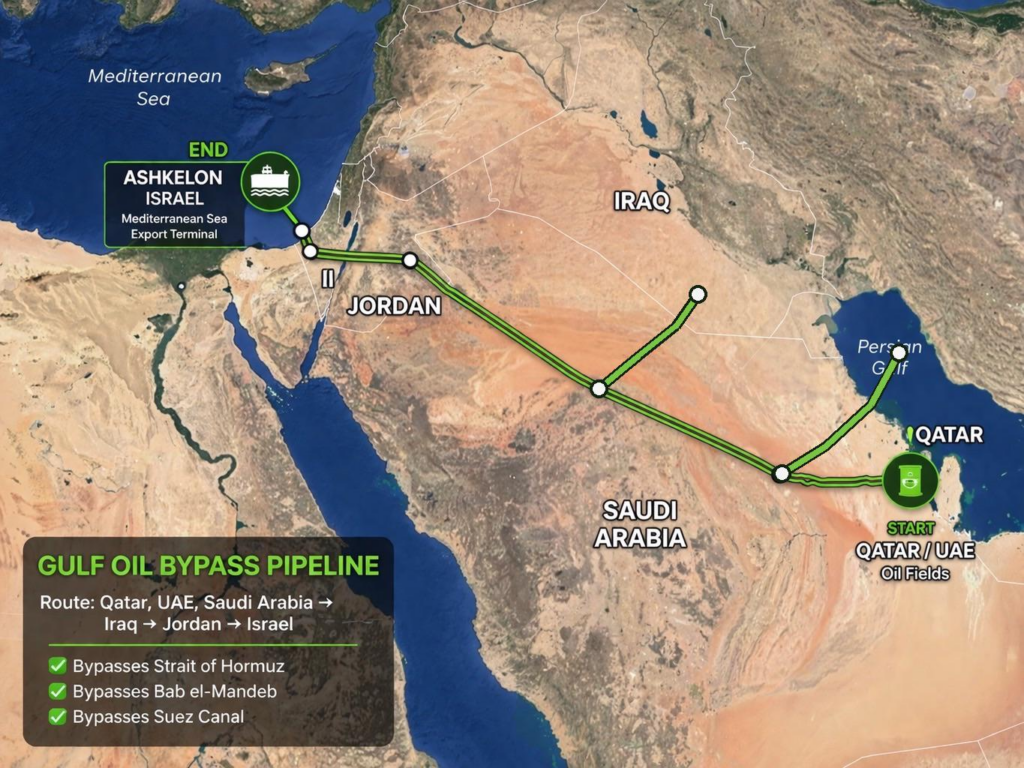
But while IMEC is a trade corridor, its oil dimension is unmistakable. The Duqm refinery and storage complex would directly feed product into IMEC’s rail system, effectively creating a land-based energy export spine under U.S. and Gulf control. This direct challenge to Beijing would undermine its dominance over Iranian oil flows, a dominance that Beijing cemented through the 25-year Iran-China Comprehensive Cooperation Agreement.
The Secret Pipeline Built With The Shah:
If Oman represents the public face of the bypass strategy, Israel is advancing a far more clandestine option, one that would have been unthinkable even three years ago.
At the heart of it is a 254-kilometre, 42-inch pipeline that snakes from the Red Sea resort of Eilat to the Mediterranean port of Ashkelon. The secretive state-owned Europe Asia Pipeline Company (EAPC) still operates the Europe Asia Pipeline, which Israel and Imperial Iran built between 1968 and 1969 as a joint venture. Declassified CIA President’s Daily Briefs from April 1968, reviewed by this reporter, show that American intelligence expected the pipeline to carry up to 60 million tonnes of Iranian crude per year to Europe, bypassing the Suez Canal. The Shah’s fall turned the partners into sworn enemies; Israel eventually took full control.
Now, Israeli Energy Minister Eli Cohen is publicly pitching a 700-kilometre extension that would connect Saudi Arabia’s existing East-West Pipeline, which already carries crude from the Kingdom’s eastern fields to Yanbu on the Red Sea, across the desert to Eilat. From there, Saudi barrels would flow into the Eilat-Ashkelon system and emerge on the Mediterranean, loaded onto tankers for European refineries. “The Gulf countries do not want to be dependent on either Iran or the Houthis when it comes to their oil exports, which are their primary source of income,” Cohen told reporters in early July. “If you create a land route, you bypass both Iran and the Houthis. The best route is through the State of Israel.”
Prime Minister Benjamin Netanyahu has been even more expansive. “Instead of going through the chokepoints of the Hormuz Strait and the Bab-el-Mandeb Strait, we’d just have oil pipelines, gas pipelines going west through the Arabian Peninsula, right up to Israel, right up to our Mediterranean ports and you’ve just done away with the chokepoints for forever,” he said in a recent cabinet address. A senior Washington source who works closely with the U.S. Treasury confirmed to OilPrice.com that the idea has found favour inside Donald Trump’s core team. “The infrastructure would stretch across Saudi and Israeli land, which means it would provide a great base for security forces to be stationed … and if Iran, or any of its backers, attacked any part of the infrastructure, we would be fully entitled, along with Israel and our Gulf allies, to hit them harder than ever before, with the definitive goal of regime change,” the source said.
The proposal’s raw political power is matched by its practical limitations. “At absolute maximum reverse flow, the Eilat-Ashkelon line can push about 1.2 million barrels per day northbound,” says Jay Letni, founder of the open-source intelligence outfit OSINT613, who has tracked the pipeline for years. “Saudi Arabia exports around 6–7.5 million barrels a day. Even at full capacity, this is a pressure valve, not a replacement for Hormuz.” Letni adds that Eilat’s port facilities have all but collapsed, activity dropped over 90% under Houthi pressure before financial collapse forced effective closure by mid-2025. Handling VLCCs would require billions in dredging, new berths, tank farms, and hardened air defences. “The 254-km desert route is exposed to precision strikes,” he notes. In June 2025, Iranian missiles damaged the Bazan refinery complex near Ashkelon, temporarily halting gas flows from the Karish and Leviathan fields. Israel’s air defence umbrella is among the best in the world, but it is not leak proof.
Then there is the environmental time bomb. Eilat’s coral reefs, among the most biodiverse in the hemisphere, sit at the doorstep of any increased tanker traffic. A 2014 rupture near the Evrona Nature Reserve spilt 5 million litres of crude, causing damage that ecologists say will take decades to reverse. “We are talking about turning a unique ecosystem into an industrial sacrifice zone for the oil industry,” says Yariv Abramovich, director of the Israel Union for Environmental Defence (Adam Teva V’Din). “The government’s secrecy around EAPC makes independent oversight nearly impossible, and that is a disaster waiting to happen.”
The Gas Dimension: Leviathan’s Planned Bypass Of Egypt.
If the Saudi‑to‑Israel oil link is the most politically explosive element of the regional redesign, a parallel gas scheme is arguably more advanced, and, for some of America’s Arab allies, more threatening. Since 2020, Israeli planners and their American backers have quietly championed a pipeline that would carry natural gas from Israel’s giant Leviathan field directly to Turkey, and from there into the European grid. Dubbed by its proponents the “Leviathan‑Med Corridor,” the project would physically bypass Egypt’s Idku and Damietta LNG terminals, which currently re-export Israeli and Cypriot gas after liquefaction, and avoid the Suez Canal altogether.
The strategic logic is unmistakable. “Egypt has built its entire gas hub strategy on the assumption that Israeli molecules have to pass through its territory to reach premium markets,” explains Dr. Brenda Shaffer, an energy and geopolitics specialist at the U.S. Naval Postgraduate School. “A direct Leviathan‑to‑Turkey line would shatter that assumption overnight. It would turn Israel into the primary European supplier and leave Cairo with a stranded asset worth tens of billions of dollars.” Turkish officials, who have been seeking ways to reduce their dependence on Russian and Iranian gas, have signalled renewed interest. In a closed-door briefing in Ankara in June 2026, Turkey’s Energy Minister Alparslan Bayraktar reportedly told industry executives that the Leviathan pipeline “has moved from a theoretical discussion to a concrete option in light of the Hormuz disruption”, and that preliminary technical talks with an international consortium were underway.
The Egyptian reaction has been one of barely concealed alarm. Cairo earned an estimated $8.2 billion in 2025 from LNG re-export’s, much of it sourced from Israeli fields. A direct pipeline to Turkey would eliminate those transit fees and undermine the financial viability of Egypt’s two massive coastal liquefaction plants. “This is not just an economic threat; it is existential for Egypt’s energy sector,” says Mahmoud El‑Gamal, a Cairo‑based oil and gas consultant. “Without Israeli gas, the LNG terminals operate at a loss. We will face a fiscal crisis and the collapse of our position as the Eastern Mediterranean’s gas hub if they divert the flow. Diplomatically, it would also weaken Cairo’s hand in regional disputes, including over water rights and the Grand Ethiopian Renaissance Dam.
U.S. advocacy for the line has been discreet but persistent. A leaked State Department cable from May 2026, reviewed by this newspaper, describes the Leviathan-Turkey pipeline as “a critical component of the broader strategy to decouple European energy security from Iranian and Russian trans‑shipment routes and to reward allies willing to deepen integration with Israel.” The cable notes that the pipeline would “tangibly demonstrate that normalisation with Israel yields concrete economic dividends” while placing “competitive pressure on actors that have refused to join the Abraham Accords framework.” Turkey, a NATO member but no friend of the current Israeli government, would be drawn closer to the U.S.‑ led bloc; Egypt, which has maintained a cold peace with Israel for decades, could see its leverage evaporate.
Within Israel, the project has encountered its own friction. Environmental groups have already challenged the underwater route across the Mediterranean, citing risks to marine ecosystems and seismic instability. The Israeli Ministry of Environmental Protection has warned that a major gas leak could devastate the coastal tourism industry. Meanwhile, the defence establishment frets about the security of an isolated sub-sea pipeline exposed to Hezbollah- or Iran‑linked sabotage. Nevertheless, in a July 2026 interview with the Jerusalem Post, Energy Minister Eli Cohen stated that “the Leviathan-Turkey option is very much alive” and confirmed that a preliminary memorandum of understanding had been signed with a U.S. engineering firm to update the feasibility study, originally completed in 2018.
Combined with the oil pipeline proposals, the Leviathan plan demonstrates a thorough effort to not only bypass Iranian chokepoints but also to reshape the entire regional energy economy, centring it around an Israeli-led axis. For Egypt, the outcome could be devastating. For Turkey, it offers an economic lifeline and a diplomatic opening. And for Iran, it is further evidence that Washington and its allies intend to render Tehran’s geographic advantages obsolete, one pipeline at a time. As one former senior CIA officer told this reporter, “The logic is simple: if you control the pipes, you control the politics. And right now, the maps are being redrawn in Tel Aviv’s favour.”
The Political Minefield: Normalisation On The Back Of A Pipeline.
All of this, however, collides with the Middle East’s original sin: the Israeli-Palestinian conflict. Saudi Arabia and Israel have no diplomatic relations, and Crown Prince Mohammed bin Salman has repeatedly conditioned normalisation on progress toward an independent Palestinian state, an idea Netanyahu’s government has categorically rejected. The ongoing war in Gaza, which has killed over 100,000 Palestinians since October 2023 according to the Gaza Health Ministry, has made any public Saudi embrace of Israel politically toxic across the Arab and Muslim worlds.
Yet behind the scenes, the energy emergency is generating unusual conversations. A senior Saudi energy adviser, speaking on condition of anonymity because he was not allowed to talk to the media, acknowledged that “Riyadh is examining every possible route to keep our crude flowing to Europe. They still consider the Israeli option, but only as a last resort if they can structure it without constituting recognition. That might mean funnelling oil through a web of shell companies, ship-to-ship transfers, or a long-term lease arrangement that never explicitly bears the Kingdom’s name, though, as Letni points out, “at the scale of modern satellite imagery and commodity flow analysis, the pattern would be exposed within weeks.”
U.S. leverage is being applied heavily. President Trump explicitly conditioned the landmark 30-year civilian nuclear cooperation pact, which Washington and Riyadh signed in July 2026, on Saudi Arabia normalising ties with Israel. “The nuclear deal is the carrot; the fear of economic collapse if Hormuz stays shut is the stick,” says Dr. Abdulaziz Alghashian, a Saudi researcher of Gulf-Israel relations. “But you cannot force a Saudi leadership to walk over the bodies in Gaza. The optics would be catastrophic.”
Palestinian civil society groups are already sounding the alarm. “Any pipeline deal that enriches Israel while Gaza is starved of fuel and water is not energy security; it is complicity in occupation and genocide,” says Shawan Jabarin, director of the Al-Haq human rights organisation, in a statement emailed to this newspaper. Pro-Palestinian activists in Jordan and across Europe have vowed mass protests should construction begin.
The normalisation ladder, however, has rungs already in place. The UAE’s Mubadala Energy invested $1 billion in Israel’s Tamar gas field, and both Egypt and Jordan are now dependent on Israeli gas, relationships that have survived diplomatic crises. The Abraham Accords broke the psychological barrier. Some Israeli planners treat Saudi normalisation as a question of “when,” not “if.” Energy Minister Cohen went so far as to say on Tuesday that “Saudi Arabia needs Israel more than Israel needs Saudi Arabia,” a remark that was met with stony silence in Riyadh.
Iran, China, And The Shadow War:
Predictably, Tehran is not sitting idly. In a rare public statement on 29 July, the Islamic Revolutionary Guard Corps Navy commander, Rear Admiral Alireza Tangsiri, warned that “any pipeline that aims to replace the strategic position of the Strait of Hormuz will be considered a hostile act, and we reserve the right to target it, wherever it may be.” Iranian state media have amplified the line that the U.S.-Israeli-Saudi schemes are “a declaration of economic war” and have threatened to arm regional proxies with the capability to strike deep into Saudi and Israeli territory.
Beijing, too, is watching. The Iran-China agreement, first revealed by this reporter in 2019, gives China a privileged position in Iranian oil and infrastructure. A Beijing-based energy strategist, who asked not to be named, said: “IMEC and the pipeline are transparent U.S. attempts to decouple global energy flows from Chinese influence. If they succeed, it reduces our leverage in the Strait of Hormuz. We will not simply accept that.” China has already stepped up naval patrols in the Gulf of Oman and is accelerating the delivery of air defence systems to Tehran, according to Western intelligence assessments.
Critical Analysis: The Mirage Of The Perfect Bypass.
Although the current plans are audacious, energy history has seen many grand bypasses that never materialised. Pipelines are tempting because they seem to offer fixed, controllable routes. In reality, they create new vulnerabilities. “A tanker can change course; a pipeline cannot,” warns Claire Jungman, a senior analyst at Vortexa. “These pipelines are pressure valves, not alternatives to the tanker network. And they themselves become targets.” The SUMED pipeline across Egypt, in which Saudi Aramco holds a 15% stake, already offers a Red Sea-to-Mediterranean option with a capacity of 2.5 million barrels a day. Yet its operators have quietly acknowledged that they have throttled it throughout because of security concerns and political friction with Cairo.
The MERA refinery and IMEC, even under the most optimistic timeline, will not deliver meaningful capacity until the 2030s. The Saudi-Israel pipeline would need at least five years of construction and billions in investment, assuming the political barriers could be overcome. And none of this would address Asia’s thirst for Middle Eastern crude, which still makes up the bulk of Gulf exports. China and India would remain dependent on the sea lanes, leaving them with strong incentives to maintain a working relationship with Tehran, or to pressure Washington to de-escalate.
Local voices in potential host communities are ambivalent. In Duqm, where the MERA project promises thousands of jobs, Omani fisherman Salim Al-Mahrouqi watches the growing construction with mixed feelings. “We need the work, yes, but we also see what happens in the Gulf. If this brings war to our shore, what then? The sea is our life.” In Israel’s Arava desert, residents near the pipeline route recall the 2014 spill and fear a repeat on a much larger scale. “They tell us it’s for energy security, but our security is the land, the water, the air,” says Dafna Shani, a farmer from Kibbutz Ketura. “We don’t want to be a bridge for dirty oil.”
Ultimately, the pipeline dream is as much a psychological operation as a logistical one. By advertising alternatives, Washington and its allies hope to dilute Iran’s deterrent power and create bargaining chips for future negotiations. But the risk is that such moves are read by Tehran not as incentives to talk, but as existential threats requiring pre-emptive escalation. In the murky world of Middle East energy politics, the line between bypass and provocation is razor-thin.
As oil traders stare at their screens and tankers rot at anchor, the most expensive commodity in the world is not crude, but certainty. And certainty remains as elusive as the peace that might one day allow these pipelines to flow.
Conclusion: The Mirage Of Certainty In An Age Of Permanent Disruption.
Their fragility matches the audacity of the plans now circulating between Washington, Tel Aviv, and only. For all the slick PowerPoint decks, the sealed memoranda of understanding, and the billion-dollar pledges, the grand strategy to cut Iran out of the global energy loop rests on a series of assumptions that history, geography, and human nature stubbornly refuse to honour. The first and most dangerous of these is the belief that pipelines and rail corridors can substitute for the political settlements that have eluded the Middle East for a century. Infrastructure, in this vision, becomes not a consequence of peace but a mechanism to impose it, a shortcut that would allow Saudi Arabia to ship oil through an Israeli state that is simultaneously bombing Gaza, Turkey to pocket transit fees while denouncing Zionism, and Oman to host a refinery that would instantly become a target the moment it processes its first barrel of Saudi crude.
“These projects are monuments to the fantasy that you can engineer your way out of a political crisis,” says Dr. Vali Nasr, professor of Middle East Studies at Johns Hopkins University and a former senior State Department adviser. “The United States has tried this repeatedly; think of the original plans for a Qatar-Turkey pipeline before the Syrian war, or the Trans-Afghanistan pipeline that never materialised. Every time, the ground shifts beneath the concrete. Today’s map is unrecognisable tomorrow, and the only people who reliably profit are the contractors and the arms manufacturers who lay the steel and then sell the missiles to protect it.”
The security paradox at the heart of the pipeline push is glaring. A supertanker, as analysts repeatedly point out, can reroute; a fixed pipeline cannot. The very quality that makes overland routes attractive, their permanence, is also what makes them hostage to every local militia, every disgruntled Bedouin tribe, every Iranian proxy with a drone and a grudge. The U.S. Treasury source’s almost gleeful suggestion that an attack on the infrastructure would justify “regime change” in Iran exposes the underlying logic: these pipelines are not just economic assets; they are tripwires. They would lock the United States into an open-ended commitment to defend thousands of kilometres of exposed steel across some of the most contested territory on earth, transforming what is currently a naval standoff into a permanent land-based confrontation. “You are essentially extending the front line of any future U.S.-Iran war into the Saudi desert and the Israeli Negev,” warns retired U.S. Marine Corps General Anthony Zinni, former head of U.S. Central Command, in an interview. “That is not a deterrent; it is a self-fulfilling prophecy.”
For the communities in the path of these steel rivers, the promise of energy security is a distant abstraction that masks a very immediate threat. In Duqm, where Omani officials speak of a new economic dawn, fisherman Salim Al-Mahrouqi’s question, “If this brings war to our shore, what then?” hangs unanswered. In Eilat, the coral reefs that have survived for millennia face suffocation not from climate change but from dredging and the ever-present risk of a catastrophic spill. The 2014 Evrona disaster taught Israel’s Arava desert dwellers what the fossil fuel industry costs when it leaks; scaling up tanker traffic through the Gulf of Aqaba would make a repeat all but inevitable. “We are being asked to accept that our land and our water are acceptable casualties in a geopolitical game we did not choose,” says Kibbutz Ketura’s Dafna Shani. The silence of the major environmental NGOs, many of whom are wary of offending governments that fund their other projects, is a quiet scandal of its own.
The diplomatic wreckage is already piling up before a single length of pipe has been welded. Egypt, America’s most populous Arab ally, is being told, through leaked cables and the quiet machinations of the Leviathan-Med Corridor, that its LNG terminals may soon be stranded assets, its $8.2 billion in annual transit revenues a memory. Cairo’s ability to manage its debt crisis and its restive population would be severely compromised, with unpredictable consequences for a country that sits astride the Suez Canal, the one chokepoint no bypass can replace. Saudi Arabia’s leadership, meanwhile, is being squeezed between the iron logic of economic survival and the political impossibility of normalising with an Israel that continues to expand settlements and kill Palestinians in record numbers. Crown Prince Mohammed bin Salman may eventually capitulate to American pressure, but the cost will be profound: a loss of legitimacy at home and across the Muslim world that money alone cannot repair. “The Kingdom is being asked to bet its moral standing on a pipeline that might not even work,” says Saudi scholar Dr. Abdulaziz Alghashian. “That is a gamble no rational actor would take unless the alternative is total collapse.”
And then there is Iran. The Islamic Republic’s leadership, whatever its internal fissures, has been handed the most potent propaganda victory since the 1979 revolution. The very existence of these bypass plans validates Tehran’s long-standing narrative that the United States and its allies seek not just to contain Iran but to erase its strategic position. Rear Admiral Tangsiri’s threat to target any pipeline that replaces Hormuz is not bluster; it is a rational military doctrine grounded in the knowledge that Iran’s conventional forces cannot match America’s but that its asymmetric capabilities can make any alternative export route prohibitively expensive. The more the U.S. invests in fixed infrastructure, the more it offers Iran targets that are impossible to hide and relatively cheap to attack. In the shadow war that would follow, it is not clear who would bleed faster: the country that needs a 1.2-million-barrel-a-day pipeline to repay its investors, or the country that needs only a few thousand dollars’ worth of drones to disrupt it.
Beijing, watching from the sidelines, has no incentive to let the American gambit succeed. The 25-year Iran-China agreement ensures that Chinese refineries will continue to receive discounted Iranian crude regardless of what happens in the Mediterranean. If anything, a permanent Hormuz closure that spares China while starving Europe would accelerate the eastward shift of global economic power, an outcome Beijing can live with, and may quietly be helping to engineer. “China is the invisible hand in all of this,” says the Beijing-based strategist. “They don’t need to fire a shot. They just need the crisis to last long enough for the dollar-based oil order to crack.”
In the end, the pipeline schemes now under frantic discussion are less a coherent strategy than a reflection of American panic, a desperate attempt to assert control over a region that has defied every imperial design since Alexander the Great. They promise to lock in an Israeli-centric energy order, but they cannot lock in peace; they promise to starve Iran of relevance, but they cannot starve it of missiles; they promise security to Europe, but they offer none to the Palestinians whose statelessness makes the entire edifice illegitimate in the eyes of a billion Muslims and the international community. The greatest danger is not that these plans will fail, but that they will be believed, that Washington will mortgage its remaining Middle Eastern credibility on a network of pipes that the next drone strike, the next intifada, or the next shift in oil markets will render obsolete overnight.
Furthermore, as Israel continues to develop these pipelines and associated infrastructure, it is increasingly positioning itself as a central hub for maritime trade, energy transportation, and wider economic routes connecting the Middle East, Asia, and international markets. However, growing instability and geopolitical tensions across the Middle East and parts of Asia are disrupting established trade corridors, creating uncertainty over regional commerce, energy security, and the future configuration of global supply routes.
As the sun sets over the empty berths at Fujairah, Captain Michalis receives word that his owners have decided to send the Aegean Glory on the long route around the Cape of Good Hope, a 50-day voyage that will cost $4 million in extra fuel and crew wages. “It’s madness,” he mutters, staring at charts that show the pipeline routes drawn in hopeful dotted lines across the Arabian Peninsula. “But at least the ocean doesn’t explode when you hit it.” In the gap between the dotted lines and the deep blue sea lies the entire story of this crisis: an epic collision between the fantasy of mastery and the reality of a world that remains, as ever, beyond any empire’s control.
Veritas Press Investigative Analysis
Independent journalism examining global affairs, power, diplomacy and accountability.
Source: Veritas Press C.I.C. | Multi-News Agencies
APPEAL: Help Support Our Work By Donating
Readers who believe that truth still matters have power over popular information. When just a few more people step up to support this work, it means more lies exposed, more corruption uncovered, and more accountability where it’s long overdue.
Help Protect Independent Journalism, Which Is Currently Under Attack.
If you believe journalism should serve the public, not the powerful, and you’re able to help, becoming a regular DONOR or a PAID SUBSCRIBER truly makes a difference.
DONATION APPEAL: If you found this reporting valuable, please consider supporting independent journalism.
Your support fuels our fearless, truth-driven journalism. In unity, we endeavour to amplify marginalised voices and champion justice, irrespective of geographical location. We operate independently, with no financial backing from billionaires; our readers support us.
But it’s also extremely important. One of Veritas Press’s greatest assets is its reader-funded model.
1. Reader funding means we can cover what we like. We’re not beholden to the political whims of a billionaire owner. We are a small, independent and impartial organisation. No one can tell us what not to say or what not to report.
2. Reader funding means we don’t have to chase clicks and traffic. We’re not desperately seeking your attention for its own sake; we pursue the stories that our editorial team deems important and believes are worthy of your time.
3. Reader Funding: enables us to keep our website and other social media channels open, allowing as many people as possible to access quality journalism from around the world, particularly those in places where the free press is under threat.
We know not everyone can afford to pay for news, but if you’ve been meaning to support us, now’s the time.
Your donation goes a long way. It helps us:
- Keep the lights on and sustain our day-to-day operations
- Hire new, talented, independent reporters
- Launch real-time live debates, community-focused shows, and on-the-ground reporting
- Cover the issues that matter most to our communities, in real time, with depth and integrity
Without your support, independent voices like ours will be silenced.
Furthermore, we have plans to expand our work, but we can’t do it without your support. Every contribution, no matter the size, helps us stay independent and build a truly people-powered media platform.
If you believe in journalism that informs, empowers, and reflects the communities we serve, please donate today.
Submissions:
For the secure submission of documentation, testimonies, or exclusive investigative reports from any global location, please utilise the following contact details for our Investigations Desk: mailto:enquiries@veritaspress.co.uk or mailto:editor@veritaspress.co.uk
GENEVA — A United Nations fact-finding mission has concluded there are “reasonable grounds to believe”
Iran’s GDP is projected to contract by 5.4 to 6.1% in 2026, its worst performance
The Trump administration is preparing a $2.8 billion weapons package for Israel containing 40,000 2,000-pound

Film alleges mass civilian deaths are routinely built into military decisions amid Israel’s genocidal war
The Israeli rights group says violence, displacement, economic strangulation, and settlement expansion form part of

Houthi forces have captured the historic Red Sea port of Mocha and are advancing on
London’s historic sanctions against Israeli settlements mark a watershed moment in UK foreign policy, but
With 95% of Gaza’s population now wholly dependent on aid and more than 90% stripped
India calls for Kashmir and Ladakh to appear only on its official map after a
ISLAMABAD – In the high-stakes political theatre of Pakistan, the battleground has shifted from the
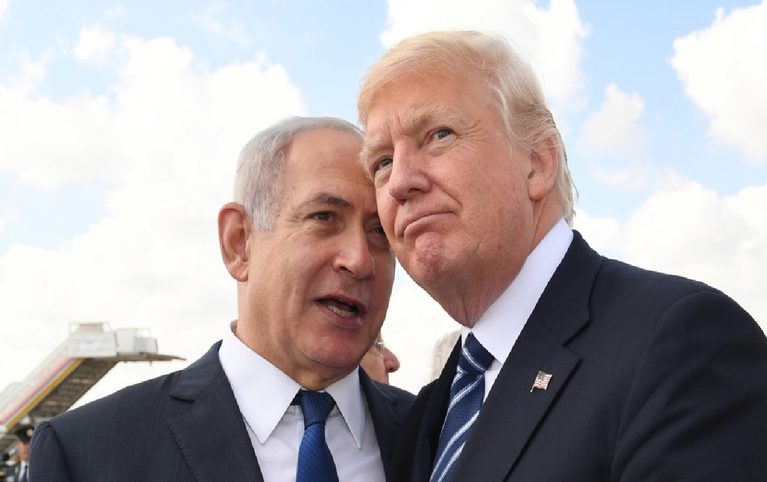





















fig2f5
n2vio8
mu9qst