



Help support our mission, donate today and be the change. Every contribution goes directly toward driving real impact for the cause we believe in.
Violent interception of the Global Sumud Flotilla near Crete, as activists say Israel has turned the Mediterranean into a battlefield for humanitarian aid.
I. The Interception: A Night of Drones, Lasers, and Gunfire
In the late hours of Wednesday, April 29, 2026, as the “Spring 2026 Mission” of the Global Sumud Flotilla sailed through international waters roughly 600 nautical miles from the Gaza Strip, the night sky above the Mediterranean was suddenly pierced by the whir of drones and the glare of military lasers. What unfolded over the next several hours, according to a chorus of survivors, organisers, and human rights groups, was not a lawful naval interdiction but a brutal, extraterritorial assault on unarmed civilians, a premeditated act of state violence that the flotilla’s organisers have unequivocally branded as “piracy”.
The Israeli Defense Forces (IDF) operation was swift and overwhelming. Military speedboats, identifying themselves as “Israel,” surrounded the flotilla’s vessels, pointing lasers and semi-automatic weapons at the activists on board. Communications were jammed, including distress channels, leaving the boats isolated and unable to call for help. “Our boats were approached by military speedboats, self-identified as ‘Israel’, pointing lasers and semiautomatic assault weapons, ordering participants to the front of the boats and to get on their hands and knees,” the Global Sumud Flotilla stated.
Gur Tsabar, a spokesperson for the flotilla, described the operation as “a straight-up attack on unarmed civilian boats in international waters”. Speaking from Toronto, he emphasised the critical legal breach at the heart of the incident: “This is illegal under international law. Israel has no jurisdiction in these waters. Boarding these boats amounts to illegal detention – potentially kidnapping on the high seas”. This view is shared by international law experts who point to Article 87 of the United Nations Convention on the Law of the Sea (UNCLOS), which guarantees freedom of navigation in international waters, a principle the flotilla’s spokesperson, Rana Hamida, says the mission operated under.
The interception, which occurred near the Greek island of Crete, far from any recognised conflict zone, has been described as the “farthest-ever” such operation by activists, a sign of what they call Israel’s “growing impunity”. By the end of the raid, the Israeli Foreign Ministry confirmed that 175 activists had been detained from more than 20 boats, though organisers initially placed the figure higher, at 211 kidnapped participants. The flotilla, a sprawling humanitarian mission of 58 vessels carrying aid and activists from 39 countries, had aimed to challenge Israel’s 19-year blockade of Gaza and deliver essential supplies to a population on the verge of famine.
II. “40 Hours Of Calculated Cruelty”: The Accounts Of The Detained
The most damning allegations against Israel are not about the interception itself, but what is said to have occurred in the 40 hours that followed. In a harrowing statement, the Global Sumud Flotilla accused Israeli forces of subjecting more than 175 detainees to “40 hours of calculated cruelty” aboard an Israeli naval vessel. This was no passive detention; it was, according to multiple testimonies, a systematic campaign of physical abuse, deprivation, and psychological torment.
Australian activist Zack Schofield, one of six Australians detained, provided a viscerally detailed account to ABC News. “All of my crew were placed in stress positions and forced to walk with our heads down; we were grabbed by our hair and moved around the ship,” he said. He described how detainees were “forcefully searched, multiple times” and had their possessions stolen or thrown into the ocean, and how their boat was sunk. The violence Schofield witnessed was extreme: “A friend of mine from the American delegation was taken into a shipping container and beaten by three Israeli soldiers with the butts of their rifles and batons, and was kicked repeatedly in the testicles. I saw elderly men shot at point-blank range with rubber bullets. I saw a young woman, part of my crew, punched in the ribs about 10 or 11 times”. He estimated that at least 10 to 12 people suffered concussions or broken ribs from being shot at close range.
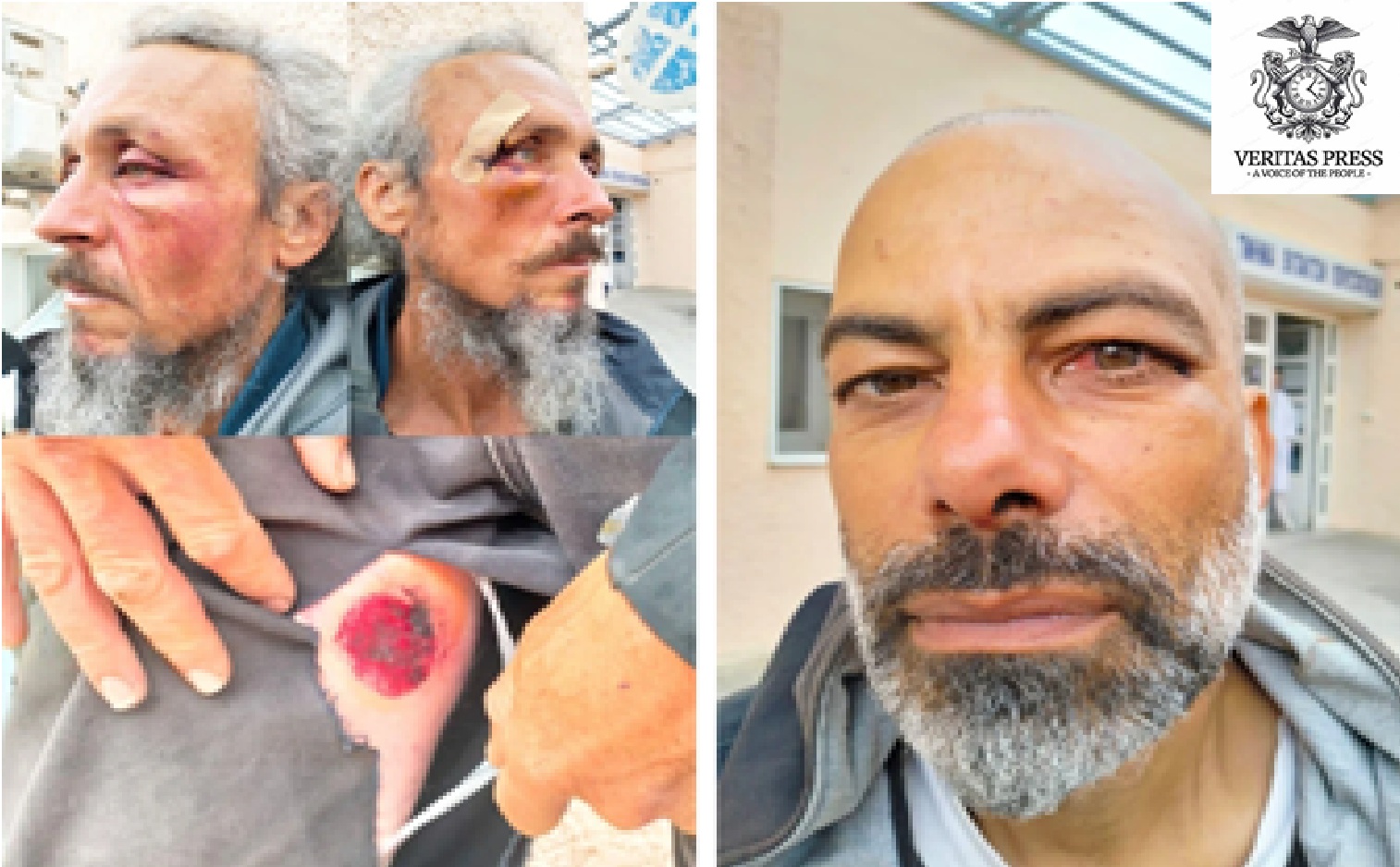
These accounts are not isolated. The flotilla reported that 31 activists from countries including New Zealand, Australia, Italy, the United States, Canada, Spain, Britain, and Germany were injured during the interception. Injuries documented by the group ranged from nasal fractures to severe contusions from physical beatings and being dragged across the deck. One activist, speaking in a video statement, described the brutal force used: “As you can see, my nose is probably broken. I feel pain in my ribs as well, and there may be a fracture. They kicked us, punched us, and dragged us on the ground. We even heard people being shot”.
The deprivation extended beyond physical violence. Detainees were denied adequate food and water and forced to sleep on floors that were repeatedly and deliberately flooded with seawater. “The Israelis flooded the deck with seawater at least a couple of times on the ship every night, to wake us up and make sure our mats were wet,” Schofield recounted. This tactic of flooding the floor, also detailed in other reports, turned the deck into a frigid, soaking bed, a form of environmental torture designed to break the spirits of the captives.
Israel’s Ministry of Foreign Affairs has categorically denied any mistreatment. In a statement to the ABC, a spokesperson claimed, “During the process of transferring the passengers to Greek forces, a number of passengers refused the transfer and began rioting violently… At no point were the passengers mistreated, and all use of force was in direct response to violence and physical resistance on the part of the rioters”. This narrative, however, is starkly at odds with the volumes of consistent, first-hand testimony describing unprovoked beatings and systemic abuse.
In a grim echo of history, Amnesty International noted that it had “documented ill-treatment and abuse of activists aboard the Global Sumud Flotilla who had been detained in in October 2025 after the Israeli military intercepted its vessels, including sleep deprivation, denial of drinking water and medical care”. The rights group added that abuses against 36 Italian activists from the 2025 mission are “currently being investigated by the Prosecutor in Rome, including on allegations of torture and other ill-treatment”.
III. The “Kidnapping” Of Two: The Targeted Detention Of Saif Abukeshek And Thiago Ávila:
While the majority of the 175 detainees were transferred to Greek authorities and eventually deported, Israel singled out two men for a different fate: Saif Abukeshek, a Spanish-Palestinian national, and Thiago Ávila, a Brazilian citizen. In what organisers describe as a targeted abduction, the two were violently removed from the flotilla and forcibly taken to the Israeli port of Ashdod for questioning, a move that has amplified international outrage and raised serious legal and human rights concerns.
Activists on board reported that the worst of the violence erupted when they attempted to peacefully shield Abukeshek and Ávila from being taken. Witnesses said participants were punched, kicked, and dragged across the deck with their hands bound, with shots fired during the chaos. The two men were subsequently brought before an Israeli court in Ashkelon on Sunday, where prosecutors sought to extend their detention.
The court documents and testimonies reveal a particularly brutal ordeal. Thiago Ávila told lawyers from the Israeli rights group Adalah that he was “subjected to extreme brutality” when the vessels were seized, adding that he was “dragged face-down across the floor and beaten so severely that he passed out twice”. Since arriving in Israel, he said he has been “kept in isolation and blindfolded”. Saif Abukeshek was similarly “hand-tied and blindfolded … and forced to lie face-down on the floor from the moment of his seizure” until reaching Israel.
The basis for their detention is a matter of fierce dispute. The Israeli foreign ministry has accused the two men of being affiliated with the Popular Conference for Palestinians Abroad (PCPA), an organisation subject to US sanctions for allegedly acting on behalf of Hamas. Israel identified Abukeshek as a leading member and suspected Ávila of “illegal activity”. Spain has forcefully condemned the detention of its nationals and rejected the Israeli accusations, demanding Abukeshek’s immediate release.
On Saturday, an Israeli court extended its detention for two more days. Adalah, the group representing them, argued that “the entire legal process is fundamentally flawed and illegal”. No charges have been filed, and the men remain at the pre-indictment stage in Shikma prison in Ashkelon, held in isolation. Their families have expressed profound fear for their safety, a concern magnified by the fact that both are fathers of young children.
IV. Greece’s Complicity: “Cooperating Fully” Or A Sovereign Betrayal?
The geographical location of the raid has thrust the Greek government into the centre of a swirling diplomatic storm. The attack occurred in international waters off the coast of Crete, an area that falls within Greece’s designated zone for search and rescue operations under international maritime law. For many, this raises a singular, devastating question: Was Greece complicit in an act of piracy on its own doorstep?
Greek politician Yanis Varoufakis, the country’s former finance minister, delivered a scathing verdict on social media, writing: “The Greek government is either complicit or incapable of defending our seas from Israel”. This sentiment was echoed across the political spectrum. The Greek Communist Party (KKE) accused the state of being an accomplice, demanding to know if the government “was aware of and in agreement with its murderous Israeli allies”. Lawmaker Dimitris Mantzos of the main opposition PASOK party demanded transparency: “Was it aware of and in agreement with its murderous Israeli allies? What did it do to protect human lives?”.
The official Greek response has been a tangle of diplomacy and defensiveness. The Greek Foreign Ministry called for “restraint and respect for international law” and requested Israel withdraw its vessels from the area. Simultaneously, Israel’s Foreign Minister Gideon Saar publicly thanked the Greek government “for its willingness to receive the flotilla participants”. This cooperation, the use of Greek shores to disembark and process the very activists Israel had just violently intercepted, has been framed by critics as a profound act of collusion.
Kostas Arvanitis, a Greek MEP, stated that any Greek facilitation would be “deeply troubling,” demanding “immediate clarification and accountability”. “The Greek government cannot allow actions affecting civilian humanitarian vessels to take place in areas under its responsibility without full transparency,” he added. The International Committee for Breaking the Siege of Gaza went further, holding Greece “directly responsible” given the raid occurred within its maritime scope.
As the flotilla’s boats, some damaged and disabled, were left adrift, the Greek coast guard escorted the freed, or released, activists to shore on the island of Crete. Among them were 34 who required immediate hospitalisation for their injuries. The remaining nearly 200 were held on buses, their fate still entangled in geopolitical complexities. For Varoufakis and many observers, the conclusion was inescapable: Greece was “conniving with Israel to victimise the brave crews of the Sumud Flotilla”.
V. International Outrage And A Green Light From Washington:
The world’s reaction has been swift but deeply divided, laying bare the geopolitical fault lines over the Palestine-Israel conflict. On one side, a coalition of eleven nations, including Türkiye, Brazil, Jordan, Pakistan, Spain, Malaysia, Bangladesh, Colombia, the Maldives, South Africa, and Libya, issued a joint statement condemning Israel’s attack as “flagrant violations of international law and international humanitarian law”. They stressed that the flotilla was a “peaceful civilian humanitarian initiative” and called for the immediate release of those detained. Türkiye, in particular, was vehement, calling the operation an “act of piracy”.
European powers voiced deep concern. Germany and Italy jointly called on Israel to respect international law and refrain from “irresponsible actions”. Rome demanded the immediate release of its nationals, while Spain’s Foreign Minister José Manuel Albares Bueno confirmed the arrival of 30 Spanish citizens in Crete but condemned the illegal detention of Saif Abukeshek. Iran’s Foreign Ministry also condemned the attack, labelling it “piracy and terrorism”.
But in a stark divergence, the United States offered what amounts to a green light. A State Department spokesperson dismissed the flotilla as a “meaningless political stunt” and urged allied nations to deny port access, docking, and logistical support to the vessels involved. This response, which effectively endorses Israel’s right to intercept humanitarian missions in international waters, has been met with shock by human rights organisations and activists who see it as a blanket of impunity for Israel’s actions.
Amnesty International’s Erika Guevara Rosas framed America’s stance within a broader context of international failure. “It is appalling that activists participating in a peaceful solidarity mission aiming to break Israel’s unlawful blockade… have been arbitrarily detained once again,” she said. “The Israeli navy crossing hundreds of miles at sea just to ensure civilian boats carrying food, baby formula, and medical supplies don’t make it to Palestinians reveals the lengths Israel is prepared to go to in order to maintain its cruel and unlawful 19-year-long blockade”.
The UN Special Rapporteur on the situation of human rights in the Palestinian territories weighed in, calling the interception “apartheid without borders”. The global condemnation, while loud, seems to crash against the immovable wall of U.S. and Israeli resolve, a dynamic that critics argue has allowed the humanitarian catastrophe in Gaza to fester and deepen.
VI. “We Will Continue”: Defiance, Hunger Strikes, And A Flotilla That Refuses To Die.
Even as the world’s governments condemn or offer qualified concern, the activists remain resolute. The interception, for all its brutality, has not succeeded in extinguishing the mission. Organisers report that of the 58 original vessels, 36 were still sailing toward Gaza after the raid, with some having escaped interception and others managing to reach Greek territorial waters. The flotilla, they insist, will go on, a floating, stubborn symbol of international civil disobedience against what they see as an illegal siege.
This defiance is being paid for in flesh and spirit. In protest of their treatment and continued detention, 60 of the activists aboard the remaining vessels have begun a hunger strike. Among them are those still being held in detention, including Thiago Ávila and Saif Abukeshek, who are on hunger strike in Shikma prison. Their legal team at Adalah has described their case as a test of Israel’s judicial integrity, arguing from the outset that the detention is fundamentally unlawful.
The broader mission is itself an act of memory. The “Spring 2026 Mission” is the second major interception by the Global Sumud Flotilla. A previous mission in September 2025 ended in a similar fashion, with Israeli forces seizing vessels and detaining hundreds, including Swedish climate activist Greta Thunberg, before deporting them. The parallels are inescapable, and for many, so is the sense of historical repetition. “History repeats itself. This time, very practically in Europe,” wrote Italian lawmaker Arturo Scotto, questioning whether such “violence and disregard for international law” could be tolerated.
For the activists, the mission is not a “PR stunt” as Israeli officials claim, but a desperate, physical response to a blockade that has left 1.5 million of Gaza’s 2.4 million Palestinians displaced and the entire population on the verge of starvation. The war that began in October 2023 has killed more than 72,000 people, injured over 172,000, and caused catastrophic destruction. Despite a so-called ceasefire in late 2025, only “extremely limited supplies” have been allowed in, as Amnesty International notes, while the population is “crammed in as little as the 40% of the Gaza Strip”.
Hussein Shuayb Ordu, an activist who was detained and then released, summarised the treatment meted out by his Israeli captors in stark, dehumanising terms: “They treated us in a way that is not befitting even animals. They crammed 200 people into containers and tortured them”. Katie Davidson, a British food engineer, explained her motivation with moral clarity: “Israel acts boldly and arrogantly because it knows it will not be held accountable”. Argentine MP Monica Schlottauer, who was also on board, drew a direct parallel to the wider struggle: “We were humiliated and subjected to psychological pressure, but we have not lost hope, because our Palestinian brothers suffer this many times over”.
VII. Conclusion: The High-Water Mark Of Impunity.
The interception of the Global Sumud Flotilla in the spring of 2026 will likely be recorded as a defining moment in the long, dark narrative of the Gaza blockade. It is a story of immense cruelty and stark geopolitical realities, where a state, emboldened by the support of a superpower, can stretch its arm across the Mediterranean to violently crush a peaceful civilian mission, and then shuffle the victims, battered and broken-boned, onto the shores of a complicit neighbour.
Tariq Ra’ouf, a Palestinian-American writer on board one of the vessels, captured the grim symbolism of what occurred. “It really goes to show Israel’s impunity and their willingness to completely disregard international law,” he said to Anadolu, noting that this raid was conducted further out at sea than ever before. Marie Alice Morel, a Haitian-German activist, voiced a deep and growing frustration with the international community’s failure to protect its own citizens: “It’s appalling that our governments, the ones we are citizens of, that are supposed to protect us, are failing this much”.
As the remaining vessels of the flotilla limp towards their destination, and as two men languish in an Israeli prison, the central question raised by the activists hangs in the salty air, unanswered by the chancelleries of the world: What is the meaning of international law, and the freedom of the seas, if a nation can commit what human rights groups call “piracy” and “kidnapping” without consequence?
The Global Sumud Flotilla, in its bloody, defiant voyage, has exposed not just the brutality of an ongoing military occupation and siege, but the profound and growing crisis of accountability in the international order. As the world looks on, the message from the activists is clear: they will keep sailing, and if their governments won’t hold Israel to account, they will put their own bodies in the way. The cost of that resistance, as the hospitals in Crete can attest, is being counted in broken bones and traumatised souls.
Source: Multiple News Agencies
Submissions:
For The Secure Submission Of Documentation, Testimonies, Or Exclusive Investigative Reports From Any Global Location, Please Utilise The Following Contact Details For Our Investigations Desk: enquiries@veritaspress.co.uk or editor@veritaspress.co.uk
Help Support Our Work:
Popular Information is powered by readers who believe that truth still matters. When just a few more people step up to support this work, it means more lies exposed, more corruption uncovered, and more accountability where it’s long overdue.
Help Protect Independent Journalism, Which Is Currently Under Attack.
If you believe journalism should serve the public, not the powerful, and you’re in a position to help, becoming a DONATOR or a PAID SUBSCRIBER truly makes a difference.
DONATION APPEAL: If You Found This Reporting Valuable, Please Consider Supporting Independent Journalism.
Help Support Our Work – We Know, We Know, We Know …
Seeing these messages is annoying. We know that. (Imagine what it’s like writing them … )
Your support fuels our fearless, truth-driven journalism. In unity, we endeavour to amplify marginalised voices and champion justice, irrespective of geographical location.
But it’s also extremely important. One of Veritas Press’s greatest assets is its reader-funded model.
1. Reader funding means we can cover what we like. We’re not beholden to the political whims of a billionaire owner. We are a small, independent and impartial organisation. No one can tell us what not to say or what not to report.
2. Reader funding means we don’t have to chase clicks and traffic. We’re not desperately seeking your attention for its own sake: we pursue the stories that our editorial team deems important and believe are worthy of your time.
3. Reader Funding: enables us to keep our website and other social media channels open, allowing as many people as possible to access quality journalism from around the world, particularly those in places where the free press is under threat.
We know not everyone can afford to pay for news, but if you’ve been meaning to support us, now’s the time.
Your donation goes a long way. It helps us:
- Keep the lights on and sustain our day-to-day operations
- Hire new, talented independent reporters
- Launch real-time live debates, community-focused shows, and on-the-ground reporting
- Cover the issues that matter most to our communities, in real time, with depth and integrity
We have plans to expand our work, but we can’t do it without your support. Every contribution, no matter the size, helps us stay independent and build a truly people-powered media platform.
If you believe in journalism that informs, empowers, and reflects the communities we serve, please donate today.
The Trump administration is preparing a $2.8 billion weapons package for Israel containing 40,000 2,000-pound

Film alleges mass civilian deaths are routinely built into military decisions amid Israel’s genocidal war
The Israeli rights group says violence, displacement, economic strangulation, and settlement expansion form part of

Houthi forces have captured the historic Red Sea port of Mocha and are advancing on
London’s historic sanctions against Israeli settlements mark a watershed moment in UK foreign policy, but
With 95% of Gaza’s population now wholly dependent on aid and more than 90% stripped
India calls for Kashmir and Ladakh to appear only on its official map after a
ISLAMABAD – In the high-stakes political theatre of Pakistan, the battleground has shifted from the
Francesca Albanese says third states have an ICJ-mandated obligation to end Israel’s occupation. But with
As Israeli jets bomb a Syrian air base over alleged Turkish deployment plans, Ankara, Washington