












Author:
Help support our mission, donate today and be the change. Every contribution goes directly toward driving real impact for the cause we believe in.
New Modeling Confirms The San Andreas And San Jacinto Faults Are More Critically Stressed Than They Have Been In A Millennium. A Year After The Landmark Study, Scientists, Emergency Planners And Residents Are Grappling With What A Simultaneous Rupture Would Really Mean, And Why The Cajon Pass ‘Earthquake Gate’ May Be The Most Dangerous Wildcard Of All.
LOS ANGELES — The ground beneath Southern California is whispering a warning that has become a scream in the peer-reviewed pages of geophysics journals. For decades, scientists have cautioned that the southern stretch of the San Andreas Fault is overdue for a massive rupture. Now, a team from the University of Hawai‘i at Mānoa has delivered the most detailed stress audit yet, concluding that multiple segments of the San Andreas and its interlaced partner, the San Jacinto Fault, have reached their highest stress levels in at least 1,000 years. The research, published in the Journal of Geophysical Research: Solid Earth in early 2025, has spent the past year ricocheting through emergency operations centres, insurance boardrooms and community meetings from the Coachella Valley to downtown Los Angeles.
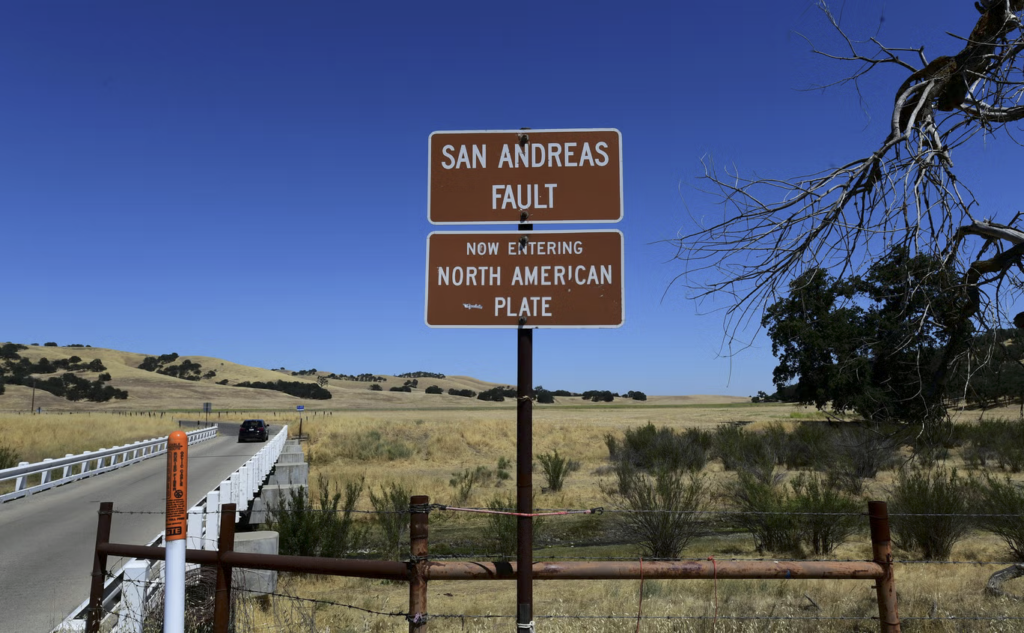
Liliane Burkhard, a research affiliate at the Hawai‘i Institute of Geophysics and Planetology and the study’s lead author, did not mince words. “Our results show that stress levels on multiple fault segments are now at or above the highest values seen in the past millennium, and that the region may be capable of a large through-going rupture involving both fault systems,” she said. In the twelve months since that statement, seismologists, public officials and millions of residents have been forced to confront an uncomfortable reality: the question is not if, but when, and now, perhaps, how big.
Yet a deeper investigative look reveals that the most alarming science is only half the story. A year after the study, officials have scrambled to update hazard maps and expand early warning systems, but critical infrastructure retrofits remain patchy, insurability is cratering in high-risk zones, and a newly discovered “earthquake gate” at Cajon Pass has introduced a terrifying X-factor that even the best simulations cannot fully resolve. The blockbuster headlines of 2025 have collided with the bureaucratic and political inertia of 2026, leaving the region in a state of anxious purgatory.
The Millennium Stress Check:
The study’s physics-based computer model did not emerge from a crystal ball. Researchers fed it a detailed, 1,000-year history of earthquakes along the two fault systems, reconstructed from radiocarbon dating of displaced sediments, tree-ring records, and the paleoseismic scars preserved in the desert floor. The simulation then ran those historical ruptures forward to calculate how much tectonic stress has accumulated to the present day.
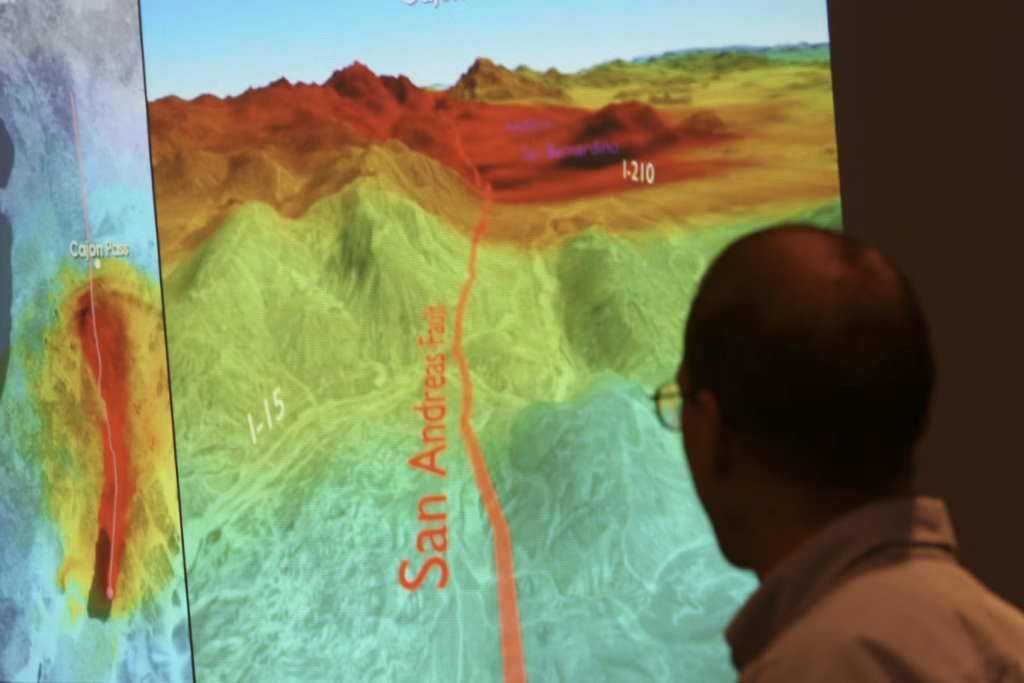
The figures are arresting. On the San Bernardino segment of the San Jacinto Fault, the modelled stress reached 3.6 megapascals, equivalent to the pressure felt 360 meters beneath the ocean surface. While that number may sound modest, Burkhard emphasised that the danger lies in scale. “The fault plane extends tens of kilometres along strike and to depths of 10 to 20 kilometres,” she explained. “When that lock gives way, the energy released scales with both the stress and the area over which it acts, which is why the resulting earthquakes are so large.”
In a media landscape that often conflates stress accumulation with imminent doom, several notable seismologists not involved with the research have urged caution. Dr. Susan Hough, a veteran geophysicist with the U.S. Geological Survey, has repeatedly reminded the public that high stress is a necessary but insufficient condition for a major earthquake. “Think of it as a loaded spring,” she said during a 2025 California Earthquake Preparedness webinar. “The spring has been loading for a long time. We know it will eventually snap. But exactly when the catch fails depends on countless tiny factors we can’t measure. This study tells us the spring is very, very tight, it doesn’t give us a countdown clock.” Despite such caveats, the phrase “highest in 1,000 years” has become a fixture in local news chyrons, feeding both public dread and a cottage industry of doomsday preparedness influencers.
The Gatekeeper Of Two Faults:
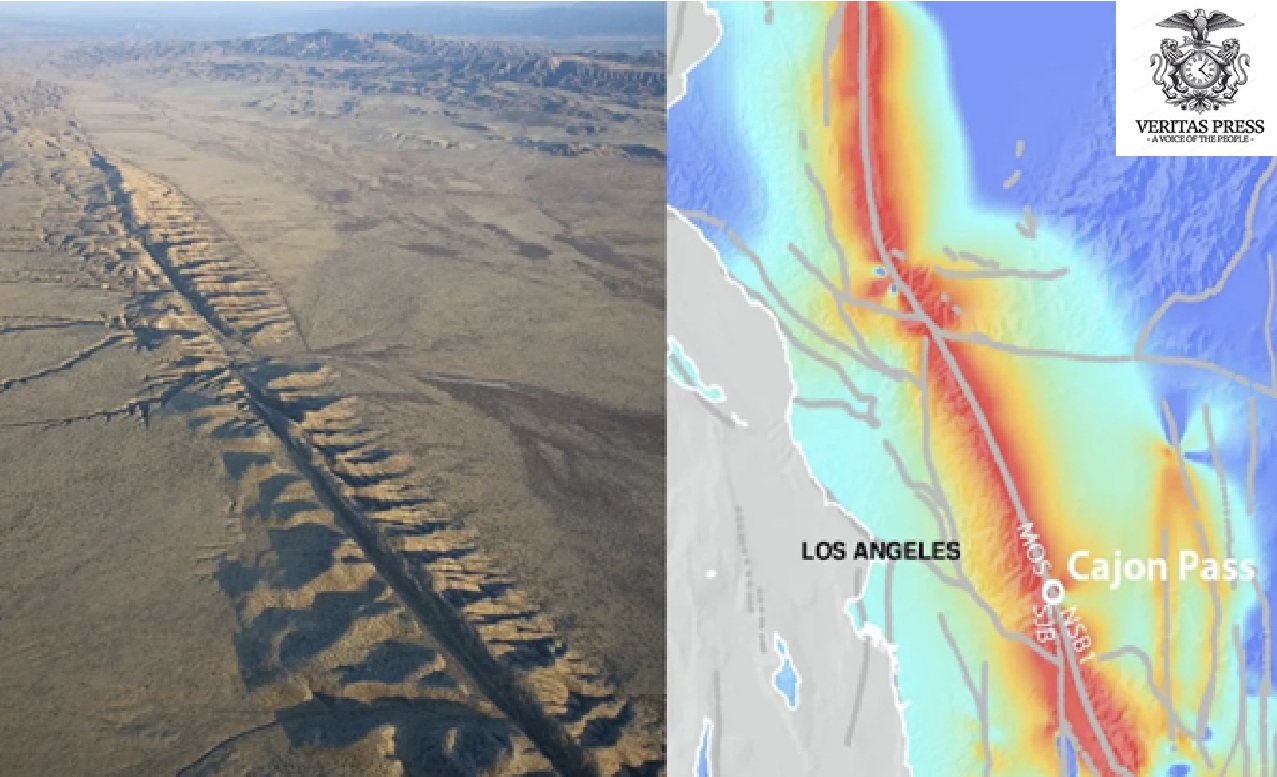
Perhaps the most unsettling finding is not the absolute stress values but the dynamic role of the Cajon Pass. This mountain corridor, carved between the San Gabriel and San Bernardino ranges and laced with the lifelines of Interstate 15 and vital rail arteries, is where the San Andreas and San Jacinto faults draw close enough to whisper to each other. Burkhard’s team found that the pass can behave as an “earthquake gate”, sometimes blocking a rupture from jumping between faults, and sometimes allowing both systems to unzip in a single, terrifying event.
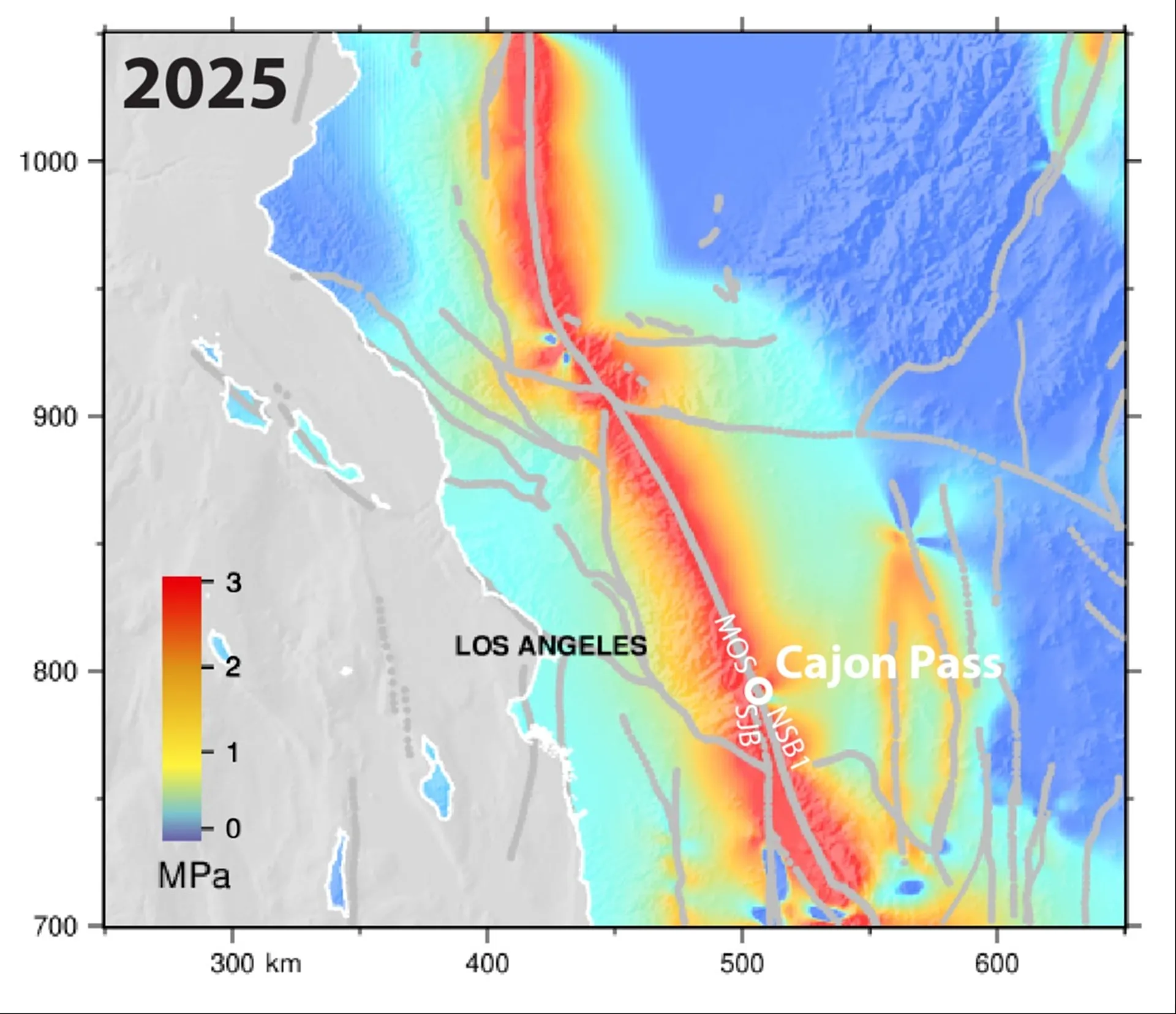
“We also found that Cajon Pass may act as an ‘earthquake gate’: sometimes blocking large ruptures from crossing between the faults, and sometimes allowing them to pass through and involve both systems in a single event,” Burkhard said. The consequences of the gate swinging open are almost incalculable. A joint rupture could tear through densely populated communities simultaneously, from the Inland Empire’s logistics hubs to the sprawling Los Angeles Basin. Cities home to more than 15 million people, Los Angeles, San Bernardino, Riverside, Ontario, Palm Springs, would be exposed to intense shaking across a front far wider than any single-fault event could produce.
“It’s the difference between a regional catastrophe and a national security crisis,” said Dr. Kenneth Hudnut, a former USGS seismologist now advising private-sector resilience efforts. “The Cajon Pass corridor contains critical energy pipelines, fibre-optic backbone routes, and the main rail and trucking lifelines that connect the Ports of LA and Long Beach to the rest of the continent. If both faults go together, you lose that corridor for months, if not years.”
A Year Of Uneasy Response: Early Warnings And Retrofit Gridlock.
In the twelve months since the study’s publication, the political and institutional response has been a study in contrasts. On one hand, the expansion of the ShakeAlert earthquake early warning system has accelerated. By mid-2026, the network of seismic sensors blanketing the state can now deliver alerts to mobile phones within two to five seconds of a large quake’s initiation, according to the Governor’s Office of Emergency Services (Cal OES). That may be enough to slow trains, open firehouse doors, and give surgeons a moment to lift a scalpel. “Seconds save lives,” said Cal OES Director Nancy Ward in a recent interview. “We’ve integrated ShakeAlert into all major transit systems, and we’re now working with school districts to automate classroom lockdowns and gas shutoffs the moment a warning triggers.”
On the other hand, the politically charged work of mandatory seismic retrofits has crawled forward. The study’s stark modelling gave fresh ammunition to activists with the nonprofit Earthquake Country Alliance, who have long pushed for a statewide mandate to retrofit the estimated 50,000 soft-story apartment buildings and brittle concrete towers that could collapse in a major quake. “Every new study says the same thing: the faults are loaded. Yet the legislature keeps treating retrofit mandates like a third rail,” said Maria de la Torre, an organiser with the Alliance in San Bernardino. “In the Inland Empire, we have entire neighbourhoods of old unreinforced masonry built before any codes existed. When the ground moves, those buildings become tombs.”
Progress has been incremental. In late 2025, the California Seismic Safety Commission issued a report recommending that all jurisdictions adopt mandatory retrofit ordinances for pre-1995 wood-frame soft-story buildings and non-ductile concrete structures by 2028. But the recommendation carries no enforcement power, and many cash-strapped cities have baulked at the cost. San Bernardino Mayor Helen Tran acknowledged the tension. “We are fully aware of the risk,” she said at a city council meeting in April 2026. “But a mandatory retrofit program could run into the hundreds of millions of dollars. We need state and federal support, not just unfunded mandates.” In the absence of compulsion, voluntary retrofitting remains sparse; by some estimates, fewer than 15% of the most vulnerable buildings in the Inland Empire have been seismically strengthened.
The Insurance Earthquake:
Perhaps no sector better reflects the region’s precarious position than the insurance market. The California Earthquake Authority (CEA), a publicly managed but privately funded entity, has seen policy uptake rise by 22% since the 2025 study hit the headlines, according to CEA spokesperson Janet Ruiz. But in the highest-risk corridors, private insurers have been quietly pulling back, declining to write new homeowners’ policies or requiring separate, expensive earthquake endorsements with deductibles as high as 25%.
“My premium doubled overnight,” said Javier Morales, a homeowner in Redlands, which sits astride the San Jacinto fault zone. “The insurance company said it was because of ‘updated risk models.’ We all know what that means, they read the same study we did. I’m paying more for a policy that will still leave me with a $100,000 deductible if the house crumbles. It feels like I’m being punished for staying in my hometown.” Consumer advocates warn that a major quake could trigger a cascading financial crisis, with uninsured or underinsured homeowners simply walking away from destroyed properties, gutting municipal tax bases when they are needed most.
Wildcards And The Lingering Unknowns:
The University of Hawai‘i study, for all its sophistication, carries important caveats that media coverage often obscures. The model assumes a simplified fault geometry and uniform friction properties that may not capture the full complexity of rock behaviour at depth. Critiques published in the past year in Seismological Research Letters have pointed out that the Cajon Pass “earthquake gate” behaviour is highly sensitive to initial conditions – tiny changes in the modelled stress shadows from past earthquakes can flip the gate from open to closed. “We are not at the point where we can predict the gate’s behaviour in the next event,” cautioned Dr. Yuri Fialko, a geophysicist at UC San Diego. “It’s a tantalising hypothesis, but nature is more chaotic than any model.”
Meanwhile, the region’s increasing exposure to climate-driven wildfires adds a secondary danger that the stress models don’t address. The Cajon Pass itself was scarred by the 2016 Blue Cut Fire and again by the 2020 Apple Fire, denuding slopes and accelerating erosion. Post-wildfire debris flows could complicate post-earthquake access for first responders. “We’re planning for a compound disaster,” said San Bernardino County Fire Chief Dan Munsey. “An earthquake in the pass during fire season could ignite ruptured gas lines and tear apart water mains that we need to fight the flames. Our worst day would be a 7.8 on the San Andreas with Santa Ana winds.”
Community Fatalism And Grassroots Resilience:
On the ground, the psychological toll is palpable but complex. In the Coachella Valley, where the San Andreas traces the foothills of the San Bernardino Mountains, some residents express a fatalistic calm. “I’ve lived here 40 years, I’ve heard ‘the Big One is coming’ since I was a kid,” said retired nurse Anita Chatterjee, sipping coffee at a Palm Springs diner. “You can’t live your life in fear. But I did finally bolt my bookcases to the wall last year after reading that study. My kids kept nagging me.” Community emergency response teams (CERT) have reported a surge in volunteers. “We trained more people in 2025 than in the previous five years combined,” said Luis Hinojosa, a CERT coordinator in Riverside. “The Burkhard study was like a giant public service announcement no government could have funded.”
Yet deeper anxieties simmer in immigrant and low-income communities where housing stock is oldest, and preparedness resources are thinnest. “We know the risks, but survival planning competes with putting food on the table,” said Gabriela Soto, a community health worker in the predominantly Latino city of San Bernardino. “Many of my clients live in unpermitted garage conversions or old apartments that shake even when a truck passes by. They ask me, ‘Where do we go?’ and I don’t have a good answer.”
The Media’s High-Wire Act:
Journalists covering the fault stress story have themselves become part of the narrative. Sensational headlines like “San Andreas at Breaking Point” generate clicks but risk public desensitisation, argues media critic and former Los Angeles Times science editor Ashley Dunn. “When every year brings a new study saying the worst is yet to come, people stop hearing it,” Dunn said. “The challenge is to convey the genuine gravity of these findings without tipping into disaster porn. The 2025 study was a real advance, but when local news breathlessly intones that a simultaneous rupture could happen any second, they’re editorialising, not informing.” The distinction matters: a misinformed public may ignore legitimate alerts, or conversely, deplete savings on unnecessary quake insurance while neglecting a simple “go bag.”
Looking Forward: A Choice, Not A Prophecy:
The lesson emerging from the year since the millennium-stress benchmark is that preparedness is a continuous negotiation between science, policy, and will. Seismologists have given Southern California a rare gift: a clearer picture of the threat than any generation before. The faults are loaded. The gate at Cajon Pass is untested in the modern era. The built environment remains deeply vulnerable. But every retrofit, every early warning sensor, every community drill converts abstract risk into tangible resilience.
“What we can say is that the system is critically stressed, and that physics-based models like this one give us a clearer picture of the range of scenarios we should be prepared for,” Burkhard said. “That information matters for hazard assessments, infrastructure planning and emergency preparedness.”
A year on, those words hang over the basin as both a verdict and a call to action. The 7.9-magnitude Fort Tejon quake of 1857 ripped 225 miles of the San Andreas and was a monster born of a similar stress buildup. The region has been uncharacteristically quiet ever since – quiet enough to build the sixth-largest economy on earth directly atop the wound. The next rupture will test whether that quiet century was a grace period wisely used, or a warning fatally ignored.
Source: Veritas Press C.I.C. | Multi News Agencies
Help Support Our Work By Donating
Popular Information is powered by readers who believe that truth still matters. When just a few more people step up to support this work, it means more lies exposed, more corruption uncovered, and more accountability where it’s long overdue.
Help Protect Independent Journalism, Which Is Currently Under Attack.
If you believe journalism should serve the public, not the powerful, and you’re in a position to help, becoming a DONATOR or a PAID SUBSCRIBER truly makes a difference.
DONATION APPEAL: If You Found This Reporting Valuable, Please Consider Supporting Independent Journalism.
Your support fuels our fearless, truth-driven journalism. In unity, we endeavour to amplify marginalised voices and champion justice, irrespective of geographical location. We operate independently, without any financial backing from billionaires.
But it’s also extremely important. One of Veritas Press’s greatest assets is its reader-funded model.
1. Reader funding means we can cover what we like. We’re not beholden to the political whims of a billionaire owner. We are a small, independent and impartial organisation. No one can tell us what not to say or what not to report.
2. Reader funding means we don’t have to chase clicks and traffic. We’re not desperately seeking your attention for its own sake: we pursue the stories that our editorial team deems important and believe are worthy of your time.
3. Reader Funding: enables us to keep our website and other social media channels open, allowing as many people as possible to access quality journalism from around the world, particularly those in places where the free press is under threat.
We know not everyone can afford to pay for news, but if you’ve been meaning to support us, now’s the time.
Your donation goes a long way. It helps us:
- Keep the lights on and sustain our day-to-day operations
- Hire new, talented independent reporters
- Launch real-time live debates, community-focused shows, and on-the-ground reporting
- Cover the issues that matter most to our communities, in real time, with depth and integrity
We have plans to expand our work, but we can’t do it without your support. Every contribution, no matter the size, helps us stay independent and build a truly people-powered media platform.
If you believe in journalism that informs, empowers, and reflects the communities we serve, please donate today.
Help By Donating Today
Submissions:
For The Secure Submission Of Documentation, Testimonies, Or Exclusive Investigative Reports From Any Global Location, Please Utilise The Following Contact Details For Our Investigations Desk: enquiries@veritaspress.co.uk or editor@veritaspress.co.uk

The Trump administration is preparing a $2.8 billion weapons package for Israel containing 40,000 2,000-pound

Film alleges mass civilian deaths are routinely built into military decisions amid Israel’s genocidal war

The Israeli rights group says violence, displacement, economic strangulation, and settlement expansion form part of

Houthi forces have captured the historic Red Sea port of Mocha and are advancing on

London’s historic sanctions against Israeli settlements mark a watershed moment in UK foreign policy, but

With 95% of Gaza’s population now wholly dependent on aid and more than 90% stripped
India calls for Kashmir and Ladakh to appear only on its official map after a

ISLAMABAD – In the high-stakes political theatre of Pakistan, the battleground has shifted from the

Francesca Albanese says third states have an ICJ-mandated obligation to end Israel’s occupation. But with
As Israeli jets bomb a Syrian air base over alleged Turkish deployment plans, Ankara, Washington
























5a7hkz
y22bo4
7g5sa8
yox44h
2rf56c
jtthq7
ic64iv
26mjvv