Kamran Faqir is a volunteer investigative journalist and writer committed to exposing hidden truths and amplifying underreported stories. Driven by social justice, he brings sharp insight and fearless truth-telling to independent journalism. NUJ registered.
Article Date Published:
Article Date Modified:
27 minutes
Views:363
Listen to this article
Help support our mission, donate today and be the change. Every contribution goes directly toward driving real impact for the cause we believe in.
A Deeper, Investigative Critique Of A Superpower’s Collision With Its Own Mythologies
WASHINGTON, D.C.— For more than a century, the United States has stood at the centre of the global economic, political, and military order. From the aftermath of World War II to the post-Cold War unipolar moment, American power shaped international institutions, financial markets, military alliances, and global culture. Today, however, a question once considered unthinkable is moving from academic journals to kitchen tables: Is the United States entering a period of imperial decline?
In the damp heat of a Louisiana summer, Charlene Duval sits at her kitchen table in Baton Rouge, sorting through a stack of unpaid bills. The air-conditioning wheezes; she cannot afford to run it. A single mother of two, she works double shifts in elder care, yet her monthly shortfall is now $600. “It’s not just the food prices,” she says, voice frayed. “It’s the feeling that the floor has gone. The country is moving, but I’m not in it.” Across the Atlantic, in Birmingham, England, a similar arithmetic gnaws at retired metalworker Alan Foster. His private pension, linked to U.S. equity funds, has cratered 14% since January. “America sneezes,” he remarks, “and we get pneumonia. Only this time it’s not a cold; it’s a wasting disease.”
Two distant households, one gravitational centre. The narratives of American decline have long cycled through think-tank reports and campaign slogans. But as the summer of 2026 unfolds, a convergence of economic tremors, geopolitical overreach, constitutional stress, and visceral social anger is forcing a reckoning. The debate is no longer about whether cracks exist, but whether the foundation itself is giving way. Yet history offers a cautionary note: predictions of American collapse have appeared repeatedly throughout U.S. history and have consistently proven premature. The reality may lie somewhere between these competing narratives.
This investigation draws on dozens of interviews with households, officials, economists, activists, and military analysts from four continents. It threads together the long‑feared “poly crisis” and the counter‑narratives of resilience, seeking not a verdict but a sharply etched portrait of a superpower suspended between the edge of a cliff and the muscle memory of its own greatness.
I. The Debt Leviathan: A Nation Carrying Nearly $40 Trillion.
One of the most visible indicators fuelling concerns about American decline is the country’s mounting debt burden and poverty. The United States government’s gross national debt, including unfunded liabilities, has now surged past $39 trillion on an intra-governmental accounting basis, reaching levels unseen outside major wartime periods. Treasury figures reveal debt escalating at an unprecedented rate, with interest payments alone nearing $1 trillion yearly, diverting funds crucial for healthcare, education, infrastructure, and social programs.
“The debt trajectory is unsustainable,” has become a recurring warning from economists across the political spectrum. In a crisp white paper released last month, the Bank for International Settlements flagged America’s fiscal trajectory as “the most significant single risk to global financial stability.” The International Monetary Fund warns that although the U.S. economy remains resilient, public debt continues to rise and could exceed 140% of GDP by the early 2030s if current trends continue. Fiscal watchdogs increasingly warn that debt servicing costs are becoming one of the fastest-growing expenditures in the federal budget. Critiques of successive Republican and Democratic administrations underscore that the crisis is bipartisan, built through decades of deficit spending, tax cuts, military expenditures, and financial bailouts.
When Washington catches a cold, the world is strapped into the same gurney. “We are exporting instability,” says Dr Lina Mousavi, senior fellow at the Peterson Institute for International Economics. “The ripple effects in Europe and Asia are not symmetrical. Britain, already faltering after its post-Brexit productivity slump, is experiencing the erosion of pension funds. Germany’s export-dependent model seizes up because American consumers stop buying. In Asia, central banks must defend their currencies against a dollar that whipsaws between safe haven spikes and credibility sell-offs.
Another indicator closely watched by economists is the growing unease surrounding U.S. government debt and the international appetite for American Treasury bonds. In recent years, several foreign governments and central banks have reduced portions of their U.S. Treasury holdings, either to diversify reserves, defend their own currencies, fund domestic spending, or reduce exposure to geopolitical risks. While U.S. Treasury securities remain among the world’s most sought-after safe-haven assets, some analysts view the gradual shift as part of a broader trend away from unquestioned reliance on the American financial system. Critics argue if demand for U.S. debt weakens over time, Washington could face higher borrowing costs at a moment when national debt has already surged to historic levels. More pessimistic observers warn that mounting debt obligations, rising interest payments, persistent inflationary pressures, and slowing global growth could eventually push the United States toward a prolonged period of economic stagnation or even a severe depression. However, many mainstream economists caution that such forecasts remain speculative, noting that the U.S. economy possesses significant structural advantages, including the dollar’s dominant reserve currency status, deep capital markets, and continued investor confidence in Treasury securities.
II. Wall Street Booms While Main Street Struggles:
The apparent contradiction of the American economy is now its defining feature: financial markets repeatedly hitting record highs while everyday economic reality tells a different story. On 27 March 2026, the S&P 500 shed 4.2% in a single session, marking its third-worst day of the decade, as resurgent core inflation collided with the debt warning. Yet even before that drop, the stock market’s brief 2025 “hike” was a feast for the asset‑owning class. The top 10% of households, who hold 89% of equities, saw their net worth swell by $4 trillion during the artificial intelligence-fuelled run-up.
Meanwhile, the bottom quintile lost buying power. Recent Federal Reserve reports show inflationary pressures spreading beyond energy prices into groceries, transportation, manufacturing, and household necessities. Low- and middle-income families increasingly rely on credit cards to manage everyday expenses, while wealthier households remain relatively insulated from economic shocks. In 2025, Feeding America’s Map the Meal Gap study revealed that 49 million Americans, or one out of every seven, experienced food insecurity, which was an increase of 5 million compared to the year before. Across the country, food banks report growing demand even as corporate profits remain robust.
Analysts describe this phenomenon as a “K-shaped economy”, one where the wealthy prosper while the majority experience stagnation or decline. “You’re looking at a bifurcated economy,” says Reverend Dr William J. Barber II, co‑chair of the Poor People’s Campaign. “The rich are profiting from hikes designed by the Federal Reserve to ‘cool’ the economy, while the poor are told to tighten belts that have no more holes. It’s violence by spreadsheet.”
In Columbus, Ohio, 58‑year‑old warehouse worker Keith Morrison gestures at his depleted refrigerator. “Last month, I had to choose between my insulin co‑pay and my daughter’s school shoes. They say the market hit new highs. High for who?”
III. Global Contagion And The Spectre Of Recession:
The possibility of a broader economic downturn remains a central concern among economists. The IMF’s April 2026 World Economic Outlook sliced global growth projections to 2.3%, the definition of a global recession, noting that “fragmentation costs” from deglobalisation and geoeconomic rivalry were subtracting 0.8 percentage points annually. The report warns that escalating geopolitical conflicts, trade fragmentation, supply chain disruptions and energy shocks could significantly weaken global growth. A prolonged Middle East conflict, it notes, could destabilise financial markets worldwide.
The consequences extend far beyond the United States. Europe faces industrial pressures linked to energy costs and slowing demand. Britain continues to struggle with stagnant productivity, inflationary pressures and post-Brexit adjustments. Asian economies remain vulnerable to disruptions in global trade routes and energy markets. As the world’s largest economy, American economic instability inevitably generates ripple effects throughout the international system.
“It’s death by a thousand paper cuts,” says Dr Zongyuan Zoe Liu, Maurice R. Greenberg fellow at the Council on Foreign Relations. “Washington treats the dollar’s privilege as eternal, but servicing the national debt now consumes 18% of federal revenue. If foreign official demand for Treasuries wanes, the spiral turns vicious.”
IV. The Cost Of Empire And Geopolitical Overreach:
Historically, empires often decline not solely because of external threats but because of the cumulative costs of maintaining global dominance. Observers frequently compare contemporary America to previous imperial powers such as Rome or Britain. The United States maintains hundreds of overseas military installations, extensive alliance commitments, and the world’s largest military budget by a considerable margin.
The wars in Iraq and Afghanistan cost trillions of dollars while producing mixed strategic outcomes. Critics argue these conflicts weakened America’s global standing, exhausted public resources, and diverted attention from domestic investment. More recently, Washington’s continued military commitments in Europe, the Middle East, and the Indo-Pacific have intensified debates over whether American power has become overstretched. Admiral (Ret.) Michael Mullen, former Chairman of the Joint Chiefs, told the Aspen Security Forum in January 2026: “The gap between our obligations and our sustainable capacity is wider than I have ever seen. We are asking our soldiers to be firefighters, diplomats, and peace‑enforcers on four continents. That is the definition of imperial overstretch.”
The decline of the dollar’s share as the global reserve currency adds financial friction. The IMF’s Currency Composition of Official Foreign Exchange Reserves data for Q1 2026 shows the greenback at 57.3%, down from 66% a decade ago. Central banks within the BRICS bloc have expedited cross-border settlements using renminbi and are developing a “BRICS Unit” digital currency for commodity trade. Although no single instrument has replaced it yet, the yuan’s rise has broken the dollar’s monopoly. This does not signal the imminent collapse of dollar supremacy; it reflects a broader trend toward a more fragmented and multipolar financial system.
V. The Israel Question And The “Bankrupt State” Accusation:
One of the most contentious issues in contemporary American politics concerns U.S. support for Israel. Critics argue Washington continues providing billions of dollars in military assistance and financial aid to Israel while many Americans struggle with the soaring costs of healthcare, unaffordable housing, and general economic insecurity. Despite crumbling domestic infrastructure, which the American Society of Civil Engineers rates a C, Congress swiftly greenlit an extra $17 billion in military aid for Israel in April 2026, pushing the total security assistance since October 2023 past $40 billion.
“It is a moral bankruptcy that finances the levelling of Gaza while telling a family in the Bronx that we cannot afford universal school meals,” argues Layla El‑Khatib, a Palestinian‑American activist with the New York‑based Adalah Justice Project. “They say the state is broke. Yet the weapons transfers never stop. That’s a policy choice, not an accounting error.”
Human rights organisations, including groups that have criticised Israeli military actions in Gaza, have increasingly questioned the political and moral costs of unconditional U.S. support. Supporters of the alliance counter that Israel remains a strategic partner in a volatile region and serves American geopolitical interests. The debate increasingly reflects wider questions about national priorities and the allocation of public resources.
Critics of American foreign policy argue that the allocation of vast public resources to overseas military commitments, foreign aid programmes, weapons transfers and strategic alliances increasingly raises questions about the country’s long-term economic sovereignty. At a time when the United States faces mounting national debt, deteriorating infrastructure, housing shortages, rising healthcare costs, and growing economic insecurity among working families, opponents contend that Washington continues to prioritise geopolitical influence abroad over investment at home. They argue that billions of taxpayer dollars directed toward foreign military assistance and overseas interventions represent resources that could otherwise strengthen public services, modernise infrastructure, expand affordable housing, improve healthcare access, and reduce fiscal deficits. Some economists and policy analysts warn that maintaining an extensive global security architecture carries significant financial costs that become increasingly difficult to sustain as debt-servicing obligations rise. From this perspective, the challenge is not simply the amount of money spent overseas, but whether an economic model reliant on continuous borrowing to fund both domestic obligations and international commitments ultimately weakens America’s fiscal independence and constrains future generations’ ability to determine their own economic priorities.
VI. Political Polarisation, Fascism, And Democratic Strain:
Perhaps the most significant challenge facing the United States lies within its own political system. Political polarisation has reached levels not seen in generations. According to the Pew Research Centre’s 2026 survey “America’s Fractured Republic,” the share of both Democrats and Republicans who view the opposing party as a “threat to the nation’s well-being” has hit 74%, a record. Election disputes, battles over voting rights, judicial appointments, and media ecosystems have produced growing distrust between political factions.
For the last three years, watchdog groups have documented an increase in authoritarian populist actions. State‑level laws restrict what can be taught about race and gender; federal execution protocols have been reintroduced; National Guard units were deployed to polling stations in midwestern states during the 2024 election cycle under the banner of “election integrity”; asylum procedures at the southern border have been administratively dismantled.
“The American Constitution is now a parchment barrier,” warns Margaret Huang, President and CEO of the Southern Poverty Law Centre. “We track 1,225 active hate and anti‑government groups. More concerning, their narratives are migrating from the fringe into congressional committee rooms. The far‑right does not need to stage a coup; it is legislating its vision into existence.”
In June 2025, the UN Special Rapporteur on contemporary forms of racism, Ashwini K.P., released a report following a 14‑day visit to the U.S. that concluded: “The glorification of a racially exclusive national identity, combined with the misuse of digital platforms to incite violence, constitutes a grave human rights crisis.” The State Department dismissed the report as “biased”, but domestically, the FBI’s 2025 annual summary recorded an 11% increase in hate crimes. “When the economy bleeds, the demagogue feasts,” explains Professor Ruth Ben‑Ghiat, a scholar of authoritarianism at New York University. “The far‑right populist controls the narrative of decline precisely so he can offer himself as the cure, while deepening the sickness.”
VII. Society Under Strain: Inequality And The Broken Social Contract.
America’s social contract is under strain. The wealth gap between the richest Americans and the rest of society continues to widen. Billionaires and large corporations have accumulated extraordinary wealth, while wages for many workers have failed to keep pace with rising living costs. Healthcare remains among the most expensive in the developed world; life expectancy improvements have slowed; homelessness continues to rise in many cities. Millions remain one medical emergency away from financial crisis.
In Youngstown, Ohio, once a symbol of steel, shuttered storefronts repeat the story, and an opioid crisis has claimed more than 1,100 lives countywide since 2020, while the County Health Rankings report a life expectancy six years below the national average. “We are the detached retina of the American body,” says community health worker Pastor Darrell Cummings. “You can’t talk about decline in abstraction. We breathe it. The nearest supermarket is 30 minutes away. The nearest dialysis centre is closing. The welfare system is a leaking boat.”
These realities challenge the image of America as a universally prosperous society. For many critics, inequality represents not merely an economic problem but a threat to democratic stability itself.
VIII. Yet America’s Strengths Remain Formidable:
Despite these challenges, declaring the collapse of the United States would be premature. Historically, predictions of American decline have emerged repeatedly, from the Civil War to the Great Depression, from Vietnam to the financial crisis of 2008. Each time, the United States adapted. The country continues to possess enormous structural advantages.
Geography is a silent superpower: friendly neighbours north and south, a vast interior, and the world’s most productive agricultural belt insulate the country from the land‑border anxieties that consume Russia, China, or India. “We enjoy a moat,” says retired General H.R. McMaster. “The Atlantic and Pacific are not just trade highways; they are strategic depth.”
Institutional and cultural inheritance: The American “experiment” remains a unique political science laboratory. The Constitution, while battered, still provides mechanisms for self-correction. The inheritance of British colonisation, property rights, common law, and the English language as the lingua franca of capital remains a distinct advantage. Universities dominate global rankings. The technology sector remains a global innovation leader. Religious freedom, however imperfectly applied, continues to incubate social experimentation; Los Angeles County alone houses over 130 distinct faith communities.
Immigration is a perennial source of renewal. Despite fierce anti-immigrant rhetoric, net international migration still added 1.1 million people in 2025. “I crossed ten borders to get here from Venezuela,” says Luis Castillo, a 29‑year‑old Uber driver in Houston. “Everywhere I went, people said America is finished. I see a place that is still arguing. That argument is life. That argument is hope.”
Military pre‑eminence: With a defence budget exceeding $950 billion, more than the next 11 nations combined, and unmatched investment in AI‑driven warfare, America’s capacity to project force remains the global benchmark. “There is no balancing coalition,” confirms Professor John Mearsheimer. “Anti-American states can irritate Washington; they cannot balance it.”
Crucially, no rival power currently combines the economic, military, technological, and cultural influence necessary to replace the United States as the central actor in the international system. “The prophets of doom have a perfect record of being wrong,” says Michael Beckley, author of Unrivalled: Why America Will Remain the World’s Sole Superpower.
IX. The Empire’s Greatest Contradiction:
The central contradiction of contemporary America is that it simultaneously displays signs of both decline and resilience. It faces rising debt, widening inequality, political dysfunction, and growing social tensions. Yet it also remains the world’s largest economy, the leading military power, a technological powerhouse, and a magnet for global talent.
The question may not be whether America is collapsing. The more important question is whether the United States can reform itself before its internal contradictions become systemic crises. As Joseph Tainter detailed, complex societies rarely collapse from a single shock; they become trapped by the accumulating cost of solving problems through ever more layers of complexity. The U.S. is layering on debt to service debt, polarisation to combat polarisation, and military commitments to secure commitments. Each “solution” deepens the underlying fragility.
History suggests great powers rarely disappear overnight. They erode gradually through a combination of economic strain, political paralysis, social fragmentation and strategic miscalculation. Whether the United States is witnessing the beginning of such a process remains one of the defining questions of the twenty-first century.
Although the American empire continues to wield extraordinary economic, military and cultural power, there are growing signs that its ability to shape events on its own terms is gradually diminishing. Across the world, emerging powers are seeking greater influence, regional blocs are pursuing more independent foreign policies, and long-standing allies are increasingly questioning aspects of Washington’s leadership. Economically, rising debt burdens, widening inequality, persistent inflationary pressures, and repeated financial crises have exposed structural vulnerabilities beneath America’s image of strength. Politically, deep polarisation, institutional distrust and social fragmentation have fuelled concerns about the resilience of the country’s democratic foundations. Abroad, costly military interventions, strategic setbacks, and shifting global alliances have led many analysts to argue that the era of uncontested American dominance is giving way to a more fragmented and multipolar world. Yet despite these challenges, the United States remains the world’s largest economy, the issuer of the dominant reserve currency, and the most powerful military force ever assembled. The debate is therefore not whether America will disappear as a global power, but whether it can adapt to a changing international landscape without experiencing the fate that befell previous empires whose ambitions ultimately exceeded their capacities. Few questions generate more discussion among economists, historians, policymakers, and ordinary citizens alike.
For millions of Americans, however, the debate over imperial decline is not an abstract academic exercise discussed in think-tanks, universities, or the corridors of power in Washington. Rising grocery bills, unaffordable housing, mounting medical debt, stagnant wages, and a growing sense that the promises once associated with the American Dream are becoming increasingly difficult to attain reflect this for millions of Americans. In communities across the country, many citizens feel disconnected from the prosperity celebrated in political speeches, corporate earnings reports, and record-breaking stock market headlines. They see wealth accumulating at the top while economic insecurity spreads throughout the working and middle classes. To them, discussions about America’s global leadership mean little if everyday life continues to become more difficult. As Charlene Duval put it from her sweltering kitchen in Baton Rouge: “They keep telling me the country is great. I need to feel it. We all do.” Her words capture a sentiment echoed by many Americans who are less concerned with geopolitical rankings, military superiority, or economic statistics than with whether national prosperity translates into a better quality of life for ordinary people. In that sense, the future of American power may ultimately be judged not by defence budgets, financial markets or diplomatic influence, but by whether the country’s citizens once again believe that the system works for them. The greatest threat to American power may therefore not come from a foreign rival abroad, but from the growing disconnect between the nation’s immense wealth and influence and the lived realities of millions of people at home.
Conclusion: The Hollow Crown, An Empire Consumed By Its Own Contradictions.
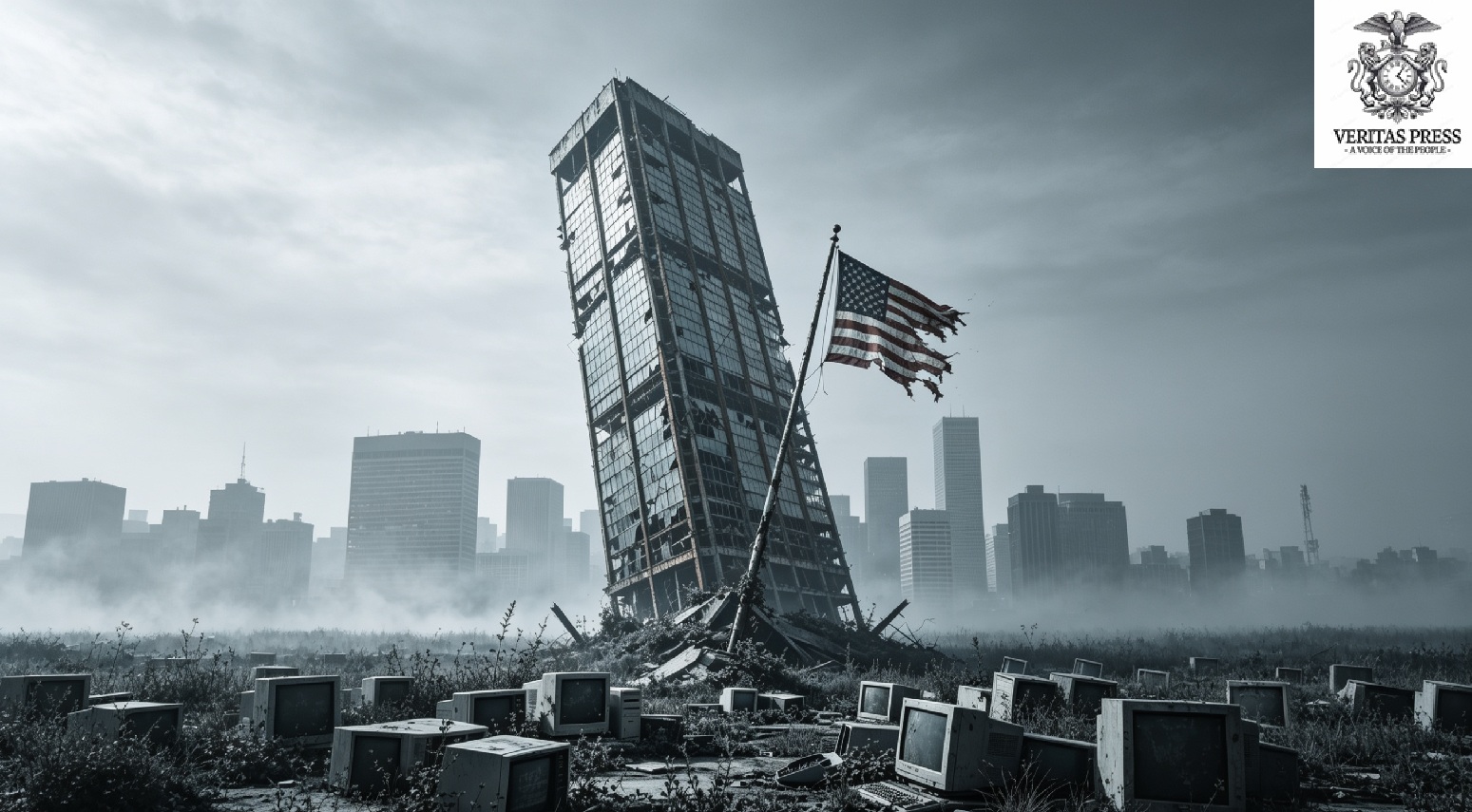
The American empire is not collapsing in a single, cinematic ruin. It is being hollowed out from within, one ledger entry, one broken social contract, one compromised institution at a time. This is the slow violence of decline that the statistics can only gesture toward: $39 trillion in debt, 49 million food-insecure citizens, a democracy on the watchlists of human rights rapporteurs, and a military apparatus that can strike anywhere on earth but cannot guarantee a child in Baton Rouge a school lunch or a pensioner in Birmingham a secure retirement. The numbers, stark as they are, barely capture the moral vertigo of a superpower that has become a case study in how to possess everything and squander it simultaneously.
What our investigation reveals is not a nation simply down on its luck but one trapped in a profound structural contradiction, and the deception lies in a political economy engineered to generate immense private wealth while systematically disinvesting from the public foundations that make such wealth possible. The “K-shaped economy” is not an accident of market cycles; it is the logical endpoint of decades of policy choices that have treated debt as a substitute for taxation, militarism as a substitute for diplomacy, and spectacle as a substitute for governance. The result is an America that is simultaneously the world’s indispensable nation and its most conspicuous cautionary tale.
The debt, that nearly $40 trillion behemoth, is not just a fiscal problem. It is the quantified expression of a political class that has lost the capacity to make hard choices, preferring instead to borrow from future generations to fund present consumption, foreign wars, and tax expenditures that disproportionately benefit those who need them least. When interest payments overtake investments in education, infrastructure, and public health, the state is no longer governing; it is merely managing its own decay. The accusation of “bankruptcy”, moral as much as fiscal, sticks because everywhere the evidence is apparent: corroding bridges, closing rural hospitals, tent encampments in the shadows of glass towers, and billions that flow without pause to foreign military campaigns while domestic needs are labelled unaffordable.
This is the architecture of decline that no stock market rally can conceal. The rich are indeed profiting from the hikes, but they are also boarding up the exits. Their wealth increasingly detaches from the productive economy, which once sustained broad-based prosperity, and instead floats on financial instruments, intellectual property monopolies, and global arbitrage. Meanwhile, the social fabric frays: political polarisation is no longer a disagreement over policy but a mutual delegitimisation that renders the very concept of a “loyal opposition” obsolete. When Pew finds that nearly three-quarters of partisans view the other side as a threat to the nation’s well-being, the civic immune system is failing. The authoritarian temptation does not need to stage a dramatic coup; it simply needs to harvest the cynicism and despair that grow in the soil of a democracy that has stopped delivering.
And yet, the empire’s defenders are not wrong to point to its formidable reserves of resilience. The geography remains a gift. The world’s brightest minds are still drawn to universities. With a single suitcase, the immigrant arrives, possessing more faith in the American idea than many native-born citizens can muster. The military remains peerless. No rival coalition can replace the United States as the global pacifier. These are not small things. They are, in fact, the raw materials of renewal. But resilience is not a force of nature; it requires stewardship. And the defining tragedy of this moment is that the institutions capable of channelling these strengths toward renewal, Congress, the courts, the regulatory state, the press, the civic square, are themselves being hollowed out by the very forces they are meant to counteract.
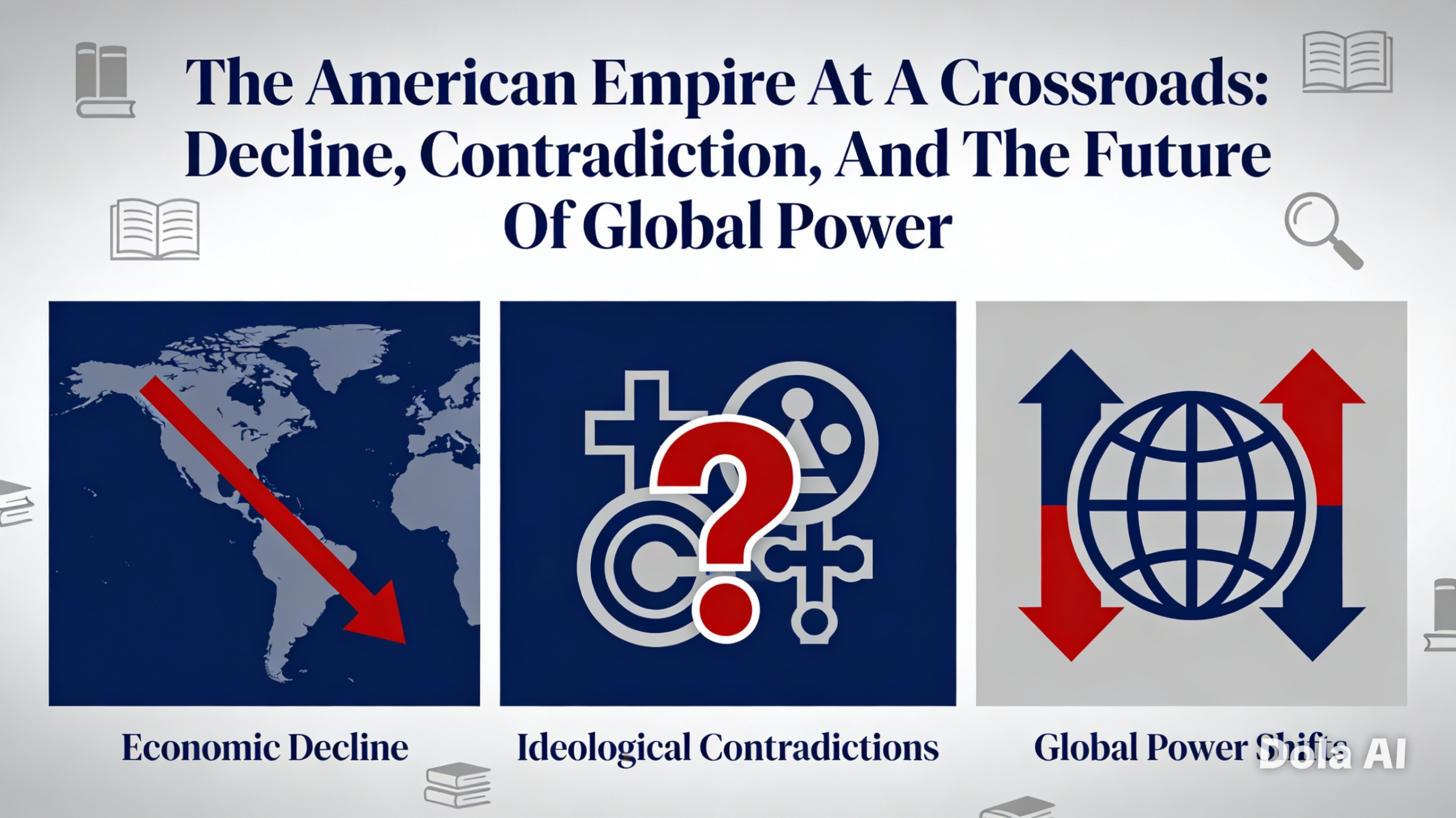
This is the crossroads that the title speaks of, but it is a crossroads with a blindfold. The United States does not face a singular choice between decline and resurgence. It faces a series of accumulating choices that demand a political system capable of long-term thinking, collective sacrifice, and moral seriousness, precisely the qualities that the current dispensation has systematically eroded. The system is not broken because it is incapable of producing good outcomes; it is broken because the incentives are aligned to produce private gains and public losses, and no faction in power has yet been willing to alter those incentives at the scale required.
So the question that hangs over this investigation is not whether the American empire is in decline; that much is already written in the lived experience of millions. The deeper, more unsettling question is whether the United States can still tell itself the truth about its condition. Empires in terminal decay are distinguished not by their problems but by their refusal to name them, preferring instead to ritualise their greatness while the foundations crumble. The Roman Senate continued to meet long after it mattered. The British pound remained a symbol of prestige even as imperial commitments bankrupted the treasury. Today, America’s political class intones the liturgy of “the greatest nation on earth” while running up debt, fuelling division, and outsourcing its moral responsibilities to the next generation and the next news cycle.
A truly investigative critique must, therefore, end not with a prediction but with an indictment of the collective evasion that passes for public discourse. The crisis is not coming; it is here, distributed unevenly across class, colour and geography. The time for comforting myths has expired. The empire will not be saved by another tech boom, another weapons system, or another electoral cycle that changes personnel without changing premises. It will be saved, if at all, by a democratic reckoning that treats the debt as a moral obligation, the social contract as non-negotiable, and the constitutional order as something to be deepened, not merely defended.
Charlene Duval, sitting in that sweltering Louisiana kitchen, did not speak of GDP or reserve currency shares. She spoke of a floor that had gone, a country moving without her. That feeling, shared in Birmingham, in Youngstown, in the borderlands and the hollowed-out heartland, is the raw data of imperial decline that no Treasury report will ever capture. To ignore it is to mistake the map of power for the territory of a nation. And the territory, for tens of millions, is already a landscape of abandonment.
The American experiment was never a guarantee. It was, from the beginning, a bet on self-governance, on pluralism, on the idea that a nation could be built on an idea rather than a bloodline. That bet is now being called in. The house does not need to fall for the wager to be lost. It only needs to stop believing it was worth making.
For The Secure Submission Of Documentation, Testimonies, Or Exclusive Investigative Reports From Any Global Location, Please Utilise The Following Contact Details For Our Investigations Desk: enquiries@veritaspress.co.uk or editor@veritaspress.co.uk
Help Support Our Work:
Popular Information is powered by readers who believe that truth still matters. When just a few more people step up to support this work, it means more lies exposed, more corruption uncovered, and more accountability where it’s long overdue.
Help Protect Independent Journalism, Which Is Currently Under Attack.
If you believe journalism should serve the public, not the powerful, and you’re in a position to help, becoming a DONATOR or a PAID SUBSCRIBER truly makes a difference.
DONATION APPEAL: If You Found This Reporting Valuable, Please Consider Supporting Independent Journalism.
Help Support Our Work – We Know, We Know, We Know …
Seeing these messages is annoying. We know that. (Imagine what it’s like writing them … )
Your support fuels our fearless, truth-driven journalism. In unity, we endeavour to amplify marginalised voices and champion justice, irrespective of geographical location.
But it’s also extremely important. One of Veritas Press’s greatest assets is its reader-funded model.
1. Reader funding means we can cover what we like. We’re not beholden to the political whims of a billionaire owner. We are a small, independent and impartial organisation. No one can tell us what not to say or what not to report.
2. Reader funding means we don’t have to chase clicks and traffic. We’re not desperately seeking your attention for its own sake: we pursue the stories that our editorial team deems important and believe are worthy of your time.
3. Reader Funding: enables us to keep our website and other social media channels open, allowing as many people as possible to access quality journalism from around the world, particularly those in places where the free press is under threat.
We know not everyone can afford to pay for news, but if you’ve been meaning to support us, now’s the time.
Your donation goes a long way. It helps us:
Keep the lights on and sustain our day-to-day operations
Hire new, talented independent reporters
Launch real-time live debates, community-focused shows, and on-the-ground reporting
Cover the issues that matter most to our communities, in real time, with depth and integrity
We have plans to expand our work, but we can’t do it without your support. Every contribution, no matter the size, helps us stay independent and build a truly people-powered media platform.
If you believe in journalism that informs, empowers, and reflects the communities we serve, please donate today.
Kamran Faqir is a volunteer investigative journalist and writer committed to exposing hidden truths and amplifying underreported stories. Driven by social justice, he brings sharp insight and fearless truth-telling to independent journalism. NUJ registered.
SEATTLE, TEHRAN — The U.S. Department of Homeland Security (DHS) will allow Iran’s national football team to enter the country 48 hours before their critical World Cup match against Egypt on Friday, a modest concession in a tournament where Team Melli’s travel conditions have sparked claims of oppression and competitive disadvantage.